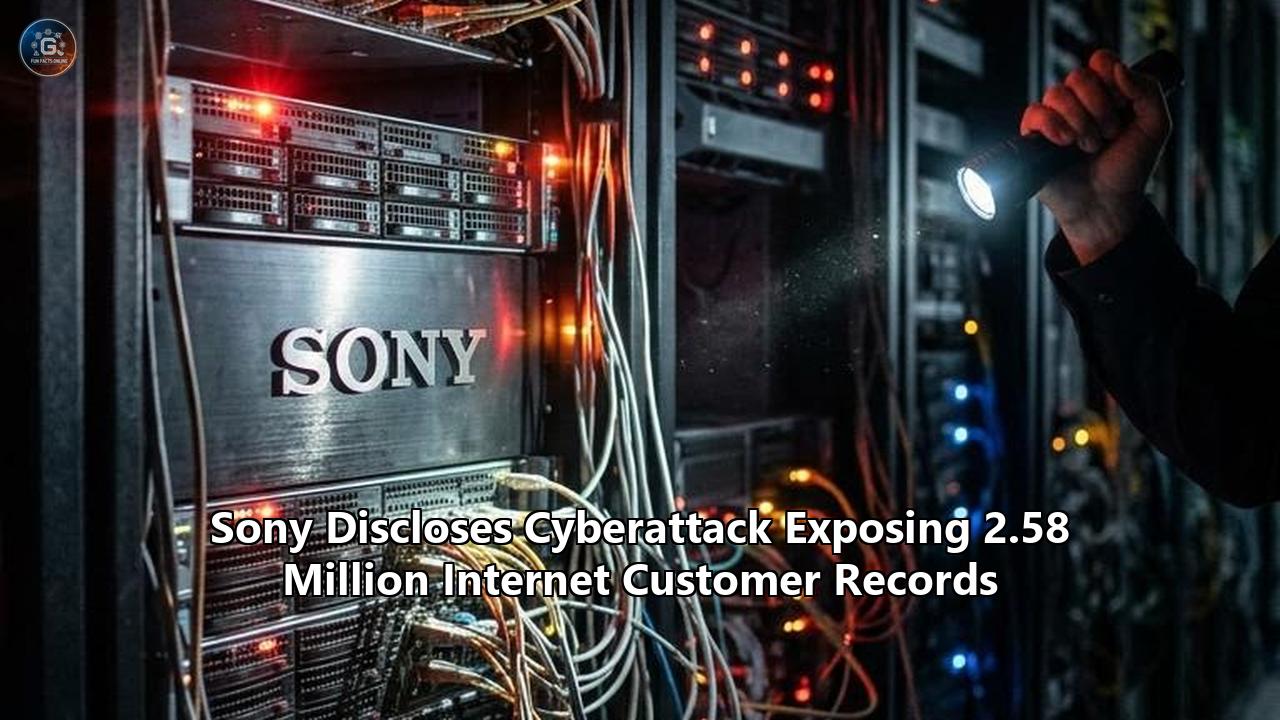
Sony Network Communications has confirmed a massive cyberattack that compromised 2,585,481 customer records across its Japanese internet service provider networks, triggering a nationwide investigation, regulatory scrutiny, and downstream phishing alerts. Disclosed on October 27, 2026, the breach struck the core customer databases supporting the company’s So-net and plala (S Course) internet access operations, exposing sensitive identity data, bank account details, and the email passwords of tens of thousands of active users.
The attack specifically compromised 2,141,986 records associated with So-net and 443,495 records connected to plala, an ISP brand contracted to support third-party telecommunications services such as NTT Docomo’s "Docomo Hikari" broadband. Alongside customer names, phone numbers, physical and email addresses, and internet connection identifiers, the intruders obtained account credentials for 54,401 email accounts across several legacy and specialized email services.
The unfolding Sony data breach represents one of the largest corporate cybersecurity incidents to hit Japan’s telecommunications sector in recent years. While Sony confirmed that credit card numbers and primary account passwords remained shielded, the exposed data provides cybercriminals with the exact telemetry needed to execute sophisticated impersonation campaigns, credential stuffing, and account takeovers.
Tracing the incident from the initial unauthorized intrusion to the current forensic containment reveals a sequence of critical turning points, systemic architectural exposures, and immediate consumer hazards.
+---------------------------------------------------------------------------------------------------------+
|                                     CHRONOLOGY OF ESCALATION                                            |
+----------------------+----------------------------------------------------------------------------------+
| October 19, 2026     | Perimeter Breached: Unauthorized intruders infiltrate the So-net database.       |
| October 20-22, 2026  | Dwell Window: Attackers enumerate tables, extract customer data and mail secrets.|
| October 23, 2026     | Detection & Severance: Suspicious traffic detected; Sony takes servers offline.  |
| October 24, 2026     | Blast Radius Confirmed: Forensics verify 2.58M customer records exfiltrated.     |
| October 25-26, 2026  | Downstream Contagion: NTT Docomo discovers active phishing targeting customers.  |
| October 27, 2026     | Public Disclosure: Mass password resets forced; report filed with Japan's PPC.   |
| October 28-31, 2026  | Operational Fallout: Scrutiny grows over data retention and wholesale supply.   |
+----------------------+----------------------------------------------------------------------------------+
October 19: The Silent Infiltration and Initial Compromise
The breach began in the early hours of Monday, October 19, 2026, when an unauthorized entity pierced the perimeter defenses of Sony Network Communications' member management infrastructure. Sony Network Communications operates as a core internet service provider (ISP) subsidiary under Sony Group Corporation, handling residential fiber-optic internet, mobile virtual network operator (MVNO) services, broadband backbones, and legacy internet dial-up infrastructures established during Japan’s initial web boom.
The attackers gained entry directly into the member database environment that houses both current and former subscriber accounts for So-net and the plala (S Course) operations.
At this early stage, the intruder's presence went completely undetected. Modern enterprise intrusion prevention systems (IPS) and security information and event management (SIEM) pipelines are designed to catch behavioral anomalies, such as unexpected database queries, privileged credential abuse, or abnormal outbound data egress. Yet the attackers moved with sufficient operational security to bypass real-time telemetry filters, remaining embedded inside the production network.
The targets of the intrusion were centralized member tables. These databases contain not just public-facing demographic details, but internal operational routing data, specifically:
- Customer full legal names
- Registered landline and cellular phone numbers
- Primary contact email addresses
- Customer account user IDs
- Dates of birth and registered gender markers
- Internal Internet Connection IDs used to provision customer broadband hardware and monitor line traffic
For four consecutive days—from October 19 through October 22—the threat actors enjoyed dwell time inside the So-net member environment. Dwell time, the period between an attacker gaining unauthorized access and an organization detecting their presence, is the most hazardous phase of any network breach. During this four-day window, the intruders were able to enumerate schema designs, crawl sensitive directories, identify user subsets, and stage massive quantities of structured records for exfiltration without interrupting daily database operations.
October 23: Detection, Severance, and Emergency Isolation
The turning point arrived on Thursday, October 23, when internal infrastructure monitors or anomalous query patterns finally tripped alarms within Sony’s internal network operations center.
Sony Network Communications engineers recognized that an outside entity was actively executing unauthorized queries and maintaining persistent external links to the subscriber database. Recognizing the gravity of the incident, response teams moved to containment protocols rather than passive observation.
On October 23, the incident response team initiated three emergency containment measures:
- Server Isolation: Responders abruptly shut down the specific production database servers exhibiting malicious activity, taking them entirely out of the active network pool to halt data manipulation or further extraction.
- Perimeter Blacklisting: Engineers identified the source IP ranges, routing nodes, and command-and-control (C2) communication channels utilized by the intruder, executing immediate border gateway protocol (BGP) blocks and firewall drop rules.
- Session Termination: Active administrative sessions and database access tokens tied to the compromised segment were forcibly terminated to close any backdoor tunnels or secondary entry points established by the hackers.
Taking affected servers offline is a delicate balance for an internet service provider. Sony had to isolate compromised membership databases without cutting broadband access for millions of Japanese homes and businesses whose physical fiber lines rely on the subsidiary’s backbone. The swift severance successfully halted the intruder's active connection, stopping the attack from migrating laterally into adjacent enterprise environments, such as Sony's high-speed NURO fiber network or Sony Interactive Entertainment’s PlayStation Network.
With the intruder evicted, forensic teams pivoted to digital triage: determining exactly what systems had been traversed, what files had been collected, and how much data had left the corporate boundary.
October 24: Forensics Unpacks the Scale and Architecture of Exposure
By Friday, October 24, forensic analysis had quantified the breach's scope, revealing that the intruders had exfiltrated millions of customer identities and sensitive credentials.
+----------------------------------------------------------------------------------------------------+
|                                    RECORD EXPOSURE BREAKDOWN                                       |
+--------------------------+-----------------------+-----------------------+-------------------------+
| Service Category         | Active Subscribers    | Former Subscribers    | Total Exposed           |
+--------------------------+-----------------------+-----------------------+-------------------------+
| So-net Membership        | 1,869,771             | 272,215               | 2,141,986               |
| plala (S Course)         | 422,365               | 21,130                | 443,495                 |
| Total Member Records     | 2,292,136             | 293,345               | 2,585,481               |
+--------------------------+-----------------------+-----------------------+-------------------------+
The investigation revealed that the 2.58 million records spanned two distinct ISP brands under Sony Network Communications’ purview. So-net made up the vast majority, accounting for 2,141,986 records. Of these, 1,869,771 belonged to active customers, while 272,215 records belonged to former users who had cancelled their internet subscriptions since March 2026.
The second dataset encompassed 443,495 records from plala (S Course), a specific service branch tied into wholesale broadband arrangements. This cohort included 422,365 current subscribers and 21,130 former subscribers who had terminated their accounts between March 2026 and the date of the intrusion.
Beyond basic identity profiles, investigators discovered a much more dangerous data layer: the exposure of 54,401 live email account passwords.
As forensic analysts dissected the architecture behind the Sony data breach, a critical structural distinction emerged: the primary membership passwords used to log into customer billing accounts and modify broadband subscriptions were securely encrypted and remained uncompromised. However, the passwords that controlled underlying email communication boxes across four distinct legacy and auxiliary mail services were exposed.
+----------------------------------------------------------------------------------------------------+
|                                  EXPOSED EMAIL CREDENTIAL DETAIL                                   |
+-----------------------------------------+----------------------+-----------------------------------+
| Service Name                            | Compromised Passwords| Service Operational Scope         |
+-----------------------------------------+----------------------+-----------------------------------+
| Mail Service (G)                        | 24,655               | General secondary webmail tier    |
| A-Box Additional Mailboxes              | 17,672               | Multi-user family/business boxes  |
| So-net VAIO Mail                        | 7,005                | Hardware-bundled proprietary mail |
| PostPet Mail Account Service            | 5,069                | Legacy animated client ecosystem  |
| Total Compromised Email Accounts        | 54,401               |                                   |
+-----------------------------------------+----------------------+-----------------------------------+
The exposure of these 54,401 passwords created an immediate, critical threat. Attackers holding active webmail and POP/IMAP credentials can monitor private messages, access financial summaries, hijack corporate communications, and issue unauthorized password reset requests across hundreds of external services tied to those email addresses.
Investigators also confirmed the leakage of 16 complete bank account records, which included financial institution names, branch details, bank account numbers, and verified account holder identities. While Sony confirmed that bank personal identification numbers (PINs) are not stored in these systems—and that credit card numbers and expiration dates remained completely untouched—the presence of bank routing and account data inside the exfiltrated cache escalated the severity of the incident. In addition, investigators identified seven exposed administrative password-reset logs, indicating that automated recovery tokens had been indexed during the database sweep.
October 25–26: The Downstream Blast Radius Hits NTT Docomo
Between Saturday, October 25, and Sunday, October 26, the incident escalated beyond Sony's corporate boundaries into Japan's broader telecommunications infrastructure.
Because Sony Network Communications functions as a wholesale backend operator for third-party consumer services, the exfiltration of the 443,495 plala (S Course) records directly impacted NTT Docomo, Japan's largest telecommunications conglomerate. NTT Docomo contracts Sony Network Communications to deliver connectivity and system administration for its flagship "Docomo Hikari" consumer fiber service.
The downstream impact of the Sony data breach extended beyond Sony’s corporate perimeter into the infrastructure of NTT Docomo, forcing both organizations to coordinate their response. NTT Docomo verified that the compromised database contained the personal identifiers of every active customer using the specific contracted service, alongside those who had cancelled their subscriptions over the preceding six months.
Almost immediately, the threat went from passive database compromise to active weaponization in the wild. Over the weekend of October 25, Japanese consumers began receiving phishing attempts, phone scam calls, and smishing (SMS phishing) messages designed to exploit the compromised subscriber data.
NTT Docomo issued an emergency advisory warning customers of fraudulent text messages and spoofed landing pages masquerading as its loyalty rewards ecosystem, the "d POINT Club". Attackers used the stolen demographic data to personalize their outreach, directing victims to lookalike domains that falsely claimed the recipient had won an exclusive Universal Studios Japan (USJ) promotional ticket giveaway.
Victims visiting these fraudulent sites were prompted to enter additional personal credentials, credit card details, and secondary authentication codes to "claim" their prize. By pairing authentic personal names and telephone numbers with real ISP subscription contexts, the attackers gave their phishing lures an unusually high degree of credibility.
ATTACK ESCALATION PATHWAY:
[October 19 Infiltration]
       │
       ▼
[Extraction of 2.58M Identities + 54K Email Passwords]
       │
       ├─────────────────────────────────┬─────────────────────────────────┐
       ▼                                 ▼                                 ▼
[So-net Direct Retaliation]    [Wholesale Spillover]        [Direct Mailbox Takeover]
Personalized phishing lures    NTT Docomo Hikari subscribers  54,401 accounts subject to
via stolen names & phone #s    targeted with fake d POINT &   unauthorized logins and
                               USJ campaign scams             cross-service password resets
October 27: Public Disclosure, Forced Password Resets, and Regulatory Notification
On Tuesday, October 27, 2026, Sony Network Communications went public with the incident, ending eight days of internal containment and investigation.
The company released a formal security advisory detailing the timeline of the attack, the specific categories of data stolen, and the division between compromised and safe systems. In its statement, the company apologized directly to its user base:
"We deeply apologize to our customers and all related parties for the immense trouble and concern this situation has caused. We take this incident very seriously and are making every effort to prevent any recurrence while taking rigorous steps to support affected users."
Simultaneously, Sony took sweeping technical remediation actions:
- Mass Invalidation of Email Credentials: To neutralize the compromised email passwords, Sony executed an automated server-side password reset on all 54,401 exposed email accounts across Mail Service (G), A-Box, So-net VAIO Mail, and PostPet Mail.
- Self-Service Recovery Lockouts: Sony disabled basic remote password-recovery mechanisms for the affected email accounts, requiring customers to authenticate through So-net’s secure, out-of-band "My Page" customer portal to establish new, complex credentials.
- Statutory Regulatory Notification: Sony formally reported the breach to Japan’s Personal Information Protection Commission (PPC), the primary regulatory body enforcing compliance under Japan’s Act on the Protection of Personal Information (APPI). Under APPI mandates, organizations must report data exposures that exceed 1,000 sensitive records or contain credentials capable of financial or identity theft within statutory reporting windows.
Crucially, the public advisory clarified what had not been touched. Sony confirmed that its high-speed NURO fiber-optic business, which runs on separate routing and database backbones, had no evidence of exposure. The company also noted that Sony Interactive Entertainment (SIE) systems, which host the global PlayStation Network and millions of international gaming accounts, were completely isolated from the incident.
Sony's public statements emphasized that while customer identification records were stolen at scale, the primary account passwords governing So-net memberships were not leaked, nor were any credit card details or bank account PINs.
October 28–31: The Operational Fallout and Data Retention Scrutiny
In the days following public disclosure, cybersecurity experts, privacy regulators, and enterprise auditors turned their attention to the structural practices that allowed the breach to reach this scale.
The controversy surrounding this latest Sony data breach underscores a pervasive operational vulnerability: data retention policies on legacy platforms. Of the 2,585,481 records stolen, 293,345 belonged to former subscribers who had formally terminated their service contracts between March 2026 and October 2026. In both the So-net and plala (S Course) cohorts, roughly one in every nine compromised records belonged to individuals who no longer had an active business relationship with the ISP.
DATA POOL DISTRIBUTION:
[========================================             ] 88.6% Active Subscribers (2,292,136 records)
[====                                                 ] 11.4% Terminated Accounts (293,345 records)
The presence of former subscribers inside an internet-facing, production-grade database has drawn criticism from privacy advocates. Under data minimization principles, organizations are expected to anonymize, archive offline, or safely purge customer personal identifiable information (PII) once an account lifecycle concludes and immediate billing reconciliation ends. Leaving hundreds of thousands of historical customer entries inside live, queried databases expanded the attack surface unnecessarily. Customers who had cancelled their subscriptions before February 28, 2026, were excluded from the compromise, indicating that Sony's internal data migration or archival processes run on a multi-month lag that left recent cancellations vulnerable to extraction.
A second technical challenge involves record deduplication. The announced figure of 2,585,481 reflects total distinct database entries rather than unique individuals. Because many Japanese households purchase multi-line bundles, maintaining a residential So-net fiber line alongside a separate plala-routed service, thousands of citizens appear multiple times across the exfiltrated tables. Sony has not yet released a deduplicated headcount, meaning the exact number of living individuals exposed is lower than the headline database count, though their individual risk profiles are higher due to multiple matched records.
Technical opacity regarding the initial intrusion vector also fuels ongoing concern. As of October 31, Sony Network Communications has refused to name:
- The specific software vulnerability or common vulnerabilities and exposures (CVE) ID exploited.
- Whether the breach involved compromised third-party vendor credentials, a misconfigured application programming interface (API), or structured query language (SQL) injection against legacy web applications.
- The malware strains, living-off-the-land binaries (LOLBins), or exfiltration toolsets used by the attackers.
- The specific threat group, criminal syndicate, or nation-state advanced persistent threat (APT) responsible for the campaign.
This lack of technical detail prevents other telecommunications operators and corporate enterprises from auditing their own environments against the methods used in the attack.
Anatomy of the Threat: How Stolen ISP Records Are Weaponized
Understanding why an ISP database breach is dangerous requires looking closely at the data points stolen. While consumer attention often fixates on stolen credit card numbers, payment card theft is immediate, easy to detect, and insured by financial institutions. Bank issuers can cancel and reissue compromised card numbers in seconds, cutting off an attacker's monetization route.
In contrast, the data exfiltrated from Sony Network Communications cannot be cancelled or reissued.
+------------------------------------------------------------------------------------------------------+
|                                     THREAT MODELING ANALYSIS                                         |
+--------------------------+---------------------------------+-----------------------------------------+
| Compromised Field        | Persistence Horizon             | Primary Weaponization Vector            |
+--------------------------+---------------------------------+-----------------------------------------+
| Legal Name & Birth Date  | Permanent (Lifetime)            | Synthetic identity theft, SIM-swapping  |
| Connection ID & User ID  | Semi-Permanent (Years)          | ISP impersonation, social engineering   |
| Phone & Physical Address | High (Years)                    | Precision smishing, physical delivery   |
| Email Address & Password | Moderate (Days until rotated)   | Secondary credential stuffing, takeover |
+--------------------------+---------------------------------+-----------------------------------------+
Precision Social Engineering and ISP Impersonation
With an authentic full name, date of birth, phone number, and internal Internet Connection ID, a scammer can call a subscriber while posing as an official Sony, So-net, or NTT Docomo technical representative. By reciting the customer's actual Internet Connection ID and date of birth, the attacker easily establishes authority.
From there, scammers can claim that the user’s optical network terminal (ONT) or home router is emitting malicious traffic, directing the victim to download a "security patch" that is actually a remote access trojan (RAT) or info-stealing malware.
The Credential Cascading Threat
The compromise of 54,401 email passwords creates an open avenue for secondary account takeovers. Password reuse remains common among consumer populations. Threat actors routinely feed combinations of exposed email addresses and passwords into automated botnets to test logins against popular retail, banking, gaming, and cloud platforms.
Even if an affected user used that password exclusively for their ISP mail, an attacker who logged into the mailbox prior to Sony’s October 27 reset can read password-reset emails, access private correspondence, and leverage trusted communication channels to deceive the user's family or business associates.
Target Profile Matching for SIM Swapping
Attackers attempting SIM swaps—convincing mobile carriers to reassign a victim's phone number to an attacker-controlled SIM card—often need customer names, addresses, dates of birth, and identity markers. The records exfiltrated from So-net and plala provide precisely the personal documentation needed to defeat carrier identity challenges, threatening users' two-factor authentication (2FA) SMS codes across their digital accounts.
Looking Ahead: Regulatory Penalties, Attribution, and ISP Threat Realities
The fallout from the breach points toward significant operational changes, regulatory scrutiny, and ongoing defensive challenges for Sony Network Communications and the broader Japanese telecommunications industry.
Japan’s PPC Regulatory Sanctions
Japan’s Personal Information Protection Commission has escalated its regulatory enforcement following repeated amendments to the Act on the Protection of Personal Information. The PPC holds broad statutory power to issue administrative guidance, demand formal remediation reports, and levy severe corporate fines if an enterprise fails to protect user information or demonstrates negligence in its data retention practices.
Sony Network Communications faces an exhaustive compliance audit examining:
- Why customer data for terminated accounts was kept in live production systems.
- Why passwords for legacy email services were stored in decryptable formats.
- How an unauthorized actor maintained access for four days without triggering automatic containment.
The Unresolved Question of Attribution
Threat intelligence analysts continue to monitor underground cybercrime forums, Telegram-based illicit trade channels, and dark web extortion leak sites. The absence of an immediate ransom demand suggests two possible operational profiles:
- Espionage and Strategic Data Harvesting: The breach may be the work of a state-sponsored advanced persistent threat seeking intelligence on Japanese infrastructure, telecommunications backbones, and communications networks.
- Delayed Monetization: Financially motivated threat actors may be staging the data for sale to private broker syndicates or planning a public extortion leak if secondary demands are not met.
If these 2.58 million records surface on illicit marketplaces, security researchers will be able to analyze file timestamps, schema dumps, and database architecture to trace the exact attack path used during the October 19 infiltration.
Systemic Overhauls Across Japanese ISPs
The compromise of wholesale partner data—specifically the hundreds of thousands of NTT Docomo customers swept into the incident—will drive changes across Japan's telecommunications supply chain.
Wholesale network arrangements and joint service infrastructure agreements will need to establish zero-trust architecture between service partners. Telecommunications providers can no longer treat internal partner networks as secure by default, and will need to separate internal operational telemetry from public-facing customer profiles.
For consumers, the advice from cybersecurity experts and telecommunications authorities remains urgent:
- Treat all incoming phone calls, SMS messages, and emails claiming to represent So-net, plala, or NTT Docomo with skepticism.
- Never follow links inside unsolicited communications, especially those promising lottery prizes, bill credits, or account security verifications.
- Manually navigate to official customer service portals to reset passwords, and audit all linked third-party accounts that share credentials with exposed ISP mailboxes.
As forensic teams and external auditors complete their post-incident analysis, the Sony Network Communications breach stands as a clear warning of the risks that emerge when modern external attacks collide with legacy telecommunications databases. Controlling the damage will depend on Sony’s willingness to address its technical debt, adopt strict data retention policies, and provide transparency on how intruders penetrated its defenses.
Reference:
- https://gbhackers.com/sony-data-breach-exposes-2-58-million-customer-records/amp/
- https://www.bleepingcomputer.com/news/security/sony-isp-subsidiary-data-breach-exposes-25-million-customer-records/
- https://mallory.ai/stories/01a18191-39c3-71a4-ada7-8fe035233a65
- https://timesofindia.indiatimes.com/sports/esports/news/sony-data-breach-2-58-million-users-affected-as-bank-details-and-passwords-exposed/articleshow/135241646.cms
- https://cyberinsider.com/sony-data-breach/
- https://www.safestate.com/post/sony-data-breach-exposes-2-58-million-isp-customer-records
- https://www.helpnetsecurity.com/2026/10/28/sony-network-communications-data-breach-so-net/
- https://cyberpress.org/sony-data-breach-2-58-million-customer-records/?amp=1
- https://www.reddit.com/r/TechNadu/comments/1xhpw8k/sony_network_communications_breach_affects_258/