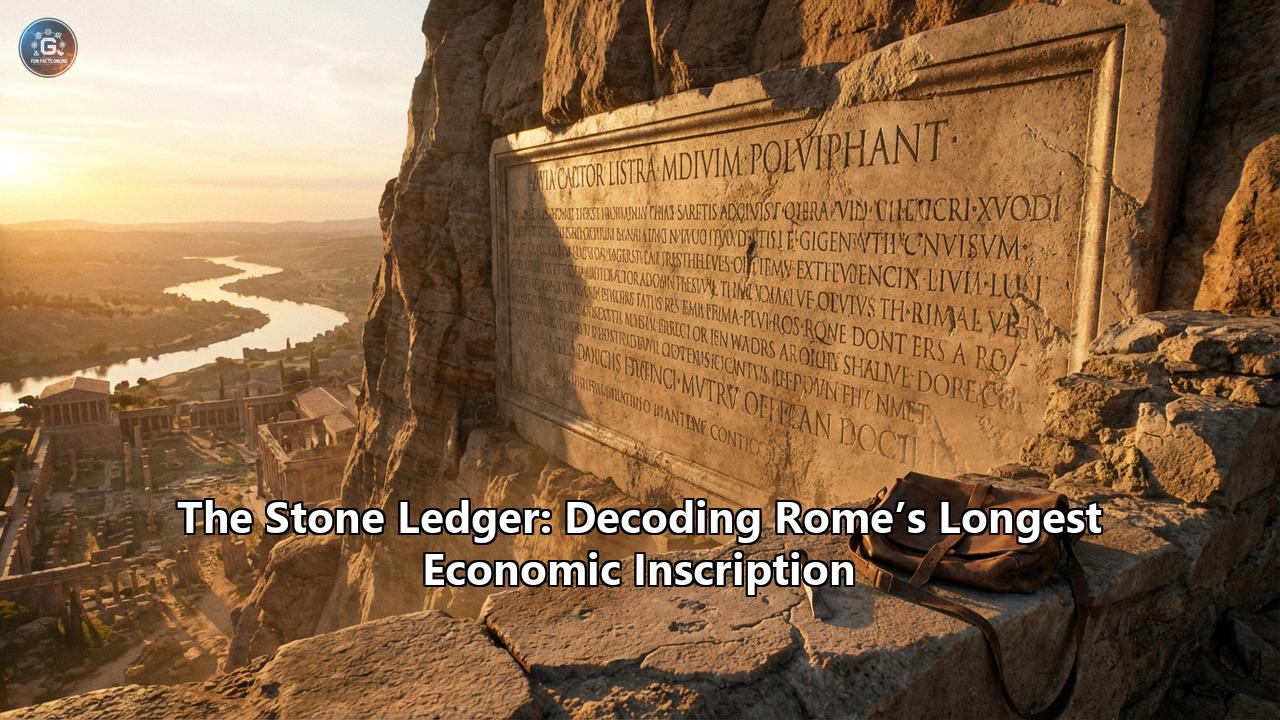
In the sun-scorched ruins of Aphrodisias, located in modern-day Turkey, a massive wall once stood covered in thousands of lines of chiseled Latin text. It was not a poem, nor a eulogy for a conqueror, nor a prayer to the gods. It was a price list.
Known to history as the Edict on Maximum Prices (Edictum de Pretiis Rerum Venalium), and to a select few scholars as "The Stone Ledger," this inscription represents the most ambitious, desperate, and detailed attempt by the Roman Empire to command the tides of its own economy. Issued in 301 AD by the Emperor Diocletian, it is the longest surviving piece of legislation from the era of the Tetrarchy. It is a monument not to victory, but to anxiety—a fossilized scream against the invisible monster of hyperinflation that was devouring the Roman world.
To walk along its fragmented panels today, scattered across museums in Berlin, Cologne, and Istanbul, is to browse the shelves of a ghost supermarket. It lists the price of a pint of beer, a pound of pork, a pair of soldier’s boots, the monthly tuition for a student, and the cost of a live lion. It tells us the wage of a shepherd and the fee of a lawyer. It freezes for eternity a moment when the Roman state tried to fix the value of everything in the known world, under penalty of death.
This is the story of that inscription—why it was carved, what it says, and why it ultimately failed to save an empire from itself.
Part I: The World on Fire
To understand the Stone Ledger, one must first understand the chaos that birthed it. By the time Diocletian rose to power in 284 AD, the Roman Empire had spent fifty years tearing itself apart. This period, known as the Crisis of the Third Century, was a perfect storm of civil war, plague, and invasion. Emperors were assassinated with clockwork regularity; the average reign was roughly two years.
But the most insidious enemy was not the Goth at the gate or the assassin in the palace—it was the coin in the soldier’s purse.
For centuries, the silver denarius had been the bedrock of the Roman economy. In the glory days of Augustus, it was 95% pure silver. But as emperors needed more money to bribe troops and pay for endless wars, they began to cheat. They mixed copper into the silver melt. By the time of Diocletian, the "silver" coin was a bronze slug with a microscopic wash of silver that rubbed off in a week. It was fiat currency in its crudest form.
The result was hyperinflation. Merchants, realizing the coins were worthless, demanded more of them for the same sack of wheat. Prices skyrocketed. Soldiers, finding their pay could no longer feed their families, demanded raises, forcing the emperors to mint even more bad coins, fueling the cycle. The economy reverted to barter. Tax collectors refused to accept the very coin the government minted, demanding goods in kind (grain, leather, weapons) instead.
Diocletian was a soldier-emperor of humble origins from Dalmatia (modern Croatia). He was a man of iron will and bureaucratic obsession. He did not view the economy as a living organism of supply and demand; he viewed it as a rebellious province that needed to be disciplined. He reorganized the army, split the empire into four administrative zones (the Tetrarchy), and doubled the size of the bureaucracy.
But the prices kept rising.
In 301 AD, Diocletian decided he had had enough. If the market would not obey him, he would command it. He would not just suggest prices; he would carve them into stone and set them up in the market squares of the Greek East. He would create a "Stone Ledger" that would stand as the final word on value.
Part II: The Preamble of Fury
The Edict begins not with dry legalese, but with a roar. The preamble is one of the most fascinating psychological documents of antiquity. It is long, complex, and dripping with moral outrage. Diocletian does not blame the debasement of the currency (which was his own government's policy) for the inflation. Instead, he blames "avarice."
The text describes merchants as "madmen" and "unscrupulous profiteers" who are possessed by a "raving greed" (avaritia ragiens). He accuses them of waiting for the armies to move so they can jack up prices, effectively holding the empire’s defenders hostage.
"Who is so insensitive and so devoid of human feeling," the Edict asks, "that he cannot know, or rather has not perceived, that in the commerce carried on in the markets or involved in the daily life of cities, immoderate prices are so widespread that the unbridled passion for gain is lessened neither by abundant supplies nor by fruitful years?"
The language creates a narrative of a benevolent state protecting the common man from the predatory merchant. It frames economics as a moral battleground. The Emperor, the "Father of the Country," is stepping in to stop the looting.
The punishment for violating the ledger was absolute.
"It is our pleasure that anyone who shall have resisted the form of this statute shall for his daring be subject to a capital penalty."Death.
And not just for the seller. The buyer who paid the illegal price was also liable to be executed, as was anyone who hoarded goods to wait for the law to be repealed.
Part III: Inside the Ledger
The Edict is divided into 32 schedules (chapters), organizing the economy into categories. What survives today is a patchwork of Greek and Latin fragments, but between them, we have prices for over 1,200 items. It is the most comprehensive inventory of Roman material culture that exists.
Let us open the ledger and walk through the Roman marketplace of 301 AD. All prices are listed in denarii communes (d.c.), a unit of account.
1. The Butcher and the Baker
Food was the primary concern. The Edict goes into obsessive detail about grades of quality.
- Wheat: 100 denarii per modius (roughly a peck or 8.7 liters).
- Barley: 60 denarii.
- Lentils: 100 denarii.
Meat was a luxury, but the list reveals the Roman palate’s diversity:
- Pork: 12 denarii per pound (Italian pound, roughly 327g).
- Beef: 8 denarii per pound. (Beef was considered inferior to pork, a working meat for the poor).
- Sausage (pork): 12 denarii.
- Sausage (beef): 10 denarii.
- Fattened Goose: 200 denarii.
- Hare: 150 denarii.
- Dormice: 40 denarii per 10. (A delicacy, often stuffed and roasted).
The Edict also standardizes the cost of alcohol. It distinguishes between quality vintages and common swill:
- Picene or Tiburtine Wine (Top shelf): 30 denarii per pint (sextarius).
- Ordinary Wine: 8 denarii per pint.
- Beer (Celtic/Pannionian): 4 denarii.
- Beer (Egyptian/Zythum): 2 denarii. (The Romans generally looked down on beer as a barbarian beverage, reflected in its low price).
2. The Clothier
Textiles take up a massive portion of the Edict, perhaps because clothing was a major store of wealth. The detail here is staggering, differentiating between wools from different provinces.
- Wool from Tarentum (Best quality): 175 denarii per pound.
- Wool from Astorga: 25 denarii per pound.
But the true obsession of the Roman status seeker was Purple. The dye, extracted from the Murex sea snail, was the ultimate signifier of power. The Edict effectively places a luxury tax on it by setting the ceiling astronomically high:
- Purple Silk (dyed with genuine Murex): 150,000 denarii per pound.
- White Silk: 12,000 denarii per pound.
To put this in perspective, a pound of purple silk cost nearly as much as a middle-class house. It was the "Bitcoin" of the 4th century—a condensed, portable form of immense value.
3. The Labor Market
Perhaps the most humanizing part of the Stone Ledger is the wage controls. Diocletian attempted to cap salaries, which tells us exactly where society placed value on different skills. These are daily wages, with the assumption that the employer also provides food (maintenance).
- Farm Laborer: 25 denarii/day.
- Carpenter: 50 denarii/day.
- Wall Painter: 75 denarii/day.
- Figure Painter (Artist): 150 denarii/day.
- Mosaic Worker: 60 denarii/day.
- Baker: 50 denarii/day.
- Sewer Cleaner: 25 denarii/day.
The professional class was paid differently, usually per student or per task:
- Elementary Teacher: 50 denarii per month per boy.
- Teacher of Architecture: 100 denarii per month per boy.
- Advocate (Lawyer): 1,000 denarii fee for standing a case.
A fascinating entry is for the Scribe. They were paid by the line (stichometry), a practice that encourages verbosity if not regulated.
- Scribe (Best writing): 25 denarii per 100 lines.
- Scribe (Second quality): 20 denarii per 100 lines.
This gives us a "Big Mac Index" for Rome. A farm laborer had to work half a day to earn a pound of pork. He had to work four days to buy a modius of wheat. He would have to work 6,000 days (16 years) to afford a single pound of purple silk.
4. Transport and Logistics
The Edict also tried to rewrite the laws of physics and geography. Transport costs in the ancient world were brutal; moving grain by cart was so expensive that the price doubled every 100 miles. Moving it by sea was cheap.
Diocletian set caps on freight rates:
- freight charge for one person: 2 denarii per mile (land).
- Rent for a wagon: 12 denarii per day.
This section was arguably the most damaging. By capping transport costs, the Edict made it unprofitable to move goods from areas of surplus to areas of famine. If the price of wheat is capped at 100 in Rome, and it costs 20 to ship it there from Egypt, but the shipper is only allowed to charge 10, the wheat simply stays in Egypt. Rome starves.
5. The Strange and the Wild
The Edict covers everything.
- A Lion: 150,000 denarii. (The same price as a pound of purple silk. This was for the arena games).
- A Leopard: 100,000 denarii.
- A Ostrich: 5,000 denarii.
- Feathers (Peacock): Recommended for decoration, price varies.
Part IV: The Economics of Failure
So, what happened when this massive regulatory stone dropped into the pond of the Roman economy?
It sank.
The Edict on Maximum Prices is cited today in almost every introductory economics textbook as the classic example of why price controls fail. Diocletian commanded that a modius of wheat be sold for 100 denarii. But if the debased coinage was so worthless that the farmer needed 200 denarii to buy the tools and seeds to grow that wheat, he had two choices:
- Sell at 100 and go bankrupt.
- Refuse to sell.
Most chose the latter. Goods vanished from the agora. Shops closed. The "Stone Ledger" had created a shortage economy.
The Christian writer Lactantius, a contemporary who despised Diocletian (mostly for persecuting Christians, but he hated the economics too), gave a chilling account of the aftermath:
"Then much blood was shed for the veriest trifles; men were afraid to offer anything for sale, and the scarcity became more excessive and grievous than ever, until, in the end, the [law], after having proved destructive to multitudes, was from mere necessity abolished."
"Blood was shed" suggests that the death penalty was indeed enforced, at least initially. Soldiers likely executed shopkeepers for selling onions for 5 denarii instead of 4. This terror didn't lower prices; it just drove the market underground. A black market exploded where goods were traded for their real value in secret, or bartered to avoid using the hated coinage entirely.
The Edict ignored the reality of velocity of money and supply chains. It treated a price as a static number, not a signal of scarcity. By freezing the signal, Diocletian blinded the economy. If a drought struck Egypt, wheat prices should rise to attract merchants to bring grain from Gaul. By fixing the price, the signal was killed, and no grain came.
Part V: The Archaeological Puzzle
The Edict was technically binding on the whole empire, but archaeologists have noticed something telling: almost all the surviving fragments come from the Eastern Empire (Greece, Turkey, Egypt). There are virtually no fragments from the West (Britain, Gaul, Spain).
This suggests that Diocletian’s co-emperor in the West, Maximian, and his junior Caesar, Constantius (father of Constantine the Great), may have quietly ignored the order. They likely nodded politely at Diocletian’s obsession, received the copies of the text, and used them as paving stones rather than public notices. The West was less urbanized and more reliant on barter, making the Edict even less enforceable there.
The fragments we do have are marvelous. The most famous is the Aezani copy, found in the Temple of Zeus in Turkey. Another key text comes from Aphrodisias, where it was carved onto the façade of the civil basilica, a constant reminder to the traders below. In 1709, the first fragments were copied by William Sherard in Stratonicea. Since then, scholars like Mommsen and Lauffer have played a centuries-long game of jigsaw puzzle, piecing together the Greek and Latin shards to reconstruct the list.
It is a bitter irony: The currency Diocletian tried to save has dissolved into nothingness. The marketplace where the Edict stood is dust. But the Stone Ledger itself—the list of failures—survived. We know exactly what a Roman paid for a pair of Babylonian leather boots (120 denarii) because the failure was carved into marble.
Part VI: The Legacy of the Ledger
The Edict was likely repealed or simply ignored after Diocletian abdicated in 305 AD to grow cabbages in his fortress-palace at Split. The emperor who followed, Constantine, eventually stabilized the economy not by fixing prices, but by introducing a new gold coin, the Solidus, which was pure and trusted. The Solidus became the dollar of the Middle Ages, lasting for seven centuries.
But the Stone Ledger remains a haunting document. It is a testament to the eternal conflict between the state's desire for order and the market's chaotic reality. It captures the Roman world in high resolution—the diversity of its imports, the stratification of its classes, and the desperate hunger for stability in a collapsing world.
It reminds us that inflation is not just a modern phenomenon of central banks and fiat dollars. It destroyed the savings of the Roman middle class, eroded the loyalty of the legions, and forced an authoritarian government to try and handcuff the invisible hand.
Today, if you visit the Pergamon Museum in Berlin, you can see a cast of the Edict. The letters are sharp, authoritarian, and precise. They demand obedience. But if you listen closely, they echo with the silence of a market where no one is selling, and the whispers of a people trading in the shadows, waiting for the stone to crack.
Reference:
- https://en.wikipedia.org/wiki/Edict_on_Maximum_Prices
- https://scholarship.law.upenn.edu/cgi/viewcontent.cgi?article=7817&context=penn_law_review
- https://bmcr.brynmawr.edu/2024/2024.07.21/
- https://kark.uib.no/antikk/dias/priceedict.pdf
- https://historia.scribere.at/historia_scribere/article/download/2284/1836/2832
- https://www.reddit.com/r/Silverbugs/comments/1ot2m82/diocletians_edict_on_prices_list_of_household/
- https://imperiumromanum.pl/en/article/edict-of-diocletian-on-maximum-prices-from-301-ce/
- https://www.forumancientcoins.com/numiswiki/view.asp?key=edict%20of%20diocletian%20edict%20on%20prices