The wind off the Sardinian coast carries the scent of salt and wild rosemary, a fragrance that has remained unchanged since the Phoenicians first steered their cedar-hulled ships into the inlet of Sant’Antioco. But below the surface of the turquoise water, a silence has fallen. The meadows of Posidonia seagrass, once the swaying cathedrals of the Mediterranean, are now empty of their queens.
For thousands of years, the Pinna nobilis—the Noble Pen Shell—stood like a sentinel in these seabeds. Growing up to four feet tall, this giant bivalve was the source of a material so rare, so light, and so impossibly golden that it was said to be woven by mermaids. It is bisso—Sea Silk. The fabric that clothed King Solomon, the fiber that likely inspired the legend of the Golden Fleece, and the material that, pound for pound, was once worth more than gold itself.
Today, the Pinna nobilis is critically endangered, wiped out by a microscopic pathogen that swept through the Mediterranean like a plague. The ancient looms are mostly silent. The "Master of Byssus," Chiara Vigo, sits in her museum guarding the last of the raw wool, bound by an oath that forbids its sale.
But just as the fabric seemed destined to fade into myth, a spark of chemistry and innovation has reignited the story. From the laboratories of South Korea to the textile archives of Switzerland, scientists have cracked the molecular code of the lost fabric. They have discovered that the secret of Sea Silk lies not in pigments, but in the very geometry of light—a revelation that promises to resurrect the cloth of gold without harming a single endangered creature.
This is the story of the lost fabric, the ecological tragedy that silenced it, and the chemical resurrection that might save its legacy.
Part I: The Thread of Water
To understand the future of Sea Silk, one must first touch its past. And the past lives in a small room in Sant’Antioco, Sardinia, where the air smells of lemon and spices.
Chiara Vigo is the last surviving Maestro di Bisso. Her hands, weathered by decades of saltwater and weaving, move with a dexterity that belies her age. She does not just weave; she prays. For Vigo, sea silk is not a commodity—it is the "soul of the sea."
"Byssus is not for sale," she repeats to every visitor, a mantra passed down through twenty-eight generations of women in her family. "It is like the flight of an eagle. How can you sell the flight of an eagle?"
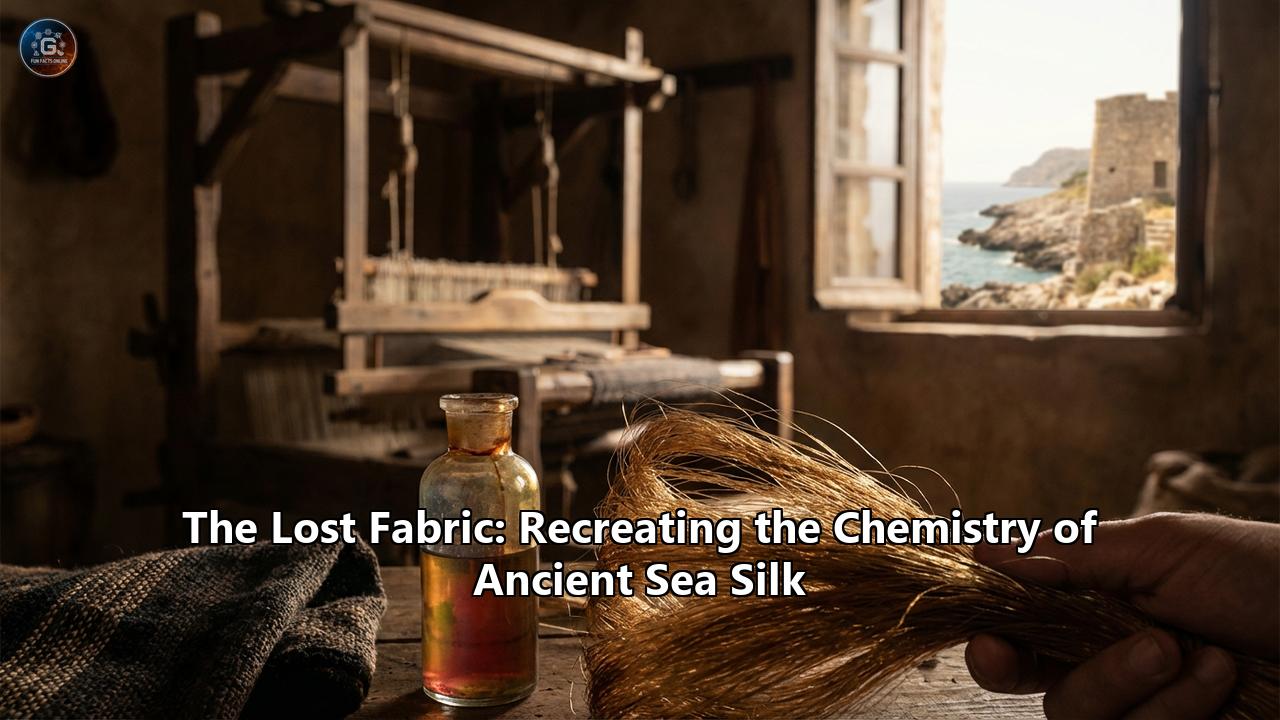
The raw material looks unpromising at first. It is a tuft of muddy, dark brown filaments, known as the "beard," which the Pinna nobilis uses to anchor itself into the sandy seabed. In the past, before the bans and the die-offs, divers would harvest these clams, sometimes killing them to extract the fiber, though Vigo practices a "non-invasive" harvest, cutting only the tips of the beard so the animal can regrow them—a technique requiring immense skill and lung capacity.
But the magic happens in the processing. The raw fibers are desalinated in fresh water for weeks, meticulously cleaned of debris, and then subjected to a secret bath. Vigo uses a mixture of lemon juice and a proprietary blend of algae and spices.
The transformation is alchemical. As the acidity of the lemon juice interacts with the proteins in the fiber, the dull brown mud-color dissolves. In its place emerges a shimmering, iridescent burnished gold. When held up to the sunlight, the fiber seems to disappear, becoming so fine it is almost invisible, yet it retains a tensile strength comparable to modern synthetics.
This is the fabric of antiquity. It is so fine that a pair of woman's gloves made from sea silk could be folded and fit inside a walnut shell. It is lighter than air, warmer than wool, and surprisingly durable. Historical records mention robes of sea silk given as diplomatic gifts between Roman Emperors and Persian Shahs. It was the fabric of the high priesthood, the "fine linen" of the Bible (though the translation is often debated, many scholars believe the buz or byssus mentioned in Chronicles refers to this marine fiber).
For centuries, the chemistry of this transformation was a mystery. Why did lemon juice turn the dark threads gold? Why did the color never fade, even after a thousand years?
Part II: The Silent Spring of the Mediterranean
While Chiara Vigo preserved the ritual, the source of the silk was dying.
The Pinna nobilis is an ecological keystone. It filters hundreds of liters of water daily, clarifying the sea. Its massive shell provides a hard substrate in the sandy bottom, creating a micro-reef for algae, sponges, and other mollusks. Inside its shell, a pair of symbiotic shrimp often live, warning the blind clam of approaching danger—a relationship observed by Aristotle.
But in 2016, a mass mortality event began off the coast of Spain. A protozoan parasite, Haplosporidium pinnae, began attacking the digestive glands of the clams. The infection prevented the animals from closing their shells, leaving them exposed to predators and starvation.
The spread was apocalyptic. Within three years, the plague had reached Turkey, Greece, and Croatia. Populations that had thrived for millennia collapsed by 99.9%. In many regions, the Pinna nobilis is now functionally extinct. The IUCN Red List reclassified the species to Critically Endangered.
The harvest of sea silk, already illegal since 1992 under the EU Habitats Directive, became a memory. The few remaining fibers in Vigo’s possession or in museum collections became relics of a lost world. The "Sea Silk" of the future seemed destined to be nothing more than a footnote in history books, a legend like the purple dye of Tyre or the flexible glass of Rome.
But science does not let go of legends easily.
Part III: The Architecture of Gold
In 2024, a team of researchers at POSTECH (Pohang University of Science and Technology) in South Korea, led by Professor Dong Soo Hwang, turned their attention to the molecular structure of byssus. They weren't looking at the endangered Pinna nobilis initially; they were studying the common "pen shell" or "gaper clam" (Atrina pectinata), a related species farmed extensively for food in the Pacific.
The byssus of the Atrina is usually discarded as waste—tons of it, smelling of low tide, thrown into landfills every year. But when the researchers cleaned and treated these fibers with the traditional lemon juice acid bath, they noticed something startling.
The fibers turned gold.
This observation triggered a deep dive into the material science of byssus. Using wide-angle X-ray diffraction and transmission electron microscopy, the team uncovered the secret that had eluded textile historians for centuries.
Sea silk is not pigmented. There is no "gold dye" molecule inside the fiber. If you were to grind the fiber into a powder, the gold color would vanish.
The color is structural.
The protein structure of sea silk is fundamentally different from the collagen found in the threads of common blue mussels (Mytilus edulis). Blue mussel threads are stretchy and collagen-rich, designed to absorb the shock of crashing waves on rocky intertidal zones.
The Pinna and Atrina clams, however, live in the sandy bottom, subjected to constant, steady drag from currents. Their byssus threads are composed of a unique class of globular proteins, which the researchers dubbed "photonins".
These proteins self-assemble into nanofibrils that are packed in a perfectly ordered, semi-crystalline helical structure. The spacing between these nanofibrils is on the order of hundreds of nanometers—exactly the wavelength of visible light.
When sunlight hits the fiber, the nanostructure interferes with the light waves. It absorbs the shorter, blue-violet wavelengths and reflects the longer, yellow-red wavelengths. This is the same physical phenomenon that gives the morpho butterfly its blue wings or the peacock its iridescence.
The lemon juice treatment—the secret of the ancient weavers—was not a dyeing process. It was a nanostructure etching process.
The mild citric acid of the lemon juice dissolves the outer, amorphous layer of the thread (the "cuticle"), which is often encrusted with debris and iron oxide. Once this dull coating is stripped away, the crystalline core of the fiber is exposed. The acid also slightly swells the protein lattice, tuning the spacing of the nanofibrils to perfectly reflect the gold spectrum.
This explains why the color never fades. A chemical dye degrades over time as UV radiation breaks the molecular bonds of the pigment. But a structural color is immortal as long as the physical shape of the material remains intact. A sea silk glove from the Roman era shines as brightly today as it did when it was knitted, because the "gold" is built into the very architecture of the thread.
Part IV: The Resurrection
The implications of the POSTECH discovery, published in Advanced Materials in mid-2025, were profound.
First, it meant that the "Lost Fabric" could be recreated without touching the endangered Pinna nobilis. The Atrina pectinata is abundant, farmed sustainably for food, and its byssus is a waste product. By collecting this waste and processing it with the specific acid-wash protocols derived from the molecular analysis, the researchers produced a fiber that was chemically and optically identical to ancient sea silk.
They spun a thread that shimmered with the same "burning sea gold" described by the Church Father Tertullian in the 2nd century AD.
Second, the discovery opened a new door for sustainable luxury. The fashion industry is one of the world's largest polluters, relying heavily on synthetic fibers (microplastics) or water-intensive crops like cotton. Here was a protein-based fiber, biodegradable, produced from food waste, that required no toxic dyes to achieve a brilliant, metallic color.
Designers began to take note. A prototype scarf, woven from the "recreated" sea silk, was displayed at the 2025 Milan Fashion Week. It rippled like liquid metal. It was lighter than the finest cashmere. And it carried the story of a 5,000-year-old tradition.
Part V: The Medical Frontier
The resurrection of sea silk is not just about fashion. The unique chemistry of the byssus thread has caught the eye of biomedical engineers.
The Pinna byssus is exceptionally biocompatible. Unlike silkworm silk, which can sometimes trigger immune responses due to sericin coatings, the sea silk proteins are remarkably inert in the human body. Furthermore, the mechanics of the fiber are extraordinary. It is stiff yet tough, capable of withstanding the high-energy environment of the ocean floor.
Researchers are now developing surgical sutures made from reconstituted sea silk proteins. These sutures would be naturally antimicrobial (a property of the Pinna byssus to prevent rot in the ocean), incredibly strong, and eventually biodegradable.
Even more promising is the "glue." The byssus thread attaches to the animal via a root system and to the seabed via an adhesive plaque. This adhesive is a water-resistant biological glue that cures underwater—the Holy Grail of materials science. Current surgical glues are often toxic or fail in the wet environment of the human body (blood, serum). A glue derived from the specific protein chemistry of the Pinna or Atrina byssus could revolutionize surgery, allowing doctors to seal wounds inside the heart or blood vessels without stitches.
Part VI: The Echo of the Golden Fleece
With the science illuminated, historians have begun to re-examine the old myths with fresh eyes. The legend of Jason and the Argonauts seeking the "Golden Fleece" in Colchis (modern-day Georgia) has always been interpreted as a sheep's fleece used to trap gold dust from rivers.
But there is a competing theory, now bolstered by the chemical evidence.
In ancient Greek, the word for sheep's wool and the word for the byssus tuft were often conflated. The Pinna nobilis was abundant in the Black Sea in antiquity. A "fleece" that shone like gold, that came from the water, and was prized by kings? It is entirely plausible that the Golden Fleece was actually a masterwork of sea silk—a garment so radiant that it seemed supernatural to those who had only ever seen dyed wool or linen.
The "gold that does not fade" is a powerful image in mythology. Now we know it is a reality of nanophysics. The ancients didn't have electron microscopes, but they had the observational power to notice that while Tyrian purple faded to a dull indigo over decades, the sea silk remained eternally bright. It was the closest thing to immortality they could wear.
Part VII: The Keeper of the Oath
Back in Sant’Antioco, the news of the scientific recreation of sea silk is met with complex emotions.
For Chiara Vigo, the Maestro, the fabric is more than proteins and nanofibrils. It is a spiritual connection. "Science can copy the molecule," she might say, "but can it copy the prayer?"
The traditional weaving of sea silk involves chanting in a dialect that mixes Sardinian with ancient Hebrew and Phoenician. The rhythm of the chant dictates the rhythm of the spin. The "Sea Oath" ensures that the fabric remains a gift, a bond between humans, rather than a product in a marketplace.
There is a risk that the industrialization of "recreated sea silk"—even if made from sustainable Atrina waste—could strip the material of its sacred context. If you can buy a sea silk tie on Amazon for $50, does it still hold the mystery of the deep?
However, there is also hope. The Pinna nobilis is still dying. Despite localized recovery efforts and captive breeding programs, the species hangs by a thread. If the demand for the "Golden Fleece" were to return without a sustainable alternative, poachers might hunt the last survivors to extinction.
The synthetic/recreated sea silk acts as a shield. It satisfies the market's hunger for the "cloth of gold" without harming the wild ecosystem. It allows the legend to live on in commerce while the living animal is left alone to recover in the sanctuary of the seagrass.
Conclusion: The Fabric of Memory
The story of Sea Silk is a tapestry woven from biology, history, and chemistry. It spans from the courts of King Solomon to the sterile labs of modern universities.
It reminds us that the ancients were chemists of the highest order, mastering natural processes through observation and intuition. They took a muddy, hairy root from a clam and, with nothing but lemon juice and the sun, turned it into gold.
We almost lost this knowledge. We almost lost the animal that gave it to us. But through a convergence of tradition (kept alive by the women of Sant’Antioco) and innovation (driven by scientists seeking sustainability), the fabric has been saved.
The Pinna nobilis may remain hidden in the depths for generations to come, slowly rebuilding its population in the quiet twilight of the seafloor. But its legacy—the golden thread that connects the ocean to the sun—has been caught, analyzed, and spun anew.
The Lost Fabric is found. And this time, it is woven with the knowledge that some treasures are too precious to be taken from the wild, but too beautiful to be forgotten.
Reference:
- https://eco-nnect.com/chiara-vigo-byssus-silk/
- https://thread-design.co.uk/scrapbook/she-spins-sea-silk-by-the-seashore/
- https://costume.mini.icom.museum/wp-content/uploads/sites/10/2018/12/Felicitas_Maeder_Toronto_article_PDF.pdf
- https://www.seasilkproject.com/
- https://www.sciencenews.org/article/golden-fabric-clam-waste-sea-silk
- https://itokri.com/blogs/craft-masala-by-itokri/the-last-surviving-sea-silk-seamstress
- https://ounodesign.com/2016/01/15/ancient-sea-silk-by-chiara-vigo/
- https://seasilk.org/history/
- https://en.wikipedia.org/wiki/Sea_silk
- https://divewise.com.mt/blogs/blogs/pinna-nobilis
- https://www.researchgate.net/publication/385936129_Pinna_nobilis_refugia_breached_Ongoing_Mass_Mortality_Event_in_the_Gulf_of_Kalloni_Aegean_Sea
- https://www.mdpi.com/1424-2818/16/6/341
- https://biz.chosun.com/en/en-science/2025/06/26/BYI3U32SHRBPJDQW76DGZWUOH4/
- https://www.jpost.com/archaeology/article-859110