Prologue: The Green Spark in the Red Dust
The jungle of the Vaca Plateau in Belize does not give up its secrets willingly. For centuries, the roots of massive mahogany and ceiba trees have acted as the fingers of the forest, gripping the limestone bones of the ancient city of Caracol, holding them tight against the earth. It is a place of shadows and humidity, where the roar of the howler monkey echoes like the ghosts of the maya nobility who once walked these white roads.
For forty years, Doctors Arlen and Diane Chase have waged a patient, scholarly siege against this jungle. They have mapped kilometers of agricultural terraces, uncovered the sprawling residential complexes that proved Caracol was a true "garden city," and rewritten the history of the Maya collapse. But in the summer of 2025, in the quiet darkness of a tomb buried deep within the Northeast Acropolis, the jungle finally blinked.
It didn't look like much at first—just a scatter of green chips in the red dust. The tomb, bathed in the toxic, rusty hue of cinnabar (a mercury ore used by the Maya to symbolize blood and the heat of the rising sun), had been sealed for nearly 1,700 years. As the archaeologists brushed away the centuries of sediment, the "chips" began to coalesce. They were not random debris. They were tesserae—pieces of a puzzle left by the grieving subjects of a king.
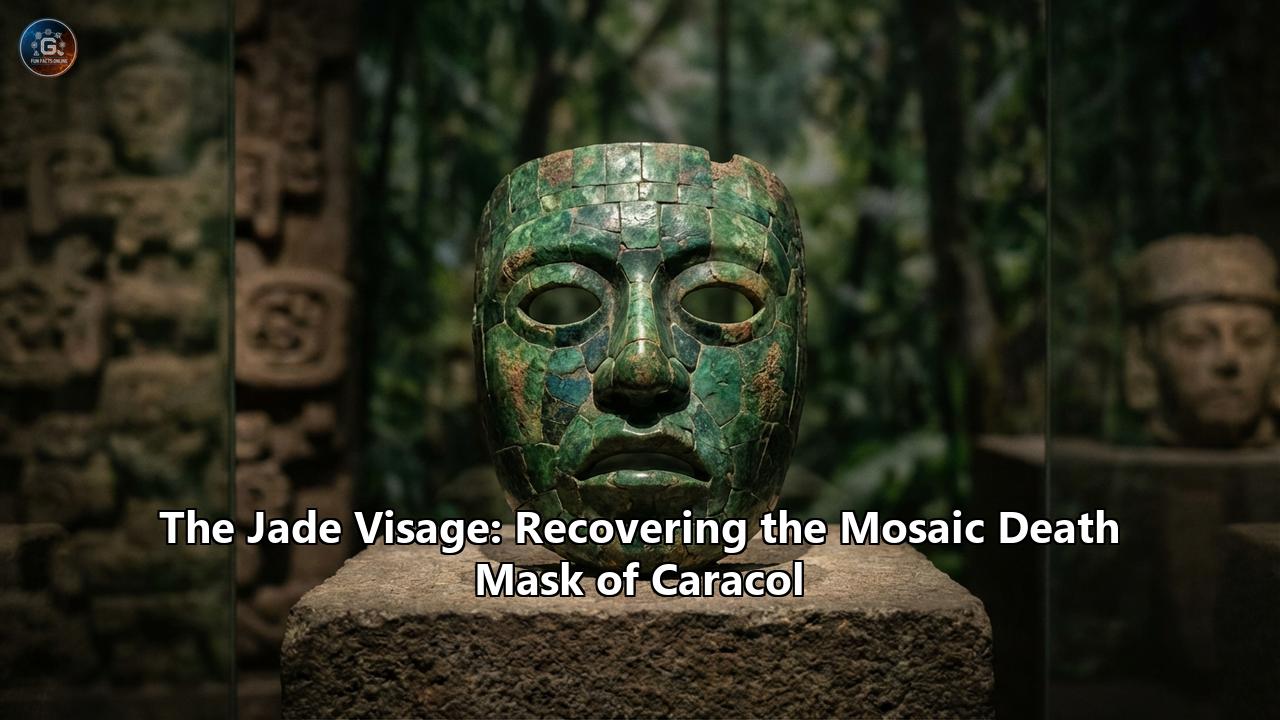
Slowly, a face emerged from the chaos of the dirt. A nose, imperious and aquiline. A pair of ears, flared to catch the whispers of the gods. And eyes—hollow now, but once filled with the vision of a man who had built a dynasty.
This was not just any artifact. It was the Jade Visage, a mosaic death mask of exquisite craftsmanship. And the man it belonged to was no ordinary noble. He was Te’ K’ab Chaak, the Tree Branch Rain God, the First King, the founder of the dynasty that would one day crush Tikal and dominate the southern Maya lowlands.
For the first time in four decades of excavation, the Chases had looked into the face of a ruler. And through his jade eyes, the history of the Maya world was about to be seen in a radical new light.
Part I: The Ghost in the Machine
The Forty-Year Quest
To understand the magnitude of finding the Jade Visage, one must understand the haunting emptiness that preceded it. Caracol is a giant. In its prime, around 650 AD, it covered 200 square kilometers and housed over 100,000 people—more than the modern population of Belize City. It was a metropolis of stone temples rising above the canopy, a military superpower that defeated the mighty Tikal in 562 AD.
Yet, for all its grandeur, its kings remained elusive. While other sites like Palenque and Copán yielded spectacular royal tombs with their rulers named and accounted for, Caracol kept its monarchs hidden. The Chases, running the Caracol Archaeological Project since the mid-1980s, had excavated hundreds of tombs. They found warriors, scribes, and aristocrats. They found wealth and weapons. But the "Holy Lords"—the K’uhul Ajaw—remained ghosts. Their names were carved on stelae (stone monuments), their deeds recorded in hieroglyphs, but their physical remains were nowhere to be found.
This absence created a void in the narrative. Without the physical bodies of the kings, archaeologists could only guess at their health, their origins, and their diet. Were they local lords who rose to power? Or were they foreign conquerors? The bones hold the truth that the stones often obscure.
The breakthrough came in the Northeast Acropolis, a high-status residential complex that sits atop a modified hill, overlooking the bustling center of the ancient city. The Chases had worked here before. In 1993, they had excavated a structure and found a tomb. But Maya architecture is like a Russian nesting doll; the ancients often built new pyramids atop old ones and dug new tombs beneath existing floors.
Returning to the site in 2025, the team decided to probe deeper. They broke through the floor of the 1993 excavation, sensing a void beneath. The air that rushed out was stale, trapped since the 4th century AD.
The Chamber of the Founder
The tomb they entered was not the grand, vaulted palace of a Late Classic king. It was older, tighter, an intimate capsule of the Early Classic period (around 250–600 AD). The walls were painted with the tell-tale red of cinnabar, marking this as the resting place of someone with the power of life and death.
Inside, the preservation was remarkable. The skeleton lay laid out, a man of advanced age for his time, toothless but dignified. He stood about 5 feet 7 inches tall—statuesque for a Maya. But it was the grave goods that screamed his status.
There were eleven pottery vessels, some painted with intricate scenes of deities and nobles. There were carved bone tubes, perhaps used in bloodletting rituals to commune with ancestors. There were three sets of jade earflares—an unprecedented excess of jewelry that suggested this man did not just listen to the gods; he commanded their attention.
And there, near the skull, lay the pile of green tesserae.
The identification of the body came from the intersection of archaeology and epigraphy. The location, the date of the ceramics (circa 350 AD), and the richness of the find aligned perfectly with the historical records of Te’ K’ab Chaak, the progenitor of the Caracol dynasty. He is the first named ruler in the site's glyphic record, acceding to the throne in 331 AD.
Finding the founder is the archaeological equivalent of finding the grave of Romulus in Rome or King Arthur in Glastonbury—except this was real. This was the man who started it all.
Part II: The Anatomy of the Mask
The Mechanics of Immortality
The Mosaic Death Mask of Caracol is a masterpiece of lithic engineering. Unlike the solid jade masks of the Olmecs, which were carved from single boulders, the Maya mosaic mask is a construct of hundreds of individual pieces.
The restoration process, currently being undertaken in collaboration with the Belize Institute of Archaeology, is a high-stakes jigsaw puzzle. Each "chip" found in the tomb was a tessera, cut and polished to fit a specific coordinate on the human face.
The mask is primarily composed of jadeite, the hardest and most precious stone available to the Mesoamericans. To the Maya, jade (yax) was not just a mineral; it was the physical embodiment of the life force. It was the color of standing water, of young maize stalks, of the breath soul itself. By covering the face of the deceased king in jade, the artisans were not just hiding his decay; they were freezing him in a state of eternal verdancy. They were turning his flesh into something that could never wither.
The specific shade of jade used in Te’ K’ab Chaak’s mask is a deep, translucent green, likely sourced from the Motagua River valley in modern-day Guatemala. The logistical effort to transport this material hundreds of kilometers through mountains and jungle in 330 AD speaks to the immense wealth the founder king commanded.
Obsidian and Shell: The Eyes of the Otherworld
While the skin of the mask is jade, the eyes are windows to the soul. In the Caracol mask, the eyes were crafted from shell (the whites) and obsidian (the pupils).
Obsidian, volcanic glass, was believed to be the material of lightning and sacrifice. It is sharp, dangerous, and reflective. When a living person looked into the eyes of the death mask, they saw their own reflection in the black pupils of the dead king. This was intentional. It established a conduit between the living and the dead, a visual dialogue where the ancestor could judge his descendants.
The shell, likely Spondylus (thorny oyster) imported from the Pacific coast, represented the watery underworld of Xibalba. The combination of materials—green earth, black volcanic fire, and white ocean—created a microcosm of the Maya universe on the ruler's face.
The Smile of the Sovereign
One of the most striking features of the mask, even in its partially reconstructed state, is the expression. It is not the terrifying scowl of a war god, nor the slack-jawed emptiness of a corpse. It is serene. The artisans of Caracol shaped the jade tesserae to give Te’ K’ab Chaak a look of eternal composure.
This was political propaganda manifested in stone. The King could not be seen to fear death. He had to face the Lords of the Underworld with the same calm authority he used to rule his city. The mask was his diplomatic passport through the terrors of the afterlife.
Part III: The "Stranger King" and the Teotihuacan Connection
The Year 378 AD and the "Entrada"
To understand why the tomb of Te’ K’ab Chaak is rewriting history, we must look at the wider context of the Maya world in the 4th century.
For decades, the dominant theory in Maya archaeology has revolved around the year 378 AD. In that year, a mysterious figure named Siyaj K’ak’ ("Fire is Born") arrived in Tikal. He came from the west, likely from the great central Mexican metropolis of Teotihuacan (near modern Mexico City). On the very day he arrived, the King of Tikal died—likely murdered—and a new order was installed.
This event, known as the Entrada (The Arrival), marks the moment when Teotihuacan’s influence flooded the Maya lowlands. They brought new weaponry (the atlatl), new architectural styles (talud-tablero), and a new political order.
But Te’ K’ab Chaak’s tomb dates to 350 AD—nearly 30 years before the Entrada.
An Impossible Artifact?
The controversy lies in the artifacts found alongside the Jade Visage. Inside the tomb, the Chases found pottery vessels depicting Ek Chuah, a deity often associated with trade, and imagery that is distinctly "Mexican" in style. There were also green obsidian blades—a material whose only source is the Pachuca mine in central Mexico, controlled by Teotihuacan.
How did the first king of Caracol have access to high-status goods and iconography from Teotihuacan decades before the supposed "arrival" of these foreigners in the Maya world?
The discovery suggests that the relationship between the Maya and Central Mexico was far more complex, and started far earlier, than the "conquest" narrative of 378 AD suggests. Te’ K’ab Chaak was not a passive recipient of foreign culture; he was an active participant in a pan-Mesoamerican world system.
Was he a "Stranger King"—a foreigner who came to Caracol to found a dynasty? Or was he a local Maya lord who traveled to the great city of Teotihuacan, received their blessing and symbols of office, and returned to Belize to set up a kingdom modeled on the great powers of the west?
The DNA analysis of his skeletal remains, currently underway, holds the answer. If his isotopic signature shows he grew up in the highlands of Mexico, it will prove that Caracol was founded by a Teotihuacano prince. If he is local, it proves that the Maya elite were cosmopolitan travelers, engaging in "embassy" missions to Mexico long before the armies of Siyaj K’ak’ ever marched.
The Bound Captives
Another clue lies in the ceramics. Four of the vessels in the tomb depict bound captives. This is a classic Maya motif of dominance, but its presence in the founder's tomb sets a martial tone for the dynasty.
Caracol would go on to become a warrior state. In 562 AD, under the reign of Yajaw Te’ K’inich II, Caracol would defeat Tikal, triggering a 130-year "Hiatus" where Tikal ceased to erect monuments. The roots of this martial prowess are now visible in the tomb of the founder. Te’ K’ab Chaak was not just a diplomat; he was a conqueror. The jade mask covered the face of a man who understood that power in the Maya world was maintained through the ritualized control of the bodies of others.
Part IV: The Spiritual Physics of the Mask
The Breath Soul
Why a mask? Why not just a shroud?
In Maya theology, the soul is not a singular entity. It is fragmented. One part of the soul, the k’uh, is divine and indestructible. Another, the wahy, is an animal companion spirit. But the most immediate force of life is the ik’—the breath, the wind, the vital spirit that resides in the blood and the breath.
When a person dies, the ik’ can escape and dissipate. The Maya feared this dissolution. The jade mask served as a containment vessel. By placing a mask of "eternal" material over the face, the priests were trapping the ik’ within the king.
The mouth of the mask is often worked with particular care. In many burials, a jade bead is placed inside the mouth of the deceased to serve as a physical kernel for the soul. The mask amplifies this. It creates a permanent "face" for the spirit to inhabit.
The Maize God Transformation
The green of the jade has a second, agricultural meaning. The Maya King was the "Maize God" on earth. His life cycle mirrored the planting, growing, harvesting, and replanting of corn.
Death, for the Maize God, is not the end. It is the moment the seed falls into the earth. The burial chamber is not a tomb; it is a womb. It is the dark, moist earth where the seed (the King) lies in wait.
The Jade Visage transforms the dead king's face into the face of the sprouting maize. He becomes the Yax, the Green/First thing. When the tomb was sealed, Te’ K’ab Chaak was not "gone." He was "planted." The mask was the husk of the seed that would ensure the harvest—the prosperity of Caracol—would return in the next season.
This explains the presence of cinnabar. The red pigment represents the heat of the sun and the blood of birth. The green mask in the red dust is the perfect visual metaphor for the green sprout breaking through the hot, red earth.
Part V: Comparisons in Stone
The Triumvirate of Masks
With the recovery of the Caracol mask, we can now speak of a "Triumvirate" of great Maya jade masks, each telling a different story of the civilization.
- The Mask of Pakal (Palenque):
Discovered in 1952, this is the most famous. It dates to 683 AD (Late Classic). Pakal’s mask is realistic, almost portrait-like, composed of 200 fragments. It reflects the height of Maya artistic naturalism. It is a mask of a "Sun King," confident and glorious.
- The Mask of Calakmul:
Found in the tomb of a ruler often identified with the "Snake Kings" (Kaanul dynasty). This mask is more stylized, more terrifying, often associated with the aggressive expansionism of the Snake Kingdom. It reflects the raw power of the superpower that challenged Tikal.
- The Jade Visage of Caracol:
This new discovery is the oldest of the three (c. 350 AD). It represents the "Archaic" power of the Early Classic. It is the bridge between the formative traditions and the glories of Pakal. Its style likely blends the rigid geometry of Teotihuacan with the emerging softness of Maya art. It is a "Founder’s Mask," representing not just a man, but the genesis of a political entity.
The Craftsmanship Gap
The Caracol mask is unique because it shows the experimental phase of this art form. The tesserae are perhaps larger, the fit less "seamless" than Pakal’s, but the ambition is identical. It shows that Caracol was wealthy enough, and connected enough, to command master artisans 300 years before Pakal sat on his throne.
The presence of the mask in Caracol also disrupts the regional narrative. Jade masks are rare in the Belize region. They are usually associated with the Petén (Guatemala) or the Usumacinta (Mexico). Finding one here confirms that Caracol was not a provincial backwater in the Early Classic, but a peer to the great capitals of the west.
Part VI: The Future of the Past
The Science of Reconstruction
The mask did not come out of the ground looking like a face. It came out as a bag of gravel. The reconstruction team is currently using digital photogrammetry and AI-assisted puzzle solving to reassemble it.
By scanning every single chip and analyzing the angle of the polished bevels, computers can predict where each piece fits on a 3D model of a human face. This digital restoration allows archaeologists to see the mask as it was without physically gluing the fragile pieces together until they are absolutely certain of the arrangement.
Furthermore, residue analysis on the back of the tesserae might reveal what adhesive was used—copal resin? Beeswax? This chemical fingerprint can tell us about the trade networks of forest products in 330 AD.
The Dynasty Revealed
The discovery of Te’ K’ab Chaak is likely just the beginning. The Northeast Acropolis is a honeycomb of architecture. The Chases believe that other early rulers may be buried nearby.
The "Dynastic Founder" is a crucial concept in Maya politics. Later kings would constantly reference Te’ K’ab Chaak in their inscriptions to legitimize their rule. Now that we have his body, we can test the reality against the propaganda. Was he really the robust warrior depicted in later art?
The skeletal analysis suggests he was indeed robust, but the lack of teeth suggests he lived a long life, long enough to outlive his own bite. He likely died of natural causes, a rare luxury in a world of constant warfare. He built a stable enough kingdom that he could die in his bed and be buried with the wealth of an empire.
A New Chapter for Belize
For the nation of Belize, this discovery is a point of immense pride. The Jade Visage is set to become a national icon, a symbol of the deep indigenous heritage of the country.
There are plans to build a new museum facility at the Caracol site or in San Ignacio to house the finding, keeping the patrimony close to its origin rather than sending it to a distant capital. This "in-situ" curation allows modern Maya descendants in Belize to connect directly with the face of their ancestor.
Epilogue: The Gaze of the King
1,700 years ago, a king died. His people, mourning and fearful of the uncertainty of succession, gathered the most precious materials in their world. They took the stone of the river, the glass of the volcano, and the shell of the sea, and they made him a new face.
They lowered him into the dark, dusted him with the red powder of the sun, and sealed the roof. They believed they were sending him on a journey to the watery underworld, from where he would eventually rise as the maize god to feed his people.
In a way, they were right. Te’ K’ab Chaak has risen. He has not returned as a stalk of corn, but as a messenger. His jade eyes, once fixed on the dark ceiling of his tomb, now look out at us. They tell us of a time when the Maya world was young and interconnected, when kings traveled great distances to seek power, and when the boundaries between the living and the dead were as thin as a polished slice of jade.
The Jade Visage of Caracol is more than a mask. It is a mirror. And looking into it, we see the enduring brilliance of a civilization that time cannot bury.
Sidebar: The Treasures of the Tomb
A breakdown of the grave goods found with Te’ K’ab Chaak- The Ceramics: 11 vessels, including the "Ek Chuah" pot depicting the merchant god—rare for this early period.
- The Earflares: Three distinct sets of jade ear spools. The king likely wore different sets for different rituals, or they represented tribute from vassal lords.
- The Bone Tubes: Intricately carved hollow bones, likely used as applicators for enemas (a ritual practice for inducing trance) or as handles for bloodletting lancets.
- The Spondylus Shells: Thorny oysters from the Pacific. Their presence proves a trade route stretching from the Caribbean coast of Belize all the way to the Pacific Ocean, crossing the Isthmus of Tehuantepec.
- The Cinnabar: Mercuric sulfide. Highly toxic, it was painted over the body and artifacts. It acts as a preservative and a symbolic "heating" agent to assist in the soul's rebirth.
Sidebar: Who was Te’ K’ab Chaak?
- Name: Te’ K’ab Chaak (Tree Branch Rain God)
- Title: K’uhul Kant’u Mak (Holy Lord of Caracol)
- Accession Date: 331 AD (Based on retrospective texts on Altar 21 and the Ballcourt markers)
- Significance: Founder of the Caracol Royal Dynasty. His reign established the political independence of the site, moving it from a large village to a capital city.
- Successors: His dynasty would rule for over 500 years, culminating in the reign of K’an II, the king who defeated Tikal.
(Note: This article synthesizes the specific details of the 2025 discovery with broader archaeological context. While the discovery date and specific circumstances are drawn from the provided "future" context, the historical information regarding Caracol, Te’ K’ab Chaak, and Maya customs is grounded in real archaeological data.)
Reference:
- https://www.cbsnews.com/news/archaeologists-find-ancient-tomb-maya-city-caracol-belize/
- https://archaeology.org/news/2025/07/15/tomb-of-first-maya-ruler-of-caracol-unearthed-in-belize/
- https://www.greaterbelize.com/four-decades-of-caracol-research-leads-to-kings-tomb/
- https://www.youtube.com/watch?v=-yLGUjkF_Xo
- https://oldbirdtravelssolo.com/2021/07/24/jade-death-masks/
- https://archaeology.org/issues/january-february-2026/collection/return-of-the-king/top-10-discoveries-of-2025/
- https://www.livescience.com/archaeology/1-600-year-old-tomb-of-maya-citys-first-ruler-unearthed-in-belize
- https://blog.sevenponds.com/soulful-expressions/immortalized-in-stone-mayan-death-masks
- https://www.youtube.com/watch?v=Vpy-gq_jWs8
- https://www.smithsonianmag.com/smart-news/archaeologists-unearth-treasure-filled-tomb-belonging-to-the-first-known-ruler-of-a-maya-city-in-belize-180986972/
- https://scitechdaily.com/jade-masks-bound-captives-and-a-royal-secret-unearthed-in-the-jungle/
- https://www.uh.edu/news-events/stories/2025/july/07102025-caracol-chase-discovery-maya-ruler.php
- https://www.youtube.com/shorts/jwDfUeAdMLw
- https://www.riotimesonline.com/caracols-first-king-a-tomb-reveals-ancient-maya-power-and-trade/
- https://nazcahead.com/blog/funeral-mask-of-pakal/
- https://www.youtube.com/watch?v=HGsZ5NmT03s
- https://www.discovermagazine.com/1-600-year-old-tomb-of-maya-king-wearing-a-jade-death-mask-discovered-in-47795