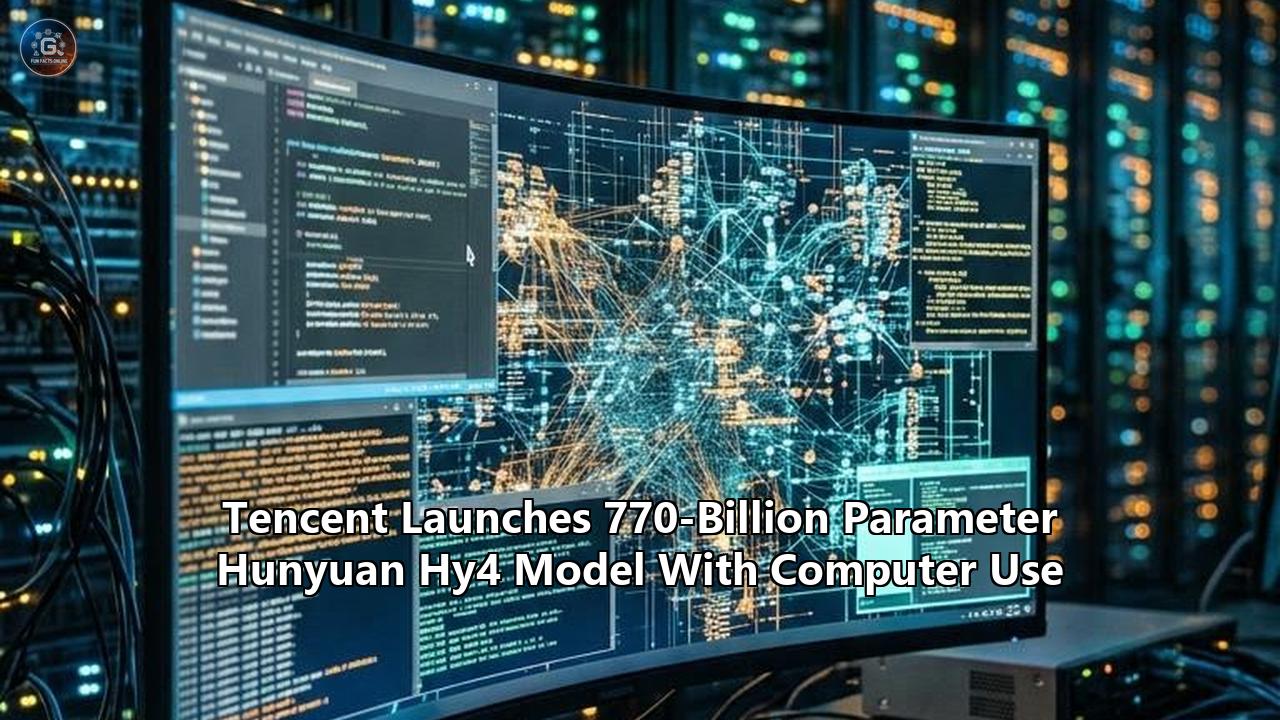
On November 4, 2026, Tencent officially rolled out the general availability of Hy4, the latest flagship generation of the Tencent Hunyuan model family. Moving well beyond the text-focused parameters of its predecessors, the new 770-billion-parameter Mixture-of-Experts (MoE) system arrived with two foundational capabilities that reposition the tech conglomerate in the global artificial intelligence landscape: native multimodal visual perception and direct, autonomous computer use.
Trading on the Hong Kong Stock Exchange immediately reflected the weight of the announcement. Shares of Tencent Holdings (HK:0700) climbed 5.93% to reach HK$425.40, outperforming the Hang Seng Index as investors digested the technical specifications and commercial deployments. Where the August preview of Hy4 offered a raw, text-only preview under an Apache 2.0 license, the production release establishes an end-to-end agentic platform capable of reading pixel displays, executing command-line instructions, and directly manipulating complex graphical user interfaces (GUIs) across software like Blender, CAD suites, and enterprise productivity software.
The launch represents far more than an incremental parameter boost. It serves as a definitive case study in how frontier artificial intelligence development is pivoting away from passive text prediction toward active operating-system agency. By analyzing the engineering choices, pricing economics, internal domain co-design, and transparent benchmark concessions embedded in Hy4, organizations can extract critical principles regarding where enterprise automation is heading, how the economics of foundation models are re-crystallizing, and why software manipulation has become the primary arena of technological competition.
+----------------------------------------------------------------------------------------------------+
|                                    TENCENT HUNYUAN HY4 OVERVIEW                                   |
+--------------------------+-------------------------------------------------------------------------+
| Architecture             | 770B Total Parameters Sparse MoE (49B Active per Token)                 |
| Layer Configuration      | 78 Layers: 1 Dense FFN + 77 MoE (256 Routed Experts, 1 Shared Expert)    |
| Attention Mechanism      | Gated DeepSeek Sparse Attention (Gated DSA) with IndexCache & iHC       |
| Context Window           | 1,048,576 Tokens (65,536 Output Completion Limit)                       |
| Core New Capabilities    | Native Visual Understanding; GUI & CLI Computer Use                     |
| Enterprise Specialization| Blender, Computer-Aided Design (CAD), Unreal Engine, Unity, Godot       |
| Reported Performance     | OSWorld 2.1: 78.9 | WorkBuddy Task Pass Rate: 96.15%                    |
| Hallucination Metrics    | Internal Rate Reduced from 12.95% to 7.2%; Speculation Down to 5.6%   |
| Hosted Pricing           | $0.834 / Million Input Tokens | $2.501 / Million Output Tokens           |
+--------------------------+-------------------------------------------------------------------------+
Technical Dissection: Sparse Scale Meets Visual Grounding
Understanding the operational leap of Hy4 requires unpacking its underlying compute architecture. The model is built as a 78-layer sparse Mixture-of-Experts system containing 770 billion total parameters, but it executes with a remarkably lean inference profile by activating only 49 billion parameters per token.
                                  [ Token Input ]
                                         │
                                         ▼
                            Layer 1: Standard Dense FFN
                                         │
                                         ▼
                   ┌───────────────────────────────────────────┐
                   │    Layers 2–78: Sparse MoE Backbone       │
                   │  ┌─────────────────────────────────────┐  │
                   │  │ 256 Routed Experts (Top-8 Activated)│  │
                   │  │                 +                   │  │
                   │  │        1 Always-Active Expert       │  │
                   │  └─────────────────────────────────────┘  │
                   └───────────────────────────────────────────┘
                                         │
                   ┌─────────────────────┴─────────────────────┐
                   ▼                                           ▼
         Gated DSA Attention                         1 Native MTP Layer
      (IndexCache + iHC Streams)                  (Speculative Decoding Engine)
                   │                                           │
                   └─────────────────────┬─────────────────────┘
                                         ▼
                          [ Multi-Step Action Generation ]
The backbone dedicates its initial layer to a standard dense feed-forward network (FFN), while the remaining 77 layers swap in an MoE configuration featuring 256 routed experts and one dedicated shared expert. During any given forward pass, an incoming token routes to its top-eight routed experts alongside the shared expert. This sparse structural design delivers frontier-scale parametric memory—critical for storing deep world knowledge and diverse application interfaces—while keeping per-token compute demands commensurate with mid-sized models.
To support long-horizon task execution over its 1,048,576-token context window, the engineering team introduced architectural efficiencies adapted from contemporary open research:
- Gated DeepSeek Sparse Attention (Gated DSA): Paired with an IndexCache mechanism, this setup reuses cross-layer sparse indices to suppress memory consumption during extended agentic loops.
- Identity Hyper-Connections (iHC): By multiplying residual streams across layers, iHC broadens inter-layer signal transmission, preserving gradient fidelity through deep networks.
- Native Multi-Token Prediction (MTP): An integrated 10-billion-parameter MTP layer (activating 0.7 billion parameters) enables speculative decoding natively, accelerating multi-step code generation and sequential coordinate planning without requiring a disconnected draft model.
Yet the structural differentiator separating Hy4 from the August preview is native multimodal fusion. Rather than piping desktop screenshots into an isolated vision-language adapter that hands text descriptions to a decoupled language model, Tencent integrated visual perception directly into the model's core latent representations.
The practical outcome of this unified latent space is fine-grained visual grounding. During public demonstrations, Tencent illustrated this capability by tasking Hy4 with querying a 2.8-gigapixel aerial photograph of an industrial harbor. The model successfully wrote code to tile, crop, and locate a single two-meter component installed on a warehouse roof without losing semantic track of the user prompt. When operating a PC, this visual acuity enables the system to distinguish between minutely differentiated user interface elements, parse dense financial diagrams, and interpret dynamic viewport renderings inside 3D development software.
The Computer Use Paradigm: From Predictive Text to Active Execution
The flagship headline of Hy4 is its ability to take over human input channels—mouse clicks, keyboard strokes, terminal execution, and browser navigation. By scoring 78.9 on the OSWorld 2.1 benchmark, Hy4 lands within striking distance of the world's leading proprietary agentic systems, trailing Claude Opus 5.5 (81.8) and Kimi K3.1 Pro (79.6) while surpassing GPT-6.1 Sol (75.2) in vendor-reported evaluations.
                 [ OSWorld 2.1 Benchmark Results (Vendor-Reported) ]
  Claude Opus 5.5       ██████████████████████████████████████████ 81.8
  Kimi K3.1 Pro         ████████████████████████████████████████   79.6
  Tencent Hy4           ███████████████████████████████████████▌   78.9
  GPT-6.1 Sol           ████████████████████████████████████       75.2
To appreciate why this matters, one must examine how computer use transforms the boundary between artificial intelligence and legacy digital infrastructure. For decades, integrating automation into enterprise workflows demanded bespoke application programming interfaces (APIs). If a software vendor did not expose an API endpoint, external programs could not interact with it.
Computer-use models bypass this bottleneck entirely. Because humans interact with computers through visual displays and peripheral inputs, a model capable of parsing a screen buffer and generating precise mouse and keyboard commands can pilot any software designed for human operation.
Traditional API Integration:
[ Model ] ──► [ Bespoke API Layer ] ──► [ Proprietary Application ] (High Friction)

Computer-Use Agent Integration:
[ Model ] ──► [ Screen Vision / Keystrokes / Clicks ] ──► [ Any GUI Software ] (Zero Friction)
Hy4’s implementation is explicitly tailored for high-friction professional software suites. Tencent specifically targeted training runs on:
- 3D Modeling and Computer-Aided Design: The system can manipulate Blender viewports and CAD drafting interfaces. In internal demonstrations, the agent accepted a rough hand-drawn 2D sketch, translated it into a fully articulated, textured 3D asset, and configured scene lighting and render passes.
- Interactive Entertainment Engines: By ingesting data curated alongside engineers from Tencent’s Interactive Entertainment Group (IEG), Hy4 interfaces directly with Unreal Engine, Unity, and Godot. Benchmark results show a 19.1% improvement on GameDev tasks and a 9.8% lift on GameLogic challenges relative to the preview release.
- Cross-Application Enterprise Workflows: The model switches between command-line shells (CLI) and graphical interfaces (GUI). An employee can command Hy4 to extract raw earnings tables from a set of PDFs, clean the numbers inside a Python terminal, plot trend lines in an Excel spreadsheet, write a summary in Microsoft Word, and package the slides in PowerPoint.
+----------------------------------------------------------------------------------------------------+
| PRINCIPLE 1: Affordance-Driven Utility                                                             |
|                                                                                                    |
| The utility ceiling of an enterprise artificial intelligence model is bounded by its operational   |
| affordances, not its cross-entropy loss. A model that improves screen grounding and keyboard/mouse |
| orchestration converts all legacy human-facing software into machine-operable environments,       |
| eliminating the economic friction of building and maintaining custom integration APIs.           |
+----------------------------------------------------------------------------------------------------+
The Enterprise Sandbox Advantage: Co-Designing for Low Latency and Truth
A recurring failure mode of generic foundation models deployed into autonomous agent roles is the compounding error rate. If an agent carries an 85% success rate per step, a ten-step workflow drops to an overall task completion rate of under 20%. Errors snowball, context drifts, and hallucinations corrupt the final deliverable.
Tencent addressed this stability dilemma through a massive, vertically integrated training setup. According to details shared with developer communities, Tencent Cloud deployed an automated agent runtime consisting of isolated sandboxes with hundreds of pre-installed enterprise applications. Hy4 was repeatedly subjected to multi-hour execution loops where it planned actions, interacted with software, observed execution errors via screen captures or command return codes, and learned recovery policies.
[ Natural Language Goal ]
          │
          ▼
┌────────────────────────────────────────────────────────┐
│             HY4 REASONING & PLANNING LOOP              │
├────────────────────────────────────────────────────────┤
│  1. Ingest Screen Buffer / Terminal State              │
│  2. Compute Multi-Step Interaction Plan                │
│  3. Emit Mouse / Keyboard / Shell Command              │
└────────────────────────────────────────────────────────┘
          │
          ▼
┌────────────────────────────────────────────────────────┐
│            ENTERPRISE APPLICATION SANDBOX              │
├────────────────────────────────────────────────────────┤
│  • Blender / CAD / Office / IDE / Shell Execution      │
│  • Visual Feedback Captured via Unified Latent Space   │
│  • Error Detection & State Drift Validation            │
└────────────────────────────────────────────────────────┘
          │
          ▼
[ Automatic Error Recovery & Task Verification ]
This dynamic sandbox regimen altered key operational metrics:
- Task Pass Rates: On Tencent’s internal WorkBuddy productivity evaluation suite, Hy4 recorded a 96.15% task pass rate, averaging an aggregate performance score of 83.18 across common enterprise scenarios.
- Hallucination Suppression: By incorporating strict factual consistency checks and time-sensitive retrieval steps, the model’s internal hallucination rate fell from 12.95% (15.76% in specialized previews) down to 7.2% overall and 5.45% in business settings.
- Speculative Guessing Elimination: The error rate driven by speculative guesswork plummeted from 23.1% to 5.6%.
This performance demonstrates how consumer and enterprise footprints compound into training advantages. Tencent did not gather these interaction logs from public synthetic data scrapes alone. They co-designed the post-training curriculum alongside domain experts from WeChat Work, Tencent Games, and corporate accounting divisions.
In a crowdsourced corporate finance evaluation featuring 213 professional analysts tackling 579 tasks, Hy4 scored 3.04 points, edging out DeepSeek-V4.1-Flash-1017 (2.97) and outpacing Kimi K3.1 Pro (2.68) and GLM-5.3 (2.68). When real workflow data shapes the training pipeline, models learn the pragmatic conventions, keyboard shortcuts, and defensive error checks that human workers use daily.
+----------------------------------------------------------------------------------------------------+
| PRINCIPLE 2: Domain-Integrated Data Flywheels                                                      |
|                                                                                                    |
| Broad web crawls provide semantic fluency, but operational resilience requires closed-loop sandbox|
| training. Tech conglomerates with sprawling software ecosystems can generate dense synthetic and   |
| human-in-the-loop interaction trajectories that open-source scraping cannot replicate, giving     |
| them an asymmetric advantage in creating reliable agents.                                          |
+----------------------------------------------------------------------------------------------------+
Commercial Realism: The Economics of Commoditized Intelligence
While the technical capabilities capture mindshare, Tencent’s commercial strategy reveals the aggressive price deflation taking place across enterprise artificial intelligence.
When launching Hy4, Tencent maintained list prices at:
- Input Tokens: $0.834 per million tokens (approximately 6 RMB).
- Output Tokens: $2.501 per million tokens (approximately 18 RMB).
- Cache Hits: $0.042 per million tokens (approximately 0.3 RMB).
To drive rapid enterprise adoption, the company layered aggressive promotions on top of these base figures: offering a 50% discount on Tencent Cloud TokenHub through December 31, 2026, and granting two weeks of complimentary usage inside its WorkBuddy and CodeBuddy workspaces.
                 [ API Pricing per Million Input Tokens (USD) ]
  Leading Western Frontier (Claude Opus Class)  ████████████████████ $15.00+
  Tencent Hy4 (Standard List Price)             █▌ $0.834
  Tencent Hy4 (TokenHub Promotional Rate)       ▌ $0.417
For software architects designing agentic systems, the cached input rate of $0.042 per million tokens is the most consequential number on the sheet. Computer-use agents operate via recursive loops: every time an agent takes an action, it captures a fresh screenshot, appends it to the multi-turn interaction history, and passes the entire accumulated context back into the model to predict the next click.
In an un-cached pricing model, a 50-step agent loop rapidly exhausts operational budgets by reprocessing hundreds of thousands of historical tokens on every single turn. At four cents per million cached tokens, re-reading massive project workspaces, open code repositories, and sequential visual frames becomes economically negligible.
Step 1:  [ System Prompt + Base Context ] ──────────────► [ Action 1 ]
                               │ (Cached at $0.042/M)
Step 2:  [ System Prompt + Base Context ] + [ Frame 1 ] ──► [ Action 2 ]
                               │ (Cached at $0.042/M)
Step 3:  [ System Prompt + Base Context ] + [ Frame 1-2 ] ─► [ Action 3 ]
...
Step 50: [ Cumulative Context Re-read at Fraction of Base Compute Cost ]
Simultaneously, the release highlights an evolving licensing posture. During the August release of the Hy4 preview, Tencent published open weights on Hugging Face under the permissive Apache 2.0 license. For the full release featuring computer use and vision, however, Tencent opted for an API-first rollout, stating that model weights and detailed system cards would be published at a later, unspecified date.
This temporary operational pause illustrates a common tension among modern developers. While open weights cultivate developer mindshare, agentic capabilities that execute code and control machines introduce novel cybersecurity and safety considerations. Tencent explicitly disclosed that it restricted Hy4's cybersecurity training to defensive remediation—such as patching known vulnerabilities—while excising offensive exploits and automated intrusion playbooks. Retaining initial control via TokenHub and OpenRouter gives Tencent time to monitor misuse vectors before publishing open checkpoints.
+----------------------------------------------------------------------------------------------------+
| PRINCIPLE 3: The Primacy of Cache Economics Over Weight Ownership                                 |
|                                                                                                    |
| In recursive agentic computing, developer adoption is not dictated solely by whether weights are   |
| open or proprietary. The decisive financial metric is context-caching efficiency. Providing high-  |
| context grounding at near-zero incremental cache cost allows platforms to lock in enterprise agent |
| runtimes even while keeping the core model weights hosted in the cloud.                             |
+----------------------------------------------------------------------------------------------------+
Frontier Blind Spots: Decoupling GUI Manipulation from Synthetic Reasoning
One of the most valuable aspects of Tencent's rollout documentation is its candid evaluation of Hy4's intellectual boundaries. In an industry often clouded by hyperbolic marketing claims, Tencent's technical report explicitly outlined areas where the flagship system trails global frontier models.
The benchmark gaps are starkest in pure mathematics, scientific abstraction, and prolonged self-supervised reasoning:
+----------------------------------------------------------------------------------------------------+
| HY-FRONTIERMATH T5 BENCHMARK COMPARISON                                                            |
+--------------------------------------------------+-------------------------------------------------+
| Model Name                                       | Score                                           |
+--------------------------------------------------+-------------------------------------------------+
| GPT-6.1 Sol                                      | 97.5                                            |
| Claude Opus 5.5                                  | 91.3                                            |
| Tencent Hy4                                      | 13.0                                            |
+--------------------------------------------------+-------------------------------------------------+
On the Hy-FrontierMath T5 evaluation—a benchmark evaluating research-grade mathematical proofs—Hy4 achieved a score of 13.0, trailing behind GPT-6.1 Sol (97.5) and Claude Opus 5.5 (91.3). Similarly, on the Hy-BioExperimentBench, the model recorded an underwhelming 30.4 out of 100, which the engineering team documented as a substantial deficit relative to top proprietary models.
Furthermore, Tencent noted that while the production release resolved the early preview's tendency to over-verify work and spend unnecessary cycles reasoning through simple queries, it still displays limitations in autonomous self-improvement and long-horizon, zero-shot code generation across novel architectures.
    [ Model Competency Profile: Mechanical Execution vs. Theoretical Reasoning ]

   Operational / UI Execution               Abstract / Research Reasoning
   ┌─────────────────────────────┐         ┌─────────────────────────────┐
   │ • Screen Grounding          │         │ • Frontier Mathematics      │
   │ • GUI / CLI Tool Switching  │   vs.   │ • Synthetic Biology Logic   │
   │ • CAD / Blender Workflow    │         │ • Zero-Shot Algorithmic R&D │
   │ • Office Suite Coordination │         │ • Long-Horizon Novel Proofs │
   └─────────────────────────────┘         └─────────────────────────────┘
          [ Hy4 Strength ]                        [ Hy4 Weakness ]
This contrast offers a crucial lesson for enterprise technology leaders: visual interface mastery is decoupled from frontier theoretical reasoning.
Navigating a computer desktop, locating UI buttons, filling forms, copying data across software boundaries, and executing shell scripts are fundamentally perceptual, procedural tasks. They require visual precision, robust memory over a 1-million-token window, and disciplined schema adherence. They do not require solving unsolved mathematical conjectures.
By prioritizing procedural reliability over abstract theoretical intelligence, Tencent optimized Hy4 for the pragmatic reality of white-collar workflows. An agent that flawlessly operates CAD software, syncs invoices, and automates game engine rigging provides immediate economic value to corporate enterprises, even if it cannot formulate original academic proofs.
+----------------------------------------------------------------------------------------------------+
| PRINCIPLE 4: The Decoupling of Procedural Agency and Deep Reasoning                               |
|                                                                                                    |
| Deploying functional computer-use agents does not require breakthrough performance in theoretical  |
| reasoning. White-collar economic workflows are overwhelmingly procedural and deterministic.        |
| Optimizing a sparse architecture for multimodal grounding, tool coordination, and error recovery   |
| unlocks commercial automation long before models master frontier scientific research.             |
+----------------------------------------------------------------------------------------------------+
Global Competitive Realities: China's Cloud Providers and the OS Pivot
The deployment of Hy4 signals a clear reorientation in how Chinese technology giants are approaching the global artificial intelligence landscape. Earlier in the model development cycle, Tencent was often characterized as a deliberate, cautious player relative to domestic competitors like Alibaba (with its Qwen ecosystem), Baidu, DeepSeek, Z.ai (GLM), and Moonshot AI (Kimi).
That posture has shifted into aggressive execution. Since restructuring its foundational infrastructure in early 2026, Tencent has sustained a rapid shipping cadence, releasing major updates roughly every two months. During the second quarter of 2026, Tencent's capital expenditure surged 176% year-over-year to 52.8 billion yuan (roughly $7.9 billion), underscoring the scale of capital dedicated to GPU clusters, network fabric, and datacenters.
                              [ Capital Deployment Acceleration ]
  Q2 Prior Year CapEx   ████████████ 19.1B RMB
  Q2 2026 CapEx         █████████████████████████████████ 52.8B RMB (+176% YoY)
Tencent’s strategy diverts from pure consumer chatbot wars to embed foundation intelligence directly into enterprise distribution channels:
1. The Super-App and Enterprise Workspace Conduit
Rather than relying solely on stand-alone web interfaces, Tencent integrated Hy4 natively across its distribution moat:
- WorkBuddy: Drew over 85 million visits in September 2026 alone.
- Yuanbao: Tencent's primary consumer assistant, where users average 38.7 sessions per month, now allows immediate switching to Hy4 across web, PC, and mobile clients.
- WeChat Work and CodeBuddy: Enterprise developers and knowledge workers can deploy computer-use workflows straight into team channels and code editors without leaving their primary communications stack.
2. International and Sovereign Cloud Strategy
Speaking at executive briefings ahead of the Global Digital Ecosystem Summit, Dowson Tong, CEO of Tencent Cloud and Smart Industries Group, and Fred Sun, General Manager of Tencent Cloud Europe, underscored that international compute demand is rapidly outstripping infrastructure supply.
To capture enterprise accounts across Europe and the Middle East that remain wary of public cloud data harvesting, Tencent is pairing models like Hy4 with Tencent Cloud Enterprise—a private-cloud infrastructure stack that deploys entirely on-premise. By delivering high-capability agent runtimes that guarantee zero data retention and operate within regulated private networks, Tencent is positioning itself as a sovereign-ready infrastructure provider.
┌────────────────────────────────────────────────────────────────────────┐
│                   TENCENT HY4 DISTRIBUTION ECOSYSTEM                   │
├────────────────────────────┬───────────────────────────────────────────┤
│ Enterprise Platforms       │ WorkBuddy, CodeBuddy, WeChat Work         │
│ Consumer Touchpoints       │ Yuanbao (38.7 sessions/mo), ima           │
│ Developer APIs             │ Tencent Cloud TokenHub, OpenRouter        │
│ Deployment Models          │ Multi-tenant Cloud, Sovereign On-Premise  │
└────────────────────────────┴───────────────────────────────────────────┘
The success of the Tencent Hunyuan model family in enterprise environments shows that models do not exist in isolation. Their commercial impact is amplified by the distribution networks they plug into. By embedding Hy4 into platforms that hundreds of millions of workers already use for daily messaging, file sharing, and code development, Tencent bypasses the user-acquisition friction that pure-play AI research labs routinely face.
Operational Takeaways for Enterprise Technology Leaders
Tencent’s launch of Hy4 provides enterprise decision-makers with a practical blueprint for navigating the transition from chat interfaces to autonomous computer-use agents. Organizations evaluating these tools should apply several strategic guidelines:
- Audit Legacy Software for Agentic Compatibility: Do not wait for enterprise software vendors to build costly modern REST APIs. Begin testing computer-use agents on legacy ERP, CAD, and internal administrative dashboards. If a human can navigate the interface with a mouse and keyboard, a model with desktop agency can automate its data flows.
- Design for Context Caching First: When calculating the total cost of ownership for multi-step agents, scrutinize input cache pricing. A system with high nominal token costs but aggressive cache discounts ($0.042/M tokens on Hy4) will operate far more cost-effectively across multi-turn sessions than a model with cheaper un-cached rates.
- Establish Containment Sandboxes: Never permit autonomous GUI agents to operate directly on bare-metal production machines with unrestricted network access. Follow Tencent’s architectural design: spin up disposable, virtualized sandboxes pre-loaded with target software, structured file boundaries, and defensive security filters to isolate unexpected behavior.
- Decouple Procedural Automation from Abstract Reasoning: Select models based on the cognitive demands of the specific task. If a workflow involves cross-referencing spreadsheets, checking visual layouts, and executing command scripts, prioritize models optimized for OSWorld-style interaction rather than overpaying for frontier reasoning models tuned for theoretical proofs.
+----------------------------------------------------------------------------------------------------+
| SUMMARY: Key Lessons from the Hy4 Launch                                                           |
|                                                                                                    |
| 1. Interface Parity: Agents operating via GUIs and CLIs make software integration frictionless.    |
| 2. Sandboxed Training: Synthetic application environments are essential for error recovery.        |
| 3. Economic Gravity: Ultra-low cache rates determine the viability of multi-turn workflows.        |
| 4. Functional Focus: UI mastery delivers immediate ROI without solving theoretical math.          |
+----------------------------------------------------------------------------------------------------+
What to Watch Next
As Hy4 transitions into widespread production, several critical milestones will determine its broader market trajectory:
- Independent Verification of Benchmark Claims: Tencent’s reported 78.9 score on OSWorld 2.1 and its 96.15% office task pass rate are vendor-reported figures. The broader research community will be watching for independent evaluations across standardized environments like SWE-bench, Terminal-Bench, and OSWorld-Verified once external labs run independent audits.
- The Delivery of Open Weights: Tencent’s announcement stated that the full Hy4 weights and technical system card will follow the hosted API launch. Whether the company releases the complete 770-billion-parameter multimodal checkpoint under an Apache 2.0 license—matching its August preview—will indicate its willingness to arm the open-source community with production-grade computer-use weights.
- Enterprise Paid Conversion Rates: With WorkBuddy logging tens of millions of monthly visits and Yuanbao expanding its usage metrics, the critical financial test over the coming quarters is whether bundling the model into productivity suites converts free tier adoption into sustainable recurring software revenue.
- Counter-Releases from Western and Domestic Rivals: Anthropic, OpenAI, Alibaba, and DeepSeek are moving quickly along the agentic frontier. How rapidly competing labs push computer use into their open-weight and hosted pipelines will dictate how long Tencent’s architectural advantages persist.
By advancing the core architecture of the Tencent Hunyuan model into desktop environments, Tencent has signaled that the generative AI race has moved beyond conversational generation. The defining standard for flagship artificial intelligence is no longer just how convincingly a system can write, but how reliably it can pick up the digital tools of human labor and get real work done.
Reference:
- https://mrkt30.com/tencent-hy4-open-source-model-explained/
- https://www.unite.ai/tencent-releases-full-hy4-model-with-vision-and-computer-use/
- https://www.reddit.com/r/AIGuild/comments/1xo39k6/tencent_releases_hy4_a_770b_parameter_ai_model/
- https://finance.biggo.com/news/10e223a7-0473-4292-b04d-b69ba9036cc7
- https://www.investing.com/news/stock-market-news/tencent-shares-jump-6-to-threeweek-high-after-hunyuan-ai-model-launch-5002172
- https://startupfortune.com/tencent-launches-hunyuan-hy4-with-vision-and-the-ability-to-click-through-apps/
- https://github.com/Tencent-Hunyuan/Hy4-preview
- https://aiprofitboardroom.com/blog/tencent-hy4-preview/
- https://emergent.sh/news/tencent-hy4-launch-770b-vision-model-computer
- https://www.orcarouter.ai/blog/tencent-hy4-ga-vision-computer-use
- https://the-decoder.com/tencent-releases-hy4-with-vision-and-computer-use-claims-second-place-among-chinese-ai-models/
- https://hy.tencent.ai/research/hy4?langVersion=en
- https://www.mindstudio.ai/blog/tencent-hunyuan-4-multimodal-agent
- https://explainx.ai/blog/tencent-hy4-official-release-770b-vision-computer-use-terminal-bench-44-4-weights-planned-2026
- https://aitoolsrecap.com/Blog/tencent-hunyuan-hy4-770b-vision-computer-use-2026
- https://www.computerweekly.com/news/366652896/Tencent-eyes-European-firms-with-open-weight-models-and-sovereign-cloud