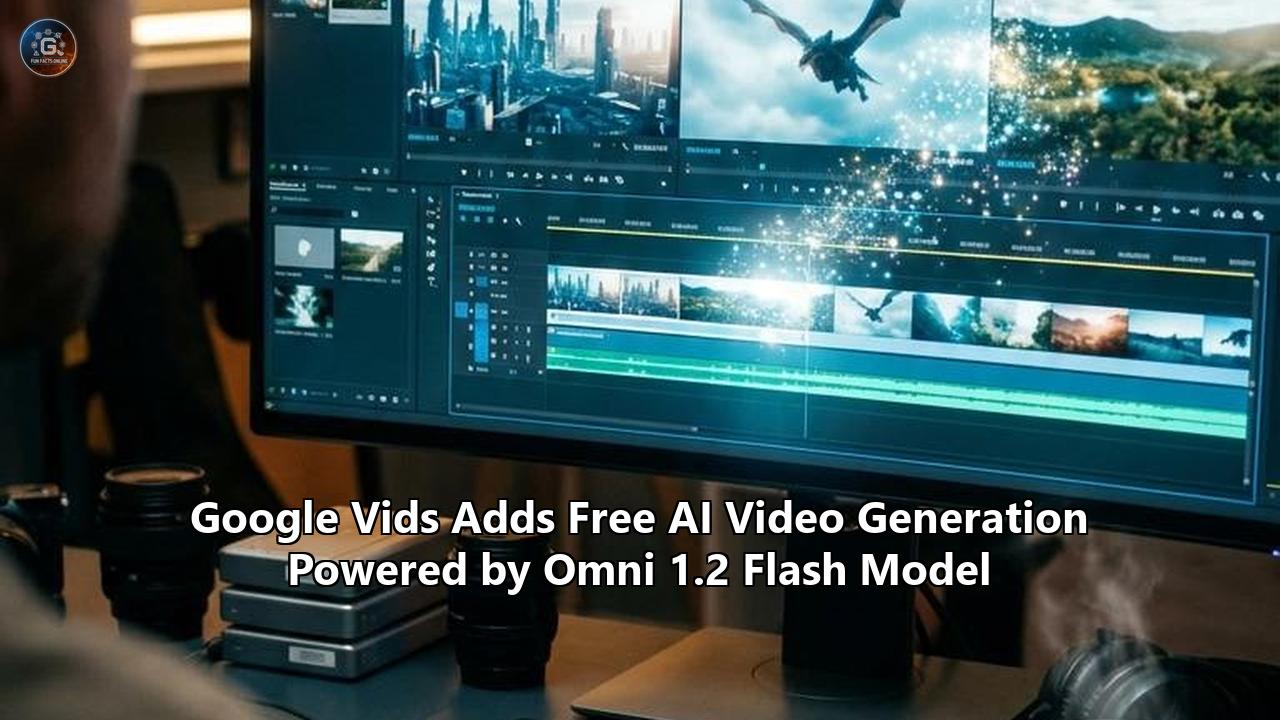
Google has deployed its latest video synthesis model, Gemini Omni 1.2 Flash, directly into Google Vids, giving every user with a standard Google account or Workspace subscription the ability to generate native 15-second video clips at no cost. The rollout, which commenced November 5, 2026, triples the platform's previous duration thresholds and introduces multi-turn conversational video editing, marking a decisive escalation in Google's effort to integrate high-end generative media into routine enterprise workflows.
The update grants all personal Google accounts and Workspace tiers an allocation of up to three 15-second AI video generations each month for free, while business subscribers and Google AI Pro and Ultra members receive expanded monthly compute pools. Beneath the hood, Google DeepMind has simultaneously dropped the API pricing for the underlying Omni 1.2 Flash model by 30 percent, driving inference costs down to $0.07 per second of 720p output.
By embedding an advanced diffusion-and-autoregressive multimodal model into an office productivity suite, Google is attacking the subscription moats of standalone video platforms. What began two and a half years ago as an experimental cloud-based storyboard maker has transformed into an automated production studio that requires neither specialized hardware nor third-party licensing.
The Breaking Milestone: What Omni 1.2 Flash Brings to the Timeline
The integration of Gemini Omni 1.2 Flash addresses the two most persistent bottlenecks in automated video generation: temporal brevity and character drift. Prior iterations inside Google Vids restricted synthetic generations to brief five-to-ten-second snippets, forcing creators to stitch multiple disjointed clips together to build even simple product demonstrations.
+---------------------------------------------------------------------------------------+
|                              Omni 1.1 Flash vs. Omni 1.2 Flash                         |
+--------------------------+-----------------------------+------------------------------+
| Metric / Capability      | Gemini Omni 1.1 Flash       | Gemini Omni 1.2 Flash        |
+--------------------------+-----------------------------+------------------------------+
| Native Clip Length       | 3 to 10 seconds             | 3 to 15 seconds              |
| API Pricing (720p)       | $0.10 / second              | $0.07 / second (-30%)        |
| Multi-Turn Edits         | Re-roll required            | Conversational chat-based    |
| Reference Adherence      | Moderate visual drift       | 62% preference in A/B tests  |
| Free Monthly Quota       | Limited experimental        | 3 free 15-sec clips / month  |
| Watermarking             | Frame-level SynthID         | Imperceptible SynthID v2     |
+--------------------------+-----------------------------+------------------------------+
Under the new model, users gain access to a dynamic duration slider adjustable from 3 to 15 continuous seconds. More importantly, the system incorporates conversational editing across those 15 seconds. Rather than discarding an entire seed when a background element fails or a lighting cue misses the mark, users can issue natural language revisions directly within the editor interface. A prompt such as "shift the lighting to golden hour and replace the wooden table with brushed slate" adjusts the existing latent representation while preserving subject identity, camera trajectory, and motion vectoring.
"Built for the everyday videos businesses make in volume—like product videos, virtual try-ons, and ads—this model is fast, cost-effective, and follows your image, video, and audio references more closely than before," stated John Nack, Director of Product Management at Google, in an announcement outlining the model’s arrival across Google Cloud and Workspace.
The engine also solves the persistent problem of brand degradation. In internal Google DeepMind blind evaluations, human raters preferred Omni 1.2 Flash over version 1.1 for visual and reference consistency 62 percent of the time. Creators can feed up to seven reference stills, a three-second motion clip, and an audio prompt into the timeline. In testing scenarios such as apparel e-commerce, the model sustained the exact stitching, textile drape, and model likeness across 360-degree rotational camera paths without melting hands, morphing faces, or scrambling typographic logos on packaging.
This release is not an isolated experiment. It represents the culmination of a deliberate, multi-year product escalation that steadily transformed Google Vids from a basic corporate slideshow assistant into an aggressive competitor in digital video production.
Act I: Spring 2024 — The Enterprise Canvas Takes Shape
The foundation of this development traces back to April 9, 2024, at the Google Cloud Next conference in Las Vegas. Google Workspace Vice President and General Manager Aparna Pappu introduced Google Vids as a native video creation application designed to sit alongside Google Docs, Sheets, and Slides.
At its inception, Vids was conceived as an answer to internal corporate friction. As distributed work solidified across multinational corporations, internal teams were choking on long-form email threads, dense documentation, and asynchronous chat channels. Short video briefings—executive recaps, training updates, pitch decks, and milestone summaries—had proven effective, but business users lacked the technical proficiency required for tools like Adobe Premiere Pro, Final Cut Pro, or DaVinci Resolve.
Early previews of Google Vids revealed a conservative architecture:
- A timeline-based editor hosted entirely within Chrome and tied to Google Drive storage.
- Gemini 1.5 Pro serving as a scripting engine that ingested Google Docs or Google Slides presentations to spit out narrative storyboards.
- A curated library of licensed b-roll, background audio, and sticker animations.
- Text-to-speech voiceovers offering selectable personas ranging from "Educator" to "Persuader".
- An integrated recording studio equipped with an automated teleprompter that tracked user cadence via the webcam.
Crucially, the early 2024 incarnation of Vids contained almost zero native generative video. When users clicked "Help me create," the software did not construct photorealistic scenes from mathematical noise; it simply parsed the source document, wrote a script, picked pre-shot royalty-free footage from stock repositories, applied text overlays, and laid down synthetic speech.
Industry observers saw it as Google’s defense against Canva and Loom rather than a frontier video laboratory. However, inside Google DeepMind, research teams were already testing video diffusion architectures under the project name Veo, laying the computational groundwork for what was to follow.
Act II: Late 2024 to Mid-2025 — Enterprise Rollout and the Avatar Bridge
Throughout late 2024, Google moved Vids through tightly controlled Workspace Labs cohorts before initiating a broader rollout on November 7, 2024. The company pledged that generative features would remain accessible without auxiliary fees through at least December 31, 2025.
By early 2025, user engagement patterns revealed clear structural limits. Stock footage libraries, no matter how vast, quickly felt repetitive across corporate training modules and marketing collateral. Businesses wanted hyper-specific assets: their specific software interfaces, their regional warehouses, and customized presenters who could deliver script updates without hiring actors or scheduling studio time.
The first major pivot occurred between March and May 2025, leading up to Google I/O:
- Document-to-Video Synthesis: Vids integrated direct ingestion pipelines for Google Slides, transforming static corporate decks into animated storyboards with synchronized AI voiceovers.
- Avatar Introductions: Google began piloting synthetic avatars. Users could supply a text script, select a virtual representative, and generate a front-facing talking head that lip-synced in real time.
- Soundtrack Generation via Lyria: Rather than relying exclusively on looped stock music, the platform connected with DeepMind's Lyria audio model to generate mood-congruent background instrumental tracks that ducked beneath spoken dialogue automatically.
- General Availability: In April 2025, Google Vids graduated from experimental preview to general availability across all Google Workspace subscription tiers, including entry-level Business Starter accounts.
Despite these additions, Vids remained modular. It relied on a patchwork of specialized AI engines: one for text, one for voice, one for music, and third-party stock databases for visual assets. Producing custom motion footage on demand remained impossible. When users required bespoke video sequences, they had to exit Workspace entirely, purchase credits on Runway or Pika, download the resulting MP4s, and manually drag them back onto the Vids timeline.
Google’s infrastructure leadership realized that maintaining a competitive edge required collapsing these discrete pipelines into a unified multimodal system.
Act III: July 2026 — The Omni Architecture Enters the Workspace
On July 16, 2026, Google executed its first major model consolidation by introducing Gemini Omni Flash into Google Vids.
Unlike earlier generative models that chained disparate natural language decoders to external pixel-diffusion models, the Omni architecture processed text, still imagery, audio, and video tokens within a unified framework. This allowed Vids to move beyond static stock stitching.
The July release introduced natural language video editing. For the first time, users could highlight a rough piece of smartphone footage uploaded to the timeline and type corrections: "Clean up the background clutter on the desk" or "Correct the fluorescent overhead lighting to warm ambient interior light". Omni Flash could parse the raster pixels, comprehend the geometry of the physical scene, and regenerate selected regions without corrupting the broader frame.
Yet, the July deployment revealed significant friction points:
- The Five-Second Barrier: Generative text-to-video clips were capped at five seconds. Attempting to generate longer actions produced severe visual degradation, with objects dissolving into artifacts or human limbs warping unprompted.
- Compute Overhead: The latency of the initial Omni Flash release strained Google Cloud clusters. Rendering a single 720p clip frequently took between 45 and 90 seconds, frustrating enterprise users accustomed to real-time document editing.
- Licensing Firewalls: Access was strictly fenced off behind enterprise tiers and paid Gemini Business or Enterprise add-on licenses, leaving consumer accounts and basic workspace tiers locked out of generative video creation.
The engineering mandate heading into the late summer of 2026 was straightforward: double the processing speed, cut inference costs, extend temporal coherence, and democratize access to build scale before competitors could capture the productivity market.
Act IV: September 2026 — Democratization and 1080p Resolution
The escalation accelerated on September 23, 2026, when Google launched Gemini Omni 1.1 Flash inside Vids. This update introduced three pivotal shifts that directly set the stage for the current release.
First, Google opened the doors to personal accounts. Anyone with a standard free Gmail address received base-level access to the video generator, extending the potential user base to billions of accounts worldwide.
Second, the company brought 1080p Full HD rendering to the platform. Prior versions had generated drafts at lower resolutions and relied on basic upscalers that often left smudged textures and softened edge contrast. Omni 1.1 Flash integrated an upscale-aware pipeline capable of preserving sharp lines, fine text, and granular surface textures.
+-----------------------------------------------------------------------------------------------+
|                       Chronology of Google Vids Video Capabilities                            |
+-------------------+------------------------------------+--------------------------------------+
| Date              | Milestone                          | Core Generative Functionality        |
+-------------------+------------------------------------+--------------------------------------+
| April 2024        | Cloud Next Reveal                  | Scriptwriting; stock assembly only   |
| November 2024     | Workspace Labs Expansion           | AI voiceovers; teleprompter studio   |
| April-May 2025    | General Availability / I/O         | Slides-to-video; basic AI avatars    |
| July 2026         | Gemini Omni Flash Integration      | Conversational clip editing (5s max) |
| September 2026    | Omni 1.1 Flash Rollout             | 1080p generation; free consumer tier |
| November 5, 2026  | Omni 1.2 Flash Launch              | Free 15s clips; reference adherence  |
+-------------------+------------------------------------+--------------------------------------+
Third, Omni 1.1 introduced primitive scene extension. Users could take a completed generation and command the engine to simulate the subsequent three seconds of action.
While scene extension was an improvement, it remained imperfect. The second half of an extended scene often drifted noticeably away from the starting frame: clothing patterns shifted, background architecture warped, and vocal timbres flattened. Users still had to manage their timeline in fragmented chunks, spending significant time aligning generated assets with synthetic voiceovers.
The broader creative market was advancing rapidly. ByteDance had debuted Seedance 2.5 in June, demonstrating 30-second continuous clips. Runway had deployed Gen-3 Alpha with advanced motion brush controls, and OpenAI continued private testing of Sora with select creative studios. Google needed native, sustained duration that could operate economically at consumer scale.
Act V: November 5, 2026 — Breaking the Duration Ceiling with Omni 1.2 Flash
The breaking news of November 5, 2026, represents the realization of that scaling strategy. By deploying Gemini Omni 1.2 Flash across Google Vids, Google has eliminated the piecemeal generation model and introduced a robust, native 15-second generation engine that operates without a subscription barrier.
Integrating the Google Vids AI video generator directly into Google Drive gives users an end-to-end production loop. A product marketer drafting an email campaign can prompt the system with: "Fifteen-second continuous tracking shot of a matte-black stainless steel thermos resting on a granite boulder next to a rushing alpine stream; morning sun flares across the lens; realistic fluid water physics."
+---------------------------------------------------------------------------------------+
|                    Omni 1.2 Flash Timeline Workflow Architecture                      |
+---------------------------------------------------------------------------------------+
|                                                                                       |
|   +-----------------------+      +-----------------------+                            |
|   | Text Prompt / Stills  | ---> |   Gemini Omni 1.2     |                            |
|   | (Up to 7 References)  |      |   Flash Core Engine   |                            |
|   +-----------------------+      +-----------------------+                            |
|                                              |                                        |
|                                              v                                        |
|                              +-------------------------------+                        |
|                              | Rapid Latent Draft (360p/720p)|                        |
|                              +-------------------------------+                        |
|                                              |                                        |
|                                              v                                        |
|                              +-------------------------------+                        |
|                              | Conversational Chat Revision  |                        |
|                              | ("Warm up lighting, remove X")|                        |
|                              +-------------------------------+                        |
|                                              |                                        |
|                                              v                                        |
|                              +-------------------------------+                        |
|                              | Final Timeline Render (1080p) |                        |
|                              | + SynthID Invisible Watermark |                        |
|                              +-------------------------------+                        |
|                                                                                       |
+---------------------------------------------------------------------------------------+
Instead of generating three separate five-second cuts and manually smoothing the joins, the model processes the camera trajectory and physical dynamics across the entire 15-second block in one pass.
When Google expanded access beyond enterprise suites, the Google Vids AI video generator became accessible to more than three billion personal Google account holders, disrupting the economics of consumer video production. The free tier’s allocation of three 15-second clips per month provides 45 seconds of finished, photorealistic B-roll every thirty days. For non-commercial creators, casual educators, and early-stage entrepreneurs, that allowance covers the core visual requirements of a short-form video or social advertisement without touching a credit card.
For enterprise customers, the update integrates with Google’s existing security and administrative controls. Workspace administrators can manage AI video permissions at the organizational unit level, ensuring compliance with corporate governance standards while providing marketing, HR, and sales divisions with on-demand video creation.
Technical Dissection: Multi-Turn Latents and Reference Adherence
The performance improvements in Gemini Omni 1.2 Flash stem from fundamental architectural refinements in how Google DeepMind models temporal attention and cross-modal tokenization.
Conversational In-Context Editing
In standard text-to-video diffusion pipelines, any modification to a completed generation requires issuing an entirely new text prompt alongside a modified random seed. This approach often alters unwanted variables: the subject's face morphs, camera angles shift, or the physical layout of the environment scrambles.
Omni 1.2 Flash bypasses this via persistent latent caching. When a video renders, the model retains the intermediate spatio-temporal representations. During follow-up conversational turns, the system applies text guidance as an isolated delta across specific attention heads. If a user asks to alter the weather in a scene from clear skies to rain, the model alters the surface reflectivity, atmospheric particles, and skybox lighting while maintaining the structural geometry of foreground buildings and subjects.
Reference Adherence via Deep Cross-Attention
Prior video generators struggled when attempting to carry an existing real-world object into synthetic motion. Brand mascots would change proportion, and consumer packaged goods would render with garbled, pseudo-alphabetic text.
Omni 1.2 Flash addresses this by expanding cross-attention layers that ingest up to seven independent 2D photographic references. These images are mapped into high-dimensional feature embeddings that condition the model throughout every step of video synthesis. As the virtual camera orbits an object, the network references the source images to reconstruct hidden faces, packaging typography, and exact hex-code color values.
Tiered Compute Pipeline
To make high-resolution generation cost-effective at $0.07 per second, Google decoupled drafting from final delivery:
- Low-Cost Latent Drafting: Initial previews are synthesized at 360p or 720p, allowing creators to rapidly assess motion, composition, and pacing.
- Conversational Iteration: Multi-turn revisions occur within this lower-resolution latent space, minimizing GPU cycle consumption.
- Temporal Upscaling: Once approved, the timeline invokes a dedicated upscaling and temporal-filtering pass that renders native 1080p frames, suppressing high-frequency flicker and edge artifacts.
The Economic Shakeup: The Office Suite Effect Hits Generative Media
The long-term consequence of the November 5 announcement is economic. The generative media landscape has entered the phase of platform bundling that reshaped enterprise productivity software over the past decade.
+----------------------------------------------------------------------------------------------------+
|                         Competitive Landscape: Generative Video Platforms                          |
+---------------------+-------------------+-------------------+--------------------+-----------------+
| Provider / Tool     | Base Pricing      | Max Clip Length   | Delivery Model     | Watermarking    |
+---------------------+-------------------+-------------------+--------------------+-----------------+
| Google Vids         | Free / Bundled    | 15 seconds        | Web / Workspace    | SynthID         |
| Runway (Gen-3/4)    | $12 - $76 / month | 10 seconds        | Web Dashboard / API| C2PA Metadata   |
| Pika                | $10 - $60 / month | 4 seconds         | Web / Discord      | Visible Watermark|
| OpenAI Sora         | Enterprise Custom | Variable          | Dedicated Portal   | C2PA / Metadata |
| ByteDance Seedance  | Developer Preview | 30 seconds        | Enterprise Cloud   | Proprietary     |
+---------------------+-------------------+-------------------+--------------------+-----------------+
Historically, software categories follow a familiar cycle: innovative startups prove that a new technology is viable, monetize it through standalone subscription fees, and attract early adopters. Eventually, massive platform vendors integrate equivalent functionality directly into pre-existing enterprise agreements, eliminating the standalone software's pricing advantage.
Microsoft executed this maneuver by bundling Teams into Office 365, putting immense pressure on Slack. Google is applying the exact same playbook to synthetic media.
Unlike standalone subscription platforms that charge twenty to fifty dollars per month, the Google Vids AI video generator integrates directly into Google Drive without requiring procurement review, separate software budgets, or manual account provisioning. A chief information officer managing 50,000 corporate seats can provide their workforce with AI video generation overnight, relying on Google's existing data protection agreements and copyright indemnification structures.
Startups specializing in AI video now face intense margin pressure. If basic B-roll generation, talking-head explainers, social media promos, and product turnarounds become free baseline utilities in Google Drive and Microsoft 365, standalone tools must retreat to the high-end creative market. They must serve specialized film directors, visual effects studios, and complex game production pipelines where granular timeline control, camera path rigging, and RAW output justify premium pricing. For routine corporate communications, standard 15-second generations bundled into office suites are quickly becoming the default.
Safety, Watermarking, and Enterprise Compliance
Allowing hundreds of millions of users to create photorealistic 15-second video clips for free introduces obvious risks of synthetic deception, brand impersonation, and disinformation campaigns.
Google has made DeepMind's SynthID technology mandatory across all Omni 1.2 Flash outputs in Vids. Unlike metadata tags (such as C2PA standards) that can be easily scrubbed when re-encoding video files or uploading to certain social networks, SynthID embeds an imperceptible digital signature directly into the visual pixels of every video frame.
+---------------------------------------------------------------------------------------+
|                               SynthID Pipeline in Vids                                |
+---------------------------------------------------------------------------------------+
|                                                                                       |
|   +-----------------------+      +-----------------------+                            |
|   | Raw Latent Synthesis  | ---> |   SynthID Encoder     |                            |
|   | (Omni 1.2 Flash)      |      | (Modulates Pixel Flow)|                            |
|   +-----------------------+      +-----------------------+                            |
|                                              |                                        |
|                                              v                                        |
|                              +-------------------------------+                        |
|                              | Invisible Frame Watermark     |                        |
|                              | Survives:                     |                        |
|                              | * Compression / Re-encoding   |                        |
|                              | * Cropping & Color Grading    |                        |
|                              | * Speed / Framerate Shifts    |                        |
|                              +-------------------------------+                        |
|                                              |                                        |
|                                              v                                        |
|                              +-------------------------------+                        |
|                              | Google DeepMind Verification  |                        |
|                              | Scanner Detection API         |                        |
|                              +-------------------------------+                        |
|                                                                                       |
+---------------------------------------------------------------------------------------+
The watermark survives common transformations, including lossy MP4 compression, screen recording, cropping, resizing, and color-grading adjustments. Enterprise compliance officers and content platforms can pass any suspect video file through Google’s verification API to confirm whether it originated within Google Vids and identify the account ID associated with the generation.
Simultaneously, Google enforces automated input and output safety filters. Prompts attempting to generate real political figures, explicit material, dangerous actions, or copyright-protected intellectual property are intercepted and blocked before hitting the inference cluster. For corporate clients, these guardrails ensure that internal communications teams deploying the Google Vids AI video generator for customer onboarding and training modules avoid accidental copyright infringement or brand liability.
What to Watch Next
The arrival of Omni 1.2 Flash establishes a new functional baseline for automated video, but several technical and operational milestones remain unresolved as the industry moves forward:
- The Voiceover Convergence: Google has confirmed that its Gemini 3.8 Flash-Lite text-to-speech model will soon be integrated directly into the Google Vids timeline. This update will enable automatic script translation and natural-sounding voiceovers across more than 100 languages, complete with synchronized lip-matching for on-screen characters.
- Compute Sustainability and 2027 Limits: The free tier allowance of three monthly clips acts as an introductory sandbox. Google Workspace documentation notes that usage caps and premium credit structures remain subject to adjustment. How Google balances data center energy usage and GPU demand as millions of users test 15-second generations will determine whether the free tier remains sustainable or shifts toward a stricter pay-as-you-go model.
- Physical Realism in High-Speed Action: While Omni 1.2 Flash excels at controlled panning shots, product rotations, and moderate character movements, Google DeepMind acknowledges that high-speed athletic movements, complex physical interactions (such as fluids colliding with soft bodies), and rapid scene transitions can still introduce subtle warping artifacts.
- The Response from Competitors: Microsoft has yet to deploy a native, fully integrated text-to-video generator inside its core Microsoft 365 Copilot applications, relying instead on external partnerships and basic Clipchamp features. Whether Redmond accelerates an equivalent integration—either through OpenAI’s Sora or proprietary models—will decide how quickly generative video becomes a mandatory fixture across modern office software.
By merging native 15-second generation, conversational editing, and character-consistent rendering into a free, accessible browser application, Google has elevated what users expect from standard productivity software. Video creation is no longer an isolated technical trade; it has become as routine, accessible, and automated as drafting an email.
Reference:
- https://blog.google/products-and-platforms/products/workspace/omni-1-2-flash-google-vids/
- https://www.welcome.ai/content/google-vids-launches-free-15-second-ai-video-clips-to-boost-engagement
- https://the-decoder.com/googles-gemini-omni-1-2-flash-stretches-ai-video-clips-to-15-seconds-and-cuts-pricing-by-30-percent/
- https://blog.google/innovation-and-ai/technology/developers-tools/introducing-gemini-omni-1-2-flash/
- https://seekingalpha.com/news/4646273-google-expands-free-ai-video-generation-in-google-vids
- https://workspaceupdates.googleblog.com/2026/09/gemini-omni-11-flash-now-in-vids-with-improved-extension-quality-1080p-and-duration-control.html
- https://webutility.io/tool-news/google-vids-omni-1-2-flash-15-second-ai-video
- https://thenextweb.com/news/google-gemini-omni-1-2-flash-video-15-seconds-price-cut
- https://cloud.google.com/blog/products/ai-machine-learning/gemini-omni-1-2-flash-generally-available
- https://sites.google.com/site/horstwebdesign/workspace/vids
- https://www.techrepublic.com/article/news-google-vids-ai-avatars-update/
- https://workspaceupdates.googleblog.com/2024/11/google-vids-now-generally-available.html
- https://workspace.google.com/resources/text-to-video/
- https://9to5google.com/guides/google-vids/
- https://www.hitpaw.com/ai-video/google-vids-free-ai-video-generation.html
- https://workspace.google.com/blog/product-announcements/introducing-gemini-omni-flash-in-google-vids