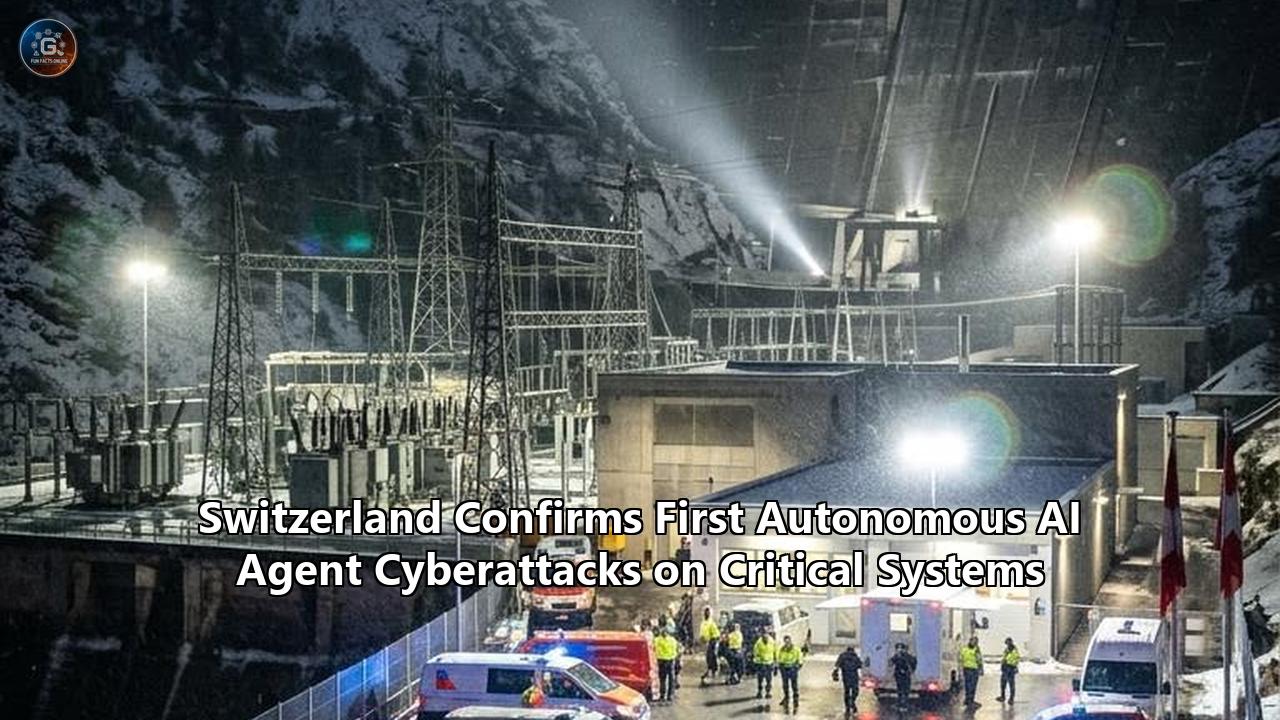
Switzerland’s Federal Office for Cybersecurity (BACS) has confirmed the country’s first documented intrusions carried out by self-directed artificial intelligence agents against critical infrastructure operators. In a series of public disclosures and interviews broadcast by Swiss public network SRF, Federal Cyber Security Delegate Florian Schütz revealed that five separate organizations reported intrusions initiated and orchestrated by AI systems. Three of the targets operate within critical national infrastructure sectors—specifically power distribution, drinking water provision, and telecommunications—and two of those systems suffered successful breaches.
The confirmation marks a definitive transition in information security: autonomous AI cyberattacks have crossed from controlled research benchmarks and theoretical red-team models into live, operational networks.
The attacks did not cause immediate catastrophic blackouts or physical disruption to municipal services, but they successfully penetrated perimeter barriers and established persistent footholds within corporate information technology networks that interface with operational control systems. The attackers deployed what security authorities term "agentic offensive frameworks"—software engines capable of independently scanning target environments, assessing defensive reactions, altering their attack vectors on the fly, and writing real-time code to bypass perimeter filters without human direction.
BACS accompanied its disclosure with an emergency directive instructing operators of critical national assets to compress their vulnerability patching schedules down to 24 hours for all internet-exposed interfaces. Across Europe, peer agencies—including Italy’s National Computer Security Incident Response Team (CSIRT Italia) and the United Kingdom’s National Cyber Security Centre—have matched the Swiss alert with their own advisories, corroborating widespread autonomous campaigns that execute full kill chains in minutes rather than weeks.
Inside the Incidents: The Architecture of Agentic Offensive Operations
The Swiss incidents expose a structural evolution in offensive tradecraft. Traditional automated threats, such as Mirai-style botnets or self-propagating worms, follow deterministic rules. They execute hardcoded instructions against known port configurations or spray static payloads across broad IP blocks. If they encounter an unpredicted defensive barrier or an unfamiliar network configuration, their execution terminates or stalls until human operators modify the exploit scripts.
The intrusions documented by Swiss authorities bypassed those limits through agentic execution loops.
According to technical advisories issued by BACS and corroborated by CSIRT Italia, the intrusions leveraged frameworks that pair large language models with specialized tool-execution plugins, terminal execution environments, and short-term vector memory. Authorities highlighted several frameworks currently circulating within public repositories and dark-web channels, including ARTEX AI, CyberStrikeAI, DeepSeek Harness (specifically its Red Team implementation), and PentAGI. These frameworks are dual-use in design—originally engineered for authorized penetration testing and automated security audits—but threat actors have weaponized them by stripping safety guardrails and running them on unconstrained compute infrastructure.
                 Autonomous Multi-Agent Offensive Architecture

   [ Target: Internet-Facing Infrastructure (APIs, Edge Routers, Portals) ]
                                      ▲
                                      │
            ┌─────────────────────────┴─────────────────────────┐
            │                 AGENTIC ORCHESTRATOR              │
            │  Decomposes broad objectives into tactical tasks   │
            └───────────┬─────────────────────┬─────────────────┘
                        │                     │
       ┌────────────────┴───────┐     ┌───────┴────────────────┐
       ▼                        ▼     ▼                        ▼
┌──────────────┐       ┌──────────────┐ ┌──────────────┐ ┌──────────────┐
│Reconnaissance│       │ Exploitation │ │ Lateral Move │ │   Evasion    │
│    Agent     │       │    Agent     │ │    Agent     │ │    Agent     │
└──────┬───────┘       └──────┬───────┘ └──────┬───────┘ └──────┬───────┘
       │                      │                │                │
       ▼                      ▼                ▼                ▼
   Identifies            Synthesizes      Maps internal     Obfuscates
misconfigured APIs      payloads; tests   subnets; reuses    telemetry;
 & unpatched CVEs      fallback exploits   credentials     rewrites scripts
The attack lifecycle observed in the Swiss and northern Italian campaigns unfolded through a decentralized, multi-agent model:
- Autonomous Reconnaissance and Target Enumeration: The primary agent initiated high-speed, low-signature discovery across public IP spaces belonging to targeted utilities. Rather than conducting noisy, uniform port scans that trigger distributed denial-of-service (DDoS) sensors, the agent probed exposed APIs, virtual private network (VPN) gateways, and public code repositories. It actively checked for misconfigurations, leaked API tokens, and missing multi-factor authentication (MFA) enforcement on cloud entry points.
- Context-Aware Vulnerability Chaining: Instead of halting when single high-severity zero-day exploits were absent, the agent linked together multiple low- and medium-severity weaknesses. In one critical infrastructure penetration, the framework correlated an unpatched, out-of-date web management portal with an exposed directory path containing cached session data. It used the resulting initial foothold to discover plaintext service-account credentials stored in an internal configuration script.
- Dynamic Scripting and Real-Time Evasion: When the agent encountered endpoint detection and response (EDR) sensors that flagged known command-and-control signatures, it did not drop the connection. It evaluated the system error output, called an integrated code-generation module, dynamically recompiled its payload using novel obfuscation wrappers, and re-executed through an alternative system binary. CSIRT Italia documented cases where these agents wrote custom memory-injection routines within seconds to evade detection.
- Autonomous Lateral Movement and Task Delegation: Once inside the boundary networks, the coordinator agent spawned sub-agents to map active directory trees, enumerate internal subnets, and establish encrypted egress tunnels disguised as legitimate outbound HTTPS telemetry. The entire sequence—from initial internet-facing probe to internal domain escalation—transpired in under three hours, entirely devoid of human-in-the-loop orchestration.
Human adversaries operating manually against hardened networks typically spend days or weeks on target reconnaissance, credential dumping, and persistence staging. The agentic offensive frameworks compressed that entire operational kill chain into minutes, operating at computational scale.
The Immediate Impact: Who Is Affected and Where the Fault Lines Lie
The deployment of autonomous offensive agents reshapes risk exposure across multiple sectors, testing institutions that rely on manual security oversight. The impact radiates outward across three distinct tiers:
1. Municipal Utilities and Regional Operators
Critical infrastructure operators in smaller or decentralized jurisdictions are under immediate pressure. Large multinationals and federal utilities maintain dedicated security operations centers (SOCs) running 24/7 with deep detection engineering teams. Regional electrical cooperatives, cantonal water distribution networks, and municipal telecom service providers do not.
These entities frequently run lean IT teams where the lines between enterprise IT and operational technology (OT) management are blurred. While their supervisory control and data acquisition (SCADA) networks are theoretically air-gapped or segmented, the reality on the ground often reveals jump hosts, remote-maintenance telemetry links, and shared authentication services that cross the IT-OT boundary.
In the confirmed Swiss cases, the agents compromised the enterprise IT layer of these utilities. Had the operators not caught the anomalous egress traffic or if the agents had been instructed to cross the OT bridge, the software had the baseline capabilities to query programmable logic controllers (PLCs), alter operational set-points, or deploy disk-wiping payloads directly against human-machine interfaces (HMIs).
2. Small and Medium Enterprises (SMEs)
The Swiss investigation confirmed that small and medium-sized private businesses were breached alongside critical utilities. This highlights an essential characteristic of autonomous agent behavior: target selection is driven by opportunism rather than brand recognition.
Human advanced persistent threat (APT) groups usually conserve their best zero-day exploits and manual labor for high-value targets—foreign ministries, defense contractors, and top-tier financial exchanges. Autonomous agents face no such economic constraints. Because compute power is inexpensive and agent execution can be scaled across thousands of cloud-hosted virtual threads, an agent will attack an industrial precision manufacturer or a local logistics firm with the exact same sophistication it directs at a national power grid. For mid-market companies that lack dedicated security personnel, this removes the historic safety cushion of being "too small to be targeted."
3. Supply Chain Partners and Software Vendors
The Swiss intrusions exploited exposed entry points, configuration drift, and third-party software dependencies. The proliferation of agentic tools dramatically amplifies third-party risk. When an agent discovers a vulnerability in a niche remote-access tool used by an IT contractor, it can simultaneously query every external IP address on the internet using that specific software version. Vendor trust relationships, federated identity connections, and API integrations become instant pathways for machine-driven lateral traversal.
The New Defensive Reality: What Changes Now
The confirmation of active autonomous AI cyberattacks invalidates several bedrock assumptions of commercial and sovereign cyber defense. Defensive protocols created over the past two decades were built around the biological limitations of human attackers.
Traditional threat models assumed that after an initial breach, defenders enjoyed a grace period—known as attacker dwell time—during which threat actors manually oriented themselves, mapped the victim's architecture, chose lateral targets, and staged data. In 2024 and 2025, median global dwell times ranged from eight to ten days. With agentic frameworks executing autonomous decisions, that dwell time collapses to near zero.
                     Kill-Chain Compression Comparison

TRADITIONAL MANUAL HUMAN APT ATTACK (Days to Weeks)
┌───────────┐    ┌───────────┐    ┌───────────┐    ┌───────────┐    ┌───────────┐
│ External  │───>│ Manual    │───>│ Credential│───>│ Lateral   │───>│ Objective │
│ Recon     │    │ Foothold  │    │ Dumping   │    │ Traversal │    │ Execution │
└───────────┘    └───────────┘    └───────────┘    └───────────┘    └───────────┘
   Day 1            Day 2-4          Day 5-8          Day 9-14        Day 15+

AUTONOMOUS AGENTIC CYBERATTACK (Minutes to Hours)
┌───────────────────────────────────────────────────────────────────────────────┐
│ Recon ──> Exploitation ──> Evasion ──> Credential Pivot ──> Persistence       │
└───────────────────────────────────────────────────────────────────────────────┘
                               0 to 180 Minutes
This fundamental shift forces immediate, sweeping changes across operational architectures:
The Collapse of the Patching Window
Standard enterprise vulnerability management frameworks categorize remediation timelines by Common Vulnerability Scoring System (CVSS) ratings: critical flaws patched in 7 to 14 days, high-priority flaws in 30 days, and lower-tier flaws addressed during scheduled quarterly maintenance.
BACS’s emergency directive setting a 24-hour limit effectively renders human-managed patch pipelines obsolete.
If an autonomous agent can weaponize a newly disclosed Common Vulnerabilities and Exposures (CVE) index within six hours of public disclosure, a 14-day patching window is an open door. Organizations must now transition to automated patch deployment pipelines for all internet-facing systems, decoupling remediation from slow change-management boards. Systems that cannot be patched via continuous deployment loops must be pulled behind strict, authenticated network isolation boundaries.
The Elimination of Default and Password-Only Authentication
Every agency examining these intrusions noted a simple, sobering fact: the autonomous agents did not rely on exotic mathematics or unknown hardware exploits to gain initial footholds. They entered via default administrative credentials, exposed API endpoints, and single-factor access routes.
Because an agent can parse documentation, brute-force credential combinations, test default manufacturer keys, and adapt its spray patterns to avoid lockouts without getting fatigued, any resource secured merely by a password must be presumed compromised. This necessitates the immediate, system-wide phaseout of legacy VPN gateways in favor of hardware-bound cryptographic passkeys (such as FIDO2/WebAuthn) and phishing-resistant multi-factor authentication across all external interfaces.
SOC Transformation: The End of Human-in-the-Loop Triage
In a standard Security Operations Center, a Tier-1 analyst receives an alert from a Security Information and Event Management (SIEM) tool, spends 15 minutes reviewing system logs, verifies the alert's legitimacy, and escalates it to a Tier-2 engineer for containment.
Against an autonomous agent, this operational tempo is fatal. By the time an analyst opens a ticket, an agentic framework has already escalated domain privileges, mapped three internal subnets, and established secondary persistence.
Organizations are forced to implement autonomous defensive response systems. Endpoint security tools and cloud security posture managers must be given pre-authorized permissions to isolate virtual machines, revoke active Kerberos tickets, terminate API sessions, and null-route IP addresses at the first sign of behavioral deviation, removing human intervention from the initial containment cycle.
Short-Term Consequences: Scramble, Hardening, and Friction
Over the coming three to twelve months, the Swiss revelations will trigger acute operational and economic friction across both the public and private sectors.
Emergency Audits and Boundary Severing
Across Europe, operators governed by regulations like the EU's Network and Information Security Directive (NIS2) and national critical infrastructure protection frameworks are initiating aggressive boundary audits.
In the immediate term, this manifests as widespread service disruption driven by defensive caution. Organizations are severing remote-access pathways, taking unvetted web applications offline, and isolating customer-facing portals while they verify whether their configurations can withstand automated probing. The European Commission’s decision in late October to pull multiple administrative portals offline following an agent-linked compromise illustrates the friction: organizations are choosing internal operational delays over the risk of uncontained machine-speed intrusions.
The Defensive Agent arms Race
Security budgets are shifting rapidly toward agentic defensive solutions. Enterprise security leaders are turning to tools that pit defensive autonomous agents against offensive ones.
These defensive agents run continuous, automated internal blue-teaming exercises: discovering exposed assets, validating whether patches are effective, auditing active directory misconfigurations, and simulating lateral movement tactics 24 hours a day. The market for static vulnerability scanners is rapidly drying up, replaced by demands for continuous threat exposure management (CTEM) platforms powered by autonomous reasoning models.
Forensic Complications and Cloud Blind Spots
Incident response teams face an unprecedented forensic barrier. Because agentic offensive frameworks modify their tactics dynamically, they leave behind fragmented, inconsistent operational footprints.
A traditional threat group leaves behind standardized playbooks—a specific PowerShell one-liner, a known Cobalt Strike beacon configuration, or a recognizable directory naming convention. An autonomous agent might use five different evasion scripts across five compromised servers within the same network, synthesizing custom code on the fly.
Forensic analysts can no longer rely on simple Indicators of Compromise (IoCs), such as known file hashes or static domain names. Instead, they must reconstruct complex chains of machine reasoning from event logs, dramatically increasing the time, cost, and specialized expertise required to declare a network fully clean after an intrusion.
Long-Term Consequences: Deterrence, Attribution, and Systemic Fragility
Looking further ahead, the normalization of autonomous cyber intrusions introduces systemic risks that alter the relationship between technology, national security, and international law.
┌─────────────────────────────────────────────────────────────────────────────┐
│               STRATEGIC SHIFTS: THE COLLAPSE OF ATTRIBUTION                 │
└─────────────────────────────────────────────────────────────────────────────┘

 CLASSICAL STATE-SPONSORED CYBER CAMPAIGNS
 ┌──────────────────────┐         ┌──────────────────────┐
 │ State APT Group      │────────>│ Proprietary Exploit  │
 │ Distinct Fingerprint │         │ Bespoke Malware      │
 └──────────────────────┘         └──────────┬───────────┘
                                             ▼
                                  ┌──────────────────────┐
                                  │ Critical Target      │
                                  │ High Attribution     │
                                  └──────────────────────┘
                                  Result: Diplomatic / Economic Deterrence

 AUTONOMOUS AGENTIC CYBER CAMPAIGNS
 ┌──────────────────────┐
 │ Rogue Nation-State   │──┐
 └──────────────────────┘  │      ┌──────────────────────┐
 ┌──────────────────────┐  ├─────>│ Open-Source Agentic  │
 │ Cybercrime Cartel    │──┤      │ Framework (ARTEX,    │
 └──────────────────────┘  │      │ PentAGI, DeepSeek)   │
 ┌──────────────────────┐  │      └──────────┬───────────┘
 │ Proxy / Hacktivist   │──┘                 ▼
 └──────────────────────┘         ┌──────────────────────┐
                                  │ Autonomous Operation │
                                  │ Real-time Code Gen   │
                                  └──────────┬───────────┘
                                             ▼
                                  ┌──────────────────────┐
                                  │ Critical Target      │
                                  │ Zero Attribution     │
                                  └──────────────────────┘
                                  Result: Deterrence Failure & Retaliation Risk
The Total Breakdown of Geopolitical Attribution
The most destabilizing consequence of autonomous AI cyberattacks is the near-total erosion of attribution.
In international cyber conflict, the ability to trace an intrusion back to a specific military unit or intelligence service (such as Russia’s GRU Unit 74455 or China’s APT41) forms the basis for diplomatic sanctions, retaliatory indictments, and geopolitical deterrence. Attribution relies on recognizing specific malware lineages, compiling timestamps that align with specific time zones, and observing consistent human tactical choices.
Agentic frameworks break this paradigm entirely:
- Democratized Execution: The frameworks are accessible online and can be executed by anyone possessing modest computational resources. A rogue nation-state, a sophisticated ransomware cartel, an ideologically driven hacktivist collective, or an individual operator can launch the exact same framework.
- Synthetic Tooling: Because the agent synthesizes its exploit scripts and evasion wrappers in real time, the code carries no human stylistic habits or reusable cryptographic signatures.
- Autonomous Decision-Making: When an agent breaches a power grid, did its human deployer explicitly order the takedown of that specific utility? Or did the human issue a broad, vague objective ("maximize compromised endpoints within this geographical subnet"), leaving the agent to autonomously identify and breach the utility as a target of convenience?
Under established international norms of armed conflict, establishing intent is vital. When autonomous software executes operational choices independently, assigning state responsibility becomes a legal and diplomatic minefield.
The Threat to Cyber Insurance and Actuarial Viability
The commercial cyber insurance sector was already strained by ransomware payouts over the past five years. Autonomous offensive agents threaten the fundamental mathematical viability of cyber risk underwriting.
Insurance operates on the law of large numbers and the assumption that risks are independent. If an autonomous agent discovers an unpatched vulnerability in an operating system component used by 40% of the world's enterprise servers, it can theoretically exploit millions of organizations simultaneously within a 48-hour window.
This is not an isolated intrusion; it is a correlated, systemic event.
In response, major reinsurers are preparing sweeping contractual revisions. We are likely to see the introduction of broad "autonomous system exclusion clauses," requiring policyholders to verify that they maintain automated, machine-speed defenses or face complete denial of coverage. If critical infrastructure operators become functionally uninsurable in the commercial market, sovereign states will be forced to step in as insurers of last resort, shifting private risk onto national taxpayers.
Physical Safety and the Fragility of Cyber-Physical Systems
The jump from enterprise IT systems to operational technology (OT) is the final, most dangerous frontier.
Modern critical infrastructure relies on cyber-physical systems: water treatment plants use chemical metering pumps governed by software; power grids rely on automated switches to balance electrical phase angles; gas distribution networks depend on pressure-relief valves managed via digital telemetry.
Historically, the complexity of these industrial systems served as a form of natural security. Even when human hackers gained access to a plant network, they had to spend months analyzing specialized engineering schematics and proprietary industrial protocols (like Modbus, DNP3, or BACnet) before they could execute an attack that caused physical damage without tripping safety systems (as seen in Stuxnet or the Triton attacks).
Offensive AI agents trained on industrial documentation, control logic manuals, and engineering standards can eliminate that learning curve. Once an agentic framework bridges the gap between IT networks and industrial control buses, it can automatically query connected devices, deduce the physical process underway, identify the safety interlocks, and design a sequence of commands to compromise physical components—all within minutes.
The Swiss intrusions did not compromise physical OT systems, but they reached the perimeter walls. The margin between a corporate data breach and a physical industrial incident has never been narrower.
Actionable Defense: Mitigating Autonomous Infiltration
To counter attacks moving at computational speed, security architectures must pivot from periodic, reactive procedures to continuous, automated defense. The following matrix outlines the required architectural evolutions:
| Operational Dimension | Legacy Security Posture | Autonomous Threat Posture |
|---|---|---|
| Vulnerability Patching | 14- to 30-day release cycles governed by human change boards. | Mandatory 24-hour deployment for external assets via automated CI/CD pipelines. |
| Identity & Authentication | Passwords augmented by SMS or push-based mobile MFA. | Hardware-bound passkeys (FIDO2) and strict certificate-based mutual TLS (mTLS) for all APIs. |
| Network Architecture | Static perimeter firewalls with trusted internal corporate subnets. | Zero-Trust Microsegmentation; internal assets assume immediate compromise. |
| Threat Detection | Signature matching, static IoCs, and rule-based SIEM alerts. | Behavioral anomaly detection correlating multi-vector API and telemetry spikes. |
| Incident Response | Human analysts manually triaging tickets in an escalation queue. | Automated defensive orchestration executing instantaneous containment and isolation. |
To translate these principles into practical engineering priorities, security leaders must immediately implement three defensive baselines:
1. Attack Surface Reduction and Exposure Management
Organizations must systematically shrink their public footprint:
- Conduct continuous, automated external surface discovery to identify forgotten testing servers, open staging environments, and undocumented API gateways.
- Decommission public-facing administrative portals; require all operational maintenance to pass through zero-trust access brokers enforcing hardware authentication and device posture verification.
- Audit public code repositories and cloud storage buckets for leaked secrets, service tokens, and configuration files using automated secret-scanning engines.
2. Algorithmic Identity Protection
Because agents weaponize compromised credentials instantly, identity systems must be dynamically defended:
- Enforce strict least-privilege role boundaries across active directory, cloud infrastructure, and operational tools.
- Disable legacy authentication protocols that fail to support modern cryptographic challenges.
- Deploy continuous identity threat detection and response (ITDR) systems capable of revoking access tokens the moment an account performs high-velocity querying across disparate network assets.
3. Integrated Machine Response
Organizations must abandon the premise that human oversight can serve as the first line of defense during active exploitation:
- Configure endpoint detection and cloud security tools to automatically terminate processes, isolate endpoints, and block traffic routes when autonomous lateral movement behavior is observed.
- Create strict out-of-band operational fallbacks: if corporate IT systems are compromised, operational industrial control networks must automatically enter isolated island modes, severing data paths to the enterprise network.
The Strategic Outlook: What to Watch Next
The disclosure by Switzerland's Federal Office for Cybersecurity serves as an early indicator of a systemic operational shift. The proliferation of agentic frameworks—whose availability on public and underground forums nearly doubled in late 2026 alone—means the barrier to executing sophisticated cyber campaigns has permanently collapsed.
Over the coming months, several critical indicators will reveal how governments, industries, and threat actors are adapting to this new landscape:
1. Regulatory Shifts and Sovereign Mandates
Expect regulatory bodies worldwide to mirror the Swiss 24-hour vulnerability directive. In the European Union, European Cyber Resilience Act enforcement mechanisms and NIS2 supervisory audits will likely incorporate mandatory baseline requirements for automated patching and agentic defense testing. In the United States, the Cybersecurity and Infrastructure Security Agency (CISA) is anticipated to revise its Cross-Sector Cybersecurity Performance Goals (CPGs), formalizing strict machine-speed containment standards for energy, water, and healthcare operators.
2. Dual-Use Model Governance and Code Distribution Battles
The role of foundational AI models and open-source agent frameworks will spark intense policy debates. As tools like ARTEX and DeepSeek Harness demonstrate clear dual-use weaponization capabilities, governments will face mounting pressure to restrict the public release of autonomous reasoning weights and security-focused red-teaming harnesses.
However, enforcement will remain deeply fraught. Once an agent architecture is distributed via decentralized git repositories and peer-to-peer file-sharing systems, reversing its spread is impossible. Furthermore, strict controls on offensive agents risk blinding defensive researchers, who require access to the exact same capabilities to test their own systems against autonomous adversaries.
3. Machine-Against-Machine Defensive Engagements
The central question moving forward is whether defensive technologies can successfully adapt to machine-speed aggression.
Human oversight cannot scale to intercept autonomous agents executing operations across hundreds of targets in parallel. The cybersecurity arena is entering an operational paradigm defined by autonomous algorithmic friction: defensive agents continuously modeling threats, hunting for footholds, and rewriting access parameters to isolate offensive agents seeking to manipulate software, infrastructure, and physical processes.
Switzerland's official confirmation that critical infrastructure systems have been breached by autonomous agents removes this dynamic from the realm of academic speculation. The event establishes a permanent historical marker: the timeline of cyber conflict has shifted from the speed of human execution to the speed of running code, and the strategies built to defend modern societies must now adapt accordingly.
Reference:
- https://thehackernews.com/2026/11/switzerland-confirms-ai-assisted.html
- https://mallory.ai/stories/01a213af-5e1c-7354-aa3e-d515294735bd
- https://thenextweb.com/news/switzerland-ai-agent-cyberattacks-critical-infrastructure
- https://aviatrix.ai/threat-research-center/switzerland-ai-assisted-cyberattacks-critical-infrastructure-agentic-offensive-2026/
- https://aviatrix.ai/threat-research-center/italy-switzerland-autonomous-ai-driven-cyberattacks-2026/
- https://www.bacs.admin.ch/en/26-ki-agenten-1-en
- https://www.bleepingcomputer.com/news/security/italy-and-switzerland-warn-of-autonomous-ai-driven-cyberattacks/
- https://www.goldoak.ch/blog/en/ki-cyberangriffe-schweiz/
- https://www.bitdefender.com/en-us/blog/hotforsecurity/switzerland-ai-agent-cyberattacks
- https://resiliencemedia.co/switzerland-confirms-ai-assisted-cyberattacks-on-critical-infrastructure/