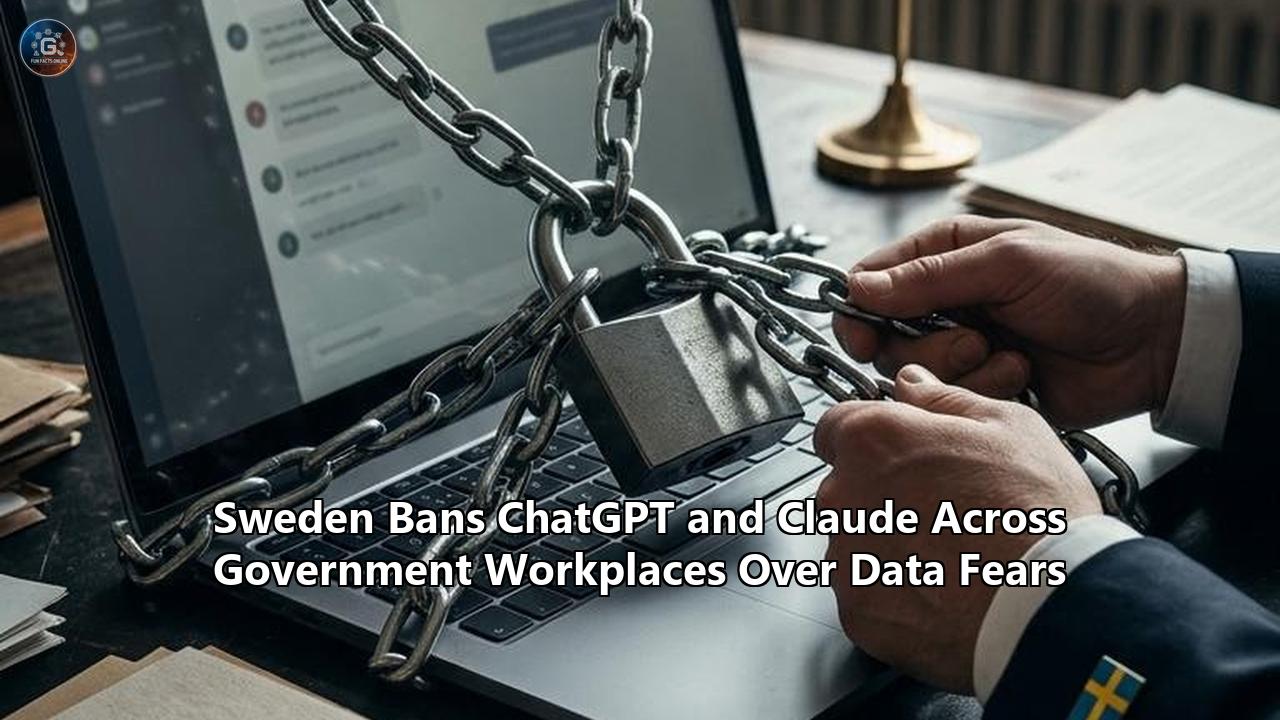
Sweden’s Government Offices has severed direct access to the consumer web interfaces of OpenAI’s ChatGPT and Anthropic’s Claude across all staff computers, ordering thousands of civil servants to halt the use of unapproved artificial intelligence platforms over escalating data security and privacy risks.
The block, which took effect across government workstations, targets browser-based consumer versions of the world's most widely used large language models. Instead of open-web chatbots, personnel inside Sweden’s ministerial apparatus—known collectively as Regeringskansliet, which includes the Prime Minister’s Office at Rosenbad and eleven national ministries—are now instructed to route automated tasks exclusively through enterprise-negotiated channels, primarily Microsoft Copilot.
The sudden policy enforcement marks one of the most structured crackdowns on shadow IT by a digitally advanced European democracy. Officials did not cite defects in the algorithmic intelligence of OpenAI or Anthropic, but rather the absence of binding data processing agreements, the persistent danger of sensitive state records leaking into commercial training corpuses, and jurisdictional exposures created when civil servants feed Swedish public administration data into servers subject to foreign surveillance statutes.
In an internal communication distributed to staff, Mikael Wettercrantz, director of digitalization and Chief Information Officer at the Government Offices, stated that utilizing open artificial intelligence tools without formal legal and contractual boundaries poses direct threats to Swedish state security.
"We have seen several examples of problematic use of open AI services," Wettercrantz wrote on the staff intranet, stressing that unregulated platforms introduce intolerable vectors into the state’s digital architecture. The directive follows internal investigations that uncovered government personnel routinely pasting unredacted departmental texts, policy drafts, and internal administrative queries into open web browsers.
This Swedish directive represents a calculated ChatGPT government ban designed to cleanly sever public consumer tools from administrative state operations. By dissecting who is affected, what structural and technical workflows change, and what the immediate and generational consequences will be, this impact analysis details how the Scandinavian nation’s intervention is redrawing the battle lines between commercial frontier AI labs and European digital sovereignty.
The Catalyst: Audits, Shadow IT, and the Prompting of State Secrets
The immediate catalyst for the decision was an alarming pattern revealed across multiple state agencies, crystallized by an internal audit conducted earlier at the Swedish Transport Administration (Trafikverket). The audit identified approximately ten different commercial AI platforms operating in widespread, unsanctioned use among staff. Employees across departments were turning to browser-based chatbots to summarize confidential memos, draft correspondence, debug internal administrative software code, and analyze infrastructure logs.
Virtually none of this usage had been routed through standard procurement protocols, vetted by internal information technology security teams, or bound by a Data Processing Agreement (personuppgiftsbiträdesavtal, or PUB agreement) under European Union law.
The reality confronting Swedish cybersecurity officials was classic enterprise shadow IT operating at national government scale. When a civil servant opens an unmanaged browser tab, logs into a personal or free-tier commercial account, and pastes an unreleased ministerial white paper into ChatGPT or Claude, several immediate points of exposure occur:
- Data Ingestion for Model Training: Unless an organization enters a specific enterprise contract with explicit zero-retention and non-training clauses, consumer inputs can be retained, logged, and used to train future model iterations. A prompt containing sensitive diplomatic considerations or internal cabinet squabbles can effectively be absorbed into vendor telemetry.
- Jurisdictional Drift: Data submitted through browser interfaces typically lands on commercial server clusters located outside the European Economic Area (EEA), primarily in the United States. This migration triggers severe compliance issues under the General Data Protection Regulation (GDPR) and exposes administrative content to US legal demands under the Foreign Intelligence Surveillance Act (FISA) Section 702 and the US CLOUD Act.
- Session and Infrastructure Vulnerabilities: Browser-based interactions carry client-side vulnerabilities, cross-account cache-poisoning risks, and tracking exposures that enterprise tenant controls are built to prevent.
The Government Offices' decision also followed an earlier ban targeting the Chinese artificial intelligence model DeepSeek, which Swedish intelligence and security services flagged over direct data exfiltration fears and non-compliance with European privacy standards. However, applying an identical hard stop to OpenAI and Anthropic—the twin darlings of Western enterprise productivity—signals that the issue is no longer just geopolitical origin; it is the fundamental architecture of the consumer cloud interface.
Who Is Directly Affected Across the Swedish Public Sector
The immediate enforcement radius centers on Regeringskansliet, the administrative nervous system of the Swedish executive branch, but its systemic fallout touches agencies throughout the state apparatus.
                     ┌────────────────────────────────────────┐
                     │          REGERINGSKANSLIET             │
                     │  (Prime Minister's Office & Ministries) │
                     │   Browser Ban: ChatGPT & Claude         │
                     └───────────────────┬────────────────────┘
                                         │ Policy Precedent
         ┌───────────────────────────────┼──────────────────────────────┐
         ▼                               ▼                              ▼
┌──────────────────┐           ┌──────────────────┐           ┌──────────────────┐
│   SKATTEVERKET   │           │       SiS        │           │ KRONOFOGDEMYND.  │
│  (Tax Agency)    │           │ (Youth/Addiction)│           │ (Enforcement)    │
│  Parallel Ban    │           │  Active Ban      │           │  Active Review   │
└──────────────────┘           └──────────────────┘           └──────────────────┘
1. The Ministerial Machine and Rosenbad
Approximately 4,500 to 5,000 employees inside the Swedish Government Offices—encompassing diplomats, political advisors, legislative draftsmen, and administrative civil servants—are directly cut off from browser-based ChatGPT and Claude. These workers had integrated language models into daily workflows for tasks ranging from summarizing 300-page official government reports (Statens offentliga utredningar, SOU) to drafting parliamentary replies and translating EU policy directives into Swedish. Those informal efficiencies ended overnight with the deployment of network-level firewall blocks.
2. Autonomous Central Agencies (Förvaltningsmyndigheter)
Sweden operates under a unique administrative framework defined by the prohibition of ministerial rule (ministerstyre). The Government Offices cannot simply dictate day-to-day administrative IT rules to independent state agencies like the Swedish Tax Agency (Skatteverket), the Swedish Social Insurance Agency (Försäkringskassan), or the Swedish Transport Administration (Trafikverket).
Yet the Government Offices' move serves as the definitive institutional beacon. Skatteverket and the National Board of Institutional Care (Statens institutionsstyrelse, SiS)—the latter managing secure youth facilities and substance abuse homes—had already moved to block consumer chatbots. The Swedish Enforcement Authority (Kronofogdemyndigheten) is currently finalizing a parallel prohibition, and a cascade of regional health authorities (regioner) and municipal governments (kommuner) are now initiating internal reviews to replicate the block.
3. Frontier AI Vendors: OpenAI and Anthropic
For OpenAI and Anthropic, the Swedish policy intervention is a public, institutional rebuff. It exposes the vulnerabilities of their self-service enterprise funnels. While both companies have built world-leading frontier foundational models, they have historically lagged behind traditional enterprise software titans in executing comprehensive, localized, sovereign institutional procurement packages for national governments. Sweden's action demonstrates that superior benchmark performance on reasoning tasks means nothing to government IT directors if the tools lack institutional data fencing.
What Actually Changes: Technical and Administrative Mechanics
The term "ban" frequently evokes images of a total technological boycott. Inside Swedish government networks, however, what has taken place is a selective architectural purge of unmanaged endpoints, replacing the Wild West of browser tabs with heavily ring-fenced, auditable systems.
BEFORE POLICY:
[ Civil Servant Workstation ] ─── Open Browser ───> Public Internet ───> [ OpenAI / Anthropic Commercial Servers ]
                                                    * No Enterprise PUB-Avtal
                                                    * Unaudited Data Retention
                                                    * Potential Model Training

AFTER POLICY (BIFURCATED ROUTE):
[ Civil Servant Workstation ]
          │
          ├── [ Browser Request to ChatGPT / Claude ] ──> [ BLOCKED AT SECURE PROXY ]
          │
          ├── [ Authorized Standard Staff ] ──> [ Microsoft Copilot Enterprise Tenant ]
          │                                     * Zero-Retention & EU Data Boundary
          │                                     * Sovereign Auditing Enabled
          │
          └── [ Authorized Specialists ]    ──> [ "Intric" Internal Secure Gateway ]
                                                * Encrypted API Call to Models
                                                * Strict No-Log Enterprise Pipeline
The Blockade of Consumer Interfaces
Technical teams at the Government Offices enforced the rule by executing deep-packet inspection and domain-level DNS/proxy restrictions on standard web endpoints, including chatgpt.com, chat.openai.com, and claude.ai. When an employee attempts to navigate to these addresses, they are intercepted by an administrative block page that alerts them to information security protocols and redirects them toward sanctioned environments.
The Survival of Microsoft Copilot
While public consumer instances of Claude and ChatGPT were shuttered, Microsoft Copilot survived the cull—becoming the primary permitted AI workspace platform for the Government Offices. The rationale reveals the central paradox of contemporary government cybersecurity: Copilot is largely powered by the exact same GPT-4-series neural architectures built by OpenAI, and in some enterprise environments offers access to Anthropic's Claude 3.5 Sonnet.
The models themselves were never the security hazard. The operational difference lies entirely in the contractual and cryptographic perimeter. Microsoft maintains long-standing, comprehensively negotiated enterprise frameworks with the Swedish state.
Under these enterprise licensing tiers, Microsoft guarantees contractual zero-data retention, explicitly guarantees that administrative data will not be used to train base foundation models, provides customer lockbox controls, offers European Data Boundary guarantees, and signs binding Article 28 GDPR Data Processing Agreements.
The Government Offices confirmed that before granting clearance to Copilot, internal cybersecurity teams conducted an exhaustive evaluation and forced an administrative tightening of the platform's tenant controls, disabling telemetry feedback mechanisms and restricting third-party plugin integrations.
The "Intric" Platform: The Backdoor for Pure Models
Crucially, the ban does not mean that Swedish government specialists are entirely divorced from OpenAI and Anthropic intelligence. A select group of vetted researchers, data analysts, and administrative developers retain access to these frontier engines through a dedicated, internally managed platform called "Intric," as well as custom-built government API wrappers.
By tapping into models via enterprise API keys rather than public web interfaces, Swedish authorities retain absolute administrative control:
- Prompts and outputs are encrypted under state-managed keys.
- Interactions are audited within state logging systems to track what data classifications are processed.
- API terms legally prohibit vendors from retaining query data for machine learning optimization.
The outcome is an aggressive segregation between the unwashed consumer browser and authenticated, sovereign programmatic pipelines.
The Legal and Constitutional Crosswinds
The enforcement of this policy inside Rosenbad cannot be understood through the lens of ordinary corporate IT policies alone. It is governed by a collision between the distinct architecture of Swedish constitutional law and expanding European Union data regulations.
1. Sweden’s Constitutional Dilemma: Offentlighetsprincipen
Sweden possesses one of the oldest freedom of information frameworks in the world, codified in the Freedom of the Press Act (Tryckfrihetsförordningen), a pillar of the Swedish Constitution. Central to this is the Principle of Public Access to Official Documents (Offentlighetsprincipen). Under this doctrine, any document—digital or physical—received or drawn up by a Swedish public authority is an official record accessible to any citizen, unless explicitly classified under the Public Access to Information and Secrecy Act (Offentlighets- och sekretesslagen, OSL).
When a civil servant drafts a policy inside an open-web chatbot, profound constitutional dilemmas emerge:
- Does sending a draft policy query to a commercial third-party server count as an official release of information under Offentlighetsprincipen?
- If the consumer platform retains the prompt log, has an unmanaged, unarchived public record been created on a server in California, in violation of Swedish national archiving statutes (Arkivlagen)?
- If an employee types non-public information protected under the OSL into a public model, that employee has committed an unlawful breach of secrecy (brott mot tystnadsplikt), potentially subject to criminal penalties under the Swedish Penal Code.
The browser-level ChatGPT government ban functions as an administrative emergency brake against civil servants inadvertently committing criminal violations of Swedish secrecy statutes.
2. GDPR and Transatlantic Jurisdictional Traps
Under the European Union's General Data Protection Regulation, Swedish government entities act as data controllers. Whenever personal data belonging to Swedish citizens—names, personal identity numbers (personnummer), health data, or tax records—is uploaded to an AI system, that system acts as a data processor.
Articles 28 and 44–49 of the GDPR mandate that any transfer of personal data outside the European Economic Area must be bound by equivalent legal safeguards. Despite the adoption of the EU-U.S. Data Privacy Framework in 2023, European privacy regulators and national administrative bodies remain acutely aware that US surveillance regimes, notably FISA 702, leave personal data exposed to American intelligence demands.
Consumer web versions of ChatGPT and Claude do not provide the dynamic geographical fencing or individual Data Processing Agreements required for public bodies to maintain lawful compliance under European law. A state ministry operating on consumer web terms is, prima facie, in violation of European regulatory compliance.
Short-Term Consequences: Friction, Disruption, and Administrative Lag
In the wake of the Monday morning network cutoff, the short-term impact across the Swedish ministries has been marked by administrative operational friction and workflow disruption.
SHORT-TERM DISRUPTIONS:
├── Workflow Disconnect: Loss of specialized agentic features unique to Claude and ChatGPT
├── Cognitive Re-tooling: Retraining civil servants from pure-play chat to Copilot Office integrations
├── Shadow IT Whack-a-Mole: Surge in personal smartphone off-network querying
└── Administrative Bottlenecks: Backlogs in IT departments processing exception requests for "Intric" access
1. The Immediate Productivity Cliff
For civil servants who had seamlessly integrated Claude 3.5 Sonnet's superior long-form reasoning, complex coding, and contextual document-drafting abilities into their daily output, pivoting to Copilot represents a noticeable disruption. While Copilot is deeply integrated into Word, Excel, and Teams, civil servants often report that its generative text generation and conversational synthesis within everyday office documents can feel more constrained and formulaic compared to direct, iterative prompting inside the Claude or ChatGPT web workspaces.
Ministries are encountering an immediate dip in processing speed for routine analytical tasks as staff navigate the retraining curve required to use Copilot’s structured enterprise prompts effectively.
2. The Resurgence of "Mobile Shadow IT"
History illustrates that sweeping network-level technological bans often produce unintended workarounds. While the Government Offices successfully blocked the web domains on official work laptops and managed mobile devices, cybersecurity teams now face the inevitable risk of off-network shadow IT.
Civil servants under tight legislative deadlines face the temptation to type queries or rephrase policy points using personal smartphones, subsequently emailing the AI-generated answers back to their official government addresses. Because this vector completely bypasses managed infrastructure, it is inherently more dangerous and difficult for state cybersecurity teams to audit than monitored desktop usage. The Government Offices has attempted to deter this practice with stern warnings regarding violations of internal security protocol, but behavioral friction remains high.
3. Bureaucratic Triage in IT Departments
IT and digitalization departments across the ministries are now inundated with formal exception requests. Specialized teams in statistical analysis, economic forecasting, and legal research are demanding access to the approved, sovereign "Intric" platform. Establishing individual user profiles, vetting authorization levels, configuring multi-factor access, and auditing API budgets has created a notable administrative bottleneck that will demand weeks of internal IT labor to normalize.
Long-Term Strategic Consequences: Remaking Public Sector AI
Beyond the short-term operational hurdles for Swedish bureaucrats, the institutionalization of this ChatGPT government ban carries profound, systemic implications for the tech industry, sovereign IT governance, and international public administration.
LONG-TERM SYSTEMIC IMPACT:
┌──────────────────────────────────────────────────────────────────────────────────┐
│ 1. BIG TECH LOCK-IN: Entrenchment of legacy IT giants over standalone AI labs     │
├──────────────────────────────────────────────────────────────────────────────────┤
│ 2. THE EUROPEAN NORDIC TEMPLATE: Unified procurement standards for the EU        │
├──────────────────────────────────────────────────────────────────────────────────┤
│ 3. THE RISE OF SOVEREIGN OPEN-WEIGHT MODELS: Government-hosted local AI engines  │
├──────────────────────────────────────────────────────────────────────────────────┤
│ 4. MARGINALIZATION OF CONSUMER INTERFACES: End of unmanaged web AI in governance │
└──────────────────────────────────────────────────────────────────────────────────┘
1. The Consolidation of Big Tech’s Government Monopoly
The clearest institutional victor in Sweden's decision is Microsoft. The move vividly illustrates how deep enterprise moats, built over decades through software licensing frameworks like Office 365, Active Directory, and Azure infrastructure, protect legacy technology conglomerates from being disrupted by newer pure-play artificial intelligence labs.
Even though OpenAI and Anthropic engineered the state-of-the-art cognitive algorithms that power this technological era, they are functionally blocked at the Swedish front gate because they lack the enterprise relationship machinery and unified identity infrastructure that Microsoft commands.
For governments, dealing with Microsoft Copilot is legally safe; it slides effortlessly into pre-existing sovereign master agreements, unified identity directories, and pre-negotiated legal dispute frameworks. For Anthropic and OpenAI to survive in the public sector, consumer brilliance is no longer enough: they must build enterprise, government-ready compliance apparatuses that mimic the legal shielding provided by the traditional enterprise giants.
| AI Access Layer | Swedish Legal Status | Compliance Mechanism | Primary Risk Factor |
|---|---|---|---|
| Consumer Web ChatGPT/Claude | Strictly Blocked | None (Standard terms of service) | Data retention, unvetted training, foreign server transfer |
| Microsoft Copilot Enterprise | Approved (Tightened) | Master Enterprise Agreement + EU Data Boundary | Vendor lock-in, reliance on proprietary US hyperscaler |
| Internal Intric Gateway (API) | Approved (Restricted) | State-managed encrypted pipeline with zero-log terms | High infrastructure maintenance, limited user seats |
| On-Premises Open Weights | Under Evaluation | Air-gapped national sovereign data centers | Computational cost, lagging reasoning capability |
2. A Policy Blueprint for the European Union
Sweden's decision does not exist in an administrative vacuum. Outside Sweden, institutions like the European Parliament have already taken drastic measures to lock down or disable consumer AI features on official staff mobile devices and internal computers to safeguard European regulatory data integrity.
The Swedish Government Offices' implementation of this ChatGPT government ban provides a clear administrative blueprint for other European Union member states. Nations across the EU—including Germany, the Netherlands, and France—are grappling with identical dilemmas regarding how civil servants interact with browser-based models.
By avoiding a crude, Luddite rejection of artificial intelligence altogether, Sweden has demonstrated how a government can embrace machine learning through managed, enterprise pipelines while decisively shutting down unmonitored consumer access. European chief information officers now have a clean precedent to cite: if an AI tool does not possess an audited, regional, enterprise-grade Data Processing Agreement that completely fences off prompts from model training, it has no place in the computers of public governance.
3. The Accelerated Push for Sovereign European Open-Source Models
While Microsoft Copilot serves as the immediate fallback, Swedish security strategists remain acutely uncomfortable with long-term reliance on any American cloud provider. Underneath the surface, Sweden's ban is already accelerating discussions regarding sovereign, local-cloud, and open-weight language models.
The Swedish public sector has been experimenting with models tailored for the Nordic linguistic landscape, such as the GPT-SW3 series developed by AI Sweden, a national center for applied artificial intelligence.
Over the long term, the realization that proprietary American consumer tools are legally too dangerous for daily government use will dramatically increase public capital allocation toward air-gapped, open-weight models (such as customized Mistral or Llama architectures) that run on sovereign, publicly controlled European servers entirely immune to the US CLOUD Act or commercial platform policy shifts.
Market Dynamics: Frontier Labs Face the Institutional Gauntlet
The fallout from Sweden’s decision sends shockwaves across the venture-backed artificial intelligence ecosystem in Silicon Valley. For the past three years, the dominant user acquisition strategy for generative AI startups has been bottoms-up: secure consumer users, let them bring the tool into their offices, spark viral employee adoption, and eventually force the chief information officer to sign an enterprise deal.
Sweden's decisive firewall block proves that in the public sector, this bottoms-up adoption model has reached a sudden dead end.
When security agencies, national data protection authorities, and government digitalization offices intervene, they do not upgrade consumer users—they sever their connections. Both OpenAI and Anthropic are finding themselves compelled to radically reorient their product development and corporate strategies toward deep institutional compliance:
- Sovereign Cloud Instances: AI labs must strike co-location and sovereign hosting agreements with regional European hosting providers, ensuring that data never touches foreign telecommunications infrastructure.
- Granular Enterprise Audit Trails: Platforms must provide governmental IT administrators with cryptographically verifiable logs documenting where every prompt is routed, processed, and destroyed.
- Total Training Immunity: Clear, legally enforceable guarantees—backed by heavy financial penalties—that public sector prompt data will never be parsed for commercial reinforcement learning or synthetic data generation.
Without these structural elements, standalone frontier AI providers will find themselves systematically cut off from multi-billion-dollar public sector procurement initiatives across the Western democratic world, leaving the field open for historical enterprise gatekeepers to monopolize government AI budgets.
What to Watch: The Unfolding Horizon
As the Government Offices of Sweden beds down its new operational paradigm, several upcoming milestones and open questions will dictate whether this restrictive model can endure or whether the irresistible momentum of shadow IT will expose flaws in the ban:
- The Spread of Agency Restrictions: Observers are watching the Swedish Enforcement Authority (Kronofogdemyndigheten) and other administrative pillars. If the entire Swedish public administration—spanning hundreds of agencies and hundreds of thousands of public servants—unifies behind a total browser block, Sweden will become the first Western nation with an entirely walled-off, sovereign AI civil service.
- The Evolution of the EU AI Act: As the European Union’s comprehensive AI Act moves progressively into full legal enforcement across member states, the compliance thresholds for "high-risk" AI use cases inside public administration and law enforcement will become exponentially more severe. The Swedish decision to enforce strict enterprise-only data boundaries is an early-stage defensive posture designed to ensure state agencies do not find themselves in non-compliance with emergent European law.
- The Shadow IT Audit Results: Within the next six to twelve months, internal audits will inevitably assess whether blocking ChatGPT and Claude on desktop browsers actually eliminated data leakage—or simply drove frustrated civil servants to process state data on non-managed personal hardware or alternative, lesser-known AI platforms. The efficacy of Sweden's network monitoring will be a critical case study for IT professionals globally.
- OpenAI and Anthropic's Counter-Strategy: It remains to be seen whether OpenAI and Anthropic will move aggressively to establish sovereign European cloud versions of their primary workspace interfaces that can satisfy the exact administrative standards demanded by Mikael Wettercrantz and the Swedish digitalization directorate. If they succeed, they could challenge Microsoft’s newly minted enterprise monopoly inside government ministries.
Sweden has drawn a definitive line in the sand. By acknowledging that the convenience of consumer artificial intelligence cannot supersede the foundational demands of state security, information hygiene, and digital sovereignty, Rosenbad has sounded a clear warning to the global tech sector: the era of unchecked, browser-based experimentation inside the corridors of national power has officially closed.
Reference:
- https://www.youtube.com/watch?v=A1d1TU1DbkQ&vl=fr
- https://www.notebookcheck.net/Sweden-s-government-blocks-ChatGPT-and-Claude-keeps-Copilot.1433522.0.html
- https://shattered.io/sweden-blocks-chatgpt-claude-government-offices-oct-26-2026/
- https://www.techradar.com/pro/security/chatgpt-and-claude-blocked-by-swedish-government-over-problematic-security-concerns
- https://www.euronews.com/2026/10/26/swedish-government-blocks-chatgpt-and-claude-heres-why
- https://247wallst.com/cards/msft-xpost-01m5sqrvvb7b7xwr3a35hdc2jy