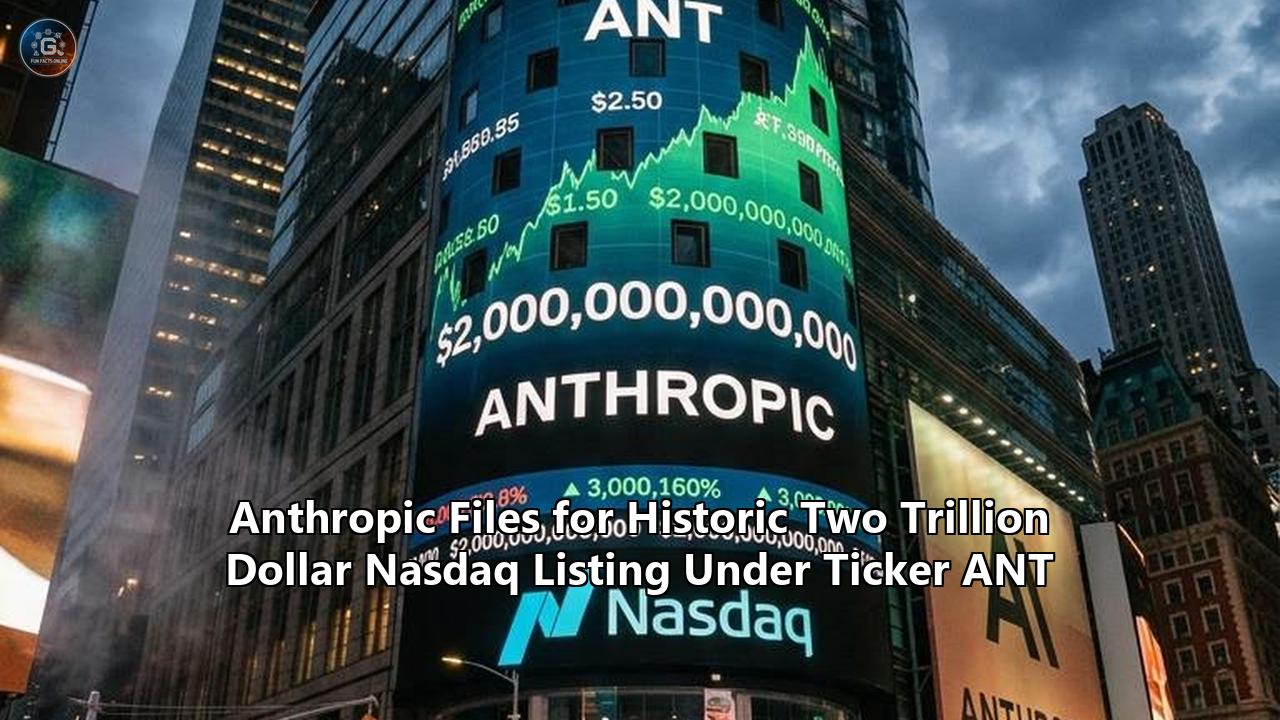
Anthropic, PBC publicly unsealed its Form S-1 registration statement with the U.S. Securities and Exchange Commission on October 26, 2026, setting into motion an initial public offering seeking a valuation between $1.5 trillion and $2 trillion on the Nasdaq Global Select Market under the ticker symbol ANT.
Led by Wall Street heavyweights Goldman Sachs and Morgan Stanley alongside a 22-bank underwriting syndicate, the transaction aims to raise upwards of $100 billion. If completed at that scale during its targeted mid-November debut, the offering will decisively overtake SpaceX’s $85.7 billion public debut in June 2026 to become the largest initial public offering in global capital markets history.
The filing reveals a business expanding at unprecedented velocity while navigating severe structural costs. Anthropic generated $16.29 billion in revenue during the first six months of 2026—a 1,300% surge over the $1.16 billion recorded in the same period of 2025. The company posted an operating profit of $974 million in the second quarter of 2026, marking its first operating income in corporate history. Yet the same prospectus registers an eye-popping headline GAAP net loss of $80.75 billion for the half-year, caused by a $72.39 billion non-cash accounting adjustment tied to the escalating fair value of its convertible preferred debt and SAFEs (Simple Agreements for Future Equity) as its private valuation surged toward $1 trillion earlier this year.
The prospective Anthropic Nasdaq listing represents a crucial market test for the artificial intelligence sector, transforming the San Francisco lab from a tightly controlled private research venture into an exchange-traded titan subject to quarterly public scrutiny. The company’s path from an insurgent splinter group of safety-minded researchers to a $2 trillion listing candidate unfolded through a series of tactical shifts, infrastructure commitments, and financial escalations.
                     ANTHROPIC REVENUE TRAJECTORY
                       (Fiscal Years 2023–2026*)
  $35B ┬
       │
  $30B ┼                                           [H1 2026: $16.29B]
       │                                           (Run-Rate: ~$47B+)
  $25B ┼
       │
  $20B ┼
       │
  $15B ┼
       │
  $10B ┼
       │
   $5B ┼                                 $4.59B
       │                                 ┌────┐
   $0B ┴───────$41M─────────$386M────────┤    ├───────────█
              FY2023        FY2024       FY2025        H1 2026
December 2020 – April 2022: The OpenAI Split and the Safe Haven Hypothesis
The genesis of Anthropic traces back to late 2020 inside OpenAI's San Francisco headquarters. Dario Amodei, then OpenAI’s vice president of research, and his sister Daniela Amodei, vice president of safety and governance, grew disillusioned with the organization’s direction following its multi-billion-dollar partnership with Microsoft and the commercial pivot toward closed-source consumer deployments. Joined by five senior researchers—Jack Clark, Jared Kaplan, Sam McCandlish, Tom Brown, and Chris Olah—the Amodeis walked out to establish an independent research laboratory centered on mechanistic interpretability and predictable AI alignment.
THE FOUNDING SPLINTER (December 2020)
  OpenAI Research Leadership ──┐
                               ├──> Amodei Siblings & 5 Lead Researchers
  Commercial Alignment Rift  ──┘
                               │
                               ▼
               Anthropic, PBC Founded (Early 2021)
               Charter: Constitutional AI & Empirical Alignment
In early 2021, the group established Anthropic as a Delaware Public Benefit Corporation (PBC), formalizing an explicit corporate charter: to balance commercial returns with the development of safe, beneficial artificial general intelligence. The founders operated under what internal documents dubbed the "Safe Haven Hypothesis"—the conviction that elite AI researchers would gravitate toward an institution where empirical safety research held veto power over commercial product rollouts.
Capital followed the technical pedigree. In May 2021, Skype co-founder Jaan Tallinn led Anthropic's $124 million Series A round, funding initial experiments into scaling laws and automated model oversight. By April 2022, as training compute demands increased, Anthropic closed a $580 million Series B round.
During this initial era, the company had zero commercial revenue. It operated entirely as a high-burn research institute, focusing its resources on the development of "Constitutional AI"—a training framework where models use a set of written ethical principles to critique and adjust their own outputs without constant human feedback loops.
2023: The Cloud Titan Proxy War and the Multi-Billion Dollar Compute Pacts
The release of consumer generative AI systems in late 2022 drastically disrupted the lab's timeline, accelerating Anthropic’s evolution from an academic safety project into an infrastructure-heavy commercial entity. Anthropic introduced its Claude model family in early 2023, offering enterprise clients a conversational interface that prioritized steerability and reduced hallucination rates.
Recognizing that advanced model training required capital and infrastructure beyond the scope of traditional venture syndicates, the Amodei siblings exploited a growing rivalry among cloud hyperscalers. While Microsoft deepened its capital commitments to OpenAI, Amazon and Google were left searching for premier foundation model partners to anchor their respective enterprise clouds.
In May 2023, Spark Capital led a $450 million Series C round, but that sum was quickly overshadowed by strategic corporate commitments. In September 2023, Amazon announced an initial $1.25 billion investment in Anthropic, which eventually scaled to a $4 billion total capital injection through convertible notes. Under the terms of the agreement, Amazon Web Services (AWS) became Anthropic's primary cloud training partner, granting Claude distribution access to tens of thousands of AWS clients through the Amazon Bedrock managed service platform.
Not content to concede ground to Seattle, Google followed weeks later, converting its earlier equity investments into an expanded multi-billion-dollar alliance that paired direct financing with massive compute credit tranches across Google Cloud’s Tensor Processing Unit (TPU) server farms.
By the close of fiscal 2023, Anthropic’s business fundamentals began to register on corporate balance sheets, though modest relative to its valuation:
- Full-Year 2023 Revenue: $41 million
- Operating Loss: $590 million
- Compute Infrastructure Footprint: ~25,000 heterogeneous GPU/TPU clusters
- Capital Raised (Cumulative): ~$7.3 billion
The escalation had begun. Anthropic closed 2023 having tied its operational survival directly to long-term compute procurement agreements with the world's two largest cloud platforms.
2024: The Enterprise Moat, Claude 3, and the Context Window Breakthrough
If 2023 was the year of strategic alliances, 2024 proved to be the period where Anthropic carved out an unassailable redoubt in the global software engineering market. In March 2024, the lab launched its Claude 3 model family: Haiku, Sonnet, and Opus.
Claude 3 Sonnet and the subsequent Claude 3.5 Sonnet release in June 2024 proved to be a watershed moment for the company's enterprise adoption. Where rivals focused heavy marketing expenditure on consumer brand awareness, multimodal video gimmicks, and general entertainment prompts, Anthropic optimized Claude for coding accuracy, complex system reasoning, and massive context windows spanning up to 200,000 tokens.
THE 2024 ENTERPRISE INFLECTION POINT
  Consumer Mindshare Focus (Rivals) ──> Volatile churn, subsidized queries
  Enterprise Integration (Anthropic) ──> Developer retention, API lock-in
                                     ──> High Gross-Margin Token Ingestion
The enterprise response was swift:
- Developers adopted Claude 3.5 Sonnet as the underlying engine for automated software engineering platforms, terminal automation, and code migration tasks.
- Global enterprise clients—including major investment banks, multinational law firms, and healthcare providers—integrated Claude via AWS Bedrock and Google Cloud Vertex AI to parse complex regulatory disclosures and proprietary codebases.
- The customer profile stabilized around high-margin API call volumes rather than consumer subscriptions that churned monthly.
Financially, 2024 reflected an order-of-magnitude surge in operational scale. Revenue expanded nearly tenfold to $386 million. Concurrently, operational burn expanded dramatically as training runs for the next-generation frontier architectures commenced. Operating losses hit $2.98 billion in 2024, driven by the relentless lease costs of thousands of Nvidia H100 and B200 clusters.
By late 2024, Anthropic's private capitalization topped $18 billion following a $1.2 billion Series D round. The boardroom, however, recognized that the private markets were approaching a structural ceiling: funding frontier model clusters requiring hundreds of thousands of interconnected accelerators would soon demand capital on an institutional scale that only public equity markets could provide.
2025: Claude Code, the Autonomous J-Curve, and the Run-Rate Explosion
The inflection point that transformed Anthropic from an enterprise SaaS favorite into a multi-trillion-dollar listing contender occurred in early 2025 with the commercial rollout of Claude Code and the Cowork autonomous agent framework.
Claude Code transformed Claude from a passive autocomplete assistant into an active, autonomous software engineer capable of running terminal commands, navigating complex multi-repository enterprise codebases, identifying security vulnerabilities, writing tests, and deploying continuous integration pipelines with minimal human intervention. Across Silicon Valley and the Fortune 500, engineering teams realized that software engineering economics had fundamentally changed.
2025 PRODUCT LEVERAGE & RUN-RATE ESCALATION
  Q1 2025: Claude Code Launch ───────> Dev productivity jumps 400%
  Q2 2025: Cowork Agent Rolled Out ──> Multi-agent office automation
  Q3 2025: Token Consumption Surges ──> Monthly token billing surpasses $1B
  Q4 2025: Enterprise ARR Breaks $9B  ─> Software industry records broken
The adoption curve bent vertically:
- Series E (March 2025): Anthropic raised $3.5 billion at a post-money valuation of $61.5 billion.
- Series F (September 2025): As enterprise software revenue accelerated, institutional growth funds poured in an additional $13 billion.
- Fiscal 2025 Actuals: Full-year revenue surged from $386 million in 2024 to $4.59 billion in 2025—an 11.9x annual expansion that outstripped the historical hypergrowth trajectories of Salesforce, Google, and Meta.
- Exit Velocity: By December 2025, the company exited the year with an annualized run-rate revenue approaching $9 billion.
Yet, the balance sheet bore the scars of this expansion. The compute infrastructure required to sustain tens of millions of concurrent agentic code loops, combined with pre-training costs for upcoming frontier models, drove Anthropic’s full-year 2025 operating loss to $8.06 billion, while total net losses reached $42 billion after non-cash financing charges.
The company found itself caught in a dynamic of extreme capital intensity: customer demand generated cash at a rate never before observed in enterprise software, but capturing that demand required unprecedented commitments to compute providers.
               QUARTERLY RUN-RATE EXPANSION (2025–2026)
  $90B ┬
       │                                                 Tracked Target
  $80B ┼                                                [~$70B–$90B]
       │                                                     :
  $70B ┼                                                     :
       │                                                     :
  $60B ┼                                                     :
       │
  $50B ┼                                      $47.0B (Mid-May)
       │                                       ┌───┐
  $40B ┼                            $30.0B     │   │
       │                            ┌───┐      │   │
  $30B ┼                 $19.0B     │   │      │   │
       │                 ┌───┐      │   │      │   │
  $20B ┼      $14.0B     │   │      │   │      │   │
       │      ┌───┐      │   │      │   │      │   │
  $10B ┼$9.0B │   │      │   │      │   │      │   │
       │├───┤ │   │      │   │      │   │      │   │
   $0B ┴┴───┴─┴───┴──────┴───┴──────┴───┴──────┴───┴─────────
        Dec    Feb        Mar        Apr        May          Dec
        2025   2026       2026       2026       2026         2026 (Est.)
Early to Mid-2026: The Series H Megaround and the Confidential June Filing
The first six months of 2026 were marked by unprecedented financial growth and escalating capital outlays. Annualized run-rate revenue expanded on a monthly basis:
- February 2026: $14 billion run-rate
- March 2026: $19 billion run-rate
- April 2026: $30 billion run-rate, surpassing Salesforce’s core enterprise software footprint
- Early May 2026: $44 billion run-rate
- Mid-May 2026: $47 billion run-rate disclosed during institutional funding presentations
In May 2026, Anthropic closed its Series H funding round, securing $65 billion in fresh equity at a valuation of $965 billion. The round, subscribed to by sovereign wealth managers, private equity consortiums, and technology conglomerates, was structured as the final private bridge to a public listing.
Concurrently, Anthropic entered into historic, long-term compute allocation contracts totaling more than $637 billion across multiple vendors:
- Google Cloud: An amended compute commitment totaling up to $114.5 billion running through 2033.
- Amazon Web Services: A fixed infrastructure purchase agreement guaranteeing at least $110 billion in compute capacity through 2036.
- SpaceXAI & Nvidia Consortium: A $120.5 billion infrastructure deployment agreement utilizing next-generation orbital tracking ground links and liquid-cooled data center compounds.
- Microsoft Azure & Specialized Cloud Operators: $31 billion in supplemental Azure throughput, alongside bespoke bare-metal deals with Nscale, Broadcom, and Lambda Labs.
On June 1, 2026, Anthropic’s board of directors authorized the confidential submission of a draft Form S-1 with the SEC. Over the summer, company executives worked behind closed doors with SEC corporate finance examiners to review the accounting treatment of its multi-billion-dollar convertible notes, compute amortization schedules, and unique public benefit corporate governance structure.
Simultaneously, the research division delivered the next generation of its core models: Claude Fable 5 and the flagship Mythos 5 reasoning architecture. These models demonstrated reliable multi-hour autonomous execution on end-to-end scientific research, complex engineering tasks, and strategic enterprise workflows, solidifying the market position of the Anthropic Nasdaq listing.
October 26, 2026: Unsealing the S-1 Prospectus
The public unsealing of Anthropic's Form S-1 on October 26, 2026, confirmed rumors that had circulated across trading floors for months. The filing revealed the company's financial operations, customer concentration metrics, and internal balance sheet structure.
               FIRST HALF (H1) 2026 FINANCIAL SUMMARY
┌──────────────────────────────────────┬───────────────────────────────┐
│ Metric                               │ Reported S-1 Figure           │
├──────────────────────────────────────┼───────────────────────────────┤
│ H1 2026 Total Revenue                │ $16,286 million ($16.29B)     │
│ H1 2025 Total Revenue (Prior Year)   │ $1,163 million ($1.16B)       │
│ Year-Over-Year Revenue Growth        │ 1,300.3%                      │
│ Q2 2026 Revenue (Single Quarter)     │ $11,560 million ($11.56B)     │
│ Q1 2026 Revenue                      │ $4,726 million ($4.73B)       │
│ Quarter-Over-Quarter Revenue Growth  │ 144.6%                        │
│ H1 2026 Computing Infrastructure Cost│ ~$9,000 million ($9.00B)      │
│ Q2 2026 GAAP Operating Income        │ +$974 million (Profitable)    │
│ H1 2026 GAAP Operating Loss          │ -$693 million                 │
│ H1 2026 Adjusted Operating Income    │ +$1,600 million ($1.60B)      │
│ Derivative Revaluation Charge (GAAP) │ -$72,388 million ($72.39B)    │
│ H1 2026 GAAP Net Loss                │ -$80,748 million ($80.75B)    │
│ Cash & Cash Equivalents              │ $112,400 million ($112.4B)    │
│ Short-Term Marketable Investments    │ $19,300 million ($19.3B)      │
│ Total Balance Sheet Liquidity        │ $131,700 million ($131.7B)    │
└──────────────────────────────────────┴───────────────────────────────┘
Unpacking the Financial Metrics
The headline figures sparked intense debate across Wall Street trading desks. The most misunderstood metric was the $80.75 billion net loss, which several initial news flashes interpreted as operational insolvency.
The prospectus demonstrates that this figure is primarily the result of GAAP fair-value accounting (ASC 815). In earlier funding rounds (Series E, F, and G), Anthropic raised substantial capital via convertible promissory notes, derivative warrant liabilities, and SAFEs. Under standard U.S. GAAP guidelines, as Anthropic’s enterprise value escalated from $61.5 billion in March 2025 to $965 billion in May 2026, the fair market value of those conversion rights increased correspondingly.
Because the shares that noteholders are entitled to convert into became dramatically more valuable, Anthropic was required to log that theoretical delta as a mark-to-market expense on its income statement:
$$\text{Fair Value Derivative Expense} = V_{\text{Series H Fair Value}} - V_{\text{Carrying Value at Inception}}$$
This single line-item accounted for $72.39 billion—or 89.6%—of the reported first-half net loss. Crucially, not a single penny of this $72.39 billion departed corporate bank accounts in operational cash outflows.
                 THE H1 2026 NET LOSS BRIDGE
┌────────────────────────────────────────────────────────┐
│ GAAP Operating Loss: -$693M                            │
│   ├── Q1 Operating Loss: -$1,667M                      │
│   └── Q2 Operating Income: +$974M (Profitable)         │
├────────────────────────────────────────────────────────┤
│ Tax, Interest, & Misc Expenses: -$7,667M               │
├────────────────────────────────────────────────────────┤
│ ASC 815 Fair-Value Adjustment Charge: -$72,388M        │
│ (Non-cash revaluation of SAFE & convertible debt)      │
├────────────────────────────────────────────────────────┤
│ Total Headline GAAP Net Loss: -$80,748M (-$80.75B)     │
└────────────────────────────────────────────────────────┘
On an operational level, the business showed notable operating leverage. In the second quarter of 2026, revenue leaped by 144% compared to the first quarter ($11.56 billion versus $4.73 billion), while direct computing and server cluster expenses expanded by roughly 65% over the same duration.
This divergence generated an operating profit of $974 million in Q2 2026, showing that token delivery gross margins are expanding as inference cluster optimization takes hold.
Enterprise Penetration and Customer Cohorts
The prospectus revealed a diversified enterprise customer base:
- Total Enterprise Clients: Over 14,000 corporate entities deploying Claude via native APIs, AWS Bedrock, or Google Cloud Vertex AI.
- Six-Figure Accounts: 11,900 customers generating greater than $100,000 in trailing-twelve-month spend as of September 30, 2026.
- Seven-Figure Accounts: More than 1,900 enterprise clients generating over $1 million annually.
- Whale Deployments: Approximately 250 enterprise contracts generating in excess of $10 million each in annualized commitments.
- Customer Concentration: The filing explicitly affirmed that no single commercial enterprise accounted for more than 10% of total revenue during the first nine months of 2026, allaying fears that Anthropic was excessively dependent on a handful of early tech partners.
The balance sheet showed that Anthropic held $112.4 billion in pure cash and cash equivalents, with an additional $19.3 billion in highly liquid, short-term marketable securities. With over $131 billion in total liquid assets, the company possesses an unprecedented capital buffer designed to withstand extended infrastructure cycles without relying on immediate external credit.
The Public Benefit Corporation Structure and the "Existential Risk" Disclosures
The prospectus for the Anthropic Nasdaq listing stands out for its structural governance and risk disclosures. Rather than adopting a conventional corporate structure focused purely on shareholder value, Anthropic structured its public offering around a specialized Public Benefit Corporation (PBC) architecture.
                     ANTHROPIC GOVERNANCE TOPOLOGY

                    ┌────────────────────────────┐
                    │  Long-Term Benefit Trust   │
                    │   (5 Independent Trustees) │
                    └─────────────┬──────────────┘
                                  │ Elects Majority
                                  ▼
┌──────────────────┐    ┌──────────────────┐    ┌──────────────────┐
│   Founder LLC    │    │Board of Directors│    │  Public Class A  │
│(Class F: 50.1%   │───>│(Corporate Oversight│<───│  Stockholders    │
│  Voting Power)   │    │  & Fiduciary)    │    │  (1 Vote/Share)  │
└──────────────────┘    └──────────────────┘    └──────────────────┘
The governance hierarchy filed with the SEC contains three distinct power centers:
- The Founders' Class F Share: A single super-voting Class F share, issued to a collective entity managed by the seven original co-founders (the Amodei siblings, Clark, Kaplan, McCandlish, Brown, and Olah), carries 50.1% of the total shareholder voting power across ordinary corporate ballots. This guarantees that ordinary Class A public stockholders will hold no direct capacity to change management, force corporate sales, or alter standard strategic initiatives.
- The Long-Term Benefit Trust (LTBT): An independent five-member trust composed of seasoned AI safety researchers, national security specialists, and corporate governance scholars. The LTBT holds the absolute authority to select, appoint, and dismiss a controlling majority of Anthropic’s Board of Directors. The Trust’s legally binding mandate is not to maximize share price or dividends, but to guarantee that model capability never outpaces model steerability, alignment, and global stability.
- Public Class A Common Stock: The shares offered to public markets on the Nasdaq Global Select Market carry one vote per share, participating fully in corporate equity and economic upside, but subordinated in governance to the Founder LLC and the LTBT.
Unprecedented S-1 Risk Factors
The 400-page prospectus contains a candid "Risk Factors" section detailing the existential and technological threats facing advanced frontier AI systems. The document explicitly warns prospective institutional buyers that:
- Advanced model architectures could unintentionally display uncontrolled emergent behaviors, catastrophic alignment failures, or be misappropriated by state actors for autonomous cyber-warfare or biological pathogen modeling.
- The company’s Board of Directors and the Long-Term Benefit Trust retain the unilateral legal right to halt commercial model serving, terminate enterprise API endpoints, or burn entire training runs if an advanced system demonstrates critical alignment anomalies—even if doing so directly devastates corporate revenue, eliminates profitability, or crashes the trading value of ANT stock.
- Anthropic faces ongoing regulatory scrutiny, including an active Federal Trade Commission (FTC) Civil Investigative Demand examining early cloud compute swaps, reciprocal hardware investments, and equity agreements with Amazon and Google.
- A structural data center power deficit threatens future model training runs, citing regional electrical grid constraints and nuclear micro-reactor licensing delays across North America and Europe.
                         THE DUAL MANDATE TENSION
  ┌─────────────────────────────────┐   ┌─────────────────────────────────┐
  │   COMMERCIAL SCALE & CAPITAL    │   │     SAFETY VETO & CHARTER       │
  ├─────────────────────────────────┤   ├─────────────────────────────────┤
  │ • Target $1.5T–$2T Market Cap   │   │ • LTBT Board Majority Veto     │
  │ • $637B Long-term Compute Pacts │   │ • Unilateral Training Shutdown  │
  │ • 14,000+ Enterprise Customers  │   │ • Anti-Proliferation Safequards │
  │ • Target $100B+ Raised in IPO   │   │ • Amodei "Compute Throttle" Call│
  └─────────────────────────────────┘   └─────────────────────────────────┘
                                    ▲
                                    │
                       Corporate Structure Balance
This philosophical tension was highlighted just weeks before the filing, when CEO Dario Amodei published a widely discussed personal essay urging international governments to impose verifiable compute caps and international regulatory controls on next-generation model training.
The fact that Amodei is now pursuing the largest public capital raise in corporate history has drawn scrutiny from critics, who argue that the company is simultaneously accelerating the frontier while preaching caution.
Speaking during an internal corporate address following the filing, Amodei addressed the contradiction:
"Safety without computational capability is irrelevance. If democratic, safety-conscious institutions do not master the scaling frontier, that frontier will simply be claimed by actors who place zero value on caution, interpretability, or constitutional restraint. The capital we raise on public markets is the fortress that protects empirical alignment."
Market Repercussions: Competitors, Cloud Giants, and the Software Paradigm
The announcement of the Anthropic Nasdaq listing sent shockwaves through both private and public software markets. On Wall Street, equities analysts began recalculating valuations across enterprise SaaS, semiconductor design, and cloud hosting sectors.
                ESTIMATED PROPOSED VALUATIONS (Q4 2026)
  $3.5T ┬
        │
  $3.0T ┼                              Microsoft (~$3.1T)
        │
  $2.5T ┼
        │
  $2.0T ┼────────────────────────────── Anthropic Target High ($2.0T)
        │                              Meta (~$1.8T)
  $1.5T ┼────────────────────────────── Anthropic Target Low ($1.5T)
        │
  $1.0T ┼                              SpaceX IPO Market Cap ($980B)
        │
  $0.5T ┼
        │
   $0B  ┴────────────────────────────────────────────────────────────
Pressure on OpenAI’s Capital Strategy
The most direct impact lands on OpenAI. Long viewed as the default bellwether of the AI cycle, OpenAI has faced internal leadership restructuring and complex non-profit transition hurdles.
Anthropic’s public S-1 filing decisively wins the race to Wall Street, securing first-mover access to massive public institutional capital and establishing an official public market valuation multiple. By pricing ANT on the Nasdaq, institutional asset managers who were previously restricted from holding illiquid private shares now possess a liquid vehicle to gain direct exposure to frontier AI software development.
OpenAI now faces pressure to accelerate its own initial public offering or risk seeing sovereign, pension, and mutual funds deploy their long-term allocations into Anthropic’s Class A shares.
The Software Multiple Recalibration
For three decades, pure-play software-as-a-service (SaaS) businesses traded on software revenue multiples grounded in predictable 80% gross margins and recurring human seat licenses. Anthropic’s filing highlights how quickly agentic token workflows are transforming those legacy seat metrics.
Legacy software vendors—including Salesforce ($41 billion annual revenue), Adobe ($25 billion), Workday ($9.5 billion), and ServiceNow ($14 billion)—face an existential paradigm shift. Enterprise spending patterns increasingly favor autonomous model tokens over multi-thousand-dollar enterprise software seats.
Why pay $150 per seat per month for traditional project management and customer-ticket software when an agent running on Claude Fable 5 or Mythos 5 can automate the workflow directly inside the infrastructure layer? Anthropic’s $16.29 billion first-half performance shows that enterprise IT budgets are already migrating.
Cloud Partner Balance Sheet Elevation
The filing provides a public windfall for both Amazon and Google. Amazon's equity stake and convertible note portfolio, accumulated through Series C and E rounds, are estimated to be worth north of $180 billion at the midpoint of the proposed offering valuation.
Furthermore, the disclosed take-or-pay computing commitments provide AWS and Google Cloud with predictable multi-billion-dollar recurring revenues through the mid-2030s, de-risking their own large-scale data center infrastructure capital expenditures.
What to Watch Next: The Road to the Opening Bell
The submission of the Form S-1 marks the start of the final regulatory and financial sprint toward opening-bell trading on the Nasdaq. As the syndicate prepares the public offering, several key milestones will determine whether Anthropic successfully closes at its targeted $2 trillion valuation ceiling.
                 THE ROADSHOW & LISTING TIMELINE
┌────────────────────────────┬─────────────────────────────────────────┐
│ Date Window                │ Milestone Event                         │
├────────────────────────────┼─────────────────────────────────────────┤
│ October 26, 2026           │ Public S-1 Registration Statement Filed │
│ November 2 – 6, 2026       │ SEC Staff Comment Letters Reviewed      │
│ November 9 – 10, 2026      │ Global Institutional Roadshow Begins    │
│ November 11, 2026          │ S-1 Amendment: Indicative Price Range   │
│ Week of November 16, 2026  │ Final Pricing, LTBT Ratification,       │
│                            │ First Trades on Nasdaq (Ticker: ANT)    │
└────────────────────────────┴─────────────────────────────────────────┘
Institutional investors and regulatory watchdogs will focus on three key variables:
- The S-1 Indicative Price Amendment: The current initial filing intentionally leaves share count, individual share price ranges, and definitive raise targets blank. Under standard SEC staff procedure, the joint bookrunners—Goldman Sachs and Morgan Stanley—will gauge sentiment during non-deal investor meetings across New York, London, Tokyo, and Abu Dhabi before filing a formal amendment establishing the initial price corridor. That amended filing, expected around November 10, will define whether the syndicate prices the company closer to the $1.5 trillion baseline or pushes for the historic $2 trillion mark.
- Institutional Skepticism on Compute CapEx: While Anthropic’s revenue growth is unmatched in enterprise technology, fund managers will scrutinize the $637 billion in long-term compute obligations. The key question during the roadshow will focus on capital efficiency: Can Anthropic sustain positive operating margins as models transition from training runs to continuous inference serving, or will future architectural updates require another cycle of heavy debt or share dilution?
- Antitrust and Governance Scrutiny: Regulators in Washington, Brussels, and London are reviewing the S-1’s reciprocal spending pacts. If the Federal Trade Commission or the Department of Justice takes formal action regarding Anthropic’s infrastructure arrangements with Amazon or Google before the effective date, the underwriters may be forced to amend terms or face operational delays.
The upcoming debut of ANT on the Nasdaq represents a defining market development for the modern computing era. If public markets embrace the offering, Anthropic will establish a precedent for how public capital funds frontier scientific engineering. The question now rests with public equity markets: whether they are ready to underwrite a $2 trillion corporate architecture that balances commercial scaling with the authority to halt its own operations in the name of safety.
Reference:
- https://dealroom.co/resources/anthropic-ipo/
- https://www.thevccorner.com/p/anthropic-s1-ipo-filing
- https://beinsure.com/news/anthropic-ipo-plans-nasdaq-listing/
- https://www.investing.com/news/stock-market-news/anthropic-files-for-nasdaq-ipo-as-revenue-jumps-to-163-billion-4972842
- https://www.pbs.org/newshour/nation/anthropic-files-for-potentially-the-biggest-ipo-ever-as-ceo-warns-of-ais-existential-risk-to-humanity
- https://qz.com/anthropic-ipo-filing-nasdaq-ant-november-102626
- https://www.chosun.com/english/industry-en/2026/10/27/G5LU6KSZTFAY5A4Q2S663FTRWE/
- https://edition.cnn.com/2026/10/26/tech/anthropic-files-ipo
- https://www.forbes.com/sites/ronschmelzer/2026/10/26/anthropic-ipo-ai-boom-valuation-risks/
- https://www.stocktitan.net/articles/anthropic-ipo-s1-2026-guide
- https://tickernews.co/anthropic-files-for-nasdaq-listing-under-ant/
- https://www.tipranks.com/news/anthropic-files-sec-prospectus-for-nasdaq-ipo-under-ticker-ant-reports-16-29-billion-first-half-revenue-and-80-7-billion-loss
- https://www.saastr.com/by-year-end-anthropic-will-out-earn-every-public-software-company-except-microsoft/
- https://decrypt.co/381818/anthropic-makes-ipo-filing-public-plans-nasdaq-listing-under-ant
- https://www.inc.com/chris-morris/anthropic-just-filed-for-a-historic-ipo-revealing-an-80-billion-loss-in-the-first-half-of-the-year/91380570
- https://www.ynetnews.com/business/article/hjb1dc32fg
- https://www.rediff.com/business/report/ai-chatbot-developer-anthropic-files-for-ipo-targets-nasdaq-listing/20261026.htm