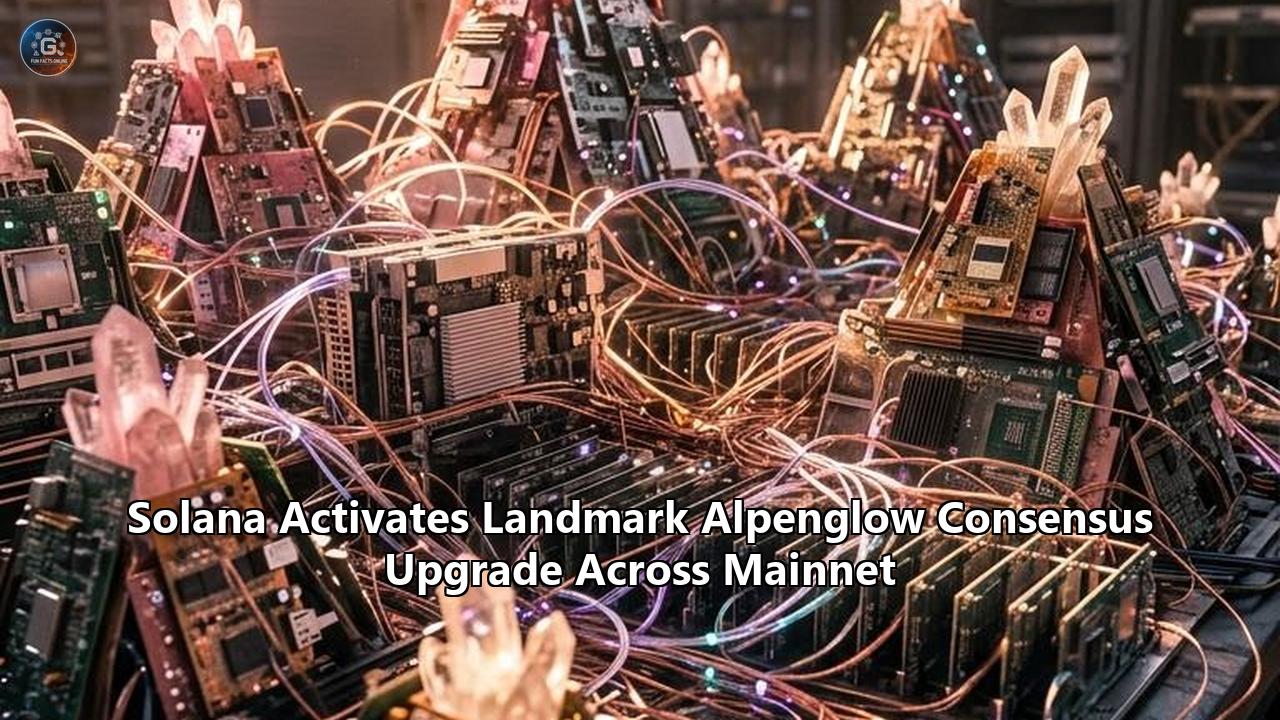
Solana’s validator network crossed slot 459,653,000 at the boundary of epoch 1064 on Wednesday, October 21, 2026, marking the successful activation of the Solana Alpenglow upgrade across mainnet-beta. Executed through the coordinated "Alpenswitch" migration protocol, the transition retired TowerBFT—the consensus engine that had anchored the network since its inception in March 2020—in favor of a newly engineered consensus protocol named Votor.
The primary operational objective of the upgrade is a dramatic reduction in settlement latency. Under the legacy architecture, transactions required approximately 12.8 seconds across 32 successive blocks to achieve deterministic finality—the point at which a transaction is mathematically irreversible. Votor compresses that settlement window to an estimated 100 to 150 milliseconds, aligning cryptographic finality with the human perception of instantaneous interaction.
LEGACY CONSENSUS (TowerBFT)
[Block Created] ──> [Optimistic Confirmation (~400ms)] ──> [32 Slots / Exponential Lockout] ──> [Finality: ~12.8s]
(Votes submitted as regular on-chain transactions, consuming 50%+ of all block space)

ALPENGLOW CONSENSUS (Votor)
[Block Created] ──> [Direct Validator P2P Voting] ──> [BLS Quorum Certificate] ──> [Finality: ~150ms]
(Votes move off-chain; zero user block space consumed; instant settlement)
The cutover, greenlit by validator governance under Solana Improvement Document 0326 (SIMD-0326) with 98.27% of participating stake in favor, represents the most complex live consensus overhaul on a major blockchain since Ethereum’s transition from Proof of Work in 2022.
"This is the largest, most ambitious blockchain upgrade since 'The Merge,' and our team took it from a white paper to running on mainnet in under 18 months," said Brennan Watt, chief executive officer of Anza, the core engineering organization leading the deployment. "This aggressive timeline was only possible because of the caliber of our development team and the incredible cast of ecosystem teams and validator operators who helped harden the protocol over months of testing."
Beyond slashing latency, the switch fundamentally restructures the network’s data pipeline and validator economics. By removing consensus voting transactions from block payloads, the network eliminates a massive source of internal congestion, freeing up more than half of its total block capacity for commercial applications, decentralized finance, and real-time payments.
The Illusion of Speed: Why Solana Required a Consensus Rebuild
To understand why Solana developers undertook an 18-month engineering campaign to replace their core protocol, one must unpack the difference between user-perceived speed and cryptographic finality.
Throughput != Latency != Finality
-----------------------------------------------------------------------------------------
Metric                  Legacy Solana (TowerBFT)            Alpenglow (Votor Phase 1)
-----------------------------------------------------------------------------------------
Block/Slot Time         400 ms (or 200 ms under SIMD-0525)  Unchanged (Execution unchanged)
Optimistic Confirmation ~400 ms                             ~150 ms
Deterministic Finality  ~12.8 seconds (32 slots)            ~100–150 milliseconds
Consensus Footprint     54%–59% of all on-chain txs         0% of user block space
Voting Fee Structure    Per-transaction gas fees            Flat 0.8 SOL per epoch (VAT)
-----------------------------------------------------------------------------------------
For years, Solana built an international reputation on transaction throughput and ultra-low latency. Generating blocks at intervals between 200 and 400 milliseconds, user interfaces made transactions appear settled almost before a finger left the screen. Yet behind that slick interface sat a probabilistic assumption known as "optimistic confirmation".
When a user submits a transfer on Solana, the current designated block producer (known as the leader) orders the transaction and streams it to the cluster. As soon as a supermajority (two-thirds) of the validator stake acknowledges observing that block, client software displays the transaction as "confirmed." However, confirmation is not absolute finality. In distributed systems, temporary network splits, software panics, or malicious validator collusion can spark chain reorganizations (reorgs), where an alternate fork outpaces the current fork and effectively erases recent unfinalized transactions.
True deterministic finality represents the point of mathematical certainty: the cryptographic state where rolling back or altering a transaction requires corrupting a supermajority of the consensus stake, triggering verifiable, punitive slashing.
Under TowerBFT, achieving deterministic finality was an iterative, agonizingly deliberate process. TowerBFT adapted the classical Practical Byzantine Fault Tolerance (PBFT) model to leverage Solana’s continuous cryptographic clock, Proof of History (PoH). Validators cast individual votes for their preferred block fork. Each consecutive vote doubled the validator's lockout period—the duration during which that validator was forbidden, on pain of protocol penalty, from voting on a competing fork.
Slot 0: Lockout = 2 slots
Slot 1: Lockout = 4 slots
Slot 2: Lockout = 8 slots
...
Slot 31: Lockout = 2^32 slots (~54 years) -> Block is "Rooted" (Finalized)
A block was only deemed fully finalized (or "rooted") once 32 consecutive blocks had been successfully constructed on top of it. At 400-millisecond slot times, that math imposed a fixed latency barrier:
$$32 \text{ slots} \times 0.4 \text{ seconds} = 12.8 \text{ seconds}$$
Even with contemporary slot optimization reducing intervals to approximately 200 milliseconds, finality still required roughly seven seconds.
For retail decentralized exchange swaps, a seven-to-twelve-second finality window was manageable because applications accepted the negligible risk of optimistic confirmation. But for institutional finance, cross-chain messaging bridges, and centralized exchange deposit desks, that window represented real operational friction.
Bridges connecting Solana to Ethereum or Layer-2 ecosystems could not credit tokens based on optimistic assumptions; a successful chain reorganization would leave the bridge insolvent. Centralized exchanges like Coinbase and Binance historically forced Solana depositors to wait 32 confirmations (nearly 15 seconds) before unlocking funds.
Furthermore, TowerBFT suffered from an inefficient data structure: validators submitted their consensus votes as standard, on-chain transactions packed into blocks alongside user swaps, NFT mints, and transfers. By late 2025, network monitoring showed that between 54% and 59% of all transactions processed on Solana were validator consensus votes rather than commercial application traffic. The network was effectively dedicating more than half of its hardware capacity and bandwidth just to whisper to itself about which block came next.
From Academic Critique to Mainnet Engine: The Origins of Alpenglow
The technical blueprint for Alpenglow was born not out of an incremental internal patch, but from an external academic critique.
In 2024, a team of distributed systems researchers from ETH Zurich—doctoral candidates Quentin Kniep and Jakub Sliwinski, alongside Professor Roger Wattenhofer—published a theoretical paper titled Halting the Solana Blockchain with Epsilon Stake. Wattenhofer, an internationally recognized figure in algorithmic consensus, and his team demonstrated that under adversarial network conditions, an attacker controlling an exceptionally small fraction of stake could exploit TowerBFT’s lockout logic to stall block production.
Recognizing both the validity of the critique and the limitations of TowerBFT, Anza recruited Kniep, Sliwinski, and Wattenhofer to design a ground-up replacement for Solana’s consensus foundation.
In May 2025, the trio published the theoretical white paper for Alpenglow. Rather than attempting to patch TowerBFT's interlocking exponential lockouts, the team proposed jettisoning TowerBFT and decoupling voting from the execution ledger entirely.
The architectural proposal split consensus modernization into three sequential phases:
- Votor (Consensus and Finalization Layer): Replaces TowerBFT with direct validator-to-validator peer-to-peer voting and aggregate cryptographic certificates, dropping finality from seconds to milliseconds.
- Fast Leader Handover: Introduces protocol-level pipelining that allows the subsequent slot leader to begin constructing blocks optimistically without waiting for the previous slot's finality certificate to clear.
- Rotor (Block Propagation Layer): A future replacement for Solana’s tree-structured Turbine system, using erasure coding to broadcast transaction shredded data across the validator cluster proportionally to stake.
               ┌────────────────────────────────────────────────────────┐
               │             THE ALPENGLOW CONSENSUS SUITE              │
               └────────────────────────────────────────────────────────┘
                                            │
          ┌─────────────────────────────────┴─────────────────────────────────┐
          ▼                                                                   ▼
┌───────────────────────────────────┐                       ┌───────────────────────────────────┐
│     PHASE 1: VOTOR (LIVE NOW)     │                       │     PHASE 3: ROTOR (PLANNED)      │
├───────────────────────────────────┤                       ├───────────────────────────────────┤
│ • Replaces TowerBFT               │                       │ • Successor to Turbine            │
│ • Direct P2P off-chain messaging  │                       │ • Erasure-coded block dispersal   │
│ • BLS Signature Aggregation       │                       │ • Relays proportional to stake    │
│ • Fast Path: 80% stake (1 round)  │                       │ • Asymptotically optimal use of   │
│ • Fallback Path: 60% stake (2 rds)│                       │   validator cluster bandwidth     │
│ • Deterministic finality: ~150 ms │                       │ • Removes leader bottleneck       │
└───────────────────────────────────┘                       └───────────────────────────────────┘
The core governance milestone arrived in September 2025, when validators overwhelmingly voted in favor of SIMD-0326. Before touching mainnet-beta, Anza orchestrated five months of adversarial drills. Starting in May 2026, a dedicated community test cluster composed of over 100 geographically distributed validator operators simulated edge cases: deliberate machine failovers, localized fiber cuts, out-of-order block generation, and simulated state divergence across software versions.
Nine dry-run network migrations were staged on testing clusters. Finally, in late September 2026, public testnet successfully executed the switchover, paving the way for the production release in Agave client version 4.3 and Wednesday’s mainnet-beta cutover.
Deconstructing Votor: The Mathematics of Sub-Second Finality
When evaluating the architectural scope of the Solana Alpenglow upgrade, the most radical departure from traditional blockchain architecture is how Votor achieves agreement.
In classical distributed systems, achieving Byzantine Fault Tolerance over a global network of hundreds or thousands of nodes typically requires multiple rounds of quadratic communication. If 1,000 validators must each send messages to 999 other validators, the network must process approximately 1,000,000 messages for a single decision. This communication explosion is why systems like Ethereum rely on epoch boundaries (taking 12 to 15 minutes for Casper finality) or why Tendermint-based chains cap active validator counts at 100 to 180 nodes.
Votor solves this bottleneck by combining direct gossip routing with Boneh–Lynn–Shacham (BLS) signature aggregation.
TRADITIONAL ED25519 VERIFICATION:
Validator A Vote ──> [Signature 1] ──> Verified Individually
Validator B Vote ──> [Signature 2] ──> Verified Individually
Validator C Vote ──> [Signature 3] ──> Verified Individually
... (Requires massive bandwidth and computational resources)

BLS SIGNATURE AGGREGATION (Votor):
[Sig 1] + [Sig 2] + [Sig 3] + ... + [Sig N]
                 │
                 ▼
    [Single Compact Aggregate Signature] (Quorum Certificate)
(Verified in one mathematical pairing operation against aggregated public keys)
The Role of BLS Signatures (SIMD-0387)
Under legacy Solana, every validator used Ed25519 digital signatures to sign their votes. While Ed25519 signatures are exceptionally fast to verify individually, they cannot be natively merged. One thousand Ed25519 votes require 1,000 distinct verification checks and consume roughly 64 kilobytes of raw payload.
Months before Alpenglow’s mainnet activation, Anza passed SIMD-0387 on July 8, 2026, mandating that every validator register an on-chain BLS12-381 public key alongside their existing identity.
BLS signatures exhibit an algebraic property known as bilinearity. If validator $i$ signs message $M$ using private key $sk_i$, generating signature $\sigma_i$, a collector node can take signatures from hundreds of different validators and combine them via elliptic curve point addition into a single aggregated signature, $\sigma_{\text{agg}}$:
$$\sigma_{\text{agg}} = \sum_{i=1}^{n} \sigma_i$$
A validator checking this certificate does not need to verify every node’s signature independently. Instead, it sums the registered BLS public keys of the contributing validators into an aggregate key ($PK_{\text{agg}}$) and performs a single cryptographic pairing calculation:
$$e(\sigma_{\text{agg}}, P) = e(H(M), PK_{\text{agg}})$$
This mathematical efficiency allows thousands of individual node confirmations to be compressed into a single Quorum Certificate (QC) measuring a few hundred bytes.
The Dual-Path Consensus Protocol
Votor does not force the network to operate at a fixed communication cadence. Instead, it runs two concurrent agreement modes: a Fast Path and a Fallback (Slow) Path.
                       BLOCK PROPOSED BY LEADER
                                  │
                                  ▼
                     VALIDATORS BROADCAST VOTES
                                  │
             ┌────────────────────┴────────────────────┐
             │                                         │
     >= 80% STAKE VOTES?                       60% TO 79% STAKE VOTES?
             │                                         │
            YES                                       YES
             │                                         │
             ▼                                         ▼
         FAST PATH                               FALLBACK PATH
             │                                         │
    1 Round of Voting                         2 Rounds of Voting
             │                                         │
             ▼                                         ▼
   FINALITY: ~100-150 ms                     FINALITY: ~300-400 ms
(Immediate Notarization) (Two-Step Confirmation)- The Fast Path (One Round):
When network conditions are healthy and low in latency, validators broadcast their BLS vote for a newly proposed block directly across high-speed peering channels. If $\ge 80\%$ of the active staked weight votes to notarize the block in the opening round, the block achieves deterministic finality immediately. No secondary round of back-and-forth voting is needed.
Because modern validator hardware and optimized networking can complete this gossip hop across global data centers within 100 to 150 milliseconds, finality is achieved almost immediately after the block is distributed.
- The Fallback Path (Two Rounds):
If network congestion, submarine cable severances, or hardware failures prevent the block from securing the 80% supermajority, Votor automatically steps down to its fallback mechanism. If at least $60\%$ of stake signs the block, an initial notarization certificate is formed, triggering a second round of voting to resolve conflicting forks or finalize the state.
Even in this degraded scenario, finality requires only two network round-trips (roughly 300 to 400 milliseconds)—still orders of magnitude faster than TowerBFT’s multi-second requirement.
Mathematically, the time required to lock a block into finality is defined as:
$$T_{\text{finality}} = \min(\delta_{80\%}, 2\delta_{60\%})$$
Where $\delta_x$ represents the network propagation and aggregation delay required to collect $x$ percent of active stake votes. In production testing across hundreds of distributed validator nodes, the 80% fast-path threshold was satisfied in over 94% of operational slots, locking finality in near the theoretical 150-millisecond floor.
Fault Tolerance Redefined: Understanding "20 + 20" Resilience
Most classical consensus protocols rely on the standard Byzantine Fault Tolerance assumption formulated by Leslie Lamport, Robert Shostak, and Marshall Pease in 1982: a system can remain safe and continue making progress so long as strictly fewer than one-third ($< 33.3\%$) of participants are corrupt or offline.
If malicious actors control 34% of the stake, they can halt block production by refusing to participate; if they split their votes, they can potentially threaten chain safety.
CLASSICAL BFT MODEL (e.g., Tendermint, PBFT)
Total Fault Tolerance: 33.3%
[ Malicious Stake + Offline Stake MUST BE < 33.3% ]
If 15% Malicious + 20% Offline = 35% Total Faults ──> NETWORK HALTS

ALPENGLOW "20 + 20" MODEL (SIMD-0326)
Asymmetric Tolerance: 20% Malicious Stake + 20% Offline Stake
[ Can tolerate UP TO 20% Active Adversarial Sabotage ]
                    +
[ Can simultaneously tolerate UP TO 20% Complete Node Outages ]
Total Resilience Envelope under defined timing = 40%
Alpenglow fundamentally breaks away from this rigid single-threshold paradigm, implementing what researchers Quentin Kniep, Jakub Sliwinski, and Roger Wattenhofer termed a "20 + 20" resilience model.
The Alpenglow protocol separates malicious adversarial behavior (such as equivocation, where a validator signs two conflicting blocks at the same height) from crash faults (where a validator node abruptly crashes, drops off the network, or suffers a localized transit blackout).
Under SIMD-0326, the network guarantees safety and liveness provided that:
- No more than 20% of the active stake is actively Byzantine (maliciously attempting to fork or corrupt consensus).
- Simultaneously, an additional 20% of active stake can be completely offline or partitioned.
In essence, the network can continue operating, executing transactions, and achieving finality even if 40% of the validator base is compromised by a mixture of hostile behavior and server infrastructure outages.
This resilience model directly reflects the realities of running high-performance hardware across global data centers. In large-scale decentralized systems, simultaneous node crashes frequently coincide with targeted distributed denial-of-service (DDoS) campaigns.
By decoupling crash thresholds from adversarial thresholds through its dual-path voting design, Alpenglow insulates Solana from the cascading liveness failures that occasionally froze the blockchain during its early developmental years.
Validator Economics: The 0.8 SOL Admission Ticket
Beyond transaction speed, the Solana Alpenglow upgrade fundamentally alters validator economics, rewriting how node operators cover operational costs and maintain active participation.
HISTORIC TOWERBFT EXPENSE MODEL:
Each Vote = On-Chain Transaction
~2 to 3 Votes per second * 432,000 slots per epoch
Daily Voting Cost: ~1.5 to 2.5 SOL per validator (regardless of profitability)
Result: Massive capital barrier for smaller validators; chain filled with vote data.

ALPENGLOW SIMD-0357 MODEL:
On-Chain Vote Transactions = 0
Each Epoch: Protocol burns a flat Validator Admission Ticket (VAT)
Cost: Exactly 0.8 SOL per epoch (deducted directly from the vote account)
Result: Predictable cost structure; 0.8 SOL burned permanently, reducing circulating supply.
Eliminating the Per-Vote Transaction Burden
Under TowerBFT, every vote submitted by a validator was an actual transaction published to the ledger. Although vote transactions paid deeply discounted network fees, the volume was staggering. A validator voting consistently across every slot could submit between 150,000 and 200,000 vote transactions per day, racking up fees between 1.5 and 2.5 SOL every 24 to 48 hours.
For community-run nodes, independent developers, and boutique validation operations, these static transaction fees created a heavy recurring expense. A validator with small stake delegation would routinely spend thousands of dollars a month purely on vote submission fees, frequently operating at a net economic loss even before accounting for datacenter hosting, bare-metal hardware, and 10-gigabit fiber connections.
The Validator Admission Ticket (VAT) Under SIMD-0357
Alpenglow eliminates individual vote transaction fees entirely. Because votes are communicated directly peer-to-peer and aggregated into compact certificates, validators no longer write transaction records to blocks.
To replace the economic skin-in-the-game previously represented by vote fees, SIMD-0357 introduced the Validator Admission Ticket (VAT).
Starting with epoch 1064, every validator participating in consensus has an exact fee of 0.8 SOL deducted from its vote account at the beginning of each epoch. This 0.8 SOL is not paid to a leader or transferred to the Solana Foundation; it is burned permanently from existence, exerting deflationary pressure on the SOL monetary supply.
The VAT framework enforces precise operational parameters:
- Pre-Funded Requirement: Validators must hold at least 0.8 SOL above their rent-exempt balance in their designated vote account prior to the epoch transition. If an operator fails to maintain this minimum balance, the protocol declines to issue an admission ticket.
- Exclusion from Consensus: A validator that fails to pay its VAT is barred from producing blocks and excluded from the voting schedule for the entire subsequent epoch. For stakers delegating to that validator, this results in an immediate loss of staking rewards for that 24-to-48-hour period.
- Admission Cap: The consensus protocol caps active validator admission at the top 2,000 nodes ranked by delegated stake weight. With Solana mainnet-beta currently maintaining roughly 650 to 750 active consensus nodes, this threshold leaves substantial headroom for new institutional and independent operators to join without degrading signature aggregation speeds.
                     EPOCH BOUNDARY INITIALIZATION
                                  │
                                  ▼
               VALIDATOR VOTE ACCOUNT BALANCE CHECK
                                  │
              ┌───────────────────┴───────────────────┐
              │                                       │
     BALANCE >= RENT + 0.8 SOL?            BALANCE < RENT + 0.8 SOL?
              │                                       │
             YES                                     NO
              │                                       │
              ▼                                       ▼
     0.8 SOL BURNED TO NULL                  VALIDATOR EXCLUDED
              │                                       │
              ▼                                       ▼
• Admission Ticket Granted             • Barred from consensus schedule
• BLS key active in aggregator         • Produces zero blocks
• Stakers earn full rewards            • Stakers earn 0 rewards this epoch
This economic model delivers financial predictability. A validator’s cost of consensus participation is decoupled from network transaction volume, slot pacing variations, or localized gas price dynamics.
At 0.8 SOL per epoch (with mainnet epochs averaging approximately 24 to 36 hours under contemporary slot frequencies), annual operational consensus fees stabilize at roughly 200 to 290 SOL, allowing node operators to budget infrastructure costs with arithmetic certainty.
Dismantling the "Ghost TPS" Mirage: What Happens to the Dashboards?
One of the most immediate, public-facing consequences of Alpenglow’s activation will unfold across public telemetry dashboards and blockchain explorers.
For years, public tracking sites like Solana Beach, Solscan, and CoinGecko displayed aggregate Transactions Per Second (TPS) figures hovering between 2,500 and 4,500. To the casual observer, Solana appeared to process 3,000 commercial user actions per second.
In reality, because TowerBFT cast consensus votes as transactions packed into blocks, between 1,500 and 2,500 of those recorded "transactions" were simply validator votes. Industry observers frequently cited this quirk to downplay Solana’s performance, arguing that the network was inflating throughput with internal consensus traffic.
PRE-ALPENGLOW MAINNET BLOCK (Avg. 400ms Slot)
┌────────────────────────────────────────────────────────┐
│  TOTAL TRANSACTIONS: ~1,200                            │
│                                                        │
│  [  Validator Vote Tx  ] [  Validator Vote Tx  ]       │
│  [  Validator Vote Tx  ] [  Validator Vote Tx  ]       │  Consensus Votes: ~650
│  [  Validator Vote Tx  ] [  Validator Vote Tx  ]       │  (54% of block capacity)
│  ----------------------------------------------------  │
│  [ Raydium Swap ] [ Jupiter Route ] [ Pyth Oracle Update ]│  User Commercial Tx: ~550
│  [ Transfer SOL ] [ Drift Margin  ] [ NFT Mint         ]│  (46% of block capacity)
└────────────────────────────────────────────────────────┘

POST-ALPENGLOW MAINNET BLOCK (Avg. 400ms Slot)
┌────────────────────────────────────────────────────────┐
│  TOTAL TRANSACTIONS: ~1,100                            │
│                                                        │
│  [ Raydium Swap ] [ Jupiter Route ] [ Pyth Oracle Update ]│
│  [ Transfer SOL ] [ Drift Margin  ] [ NFT Mint         ]│  User Commercial Tx: ~1,100
│  [ Cross-Chain Bridge Settlement  ] [ Lending Liquid.  ]│  (100% of block capacity)
│  [ Micro-Payment] [ Game State Sync] [ Token Launch   ]│  ZERO VOTE TRANSACTIONS
│                                                        │
│  (Votes aggregated off-chain into single BLS Header)   │
└────────────────────────────────────────────────────────┘
Following the activation of Votor, public explorers will display an apparent structural shift:
- Reported TPS figures will abruptly drop from 3,000+ down to 800–1,200.
- True application capacity will double or triple, because the block space previously crowded out by validator voting transactions has been liberated for general compute.
Explorers are rapidly updating indexing software to clarify these metrics. The phantom voting transactions are gone. Every transaction observed on the Solana ledger following slot 459,653,000 represents actual application compute: a decentralized finance swap, a transfer, a liquidity deposit, an oracle update, or an account state change.
Rather than signaling diminished demand, a lower post-upgrade headline TPS reflects a far cleaner, more efficient state machine that no longer clogs its execution tubes with consensus messaging.
Real-World Ripple Effects: DeFi, Bridges, and High-Frequency Finance
While cutting deterministic finality from 12.8 seconds to 150 milliseconds is an extraordinary computer science feat, its ultimate significance lies in how this speed alters market structure across the broader cryptocurrency landscape.
                     SETTLEMENT LATENCY COMPARISON
-------------------------------------------------------------------------
Rail / Network                      Deterministic Finality Time
-------------------------------------------------------------------------
Bitcoin (6 Confirmations)           ~60 minutes
Ethereum L1 (Casper FFG)            ~12.8 to 15 minutes
Optimistic Rollups (Dispute Period) ~7 days
Standard ZK-Rollup (Proof Gen)      ~10 to 30 minutes
Legacy Solana (TowerBFT)            ~12.8 seconds
Visa / Mastercard Processing        ~150 to 200 milliseconds
Solana Alpenglow (Votor Fast Path)  ~100 to 150 milliseconds
-------------------------------------------------------------------------
1. The Death of Bridge Delay and Intent Arbitrage
Cross-chain bridges have long served as one of Web3's most brittle components. When moving assets between Solana and ecosystems like Ethereum or Arbitrum, bridge protocols (such as Wormhole, deBridge, or LayerZero) were constrained by Solana's 12.8-second deterministic finality window.
If a bridge credited funds on Ethereum after receiving only an "optimistic confirmation" on Solana, a subsequent validator reorganization on Solana could theoretically allow a malicious actor to spend funds on Solana, bridge them out, rollback the Solana transaction, and walk away with double the capital. As a result, secure cross-chain bridges forced users to wait 32 blocks before minting or releasing target tokens.
With the Solana Alpenglow upgrade, cross-chain messaging can achieve mathematical finality inside of a single human eye-blink.
A user bridging USDC from Solana to Base or Arbitrum can execute an intent order that finalizes deterministically on Solana within 150 milliseconds, enabling relayers to disburse destination capital instantaneously without capital at risk. The friction of cross-chain liquidity fragmentation is reduced to the transit time of light over fiber cables.
2. Centralized Exchange Parity and Instant Ingestion
Depositing crypto into a centralized exchange has historically felt clunky compared to the responsive front-ends of traditional brokerages. When traders send assets to Coinbase, Kraken, or Binance, the exchange software tracks the deposit through a sequence of confirmations. For Bitcoin, users wait 30 to 60 minutes; for Ethereum, three to five minutes; for legacy Solana, roughly 15 seconds.
Following Alpenglow, Solana transactions become irreversible within roughly 150 milliseconds.
Exchange engineering teams are adjusting risk parameters to credit Solana deposits after just one or two block QCs. Depositing SOL or stablecoins to an exchange order book now settles with the same speed as updating an internal database, enabling rapid arbitrage between on-chain decentralized exchanges and off-chain centralized venues.
                           ON-CHAIN DEX ARBITRAGE
                                     │
                 ┌───────────────────┴───────────────────┐
                 │                                       │
         LEGACY TOWERBFT                         ALPENGLOW (VOTOR)
                 │                                       │
• Trader detects CEX/DEX spread         • Trader detects CEX/DEX spread
• Submits on-chain atomic swap          • Submits on-chain atomic swap
• Swap optimistically lands in 400ms    • Swap lands and finalizes in ~150ms
• Must wait ~12.8s for true finality    • Zero rollback risk almost immediately
• Risk of toxic flow during lag         • Market makers quote tighter spreads
• Wider spreads to buffer risk          • Capital efficiency matches Nasdaq/CME
3. High-Frequency Order Books and Capital Efficiency
Automated market makers (AMMs) tolerate slight confirmation delays because their price curves automatically adjust based on reserve ratios. But central limit order book (CLOB) architectures—such as Phoenix and OpenBook—depend on deterministic execution.
When high-frequency market makers quote bids and asks on-chain, any lag between trade acceptance and deterministic finality represents toxic risk. If a market crash occurs during a multi-second finality window, market makers can be caught holding bad fills on unfinalized forks. To compensate for this structural exposure, market makers quote wider bid-ask spreads.
By delivering sub-200ms finality, Votor gives market makers on Solana the settlement certainty of traditional electronic exchanges like Nasdaq or CME. Spreads can compress, slippage for everyday traders decreases, and institutional trading desks can deploy capital without holding back massive insurance reserves to protect against chain reorgs.
Architectural Deep Dive: How the "Alpenswitch" Unfolded in Real Time
Replacing a consensus engine on a blockchain actively securing tens of billions of dollars in economic value is the distributed systems equivalent of swapping out a commercial airliner’s jet engine mid-flight.
The procedure that accomplished this feat at slot 459,653,000 is formalized under SIMD-0384: Alpenswitch.
                              THE ALPENSWITCH TRANSITION
═══════════════════════════════════════════════════════════════════════════════════
Slot 459,648,000 (Epoch 1064 Start)
│  • SIMD-0384 Feature Gate Arms
│  • TowerBFT continues active operation for exactly 5,000 buffer slots (~18 min)
│  • Validators verify BLS public key registry and vote account balances
▼
Slot 459,652,999 (Genesis Boundary Slot)
│  • Final TowerBFT block constructed
│  • 446 of 654 active validators submit pre-transition signatures
│  • Genesis certificate (getAgGenesisCert) compiled
▼
Slot 459,653,000 (THE CUTOVER BOUNDARY)
│  • TowerBFT voting engine instantly shut down
│  • On-chain voting program stops processing vote transactions
│  • Votor P2P message bus opens
│  • 0.8 SOL burned from eligible validator vote accounts
▼
Slot 459,653,001+ (Native Alpenglow Consensus)
   • First pure Votor block produced
   • BLS aggregate signatures form primary Quorum Certificates
   • Deterministic finality drops to sub-200ms
═══════════════════════════════════════════════════════════════════════════════════
The migration was carefully choreographed through four distinct technical stages:
- Feature Gate Arming at Epoch 1064 Boundary:
When the cluster crossed into epoch 1064 at approximately 13:20 UTC, protocol feature gate A1pengvuM6JEcyNuTnMqepBKhwHE3N6PmUrdATGawhJS activated. However, the chain did not immediately switch.
To ensure total network synchronization, the software maintained legacy TowerBFT for an exact buffer window of 5,000 slots (approximately 18 minutes). This buffer provided validator nodes time to initialize their off-chain communication channels and confirm their BLS key registries.
- The Genesis Certificate Lockout (Slot 459,652,999):
At slot 459,652,999—the final block before cutover—the network compiled the root state. Four hundred and forty-six of the network’s active validators, representing well over the requisite supermajority of active stake, successfully verified and signed the transitional state proof.
This cryptographic snapshot bound the final TowerBFT root to the initial Alpenglow state, ensuring that historical transaction roots remained cryptographically linked.
- Consensus Cutover (Slot 459,653,000):
As slot 459,653,000 was executed, the internal transaction validator routine abruptly decoupled. The on-chain vote program permanently ceased admitting vote transactions into block space. Simultaneously, the Agave client consensus modules flipped the active voting loop to the Votor peer-to-peer gossip channels.
For validators that had neglected to fund their vote accounts with 0.8 SOL or had failed to register valid BLS keys, the software executed an immediate, graceful disconnect from block production.
- Quorum Certificate Verification:
Within 300 milliseconds of crossing slot 459,653,000, the first Alpenglow native Quorum Certificate was generated, signed by over 80% of active validator stake, and validated across the cluster. The transition completed without stalling block production or requiring a centralized manual restart.
What Changes for Developers, Operators, and Regular Users?
Whenever an L1 blockchain rewires its consensus logic, ecosystem participants must evaluate the blast radius of breaking changes. The Solana engineering team went to great lengths to ensure that while the engine was replaced, the steering wheel and pedals remained identical.
                     IMPACT MATRIX ACROSS THE STACK
═══════════════════════════════════════════════════════════════════════════════════
PARTICIPANT          ACTION REQUIRED?        PRIMARY OPERATIONAL CHANGE
═══════════════════════════════════════════════════════════════════════════════════
Token Holders        NO                     None. Wallets, token addresses, and
                                            delegated stakes operate identically.
-----------------------------------------------------------------------------------
Smart Contracts      NO                     SVM execution and programs are
                                            unaltered. Fees and instructions remain
                                            standard.
-----------------------------------------------------------------------------------
dApp Developers      MINIMAL                Commitment level "confirmed" and
                                            "finalized" converge. UI confirmation
                                            spinners can be retired.
-----------------------------------------------------------------------------------
RPC Infrastructure   YES                    Block streams encounter new `bank_id`
                                            metadata; internal vote transaction
                                            filters must be updated.
-----------------------------------------------------------------------------------
Validators           YES (MANDATORY)        Must run Agave 4.3+ or compatible
                                            Firedancer; maintain BLS keys; pay 0.8
                                            SOL VAT every epoch.
═══════════════════════════════════════════════════════════════════════════════════
End Users and Token Delegators
For retail token holders, decentralized application users, and stakers, the upgrade requires zero manual intervention. Private keys, token balances, smart contracts, and wallet user interfaces function as before.
However, users interacting with applications will notice an immediate qualitative enhancement: interface spinners confirming payments, NFT transfers, and token approvals will disappear almost instantly. The historical wait for an exchange or payment processor to declare a transaction "settled" has vanished.
For SOL delegators, staking rewards continue accruing as intended, provided their chosen validator node completed its technical migration. Stakers whose chosen validators failed to register BLS public keys or neglected to pre-fund their vote accounts will stop earning rewards until their operators rectify the shortfall.
Application Developers and Smart Contract Engineers
Solana’s execution layer—the Solana Virtual Machine (SVM)—remains unchanged. Smart contracts written in Rust, Python (Seahorse), or Solidity (via hyper-compilers) execute identically. Gas fees, transaction formats, and account read/write locks continue operating without modification.
The primary upgrade impact for frontend developers sits within JSON-RPC API commitment configurations. Historically, developers configuring web3 client libraries chose between two primary commitment levels:
- 'confirmed': The block was optimistically agreed upon by two-thirds of stake (low latency, tiny reorg risk).
- 'finalized': The block reached 32 successive root confirmations (high latency, zero reorg risk).
With Votor live on mainnet, 'confirmed' and 'finalized' converge into practically the same event. Applications no longer need to implement complex polling logic or fallback timeouts to wait for root status; querying 'finalized' now returns confirmation inside 200 milliseconds.
Infrastructure Providers, gRPC Indexers, and RPC Nodes
The heaviest integration burden lands on downstream infrastructure operators: RPC providers, block indexers, centralized exchange engineers, and MEV searchers.
Because Votor decouples voting from blocks, RPC nodes streaming shreds (the smallest packet fragments of a Solana block) now encounter a new structural field: bank_id.
Under Votor, temporary parallel banks can exist simultaneously within a single slot while validators exchange fast-path certificates. Indexers relying on old block stream assumptions must update their parsing libraries to track bank_id metadata to distinguish between competing candidate banks within the same slot window before final notarization.
What Lies Ahead: Fast Leader Handover and the Path to Rotor
The successful activation of the Solana Alpenglow upgrade marks the completion of the consensus roadmap's critical first chapter, but the overarching protocol evolution remains ongoing.
THE EVOLUTIONARY ROADMAP
─────────────────────────────────────────────────────────────────────────────
[ October 21, 2026 ]  PHASE 1: VOTOR ACTIVATION (SIMD-0326)
                      • Sub-second deterministic finality live on mainnet
                      • BLS aggregation replacing TowerBFT
                      • VAT economic transition active
                              │
                              ▼
[ Target: Q1 2027 ]   PHASE 2: FAST LEADER HANDOVER (SIMD-0337)
                      • Optimistic pipelined block generation
                      • Inter-slot transition latency drops to near-zero
                      • Leaders build immediately without waiting for QC ACK
                              │
                              ▼
[ Target: Late 2027 ] PHASE 3: ROTOR BLOCK DISPERSAL (SIMD-TBD)
                      • Full retirement of Turbine tree-broadcasting
                      • Erasure-coded stake-weighted distribution
                      • Multi-gigabit cluster throughput without bottlenecks
─────────────────────────────────────────────────────────────────────────────
With Votor active and delivering sub-second finality, Anza and ecosystem development teams are redirecting engineering resources toward the two remaining phases of the original Alpenglow design:
1. SIMD-0337: Fast Leader Handover Markers
Currently, while Votor finalizes individual blocks within 150 milliseconds, block producers (leaders) must still respect fixed scheduling boundaries when transferring production rights to the next sequential leader in the leader schedule.
SIMD-0337 introduces Fast Leader Handover markers. This protocol adjustment permits the subsequent slot leader to begin optimistically constructing its block payload the moment it receives shredded transactions from the current leader, rather than pausing to verify that the cluster’s aggregate Quorum Certificate has cleared the previous slot.
This pipelining collapses inter-slot handover latency, enabling uninterrupted, fluid transaction execution across multi-leader shifts.
2. Rotor: Overhauling Block Propagation
The ultimate frontier for Solana's lower-level architecture is Rotor—the component slated to replace Turbine.
Today, block propagation is handled by Turbine, which breaks blocks into small packets called shreds and transmits them down a tree-structured hierarchy of validators. While Turbine was foundational to Solana’s early success, hierarchical trees suffer from hop-by-hop latency amplification; a slow or dropping node near the top of the tree can delay hundreds of downstream validators.
Rotor reimagines block distribution using advanced erasure coding. Under Rotor:
- The leader shreds a block and distributes independent, coded slices directly to validators proportionally to their staked weight.
- Validators cross-relay these erasure-coded fragments across a flattened, single-hop mesh.
- No single validator node bears the brunt of distributing the entire block, alleviating the leader's bandwidth choke point and ensuring optimal cluster-wide bandwidth utilization.
Rotor is currently progressing through independent mathematical formalization and testnet sandboxing, with core developers eyeing a governance proposal once Votor has established several months of stable mainnet operation.
Client Diversity and Firedancer Integration
Wednesday’s migration also represented a trial for Solana’s emerging multi-client ecosystem.
While the primary Agave 4.3 client powered the Alpenswitch migration, Jump Crypto’s independent, C++-based Firedancer client software supported Alpenglow consensus compatibility through its latest 26.10 production candidate releases.
With both Agave and Firedancer clients validating blocks under the Votor consensus rules, Solana takes an essential step toward hardening its network resilience against client-specific software bugs—a maturity milestone that places it alongside Ethereum in achieving true multi-client architectural redundancy.
               SOLANA MULTI-CLIENT MAINNET CONSENSUS
                                 │
        ┌────────────────────────┴────────────────────────┐
        ▼                                                 ▼
┌───────────────────────────────┐ ┌───────────────────────────────┐
│         AGAVE 4.3+            │ │       FIREDANCER 26.10+       │
│  • Rust Implementation        │ │  • C / C++ Implementation     │
│  • Core Anza Engineering      │ │  • Jump Crypto Development    │
│  • Native Votor BLS Engine    │ │  • Ultra-High Throughput Path │
└───────────────────────────────┘ └───────────────────────────────┘
        │                                                 │
        └────────────────────────┬────────────────────────┘
                                 │
                                 ▼
                     UNIFIED VOTOR CONSENSUS
                   (~150ms Deterministic Finality)
As epoch 1064 continues to unfold, engineers across the globe are scrutinizing real-time telemetry: monitoring Quorum Certificate formation times, observing fork choice convergence, tracking the flat 0.8 SOL burning rate, and measuring cross-border settlement confirmations.
By successfully decommissioning TowerBFT and activating Votor on its primary live network, Solana has achieved a structural objective: proving that a globally distributed, decentralized blockchain can deliver deterministic settlement speeds that match the fastest centralized financial networks on Earth.
Reference:
- https://solana.com/upgrades/alpenglow
- https://www.kucoin.com/news/flash/solana-to-launch-major-consensus-upgrade-alpenglow-on-october-21
- https://www.opensolanahub.com/news/alpenswitch-testnet-september-2026.html
- https://www.prnewswire.com/news-releases/alpenglow-is-live-on-solana-the-worlds-fastest-finality-on-a-global-network-302915579.html
- https://tatum.io/blog/solana-alpenglow
- https://orbitflare.com/blog/fundamentals/alpenglow-solana-consensus-explained
- https://learn.backpack.exchange/articles/solana-alpenglow-upgrade
- https://www.galaxy.com/insights/perspectives/alpenglow-what-we-learned-running-solanas-biggest-consensus-change
- https://www.tokenpost.com/news/technology/36424
- https://chainstack.com/solana-alpenglow-votor-towerbft/
- https://orbitflare.com/blog/fundamentals/alpenglow-solana-consensus-explained
- https://solana.com/alpenglow
- https://cryptobriefing.com/anza-alpenglow-solana-finalization-100x/
- https://www.galaxy.com/insights/perspectives/alpenglow-what-we-learned-running-solanas-biggest-consensus-change
- https://www.blockdaemon.com/blog/what-is-solanas-alpenglow-and-how-does-it-mean-for-institutional-sol-staking
- https://drops.dagstuhl.de/entities/document/10.4230/LIPIcs.DISC.2025.42
- https://www.helius.dev/blog/agave-v4-3
- https://www.helius.dev/blog/alpenglow
- https://quentinkniep.com/research/solana-alpenglow-consensus.html
- https://solana.com/upgrades/alpenglow
- https://www.kiln.fi/post/solanas-alpenglow-upgrade-what-it-means-for-stakers-and-validators
- https://www.galaxy.com/insights/perspectives/alpenglow-what-we-learned-running-solanas-biggest-consensus-change
- https://solana.com/upgrades/bls-pubkey-vat
- https://swissborg.com/blog/solana-alpenglow-upgrade
- https://www.binance.com/en/square/post/378386163603545
- https://defidevcorp.beehiiv.com/p/simd-0326
- https://genfinity.io/2026/10/21/solana-alpenglow-150ms-finality-mainnet/
- https://coinstats.app/news/11d7f18b2e3e9f31087be8e30872866f65ca9445e7fcf918124a9814307e093d_Solana-Alpenglow-starts-on-October-21-in-epoch-1064-what-matters-now-for-stakers/
- https://solana.com/upgrades/alpenglow
- https://solanahub.de/en/news/alpenglow-mainnet-epoche-1064/