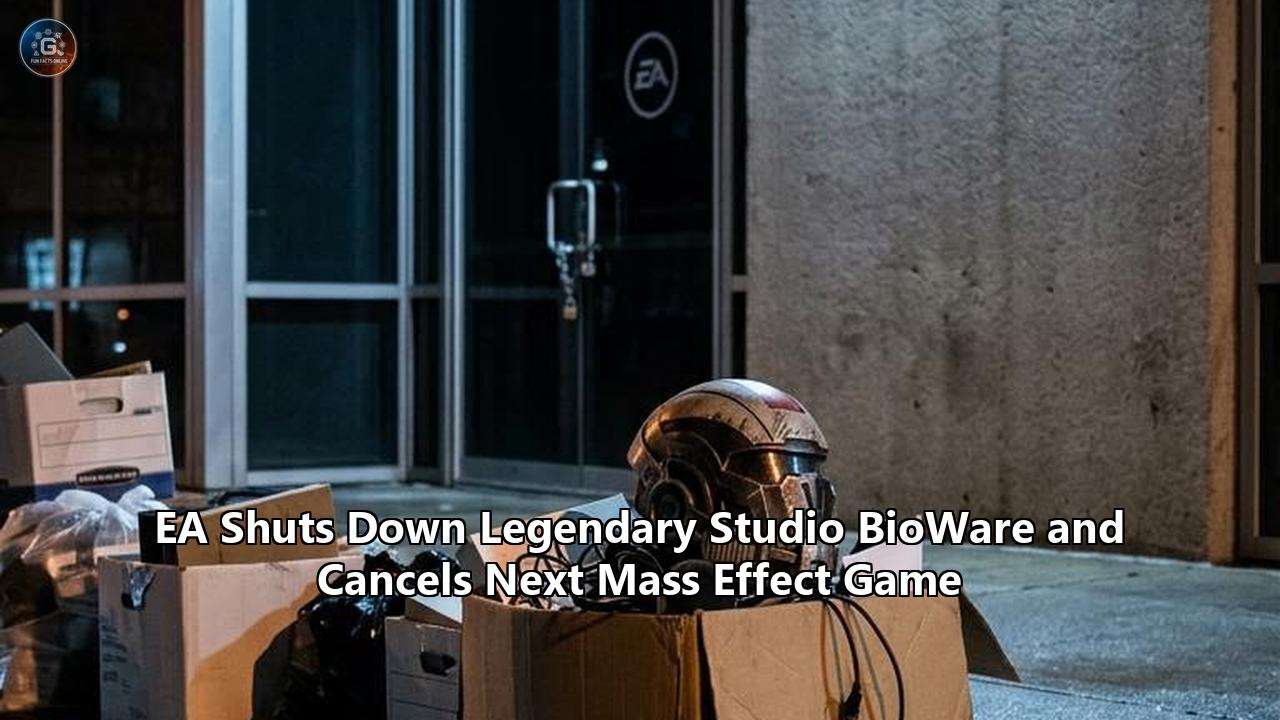
Electronic Arts has shuttered BioWare, dismantling one of the most revered narrative institutions in video game history and canceling the next installment of the Mass Effect franchise.
The decision, confirmed through an internal memo sent to staff by EA Chief Studios Officer Cam Weber and Chief Operating Officer David Tinson, ends three decades of Canadian role-playing game development and eliminates roughly 400 jobs across the publisher’s global workforce. Approximately 50 of those cuts fall directly upon BioWare’s final core team, terminating operations at the developer’s historic headquarters in Edmonton, Alberta.
"Over the past several months, we’ve taken a hard look at our business, how we operate, and what it will take to lead in this next era of interactive entertainment," Weber and Tinson wrote in the internal notice. "As we focus on these larger opportunities, we’ve had a small team at BioWare working on early development for Mass Effect. We’ve made the decision not to move forward with this development, which means we’re closing the studio and our Edmonton workspace".
Shortly after the memo leaked, BioWare posted a public farewell verifying the termination of the untitled Mass Effect project, known colloquially across the gaming community as Mass Effect 5:
"For more than 30 years, BioWare has been more than a studio. It has been a home for storytellers, developers, and the players who brought our worlds to life. Baldur’s Gate. Neverwinter Nights. Star Wars: Knights of the Old Republic. Dragon Age. Mass Effect. Anthem. Now, after more than three decades of shared adventures, BioWare is closing and early development on the next Mass Effect project is ending. There is nothing easy about writing those words".
The dissolution arrives less than three months after Electronic Arts completed a $55 billion leveraged buyout that took the publishing giant private under a consortium led by Saudi Arabia’s Public Investment Fund (PIF), alongside private equity firm Silver Lake and Affinity Partners. The transaction saddled EA with an estimated $18 billion to $20 billion in corporate debt, precipitating an immediate mandate to slash up to $700 million in research and development expenses.
Faced with steep debt-servicing obligations, EA leadership elected to excise high-budget, single-player narrative projects requiring half-decade incubation periods in favor of recurring live-service ecosystems, annualized sports franchises, and lower-risk licensed action titles.
The elimination of BioWare is more than an ordinary cost-cutting maneuver; it marks a defining fracture in the commercial viability of prestige Western RPGs produced within the corporate publisher model.
The Financial Architecture: How a $55 Billion Buyout Sealed BioWare's Fate
To understand why the BioWare studio closure occurred with such abrupt finality, one must follow the capital flows of EA's mid-2026 privatization.
When the consortium helmed by Saudi Arabia's PIF finalized its acquisition on August 4, 2026, the deal went down as the largest leveraged buyout in entertainment history. In a leveraged buyout, the acquiring parties do not simply finance the transaction with cash reserves; they borrow against the assets and future cash flows of the company being acquired. EA’s balance sheet, historically maintained with minimal leverage and a net cash cushion, was instantly burdened with nearly $20 billion in high-yield debt.
Servicing that debt requires an estimated $1 billion in annual interest payments alone. For a publisher that historically generated between $1.1 billion and $1.3 billion in annual net operating cash flow, the financial math tightened instantly. Every business unit was abruptly categorized by capital efficiency: how quickly, and with what degree of predictability, could an invested dollar return cash to service the balance sheet?
EA Capital Realignment (Post-Buyout)
┌─────────────────────────────────────────────────────────────┐
│ High-Margin Cash Flow Drivers: Protected & Funded           │
│  ├─ EA Sports Ecosystem (EA Sports FC, Madden NFL)          │
│  ├─ Live-Service Operations (Apex Legends)                  │
│  └─ Proven Action IP (Star Wars Jedi, Marvel's Iron Man)    │
└─────────────────────────────────────────────────────────────┘
                             │
                             ▼
┌─────────────────────────────────────────────────────────────┐
│ High-Cost, Long-Runway R&D: Eliminated or Downsized         │
│  ├─ BioWare Edmonton (Mass Effect 5 Canceled / Studio Closed│
│  ├─ Maxis Experimental (Project Lotus Shelved)              │
│  └─ Full Circle (Skate Team Downsized)                      │
└─────────────────────────────────────────────────────────────┘
Long-form, single-player narrative RPGs represent the antithesis of predictable, fast cash velocity. They require enormous upfront capital outlays—frequently exceeding $200 million over six- to eight-year development cycles—with no monetization engine beyond base unit sales and downloadable expansions.
BioWare entered this corporate restructuring already operating on borrowed time. The studio’s last major release, Dragon Age: The Veilguard, shipped in late 2024 following an agonizing decade in development hell. The project moved through multiple creative overhauls—initially conceived as a reactive spy thriller under codename Joplin, rebooted into a live-service multiplayer framework as Morrison, and finally reconstructed into a single-player action-RPG.
While The Veilguard achieved modest critical reception, landing in the mid-70s on review aggregators, it fell far short of EA's internal commercial threshold. Industry estimates indicated the game sold between 2.5 and 3 million copies worldwide in its initial six-month window—a respectable tally for an independent studio, but an unsustainable return on a project that absorbed ten years of studio overhead, hundreds of developer hours, and a high-profile marketing campaign.
Prior to The Veilguard, BioWare had not delivered an unqualified commercial and critical blockbuster since Dragon Age: Inquisition in November 2014. The studio spent twelve years navigating public misfires and administrative friction:
- Mass Effect: Andromeda (2017) suffered from severe animation glitches, engine incompatibility, and fractured cross-studio collaboration, leading to the indefinite shelving of single-player DLC.
- Anthem (2019), an ill-fated pivot toward a destiny-style shared-world shooter, collapsed under the weight of fundamental game-loop flaws, culminating in the cancellation of its promised "Anthem Next" reboot and the eventual termination of live servers.
- Star Wars: The Old Republic, BioWare's long-running MMO, was stripped from the studio’s portfolio in 2023 and reassigned to external developer Broadsword Online Games to reduce overhead.
Former BioWare executive producer Mark Darrah, who spent over two decades at the studio before departing during The Veilguard’s production, publicly forecasted this dynamic shortly after the buyout was announced. Darrah noted that when a company absorbs tens of billions in leverage, "you are going to be looking for additional cost savings. And for a company where a majority of your costs come from people, that is likely going to mean layoffs and studio closures".
When Weber and Tinson sat down to find $700 million in structural R&D reductions, a sub-100-person studio in Alberta working on an unreleased Mass Effect project still in pre-production was the most vulnerable line item on the spreadsheet.
Who Is Affected: Mapping the Human and Operational Casualties
The dismantling of BioWare creates immediate operational fallout across several tiers of the interactive entertainment ecosystem, directly affecting creative personnel, secondary EA studios, corporate workforces, and the broader Canadian technology sector.
The Developers and Creative Leadership
The immediate human consequence centers on the roughly 50 staff members working out of BioWare's Edmonton office. These developers represented the remnants of a team that had already endured aggressive downsizing. In August 2023, BioWare dismissed 50 veteran developers—including lead writers, technical directors, and quality-assurance veterans who had been with the company for decades. A second quiet round of departures in 2025 further depleted the ranks.
The staff remaining on October 21, 2026, were primarily senior architects, world-builders, and systems designers laying the groundwork for the next Mass Effect in Unreal Engine 5. Unlike the Frostbite-era struggles that hamstrung Andromeda and Anthem, this technical strike team was built around modern, industry-standard toolsets.
EA stated that "some impacted employees may have a chance to get a different job within EA". In practice, internal reassignments during broad publisher layoffs are limited. Most of these specialists face entering a depressed North American video game job market that has absorbed more than 35,000 corporate layoffs between 2023 and 2026.
The Broader EA Restructuring
BioWare’s shutdown is the centerpiece of a wider 400-person purge across Electronic Arts' global enterprise. Multiple subsidiary teams have suffered corresponding cancellations and headcount reductions:
- Maxis: Development on Project Lotus, a planned creative spin-off and companion title within The Sims universe, has been officially terminated. Maxis resources are being consolidated into Project Evergreen, an effort to preserve the aging live-service architecture of The Sims 4 while developing next-generation social simulation tools.
- Full Circle: The Vancouver-based studio developing Skate suffered significant staff reductions. EA confirmed the team will be downsized to follow a stricter, stripped-down development roadmap aimed at shipping a live-service monetization framework with fewer bespoke narrative or cinematic features.
- Ripple Effect Studios: The Los Angeles-based developer tasked with supporting the Battlefield series lost personnel across its engineering and design departments as EA reorganizes its shooter pipeline.
EA Studio Restructuring: October 2026 Headcount Impacts
┌───────────────────────────┬───────────────────────┬──────────────────────────────┐
│ Studio / Unit             │ Operational Action    │ Project Impact               │
├───────────────────────────┼───────────────────────┼──────────────────────────────┤
│ BioWare (Edmonton)        │ Complete Shutdown     │ Next Mass Effect Canceled    │
│ Maxis                     │ Selective Cuts        │ Project Lotus Shelved        │
│ Full Circle (Vancouver)   │ Production Downsizing │ Skate Roadmap Trimmed        │
│ Ripple Effect Studios     │ Workforce Reduction   │ Battlefield Support Realined │
│ EA Corporate Operations   │ Administrative Trim   │ R&D Budget Cut ($700M target)│
└───────────────────────────┴───────────────────────┴──────────────────────────────┘
The Canadian Digital Media Corridor
Beyond Electronic Arts, the BioWare studio closure deals an existential blow to the regional game development ecosystem in Western Canada.
Founded in Edmonton in 1995 by medical doctors Ray Muzyka, Greg Zeschuk, and Augustine Yip, BioWare served as the foundation of Alberta’s interactive media economy for three decades. Its presence turned Edmonton into an unexpected hub for global software engineering, drawing specialized creative talent, technical directors, and voice artists from around the world. The studio spurred university game-design curricula at the University of Alberta and anchored tax-incentive programs designed to keep digital talent in the province.
With BioWare gone, Alberta loses its sole flagship AAA development studio. The closure is expected to accelerate a regional brain drain, driving experienced software engineers toward established production hubs in Montreal, Vancouver, or completely out of the interactive entertainment sector into enterprise cloud engineering and simulation software.
What Changes: The Corporate Playbook and EA's New Creative Doctrine
The dissolution of BioWare crystallizes a permanent philosophical shift in Electronic Arts' production strategy. The internal directive from Weber and Tinson clearly demarcates which categories of interactive entertainment the publisher will finance, and which types of creative risk are no longer permitted on its balance sheet.
The Retreat from Sprawling Single-Player Narrative
For nearly twenty years following its 2007 acquisition of BioWare for $860 million, EA maintained at least one studio dedicated exclusively to deep, branching, choice-driven role-playing games. The closure marks an absolute exit from this space.
EA’s contemporary management no longer views expansive, multi-branching narrative design as an asset. Branching dialog trees, moral alignment systems, and thousands of lines of bespoke, conditional voice acting increase production costs exponentially while providing zero direct mechanics for recurring user spend. In a branching RPG, an estimated 30% to 40% of the cinematic and narrative content produced by developers is never seen by a player in a single playthrough. From a private equity optimization lens, paying premium development wages for unseen digital assets is viewed as capital inefficiency.
The Pivot to the "Core Pillars"
EA’s future release slate has been reduced to three specific commercial lanes, detailed explicitly in the executive memo:
- High-Margin Sports and Iterative Engines: The company’s financial lifeblood remains EA Sports FC (formerly FIFA) and Madden NFL. To reinforce this pipeline, EA revealed two new sports initiatives: Project Gridiron, an open-world American football experience designed to capture casual online audiences, and pre-production on a long-requested revival of the Fight Night boxing franchise.
- Live-Service Shooter Hubs: Apex Legends will continue to receive long-term maintenance and content investment despite recent seasonal revenue slowdowns. Concurrently, EA announced an unprecedented direct collaboration: Respawn Entertainment and DICE are being joined at the hip to co-develop an unannounced shooter project alongside upcoming Battlefield titles, widely reported to be an attempt to reboot the Star Wars: Battlefront brand under a unified technical architecture.
- Controlled-Scope Licensed Action-Adventure: Rather than funding proprietary narrative universes with unproven commercial yields, EA’s single-player output will rely on globally established corporate intellectual property. Production is proceeding on the third entry in Respawn’s Star Wars Jedi series (following Fallen Order and Survivor) and EA Motive’s Marvel’s Iron Man. These projects feature tight, linear or semi-open action-adventure designs with clear, singular narrative paths that are cheaper to write, direct, animate, and localize than massive systemic RPGs.
Electronic Arts Resource Allocation Model: Pre- vs. Post-2026
┌────────────────────────────────────────┬────────────────────────────────────────┐
│ PRE-2026 MODEL (Public EA)             │ POST-2026 MODEL (Private Consortium EA)│
├────────────────────────────────────────┼────────────────────────────────────────┤
│ • Portfolio balance: Sports, Live-Ops, │ • Ruthless prioritization: Sports and  │
│   Prestige Single-Player RPGs          │   perpetual Live-Service ecosystems    │
│ • Long incubation periods tolerated   │ • High hurdle rates: 3-to-4 year cycle │
│   for prestige brands (Veilguard)      │   limits; immediate ROI mandates       │
│ • Exploration of new IP / formats      │ • Heavy reliance on globally safe      │
│   (Anthem, Wild Hearts, Immortals)     │   licensed IP (Marvel, Star Wars)      │
│ • Multiple standalone studio cultures   │ • Centralization of engineering teams; │
│   and regional development clusters    │   consolidation around core hubs       │
└────────────────────────────────────────┴────────────────────────────────────────┘
Anatomy of a Fall: The 15-Year Erosion of BioWare Magic
The shock of the BioWare studio closure is softened by the realization that the studio’s demise was not an overnight occurrence, but the culmination of a decade and a half of structural misalignment, cultural erosion, and executive mismanagement.
The Fallacy of "BioWare Magic"
For years, internal teams at BioWare operated under the folklore of "BioWare Magic"—a studio colloquialism describing a development process where projects languished in indecision, technical confusion, and constant script rewrites for years, only to magically coalesce into a coherent, brilliant game during the final nine months of brutal, around-the-clock crunch.
This pattern worked during the creation of early landmarks like Star Wars: Knights of the Old Republic (2003) and Mass Effect (2007) when games were structurally smaller, visual fidelity requirements were modest, and development teams consisted of 50 to 80 people.
Once game development scaled into the modern AAA era—requiring hundreds of cross-functional artists, engineers, outsourced asset pipelines, and motion-capture stages—the "magic" failed. The human and organizational cost of building games without firm pre-production planning manifested directly in the disastrous launches of Mass Effect: Andromeda and Anthem. As former developers noted in retrospective accounts, relying on crunch to pull a broken design together was not a process; it was an organizational failure that burned out generations of elite talent.
The Frostbite Mandate
In the early 2010s, EA executive leadership mandated that all internal studios abandon commercial engines like Epic Games' Unreal Engine in favor of DICE's proprietary Frostbite engine. The corporate goal was rational: eliminate multi-million dollar third-party royalty fees and build a unified internal toolset across the publisher.
For BioWare, the Frostbite mandate was catastrophic. Frostbite was engineered specifically for first-person multiplayer shooters with destructible environments; it possessed zero native architecture for third-person cameras, inventory systems, branching dialogue trees, quest tracking, or party-based tactical combat.
BioWare engineers spent years building basic RPG infrastructure from scratch rather than focusing on storytelling or systems design. Dragon Age: Inquisition shipped only after extraordinary technical strain. By the time development on Anthem and early iterations of The Veilguard began, the studio was drowning in engine friction.
BioWare was finally allowed to abandon Frostbite and return to Unreal Engine 5 for the now-canceled Mass Effect project, but the transition came too late to save the studio from the structural delays that had already accumulated over an entire hardware generation.
The Brain Drain of Visionary Leadership
The creative identity of BioWare was inextricably tied to an ensemble of writers, directors, and producers who established the tonal architecture of Western gaming:
- Ray Muzyka and Greg Zeschuk: The co-founders, known affectionately across the industry as the "Doctors," departed in September 2012, disillusioned with corporate consolidation and exhausted by the public backlash surrounding the controversial ending of Mass Effect 3.
- Casey Hudson: The project director who oversaw the original Mass Effect trilogy left in 2014, returned as Studio General Manager in 2017 to steady the ship after Andromeda, and departed permanently in late 2020.
- David Gaider: The lead writer who built the world of Thedas, establishing the deep lore, factional politics, and companion dynamics of Dragon Age, resigned in 2016.
- Drew Karpyshyn: The lead writer responsible for the sci-fi foundations of Mass Effect 1 & 2 and KOTOR left the studio multiple times, finding the modern corporate game development process restrictive.
- Patrick Weekes: The veteran narrative lead who crafted beloved characters like Mordin Solus and served as Lead Writer on The Veilguard was laid off in 2025 during EA's preliminary cuts.
With every departure of an original visionary, institutional memory evaporated. By 2026, the individuals sitting in the Edmonton office were no longer the creative collective that had designed the Citadel, charted the deep roads, or coded the tactical pause system of Baldur’s Gate. BioWare had become a legacy brand name plastered over a revolving roster of contracted staff, managed by corporate executives seeking a return on a legendary pedigree that had already dissolved.
Short-Term Consequences: An Industry Shockwave
The fallout over the next three to twelve months will reshape both player sentiment toward Electronic Arts and the logistical balance of the interactive entertainment marketplace.
The Immediate Fate of Mass Effect
The outright cancellation of the next Mass Effect leaves the franchise entirely dormant. Teased at The Game Awards in December 2020 with a cinematic trailer showing an older Liara T'Soni picking up a piece of N7 armor in the snow, the game spent six years stuck in concepting and early pre-production while the bulk of BioWare was forced to salvage The Veilguard.
The assets, narrative documents, and early engine builds developed under project director Mike Gamble will be archived internally at EA. The proprietary lore, universe bible, and conceptual character designs are now locked inside EA's vault. Unless EA takes the unprecedented step of licensing the IP to an external production house—a move fraught with legal and creative complexities—the Mass Effect universe has effectively reached its conclusion.
The cancellation lands with profound bitterness for the community. The Mass Effect Legendary Edition, released in 2021, was a massive commercial hit that proved the enduring public appetite for the franchise, selling millions of copies and outperforming EA's baseline expectations. Despite that demonstrable demand, the multi-year runway required to deliver a brand-new AAA space epic proved incompatible with EA’s post-privatization debt realities.
Cultural and Geopolitical Tension
The shuttering of BioWare under Saudi ownership brings an unavoidable cultural friction to the surface. For two decades, BioWare was widely recognized as an early champion of progressive storytelling, LGBTQ+ romance options, gender equity, and inclusive character customization within major gaming releases. Games like Dragon Age: Inquisition and The Veilguard featured non-binary characters, explicit same-sex romances, and complex queer narratives that were baked into the core themes of identity and rebellion.
The Public Investment Fund of Saudi Arabia, chaired by Crown Prince Mohammed bin Salman, operates under a government where homosexuality is legally criminalized and heavily penalized. Former BioWare writer Patrick Weekes publicly voiced concerns following the August 2026 buyout, questioning whether EA’s new sovereign-backed ownership would intentionally target and marginalize studios known for progressive political and inclusive social content.
While EA executives framed the closure exclusively around financial hurdles, operational efficiency, and project prioritization, the swift cancellation of BioWare’s progressive creative pipeline under a Middle Eastern sovereign wealth fund will remain an intense point of controversy and debate among industry labor advocates and community watchdogs.
Immediate Player Backlash and N7 Day 2026
The timing of the announcement guarantees widespread consumer turbulence. BioWare's annual fan celebration, "N7 Day"—traditionally held on November 7 to celebrate the Mass Effect community with merchandise drops, developer streams, and narrative teasers—is weeks away.
Instead of a promotional celebration, November 7, 2026, will become an organized wake. Community hubs across Reddit, Discord, and social platforms are organizing boycotts of EA’s upcoming winter release slate, alongside mass cancellations of active EA Play subscriptions. While core sports gamers purchasing EA Sports FC or Madden may remain indifferent to the news, EA’s standing among core PC and console gaming enthusiasts has cratered to lows not seen since the height of the Star Wars Battlefront II loot-box crisis in 2017.
Long-Term Consequences: The Structural Death of the AAA Narrative RPG
Looking beyond the immediate horizon, the shuttering of BioWare provides a chilling diagnosis of the systemic crisis facing the entire AAA video game sector.
The High-End Narrative RPG Trilemma
                     High Agency & Deep Lore
                         (BioWare Model)
                              ▲
                             / \
                            /   \
                           /     \
                          /       \
                         /  Crisis  \
                        /    Zone    \
                       /              \
  Predictable Production               Low-Risk Commercial
         Cycles                               Runways
 (Annualized Shooters/Sports)          (Pre-established IP)
The high-budget, single-player narrative RPG is increasingly impossible to produce within the modern, debt-financed corporate publishing framework. The genre demands:
- Massive initial script-writing and systemic world-building phases that cannot be automated.
- Complex choice-and-consequence mechanics requiring double or triple the animation and QA testing of linear games.
- High fidelity photorealistic graphics that rapidly escalate production costs.
- An economic model that relies almost exclusively on one-time, $70 box-price transactions.
When compared against games like Apex Legends or EA Sports FC—which cost significantly less to maintain annually while generating hundreds of millions of dollars per quarter in pure, high-margin microtransactions—the traditional RPG fails every corporate financial test.
The Independent Counter-Narrative: The Larian Lesson
The demise of BioWare stands in stark contrast to the historic triumph of Larian Studios with Baldur's Gate 3 in 2023. Baldur's Gate, the very franchise BioWare invented in 1998, reached its artistic and commercial zenith in the hands of an independent, privately held studio that answered to no external shareholders, Wall Street analysts, or private-equity consortiums.
Larian founder Swen Vincke retained majority ownership of his studio, allowing Larian to spend six years developing an uncompromising, highly reactive role-playing epic. Larian used early access to fund production organically, iterated directly with players, refused to implement predatory monetization, and proved that a market of tens of millions of players still hungers for deep narrative role-playing.
The juxtaposition is clear:
- Under an independent structure guided by creative leadership, the RPG genre flourishes.
- Under a corporate publisher accountable to private equity debt schedules, the RPG genre is marked for elimination.
BioWare did not fail because the public stopped loving Mass Effect or Dragon Age. BioWare failed because it was trapped within a corporate machine that demanded games built by committee, forced onto ill-fitting shooter engines, compromised by live-service market mandates, and ultimately discarded when they could not match the cash-generating efficiency of an annualized sports title.
The EA Studio Graveyard Welcomes Its Crown Jewel
With the BioWare studio closure, Electronic Arts adds the most celebrated name yet to its historic corporate graveyard. Over four decades, the publisher has acquired legendary, genre-defining creative studios, only to dismantle them following corporate mandates, commercial misses, or structural realignments:
- Origin Systems (Acquired 1992, Closed 2004): Pioneers of the modern PC RPG and MMO with Ultima and System Shock.
- Bullfrog Productions (Acquired 1995, Closed 2001): Peter Molyneux's strategy powerhouse behind Populous, Syndicate, and Dungeon Keeper.
- Westwood Studios (Acquired 1998, Closed 2003): The creators of the modern real-time strategy genre with Command & Conquer.
- Maxis Emeryville (Acquired 1997, Main Studio Closed 2015): Will Wright’s simulation laboratory that created SimCity.
- Pandemic Studios (Acquired 2007, Closed 2009): Creators of Mercenaries and the original Star Wars: Battlefront.
- Visceral Games (Closed 2017): Masters of cinematic survival horror with Dead Space, shuttered mid-production on an ambitious single-player Star Wars project.
- BioWare (Acquired 2007, Closed 2026): Architects of modern cinematic choice-driven RPGs, from Knights of the Old Republic to Mass Effect and Dragon Age.
Each closure followed an identical pattern: an initial period of high-profile success, followed by the gradual departure of founding leaders, an executive push toward corporate homogenization or live-service trends, a string of compromised releases, and finally, a corporate memo citing the need to "realign resources toward our greatest growth opportunities".
What to Watch Next: The Road Ahead
As the reality of the studio closure settles across the landscape, several critical milestones and unresolved questions will dictate how this chapter in gaming history concludes:
- Severance and Union Pushback: The Alberta workforce lacks a formal collective bargaining agreement, but labor organizers in Canada—including Game Workers Unite and CWA Canada—are already scrutinizing the termination packages offered to the 50 laid-off Edmonton developers. Legal challenges surrounding termination notices under Alberta’s Employment Standards Code may emerge.
- The Formation of "BioWare Diaspora" Studios: Historically, major studio closures lead to the birth of agile independent developers. Just as BioWare alumni previously founded studios like Beamdog, Inflexion Games (Nightingale), and Humanoid Origin, watch for newly formed independent teams emerging from Alberta and British Columbia seeking venture capital to build smaller-scale, choice-driven spiritual successors.
- The Fate of Intellectual Property: Watch whether EA holds Mass Effect and Dragon Age in complete corporate stasis, or if the debt-laden publisher explores monetization via media adaptations. A long-gestating Mass Effect television series at Amazon MGM Studios could become EA’s primary vehicle for extracting value from the brand without risking interactive software capital.
- Further Privatization Cuts: BioWare is unlikely to be the final casualty of EA's $55 billion take-private transaction. Financial analysts will closely track EA's performance leading into the 2026 holiday quarter. If live-service spending dips or licensed games like Marvel's Iron Man suffer scope creep, mid-tier development branches like Codemasters or Criterion could face similar consolidation.
The lights have been turned off at BioWare’s headquarters in Edmonton. The Normandy is grounded permanently, the Dread Wolf’s saga is abruptly concluded, and an era that defined modern video game storytelling has definitively ended.
Reference:
- https://www.tweaktown.com/news/114215/bioware-shuts-down-new-mass-effect-game-cancelled/index.html
- https://www.gamespot.com/articles/ea-kills-bioware-cancels-new-mass-effect-pauses-new-sims-game-and-all-the-other-big-ea-news-that-just-happened/
- https://www.windowscentral.com/gaming/xbox/ea-officially-shuts-down-bioware-and-cuts-400-jobs-mass-effect-5-has-been-cancelled
- https://qz.com/electronic-arts-bioware-shutdown-layoffs-mass-effect-102126
- https://www.ign.com/articles/bioware-shutting-down-next-mass-effect-canceled
- https://www.thurrott.com/games/343118/electronic-arts-shuts-down-bioware
- https://gameinformer.com/2026/10/21/ea-is-shutting-down-legendary-rpg-studio-bioware-amid-new-round-of-layoffs
- https://aftermath.site/electronic-arts-closing-bioware-laying-off-hundreds/
- https://www.shacknews.com/article/151092/ea-closes-bioware-lays-off-400
- https://www.gamesindustry.biz/bioware-is-closing-after-30-years
- https://www.gamespot.com/articles/what-55-billion-buys-everything-included-in-the-ea-acquisition/1100-6535111/
- https://www.pcgamer.com/gaming-industry/ea-could-sell-off-studios-after-saudi-and-kushner-funded-usd55-billion-acquisition-says-former-dragon-age-producer-its-hard-to-imagine-that-youd-have-bioware-pivot-from-having-very-progressive-messaging-to-having-the-reverse/
- https://www.mensjournal.com/news/a-legendary-gaming-studio-behind-mass-effect-and-dragon-age-is-shutting-down
- https://massivelyop.com/2026/10/21/electronic-arts-officially-shuts-down-bioware-and-lays-of-400-workers-in-the-process/
- https://www.gamesradar.com/games/rpg/ea-cancels-new-mass-effect-closes-bioware-after-being-bought-by-saudi-arabia/
- https://shattered.io/bioware-shutdown-ea-55-billion-buyout-first-cut-2026/