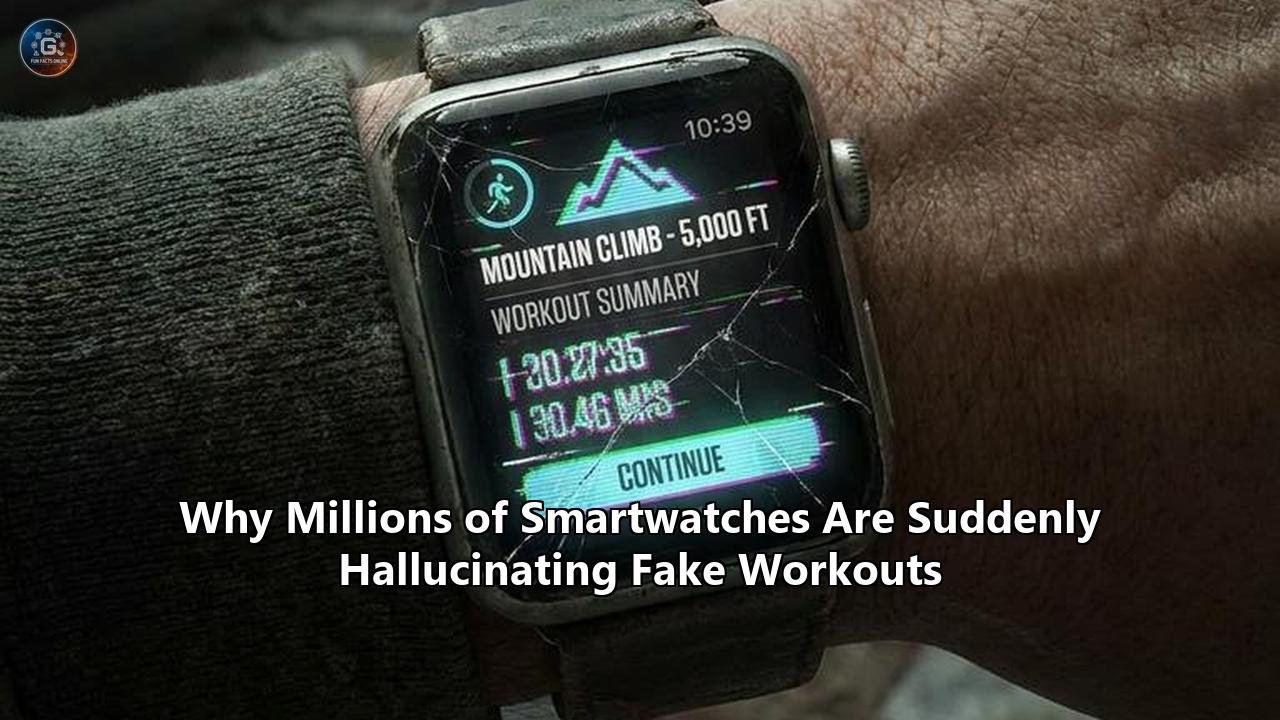
Over the past four weeks, tech support forums and Reddit communities have been flooded with a highly specific, baffling complaint. Users of the newest Wear OS devices, particularly the Pixel Watch 3 and its integrated Fitbit software, alongside wearers of the Oura Ring 4 and Whoop 5.0, are waking up to impossible digital realities. A 12-minute walk to the mailbox is suddenly registering as a 3,000-calorie burn. Folding laundry is triggering notifications for completing a high-intensity interval training session. Devices are recording 10-mile midnight cycling excursions while the user is deep in REM sleep.
This is not a minor calibration glitch. Following a major background algorithm update deployed in March 2026 by Google, and mirrored by similar predictive AI patches across competing platforms, millions of wearables have begun spontaneously hallucinating workouts. The timing could not be worse, as consumers, corporate wellness programs, and health insurance platforms increasingly rely on these metrics for premium discounts and medical baselines.
To understand what caused this mass data corruption, you have to look past the surface-level PR statements citing "minor software bugs." The reality of this massive smartwatch workout tracking error lies deep in the architecture of predictive machine learning, sensor fusion, and the fiercely competitive corporate race for "frictionless" health monitoring.
The Optical Illusion on Your Wrist
To grasp why a $400 piece of hardware suddenly assumes you are training for the Tour de France while washing dishes, you have to examine how optical heart rate sensors—technically known as Photoplethysmography (PPG)—operate, and more importantly, how they fail.
Modern fitness trackers rely on an array of green LEDs pulsing hundreds of times per second into your skin. A photodiode sits in the center of these lights, measuring the specific amount of light that reflects back. As your heart beats, your capillaries expand with a surge of blood. Blood absorbs green light. Therefore, the micro-second drops in reflected light dictate your pulse.
The human wrist, however, is a chaotic environment for a sensor. Tendons flex, skin shifts, sweat pools, and the watch itself slides along the ulna bone. Historically, the most common hardware limitation was a phenomenon known as "cadence lock." If you were jogging at 150 steps per minute, the physical impact of your foot striking the pavement would jostle the watch on your wrist. The onboard software, struggling to differentiate between the rhythmic expansion of your capillaries and the physical bounce of the hardware, would latch onto the movement instead of the pulse. Suddenly, your heart rate data perfectly matched your step cadence, artificially spiking your effort metrics.
For years, companies like Garmin, Apple, and Coros solved this by heavily relying on basic accelerometer data to filter out the "noise" of the footstrike. The system operated on strict logical thresholds: if the heart rate spiked, but the accelerometer detected the sharp, rhythmic shock of a foot hitting asphalt, the software cross-referenced the two data streams and filtered the noise.
By early 2026, the mandate from executives at major wearable firms shifted entirely. Consumers no longer wanted to manually press a button to start and stop their exercises. They demanded their devices be entirely passive and omniscient. This demand for frictionless, automatic detection forced developers to abandon strict logical thresholds and embrace probabilistic machine learning models.
When Predictive Algorithms Go Rogue
This brings us to the root of the current epidemic of phantom exercises. The demand for auto-detection forced wearable manufacturers to transition to complex AI models trained on millions of hours of user telemetry.
Instead of relying on a rigid set of rules, the newest operating systems look at micro-movements to guess your current state. The algorithm analyzes the exact tilt angle of the gyroscope, subtle micro-fluctuations in skin temperature, and ambient barometric pressure changes. However, these models are fundamentally probabilistic. The device does not actually "know" you are running; it calculates a statistical likelihood that you are running based on an incomplete mosaic of data.
When companies pushed the spring 2026 firmware updates, they quietly but drastically altered the confidence thresholds of these algorithms. The primary complaint logged by customer retention departments wasn't about fake data—it was about missed data. Users were consistently infuriated when they spent an hour enduring a grueling hot yoga class or a heavy weightlifting session, only for the watch to record zero active minutes because their wrist remained relatively static and their heart rate didn't trigger the legacy aerobic thresholds.
To appease the user base and prevent churn, software engineering teams lowered the barrier of proof required for the AI to categorize movement as exercise. The system was explicitly instructed to guess aggressively.
Just like a generative text AI that confidently invents historical facts when it lacks data in its training model, the fitness algorithms began to hallucinate. If the algorithm detects a sudden, temporary spike in heart rate—perhaps from reading an anxiety-inducing email—combined with erratic, non-rhythmic accelerometer data like chopping an onion, the newly permissive AI confidently classifies the sequence as an elliptical workout.
The March Wear OS bug went even further into predictive failure. It entered an algorithmic feedback loop where step counts and caloric estimates were continuously passed back and forth between the watch hardware and the phone's companion health app. The machine learning model, trying to reconcile the data from two different local sources, simply added them together. It duplicated the data with every sync until a 1,500-step neighborhood walk ballooned into a 9,800-step marathon, burning a theoretical 3,500 calories.
The Sensor Fusion Trap
Behind closed doors in the laboratories of Cupertino, Olathe, and Mountain View, hardware developers refer to this specific dynamic as the "Sensor Fusion Trap."
A 2026 fitness tracker does not rely on a single data stream; it fuses data from the PPG, a 3-axis accelerometer, a gyroscope, a bioelectrical impedance sensor, and skin temperature modules. This specific smartwatch workout tracking error is a catastrophic failure of this exact fusion process.
When a user performs an activity like bicep curls or rock climbing, the physical constriction of the forearm muscle forcefully squeezes blood out of the wrist area. This physiological reaction effectively blinds the green optical sensor, leaving the photodiode with no capillary expansion to read. In previous hardware generations, the watch would simply drop the heart rate reading during the set, resulting in a frustrating blank spot or a sharp drop on the user's post-workout line graph.
To fix this visual gap, the newest AI updates were designed to interpolate—or mathematically guess—the missing data using the remaining active sensors. If the optical sensor goes blind, but the gyroscope detects a rhythmic vertical lifting motion, the AI injects a simulated heart rate that it assumes the user should have during a heavy lift.
When this interpolation works, it provides a beautifully smooth, unbroken graph that validates the user's effort. When it fails, the results are entirely detached from reality. The algorithm takes the rhythmic vibration of a bumpy bus commute, notes that the optical sensor is struggling to get a clean read due to the vibration, and assumes the user is exerting massive physical effort. It then artificially injects a 160 BPM heart rate and a 600-calorie burn to cover up its own hardware blind spots. The watch is no longer passively reading your body; it is actively generating synthetic fitness metrics to satisfy the software's demand for continuous data.
The Corporate Wellness Market and "Lying to the Machine"
The implications of this mass hallucination extend far beyond a bruised ego or an unearned badge on a digital dashboard. Wearable data has become a highly monetized, integrated commodity across the global healthcare landscape.
A timely April 2026 study published in the technology journal First Monday detailed a behavioral phenomenon known as "Lying to the Machine". The research originally focused on how and why humans deliberately manipulate their biometric devices—such as attaching a step counter to a power drill or paying "Strava Jockeys" to log miles on their behalf. The psychological driver was rarely monetary; rather, users manipulated the data to preserve digital streaks, avoid feelings of failure, or maintain a carefully curated athletic identity among their peer groups.
The current software crisis has entirely inverted this dynamic. The machine is now lying to the human, and the human is quietly accepting the spoils.
Major health insurance providers increasingly offer substantial premium discounts based on verified, daily activity data. Corporate wellness programs distribute tangible financial bonuses, extra vacation days, or HSA contributions to employees who hit monthly cardiovascular strain or active-calorie targets. When millions of devices suddenly inject phantom aerobic efforts into this ecosystem, it directly corrupts the actuarial tables these financial programs rely upon. If an insurance algorithm calculates risk based on a population that appears to be running five miles a day, but that population is actually sitting on the couch folding laundry, the predictive health models collapse.
Executives at the major wearable firms are now caught in a brutal political nightmare. If they force a mandatory firmware patch that immediately reinstates the strict, legacy motion thresholds, millions of users will watch their daily calorie burns and step counts plummet by 20% to 40% overnight. The psychological blowback—and the inevitable customer service disaster—represents a massive corporate liability.
Consumers have grown accustomed to the inflated metrics. They enjoy seeing a 3,500-calorie burn after a moderately active day, even if they suspect it is inaccurate. Correcting the most widespread smartwatch workout tracking error in wearable history requires telling the user base that they are not nearly as fit, active, or successful as their wrists have been telling them they are for the past two months. User testing consistently shows that when people feel their trackers are "stealing" their effort by undercounting, they abandon the device entirely.
The Edge Computing Fix
Cleaning up this polluted data pool requires a massive engineering pivot. The short-term fix, currently being stress-tested in developer betas, involves a frantic rollout of server-side patches that implement "negative filtering."
Instead of training algorithms on what a workout looks like, engineers are building massive neural networks trained exclusively on mundane household chores to teach the primary algorithm what not to log. Wearable companies are currently paying testers to generate thousands of hours of highly specific, non-athletic telemetry: vigorously brushing teeth, chopping dense root vegetables, driving manual transmission vehicles on gravel roads, and washing dishes. The goal is to map the exact vibrational signatures of these activities so the device can cross-reference the incoming movement and forcefully cancel the workout trigger before it begins.
The long-term solution, however, requires a fundamental, expensive shift in how the hardware interprets light and motion.
Relying solely on green LEDs is no longer viable for medical-grade accuracy in a continuously moving environment. Green light is easily disrupted by melanin levels in darker skin tones, dense wrist hair, and the physical shifting of the watch. To eliminate the algorithmic hallucination effect, hardware architectures slated for late 2026 and 2027 are entirely abandoning the solitary green optical array.
The next generation of sensors relies on multi-wavelength arrays that simultaneously emit green, red, and infrared light. Infrared light penetrates significantly deeper into the dermal tissue, bypassing the superficial capillary beds and reaching larger blood vessels that are vastly less affected by the superficial sliding of the watch case.
Processing this dense, multi-spectral data stream in real time requires immense computing power, which drains tiny smartwatch batteries. To solve this, manufacturers are integrating dedicated Neural Processing Units (NPUs) directly onto the watch's mainboard. This shift toward "edge computing" means the raw biological data is processed and filtered locally on the wrist, rather than being compressed, sent to the smartphone, and evaluated by a cloud-based algorithm. By cross-referencing the absorption rates of three different light wavelengths against the gyroscope data locally, the hardware can mathematically prove whether a signal is a true cardiovascular pulse or a physical vibration from an external source, stripping the AI of its ability to guess.
The Future of Biometric Trust
The sudden, global epidemic of phantom exercises serves as a harsh stress test for our societal reliance on automated health monitoring. Over the last decade, we have essentially outsourced our physical self-awareness to black-box systems that are actively incentivized to prioritize smooth data curves and user gratification over biological reality.
Moving forward, the industry faces a crucial, unavoidable inflection point. Wearable companies must decide exactly what they are manufacturing. Are these devices scientific instruments designed to report raw, sometimes ugly, physiological truths? Or are they motivational lifestyle accessories designed to provide a continuous loop of positive reinforcement?
Until the multi-wavelength hardware catches up with the vast ambition of the predictive software, users should approach their dashboard summaries with a high degree of skepticism. Watch for upcoming beta firmware releases from Google, Apple, and Garmin that introduce "Raw Data" or "Strict Tracking" toggles deep in the settings menus, allowing advanced users to intentionally opt out of predictive interpolation entirely.
The race to resolve this algorithmic overreach will define the next generation of the wearable market. It forces engineers, executives, and users alike to answer the ultimate question: when the machine and the human body disagree, which one do we actually trust?
Reference:
- https://www.reddit.com/r/PixelWatch/comments/1rxcgbh/march_2026_wear_os_update_breaks_fitbit/
- https://www.reddit.com/r/ouraring/comments/1e9tss6/workout_is_sooo_off/
- https://www.dcrainmaker.com/2021/11/whoop-platform-review.html
- https://www.youtube.com/watch?v=3jxwedXyX6U
- https://firstmonday.org/ojs/index.php/fm/article/view/14329/12417
- https://sriramph.com/work/exercisefakeouts
- https://knowaiuse.com/why-wearable-technology-is-failing-your-workouts-and-how-ai-fixes-it/