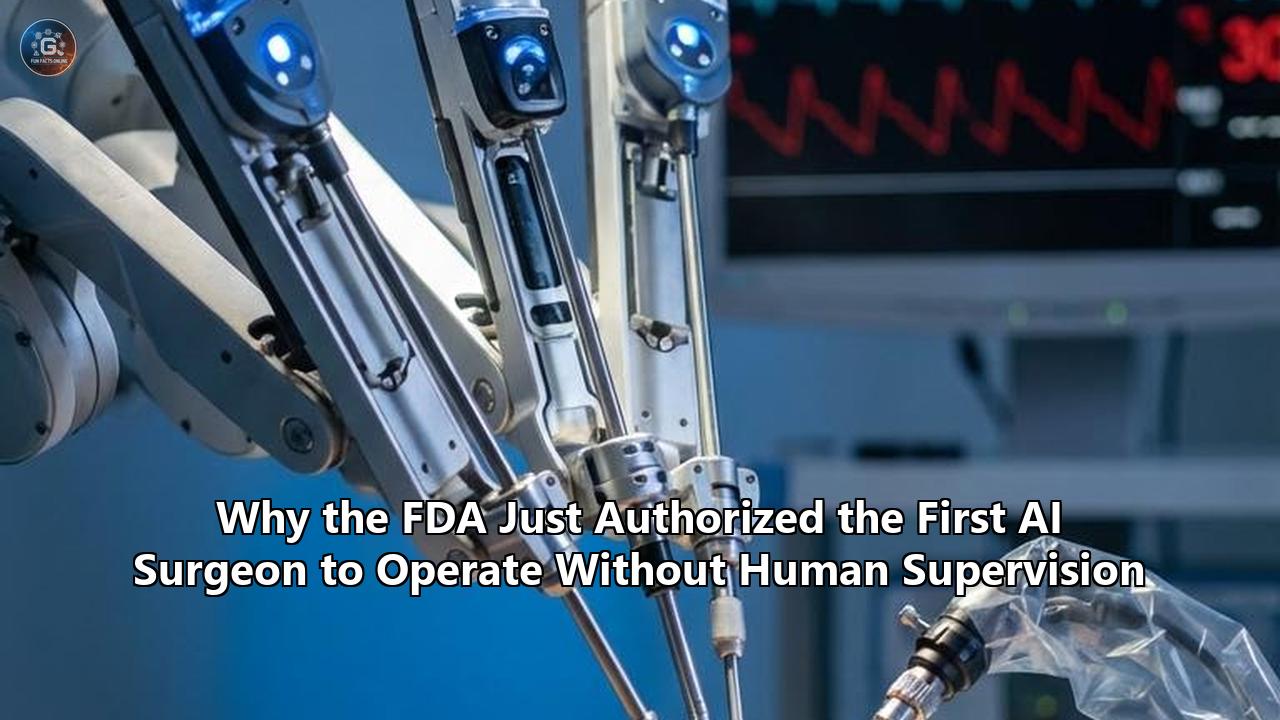
Late this April, the medical community crossed a threshold that science fiction has promised for decades. The U.S. Food and Drug Administration (FDA) granted De Novo authorization to the first commercially available surgical robotics platform cleared to perform specific soft-tissue procedures without direct human manipulation.
The system, based on the Hierarchical Surgical Robot Transformer (SRT-H) architecture originally developed at Johns Hopkins University and brought to market by Semaphor Surgical, was authorized to execute the critical cutting and clipping phases of a laparoscopic cholecystectomy (gallbladder removal) entirely on its own.
For the first time in medical history, a surgeon can step back from the control console, remove their hands from the joysticks, and watch a machine independently analyze live tissue, formulate a surgical plan, and execute microscopic incisions with sub-millimeter precision. If the patient breathes heavily and their organs shift, the robot adjusts its trajectory in real-time. If the machine encounters an unexpected anatomical variation, it pauses, recalculates, and corrects its own approach.
The arrival of an FDA approved AI surgeon fundamentally alters the relationship between human physicians and medical technology. This authorization transitions surgical robotics from high-tech puppetry into the realm of intelligent clinical collaboration.
Understanding how we reached this milestone requires dissecting the converging leaps in artificial intelligence, computer vision, and regulatory frameworks that finally made unsupervised robotic surgery a reality.
The Regulatory Pivot: Moving Beyond the Human Puppet
To grasp the magnitude of this week’s authorization, one must look at the slow, heavily regulated history of surgical robotics.
The FDA cleared the first robotic surgical assistant, the AESOP system, back in 1993, classifying it as a moderate-risk Class II device. In 2000, Intuitive Surgical received authorization for the da Vinci Surgical System, a platform that permanently altered operating rooms worldwide. However, for over a quarter of a century, the FDA classified all of these systems under a rigid regulatory framework known as "Level 1 Autonomy" or "Robot Assistance".
In a Level 1 system, the robot possesses zero independent decision-making capability. The surgeon sits at a console viewing a 3D feed, and the robotic arms precisely mimic the surgeon's hand, wrist, and finger movements inside the patient. The machine filters out natural human hand tremors and allows for greater articulation in tight spaces, but it is ultimately a highly sophisticated extension of the human body. The surgeon remains entirely responsible for every millimeter of movement.
The leap from Level 1 (teleoperation) directly to Level 4/Level 5 (high to full autonomy) presented an unprecedented challenge for the FDA. Historically, medical devices are cleared based on fixed parameters. A pacemaker, a scalpel, or a traditional robotic arm behaves exactly the same way every time it is used. But an AI-driven autonomous surgeon relies on machine learning models that are probabilistic, dynamic, and constantly adapting to chaotic biological environments.
The regulatory logjam began to clear in early 2025 when the FDA released finalized guidance for AI-enabled medical devices. Recognizing that static regulations could not govern dynamic algorithms, the agency adopted a "Total Product Life Cycle" approach. Central to this framework was the introduction of Predetermined Change Control Plans (PCCPs).
Under a PCCP, a medical device manufacturer can pre-define how its algorithm will learn and update over time. As long as the AI's autonomous decisions remain within these pre-approved safety boundaries, the manufacturer does not need to seek a new FDA clearance for every software update. This regulatory mechanism paved the way for Semaphor Surgical to submit the SRT-H platform for De Novo classification—a pathway designed for novel medical devices that have no existing legal predicate on the market.
The agency’s authorization this week came with strict parameters. The AI is currently only cleared for specific steps of a cholecystectomy, a procedure performed approximately 700,000 times a year in the United States. Furthermore, it operates under "supervised autonomy." The human surgeon must be present in the operating room and retains the ability to verbally override the system or hit a physical kill switch at any moment.
Dissecting the Machine Mind: How Software Learns to Suture
You cannot program a robot to perform surgery using traditional, rule-based coding. Human anatomy is far too variable; no two gallbladders look exactly alike, and the amount of visceral fat, scar tissue, and vascular structure varies wildly from patient to patient.
Instead of writing a rigid set of instructions, the researchers who built the SRT-H architecture relied on imitation learning. They trained the machine the same way a medical school trains a surgical resident: by forcing it to watch the experts.
The Surgical Transformer Architecture
The underlying intelligence of this newly authorized system is built on the same "Transformer" neural network architecture that powers Large Language Models like ChatGPT. However, instead of processing tokens of text to predict the next word in a sentence, the Hierarchical Surgical Robot Transformer processes continuous streams of visual and kinematic data to predict the next physical movement of a scalpel.
During the development phase at Johns Hopkins University, Stanford, and collaborating institutions, engineers fed the AI model massive datasets containing hundreds of hours of recorded surgical video. These datasets did not just include video; they were paired with the exact kinematic data from the da Vinci robotic arms used during those procedures. Every time the human surgeon twisted their wrist, translated the arm, or opened the robotic grippers, the data was recorded and synchronized with the video feed.
Annotators painstakingly labeled this data, breaking down complex surgeries into discrete sub-tasks, such as "isolate cystic duct," "apply primary clip," and "sever tissue". Crucially, the dataset also included human mistakes and corrections. If a surgeon moved too far to the left and had to pull back, the AI learned both the error and the recovery path.
The Two-Brain System
The resulting SRT-H platform operates using a dual-transformer system:
- The High-Level Planner: This neural network acts as the strategic brain. It analyzes the live endoscopic video feed, assesses the anatomical landscape, and formulates the next logical step in natural language (e.g., "Place the second clip on the left tube").
- The Low-Level Action Generator: This secondary network translates the strategic command into raw mathematics. It calculates the precise joint angles, torque, and spatial coordinates required to move the robotic arms and execute the task.
Because the high-level planner "thinks" in natural language, it provides an intuitive interface for the human surgeon overseeing the procedure. If the human doctor sees the robot approaching an artery at a sub-optimal angle, they do not need to grab a joystick. They can simply speak to the machine, saying, "Move the left arm slightly to the right," and the system processes the audio, recalculates its spatial coordinates, and adjusts its physical trajectory in real-time.
The Physics of Soft Tissue: Overcoming Biology's Chaos
The path to an FDA approved AI surgeon was obstructed by the fundamental laws of biology. Engineers have possessed the technology to automate rigid orthopedic surgeries—like precise bone cuts for knee replacements—for years. Bones do not move on their own, and they do not spontaneously change shape.
Soft tissue, however, is a chaotic, deformable, and highly unpredictable environment.
When a patient is under anesthesia, the mechanical ventilator forces air into their lungs, causing the diaphragm to heave up and down. Consequently, the liver, gallbladder, and intestines constantly shift in the surgical field. Furthermore, soft tissue deforms when touched. If a robotic arm presses a pair of forceps against a bowel segment, the tissue yields, altering the spatial coordinates of everything around it. Finally, there is the issue of blood; even a minor capillary bleed can instantly obscure the camera lens, blinding a computer vision system that relies on high-contrast visual inputs.
To solve the soft tissue problem, the engineers behind the SRT-H framework implemented advanced tissue-tracking algorithms and multimodal sensory integration. The robotic vision system does not rely solely on standard RGB (red, green, blue) optical cameras. It utilizes near-infrared imaging and fluorescent dyes injected into the patient's bloodstream. These dyes cause critical structures—such as the cystic artery and bile ducts—to glow brightly under specific light frequencies, allowing the AI to "see" through obscuring tissue and minor bleeding.
Simultaneously, the system incorporates high-fidelity piezoelectric force sensors embedded in the surgical instruments. These sensors provide real-time haptic feedback, measuring tool-tissue interaction forces with microscopic resolution. By combining the visual data with haptic data, the AI can calculate the exact viscoelastic properties of the tissue it is manipulating. It knows the difference between the rigid resistance of a healthy bile duct and the softer, yielding texture of surrounding fat.
In early clinical trials, the system demonstrated an ability to track moving tissue and self-correct its surgical path faster than a human operator could perceive the shift. When researchers deliberately introduced variables—such as shifting the patient's position mid-surgery or adding artificial blood to obscure the camera—the AI maintained its trajectory, successfully completing the gallbladder removal steps without catastrophic error.
The Economic Equation: Throughput, Complications, and Capital
While the technological achievements are staggering, the rapid commercialization and regulatory push for autonomous robotics are largely driven by hospital economics. The global surgical robotics market is currently exploding, projected to surpass $18.3 billion globally in the near future, with AI-enabled platforms capturing an increasingly dominant share of new installations.
For hospital administrators, the financial calculus of adopting an FDA approved AI surgeon centers on two critical metrics: OR throughput and complication mitigation.
Maximizing Operating Room Time
Operating rooms are the financial engines of modern hospitals, but they are also incredibly expensive to run. Every minute in an active OR costs a facility anywhere from $30 to $100 in overhead, staffing, and equipment costs.
In early aggregated studies, AI-assisted and semi-autonomous robotic surgeries have demonstrated a remarkable ability to increase surgical efficiency. Meta-analyses of modern AI-robotic platforms indicate they can reduce total operative time by up to 25% compared to conventional manual methods.
A human surgeon naturally experiences cognitive fatigue. They must pause to adjust the camera, reposition their posture, or mentally recalculate their approach when encountering unexpected anatomy. The AI system does not blink, does not fatigue, and calculates its instrument trajectories instantaneously. By shaving 20 minutes off a standard 90-minute procedure, a hospital can theoretically schedule one or two additional surgeries per OR per day. Multiplied across an entire surgical department over a fiscal year, the increase in billable throughput easily offsets the multi-million-dollar capital acquisition cost of the robotic platform.
Eradicating the "Never Event"
Beyond speed, the primary economic driver is the reduction of surgical errors. In conventional laparoscopic cholecystectomies, one of the most feared complications is a bile duct injury. If a human surgeon misidentifies the anatomy and severs the common bile duct instead of the cystic duct, the patient faces catastrophic consequences, requiring complex reconstructive surgery, extended ICU stays, and immense pain. For the hospital, it triggers massive malpractice liability and severe readmission penalties.
Early clinical data reveals that the integration of AI assistance into robotic surgery can reduce intraoperative complications by roughly 30%. Because the autonomous system relies on multi-spectral imaging and fluorescent tracking, it is practically impossible for the AI to mistake the common bile duct for the cystic duct. The machine refuses to cut unless its algorithm calculates a near-100% certainty regarding the anatomical structure it is facing.
By standardizing the quality of the procedure, autonomous systems promise to democratize top-tier surgical outcomes. Currently, surgical complication rates vary wildly depending on the specific hospital and the individual skill level of the attending surgeon. An autonomous system ensures that a patient in a rural, underfunded community hospital receives the exact same microscopic precision as a patient at an elite academic medical center.
The Liability Labyrinth: Who Gets Sued When the Robot Slips?
The introduction of unsupervised surgical actions forces the legal and insurance industries into uncharted territory. For centuries, medical malpractice law has rested on the "captain of the ship" doctrine. The lead surgeon in the operating room is legally responsible for everything that happens to the patient.
When a human surgeon utilizes a Level 1 teleoperated robot like the traditional da Vinci system, liability is straightforward. If the human pulls the joystick too far to the left and tears an artery, the human is at fault. The robot simply did exactly what it was told.
But what happens when an FDA approved AI surgeon makes its own autonomous decision to cut, and that decision proves fatal?
If the human surgeon’s hands are not on the controls, does the liability shift from the physician to the software developer? This question mirrors the ongoing legal battles in the autonomous vehicle industry, where courts must determine whether a crash was caused by driver inattention or a flaw in the self-driving algorithm.
Currently, the FDA’s authorization requires a "human in the loop." The surgeon is mandated to oversee the procedure and retains verbal and physical override capabilities. From a legal standpoint, this classifies the surgeon as a "learned intermediary." Because the physician has the power to intervene, hospital legal departments and malpractice insurers are likely to argue that the physician remains the ultimate captain of the ship.
However, this creates a paradoxical trap for the human doctor. If the AI system is statistically safer and more precise than human hands, a surgeon who intervenes and takes manual control risks massive liability if they subsequently make a mistake. Conversely, if the surgeon trusts the AI and the AI makes an unprecedented error, the surgeon will be sued for failing to intervene in time.
Legal scholars anticipate a slow shift from medical malpractice claims toward product liability claims. If an autonomous system injures a patient due to a flaw in its training data or a glitch in its transformer architecture, plaintiffs will likely bypass the human surgeon and file suits directly against the robotic manufacturer. As these systems proliferate, we may see hospitals and hardware manufacturers entering into complex indemnification agreements, fundamentally altering how medical risk is underwritten.
The End of "See One, Do One, Teach One": Redefining Surgical Education
Integrating an FDA approved AI surgeon into academic medical centers forces a fundamental rewrite of surgical residency programs. Since the late 19th century, surgical training has been governed by the apprentice model, famously summarized by the maxim: "See one, do one, teach one."
A resident watches an attending physician perform a gallbladder removal, eventually gets to hold the tools and perform the routine cuts themselves under strict supervision, and finally masters the procedure well enough to teach the next generation.
But if a machine can execute the routine clipping and cutting of a gallbladder with 100% precision, it becomes ethically questionable to allow a clumsy, inexperienced human resident to practice on a live patient. Why would a hospital permit a human trainee—who has a known error rate—to fumble with the cystic artery when the AI can do it perfectly in half the time?
This creates the "deskilling" dilemma. If residents are no longer allowed to perform the routine, foundational steps of soft-tissue surgery, how will they ever develop the manual dexterity required to handle complex, chaotic emergencies? If the AI encounters a rare anatomical anomaly it cannot process and abruptly hands control back to the human surgeon, that human must possess the elite skills to take over. Yet, they may lack the muscle memory because the robot has always done the cutting for them.
To combat this, medical schools are heavily investing in ultra-high-fidelity virtual reality simulators and synthetic cadavers. The surgical resident of the 2030s will likely log thousands of hours in simulated, haptic-enabled VR environments before ever touching a human patient.
Simultaneously, the role of the surgeon will shift from "mechanical operator" to "clinical overseer." Future surgical training will focus less on manual dexterity and more on system management, data interpretation, and crisis intervention. The human physician will become a manager of intelligent machines, directing the flow of the operation, verifying AI decisions against holistic patient histories, and stepping in only when biology throws an uncomputable variable at the algorithm.
The Next Frontier: Where Unsupervised Surgery Goes From Here
While this first FDA approved AI surgeon is currently restricted to specific steps in soft-tissue procedures like gallbladder removals, the regulatory floodgates have officially opened. The SRT-H architecture, built on imitation learning, is highly scalable. Because the AI learns by watching video rather than through hard-coded rules, expanding its capabilities is largely a matter of feeding it new datasets.
Researchers at institutions like Johns Hopkins are already compiling annotated datasets for bowel anastomosis (suturing intestines together), hernia repairs, and appendectomies. In the coming years, we can expect Semaphor Surgical, Intuitive, Medtronic, and emerging startups to push for expanded De Novo authorizations, gradually adding new procedures to the autonomous repertoire.
Looking slightly further out, the convergence of autonomous surgical AI and telecommunications networks opens the door to true remote surgery. Currently, latency issues make long-distance teleoperation dangerous; a split-second lag in a video feed can result in a torn blood vessel. But if the robot possesses local, autonomous intelligence, the human surgeon does not need to control every micro-movement. A specialist in New York could oversee an autonomous surgical robot operating on a patient in a rural clinic in Wyoming, issuing high-level verbal commands over a 6G network while the machine's local AI handles the physical execution and lag-free tissue tracking.
Even further down the pipeline is the integration of AI with intracorporeal robotics—sub-millimeter, magnetically controlled microrobots that navigate inside the human vascular system to deliver targeted drugs or perform localized cellular ablation without a single external incision.
We are leaving the era where surgical success relies entirely on the steady hands and rested mind of a human physician. The authorization of autonomous soft-tissue surgery represents a permanent transfer of physical responsibility from human biology to machine intelligence.
The surgeon is no longer a solo artist working with mechanical tools. They are now the conductor of an intelligent, learning, and self-correcting technological orchestra. The operating room will never be the same.
Reference:
- https://www.roboticssummit.com/event-speaker/axel-krieger/
- https://malonecenter.jhu.edu/robot-performs-first-realistic-surgery-without-human-help/
- https://h-surgical-robot-transformer.github.io/
- https://www.news-medical.net/news/20240429/FDA-approved-surgical-robots-trend-toward-autonomy-study-finds.aspx
- https://www.sciencedaily.com/releases/2000/07/000717072719.htm
- https://pmc.ncbi.nlm.nih.gov/articles/PMC12836364/
- https://pmc.ncbi.nlm.nih.gov/articles/PMC10862530/
- https://www.deeplearning.ai/the-batch/doctors-at-stanford-johns-hopkins-and-optosurgical-operate-on-animal-organs-without-human-intervention/
- https://engineering.jhu.edu/faculty/axel-krieger/
- https://robocloud-dashboard.vercel.app/learn/blog/surgical-robotics-2026
- https://int.livhospital.com/5-key-advances-in-robotic-surgerys-future/
- https://intuitionlabs.ai/articles/surgical-ai-companies
- https://journal.hep.com.cn/isr/EN/10.15302/ISR.2025.000001
- https://healthjournalism.org/blog/2025/09/ai-is-enabling-robots-to-assist-in-surgery-what-to-know/
- https://www.mewburn.com/forward/no-hands-on-deck-the-dawn-of-fully-autonomous-surgery
- https://imersesurgical.com/