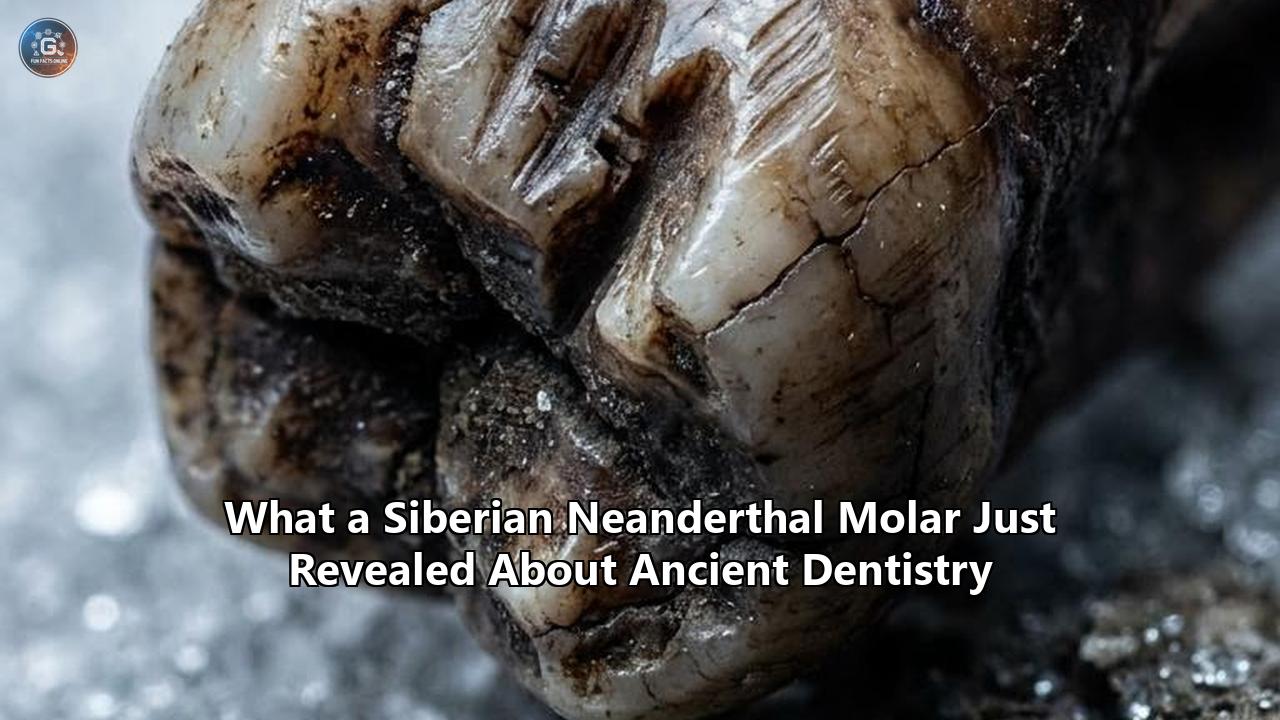
About 59,000 years ago, deep inside a limestone cave in the Altai Mountains of southwestern Siberia, a Neanderthal faced an agonizing medical crisis. A severe cavity in a lower left molar had breached the enamel, eaten through the dentin, and was approaching the sensitive pulp chamber, causing unrelenting pain. Instead of simply enduring the affliction or attempting to numb it with local plants, this individual—or more likely, a dedicated caregiver—took decisive, invasive action. Using a sharp, precisely knapped piece of jasper, someone manually drilled into the rotting tooth to hollow out the infected tissue and alleviate the pressure.
This prehistoric operation is detailed in a study published on May 13, 2026, in the journal PLOS One. Unearthed from Chagyrskaya Cave, the fossilized tooth, designated Chagyrskaya 64, represents the oldest known evidence of deliberate, invasive dental surgery in any hominid species. The discovery eclipses the previous record by more than 40,000 years and marks the first time such an advanced medical procedure has been documented outside of Homo sapiens.
Led by scientists at the Russian Academy of Sciences in St. Petersburg, the research team utilized micro-tomography and experimental archaeology to reconstruct the event. They concluded that the deep, irregular concavity on the tooth’s chewing surface was not the result of natural wear, trauma, or passive decay, but a highly targeted surgical intervention. Microscopic V-shaped grooves and parallel striations lining the cavity walls match the exact wear patterns produced by a rotating stone drill.
"What amazed me was how intuitively the person who owned this tooth understood exactly where the pain was coming from and realized that its source could be removed," said lead author Dr. Aliza Zubova from the Peter the Great Museum of Anthropology and Ethnography.
The identification of this procedure forces anthropologists and medical historians to rapidly reassess the cognitive and cultural capacities of our closest extinct relatives. It establishes that Neanderthals possessed not only the empathy required to care for their sick, but the empirical reasoning to diagnose a localized internal ailment and execute a complex, mechanical solution to treat it.
The Challenge: Surviving Dental Pathology in the Pleistocene
To understand the magnitude of this discovery, one must examine the severe physiological threat posed by tooth decay in the Paleolithic environment. The Neanderthals inhabiting the Altai Mountains lived in a brutal, high-stress ecosystem. The region was populated by cave hyenas, woolly rhinoceroses, and wolves, requiring hominids to maintain peak physical condition to hunt, forage, and survive harsh winters.
Dental health was not merely a matter of comfort; it was a fundamental metric of survival. The hominid diet relied heavily on mastication. Meat had to be chewed, hides had to be processed using the teeth as a "third hand," and fibrous plant materials required extensive grinding. An individual with a compromised jaw was at an immediate, severe disadvantage.
The specific pathology observed in the Chagyrskaya 64 molar is a massive carious lesion—a cavity. While Neanderthals generally consumed a low-carbohydrate, meat-heavy diet that kept rates of tooth decay relatively low, cavities did occur, particularly when their diets were supplemented with starchy tubers, roots, or sweet berries.
When cariogenic bacteria in the mouth ferment carbohydrates, they produce lactic acid, which strips calcium and phosphate from the tooth enamel. Enamel is the hardest substance in the human body, but once it is breached, the decay accelerates rapidly through the softer, underlying dentin. Dentin is highly porous, filled with microscopic tubules that communicate directly with the dental pulp.
Once decay approaches or enters the pulp chamber—the highly vascularized and innervated core of the tooth—the resulting condition is pulpitis. Because the pulp is encased in rigid walls of dentin and enamel, the inflammation has nowhere to expand. The swelling compresses the nerves and blood vessels, resulting in an intense, throbbing, localized agony that ranks among the most severe pain a human can experience.
If left untreated, the infection does not simply stop at the tooth. The necrotic tissue in the pulp chamber provides a pathway for bacteria to travel down the root canals and into the alveolar bone of the jaw, forming an apical abscess. In a Pleistocene environment without systemic antibiotics, a jaw abscess could easily evolve into sepsis or Ludwig's angina—a rapidly spreading bacterial infection of the floor of the mouth that can compromise the airway and cause death.
For the owner of the Chagyrskaya 64 tooth, the pain would have been inescapable. Passive remedies, which Neanderthals were known to use, had likely failed. Previous archaeological evidence shows that Neanderthals used wooden toothpicks to clear impacted food and relieve minor gum irritation. Some studies indicate they chewed on bark containing salicylic acid (the active ingredient in aspirin) or used other medicinal plants to manage pain. However, rubbing herbs on the gums or picking at the spaces between teeth provides no relief when the infection is sealed deep within the crown of a decaying molar.
The challenge was entirely mechanical: the necrotic, infected tissue had to be physically extracted from the crown to relieve the pressure and halt the localized decay. Without intervention, the individual faced chronic debilitation, malnutrition due to the inability to chew, and a high risk of fatal systemic infection.
What Went Wrong: The Failure of the Brute Stereotype
The significance of the Chagyrskaya 64 discovery lies not just in the tooth itself, but in how it dismantles long-held assumptions about evolutionary biology and hominid cognition. For more than a century, the prevailing scientific narrative categorized Neanderthals as cognitively deficient, culturally stagnant, and incapable of the innovative problem-solving associated with modern humans.
When early anthropologists first discovered Neanderthal remains in the 19th and early 20th centuries, they reconstructed them as stooped, apelike figures. This bias profoundly influenced the interpretation of Neanderthal pathology. If a Neanderthal skeleton showed signs of severe injury or disease, older interpretations often framed their survival as a matter of brute hardiness or animalistic self-medication. The idea that they possessed a structured system of healthcare, or the capacity to perform active medical interventions, was largely dismissed.
This theoretical blind spot represented a significant failure in our understanding of hominid behavioral ecology. It assumed a distinct cognitive barrier between Homo sapiens and all other species.
Furthermore, diagnosing the source of internal pain requires advanced abstract reasoning. Pain is an invisible, subjective experience. When an individual suffers from a deep cavity, the pain radiates throughout the jaw, face, and sometimes up to the ear or down the neck—a phenomenon known as referred pain. Identifying that this widespread agony originates from a specific, discolored lesion on a single tooth requires connecting an internal, sensory experience to a visible, external anomaly.
"Finding the Chagyrskaya molar tells us they could diagnose the source of pain by connecting an internal sensation to a visible, decayed lesion, which is not an obvious leap without a modern understanding of medicine," noted Dr. Kseniya Kolobova, an archaeologist at the Institute of Archaeology and Ethnography, Siberian Branch of the Russian Academy of Sciences.
To deduce that removing the discolored, rotted tissue would cure the invisible pain requires an even greater leap of logic. It shifts the behavior from instinctual self-soothing—like a dog licking a wound or a non-human primate eating roughage to clear parasites—into the realm of deliberate, hypothesized medical treatment. The failure of past archaeological models to credit Neanderthals with this level of deductive reasoning meant that subtle evidence of ancient healthcare was likely overlooked for decades.
The Evolution of Ancient Dentistry Methods
Tracing the timeline of prehistoric medical interventions provides necessary context for why the Siberian molar is causing such a massive reassessment in the scientific community. The evolution of ancient dentistry methods reflects a gradual transition from simple palliative care to complex surgical mitigation.
Prior to the PLOS One publication, the established timeline of dental care was cleanly divided between passive habits and active surgery.
1. The Palliative Use of Toothpicks
The most widespread and basic form of prehistoric dental care involved the use of rudimentary toothpicks. Traces of toothpick use—identified by smooth, polished grooves on the interproximal surfaces of teeth (the spaces between adjacent teeth)—have been observed in hominid fossils dating back nearly two million years. Even Homo habilis, one of the earliest known members of our genus, left behind dental micro-wear suggesting they used stiff grass stalks or small twigs to dislodge trapped food.
Neanderthals heavily utilized this practice. A famous 130,000-year-old Neanderthal specimen from Krapina, Croatia, showed extensive toothpick grooves, indicating a regular habit of oral hygiene or pain management for inflamed gums. However, toothpick use is not exclusive to hominids; Japanese macaques (Macaca fuscata) and other primates have been observed using improvised tools to clean their teeth. Therefore, while it demonstrates tool use, it does not necessarily indicate a complex medical framework.
Interestingly, the Chagyrskaya 64 tooth also features a pronounced interproximal groove on its distal aspect, indicating that the individual routinely used toothpicks. The toothpicks, however, were not enough to stop the aggressive carious lesion forming on the chewing surface of the crown.
2. The Earliest Known Homo Sapiens Dentistry
Before the Chagyrskaya discovery, the oldest universally accepted evidence of intentional, invasive cavity treatment belonged to a Homo sapiens specimen found in the Villabruna rock shelter in Italy. Dating to roughly 14,000 years ago, during the Late Upper Paleolithic, the Villabruna tooth featured a cavity that had been manually scraped out using tiny micro-lithic flint tools.
Other early examples of Homo sapiens dentistry include a 13,000-year-old tooth from the Riparo Fredian site in Italy, where the cavity had been enlarged and then packed with a mixture of bitumen (a natural tar) and plant fibers, serving as a primitive dental filling. By 9,000 years ago, communities in Mehrgarh, Pakistan, were using flint-tipped bow drills to bore highly uniform holes into teeth, indicating a specialized class of bead-makers had transferred their drilling technology to medical applications.
3. The Chagyrskaya 64 Anomaly
The Siberian molar drastically rewrites this timeline. By pushing the date of intentional dental surgery back to 59,000 years ago, Chagyrskaya 64 predates the Villabruna specimen by a massive margin of 45,000 years.
More crucially, it proves that the conceptual framework required for invasive surgery did not originate exclusively with modern humans. The Neanderthals of the Altai Mountains independently developed their own ancient dentistry methods, utilizing the specific stone tool technologies available in their Middle Paleolithic Mousterian toolkit to address a biological crisis.
Action by Experts: Decoding the Fossilized Evidence
Identifying a 59,000-year-old dental surgery requires a highly interdisciplinary approach, merging paleopathology, traceology (the study of microscopic wear patterns on tools and bones), and high-resolution digital imaging. The research team’s methodology provides a masterclass in how modern science extracts behavioral data from calcified remains.
The Chagyrskaya Cave was initially excavated over a series of field seasons, notably during a rainy period in the summer of 2016. Working carefully with scalpels and small knives under dripping cave ceilings, archaeologists slowly exposed a rich layer of Pleistocene history. The site proved exceptionally wealthy in artifacts, yielding heaps of stone and bone tools, alongside more than 70 hominin fossils—including 26 dental specimens. These fossils belonged to the easternmost known population of late Neanderthals, who had migrated into Siberia from Eastern Europe around 60,000 to 70,000 years ago.
When researchers first examined Chagyrskaya 64—a lower left second molar from an adult—they immediately noticed the large, irregularly shaped concavity extending deep into the floor of the pulp chamber. Initial skepticism was high; post-mortem damage, natural decay, and aggressive chewing of abrasive foods can all create unusual cavities in fossilized teeth.
To determine the exact origin of the hole, the team utilized a micro-CT (computed tomography) scanner, which uses X-rays to create non-destructive, high-resolution 3D models of the tooth's internal and external structures. They supplemented this with a scanning electron microscope (SEM) to analyze the cavity walls at the micron level.
The digital imaging revealed a wealth of artificial markers:
- Radial and Parallel Grooves: The interior walls of the cavity were lined with parallel, linear scratch marks and V-shaped grooves.
- Corrugated Bases: The microscopic valleys of these grooves featured corrugated textures indicative of mechanical abrasion by a hard, sharply edged material, rather than the smooth, organic decay caused by bacterial acid.
- Demineralization Patches: The micro-CT scan showed localized changes in the density of the surrounding dentin. There were two distinct patches of deep demineralization, confirming that severe tooth decay had been present prior to the physical alteration of the tooth.
"Our initial reaction was careful skepticism because the deep concavity didn't match normal wear or trauma," noted Dr. Kolobova. "The real turning point came during microscopic analysis when we spotted parallel striations and V-shaped grooves diagnostic of a rotating stone tool".
The orientation of the microscopic scratches was the definitive clue. The grooves wrapped around the walls of the pits in a circular formation. As paleoarchaeologist Andrey Krivoshapkin pointed out, this specific pattern "is exactly what you would expect from a rotating or drilling motion with a hard, pointed stone tool". It was not a haphazard scraping, but a deliberate, rotational boring action aimed directly at the center of the carious lesion.
Experimental Archaeology: Replicating the Surgery
Observing microscopic grooves is only the first step in the scientific process; proving how they were made requires replication. To confirm their hypothesis, the researchers engaged in experimental archaeology, attempting to reproduce the exact wear patterns on modern human teeth using the technology available to the Chagyrskaya Neanderthals.
The Mousterian lithic industry used by this population featured a variety of tools, including side scrapers, hand axes, and sharp-pointed implements known as perforators. The researchers sourced local Siberian jasper, a hard, cryptocrystalline quartz that fractures with sharp, durable edges, and knapped exact replicas of the perforators found in the same archaeological layer as the tooth.
Using recently extracted modern human teeth (including a wisdom tooth donated by one of the researchers themselves), the team set out to recreate the prehistoric operation.
The experimental protocol yielded several critical insights into the biomechanics of Neanderthal surgery:
- The Technique: The most effective method for penetrating the hard dental tissue was manually pinching the elongated jasper perforator between the thumb and forefinger, and rotating it back and forth under firm, downward pressure—effectively using the stone as a hand drill.
- The Time Investment: Drilling through the remaining enamel and deeply into the dentin was an arduous task. The experiments demonstrated that it took between 35 and 50 minutes of continuous, high-pressure rotational work to penetrate the tissue to the depth seen in the fossil.
- The Wear Match: When the experimentally drilled teeth were placed under the scanning electron microscope, the artificial grooves, V-shaped pits, and parallel striations matched the fossilized Chagyrskaya 64 molar almost exactly.
Reviewing the data, Dr. John Olsen, an archaeologist at the University of Arizona and co-author of the report, characterized the findings bluntly: "Basically a root canal... This [hole] was created by a stone tool handled by a Neanderthal between the thumb and the forefinger... We think this is an open and shut case".
Justin Durham, a professor of orofacial pain at Newcastle University and the British Dental Association's chief scientific adviser, reviewed the images independently of the study team. Assessing the surgical execution, he noted, "If I was marking this for a dental student, I wouldn't give it an A, but given the circumstances it's pretty impressive... a decent job".
Surviving the Operation: Evidence of Healing and Post-Operative Wear
One of the most pressing questions surrounding ancient invasive procedures is whether the patient survived the trauma. A 35-to-50-minute operation involving a stone drill grinding directly into an infected nerve cavity would have been unimaginably painful, inducing massive shock and stress. Novocaine, as observers have pointed out, would not be invented for another 60,000 years.
However, the bioarchaeological evidence indicates that the procedure was highly successful.
When analyzing the margins and interior edges of the drilled cavity on Chagyrskaya 64, the researchers discovered a distinct layer of post-operative wear polish. The sharp, jagged edges created by the initial drilling process had been worn smooth by the friction of chewing food over a prolonged period.
"Finding post-operative wear polish on the cavity edges confirmed the individual survived and used the tooth afterward, ruling out any possibility of post-mortem damage," explained Kolobova.
This smoothing process takes months, if not years, to develop. It confirms that the individual not only survived the agonizing procedure but recovered sufficiently to resume normal mastication on that side of their jaw. By successfully clearing out the necrotic tissue, the operation likely accelerated the death of the exposed nerve or allowed the localized infection to drain, eventually reducing the severe pressure and alleviating the chronic pain. The treatment worked.
The Social Operatory Room: Care, Compassion, and Dexterity
The implications of this successful surgery extend far beyond the mechanical act of drilling a tooth; they offer a profound glimpse into the social structure and collaborative care systems of Neanderthal communities.
When considering the logistics of the operation, it becomes immediately apparent that the patient could not have performed this procedure on themselves. The lower left second molar is located deep in the posterior of the mouth. The angle required to apply consistent, heavy downward pressure with a rotating stone drill for up to 50 minutes makes self-surgery physically impossible.
The procedure required a practitioner—a second individual who possessed the manual dexterity, the fine motor skills, and the patience to execute the operation. Dr. Kseniya Kolobova emphasized the immense difficulty of the prehistoric operating environment: "In real life, the tooth was in the mouth, and inflammation and swelling would have created additional difficulties, clearly making the situation even more complex." She added that the mouth is "a difficult space to work in," requiring "good manual dexterity, patience, and a helper who can hold the head still".
This scenario requires a sophisticated social dynamic. The patient had to trust the practitioner enough to allow them to inflict acute, intense pain in order to achieve long-term relief. At least one other helper was likely necessary to restrain the patient, hold their jaw open, and manage the inevitable flow of blood and saliva.
The existence of such organized medical intervention aligns with a growing body of evidence regarding Neanderthal social care. In 2022, genetic analysis of the individuals found in Chagyrskaya Cave revealed the first known Neanderthal family unit, including a father and his teenage daughter, alongside several other closely related individuals. They lived in small, tightly knit bands of 10 to 20 people.
In a community that small, the incapacitation of a single adult due to a severe dental infection threatened the survival of the entire group. Caring for the sick was not merely an act of compassion; it was a demographic necessity. Previous studies of Neanderthal remains across Europe and Asia have shown individuals who survived massive traumas—shattered femurs, amputated arms, and severe cranial impacts—long after their injuries had healed. These individuals could not have survived the initial trauma or the recovery period without their community providing them with water, processed food, and physical protection.
The Chagyrskaya 64 tooth elevates this concept of social care. It shows that Neanderthals did not merely nurse the sick passively; they intervened actively. As Dr. Zubova summarized, "Because Neanderthals were long viewed as a more primitive branch of the human family, care for community members during the Middle Palaeolithic has been regarded as something exceptional. But as the evidence mounts, it increasingly suggests that Neanderthals treated their sick and weak no differently than modern humans did".
Broader Implications for Evolutionary Medicine
The validation of these ancient dentistry methods fundamentally reshapes our understanding of the evolution of human healthcare.
For decades, the standard model of evolutionary medicine posited that active, invasive medical procedures were a hallmark of the Holocene—the geological epoch that began around 11,700 years ago, coinciding with the rise of agriculture, settled societies, and modern Homo sapiens. The logic assumed that only large, stable societies with specialized labor had the time, safety, and cognitive framework to experiment with surgery.
The Altai Mountains discovery shatters this paradigm. It proves that the cognitive prerequisites for surgery—anatomical observation, hypotheses regarding the source of disease, tool modification for medical purposes, and cooperative execution—were present in hominid populations at least 60,000 years ago, deep in the Pleistocene.
Gregorio Oxilia, a researcher who previously analyzed the 14,000-year-old Italian tooth, noted that pushing the date of intentional dentistry back by roughly 45,000 years "fundamentally reshapes our understanding of the evolution of human healthcare".
Furthermore, the procedure required specialized tool use. The jasper perforator was not a generalized hand axe repurposed randomly; its use was targeted and deliberate. The study authors noted that the tooth exhibits traces of multiple distinct types of manipulations requiring different tools. The individual used a toothpick to clear the gums, and the practitioner used a sharp stone drill to bore into the cavity.
Selecting different tools for different stages of medical treatment demonstrates an advanced operational sequence. It indicates that the Chagyrskaya Cave Neanderthals maintained a mental library of materials and their specific mechanical properties, applying them systematically to solve a biological problem. "These patterns bring Neanderthal behavior closer to modern humans and differentiate that behavior from the instinctive actions of other primates," the study authors wrote in PLOS One.
The integration of advanced toolmaking and medical care also raises intriguing questions about knowledge transmission. Was this surgical technique an isolated stroke of genius by one desperate group in Siberia, or was it a specialized piece of medical knowledge passed down through generations of Neanderthals? Given that hominid populations in the region persisted for thousands of years, the transfer of medical knowledge via oral communication and apprenticeship is highly probable.
Examining the Limits of the Evidence
While the evidence for mechanical intervention is robust, bioarchaeologists must remain cautious about interpreting the exact nature of the prehistoric operatory room. Rachel Kalisher, a bioarchaeologist at UC San Diego who was not involved in the PLOS One research, praised the rigorous methodology of the study, noting, "They did a lot of great work and they have beautiful data presented".
She agreed that the deep hole was highly likely to have been produced by a stone tool, though she maintained a healthy scientific skepticism about absolute intent, suggesting that proving intentional medical surgery beyond a shadow of a doubt in a 59,000-year-old fossil remains challenging. "It's certainly believable... But I'm not sure that the evidence that they provide is necessarily the smoking gun," Kalisher added.
However, the combination of the pathology (a pre-existing cavity causing pain), the biomechanics (rotational drilling with a tool rather than random scratching), and the outcome (survival and continued use of the tooth) builds an overwhelming circumstantial case that the team considers an "open and shut" confirmation of medical intent.
One unresolved aspect of the procedure is the potential use of anesthetics or antiseptics. While the mechanical aspect of the ancient dentistry methods is now preserved in the dentin, chemical interventions leave virtually no trace after 59,000 years.
Did the Chagyrskaya Neanderthals utilize botanical knowledge to aid the surgery? Evidence from other Neanderthal sites, such as El Sidrón in Spain, has shown traces of yarrow and chamomile trapped in dental calculus (hardened plaque). Both plants have known anti-inflammatory and mild analgesic properties, and they offer little nutritional value, suggesting they were chewed specifically for medical purposes.
Given the extreme pain involved in drilling into an inflamed pulp chamber, it is highly plausible that the prehistoric practitioner administered some form of botanical pain relief, either by having the patient chew medicinal bark beforehand or by packing the surgical site with crushed herbs post-operation to prevent further infection. Unfortunately, without preserved dental calculus directly covering the surgical site, this aspect of the procedure remains speculative.
What to Watch For Next: The Future of Paleopathology
The revelations from Chagyrskaya Cave represent a critical inflection point in the field of paleopathology, demanding a proactive shift in how archaeologists analyze fossilized remains.
Moving forward, the validation of these ancient dentistry methods will prompt a massive re-examination of existing museum collections. Across the globe, thousands of hominid teeth are stored in archival drawers. Many of these specimens feature anomalous wear, chips, or irregular cavities that were previously dismissed as taphonomic damage (natural decay occurring after death) or dietary wear and tear.
Armed with the knowledge that Neanderthals were capable of utilizing stone drills for medical purposes, researchers will likely subject these older collections to new rounds of high-resolution micro-CT scanning and scanning electron microscopy. It is highly probable that other examples of prehistoric surgery have already been excavated but remain unrecognized in the archives. Finding additional instances would confirm that medical drilling was a widespread cultural practice rather than an isolated, localized event.
Furthermore, excavation techniques in the field will continue to adapt. The Chagyrskaya Cave and neighboring sites in the Altai Mountains—such as Denisova Cave, famous for the discovery of the Denisovan hominid lineage—remain highly active archaeological zones. As teams continue to sift through the Pleistocene sediments, they will be increasingly vigilant for specialized micro-tools that may have been crafted explicitly for medical applications rather than hunting or hide processing.
Finally, the intersection of genomics and paleopathology will offer new frontiers. By extracting DNA from dental calculus or the pulp chambers of ancient teeth, scientists may soon be able to sequence the exact strains of cariogenic bacteria that tormented our ancestors, tracking the evolutionary arms race between human diets, oral microbiomes, and prehistoric healthcare.
The 59,000-year-old molar from Siberia is a stark reminder of the shared vulnerabilities that define the human condition. Across tens of thousands of years, the acute, throbbing pain of a rotting tooth remains a universal experience. Yet, the response to that pain—the ingenuity to craft a tool, the courage to submit to a painful intervention, and the compassion to operate on a suffering peer—proves that the defining characteristics of modern medicine were alive and well in the depths of the Paleolithic era.
Reference:
- https://www.sciencefocus.com/news/neanderthals-dentist-tooth
- https://journals.plos.org/plosone/article?id=10.1371/journal.pone.0347662
- https://arkeonews.net/59000-year-old-neanderthal-tooth-may-be-the-earliest-evidence-of-dental-treatment/
- https://gizmodo.com/neanderthal-dentists-treated-cavities-with-stone-drills-yes-really-2000757613
- https://www.nprillinois.org/2026-05-13/neanderthals-may-have-drilled-out-a-cavity-59-000-years-ago
- https://www.nationalgeographic.com/history/article/neanderthal-dentist-tooth
- https://www.livescience.com/archaeology/neanderthals/exceptional-drilled-tooth-reveals-neanderthals-practiced-dentistry-in-siberia-60-000-years-ago
- https://www.popsci.com/science/neanderthal-teeth-cavities/
- https://www.discovermagazine.com/59-000-year-old-neanderthal-tooth-may-reveal-the-earliest-known-dental-procedure-and-pain-treatment-49093
- https://www.sciencenews.org/article/first-evidence-neandertal-dentist-molar
- https://www.theguardian.com/science/2026/may/13/neanderthals-stone-drills-treat-cavities-tooth-siberia-dentist