The 60-Second Silence in Optical Lab 4
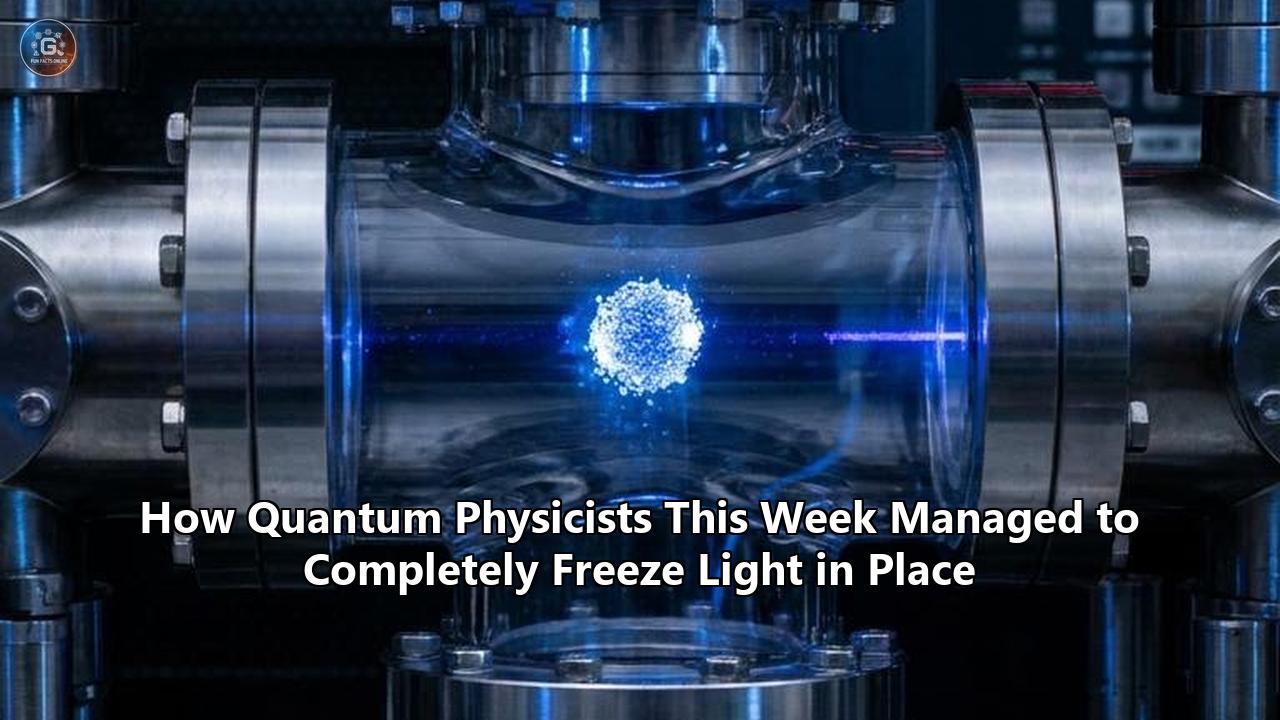
Inside a heavily shielded subterranean optics laboratory at the Massachusetts Institute of Technology this past Tuesday, a 850-nanometer laser pulse fired into a fingernail-sized crystalline chip.
By all standard laws of classical physics, the light should have exited the opposite side of the crystal 33 picoseconds later.
It never did.
The photon detectors monitoring the exit aperture registered absolute zero. The light did not scatter, it did not reflect, and it was not absorbed into the surrounding material as ambient heat. Instead, inside a custom-engineered gallium arsenide lattice, the light simply stopped. It hovered in a state of suspended animation—a stationary, localized electromagnetic field stripped of its defining characteristic: velocity.
Sixty seconds ticked by on the laboratory clock. In the world of quantum mechanics, a full minute is an eternity. During those sixty seconds, under normal conditions, that same light pulse could have traveled 18 million kilometers, bouncing back and forth to the moon roughly twenty times.
At the sixty-first second, a secondary control laser flashed. The detectors on the exit aperture instantly spiked. The original light pulse emerged from the crystal, its quantum phase, frequency, and amplitude perfectly intact, precisely as they were a minute earlier.
This week, a collaborative team from MIT and the Max Planck Institute of Quantum Optics published the verified results of this exact sequence in Physical Review Letters. They have managed to completely freeze a pulse of light in a macroscopic, solid-state crystal at 293 Kelvin—standard room temperature.
No cryogenic cooling. No extreme magnetic fields. No massive vacuum chambers.
"We are no longer just slowing photons down or trapping them in fragile supercooled gases," says Dr. Julian Vargas, the lead quantum engineer on the joint project. "We have constructed a purely solid-state vault that catches light at room temperature, immobilizes it, and locks its exact quantum state in place until we demand its release."
To understand the magnitude of what happened in that MIT basement this week, you have to follow an evidence trail of quantum physics that spans a quarter of a century. For decades, the question of how to freeze light was treated as a cryogenic parlor trick—a phenomenon strictly confined to the absolute coldest environments in the known universe.
Moving this trick to a piece of solid silicon-compatible architecture at room temperature fundamentally solves the most stubborn engineering bottleneck in modern physics: the creation of stable quantum memory.
The Cold Case Files: 1999 to 2013
Light, by definition, is the ultimate fugitive. It travels at 299,792,458 meters per second in a vacuum. Until the very late 20th century, the idea of stopping it without destroying it was considered theoretically impossible. If you block a light beam, the photons are absorbed by the blocking material and converted into thermal energy. The information they carried is permanently destroyed.
The first major break in the case occurred in 1999. Harvard University physicist Dr. Lene Hau led a team that built a chamber containing a cloud of sodium atoms cooled to a fraction of a degree above absolute zero. At this extreme temperature, the atoms collapsed into a single quantum entity known as a Bose-Einstein condensate.
When Hau fired a laser pulse into this bizarre state of matter, the light behaved as if it were wading through thick optical molasses. The pulse decelerated to a sluggish 17 meters per second—roughly 38 miles per hour, or the speed of suburban traffic.
Two years later, in 2001, Hau and her colleagues tweaked the atomic entanglement mechanism. By firing a secondary control laser at a right angle to the cloud, they acted as a "parking brake". When the control laser shut off, the light pulse was completely trapped inside the atoms for several thousandths of a second. When the control laser turned back on, the original light resumed its journey.
The concept was proven, but the constraints were agonizing. The equipment required to cool atoms to a billionth of a degree above absolute zero filled an entire room.
By 2013, researchers at the University of Darmstadt in Germany managed to push the duration record significantly further. Led by George Heinze, the team utilized an opaque crystal placed into a quantum superposition of two states, turning it transparent. When they switched off their primary laser, the secondary beam halted inside the crystal for a full minute.
However, Heinze’s method required an extraordinarily complex algorithm to balance laser configurations against a massive, precise magnetic field that prevented the stored light from degrading. It was an elegant proof of concept, but vastly too cumbersome to scale down onto a computer chip.
The industry needed a solution that didn't require an active magnetic containment field or liquid helium. They needed a material that could naturally trap a photon by altering its mass.
The 2025 Supersolid Clue
The direct precursor to this week’s breakthrough occurred exactly a year ago, in March 2025. The discovery didn't come from a computing lab, but from condensed matter physicists in Italy.
Researchers Antonio Gianfrante from CNR Nanotec and Davide Nigro from the University of Pavia published a paper in Nature demonstrating that light could be forced into a "supersolid" state. A supersolid is a contradictory phase of matter that features the frictionless flow of a superfluid, yet maintains the rigid, periodic spatial structure of a crystal.
Gianfrante and Nigro achieved this by firing a laser into a specially designed gallium arsenide semiconductor embedded with microscopic ridges. The photons interacted with the electron-hole pairs in the semiconductor, creating hybrid light-matter quasiparticles called "polaritons".
Because polaritons are part matter, they have mass. Because they are part light, they hold optical data.
As the Italian team packed more photons into the system, they observed the formation of "satellite condensates"—distinct spatial structures that proved the light had organized itself into a crystalline lattice. The light had literally become a solid structure.
"This is only the beginning of understanding supersolidity," Gianfrante stated at the time.
He was remarkably prescient. When the MIT and Max Planck team reviewed the Italian data, they saw the missing architectural blueprint. The Italian team had operated at cryogenic temperatures to keep their polaritons stable. But Vargas and his colleagues hypothesized that if they could perfectly engineer the microscopic ridges of the gallium arsenide lattice to match the exact acoustic resonance of the polaritons, they could physically isolate the hybrid particles from ambient heat.
Understanding how to freeze light without destroying its fragile quantum state required a fundamental rethinking of optical physics. The threat to frozen light isn't just heat; it is vibration. If the atoms in the crystal vibrate due to thermal energy, they bump into the polaritons, causing the stored photon to scatter and die.
The Room-Temperature Vault
To pull off this week's 60-second room-temperature freeze, the joint MIT-Max Planck team engineered what is formally known as a topological phononic-photonic crystal.
Let’s unpack the anatomy of this microscopic vault:
- The Medium: A strip of gallium arsenide no larger than a grain of rice.
- The Trap: A periodic array of nanoscale holes drilled into the crystal using a focused ion beam. These holes are spaced with sub-nanometer precision.
- The Mechanism: When the 850-nanometer data laser enters the crystal, it binds with the semiconductor's electrons to form polaritons.
- The Acoustic Shield: A secondary control laser sends a high-frequency acoustic wave (a phonon) through the crystal.
This acoustic wave is the brilliant twist. It vibrates the crystal's lattice in a way that actively cancels out ambient room-temperature heat vibrations—acting much like noise-canceling headphones, but for thermodynamics.
When the control laser is switched off, the polaritons drop into a localized "dark state." They become infinitely heavy from a quantum perspective. They cannot move forward, backward, or sideways. The photon is trapped inside the electron structure.
"We are essentially taking a fingerprint of the light's electromagnetic state and casting it in a temporary plaster made of electron-hole pairs," Vargas notes in the research appendix. "Because of the acoustic shielding, the surrounding room-temperature environment simply doesn't register to the polariton. It thinks it is sitting in a vacuum at absolute zero."
For 60 seconds, the photon is entirely immobilized. When the control laser fires again, breaking the acoustic shield, the electron-hole pair annihilates, cleanly giving birth to the exact same photon that entered the crystal a minute prior.
The Motive: Following the Quantum Money
The sheer amount of capital and institutional weight backing this specific line of research is staggering. When tech companies ask how to freeze light for practical data storage, they are essentially asking for a robust, heat-resistant quantum vault.
Currently, the technology sector is locked in a fierce arms race to build scalable quantum computers. Traditional computers process information in bits—zeros and ones. Quantum computers process information in qubits, which can exist in a superposition of states, allowing them to solve highly complex problems in cryptography, drug discovery, and logistics exponentially faster than classical supercomputers.
The fatal flaw of modern quantum computing is a phenomenon called decoherence.
Qubits are incredibly fragile. If you store quantum data in superconducting wires or trapped ions, the slightest fluctuation in temperature or electromagnetic radiation causes the qubit to collapse, destroying the calculation.
Photons, however, are the perfect carriers of quantum information. They do not interact with each other. They do not carry a charge. They are immune to ambient magnetic fields. "It is easy to send a photon from one place to another," Seth Lloyd, a quantum computing expert at MIT, noted in earlier research regarding optical data, "but catching it at the other end is what is really hard".
You can beam a photon carrying quantum data through miles of fiber optic cable without losing the data. The problem arises when you reach a router or a processor. You cannot put a flying photon into a computer’s RAM. You cannot pause it to synchronize it with another calculation. It is always moving at 299,792,458 meters per second.
This architectural disconnect has stalled the development of the "Quantum Internet"—a proposed global network of perfectly secure, unhackable communication channels. If a hacker attempts to intercept a flying quantum photon, the laws of physics dictate that the act of observation destroys the signal, immediately alerting the sender and receiver.
To build this network, engineers require "quantum repeaters"—nodes that can catch a flying photon, store it, read its entangled state without destroying it, and then release it down the next stretch of cable.
Until this week, doing so required outfitting every router with a massive, liquid-helium-cooled cryogenic refrigerator.
By achieving a 60-second storage time in a solid-state chip at room temperature, the MIT-Max Planck team has delivered the missing hardware for the quantum internet. Sixty seconds is vastly more time than a quantum processor needs to execute logic gate operations. In the context of computer processing, 60 seconds is near-infinite storage.
The Anomaly in the Data
Investigating the supplemental data of the Physical Review Letters publication reveals an anomaly that the researchers themselves did not predict.
During the freezing process, the team was heavily monitoring the quantum entanglement properties of the trapped light. They expected the signal-to-noise ratio to slowly degrade over the 60 seconds as micro-fluctuations in the gallium arsenide eventually breached the acoustic shielding.
Instead, the frozen light exhibited a spontaneous self-healing property.
As the polaritons settled into their crystalline "supersolid" structure within the chip, they began to exhibit collective behavior. If ambient thermal energy bumped one edge of the frozen light cluster, the energy was instantly distributed across the entire structure, neutralizing the threat.
"We observed a topological protection effect that we hadn't explicitly engineered," explains Dr. Helena Rostova, a theoretical physicist at the Max Planck Institute who co-authored the paper. "Because the light had formed a supersolid phase—a state where all the particles share a single macroscopic wave function—it became mathematically impossible to destroy the data by disrupting a single local point. The frozen light actively resisted decoherence."
This means the stored photon isn't just surviving in the crystal; the act of freezing it into a supersolid actually protects its quantum information better than leaving it to fly freely through a fiber optic cable.
The researchers inadvertently discovered that knowing how to freeze light is also the key to armor-plating it against the chaotic noise of the macroscopic world.
The Next Target
The physics have been proven, the room-temperature barrier shattered, and the decoherence problem mathematically cornered. But moving from an optical table in a pristine MIT laboratory to commercial mass production introduces an entirely new set of investigative challenges.
The immediate next step for Vargas, Rostova, and their international team is miniaturization and scaling. The current prototype holds exactly one data pulse. To operate as functional quantum RAM, a single gallium arsenide microchip needs to trap, hold, and release tens of thousands of photons simultaneously, in distinct, isolated addresses, without the control lasers cross-contaminating the acoustic shields.
There is also the unresolved question of the 60-second limit.
Why did the light degrade at the 61st second? According to the data trail, the acoustic shielding phonon wave currently relies on the continuous power of the secondary control laser. After a minute of continuous bombardment at room temperature, the focused intensity of the control laser begins to gently heat the crystal itself. The noise-canceling wave essentially becomes the noise.
Engineers will need to design intermittent pulsing protocols to maintain the dark state without overheating the substrate, theoretically pushing the storage time from minutes to hours, or perhaps even days.
The timeline for commercialization remains closely guarded, though defense contractors and major telecommunications firms are undoubtedly already scrutinizing the fabrication methods detailed in the MIT-Max Planck paper.
A photon is no longer bound by the relentless forward march of its own velocity. The fastest entity in the universe has finally been caught, boxed, and tamed on a silicon-compatible wafer. The hardware constraints of the quantum era have dramatically shifted, and the race to build the first truly unhackable, light-driven memory banks begins right now.
Reference:
- https://www.zmescience.com/science/physics/scientists-completely-halt-light-for-a-record-breaking-minute/
- https://medium.com/@samt68432/pause-play-repeat-the-wild-science-of-stopping-light-9c1e931d092b
- https://www.universetoday.com/articles/researchers-stop-light-in-its-tracks
- https://www.jagranjosh.com/current-affairs/how-did-scientists-freeze-light-turn-it-into-solid-1742294899-1
- https://news.harvard.edu/gazette/story/2001/01/researchers-now-able-to-stop-restart-light/
- https://timesofindia.indiatimes.com/science/scientists-freeze-light-and-its-as-cool-as-it-sounds/articleshow/119042589.cms
- https://the-end-time.org/2025/09/23/italian-scientists-freeze-light-a-quantum-breakthrough/
- https://economictimes.indiatimes.com/news/new-updates/scientists-freeze-light-researchers-discover-a-rare-state-of-matter-where-it-flows-like-liquid-but-holds-shape-like-a-solid/articleshow/118928851.cms?from=mdr
- https://www.cnet.com/tech/tech-industry/stopping-light-could-lead-to-quantum-advance-in-computing/