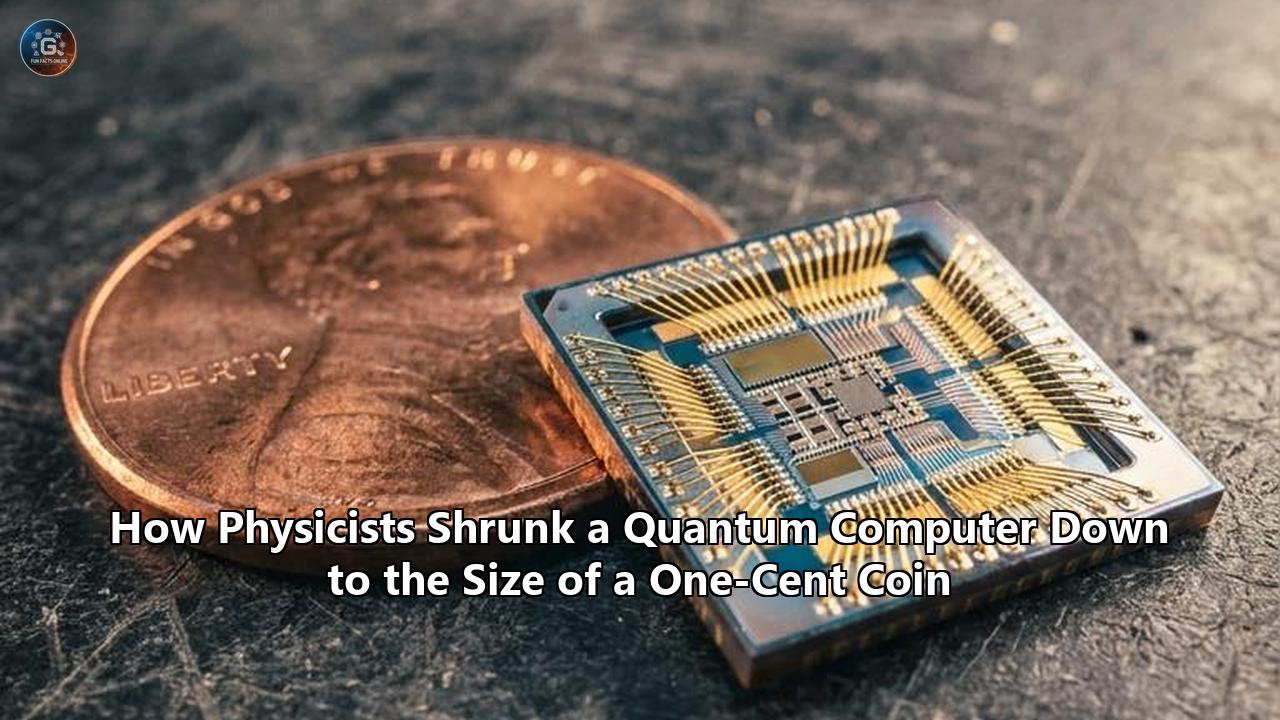
For decades, the central challenge of quantum computing has been one of scale. The most powerful quantum processors require massive, room-sized infrastructures dominated by tangled webs of coaxial cables, high-precision lasers, and towering dilution refrigerators designed to keep fragile quantum bits (qubits) near absolute zero. This physical bottleneck has relegated quantum technology to highly controlled laboratory basements and massive corporate data centers.
However, a breakthrough published in Science Advances by an international team of physicists led by Andrii Chumak at the University of Vienna has dramatically altered this trajectory. By extending the lifetime of magnons—quasiparticles representing collective spin waves in magnetic materials—by nearly a hundredfold, researchers have laid the physical foundation to shrink the core of a quantum computer down to the size of a one-cent coin.
This achievement marks a transition from a physics-constrained pursuit to an engineering-driven timeline. By demonstrating magnon coherence times of up to 18 microseconds—nearly 100 times longer than the previously recorded limits of a few hundred nanoseconds—the team has proved that magnetic waves can reliably store and carry quantum information inside solid-state chips. This brings the realization of a practical, highly integrated miniature quantum computer closer to commercial reality.
Squeezing Light into Solids: The Physics of Magnons
To understand why this breakthrough is a pivotal shift, it is necessary to examine the fundamental limitations of existing quantum architectures. Most leading quantum platforms rely on either superconducting circuits or trapped ions. While highly precise, superconducting qubits are large (measured in millimeters) and require individual, shielded microwave control lines. Trapped-ion systems, on the other hand, rely on massive tables of optical components and high-precision lasers to manipulate individual atoms.
Photons are excellent carriers of quantum information because they travel at the speed of light and suffer very little environmental decoherence. However, photons require open space or optical fibers to propagate. Because their wavelengths are relatively large—typically in the micrometer or millimeter range—optical circuits cannot easily be shrunk down to nanoscale dimensions without losing control of the light.
This is where magnons offer a compelling alternative. Magnons are collective excitations of a material's magnetization. They are often described as ripples spreading across a pond after a stone is dropped, but instead of water molecules, it is the magnetic spins of atoms precessing in unison.
Spin Wave Propagation (Magnon)
   ↑       ↗       →       ↘       ↓       ↙       ←       ↖       ↑
  [Atom]  [Atom]  [Atom]  [Atom]  [Atom]  [Atom]  [Atom]  [Atom]  [Atom]
  ├────────────────────────────────────────────────────────────────────┤
  │                 Propagating Wave of Magnetization                  │
  └────────────────────────────────────────────────────────────────────┘
Because magnons propagate inside solid magnetic materials, they do not require open optical pathways. Crucially, their wavelengths can shrink to the nanometer scale while maintaining their frequency. This means magnonic circuits can theoreticaly be built using the same high-density nanolithography methods used to manufacture modern smartphone silicon chips.
For years, the Achilles' heel of this approach was the dissipation of these spin waves. Magnons were notoriously short-lived, decaying in a few hundred nanoseconds. This fleeting existence made them far too unstable to function as quantum memory or to carry qubits across a chip before the information was lost to thermal noise.
Inside the Vienna Experiment: Overturning Dissipation Limits
The team led by Andrii Chumak, head of the Nanomagnetism and Magnonics Research Unit at the University of Vienna, achieved their 100-fold lifetime extension by combining materials science with precise quantum manipulation.
The primary material used in the study was yttrium iron garnet ($Y_3Fe_5O_{12}$, or YIG). YIG is a synthetic, insulating ferrimagnet recognized for having the lowest known magnetic damping of any material. The researchers prepared ultra-pure, single-crystal YIG spheres measuring just 0.3 millimeters in diameter.
To achieve the 18-microsecond coherence threshold, the experimental design relied on two critical techniques:
- Short-Wavelength Dipole-Exchange Magnons: Traditional quantum magnonics experiments utilize uniform magnons (where all spins precess in phase). However, these uniform waves are highly susceptible to scattering off tiny surface defects on the edges of the YIG sphere. By intentionally exciting short-wavelength dipole-exchange magnons, the team generated waves that are naturally less sensitive to surface irregularities, effectively bypassing the mechanical defects of the crystal.
- Sub-Kelvin Cryogenic Freezing: The YIG spheres were placed inside a mixed-phase dilution cryostat and cooled to 30 millikelvin—just a fraction of a degree above absolute zero. At this extreme temperature, the thermal vibrations (phonons) that typically collide with and destroy magnons are frozen out.
Experimental Architecture (University of Vienna)
 ┌─────────────────────────────────────────────────────────────┐
 │  Mixed-Phase Cryostat (Cooled to 30 Millikelvin)            │
 │                                                             │
 │   ┌─────────────────────────────────────────────────────┐   │
 │   │  Coplanar Waveguide (CPW)                           │   │
 │   │                                                     │   │
 │   │        [0.3-mm Ultra-Pure YIG Sphere]               │   │
 │   │                      │                              │   │
 │   │                      ▼                              │   │
 │   │     (Excitation of Short-Wavelength Magnons)        │   │
 │   └─────────────────────────────────────────────────────┘   │
 └─────────────────────────────────────────────────────────────┘
The most profound realization of the experiment came when the team compared three YIG spheres of varying material purities. The cleanest specimen yielded a magnon lifetime of 18 microseconds, while the less pristine spheres achieved lifetimes of 5 and 11 microseconds.
This gradient demonstrated that the physical limit of a magnon's lifespan is not dictated by an unyielding law of quantum mechanics. Instead, it is bounded entirely by microscopic trace impurities and crystal defects in the YIG lattice. Consequently, further advancements in material purification and fabrication can push these coherence times even higher, mimicking the purity scaling that drove the classical silicon transistor revolution.
Who Is Affected? A Multi-Industry Ripple Effect
The transition of magnons from highly volatile, short-lived waves into stable information carriers fundamentally reshapes the timelines and strategies of several global industries.
                              ┌────────────────────────┐
                              │  Magnon Lifespan       │
                              │  Breakthrough (18 µs)  │
                              └───────────┬────────────┘
                                          │
                  ┌───────────────────────┼───────────────────────┐
                  ▼                       ▼                       ▼
       ┌─────────────────────┐ ┌─────────────────────┐ ┌─────────────────────┐
       │   Quantum Chip      │ │  Materials Science  │ │ Cybersecurity &     │
       │   Architects        │ │  & Crystallography  │ │ National Security   │
       └─────────────────────┘ └─────────────────────┘ └─────────────────────┘
Quantum Chip Architects and Hardware Developers
For system designers at organizations like Google Quantum AI, IBM, and Rigetti Computing, this development provides an entirely new tool for managing physical footprint and qubit interconnectivity.
Currently, superconducting quantum processors are limited by the physical size of their millimeter-scale qubits and the massive "candelabra" wiring harness of dilution refrigerators. By integrating magnon-based components, hardware developers can transition toward ultra-dense, on-chip architectures.
Instead of routing hundreds of individual coaxial lines to control qubits, a single magnon-based transmission line can act as a shared highway to transfer quantum states across a chip.
Materials Scientists and High-Purity Crystallographers
This breakthrough shifts the competitive landscape of quantum computing hardware directly into the hands of materials scientists and crystal growth specialists. Companies and research groups specializing in liquid-phase epitaxy (LPE)—the primary method used to grow single-crystal YIG films on Gadolinium Gallium Garnet (GGG) substrates—will see a sharp increase in demand.
Crystallographers like Carsten Dubs, a co-author of the Science Advances study who specializes in growing highest-quality YIG, are now at the center of the quantum hardware supply chain. The race is no longer just about designing better quantum software algorithms; it is about who can synthesize the purest, defect-free magnetic crystals at the atomic scale.
Defense, Aerospace, and Mobile Edge Computing Sectors
For sectors that require decentralized, field-deployable computing power—such as the military, aerospace, and autonomous transport—the physical footprint of a quantum computer is its most restrictive attribute.
A room-sized machine cannot be installed on a reconnaissance drone, an orbital satellite, or a navy vessel. By demonstrating a pathway toward a miniature quantum computer, the Vienna-led research makes decentralized quantum sensors, localized post-quantum cryptographic systems, and rugged edge-computing nodes viable for real-world deployment.
What Changes? Overcoming the Two Biggest Barriers in Quantum Computing
By showing that magnons can match the coherence properties of typical superconducting transmon qubits, the University of Vienna team has addressed two of the most stubborn bottlenecks in modern quantum engineering: the scalability bottleneck and the interoperability bottleneck.
1. Eliminating the "Quantum Wiring" Bottleneck via the Quantum Bus
In superconducting quantum processors, each qubit must be individually addressed by microwave lines. As systems scale from 100 qubits to 1,000 and beyond, the physical space inside the refrigerator becomes overcrowded with cables. This thermal and physical crowding is known as the "wiring bottleneck."
Because magnons can couple to multiple qubits simultaneously through a shared solid-state pathway, they can act as a quantum bus.
Conventional Superconducting Qubit Coupling (Individual Wiring)
  [Control Line 1] ───► [Qubit A]
  [Control Line 2] ───► [Qubit B]   (High wiring overhead, scaling limits)
  [Control Line 3] ───► [Qubit C]

Magnon-Based Qubit Coupling (Shared Quantum Bus)
  [Control Line] ───► ┌────────────────────────────────────────┐
                      │    YIG Solid-State Magnon Bus          │
                      │   (Propagating Spin Waves / 18 µs)     │
                      └─▲──────────────────▲──────────────────▲┘
                        │                  │                  │
                    [Qubit A]          [Qubit B]          [Qubit C]
This solid-state bus allows different parts of a quantum processor to communicate over a single, shared magnetic channel without requiring dedicated control lines. By routing quantum information via collective spin waves, chip designer can dramatically reduce the physical complexity of the control interface, clearing a path toward high-density integration on a single coin-sized substrate.
2. Solving Interoperability: The Universal Translator
The quantum landscape is highly fragmented. Some physical systems are excellent at processing information (such as superconducting qubits), while others are unmatched at storing it (like spin defects in diamond) or transmitting it over distances (like optical photons).
The difficulty lies in getting these disparate systems to communicate with one another. Converting a fragile quantum state from a microwave-frequency superconducting circuit into an optical photon usually introduces catastrophic signal loss.
Magnons reside within a solid-state host and naturally couple to multiple types of physical phenomena. Because they generate magnetic dipoles, they couple directly to superconducting microwave circuits. Simultaneously, because of magneto-optical effects, they can interact with laser light (photons).
This dual compatibility positions magnons as universal quantum translators. They can accept a quantum state from a superconducting processor, convert it into a spin wave, and then translate it into an optical photon for long-distance transmission over a fiber-optic network, all on a single chip.
Short-Term Consequences: Accelerating the Hybrid Quantum Wave
In the immediate term, this development will trigger a rapid reallocation of R&D capital toward hybrid solid-state architectures.
The Rise of Hybrid Quantum Platforms
Over the next 12 to 24 months, major quantum computing developers will likely pivot away from "pure" monolithic architectures. Instead of attempting to build processors solely out of superconducting transmons or trapped ions, companies will focus on hybrid architectures that pair the processing power of superconducting circuits with the low-loss routing capabilities of magnonic buses.
We can expect to see major joint research initiatives between academic centers like Vienna and corporate laboratories to prototype the first multi-qubit chips utilizing YIG-based magnonic interconnects.
Hybrid Quantum Processing Unit (QPU)
 ┌─────────────────────────────────────────────────────────────┐
 │  Silicon Chip Substrate                                     │
 │                                                             │
 │   ┌───────────────────────┐         ┌───────────────────────┐ │
 │   │ Superconducting Qubits│         │ Superconducting Qubits│ │
 │   │ (Processing Array A)  │         │ (Processing Array B)  │ │
 │   └───────────┬───────────┘         └───────────┬───────────┘ │
 │               │                                 │             │
 │               ▼                                 ▼             │
 │   ┌─────────────────────────────────────────────────────────┐ │
 │   │   Yttrium Iron Garnet (YIG) Magnon Bus                  │ │
 │   │  (Low-Loss On-Chip Coherent Translator)                 │ │
 │   └───────────────────────────┬─────────────────────────────┘ │
 │                               │                               │
 │                               ▼                               │
 │                  ┌────────────────────────┐                   │
 │                  │ Photonic Fiber Interface│                   │
 │                  └────────────────────────┘                   │
 └─────────────────────────────────────────────────────────────┘
The Transducer Engineering Challenge
The focus of experimental physics will shift from proving magnon lifetimes to building efficient interface hardware. As Andrii Chumak noted following the publication, the next immediate hurdle is creating nanoscale transducers that can excite and detect these short-wavelength dipole-exchange magnons with high fidelity.
Because these magnons are incredibly tiny, conventional microwave antennas are too bulky to couple with them efficiently. Researchers must develop nanometer-scale transducers capable of converting electrical currents into localized spin precessions.
A Gold Rush in Ultra-Pure YIG Epitaxy
The specialized material requirements of quantum magnonics will spur investment in advanced crystal growth facilities. Currently, high-purity YIG films are produced in small, specialized batches primarily for laboratory research.
As the demand for defect-free crystals grows, the semiconductor manufacturing industry will begin exploring ways to scale LPE and chemical vapor deposition (CVD) processes for YIG. Silicon foundries may invest in fabricating hybrid YIG-on-Silicon wafers to enable the integration of magnonic buses directly onto standard industrial microchips.
Long-Term Consequences: Decentralized Quantum and the Mobile Quantum Core
Looking further ahead, the successful integration of magnonic systems points to a structural shift in how quantum computational power is distributed, utilized, and integrated into society.
From Data-Center Mainframes to Localized Edge Devices
The historical parallel to this transition is the invention of the silicon integrated circuit in the late 1950s, which freed classical computing from massive vacuum-tube cabinets.
Currently, quantum computing operates on a strict cloud-access model: users send classical data to a central corporate server, which processes it on a room-sized quantum machine and returns the result.
A high-performance, magnon-integrated chip could act as a miniature quantum computer operating at the edge.
Cloud-Based Quantum Model (Current)
  [User Terminal] ──(Internet)──► [Remote Data Center] ──► [Room-Sized Quantum Computer]

Decentralized Edge Quantum Model (Future)
  [Local Hardware Device] ──(On-Chip Bus)──► [Miniature Quantum Chip (Coin-Sized Core)]
By placing quantum processing directly onto localized devices, industries can bypass the latency, bandwidth, and security concerns associated with sending highly sensitive data over public networks.
This local processing capability is particularly vital for real-time applications such as autonomous navigation, localized molecular simulation, and on-the-fly encrypted communications in remote areas.
Secure Quantum Key Distribution (QKD) on Satellites
As quantum decryption capabilities advance, the global telecommunications infrastructure must adopt quantum-safe security protocols. Quantum Key Distribution (QKD) is highly secure, but deploying QKD hardware over global distances requires orbital satellite networks.
Weight and power constraints are severe in space exploration and satellite design. Replacing massive, laser-heavy optical tables with solid-state, magnon-mediated PICs (Photonic Integrated Circuits) will allow aerospace companies to pack quantum encryption transceivers into lightweight, low-power smallsats and CubeSats. This will make global, satellite-based quantum cryptography networks economically viable.
High-Fidelity Quantum Metrology and Sensing
The ability to sustain coherent magnons for 18 microseconds has profound implications for sensing and measurement technology. Because spin waves are highly sensitive to their electromagnetic surroundings, long-lived magnons can be used as extremely precise detectors for faint magnetic fields, temperature fluctuations, and mechanical pressures.
This will enable a new class of non-invasive, ultra-precise medical sensors—such as portable, high-resolution magnetoencephalography (MEG) arrays—and highly sensitive geological scanning equipment capable of detecting underground mineral deposits or seismic activity without physical drilling.
The Cryogenic Conundrum: Can We Really Build a Coin-Sized System?
While the physics community is enthusiastic about the Vienna breakthrough, a pragmatic engineering question remains: How can a quantum computer be described as "the size of a one-cent coin" if it still requires a dilution refrigerator cooled to 30 millikelvin to operate?
This paradox highlights the difference between the computational core of a machine and its ancillary support systems.
While the processing chip itself is now small enough to fit on a penny, the surrounding cooling apparatus remains bulky. Resolving this discrepancy is the next major frontier in quantum engineering.
Total Quantum System Footprint
 ┌────────────────────────────────────────────────────────────────────────┐
 │  Auxiliary Cryogenic Cooling Structure (Dilution Refrigerator)          │
 │                                                                        │
 │   ┌────────────────────────────────────────────────────────────────┐   │
 │   │  Micro-Cryostat/On-Chip Cooler                                 │   │
 │   │                                                                │   │
 │   │   ┌────────────────────────────────────────────────────────┐   │   │
 │   │   │  Miniature Quantum Computer Core (The "Penny")         │   │   │
 │   │   │                                                        │   │   │
 │   │   │  [YIG Magnon Bus] ──► [High-Density Qubit Arrays]      │   │   │
 │   │   └────────────────────────────────────────────────────────┘   │   │
 │   └────────────────────────────────────────────────────────────────┘   │
 └────────────────────────────────────────────────────────────────────────┘
Addressing this cooling challenge is progressing along three parallel development paths:
1. The Co-Development of Micro-Cryostats and On-Chip Cooling
Traditional dilution refrigerators are hand-built, room-sized towers designed to cool large, bulky experimental setups. However, when the target payload is a single, flat, coin-sized silicon-YIG chip, the volumetric cooling requirement drops by several orders of magnitude.
Cryogenic engineering companies are developing micro-cryostats—highly integrated, automated, closed-loop cooling units about the size of a standard desktop computer tower. Additionally, research into solid-state on-chip laser cooling and micro-thermoelectric coolers may eventually allow localized chip areas to be chilled to millikelvin temperatures without requiring massive external liquid-helium systems.
2. Room-Temperature Magnonic Architectures
While the Vienna experiment was conducted at 30 millikelvin to achieve the maximum possible coherence in the quantum regime, magnons themselves are highly robust and can propagate at room temperature. In fact, room-temperature magnonic logic gates and signal processors have already been demonstrated for classical, non-von Neumann computing systems.
As materials scientists continue to improve the purity of YIG and explore novel multi-layered ferromagnetic materials, they may unlock ways to protect quantum spin waves from thermal decoherence at much higher temperatures. If magnon coherence can be sustained at liquid-nitrogen temperatures (77 Kelvin) or even room temperature, the need for complex dilution refrigerators would be completely eliminated, allowing true, uncompromised miniaturization.
3. Dedicated Coprocessors and Desktop Quantum Computers
Even with small-scale cryogenic systems, the physical footprint of a localized quantum machine will shrink dramatically. Companies like SpinQ Technology have already commercialized desktop-sized, portable quantum systems designed for education and basic algorithm design. These portable units use nuclear magnetic resonance (NMR) and operate at room temperature, though they are limited to 2 or 3 qubits.
By incorporating high-coherence, magnon-based chips, future iterations of these portable devices could scale from simple demonstrational units into highly functional, desktop-sized quantum coprocessors capable of executing complex optimization algorithms locally.
The Horizon: Key Milestones to Monitor
As the quantum computing ecosystem digest the implications of this breakthrough, the road from a laboratory proof-of-concept to industrial integration will be defined by several key technical milestones.
Milestones to Watch (2026–2030)
| Timeframe | Expected Technical Development | Critical Metrics to Watch |
|---|---|---|
| Short-Term (1–2 Years) | Direct measurement of magnon lifetime using echo-type spectroscopy. | Transition from inferred parametric measurement to direct temporal verification. |
| Mid-Term (3–5 Years) | Prototyping of nanoscale transducers integrated with superconducting transmons. | Coupling efficiency of electrical-to-magnon conversion above 90%. |
| Long-Term (5–10 Years) | First multi-qubit processor utilizing a coherent, solid-state magnon bus. | Demonstration of 100+ qubits connected via a single YIG channel without wiring crosstalk. |
The team in Vienna has proved that the primary limit on magnon lifetime is a materials engineering problem rather than a fundamental physical barrier.
This distinction changes the outlook for the field. By transforming a fundamental scientific roadblock into a challenge of manufacturing and materials synthesis, the path toward a commercially viable miniature quantum computer is clearer and more defined than ever before.
References
- --- Vienna-led team measures magnon lifetimes up to 18 microseconds, pointing to future chip-scale quantum devices. (International Business Times, 2026)
- --- Physicists extend magnon lifetimes by nearly 100 times, enabling potential coin-sized quantum computers. (ScienceDaily, 2026)
- --- New discovery led by Andrii Chumak at the University of Vienna published in Science Advances. (StarDrive, 2026)
- --- Columbia Engineering stacks 2D superconducting qubits, achieving 1,000-fold size reduction. (TweakTown, 2021)
- --- UMass Amherst and UC Santa Barbara demonstrate photonic chips replacing bulky laser setups. (Futura-Sciences, 2026)
- --- Rostyslav O. Serha, et al., "Ultralong-living magnons in the quantum limit," Science Advances, May 2026. (ResearchGate, 2026)
- --- Vienna research team explores magnons as a "quantum bus" and universal translators in hybrid setups. (AZoQuantum, 2026)
- --- How short-wavelength magnons circumvent surface defects at millikelvin temperatures. (Quantum Zeitgeist, 2026)
- --- Andrii Chumak on direct echo-type measurements and nanoscale transducers for quantum integration. (Physics World, 2026)
- --- Purity's pivotal influence: how materials science is reshaping the limits of quantum magnonics. (DigiconAsia, 2026)
- --- The Nanomagnetism and Magnonics Research Unit on integrating single propagating magnons with SC qubits.* (University of Vienna, 2026)
Reference:
- https://www.ibtimes.sg/tiny-magnetic-waves-could-pave-way-penny-sized-quantum-computers-88969
- https://www.futura-sciences.com/en/this-breakthrough-could-shrink-quantum-computers-to-a-size-you-wont-believe_32846/
- https://www.sciencedaily.com/releases/2026/06/260626030431.htm
- https://www.stardrive.org/index.php/sd-science-news/74309-new-discovery-could-unlock-quantum-computers-the-size-of-a-coin
- https://www.tweaktown.com/news/83064/quantum-computing-chip-shrunk-to-thousandth-the-size-possible-before/index.html
- https://scitechdaily.com/new-discovery-could-unlock-quantum-computers-the-size-of-a-coin/
- https://www.researchgate.net/publication/404370338_Ultralong-living_magnons_in_the_quantum_limit
- https://orcid.org/0000-0001-5515-0848
- https://digiconasia.net/news/longer-lasting-magnons-could-enable-smaller-more-practical-quantum-computers
- https://physicsworld.com/a/new-class-of-magnons-live-a-hundred-times-longer/
- https://www.azoquantum.com/News.aspx?newsID=11117
- https://www.bluequbit.io/blog/quantum-computing-stocks
- https://medium.com/tech-and-me/how-105-coin-spinners-can-help-you-understand-googles-new-quantum-chip-e7924f85fd05
- https://quantumzeitgeist.com/magnons-last-longer-100x-enabling/
- https://nanomag.univie.ac.at/research/quantum-magnonics/
- https://www.spinquanta.com/news-detail/the-worlds-first-portable-quantum-computer-spinq-gemini-mini-was-unveiled
- https://www.fintech.am/en/worlds-first-portable-quantum-computers-on-sale-in-japan-prices-start-at-8700/