Imagine a highway where the vehicles travel at literally the speed of light. There are no speed limits, no exhaust fumes, and billions of cars can occupy the same lane simultaneously without ever crashing, provided they are painted slightly different colors.
For decades, the foundation of our digital world has been the electronic highway—copper wires and silicon transistors funneling electrons through microscopic grids. But electrons are unruly commuters. They bump into each other, they generate massive amounts of heat, and they experience "traffic jams" known as resistance and capacitive delays. As artificial intelligence, quantum computing, and global data centers demand exponentially more bandwidth, the electronic highway is gridlocked.
The solution lies not in building wider copper roads, but in changing the vehicles entirely. Welcome to the era of integrated photonics, where we replace electrons with photons. And at the very heart of this light-speed revolution lies one of the most elegant and crucial structures in modern physics: the photonic racetrack resonator.
By applying the principles of highway engineering to microscopic loops of light, scientists are achieving unprecedented feats of optical amplification, filtering, and data routing. But how do you force a beam of light to take a hairpin turn? How do you keep it from flying off the track? And how does a simple loop become a powerful amplifier for the optical internet?
Let’s descend to the nanoscale and explore the thrilling physics of photonic racetracks.
Anatomy of a Light-Speed Racetrack
If you were to look at a modern photonic integrated circuit (PIC) under an electron microscope, you wouldn't see wires. You would see "waveguides"—microscopic ridges of high-index optical materials, such as silicon or silicon nitride, resting on a bed of glass (silicon dioxide).
Light travels through these waveguides much like water flows through a pipe, confined by a phenomenon called total internal reflection. Because the waveguide material has a higher refractive index than the surrounding cladding, light bouncing against the walls is perfectly reflected inward, unable to escape.
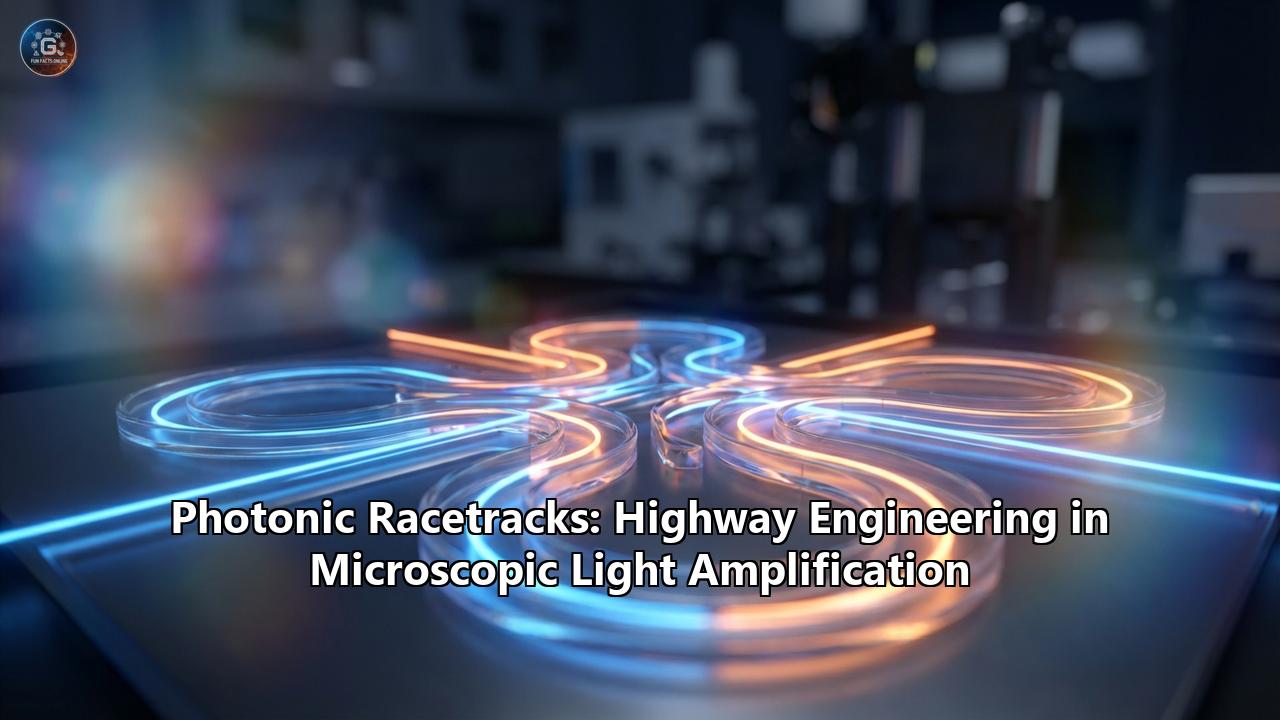
A racetrack resonator is created by taking a straight waveguide and looping it back on itself, resembling a microscopic Indianapolis 500 track. It consists of two straightaways connected by two 180-degree semicircular curves. Next to this closed loop runs a secondary, straight waveguide known as the "bus" waveguide.
The anatomy of this system is perfectly analogous to a modern highway:
1. The On-Ramps and Off-Ramps (The Directional Coupler)Light doesn’t enter the racetrack through a physical intersection; it uses quantum mechanics. When the straight bus waveguide is brought incredibly close to the straightaway of the racetrack—separated by a gap of just a few hundred nanometers—the light's electromagnetic field "leaks" across the gap. This leaking is called an evanescent field. Through a process called evanescent coupling, photons elegantly hop the median and enter the racetrack without the waveguides ever touching.
2. The Straightaways (The Interaction Zones)The straight sections of the racetrack serve two purposes. First, they provide the necessary length for the on-ramp coupling to occur efficiently. Second, they are the prime real estate for "active" components. By placing metal electrodes near the straightaways, engineers can apply electric fields to change the refractive index of the material—a process known as electro-optic modulation. This acts as a traffic signal, subtly altering the speed of the light and encoding digital 1s and 0s onto the beam.
3. The Curves (The Danger Zones)Driving in a straight line is easy; cornering is hard. When light hits the 180-degree turns of the racetrack, the outer edge of the electromagnetic wave has to travel faster than the inner edge to keep up. Because nothing can exceed the speed of light in that medium, the wave stretches, distorts, and part of the light simply radiates away into the surrounding chip. This is known as bending loss, and minimizing it is the ultimate test of nanoscale highway engineering.
Banking the Turns: Euler Curves and Adiabatic Bends
In traditional optics, a microscopic loop was simply designed as a perfect circle (a micro-ring resonator). However, as engineers pushed for smaller device footprints to pack more components onto a single chip, they realized that a sudden transition from a straight waveguide to a tight circular curve was disastrous.
Imagine driving a Formula 1 car down a straightaway at 200 mph and suddenly jerking the steering wheel to enter a perfectly circular roundabout. The abrupt change in the radius of curvature would throw the car off the track. Photons experience the exact same violent mismatch. The optical "mode" (the shape of the light beam) shifts sharply outward when entering a curve, causing massive scattering and radiation loss.
To solve this, optical physicists became highway engineers. Real-world roads and railways use "transition curves" or Euler spirals, where the radius of the curve changes gradually from straight to circular.
Recent advancements in 2025 and 2026 have applied these exact mathematical principles to integrated photonics. By designing racetrack resonators with modified Euler curves—where the bend radius decreases adiabatically (smoothly and without sudden energy loss)—engineers can keep the photons perfectly centered in their lane.
Furthermore, engineers have begun using widened, multi-mode waveguides for the curves, which reduces the interaction of the light with the rough, etched sidewalls of the track. Even though the track is wider, the Euler bends ensure that only the "fundamental" lane (the single mode) is occupied. Using this technique, recent experiments with exotic chalcogenide glasses ($Ge_{23}Sb_7S_{70}$) have yielded micro-racetracks with a microscopic 180-degree bend radius of just a few dozen micrometers, while achieving intrinsic Quality (Q) factors exceeding 4.5 million, and even up to 38 million in the mid-infrared spectrum.
Drafting and Resonance: How Light Amplifies Itself
Why go through all the trouble of making light run in circles? The answer is resonance, the secret engine of microscopic light amplification.
When light couples into the racetrack, it races around the loop. If the total circumference of the track is an exact multiple of the light’s wavelength, a magical phenomenon occurs: constructive interference.
As the light completes one lap, it perfectly syncs up with the new light entering from the bus waveguide. The peaks of the electromagnetic waves align with the peaks, and the troughs with the troughs. With every lap, the intensity of the light inside the racetrack builds upon itself. Even if only a tiny fraction of light enters the loop on each pass, the continuous trapping and stacking of photons causes the light inside the racetrack to become hundreds or even thousands of times more intense than the light in the outside bus waveguide.
This is microscopic light amplification in its purest form. The racetrack acts as an optical cavity, storing photonic energy.
The efficiency of this buildup is measured by the Quality Factor (Q-factor). A low Q-factor means the track is bumpy (high scattering loss) or the curves are too sharp (high bending loss), causing light to leak out after only a few laps. A high Q-factor—like the multi-million Q-factors achieved in modern ultra-low-loss tracks—means a single photon might complete millions of laps before dissipating.
This intense optical buildup is highly wavelength-specific. If a color of light enters the chip that does not perfectly match the track's circumference, it undergoes destructive interference and is entirely rejected, passing straight down the bus highway without entering the loop. Therefore, racetrack resonators act as ultra-precise optical filters. They can pluck a specific color of light out of a dense, multi-color fiber optic cable, acting as the microscopic off-ramps that route data to your computer.
Furthermore, engineers can use this resonance for Coherent Perfect Absorption (CPA) and coherent amplification. By feeding two precisely tuned light beams into a silicon racetrack resonator and controlling their relative quantum phase, engineers can completely trap and absorb the light, or dynamically modulate the output, achieving all-optical amplification where one light beam acts as a "transistor" to control and boost another.
Paving Materials: The Asphalt of the Nanoscale
Just as different physical environments require different paving materials—asphalt for highways, concrete for bridges, dirt for rally tracks—photonic racetracks rely on highly specialized material platforms, each with its own unique refractive index and properties.
- Silicon-on-Insulator (SOI): The traditional workhorse. Silicon is highly transparent to the infrared light used in telecommunications (1550 nm). Because the semiconductor industry has spent decades perfecting silicon etching, we can manufacture millions of silicon racetracks on a single chip cheaply. However, silicon suffers from "two-photon absorption" at very high light intensities, which acts like microscopic potholes that scatter light.
- Silicon Nitride ($Si_3N_4$): The luxury autobahn. Silicon nitride has a lower refractive index contrast than silicon, meaning it requires slightly wider curves to prevent bending loss. However, it does not suffer from two-photon absorption and is incredibly smooth. It is the material of choice for high-power amplification and visible-light routing.
- Thin-Film Lithium Niobate (TFLN) & Lithium Tantalate ($LiTaO_3$): The ultimate high-speed rail. Lithium Niobate has a legendary "electro-optic coefficient," meaning its refractive index changes instantly when exposed to an electric voltage. Historically, it was difficult to etch into tiny racetracks, but recent breakthroughs in "thin-film" manufacturing have allowed engineers to carve perfect Euler curves into TFLN. Recently, Lithium Tantalate racetracks have been used to build room-temperature millimeter-wave receivers with sub-ambient noise, converting microwave signals directly into light with unprecedented efficiency.
- Chalcogenide Glasses & Polymers: The exotic off-roaders. For sensing toxic gases or detecting biological molecules, engineers need to use mid-infrared light. Standard silicon absorbs this light, so researchers use exotic Chalcogenide glasses (like Arsenic Trisulfide or Germanium-Antimony-Sulfur compounds) to create ultra-high-Q mid-infrared racetracks. Alternatively, polymer-based racetracks featuring piezoelectric actuators offer incredible flexibility and ultra-low power consumption for tunable networks.
The Fast and the Furious: Nonlinear Optics and Microcombs
When you confine highly intense, amplified light inside a high-Q racetrack resonator, the normal rules of physics begin to bend. The light becomes so heavily concentrated that it starts to interact with the track itself—and with other light beams. This is the realm of Nonlinear Optics.
Normally, two flashlight beams shone at one another will pass right through each other without interacting. But inside a racetrack, the massive electromagnetic field triggers the Kerr Effect, where the light actually changes the refractive index of the track in real-time.
If you pump a single, powerful, continuous-wave laser into a high-Q racetrack, the Kerr effect forces the light to undergo four-wave mixing. The single color of light begins to spontaneously spawn entirely new colors. Two photons of the original color will annihilate each other to create two new photons—one of a higher frequency, one of a lower frequency.
As this cascade continues, the racetrack emits an Optical Frequency Comb (or microcomb). The output is a massive spectrum of lasers, perfectly spaced apart like the teeth of a comb.
In our highway analogy, you have driven a single massive truck onto a racetrack, and through pure kinetic resonance, the truck has spontaneously split into hundreds of slightly smaller cars, all driving in perfectly parallel lanes at exactly the same speed. This technology is revolutionizing Wavelength Division Multiplexing (WDM). Instead of needing a hundred separate lasers to send a hundred different data streams down an optical fiber, a single cheap laser paired with a photonic racetrack can generate the entire spectrum of data lanes simultaneously.
Furthermore, extreme confinement allows for Brillouin Lasing, where the light actually couples with acoustic sound waves (phonons) vibrating through the crystal lattice of the track. Recent 2025 experiments using chalcogenide racetracks have achieved on-chip Brillouin lasing with incredibly low power thresholds, creating lasers with breathtaking spectral purity—the "cleanest" and narrowest light ever generated on a microchip.
The Finish Line: Revolutionary Applications
The engineering of these microscopic optical highways is not merely an academic exercise. Racetrack resonators are actively being deployed to solve some of the 21st century's most critical technological bottlenecks.
1. Data Centers and AI InfrastructureTraining massive AI neural networks requires moving terabytes of data between GPUs in fractions of a second. Copper wires generate too much heat and consume massive amounts of electricity. Photonic transceivers utilizing arrays of silicon and lithium niobate racetrack modulators are now shuttling data across data centers entirely via light, reducing power consumption by orders of magnitude while accelerating AI training.
2. Next-Generation Lidar and Autonomous VehiclesAutonomous cars require Lidar (Light Detection and Ranging) to map the world in 3D. Traditional Lidar relies on bulky, spinning mechanical lasers on top of the car's roof. Using electrically tuned racetrack resonators, engineers can create "optical phased arrays" that steer beams of light across the road entirely solidly, with zero moving parts, fitting the entire sensor onto a chip the size of a fingernail.
3. Biosensing and Environmental MonitoringBecause the evanescent field of the light slightly extends outside the racetrack's surface, these loops are incredibly sensitive to their environment. If a specific gas molecule (like methane or CO2) or a biological virus binds to the surface of the racetrack, it slightly slows the light down, shifting the resonant frequency. Racetrack gas sensors operating in the near- and mid-infrared spectrum can now detect toxic gases at parts-per-billion levels in real-time, functioning as a microscopic "canary in the coal mine".
4. Quantum ComputingIn the race to build quantum computers, photons are excellent "qubits" because they don't easily lose their quantum state to environmental noise. Racetrack resonators are being used to generate entangled photon pairs on-chip. By pumping a laser into the loop, the nonlinear effects occasionally spit out two perfectly entangled photons, which are then routed down different waveguides to perform quantum logic operations.
The Checkered Flag
The transition from electronics to integrated photonics is as monumental as the leap from the horse-drawn carriage to the combustion engine. We are literally rewiring our world to run on light.
Yet, the microscopic highway engineers are still hard at work. Challenges remain, particularly regarding thermal stability. Because light generates a tiny amount of heat, and the refractive index of silicon is highly sensitive to temperature, a racetrack running at full capacity can slowly "drift" out of its resonant lane. Engineers are constantly developing advanced control loops, micro-heaters, and novel athermal polymer coatings to keep the tracks perfectly tuned regardless of the weather.
The photonic racetrack stands as a testament to human ingenuity—a perfect intersection of quantum physics, material science, and macro-scale highway engineering, all shrunk down to the size of a human cell. As we look to a future defined by artificial intelligence, quantum networks, and instantaneous global connectivity, it is comforting to know that the heavy lifting is being done by microscopic loops of light, endlessly racing toward tomorrow.
Reference:
- https://www.researchgate.net/figure/Si-racetrack-resonator-for-CPA-aschematic-representation-of-the-device-bWaveguide_fig1_303395350
- https://validate.perfdrive.com/?ssa=3b6f2c2c-1797-9eaa-3733-b5ab24ff6fa4&ssb=80548270023&ssc=https%3A%2F%2Fopg.optica.org&ssi=fe111ffb-d3hy-6598-6947-a23fc56c4be1&ssk=botmanager_support@radware.com&ssm=35711831904294365131708705405407&ssn=b51d8eb996fde618aa1c967a4f21b7b85bec19952da2-53d1-b10b-31f5c9&sso=b59f70b-335a-5b9b7d74d49ff0267db87ae1e427256f0b5e84c7a476d2d9&ssp=28014163121772096748177205245998220&ssq=34611362490915778509724908175772937937370&ssr=MTgwLjE4OC4xNzQuMjg=&sst=python-requests%2F2.32.3&ssv=&ssw=
- https://pubs.aip.org/aip/jap/article/130/7/070907/158219/Materials-for-emergent-silicon-integrated-optical
- https://www.researchgate.net/publication/400228475_Chalcogenide_Racetrack_Resonators_With_Intrinsic_Q_Factor_Above_5_Million
- https://www.researchgate.net/publication/401105063_Ultrahigh-Q_chalcogenide_micro-racetrack_resonators
- https://scispace.com/pdf/all-optical-fiber-optic-coherent-amplifier-2m5s3ri66j.pdf
- https://www.preprints.org/manuscript/202601.1885/v1
- https://arxiv.org/html/2510.06176v1
- https://otip.sjtu.edu.cn/en/results/papers