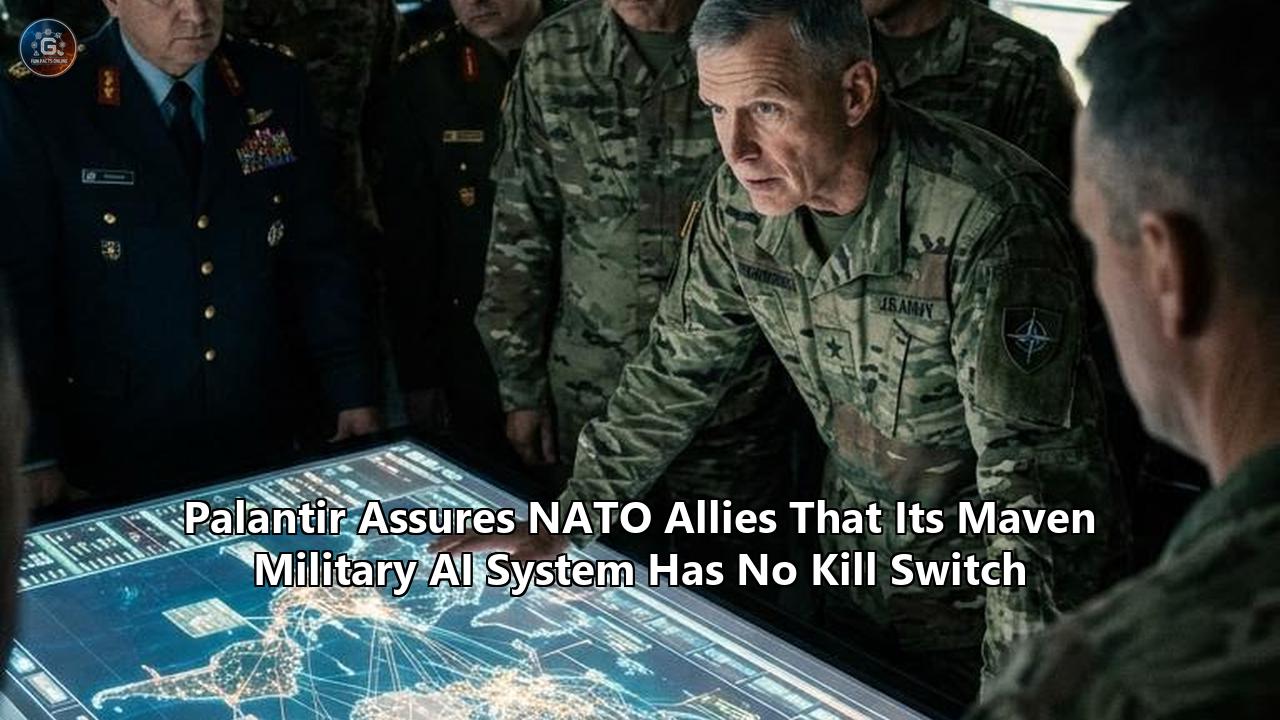
BRUSSELS — US defense software contractor Palantir has issued an explicit assurance to European allies that its flagship military artificial intelligence platform contains no remote "kill switch," mounting an urgent campaign to calm mounting European anxieties over dependence on American defense technology.
Speaking in Brussels, Louis Mosley, Palantir’s executive vice president for the UK and Europe, addressed European defense officials and commanders following revelations that commercial satellite access had been restricted on the battlefields of Ukraine. Mosley affirmed that the Palantir Maven AI system, deployed across NATO’s Supreme Headquarters Allied Powers Europe (SHAPE), remains entirely under sovereign customer command.
“What we have seen in the news over the past few days around Starlink is extremely concerning,” Mosley said. “But as concerns Palantir, I can provide categorical reassurance that where customers have bought our software, they are in full operational control of that software. There are no kill switches. There’s no ability for Palantir or the US government to reach in and switch it off.”
The assurance arrives at an exceptionally volatile moment for the transatlantic alliance. While NATO headquarters finalized the operational integration of the Maven Smart System in 2026, the continent's two largest military powers—France and Germany—have openly rejected the platform for their national forces. Instead, Paris and Berlin are pursuing independent, sovereign alternatives, exposing a deep doctrinal and technological schism within the Western alliance over how military software should be built, owned, and governed.
The Trigger: Starshield, Ukraine, and the Specter of Digital Chokeholds
The immediate catalyst for Palantir’s public reassurance was not a malfunction within Maven itself, but a geopolitical crisis that played out thousands of kilometers away across Ukrainian airspace.
Ukrainian front-line operators reported widespread disruptions to their Starshield satellite communication terminals—the hardened, military-grade iteration of SpaceX’s commercial Starlink constellation. Terminals mounted on fast-moving platforms, specifically aerial interceptor drones tasked with tracking and downing incoming Russian cruise missiles and Shahed loitering munitions, abruptly stopped transmitting telemetry and command feeds.
The technical throttling severely hobbled Ukrainian air defense operations in critical sectors. More alarming for European defense planners, however, were the circumstances surrounding the disruption. The restrictions occurred in the immediate wake of political friction between Washington and Kyiv over Ukrainian deep strikes against Russian oil refineries. While SpaceX executives attributed the terminal cutoffs to operational boundary enforcement and technical modifications, reports originating in Washington suggested that the restriction had been executed following direct political signals from the White House.
The episode laid bare a vulnerability that European military theorists had warned of for years: reliance on American commercial technology allows outside political forces to exercise operational control over foreign battlefields in real time.
                                      BATTLEFIELD SOFTWARE MODELS

               Cloud-Tethered SaaS                                    Sovereign Enclave Platform
             (e.g., SpaceX Starshield)                                (e.g., Palantir Maven Smart System)
  ┌──────────────────────────────────────────────┐        ┌──────────────────────────────────────────────┐
  │ • Proprietary Satellite Constellation        │        │ • On-Premise / Edge Deployable Nodes         │
  │ • Centralized Cloud Relays (US Controlled)   │        │ • Air-Gapped Operational Infrastructure      │
  │ • Real-time Geo-fencing & Speed Limiting     │        │ • National Security-Cleared Operators        │
  │ • Remote Firmware Throttling                 │        │ • Local Command Holds Decryption Keys        │
  └──────────────────────┬───────────────────────┘        └──────────────────────┬───────────────────────┘
                         ▼                                                       ▼
            Operational Vulnerability:                              Operational Tradeoff:
         Instantaneous Remote Shutoff                             Algorithmic Atrophy Over Time
If a private American contractor, under pressure from a shifting administration in Washington, could flip a digital switch and blind an ally's interceptor drones mid-flight, could the same leverage be applied to NATO’s core targeting and intelligence nodes?
Mosley’s intervention was designed to draw a sharp architectural boundary between Starshield and the Palantir Maven AI system. Where Starshield is an active, continuous communication utility piped from commercial satellites owned and operated exclusively on American soil, Palantir’s platform functions as an analytical operating system deployed onto the customer’s private infrastructure.
Yet, for skeptics throughout European ministries of defense, Mosley's denial of a physical "off switch" failed to resolve the broader strategic dilemma. A system does not require a malicious back door to remain tethered to the power that built it.
Architectural Reality: Inside the Maven Smart System NATO
To understand the boundaries of Palantir’s assurance requires unpacking what the Maven Smart System actually does and where its components live.
Born out of the Pentagon’s algorithmic warfare program launched in 2017—originally branded Project Maven—the software began as a targeted computer vision effort to parse thousands of hours of drone surveillance footage from the Middle East. Following employee protests at Google that prompted the tech giant to abandon the program, Palantir assumed primary development of the analytical platform, turning it into the central nervous system for Combined Joint All-Domain Command and Control (CJADC2) across US combatant commands.
NATO acquired its own customized variant, known formally as Maven Smart System NATO (MSS NATO), under a procurement contract finalized in March 2025. Procured through the NATO Communications and Information Agency (NCIA) in an unusually rapid six-month contracting cycle, the system achieved full technical operational capability at SHAPE in Mons, Belgium, in June 2026.
                     PALANTIR MAVEN SMART SYSTEM NATO (MSS NATO)
                                 FUNCTIONAL TOPOLOGY

  INGESTION LAYER        DATA FUSION & ONTOLOGY           AI ANALYTICS            OPERATIONAL C2

 ┌───────────────┐      ┌────────────────────────┐      ┌───────────────┐      ┌─────────────────┐
 │ Commercial &  │─────▶│                        │─────▶│ Computer      │─────▶│ Dynamic Common  │
 │ Military ISR  │      │                        │      │ Vision (CV)   │      │ Operating       │
 └───────────────┘      │   Palantir Dynamic     │      └───────────────┘      │ Picture (COP)   │
 ┌───────────────┐      │   Ontology Core        │      ┌───────────────┐      └────────┬────────┘
 │ Synthetic     │─────▶│                        │─────▶│ Multi-Modal   │               │
 │ Aperture Radar│      │ • Entity Resolution    │      │ Large Language│               │
 └───────────────┘      │ • Multi-Classification│      │ Models (LLMs) │               ▼
 ┌───────────────┐      │ • Temporal Correlation │      └───────────────┘      ┌─────────────────┐
 │ ELINT/SIGINT  │─────▶│                        │      ┌───────────────┐      │ Automated Target│
 │ Intercepts    │      │                        │─────▶│ Predictive    │─────▶│ Workflow & Fire │
 └───────────────┘      └────────────────────────┘      │ Strike Routing│      │ Coordination    │
                                                        └───────────────┘      └─────────────────┘
At SHAPE, Task Force Maven, headed by Col. Arnel David, oversees the daily employment of the system. MSS NATO ingests vast rivers of unorganized battlefield data: synthetic aperture radar returns, electro-optical satellite imagery, electronic emissions, intercepted radio traffic, and commercial maritime and aviation transponder feeds.
The system relies on Palantir’s ontology engine, a software layer that maps disparate data points to real-world objects. A radar return, an infrared thermal bloom, and an intercepted radio transmission are combined to identify a specific, moving Russian surface-to-air missile battery. Machine learning models run object-detection passes over high-resolution satellite swaths, identifying aircraft, naval hulls, and supply convoys in seconds—tasks that previously occupied hundreds of intelligence analysts over days.
Once processed, the data is pushed forward into automated targeting workflows. The system scores targets by priority, checks them against rules of engagement, cross-references available munitions held by allied air wings or artillery battalions, and routes actionable strike recommendations to human commanders.
Crucially, Palantir delivers this capability as a deployable software artifact. It can be hosted on sovereign hardware arrays or private cloud enclaves maintained directly by NATO personnel. The customer generates and holds the operational cryptographic keys.
“It can absolutely be operated independently of us,” Mosley emphasized. He noted that when technical support is required on site, Palantir mandates that company personnel must be citizens of the purchasing nation who hold the requisite national defense security clearances.
From an engineering perspective, Mosley’s claim stands on firm ground: Palantir does not build persistent backdoor telemetry channels into its sovereign defense installations that would allow a software engineer in Denver or a Pentagon official in Virginia to send an unauthenticated remote execution command to brick an isolated instance running inside a bunker in Mons.
However, in the field of military software, a physical kill switch is only the crudest method of terminating an operational capability.
Kill Switches vs. Algorithmic Atrophy: The Anatomy of Software Dependence
The central debate in European defense capitals is not whether Palantir embedded a clandestine self-destruct mechanism into its code. The danger lies in what defense technologists refer to as operational atrophy—the unavoidable decay of advanced software when it is cut off from the continuous industrial pipeline of the vendor that built it.
Military AI is not a static piece of hardware like an artillery tube or a guided torpedo, which can sit in an environmentally controlled depot for two decades and still fire on demand. AI systems are volatile, dynamic software fabrics. They require continuous calibration against an evolving operational environment.
┌───────────────────────────────────────────────────────────────────────────────────┐
│                    THE SPECTRUM OF MILITARY SOFTWARE DEPENDENCE                   │
├────────────────────────┬─────────────────────────┬────────────────────────────────┤
│ Threat Mechanism       │ Vector of Action        │ Operational Consequence        │
├────────────────────────┼─────────────────────────┼────────────────────────────────┤
│ Direct Kill Switch     │ Remote network payload  │ Instantaneous shutdown of C2   │
│                        │ or backdoor command     │ software; immediate loss of    │
│                        │ transmission            │ target tracking                │
├────────────────────────┼─────────────────────────┼────────────────────────────────┤
│ Patch & Security       │ Withholding CVE patches │ Exploitation of underlying OS  │
│ Embargo                │ and vulnerability fixes │ or microservice bugs; systems  │
│                        │                         │ become vulnerable to intrusion │
├────────────────────────┼─────────────────────────┼────────────────────────────────┤
│ Model Drift & Weight   │ Cutting access to       │ Target identification errors   │
│ Stagnation             │ training pipelines and  │ increase; inability to adapt   │
│                        │ retraining clusters     │ to adversary electronic jamming│
├────────────────────────┼─────────────────────────┼────────────────────────────────┤
│ API & Component        │ Terminating licenses to │ Fused intelligence pipeline    │
│ Ingestion Halts        │ commercial satellite    │ collapses; system blind to     │
│                        │ feeds and microservices │ new external data streams      │
└────────────────────────┴─────────────────────────┴────────────────────────────────┘
1. Algorithmic Drift and Retraining Dependencies
The core value of the Palantir Maven AI system lies in its computer vision and multimodal analytical models. These models are trained on specific visual signatures, electromagnetic spectra, and operational doctrines.
When an adversary adapts—applying counter-drone camouflage, painting fake airframes on runway tarmac, changing radar waveform modulation, or deploying novel electronic warfare pods—machine learning models degrade. This phenomenon, known as algorithmic drift, causes target-detection confidence scores to plummet.
To counter drift, the models must be retrained on fresh operational data. Retraining frontier defense models is computationally demanding and relies on proprietary training pipelines.
If Washington were to invoke the International Traffic in Arms Regulations (ITAR) or issue an export denial against an allied nation, that nation could keep running its local Maven instance, but the intelligence engine inside it would freeze in time. Within months, as electronic warfare conditions and physical assets shifted across the front lines, the AI’s diagnostic value would degrade.
2. Microservice Architecture and Continuous Integration
Modern enterprise defense systems are composed of dozens of interconnected microservices—isolated containerized programs handling everything from coordinate transformation to secure message routing.
These microservices rely on commercial libraries and continuous integration/continuous delivery (CI/CD) pipelines. They require regular updates to patch zero-day vulnerabilities, address container operating-system bugs, and maintain security accreditations.
If vendor support is terminated, a military command faces an acute operational dilemma: either freeze the software environment, accepting severe cyber vulnerabilities that hostile intelligence services can exploit, or attempt to modify proprietary code bases without source code rights, running the risk of destabilizing the entire platform.
3. Commercial Feed Ingestion
Maven delivers battlefield clarity because it ingests high-frequency data pipelines: commercial synthetic aperture radar from constellations like Capella or ICEYE, commercial optical passes from Planet Labs and Maxar, and commercial radio frequency mapping from Hawkeye 360.
Many of these providers are American companies subject to US regulatory jurisdiction. Even if the Palantir software continues running in an allied command center without interruption, a coordinated policy move by the US executive branch could restrict the commercial data feeds flowing into the system.
A fully operational AI analytical engine operating over an empty data lake produces no target coordinates.
Diverging Fronts: How France and Germany Broke with Palantir
These structural realities explain why Mosley’s assurances, while factually grounded in Palantir’s local-hosting deployment models, have done little to halt the widening divide between the Pentagon-aligned camp and continental Europe.
The Western alliance has fractured into three competing strategies for battlefield command-and-control software:
                                  NATO DEFENSE AI STRATEGIES

  THE TURNKEY INTEGRATORS                THE DATA SOVEREIGNISTS              THE AUTONOMOUS BUILDERS
      (SHAPE, US, UK)                          (Germany)                            (France)
  ┌───────────────────────┐             ┌───────────────────────┐            ┌───────────────────────┐
  │ • Palantir Maven MSS  │             │ • Multi-vendor modular│            │ • Arcadia platform    │
  │ • Prioritizes speed,  │             │   stack (30+ vendors) │            │ • Native Mistral AI / │
  │   immediate lethality,│             │ • Hard boundary: zero │            │   Thales architecture │
  │   and deep integration│             │   private contractor  │            │ • Tactical mesh nodes │
  │ • Accepts structural  │             │   database access     │            │ • Complete digital and│
  │   vendor dependence   │             │ • Timeline: 2028 field│            │   intellectual control│
  └───────────────────────┘             └───────────────────────┘            └───────────────────────┘
Germany: The Administrative and Data-Access Hardline
Berlin’s rejection of the Palantir Maven AI system was delivered decisively in April 2026 by Vice Admiral Thomas Daum, head of the Bundeswehr’s Cyber and Information Domain Service (CIR). Daum rejected adopting Maven for the national armed forces, stating that granting employees of a private company access to the German military’s national operational databases was entirely out of the question.
German defense law and military operational culture maintain strict separations between commercial industry and operational command. While Palantir offered models where locally cleared German citizens would handle deployments, the Bundeswehr’s legal and technical evaluators determined that deploying a closed-source proprietary core created unacceptable supply-chain risks.
Instead, Daum’s command initiated a comprehensive sovereign market evaluation, reviewing roughly 30 separate artificial intelligence tools from domestic and select European tech firms. Berlin plans to deliver an operational prototype in the second quarter of 2027, targeting full field deployment by 2028.
The primary trade-off of the German strategy is time. By eschewing a fielded, operational system like Maven, the Bundeswehr faces a multi-year gap where its automated intelligence processing remains fragmented across legacy systems, even as Russian forces along NATO's eastern frontier scale up autonomous drone coordination and rapid sensor-to-shooter links.
France: Building an Asymmetric Counter-System
France has adopted an even more assertive posture. Rather than simply conducting a lengthy procurement review, Paris has actively developed and fielded a direct sovereign rival: the Arcadia battlefield command platform.
Developed by the French Armed Forces Ministry in partnership with a consortium of domestic champions—including open-source AI developer Mistral AI, aerospace leaders Safran and Airbus, and defense electronics group Thales—Arcadia is an explicit effort to achieve strategic autonomy in operational intelligence.
Speaking during an operational briefing, General Patrick Justel, deputy chief of staff of the French Army, framed the project in direct opposition to Palantir’s European ambitions:
"Arcadia is our response to Maven. The question arises whether we should adopt Maven blindly, or should we look for other solutions? When we talk to our European partners, we get the same reaction of, 'Well, we've kind of gone with Maven because there's no choice, but if countries in Europe are able to build an alternative, we'll go for it.'"
France deployed Arcadia during the live Coalition Warrior Interoperability Exercise (CWIX) in Poland, putting the system through its paces across joint allied formations.
The French approach is ideological, doctrinal, and technical. Under French military doctrine, targeting data and kinetic command chains are considered sovereign sovereign responsibilities that can never be filtered through software governed by foreign export control laws.
Architectural Duel: Palantir Maven vs. France’s Arcadia
The competition between the Palantir Maven AI system and France’s Arcadia is not merely a political dispute over where corporate headquarters are located. It represents two fundamentally different technical philosophies regarding how military networks should be architected for high-intensity warfare.
┌──────────────────────────────────────────────────────────────────────────────────┐
│             ARCHITECTURAL COMPARISON: MAVEN SMART SYSTEM VS. ARCADIA             │
├─────────────────────────┬───────────────────────────┬────────────────────────────┤
│ Feature                 │ Palantir Maven MSS        │ French Consortium Arcadia  │
├─────────────────────────┼───────────────────────────┼────────────────────────────┤
│ Network Architecture    │ Centralized Cloud Enclave │ Decentralized Tactical     │
│                         │ with edge nodes           │ Mesh Network               │
├─────────────────────────┼───────────────────────────┼────────────────────────────┤
│ Core AI Engines         │ Proprietary US frontier   │ Mistral AI foundational    │
│                         │ models + custom vision    │ models + Safran/Thales CV  │
├─────────────────────────┼───────────────────────────┼────────────────────────────┤
│ Data Standards          │ Palantir Proprietary      │ Native Federated Mission   │
│ Integration             │ Dynamic Ontology          │ Networking (FMN) Profiles  │
├─────────────────────────┼───────────────────────────┼────────────────────────────┤
│ Vulnerability Profile   │ Susceptible to backhaul   │ Susceptible to tactical    │
│                         │ communications severing   │ node compute limitations   │
├─────────────────────────┼───────────────────────────┼────────────────────────────┤
│ Operational Readiness   │ Deployed; 100k+ users;    │ Tactical field trials;     │
│                         │ full technical IOC (2026) │ prototype operational 2026 │
└─────────────────────────┴───────────────────────────┴────────────────────────────┘
Centralized Enterprise Compute vs. Tactical Mesh Resiliency
Maven’s operational architecture reflects its origins in the Pentagon’s extensive global infrastructure. It relies on aggregating data up into massive, high-throughput cloud environments—whether commercial hyperscalers like AWS GovCloud and Microsoft Azure or hardened military data centers—where large compute clusters can run inference and correlate millions of global entities in real time.
While Palantir has engineered lightweight edge-deployment nodes for tactical vehicles and forward command posts, the system’s primary power resides in its ability to execute compute-heavy data fusion at the operational headquarters level.
Arcadia, by contrast, was engineered from the outset around the threat of contested communication environments. French Army doctrine assumes that against a peer adversary like Russia, long-range satellite and fiber backhaul links back to a centralized headquarters will be jammed, intercepted, or severed within the opening hours of conflict.
Consequently, Arcadia employs a decentralized mesh architecture. Forward command posts are linked directly to ruggedized, field-deployed edge servers operating locally.
If an electronic warfare strike isolates a French brigade command post from Paris or NATO SHAPE, the local Arcadia node continues operating autonomously. It processes inputs from local tactical drones, radar sets, and thermal optics, running local inference engines without needing to ping a central data lake.
When network connectivity is restored, the mesh synchronizes asynchronously, passing updated tracks and operational states across the broader operational web.
Open-Weight European Models vs. Vertically Integrated Stacks
The two platforms take opposite approaches to artificial intelligence development.
Palantir builds its edge using a tightly integrated stack, wrapping proprietary algorithms and fine-tuned commercial models within its specialized data ontology. This provides unmatched immediate usability. An allied officer can navigate a complex targeting flow without understanding the underlying matrix mathematics, guided by an interface tested across thousands of operational hours.
Arcadia relies heavily on open-weight and modular foundational models developed by French AI firm Mistral AI, combined with specialized computer-vision algorithms designed by Thales and Safran.
Because the French military maintains full access to the source code, weights, and training regimens of Mistral’s foundational models, French military engineers can retrain, prune, and deploy them on localized hardware without seeking permission, security certifications, or API tokens from an external foreign vendor.
The trade-off is one of raw analytical breadth. Palantir’s platform has digested vast troves of real-world operational intelligence from multiple combat theaters, tuning its models against real-world target profiles over nearly a decade of active military service. Arcadia’s models, though mathematically sophisticated, lack this extensive operational pedigree.
The FMN Interoperability Battle
The split has triggered a fierce battle over standardization within NATO. General Justel publicly challenged Maven’s interoperability, asserting that Arcadia was built from the ground up to comply with NATO's Federated Mission Networking (FMN) standards—the common protocols that allow disparate national systems to share battlefield maps and target tracks.
Justel argued that Maven was designed to pull users into a single, proprietary software environment, rather than communicating smoothly across federated systems.
Palantir vigorously rejected that characterization, stating that the Maven Smart System complies with core FMN principles and has demonstrated compliance with key NATO data-security standards required for formal alliance certification.
Palantir confirmed it remains open to integrating its platform directly with Arcadia or any other national European system. Yet behind the polite institutional language lies a high-stakes commercial reality: if Maven becomes the de facto standard at SHAPE, any national European alternative will bear the burdensome technical cost of continuously adapting its interfaces to match Palantir's rapidly iterating architecture.
Mosley’s Realpolitik: The Inconvenient Truths of European Autarky
While Louis Mosley was quick to provide reassurances regarding operational control in his discussions with Reuters, he struck a distinctly different, more combative tone when speaking with Bloomberg on the same day in Brussels.
Addressing the accelerating push in Paris and Berlin for complete digital and technological autonomy, Mosley warned that European leaders were indulging in a dangerous illusion of self-sufficiency.
“Europe is going to have to accept some dependency on American tech companies,” Mosley stated flatly, pointing out that attempting to reconstruct the multi-trillion-dollar American commercial technology stack within the European defense sector is economically and operationally unrealistic.
Mosley warned that while European politicians express alarm over American defense software, their industrial supply chains are compromised by dependencies that are far more perilous. Most critically, European defense manufacturers building the drones, missiles, and armored platforms intended to defend the continent remain almost completely dependent on China for the processed rare-earth permanent magnets and refined minerals required to run their electric motors, guidance actuators, and radar sensors.
                               THE STRATEGIC DEPENDENCY PYRAMID

                        ▲
                       / \   BATTLEFIELD SOFTWARE LAYER
                      /   \  Current European target for sovereignty (Arcadia/CIR)
                     /=====\ Fast development, but high algorithmic complexity.
                    /       \
                   /         \ COMPUTING HARDWARE & CHIPS
                  /           \ Dependent on US IP (Nvidia/AMD) and Taiwanese
                 /=============\ foundries (TSMC). No sovereign European path exists.
                /               \
               /                 \ RAW MATERIALS & COMPONENTS
              /                   \ Total dependency on foreign supply chains (e.g.,
             /_____________________\ Chinese rare earths for drone magnets, sensors).
Mosley’s critique cuts to the heart of the European dilemma. Software sovereignty is fundamentally hollow without hardware sovereignty.
Even if France and Germany successfully deploy Arcadia or a sovereign Bundeswehr AI platform, that software must run on high-performance compute silicon. Today, military-grade artificial intelligence models—including those developed by France's Mistral AI—are trained and executed on graphics processing units (GPUs) and specialized accelerators designed by American companies like Nvidia, AMD, and Intel, manufactured by TSMC in Taiwan, and packaged using global supply lines.
If the geopolitical crisis that European defense planners fear were to materialize—one in which an isolationist American administration cut access to vital defense technology—the supply of advanced semiconductors would be disrupted long before software licenses expired.
Furthermore, building an alternative to a platform like Maven requires immense capital investment. The Pentagon poured billions of dollars into Project Maven, algorithmic warfare experiments, and CJADC2 enterprise frameworks over nearly a decade, generating an ecosystem in which more than 100,000 active military personnel interact with the software daily.
European defense budgets, despite recent historic increases, remain encumbered by fragmented procurement programs, where national funds are split among competing domestic airframe, armor, and naval projects. Replicating the breadth, testing iterations, and data infrastructure of the Palantir Maven AI system across 32 allied nations demands investments that no single European state has demonstrated the political will to fund.
Strategic Consequences: A Fractured Transatlantic Battlespace
The emergence of competing defense software stacks across NATO creates acute tactical operational risks that extend far beyond procurement budgets.
Military alliances succeed based on operational interoperability—the ability of disparate armed forces to see the same battlefield, communicate across common frequencies, share targeting data instantly, and execute coordinated strikes under unified operational command.
If NATO’s central strategic headquarters at SHAPE runs on the Palantir Maven AI system, while the German Bundeswehr relies on a distributed multi-vendor platform, and the French Army maneuvers using Arcadia’s mesh network, the alliance risks developing a software-driven Tower of Babel.
                                  NATO's OPERATIONAL DILEMMA:
                            SOFTWARE TOWER OF BABEL VS. SPEED

                                 NATO ALLIED COMMAND
                                     OPERATIONS
                                   (SHAPE - Mons)
                                         │
                             ┌───────────┴───────────┐
                             │  Palantir Maven MSS   │
                             └───────────┬───────────┘
                                         │
         ┌───────────────────────────────┼───────────────────────────────┐
         │                               │                               │
         ▼                               ▼                               ▼
  UNITED KINGDOM                      GERMANY                         FRANCE
  BRITISH ARMY                      BUNDESWEHR                     FRENCH ARMY
┌──────────────────┐            ┌──────────────────┐            ┌──────────────────┐
│ Integrated Maven │            │ Sovereign CIR AI │            │ Arcadia Mesh C2  │
│ Architecture     │            │ Stack (2028+)    │            │ (Mistral/Thales) │
└────────┬─────────┘            └────────┬─────────┘            └────────┬─────────┘
         │                               │                               │
         └───────────────────────┬───────┴───────────────────────────────┘
                                 │
                                 ▼
                     TRANSLATION FRICTION POINT:
               • Latency introduced by translation gateways
               • Data loss across differing ontological schemas
               • Degradation of millisecond sensor-to-shooter loops
In a high-intensity conflict against an adversary utilizing automated strike complexes, operational speed is the decisive variable. Targets across the modern battlespace emerge and disappear within narrow windows lasting only minutes or seconds.
If target tracks identified by French reconnaissance drones running Arcadia must pass through software translation gateways, conversion filters, and security boundaries before being ingested into NATO’s Maven common operating picture at SHAPE—and then passed down to a German artillery brigade using a different software ontology—the operational delay will render the data obsolete.
The joint declaration signed between French President Emmanuel Macron and German Chancellor Friedrich Merz, committing both nations to build a "European sovereign digital backbone" and establish a "European collaborative combat standard," represents an attempt to counter this fragmentation.
Yet, as both leaders acknowledged, the initiative faces an uphill battle. It requires synchronizing disparate defense acquisition systems, overcoming deep commercial rivalries between French and German defense contractors, and funding complex software engineering programs that take years to deliver results.
In the meantime, frontline operational commanders cannot afford to wait for long-term political projects to mature. As Col. Arnel David noted at NATO’s TechNet conference in Brussels, the volume of modern sensor data is overwhelming military staffs. Military forces require effective operational intelligence software immediately, which is why NATO’s Allied Command Operations moved so rapidly to operationalize the Maven system.
What Comes Next: The Hard Road Ahead for Sovereign Defense Tech
The assurances delivered by Palantir in Brussels may have clarified the narrow technical point regarding remote kill switches, but they have done little to slow the structural realignment underway within the transatlantic defense sector.
Over the coming months and years, three critical milestones will determine whether Europe’s quest for digital defense sovereignty succeeds or collapses under the weight of its own operational compromises:
- The Interoperability Trials (2027): Following the initial CWIX deployments in Poland, NATO’s Allied Command Transformation will conduct rigorous technical evaluations testing the ability of France’s Arcadia to pass bidirectional, real-time fire-control data directly into the Palantir Maven AI system at SHAPE. If technical friction, data translation latency, or classification barriers degrade targeting cycles, NATO commanders will face intense pressure to standardize on a single platform, forcing member states to choose between national sovereignty and alliance-wide lethality.
- The German CIR Prototype Evaluation (Q2 2027): Vice Admiral Thomas Daum’s cyber command must demonstrate whether its multi-vendor approach can deliver a viable operational prototype capable of matching Maven’s computer-vision accuracy and data-fusion speed. If Berlin’s domestic consortium fails to match the performance of already-fielded American systems, the Bundeswehr will face difficult questions from allied commanders about why operational readiness is being subordinated to industrial protectionism.
- The Compute Supply-Chain Reckoning: As European defense developers accelerate the deployment of sovereign models like Mistral AI in tactical environments, the demand for specialized edge-compute silicon will soar. European policy leaders will be forced to confront the limits of software sovereignty if the physical processors powering their national algorithms remain subject to American export controls and Asian supply-chain disruptions.
The controversy over Palantir’s presence at NATO headquarters has established a permanent shift in military procurement. The era in which European militaries treated software as an off-the-shelf logistical commodity has ended. Software is now recognized for what it has always been: the strategic center of gravity in modern warfare.
While Palantir has made it clear that it will not shut down the systems defending Europe, European leaders are increasingly unsettled by the reality that the keys to the continent's digital battlefield remain forged in Silicon Valley. The struggle between immediate operational lethality and long-term technological sovereignty will shape the doctrine, procurement, and battlefield readiness of the Western alliance for decades to come.
Reference:
- https://live.euronext.com/en/financial-news/palantir-says-it-cannot-shut-nato-ai-system-europeans-fear-us-tech-dependence
- https://www.forbes.com/sites/zacharyfolk/2026/10/22/palantir-says-it-cant-shut-down-european-military-ai-system-days-after-extremely-concerning-starlink-slowdown/
- https://www.benzinga.com/markets/tech/26/10/62531164/palantir-makes-sovereignty-its-selling-point-after-ukraines-starlink-disruptions
- https://shape.nato.int/news-releases/nato-acquires-aienabled-warfighting-system-
- https://explainx.ai/blog/palantir-maven-nato-no-kill-switch-starlink-ukraine-europe-sovereignty-what-is-confirmed-2026
- https://www.benzinga.com/markets/equities/26/07/60541028/palantir-faces-potential-setback-as-france-germany-seek-european-military-software-supplier
- https://www.euronews.com/2026/10/22/palantir-says-nato-ai-system-has-no-kill-switch-after-starlink-disruptions-in-ukraine
- https://thenextweb.com/news/palantir-says-it-cannot-switch-off-natos-maven-ai-system
- https://moderndiplomacy.eu/2026/10/22/palantir-says-it-cannot-switch-off-natos-ai-system-as-europe-fears-us-tech-dependence/
- https://explainx.ai/blog/palantir-maven-nato-no-kill-switch-starlink-ukraine-europe-sovereignty-what-is-confirmed-2026
- https://www.bdemerson.com/article/maven-smart-system
- https://thedefensepost.com/2024/05/30/palantir-maven-battlefield-analyzer/
- https://medium.com/@m.salah2405/project-maven-the-architecture-of-algorithmic-warfare-3ff147e7b520
- https://www.afcea.org/signal-media/emerging-edge/nato-task-force-maven-good-thing-says-program-director
- https://finance.biggo.com/news/387dd726-b2ae-42fe-93de-250629fab2fe
- https://finance.biggo.com/news/387dd726-b2ae-42fe-93de-250629fab2fe
- https://thenextweb.com/news/palantir-says-it-cannot-switch-off-natos-maven-ai-system
- https://thenextweb.com/news/bundeswehr-30-ai-tools-prototype-2027-palantir-alternative
- https://www.euronews.com/2026/06/07/nato-drills-france-to-test-ai-battlefield-tech-as-alternative-to-us-system
- https://www.defensenews.com/global/europe/2026/06/06/france-to-test-its-own-ai-powered-battlefield-command-in-june-nato-exercise/
- https://aibusinessweekly.net/p/france-arcadia-ai-nato-palantir-maven-sovereign-2026