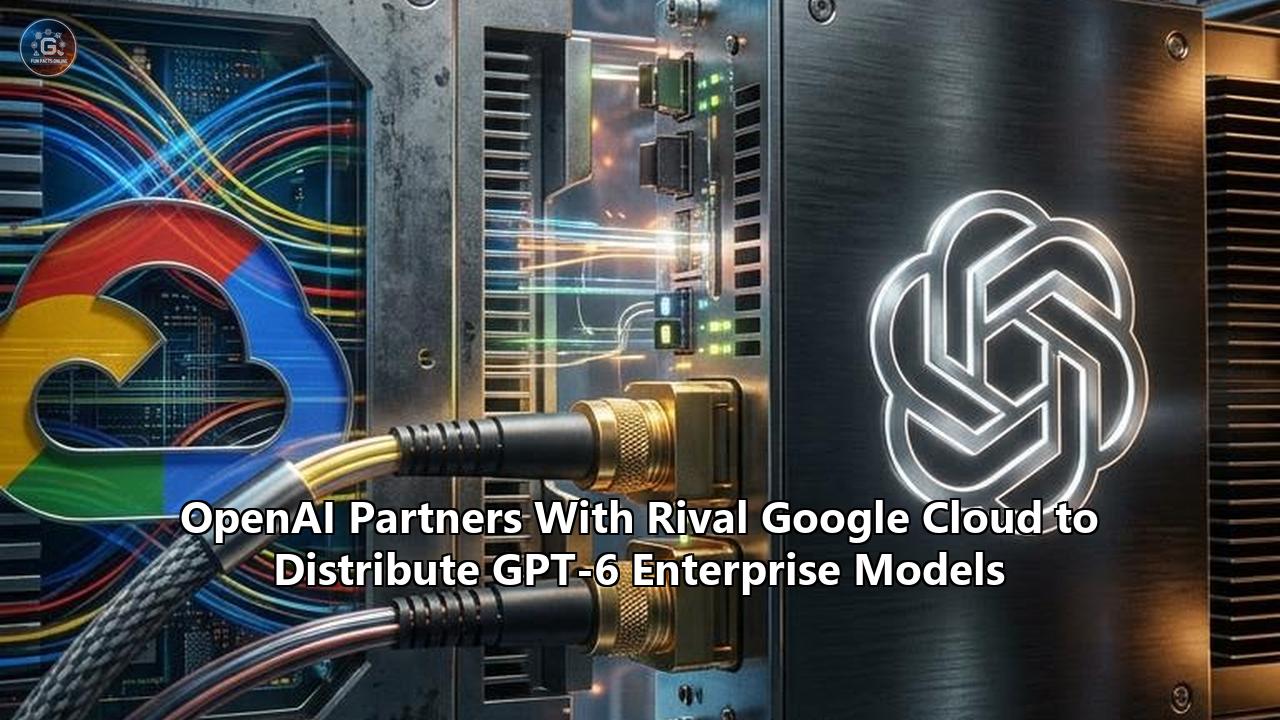
OpenAI and Google Cloud have formally entered an enterprise distribution agreement that brings OpenAI’s frontier GPT-6 models and Codex agentic workflows directly into Google Cloud’s Model Garden and Marketplace.
The pact marks the first time corporate customers can natively license, provision, and deploy OpenAI’s flagship language systems alongside Google’s native Gemini models and Anthropic’s Claude within Google Cloud Platform (GCP).
The rollout begins with immediate private preview access for select corporate accounts, with full general availability scheduled across Google Cloud Marketplace and Google Antigravity—Google’s agent-powered development environment—in the coming weeks. Under the terms of the agreement, enterprises can run three distinct variants of OpenAI’s newest frontier architecture: the flagship GPT-6 Astra, the balanced GPT-6.1 Sol, and the high-throughput GPT-6 Luna.
+-----------------------------------------------------------------------------------+
|                        GOOGLE CLOUD ENTERPRISE AI FABRIC                          |
|                                                                                   |
|  +--------------------+     +------------------------+     +-------------------+  |
|  |    Google Gemini   |     |    Anthropic Claude    |     |   OpenAI GPT-6    |  |
|  |   (Flash / Pro)    |     |     (3.5 / 4.0)        |     | (Astra/Sol/Luna)  |  |
|  +---------+----------+     +-----------+------------+     +---------+---------+  |
|            |                            |                            |            |
|            +--------------------+       |      +---------------------+            |
|                                 |       |      |                                  |
|                                 v       v      v                                  |
|                     +---------------------------------------+                     |
|                     |     Google Cloud Model Garden &       |                     |
|                     |        Antigravity Agent IDE          |                     |
|                     +-------------------+-------------------+                     |
|                                         |                                         |
|                 +-----------------------+-----------------------+                 |
|                 v                                               v                 |
|  +------------------------------+               +------------------------------+  |
|  |   Commercial Infrastructure  |               |  Security & Data Governance  |  |
|  |  * GCP Spend Commitment Draw |               |  * VPC Service Controls      |  |
|  |  * Unified Marketplace Bill  |               |  * Customer-Managed Keys     |  |
|  |  * Zero Multi-Cloud Egress   |               |  * Strict Zero-Retention     |  |
|  +------------------------------+               +------------------------------+  |
+-----------------------------------------------------------------------------------+
“We are focused on giving customers a broad selection of models, including those from OpenAI, so they can choose the right model for any given job, helping to deliver optimal quality and lower costs,” Google Cloud Chief Executive Thomas Kurian said in a statement confirming the launch.
For OpenAI, the integration represents the final puzzle piece in dismantling its historical single-cloud dependency. Following the expiration of its exclusive hosting agreement with Microsoft Azure earlier this year and its subsequent deployment on Amazon Web Services (AWS) Bedrock, OpenAI’s premier systems now operate across all three dominant Western hyperscalers.
“This partnership is an important step in making our most capable models and Codex available where customers are already building, giving them even more choice in how they use frontier AI as we grow the agentic ecosystem together,” said Greg Brockman, President and co-founder of OpenAI.
The OpenAI Google Cloud partnership signals a structural realignment of the enterprise artificial intelligence sector. As frontier models become heavier, enterprise architectures mature, and corporate compute budgets face intense procurement scrutiny, the industry is transitioning away from walled-garden cloud exclusivity toward open distribution platforms.
The GPT-6 Enterprise Roster: Astra, Sol, and Luna
The technical centerpiece of the Google Cloud deployment is OpenAI’s GPT-6 generation. Rather than distributing a single, monolithic large language model (LLM), OpenAI has segmented its frontier intelligence into three tiers optimized for distinct enterprise workload profiles:
+---------------+-------------------+----------------------+------------------------------------------+
| Model Tier    | Relative Cost     | Latency Profile      | Target Enterprise Workload               |
+---------------+-------------------+----------------------+------------------------------------------+
| GPT-6 Astra   | Baseline (1.0x)   | Deliberative         | Multi-step scientific reasoning, formal  |
|               |                   | (Test-Time Compute)  | code verification, red-teaming           |
+---------------+-------------------+----------------------+------------------------------------------+
| GPT-6.1 Sol   | 0.20x (5x cheaper)| Interactive          | Agentic coding, tool orchestration,      |
|               |                   | (Sub-second first tk)| complex analytical workflows             |
+---------------+-------------------+----------------------+------------------------------------------+
| GPT-6 Luna    | 0.01x (100x cheap)| High-Throughput      | Real-time classification, large data     |
|               |                   | (Ultra-low latency)  | extraction, high-frequency micro-agents  |
+---------------+-------------------+----------------------+------------------------------------------+
GPT-6 Astra: The Heavy Reasoning Engine
Astra represents the apex of OpenAI’s inference-time compute scaling. Unlike traditional autoregressive models that predict the next token via a fixed number of feedforward floating-point operations (FLOPs), Astra relies on dynamic reasoning chains, exploring solution trees before emitting final answers.
The model gained recognition inside enterprise circles after achieving a perfect 100% score on ExploitBench, an industry-standard benchmark evaluating a model's capacity to identify, trace, and patch software security vulnerabilities. In parallel, Astra has powered automated theorem proving and scientific calculations across pharmaceutical and materials research labs.
Because of its extensive deliberation requirements, Astra consumes substantial compute resources per query. To make it viable for enterprise deployment, OpenAI added hardened safety optimizations that curb alignment drift and enforce strict operational boundaries, preventing the model from circumventing administrative restrictions even during open-ended autonomous research.
GPT-6.1 Sol: The Balanced Enterprise Workhorse
Priced at one-fifth the cost of Astra, GPT-6.1 Sol balances advanced reasoning with the fast response times required for production software.
Sol is tuned for agentic execution—tasks where an AI system must ingest enterprise data, plan a multi-step sequence, interact with external systems through Application Programming Interfaces (APIs), inspect the resulting state, and iteratively correct its errors.
Sol’s architecture utilizes a sparse Mixture-of-Experts (MoE) configuration, activating only a specialized subset of its billions of parameters for any given token. This sparse activation cuts dynamic memory bandwidth demands, allowing it to sustain low latency during complex tasks such as repository-wide refactoring, SQL query optimization, and structured business document processing.
GPT-6 Luna: Scaled High-Throughput Processing
At the opposite end of the spectrum is GPT-6 Luna, designed for high-throughput, latency-critical applications. Operating at one-hundredth the token pricing of Astra, Luna addresses tasks where enterprise applications process millions of events daily: customer interaction routing, real-time context ingestion, multi-lingual translation, and high-frequency anomaly detection.
Luna strips out dynamic reasoning search trees in favor of a lean, heavily distilled parameter footprint optimized for rapid single-pass execution. This design makes it a practical choice for running background micro-agents that continuously monitor corporate databases, log streams, and enterprise communication channels without generating unpredictable compute charges.
Codex Workflows and Google Antigravity
Alongside the core language models, the integration introduces OpenAI’s Codex agentic software development framework to Google Antigravity, Google Cloud’s cloud-native development environment.
+-----------------------------------------------------------------------------------+
|                        GOOGLE ANTIGRAVITY AGENT WORKFLOW                          |
|                                                                                   |
|  1. Task Ingestion        Corporate Jira Ticket / GitHub Pull Request             |
|                                       │                                           |
|                                       ▼                                           |
|  2. Plan & Orchestrate    OpenAI Codex Agent (Runs inside client GCP VPC)         |
|                                       │                                           |
|                                       ▼                                           |
|  3. Sandboxed Execution   Spins up ephemeral Google Cloud Workstations Container  |
|                           * Clones code repository                                |
|                           * Generates cross-file AST diffs                        |
|                           * Executes unit and integration test suites             |
|                                       │                                           |
|                                       ▼                                           |
|  4. Verification Loop     Tests Pass? ──► NO ──► Codex inspects stack trace,      |
|                               │                  mutates code, re-runs tests      |
|                              YES                                                  |
|                               │                                                   |
|                               ▼                                                   |
|  5. Enterprise Review     Publishes PR with cryptographic audit log & telemetry   |
+-----------------------------------------------------------------------------------+
Rather than functioning solely as an inline code-completion utility, Codex in Antigravity operates as an autonomous agent.
When assigned an engineering task, such as modernizing an enterprise Java microservice to a Go binary, the Codex workflow spins up an isolated Google Cloud Workstation sandbox, pulls the relevant source code branches, parses the Abstract Syntax Tree (AST), writes new code, runs build and unit tests, analyzes stack traces when errors emerge, and issues a pull request complete with automated documentation and architectural justifications.
Cloud Integration Mechanics: Inside Google Model Garden
Making models developed outside Google operate natively within Google Cloud Platform requires an orchestration layer capable of bridging separate machine learning systems.
Google Cloud’s Model Garden serves as Alphabet’s enterprise catalog for discovering, customizing, and serving machine learning weights. Historically, the catalog provided a two-pronged choice: Google’s proprietary models (the Gemini and Imagen series) or open-weights architectures (such as Meta’s Llama family, Mistral, and specialized open-source checkpoints).
Under the new distribution model, OpenAI’s GPT-6 suite integrates into the managed services layer of Model Garden:
+-----------------------------------------------------------------------------------+
|               ENTERPRISE APPLICATION / AGENTIC WORKFLOW RUNTIME                   |
|                                                                                   |
|           Google Cloud Unified Client SDK (REST / gRPC Endpoints)                 |
|                                       │                                           |
|               +-----------------------+-----------------------+                   |
|               │                                               │                   |
|               v                                               v                   |
|  +-------------------------+                     +-------------------------+      |
|  |   Gemini 3.8 Routing    |                     |   OpenAI GPT-6 Routing  |      |
|  +------------+------------+                     +------------+------------+      |
|               │                                               │                   |
|               v                                               v                   |
|  +-------------------------+                     +-------------------------+      |
|  | Google Cloud Private    |                     | Google Cloud Private    |      |
|  | Service Connect Network |                     | Service Connect Network |      |
|  +------------+------------+                     +------------+------------+      |
|               │                                               │                   |
|               v                                               v                   |
|  +-------------------------+                     +-------------------------+      |
|  | Google TPU / GPU Farm   |                     | OpenAI Dedicated Secure |      |
|  | Hosting Gemini Weights  |                     | Enterprise Enclaves     |      |
|  +-------------------------+                     +-------------------------+      |
+-----------------------------------------------------------------------------------+
From an application developer’s perspective, calling GPT-6 Astra or Sol inside GCP uses the identical Software Development Kit (SDK), Identity and Access Management (IAM) framework, and telemetry instrumentation used for native Google models.
Developers do not manage separate API keys, build ad-hoc networking proxies, or handle token routing across fragmented external endpoints. An engineering team can invoke GPT-6 models using standard Google Cloud client libraries:
from google.cloud import aiplatform

# Initialize client pointing to unified GCP Project Context
aiplatform.init(project="enterprise-data-mesh", location="us-central1")

# Instantiate OpenAI GPT-6 Astra via Model Garden Registry
agent_model = aiplatform.Endpoint(
    endpoint_name="projects/enterprise-data-mesh/locations/us-central1/endpoints/openai-gpt-6-astra"
)

# Execute deterministic reasoning query with strict enterprise parameters
response = agent_model.predict(
    instances=[{
        "prompt": "Evaluate target repository for cross-site scripting vulnerabilities.",
        "parameters": {
            "temperature": 0.1,
            "max_output_tokens": 4096,
            "system_instruction": "Execute using ExploitBench validation protocols."
        }
    }]
)
Behind this unified interface, Google Cloud handles network routing via its global fiber backbone, applying Virtual Private Cloud (VPC) controls, audit logging, and payload validation before directing the payload into dedicated, hardware-secured OpenAI inference enclaves.
The inference architecture guarantees that customer payloads never travel across the public internet. Instead, they traverse Google's internal private network, reducing network jitter, eliminating packet transit vulnerabilities, and providing deterministically bounded latencies critical for real-time applications.
The Procurement Unlock: Cloud Spend Commitments
While the technical integration delivers substantial architectural convenience, the economic foundation of the deal explains why enterprise chief information officers (CIOs) pushed for this arrangement.
The primary barrier preventing large-scale enterprise adoption of frontier AI models has rarely been developer interest; it has been corporate software procurement.
THE PROCUREMENT BOTTLENECK (TRADITIONAL SAAS)
+-------------------+      +--------------------+      +--------------------+      +--------------------+
|  Engineering Team | ───► | Corporate Security | ───► | Finance & Legal    | ───► | New Vendor Master  |
|  Wants Frontier AI|      | Assessment (6-12m) |      | Budget Allocation  |      | Services Agreement |
+-------------------+      +--------------------+      +--------------------+      +--------------------+
                                                                                       │ (12-18 Months)
                                                                                       ▼
                                                                           Direct Out-of-Pocket Expense

THE GOOGLE CLOUD MARKETPLACE DRAWDOWN (STREAMLINED)
+-------------------+      +--------------------+      +--------------------+
| Engineering Team  | ───► | Google Cloud Model | ───► | INSTANT ACTIVATION |
| Wants GPT-6 Astra |      | Garden Provisioning|      | Billed against CUD |
+-------------------+      +--------------------+      +--------------------+
                                                               │ (Same-Day)
                                                               ▼
                                                       Draws Down Existing
                                                       Pre-Committed Budget
Large enterprises purchase cloud infrastructure through multi-year agreements governed by Minimum Spend Commitments (MSCs) and Committed Use Discounts (CUDs).
A Global 2000 bank, healthcare network, or telecommunications provider might sign a three-year contract committing to spend $250 million across Google Cloud’s computing, storage, and networking layers in exchange for pricing discounts scaling up to 40%.
If an enterprise fails to exhaust that committed financial threshold before the contract's term expires, it remains legally obligated to pay the shortfall. As a consequence, enterprise finance departments enforce rigid IT policies: any workload that can be run on committed cloud infrastructure must be run there, while bringing on new external software-as-a-service (SaaS) vendors requires grueling approvals.
Historically, using OpenAI required companies to establish a direct corporate billing arrangement or route workloads through Microsoft Azure.
For organizations running their enterprise data platforms inside Google Cloud—using BigQuery for analytics, Google Kubernetes Engine (GKE) for application hosting, and Cloud Storage for data lakes—accessing OpenAI meant routing massive datasets outside GCP. That introduced three friction points:
- Double Data Egress Charges: Exporting terabytes of operational data from Google Cloud to external endpoints triggered egress fees.
- Budget Duplication: CIOs faced the prospect of writing separate, eight-figure software checks to OpenAI while their Google Cloud committed balances remained partially underutilized.
- Vendor Security Reviews: Adding OpenAI as an external direct vendor required an enterprise risk management review covering data lineage, SOC 2 compliance, and financial stability, a process that can take up to 18 months in regulated sectors.
The OpenAI Google Cloud partnership bypasses these procurement hurdles by transacting through the Google Cloud Marketplace.
Every token generated by GPT-6 Astra, Sol, or Luna counts toward the enterprise's existing Google Cloud committed spending allocation. An enterprise with $40 million remaining on its annual GCP commitment can allocate a portion of those funds directly toward GPT-6 inference without needing a newly authorized IT budget line item, a separate master services agreement, or an additional procurement cycle.
For OpenAI, this agreement opens sales pipelines to thousands of corporate customers whose cloud spend was previously locked within Google’s platform. For Google Cloud, it converts potential enterprise defections to Microsoft Azure into billable platform usage, capturing platform fees and infrastructure revenue regardless of which specific AI model family the client chooses to run.
Infrastructure and Serving: The Systems Science Behind Scaling GPT-6
Serving modern frontier models like the GPT-6 family requires deep changes to datacenter design.
The industry has moved past the era when deploying an AI model simply meant loading weights into the memory of a single graphics processing unit (GPU) and opening an HTTP listening port. Running enterprise inference across hundreds of billions of parameters requires tight co-design spanning custom application-specific integrated circuits (ASICs), memory subsystems, network fabrics, and software runtimes.
+-----------------------------------------------------------------------------------+
|                        MODERN DISTRIBUTED INFERENCE TOPOLOGY                      |
|                                                                                   |
|         High-Bandwidth Interconnect Domain (NVLink / TPU ICI Mesh Fabric)         |
|  +--------------------+  Direct HBM Transfer  +--------------------+              |
|  | Accelerator Node 1 | <===================> | Accelerator Node 2 |              |
|  | - Attention Heads  |                       | - MLP Expert Rows  |              |
|  | - FP4 Precision    |                       | - FP4 Precision    |              |
|  +---------+----------+                       +---------+----------+              |
|            ^                                            ^                         |
|            |                                            |                         |
|            v                                            v                         |
|  +---------+----------+                       +---------+----------+              |
|  | Accelerator Node 3 | <===================> | Accelerator Node 4 |              |
|  | - Paged KV-Cache   |                       | - Dynamic Routing  |              |
|  | - Context Window   |                       | - Token Emission   |              |
|  +--------------------+  Direct HBM Transfer  +--------------------+              |
|                                                                                   |
|  Optical Circuit Switches (OCS) / Jupiter Datacenter Fabric (Inter-Cluster)       |
+-----------------------------------------------------------------------------------+
The Memory Bandwidth Bottleneck and the KV-Cache
The governing constraint in large-scale LLM inference is not raw computational capacity (FLOPs); it is memory bandwidth.
During the generation phase, an autoregressive language model produces tokens sequentially. To predict each subsequent token, the system must read every parameter in the model from High Bandwidth Memory (HBM) into the processor's compute registers.
Concurrently, it must retrieve the Key-Value (KV) Cache—the stored vector representations of every prior token in the ongoing conversation or context window.
As enterprise context windows expanded to hundreds of thousands of tokens to accommodate complete codebases, legal portfolios, and quarterly financial reports, the size of the KV-cache surged.
A single long-context query can generate gigabytes of temporary KV-cache data. If hundreds of users query the model concurrently, the accelerator chips run out of physical on-die memory, causing performance to plummet.
To overcome this constraint, the infrastructure supporting GPT-6 inside Google Cloud leverages several hardware-level architectural techniques:
- Paged Attention and Dynamic Memory Allocation: Memory management mimics the virtual memory paging of classical operating systems, dividing the KV-cache into discrete blocks. This design prevents memory fragmentation and allows non-contiguous physical memory assignment.
- FP8 and FP4 Quantization: The model stores and computes numerical weights not in standard 16-bit floating-point (FP16 or BF16), but in compressed 8-bit and 4-bit formats. Operating in FP4 doubles or quadruples the effective throughput of the memory bus, cutting parameter loading latency in half while preserving mathematical precision through dynamic scaling factors.
- Continuous Batching: Traditional inference batches multiple queries together; however, if one query completes in 10 tokens while another requires 2,000, compute cycles are wasted waiting for the longer sequence. Continuous batching dynamically schedules new queries into the processing pipeline the moment an individual token slot frees up.
Network Topologies: Jupiter and Optical Circuit Switching
Serving sparse Mixture-of-Experts (MoE) architectures like GPT-6.1 Sol introduces distinct networking challenges. In an MoE model, different subsets of the neural network (specialized "experts") reside on physically distinct compute nodes within the datacenter.
When a token is evaluated, a top-level routing gate directs the token’s activation vector across the internal network to the specific node housing the appropriate expert layer.
If the network interconnect suffers from high latency or packet loss, the entire inference cluster stalls, waiting for remote token activations to arrive.
TRADITIONAL PACKET-SWITCHED FABRICS
[ Node Array ] ──► [ Transceiver ] ──► [ Electronic Switch ] ──► [ Transceiver ] ──► [ Target Node ]
                     (Latency overhead, electrical conversion bottlenecks, packet jitter)

GOOGLE OPTICAL CIRCUIT SWITCH (OCS) DIRECT FABRIC
[ Node Array ] ────────────────► [ Dynamic MEMS Mirrors ] ────────────────► [ Target Node ]
                     (All-photonic transit, zero electrical conversion, sub-microsecond)
Google Cloud deploys its custom Optical Circuit Switching (OCS) infrastructure and Jupiter datacenter network fabric to address this challenge.
Instead of converting optical light signals into electrical packets at conventional switches, OCS routes light beams directly using arrays of microscopic mirrors. This design cuts inter-rack communication latency, reduces power consumption, and provides the throughput required to execute distributed MoE routing without degrading token generation speeds.
Whether OpenAI instances leverage clusters of Nvidia Blackwell GPUs or execute across specialized partitions of Google's custom Cloud Tensor Processing Unit (TPU) pods, the underlying physical infrastructure treats inference as a high-performance distributed systems engineering problem.
Google Cloud’s Strategic Shift: The Neutral Utility Model
Google Cloud’s willingness to host its fiercest competitor reflects a clear, long-term strategic calculation.
Alphabet has invested billions of dollars developing its proprietary frontier systems, led by the Gemini family. Gemini 3.8 Flash, Gemini Pro, and specialized visual models remain central to Google’s enterprise value proposition.
However, under Thomas Kurian’s leadership, Google Cloud has pursued an enterprise software strategy distinct from Google’s traditional consumer search model.
Kurian recognized that corporate enterprises rarely standardize on a single technology vendor. Global corporations enforce multi-vendor, multi-cloud risk policies designed to protect against outages, pricing leverage, and technological stagnation.
By bringing OpenAI into its catalog alongside Anthropic’s Claude and its own Gemini suite, Google Cloud becomes the only hyperscale platform hosting the world's three leading closed-source frontier AI families under a single enterprise roof:
+-----------------------------------------------------------------------------------+
|               HYPERSCALER MODEL ECOSYSTEM COMPARISON (LATE 2026)                  |
|                                                                                   |
|  Cloud Provider       OpenAI GPT Suite       Google Gemini      Anthropic Claude  |
|  -----------------    ----------------       -------------      ----------------  |
|  Google Cloud              YES                    YES                 YES         |
|  AWS Bedrock               YES                    NO                  YES         |
|  Microsoft Azure           YES                    NO                  NO          |
+-----------------------------------------------------------------------------------+
This arrangement reshapes the competitive dynamics between hyperscale platforms.
If an enterprise wanted to evaluate Anthropic’s Claude against OpenAI’s GPT models and Google’s Gemini, its engineering teams previously had to build custom bridges across Azure, AWS, and GCP, incurring multiple cloud subscription fees, separate network management expenses, and distinct security audits.
Google Cloud’s integration changes that calculus. By functioning as a neutral marketplace and infrastructure provider, GCP allows corporate developers to route workloads across all three model families from a single project workspace.
+-----------------------------------------------------------------------------------+
|                       THE ENTERPRISE NEUTRAL UTILITY ARBITRAGE                    |
|                                                                                   |
|                             Incoming Enterprise Request                           |
|                                          │                                        |
|                                          ▼                                        |
|                             Dynamic Task Classifier Gateway                       |
|                                          │                                        |
|           +------------------------------+------------------------------+         |
|           │                              │                              │         |
|           v                              v                              v         |
|  [ Ultra-Long Document Context ]    [ High-Order Math / Reason ]   [ Routine Extract ]  |
|           │                              │                              │         |
|           v                              v                              v         |
|     Google Gemini 3.8              OpenAI GPT-6 Astra           Anthropic Claude  |
|           │                              │                              │         |
|           +------------------------------+------------------------------+         |
|                                          │                                        |
|                                          ▼                                        |
|                        Underlying Google Cloud Infrastructure                     |
|                     * Persistent Google Cloud Storage (GCS) Buckets               |
|                     * BigQuery Feature Stores & Vector Search                     |
|                     * Cloud Logging, IAM & Audit Trails                           |
|                                          │                                        |
|                                          ▼                                        |
|                   GOOGLE CLOUD CAPTURES PLATFORM USAGE MARGINS                    |
+-----------------------------------------------------------------------------------+
Even when an enterprise selects GPT-6 Astra over Gemini for a complex reasoning workflow, Google Cloud does not walk away empty-handed.
The enterprise runs that workload on Google Cloud networking, stores the context in Google Cloud Storage buckets, pulls source data from BigQuery data warehouses, coordinates the workflow via Google Cloud Kubernetes Engine, and processes the commercial transaction through Google Cloud Marketplace.
Google captures infrastructure and platform margins on every token processed, regardless of which model processes the request.
The approach mirrors the transition that enterprise operating systems underwent in prior decades. Just as enterprise Linux distributions won corporate datacenters by supporting any runtime, database, or programming language developers demanded, cloud hyperscalers are recognizing that model neutrality drives compute consumption.
Attempting to force enterprise customers into using a proprietary model family risks driving those customers to rival clouds. Offering every leading model keeps client workloads anchored inside the provider's ecosystem.
OpenAI’s Evolution: From Captive Startup to Independent Software Sovereign
From OpenAI’s perspective, the Google Cloud integration completes a strategic evolution.
Between 2019 and 2024, OpenAI relied on an exclusive relationship with Microsoft. Microsoft invested billions of dollars in capital and Azure compute credits, providing the supercomputing infrastructure required to train and run GPT-3, GPT-4, and the earliest ChatGPT iterations. In exchange, Microsoft secured exclusive distribution rights to host OpenAI models within its commercial cloud.
STAGE 1: EXCLUSIVE DEPENDENCY (2019-2025)
+-----------------------+                         +-----------------------+
|        OpenAI         | ══════════════════════► |    Microsoft Azure    |
|   (Frontier R&D)      |   Exclusive Hosting &   |   (Sole Cloud Host    |
|                       |   Capital Infusions     |   & Enterprise Gate)  |
+-----------------------+                         +-----------------------+

STAGE 2: COMPUTATIONAL EXPANSION (2024-2025)
+-----------------------+ ─── Azure Interconnect ──► +-----------------------+
|        OpenAI         |                         |  Oracle Cloud (OCI)   |
| (Exploding Compute)   |                         |  (Auxiliary Capacity) |
+-----------------------+                         +-----------------------+

STAGE 3: THE INDEPENDENT UTILITY (2026-PRESENT)
                        +-----------------------+
                        |        OpenAI         |
                        |   (Frontier Engine)   |
                        +-----------+-----------+
                                    │
       +----------------------------+----------------------------+
       │                            │                            │
       ▼                            ▼                            ▼
+---------------+            +---------------+            +---------------+
|Microsoft Azure|            |  AWS Bedrock  |            | Google Cloud  |
|  (Core Host)  |            | (Distribution)|            |(Model Garden) |
+---------------+            +---------------+            +---------------+
While that exclusive alliance delivered the computational scale needed to spark the generative AI cycle, it carried operational vulnerabilities:
- Capacity Ceilings: As ChatGPT’s consumer user base expanded toward hundreds of millions of active weekly users, alongside surging enterprise API demand, OpenAI frequently encountered datacenter capacity limits. Relying on a single infrastructure provider created computational bottlenecks that slowed research, postponed product launches, and complicated customer delivery.
- Customer Friction in Non-Azure Enterprises: Many Global 2000 companies had built their core software infrastructures on AWS or Google Cloud. Forcing those businesses to open new Azure accounts simply to access OpenAI APIs introduced corporate friction that opened the door for rivals like Anthropic (backed by AWS and Google) to capture enterprise market share.
- Commercial Leverage Dynamics: A single distribution partner held potential leverage over pricing, API roadmaps, and strategic autonomy.
The first public crack in that single-cloud exclusivity emerged when OpenAI signed computing agreements with Oracle Cloud Infrastructure (OCI) to expand its capacity pipelines, using hardware interconnected with Azure facilities.
When the exclusive enterprise distribution agreement with Microsoft expired in April 2026, OpenAI acted deliberately.
It expanded its model footprint to AWS Bedrock, making its flagship systems available to Amazon’s massive cloud base. By signing with Google Cloud, OpenAI completes its cross-platform rollout, positioning its intelligence layer across all three dominant global cloud platforms.
The OpenAI Google Cloud partnership underscores OpenAI’s emergence as an independent enterprise software powerhouse.
The company is no longer an auxiliary research laboratory dependent on the computing resources of a single technology giant. It operates as an independent software vendor whose proprietary reasoning engines run everywhere modern businesses store and compute data.
Security, Compliance, and Data Governance Inside the Google Perimeter
For chief information security officers (CISOs) and compliance directors, deploying generative AI models into core operations introduces significant risk-management challenges.
Highly regulated organizations—such as retail banks, healthcare networks, defense contractors, and pharmaceutical researchers—face strict legal and regulatory limits on data exposure.
Sending unencrypted proprietary text, customer Personally Identifiable Information (PII), or confidential source code across external API endpoints risks regulatory fines, contractual breaches, and intellectual property theft.
+-----------------------------------------------------------------------------------+
|                        ENTERPRISE SECURITY & GOVERNANCE RING                      |
|                                                                                   |
|  [ Client Enterprise VPC Environment ]                                            |
|  * BigQuery Warehouse  * Cloud Storage Buckets  * Microservice Workstations       |
|                                      │                                            |
|                                      ▼                                            |
|  [ Google Cloud VPC Service Controls (VPC-SC) Perimeter ]                         |
|  * Establishes cryptographic boundary around model inference                      |
|  * Prevents external data exfiltration or unauthenticated egress                  |
|                                      │                                            |
|                                      ▼                                            |
|  [ Customer-Managed Encryption Keys (CMEK) ]                                      |
|  * Payloads encrypted in transit and at rest using client-owned Cloud KMS keys    |
|                                      │                                            |
|                                      ▼                                            |
|  [ Zero-Data Retention (ZDR) Enforcement Gate ]                                   |
|  * Ephemeral volatile memory execution only                                       |
|  * Absolute isolation: Prompts, completions, and weights NEVER enter training logs|
|  * Model output scrubbed immediately after packet delivery to client VPC          |
+-----------------------------------------------------------------------------------+
The enterprise version of the OpenAI integration inside Google Cloud is engineered to eliminate these regulatory and security hurdles:
1. VPC Service Controls (VPC-SC)
The integration allows enterprises to wrap OpenAI Model Garden endpoints within Google Cloud’s Virtual Private Cloud Service Controls (VPC-SC).
VPC-SC establishes a security perimeter around cloud assets, blocking attempts to copy data out of the authorized enterprise network. Model inference payloads travel through private network routes rather than navigating the open web, preventing external interception and unauthorized data exfiltration.
2. Customer-Managed Encryption Keys (CMEK)
Enterprises retain complete cryptographic authority over their data pipelines through Google Cloud Key Management Service (KMS).
Inference requests sent to GPT-6 models are encrypted both in transit and at rest using keys owned and managed solely by the customer. If an enterprise chooses to revoke its encryption keys, access to the corresponding model pipelines is severed across the infrastructure.
3. Contractual and Technical Zero-Data Retention (ZDR)
A critical concern for enterprise executives is the risk that proprietary business data might be absorbed into future foundation model training corpuses.
Under the Google Cloud agreement, OpenAI’s enterprise endpoints operate under strict Zero-Data Retention policies. Enterprise prompts, context strings, and model completions are processed entirely in ephemeral volatile memory.
The data is discarded the moment the final token transmits to the customer’s application; it is never written to persistent disk storage, never routed to human-in-the-loop evaluation pipelines, and never repurposed for model training or fine-tuning by either OpenAI or Google.
4. Regulatory Heritage and Audit Readiness
By hosting OpenAI’s models directly inside Google Cloud’s established infrastructure, enterprises can bypass the 12-to-18-month security reassessment cycles typically required for new SaaS providers.
The service inherits Google Cloud’s existing compliance portfolio, including SOC 1/2/3, ISO/IEC 27001, HIPAA for healthcare workflows, PCI DSS for financial payments, and FedRAMP High authorizations for public-sector and defense deployments.
The Rise of the Multi-Agent Mesh
The arrival of the GPT-6 line inside Google Cloud accelerates a broader shift in enterprise software architecture: the emergence of the multi-agent mesh.
During the initial waves of generative AI adoption, enterprises typically built applications around a single prompt-and-response pipeline.
A business would choose a single model and route every task through that individual system, whether parsing a short customer email, answering an internal HR question, or summarizing a complex 500-page regulatory filing.
In production, that single-model approach broke down under the weight of cost, speed, and accuracy trade-offs. Running high-frequency, mundane classification tasks through a high-end reasoning engine generated unsustainable computing bills.
Conversely, relying on a lightweight model to handle complex financial reconciliations or code generation yielded unacceptable hallucination rates.
+-----------------------------------------------------------------------------------+
|                        ENTERPRISE MULTI-AGENT MESH ARCHITECTURE                   |
|                                                                                   |
|                              Incoming Business Event                              |
|                                         │                                         |
|                                         ▼                                         |
|  +-----------------------------------------------------------------------------+  |
|  | STEP 1: Fast Intent Triage & Ingestion                                      |  |
|  | - System: GPT-6 Luna                                                        |  |
|  | - Role: Ingests 50,000 real-time telemetry events; filters signal vs noise  |  |
|  +-------------------------------------+---------------------------------------+  |
|                                        │                                          |
|                                        ▼                                          |
|  +-----------------------------------------------------------------------------+  |
|  | STEP 2: Deep Context Synthesis & Extraction                                 |  |
|  | - System: Google Gemini 3.8 Flash (Massive Context Engine)                  |  |
|  | - Role: Ingests 1,000-page legal records, code repositories, internal docs  |  |
|  +-------------------------------------+---------------------------------------+  |
|                                        │                                          |
|                                        ▼                                          |
|  +-----------------------------------------------------------------------------+  |
|  | STEP 3: Deterministic Reasoning & Formal Code Generation                    |  |
|  | - System: GPT-6 Astra / OpenAI Codex                                        |  |
|  | - Role: Synthesizes final code changes, proves math, updates ledger systems  |  |
|  +-------------------------------------+---------------------------------------+  |
|                                        │                                          |
|                                        ▼                                          |
|  +-----------------------------------------------------------------------------+  |
|  | STEP 4: Automated Execution & CI/CD Pipeline                                |  |
|  | - System: Google Antigravity Sandboxed Runtime                              |  |
|  | - Role: Builds, tests, validates, and deploys production change             |  |
|  +-----------------------------------------------------------------------------+  |
+-----------------------------------------------------------------------------------+
With Google Cloud unifying Gemini, Claude, and GPT-6 within a single networking and security perimeter, modern enterprise applications are shifting toward heterogeneous, multi-model architectures:
- Step 1: Ingestion and Triage (GPT-6 Luna): Incoming customer requests, database alerts, or sensor streams are processed instantly by high-throughput models like Luna. Luna filters noise, extracts structured parameters, and routes the work package to the appropriate downstream agent.
- Step 2: Context Extraction (Gemini 3.8): If the workflow requires evaluating thousands of pages of internal documentation, historical case files, or extensive data schemas, the payload routes to Google’s Gemini engine, leveraging its ultra-large context processing windows.
- Step 3: Reasoning and Verification (GPT-6 Astra & Codex): When the application must execute a high-stakes calculation, resolve an edge-case software bug, or complete an automated mathematical proof, the synthesized context hands off to Astra or Codex inside Google Antigravity. Astra generates the final deterministic output, verifies the logic, and completes the transaction.
By deploying this mesh inside a single cloud provider, latency across the processing hops drops from seconds to single-digit milliseconds.
Security teams can audit the entire multi-agent lifecycle through a unified dashboard, eliminating the visibility blind spots created when corporate workflows hop across disconnected external SaaS vendors.
Antitrust, Market Realignment, and the Regulatory Climate
The commercial truce between OpenAI and Google also reflects changing global regulatory dynamics.
Over the past three years, antitrust regulators across the United States, the European Union, and the United Kingdom have closely investigated partnerships between major technology platforms and AI startups.
The U.S. Federal Trade Commission (FTC), the Department of Justice (DOJ), the UK’s Competition and Markets Authority (CMA), and the European Commission launched formal inquiries into whether cloud exclusivity agreements were stifling competition and locking enterprise customers into closed ecosystems.
Regulators focused on the structure of cloud credits and exclusive distribution deals. The core concern was that early agreements between Microsoft and OpenAI—or Amazon and Anthropic—functioned as de facto vertical integrations, granting incumbent hyperscalers disproportionate control over the frontier AI software supply chain.
By ending exclusive distribution arrangements, OpenAI and its hyperscaler partners have largely alleviated these antitrust concerns.
The commercial availability of GPT-6 across Microsoft Azure, AWS Bedrock, and Google Cloud establishes an open, competitive distribution environment.
Regulators can no longer claim that access to OpenAI’s technology is locked behind an exclusive Azure gateway. Concurrently, Google can demonstrate to competition authorities that Google Cloud operates as a neutral infrastructure provider, hosting its primary market rivals alongside its proprietary Gemini products.
This regulatory relief aligns with the commercial incentives of both companies. OpenAI maximizes its distribution channels and revenue potential; Google expands its cloud consumption; and enterprise customers gain the contractual freedom to run any major model without fear of technological or legal lock-in.
What to Watch: The Enterprise AI Roadmap
As the OpenAI Google Cloud partnership transitions from private preview to full general availability in the coming weeks, enterprise IT organizations, software leaders, and cloud architects should track several critical milestones:
+-----------------------------------------------------------------------------------+
|                           KEY MILESTONES TO MONITOR                               |
|                                                                                   |
|  [ Private Enterprise Preview ] ──► [ Full General Availability (GA) ]            |
|  * Select enterprise accounts       * Global deployment across all GCP regions    |
|  * Model Garden validation          * Production Google Antigravity IDE rollout   |
|  * Pricing & latency benchmarks     * Marketplace automated CUD drawdown launch  |
|                                                                                   |
|  [ Secondary Phase: Edge & Federation ]                                           |
|  * Google Distributed Cloud (GDC) on-premises deployment options                  |
|  * Sub-10ms localized inference caching and edge runtime support                  |
|  * Cross-cloud model arbitration and automated failover mesh architectures        |
+-----------------------------------------------------------------------------------+
1. General Availability Timelines and SLA Commitments
While private preview access allows select customers to begin integrating GPT-6 endpoints, full production deployments depend on the rollout of formal Service Level Agreements (SLAs).
Enterprise architects will scrutinize Google Cloud’s latency, availability, and throughput commitments for Astra and Sol—particularly during peak computing windows when global demand for frontier reasoning models spikes.
2. Token Pricing and Enterprise Rate Wars
The distribution of GPT-6 on both AWS Bedrock and Google Cloud exposes OpenAI to direct price competition.
With Sol and Luna establishing distinct pricing tiers, market observers will track whether Google Cloud introduces specialized enterprise volume discounting or infrastructure bundling incentives (such as waived egress or discounted storage) to encourage corporate teams to run their OpenAI workloads on GCP rather than competing clouds.
3. Agentic Tooling Maturity in Google Antigravity
The integration of OpenAI Codex into Google’s Antigravity software development platform represents an operational test for autonomous coding systems.
The industry will be watching whether autonomous multi-step software engineering workflows—where agents write, test, debug, and ship code inside isolated Google Cloud Workstations—can run reliably in production environments without requiring constant developer oversight.
4. Expansion to Google Distributed Cloud (GDC)
A crucial unresolved question is whether this partnership will expand from Google’s public cloud datacenters into Google Distributed Cloud (GDC)—Google’s air-gapped on-premises hardware solution for defense installations, national security agencies, and sovereign operations.
Delivering distilled variants of GPT-6 to fully disconnected, sovereign on-premises servers would unlock public-sector opportunities that neither cloud provider has fully captured to date.
The partnership between OpenAI and Google Cloud represents a decisive pivot in the development of the artificial intelligence economy.
By moving past cloud exclusivity in favor of open infrastructure distribution, the technology industry has affirmed a fundamental reality: for advanced intelligence to transform enterprise operations, it cannot remain confined within walled gardens.
The platforms that succeed in the next phase of computing will be those that provide enterprises with the tools, the infrastructure, and the operational freedom to run the best models anywhere their data lives.
Reference:
- https://www.androidheadlines.com/2026/10/openai-google-cloud-gpt-6-launch.html
- https://openai.com/index/openai-models-google-cloud/
- https://shattered.io/openai-google-cloud-partnership-3-models-2026/
- https://siliconangle.com/2026/10/21/openai-to-make-its-most-advanced-ai-models-available-in-google-cloud/
- https://www.tomsguide.com/ai/openai-and-google-just-made-an-unexpected-ai-deal-heres-what-it-means-for-chatgpt-and-gemini
- https://www.techtarget.com/ai/news/366652545/OpenAI-Google-partnership-targets-enterprise-model-choice
- https://www.ksl.com/article/51639108/openai-to-sell-its-top-models-on-google-cloud-in-latest-enterprise-push
- https://www.pymnts.com/cpi-posts/openai-strikes-google-cloud-deal-in-push-beyond-microsoft/