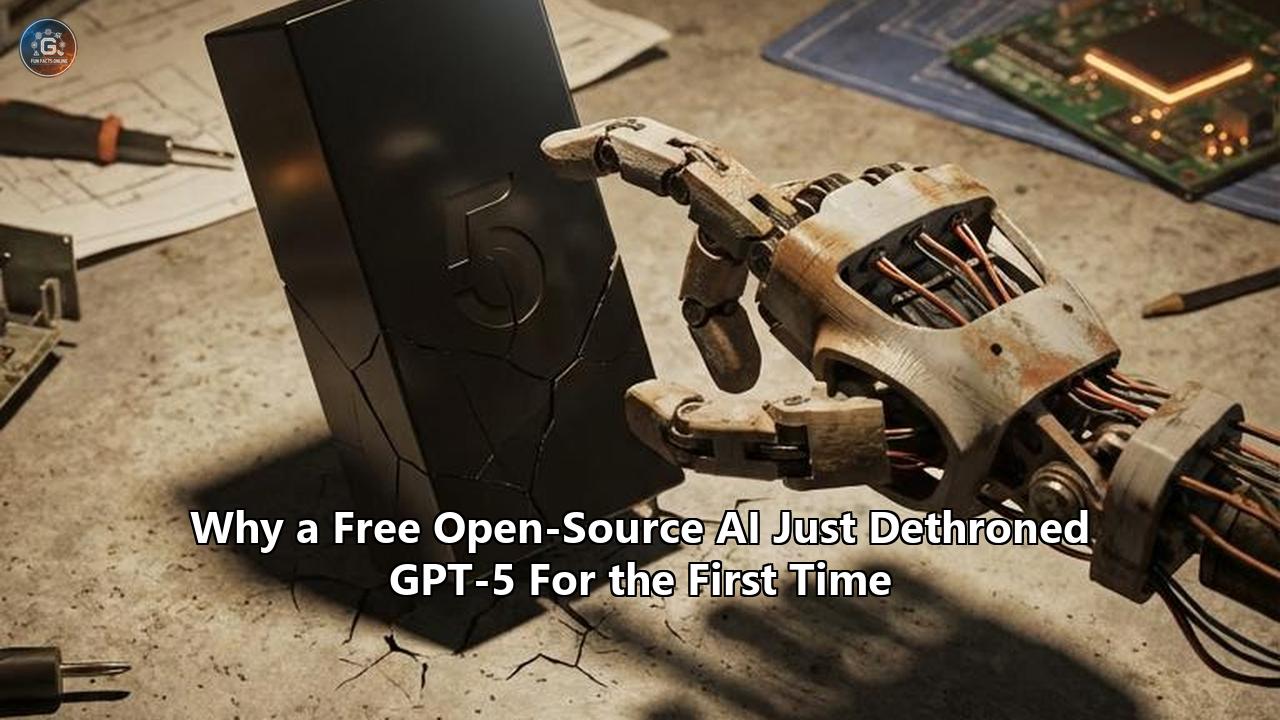
The 1352 Threshold: How Open Weights Just Broke the AI Monopoly
Late last night, the most closely monitored leaderboard in the artificial intelligence industry quietly updated its rankings. For the past eight months, the LMSYS Chatbot Arena—a crowdsourced benchmarking platform that relies on millions of blind, pairwise A/B tests to rank large language models—has been a predictable monument to the financial dominance of massive tech corporations. The top five slots have been aggressively traded between OpenAI, Google, and Anthropic, companies that routinely spend billions of dollars on single training runs.
At exactly 11:45 PM UTC on April 8, 2026, that hierarchy fractured.
A completely free, downloadable model named Mistral-Behemoth-Instruct—a collaborative fine-tune of a massive open-weight architecture—crossed the 1352 Elo threshold. In doing so, it pushed OpenAI’s flagship GPT-5.2 model down to the number two spot for the very first time. The event marks a critical turning point in the economics and trajectory of artificial intelligence. It confirms that the gap between heavily funded proprietary models and community-driven, open-weight architectures has not just narrowed; it has briefly, entirely closed.
The debate surrounding open source AI vs GPT-5 has raged since OpenAI began heavily commercializing its foundational models. For years, the prevailing consensus among Silicon Valley executives was that open-source models would perpetually lag twelve to eighteen months behind the proprietary frontier. The sheer cost of compute, the complexity of managing exascale data pipelines, and the proprietary secrets of alignment were supposed to create an unbridgeable moat.
To understand how a decentralized network of researchers just dismantled a multi-billion-dollar monopoly, we have to trace the exact sequence of technical and economic shifts that brought the industry to this breaking point. The story of how open source caught up to the frontier is a timeline of brute-force financial scaling, regulatory panic, and brilliant algorithmic subversion.
August 2025: The Illusion of the Unbridgeable Moat
The current era of AI dominance was cemented in August 2025, when OpenAI officially rolled out GPT-5. At the time of its release, the model felt like an insurmountable achievement. It was not merely a language generator; it was a unified, multimodal system with a default one-million-token context window, persistent cross-session memory, and native chain-of-thought reasoning that occurred before a single output token was generated.
The immediate aftermath of the GPT-5 launch sent a shockwave through the enterprise software sector. The model was capable of reading entire codebases, identifying logical flaws across dozens of interlinked files, and executing multi-step agentic workflows without human intervention. The cost of training GPT-5 was never officially disclosed, but infrastructure analysts estimated the training run utilized over 50,000 Nvidia H100 GPUs running continuously for 110 days—a capital expenditure that few sovereign nations, let alone open-source collectives, could justify.
During this period, the open-source community appeared completely outgunned. The best available open models at the time—Llama 3 and the early, smaller iterations of Llama 4—were highly efficient but structurally limited. They maxed out at roughly 70 to 100 billion parameters. While they could run on consumer hardware, they collapsed under the weight of complex, multi-hop reasoning tasks that GPT-5 handled with ease.
Venture capital firms began adjusting their thesis. The narrative solidified: open-source AI would serve as the "Android" of the ecosystem—ubiquitous, cheap, and entirely sufficient for basic routing and simple summarization tasks. But the cutting edge, the elusive pursuit of Artificial General Intelligence (AGI), would remain strictly behind the paywalls of API endpoints controlled by Sam Altman, Sundar Pichai, and Dario Amodei.
December 2025: The Proprietary Bloodbath and the Open-Source Winter
The escalation at the frontier intensified in December 2025. Google, desperate to reclaim the narrative, dropped Gemini 3 Pro, a model heavily optimized for native multimodality and real-time video processing. Internally at OpenAI, the launch triggered a documented "Code Red". The company abandoned its planned holiday release schedule and accelerated the deployment of GPT-5.2 on December 11, 2025.
GPT-5.2 introduced dual modes: "instant" for standard queries and a "thinking" mode that dynamically scaled inference compute for deep reasoning tasks. It also launched alongside GPT-5.2-Codex, which specifically targeted enterprise software refactoring.
As the giants traded blows at the top of the leaderboards, the open-source community entered a period of quiet stagnation. The financial math of competing simply did not work. Training a dense 1-trillion parameter model from scratch requires a distributed network of high-bandwidth compute that open-source researchers simply could not access. Furthermore, the high-quality human data required for the final alignment phase—where models learn to format answers, avoid toxic outputs, and structure code perfectly—was locked up in expensive contracts with data-labeling firms like Scale AI.
The dynamic of open source AI vs GPT-5 seemed completely resolved. If a startup wanted to build an enterprise-grade agent, they had to pay OpenAI's API tax. Local deployment was relegated to hobbyists and organizations with extreme data privacy constraints who were willing to accept a significant performance penalty.
January 2026: The Synthetic Data Rebellion
The turning point did not arrive in the form of a massive hardware grant or a sudden influx of capital. It arrived through a subtle, highly technical breakthrough in how data is curated and utilized.
By January 2026, researchers at several decentralized AI labs realized that attempting to replicate the brute-force scaling laws of GPT-5 was a fool's errand. Instead of throwing more compute at the problem, they needed to fundamentally alter the quality of the data going into the models. The internet, as a training corpus, had been exhausted. Scraping Reddit, Wikipedia, and GitHub yielded diminishing returns because the vast majority of human-generated text is logically flawed, poorly formatted, or entirely mundane.
The open-source community pivoted entirely to synthetic data distillation.
Using highly optimized prompt pipelines, researchers began using API access to GPT-5.2 and Claude 3.5 to generate massive datasets of flawless reasoning traces. They asked the proprietary models to solve complex mathematics and software engineering problems, but specifically instructed them to write out every single step of their internal logic before outputting the final answer.
This process generated hundreds of millions of high-quality "thinking" tokens. The community then used these synthetic datasets to train much smaller, highly efficient open models. The results were immediate and startling. A 70-billion parameter model, trained exclusively on the synthetic reasoning traces of a 2-trillion parameter model, began to exhibit the same logical deduction capabilities as its teacher. This "distillation of thought" bypassed the need for a massive, expensive pre-training run on raw internet data. The open-source community was effectively using the frontier models to train their eventual replacements.
February 2026: Decentralizing the Compute Bottleneck
Even with highly efficient synthetic data, the open-source community still needed a massive foundational architecture to handle the sheer breadth of general knowledge required to unseat GPT-5.2. A small model could be taught to code brilliantly, but it would inevitably fail at complex multilingual translations or niche academic reasoning due to a lack of parameter capacity.
The compute bottleneck was solved in February 2026 through the formation of a decentralized hardware alliance. Organizations including Together AI, Hugging Face, and a consortium of European academic supercomputing centers (notably utilizing the Jean Zay cluster in France) pooled their idle GPU resources. Furthermore, the early availability of Nvidia's Blackwell B200 chips at select cloud providers created an opportunity.
Instead of training a dense model where every parameter activates for every word, the alliance doubled down on an extreme version of the Mixture of Experts (MoE) architecture.
In an MoE model, the neural network is divided into hundreds of specialized "experts." A routing mechanism determines which specific experts are needed for a given prompt. This means a model can have 2 trillion total parameters (holding a vast amount of knowledge) but only use 30 billion parameters during inference (keeping it fast and cheap to run).
The alliance finalized the training of a massive open-weight base model, utilizing a 1.8-trillion parameter MoE architecture. The raw computational power was managed through newly developed asynchronous training protocols that allowed clusters in Paris, San Francisco, and Tokyo to sync their weights over the public internet without catastrophic latency drops.
March 2026: The Foundation Drop and the Swarm
On March 14, 2026, the European consortium officially dropped the base weights for their 1.8-trillion parameter model, dubbed Behemoth-Base.
A base model is essentially an extremely powerful autocomplete. It possesses vast knowledge but lacks the conversational alignment and safety guardrails required to function as a useful chatbot. When prompted with a question, a base model is just as likely to generate ten more questions as it is to provide an answer.
When OpenAI finishes a base model, a closed team of internal researchers spends months using Reinforcement Learning from Human Feedback (RLHF) to align it. They use proprietary algorithms to penalize the model for unsafe answers and reward it for helpful, concise formatting.
When Behemoth-Base dropped onto Hugging Face, the open-source alignment process was entirely different. It was a swarm.
Within forty-eight hours, thousands of independent developers, specialized alignment labs like Nous Research, and corporate engineering teams downloaded the weights. Because the model utilized the MoE architecture, it could be loaded onto a cluster of eight commercially available GPUs—expensive, but well within the budget of a mid-sized tech company or a dedicated group of researchers.
The swarm began applying Direct Preference Optimization (DPO)—a mathematical technique that aligns a model without the need for a separate, complex reward model. They fed the base model the ultra-high-quality synthetic reasoning datasets generated back in January. They specifically stripped out the "lobotomized" safety guardrails that often plague proprietary models. Corporate models like GPT-5.2 frequently refuse to generate code that resembles a cyber-security exploit, even if a user is clearly asking for a benign penetration testing script. The open-source swarm explicitly trained Mistral-Behemoth-Instruct to answer the user's prompt exactly as requested, without the moralizing lectures or hyper-sensitive refusal triggers common in the commercial API landscape.
April 2026: Dissecting the Winning Architecture
By early April, the final aligned version of the model was submitted to the LMSYS Chatbot Arena for blind testing.
The Arena operates on a ruthless, un-gameable premise. A human user types a prompt into a chat box. Two anonymous models generate responses side-by-side. The user reads both answers and clicks on the one they prefer. The platform uses the Elo rating system—borrowed from competitive chess—to adjust the rankings. You only gain significant points by beating an opponent with a higher rating.
For a week, Mistral-Behemoth-Instruct quietly accumulated wins. The data logs from the Arena reveal exactly why it began beating GPT-5.2 in head-to-head matchups.
First, the open model excelled at complex coding tasks without the latency of GPT-5.2's heavy "thinking" mode. Because the open model was trained heavily on highly distilled, flawless synthetic code, its default routing path for Python and C++ queries was incredibly efficient. Users noted that it frequently provided complete, refactored scripts without leaving placeholders like // insert rest of code here—a persistent annoyance with API-bound models trying to save compute costs.
Second, the open model suffered from zero brand bias or corporate hedging. In subjective writing tasks—drafting marketing copy, writing fictional stories, or composing emails—human raters strongly prefer models that adopt a distinct, confident tone. GPT-5.2, burdened by OpenAI's need to avoid controversy, often defaults to a sterile, highly sanitized corporate voice. The open model, unburdened by corporate liability, generated text that humans consistently rated as more engaging, nuanced, and stylistically versatile.
Finally, the context window handling proved superior for specific retrieval tasks. While GPT-5 advertises a one-million-token window, independent benchmarks have long shown that proprietary models suffer from the "lost in the middle" phenomenon, where they forget information buried deep within a massive document. The open-source architecture utilized a novel technique called RingAttention, distributing the memory load across its MoE experts more efficiently. When users uploaded 300-page legal PDFs and asked hyper-specific extraction questions, the open model found the correct clause more reliably than the OpenAI endpoint.
At 11:45 PM on April 8, the mathematical threshold was breached. The Elo rating for Mistral-Behemoth-Instruct hit 1352. GPT-5.2 slipped to 1349.
The Enterprise Recalibration: API Rents vs. Sovereign Infrastructure
The immediate consequence of the open source AI vs GPT-5 flippening is a massive recalibration in enterprise software strategy.
For the past two years, the default playbook for integrating artificial intelligence into a business has been simple: sign an enterprise contract with OpenAI, send your proprietary company data to their servers via API, and pay a toll for every million tokens processed. This model generated unprecedented revenue for OpenAI, pushing their valuation past the $150 billion mark.
However, Chief Information Security Officers (CISOs) and Chief Financial Officers (CFOs) have increasingly chafed under this arrangement. Sending highly sensitive customer data, proprietary source code, or unreleased financial reports to a third-party server creates massive data leakage risks. Furthermore, the variable cost of API usage makes budgeting for AI features nearly impossible. A sudden spike in user activity can result in a catastrophic monthly cloud bill.
The existence of a free, open-weight model that equals or exceeds GPT-5.2 fundamentally destroys the economic justification for the API tollbooth.
If a bank or a healthcare provider can download the weights of the smartest model in the world and run it on their own internal, air-gapped Virtual Private Cloud (VPC), the security risks evaporate. The financial model shifts from a variable, unpredictable operational expense (OpEx) to a fixed capital expense (CapEx)—buying the hardware to run the model locally.
This morning, shares of major cloud providers that lease out raw GPU compute (AWS, Google Cloud, Microsoft Azure) saw a surge in pre-market trading, while the secondary market valuations for AI API wrappers plummeted. The market has instantly recognized that the future of enterprise AI involves renting the hardware, not renting the intelligence.
The Impending Regulatory Collision
While enterprise software developers celebrate the democratization of frontier-level intelligence, government regulators are currently navigating a crisis of their own design.
The flippening represents the exact scenario that policymakers in Washington and Brussels have been quietly dreading. When OpenAI launched GPT-5, they implemented strict, centralized safety protocols. If a user asked GPT-5 for instructions on synthesizing a dangerous pathogen or exploiting a critical zero-day vulnerability in banking software, the centralized API would flag the prompt, refuse to answer, and potentially log the user's IP address for review.
The safety of the ecosystem relied entirely on the fact that the most capable models were locked inside heavily monitored corporate servers.
As of today, a model with the exact same capabilities—including advanced logical deduction, multi-step planning, and autonomous code execution—can be downloaded via a magnet link on BitTorrent. There is no central off-switch. There is no API key to revoke. A malicious actor can load Mistral-Behemoth-Instruct onto a private cluster in a non-extradition jurisdiction and use it to automate sophisticated spear-phishing campaigns or probe critical infrastructure for vulnerabilities at machine speed.
The European Union's AI Act, which went into full enforcement late last year, explicitly carved out exemptions for open-source models to foster innovation. However, those exemptions were drafted under the assumption that open-source models would remain significantly less capable than commercial frontier models.
This morning, regulatory agencies are scrambling to interpret how existing frameworks apply when the open-source exemption suddenly covers the most powerful intelligence on the planet. Calls for "compute governance"—the strict tracking and regulation of the physical GPU chips required to run these models—are already echoing through legislative chambers. The debate is no longer theoretical; the proliferation of frontier AI is now an irreversible reality.
What to Watch for Next: The Proprietary Counter-Offensive
The current triumph on the LMSYS leaderboard is a historic milestone, but the landscape of artificial intelligence is notoriously volatile. The open source AI vs GPT-5 dynamic is merely the current battleground; the war for the definitive architecture of the future is far from over.
The immediate question is how the proprietary labs will respond to the destruction of their moat. OpenAI has undoubtedly been holding GPT-6, or an equivalent next-generation architecture (often rumored as the Q-Star evolution), in reserve. The commoditization of GPT-5 level reasoning forces their hand. To justify their valuation and maintain their enterprise subscriptions, OpenAI must prove that they still possess a definitive edge. We should expect a massive, highly publicized product announcement from OpenAI within the next sixty days, likely focusing on continuous, autonomous agentic loops—systems that do not just answer questions, but run in the background for days, managing complex logistical tasks across hundreds of different applications.
Anthropic and Google will similarly accelerate their timelines. We are entering an era of hyper-competition where the half-life of a state-of-the-art model is measured in weeks, not years.
Simultaneously, we must watch the open-source community's push into native multimodality. While Mistral-Behemoth-Instruct dominates text and code, proprietary models still hold an advantage in processing raw, high-frame-rate video and spatial audio streams in real-time. The next frontier for the decentralized swarm will be integrating vision and auditory sensors directly into the base architecture without degrading the model's logical reasoning.
For the developers, researchers, and early adopters refreshing the leaderboards this morning, the numerical shift from 1349 to 1352 is more than just a victory for a specific architecture. It is a definitive proof of concept. It proves that human intelligence, when decentralized and collaborative, can outpace even the most heavily capitalized corporate monopolies in the world. The moat was never unbridgeable. It just took the right swarm to cross it.
Reference:
- https://www.reddit.com/r/LocalLLaMA/comments/1kb6bbl/new_study_from_cohere_shows_lmarena_formerly/
- https://aiengineerlab.in/models/benchmarking/
- https://medium.com/artificial-corner/gpt-5-launch-is-expected-in-august-2025-heres-everything-we-know-so-far-cb92617e318b
- https://daily.dev/blog/gpt-5-by-openai-everything-you-should-and-shouldnt-expect
- https://www.axios.com/2025/07/24/openai-gpt-5-august-2025
- https://en.wikipedia.org/wiki/Llama_(language_model))
- https://www.reddit.com/r/LocalLLaMA/comments/1jrfqnu/meta_set_to_release_llama_4_this_month_per_the/
- https://en.wikipedia.org/wiki/GPT-5.2
- https://medium.com/@generativeai.saif/meta-launches-llama-4-revolutionary-open-source-multimodal-ai-models-8a8bab605c54