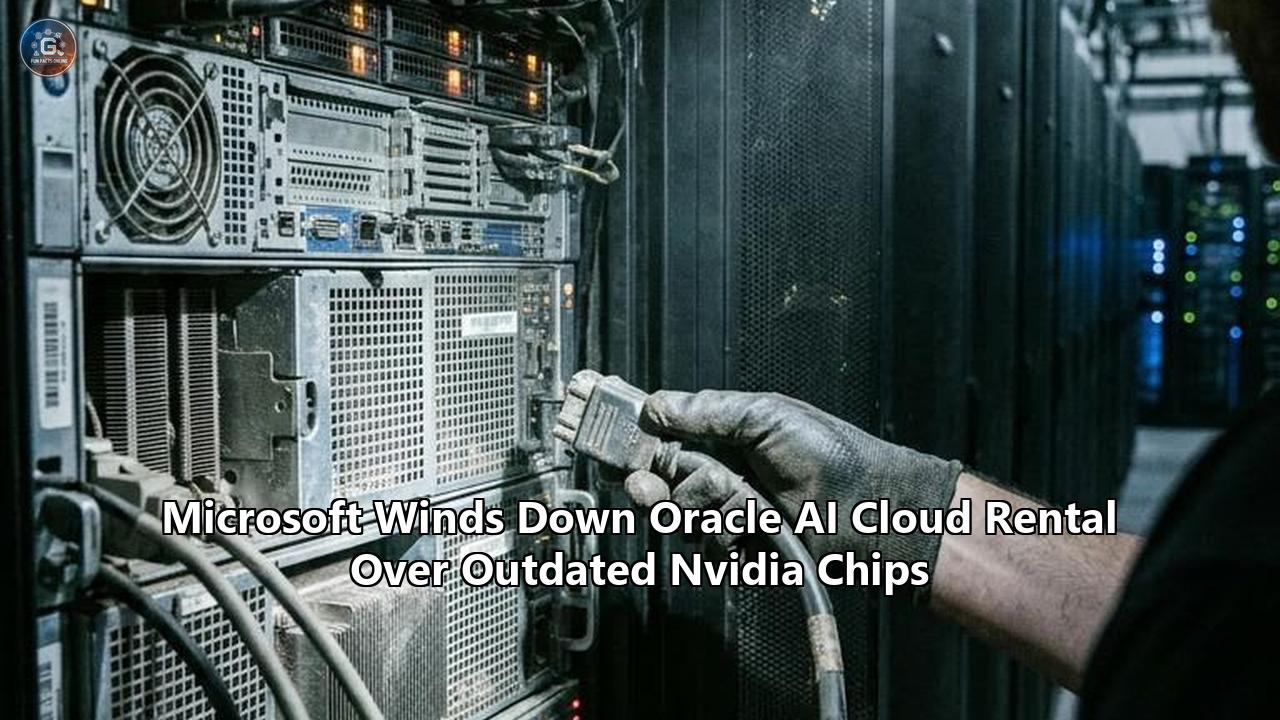
Microsoft has begun systematically deactivating artificial intelligence computing capacity leased from Oracle and has declined to renew its multi-year agreement, according to people familiar with the infrastructure operations. The quiet wind-down, which escalated over late summer and culminated in early November 2026, stems directly from hardware obsolescence: the Oracle servers in question run older-generation Nvidia graphics processing units (GPUs) that no longer satisfy Microsoft’s engineering and performance thresholds.
The disclosure rattled public markets, sending Oracle shares tumbling as much as 5.2% intraday to $109.21 and pulling down a broader basket of specialized infrastructure providers. The move strips Oracle of one of its most high-profile cloud tenants and punctures the assumption that any functional GPU cluster, regardless of age, can command indefinite enterprise demand.
The uncoupling marks a defining transition in enterprise artificial intelligence. The initial era of panic buying—characterized by hyperscale cloud operators renting whatever silicon they could find across competitor data centers—has yielded to strict workload optimization. As frontier models expand context windows, adopt mixture-of-experts architectures, and require intense memory bandwidth, the performance gap between legacy accelerators and current-generation architectures has widened from a minor operational nuisance into an unsustainable cost penalty.
The unwinding of the Microsoft Oracle AI cloud agreement exposes how quickly enterprise infrastructure requirements are shifting and highlights the risks facing debt-heavy cloud operators caught holding aging hardware.
THE ESCALATION TIMELINE
├── Nov 2023: THE SCRAMBLE — Microsoft inks emergency deal for Oracle Cloud Infrastructure (OCI) to power AI-assisted Bing.
├── Mid 2024: THE $80B BET — Microsoft commits billions across neoclouds (CoreWeave, Nscale, Nebius, IREN) amid capacity deficits.
├── Early 2025: THE SILICON CHASM — Nvidia's Blackwell and Hopper widen efficiency gaps over Ampere (A100), breaking token economics.
├── June 2026: THE FIRST CRACKS — Microsoft lets expansion talks with Oracle collapse; starts tightening neocloud oversight.
├── Late Summer 2026: THE DRAWDOWN — Microsoft engineers quietly shut down OCI clusters as first-party Azure capacity comes online.
└── Nov 2026: THE RUPTURE — News breaks of non-renewal; Oracle shares slide over 5% as market confronts hardware write-downs.
Turning Point 1: The November 2023 Compute Panic
To understand why Microsoft walked away from Oracle's servers, one must first examine the environment that forced the two rivals together in the autumn of 2023.
Twelve months after the public debut of OpenAI’s ChatGPT, Microsoft was facing an infrastructure shortfall. Chief Executive Officer Satya Nadella and Chief Technology Officer Kevin Scott had committed the company to integrating generative AI across its commercial product line, led by an ambitious overhaul of Bing search. Powered by the Prometheus model—an internal orchestration layer built atop OpenAI’s GPT-4—the conversational search engine saw user queries jump overnight.
Every chat interaction consumed multiples of the computational energy required by a traditional algorithmic index search. The sudden spike placed unprecedented strain on Azure’s data center fleet.
Azure's highest-tier clusters were already heavily allocated to OpenAI for training frontier models and serving commercial developer application programming interfaces (APIs). Internal Microsoft teams, including those building Office 365 Copilot and Bing Chat, were competing for the same finite pools of high-bandwidth compute.
At the time, lead times for new server racks from Nvidia stretched beyond 40 weeks. The semiconductor supply chain was severely constrained by Taiwan Semiconductor Manufacturing Company’s (TSMC) Chip-on-Wafer-on-Substrate (CoWoS) advanced packaging capacity. Hyperscalers could not build data centers fast enough to house the silicon they had ordered, let alone secure the electrical grid interconnections needed to power them.
THE 2023 HYPERSCALER BOTTLENECK
[Generative AI Consumer Surge: Bing Chat / ChatGPT]
                      │
                      ▼
[Azure First-Party Capacity Maxed Out Serving OpenAI Training]
                      │
                      ▼
[Nvidia Supply Chain Stalled: CoWoS Packaging Shortages (40+ Wk Lead Times)]
                      │
                      ▼
[Emergency Bridge Strategy: Competitor Leases & Neocloud Commitments]
Oracle, led by founder Larry Ellison and Chief Executive Officer Safra Catz, saw an opportunity. Years earlier, Oracle Cloud Infrastructure (OCI) had designed its second-generation cloud around bare-metal instances linked by low-latency Remote Direct Memory Access over Converged Ethernet (RoCE) networking. While Amazon Web Services (AWS) and Google Cloud Platform (GCP) prioritized virtualized instances, Oracle had optimized its physical infrastructure for distributed database clusters—an architecture that happened to map effectively onto distributed deep-learning workloads.
Oracle had secured substantial allocations of Nvidia GPUs early in the cycle, outfitting data center halls while its larger competitors were still retooling legacy facilities.
In November 2023, the two companies confirmed the landmark Microsoft Oracle AI cloud partnership. Under the multi-year contract, Microsoft agreed to rent OCI compute capacity specifically to handle the inference spikes driven by Bing’s AI search features.
The financial terms were kept private, but the strategic dynamic was clear: Microsoft, the world's second-largest cloud provider, was paying its long-standing database rival to keep its consumer products online. At the time, executive leadership in Redmond viewed the OCI expenditure as an acceptable bridge payment. Rented competitor capacity would carry the load until Azure’s first-party capital expenditure programs came online.
Turning Point 2: 2024’s $80 Billion External Expansion
By mid-2024, Microsoft’s reliance on outside cloud infrastructure had evolved from an emergency stopgap into an expansive procurement strategy.
Wall Street was scrutinizing hyperscale capital expenditures, demanding that cloud operators meet enterprise demand without letting return on invested capital deteriorate. In response, Microsoft developed a bifurcated infrastructure strategy: continue deploying tens of billions of dollars into self-built, self-operated Azure data centers, while simultaneously executing off-balance-sheet commitments with third-party operators to manage demand spikes.
This strategy fueled the rise of the specialized cloud sector—often referred to as "neoclouds." These providers specialized in buying GPU clusters, wrapping them in bare-metal software, and leasing them on multi-year terms to model builders and enterprise software providers.
Over an 18-month span, Microsoft assembled more than $80 billion in long-term lease commitments spread across an array of partners:
- CoreWeave: Microsoft committed billions to secure access to tens of thousands of Nvidia GPUs, becoming the primary anchor tenant that helped the former cryptocurrency miner establish a major footprint in AI compute.
- Nebius Group: Formed out of the international restructuring of Yandex, Nebius secured long-term multi-hundred-million-dollar compute agreements backed by European and North American facilities.
- Nscale: A British provider with access to low-cost European power and Scandinavian sites, Nscale secured major commitments from Microsoft to supply dedicated clusters.
- IREN (Iris Energy): The data center operator signed agreements with Microsoft to repurpose high-density industrial facilities for enterprise compute.
- Oracle Cloud Infrastructure: OCI served as the enterprise-grade foundation of this external network, absorbing enterprise inference and search traffic.
For Oracle, these deals were central to its corporate repositioning. Catz and Ellison regularly cited OCI’s AI momentum during quarterly earnings calls, pointing to an expanding contracted revenue backlog that eventually reached $664 billion by late summer 2026. Oracle highlighted its ability to service customers ranging from OpenAI to Microsoft as proof that OCI had achieved parity with the industry's primary cloud providers.
Yet the structural stability of these arrangements depended on a key assumption: that the underlying silicon would remain commercially viable throughout the entire duration of the underlying property and infrastructure leases.
THE EXTERNAL COMPUTE ROSTER (2024-2025 COMMITMENTS)
┌───────────────────────┬──────────────────────────┬──────────────────────────────┐
│ Provider              │ Primary Geographic Footprint│ Dedicated Workload Focus    │
├───────────────────────┼──────────────────────────┼──────────────────────────────┤
│ Oracle (OCI)          │ North America, Global    │ Bing AI, Enterprise Search   │
│ CoreWeave             │ North America, Europe    │ Foundation Model Training    │
│ Nebius Group          │ Europe, North America    │ Specialized Model Tuning     │
│ Nscale                │ UK, Texas, Nordics       │ Hyperscale Surge Capacity    │
│ IREN (Iris Energy)    │ North America            │ High-Density AI Clusters     │
└───────────────────────┴──────────────────────────┴──────────────────────────────┘
Turning Point 3: The Silicon Chasm and the Token-Per-Watt Reckoning
Between late 2024 and early 2026, the underlying economics of AI processing shifted dramatically. The semiconductor industry diverged along architectural lines, breaking the financial assumptions of earlier infrastructure deals.
The servers Oracle allocated to Microsoft under the 2023 agreement were predominantly outfitted with Nvidia’s Ampere-generation A100 GPUs, first brought to market in 2020. While Ampere silicon had served as the workhorse for initial large language model training runs—including GPT-3 and the earliest releases of ChatGPT—it was designed prior to the emergence of modern generative inference techniques.
Nvidia’s release cycle subsequently compressed. The Hopper architecture (H100 and H200) was rapidly succeeded by the Blackwell platform (B200 and the rack-scale GB200 NVL72). Each generation did not simply provide incremental clock-speed gains; they introduced architectural changes that fundamentally altered the cost to generate an AI token.
THE ARCHITECTURAL DIVIDE: AMPERE VS. HOPPER VS. BLACKWELL
┌──────────────────────────┬───────────────────┬───────────────────┬───────────────────┐
│ Metric / Feature         │ Nvidia A100 (2020)│ Nvidia H100 (2022)│ Nvidia B200 (2024)│
├──────────────────────────┼───────────────────┼───────────────────┼───────────────────┤
│ Architecture             │ Ampere            │ Hopper            │ Blackwell         │
│ Memory Standard          │ HBM2e (40-80 GB)  │ HBM3 (80 GB)      │ HBM3e (192 GB)    │
│ Memory Bandwidth         │ Up to 2.0 TB/s    │ Up to 3.35 TB/s   │ Up to 8.0 TB/s    │
│ Native Low-Precision     │ FP16, INT8, BF16  │ FP8 Transformer   │ FP4 / FP8 Micro-  │
│ Engine                   │                   │ Engine            │ tensor Scaling    │
│ Interconnect Speed       │ NVLink 3 (600GB/s)│ NVLink 4 (900GB/s)│ NVLink 5 (1.8TB/s)│
│ Relative Inference Efficiency │ Baseline (1.0x)   │ ~3.5x - 4.0x      │ ~12.0x - 15.0x    │
└──────────────────────────┴───────────────────┴───────────────────┴───────────────────┘
Three technical bottlenecks explain why Microsoft's engineering teams found Oracle’s older clusters increasingly incompatible with their operational needs:
1. Memory Bandwidth and the KV-Cache Squeeze
In modern generative AI inference, the primary bottleneck is rarely raw floating-point compute capacity; it is memory bandwidth. As models handle expanding context windows—shifting from 4,000 tokens to 32,000, 128,000, or more than a million—the Key-Value (KV) cache grows rapidly. The KV cache stores historical attention states in high-speed GPU memory so the model does not have to recompute past tokens at every step.
The A100’s HBM2e memory operates at a maximum bandwidth of roughly 2.0 terabytes per second (TB/s). By comparison, the H100’s HBM3 pushes 3.35 TB/s, the H200 delivers 4.8 TB/s, and the Blackwell B200 reaches 8.0 TB/s.
When running high-volume consumer inference like Bing search across millions of concurrent users, an A100 cluster spends excessive clock cycles waiting for memory access rather than performing computations. To process queries within acceptable latency windows, engineers are forced to over-provision older GPUs, which drastically degrades cost efficiency.
2. Numerical Precision and the Transformer Engine
The Ampere A100 architecture was optimized around 16-bit floating-point (FP16) operations and standard integer math. Hopper introduced dedicated hardware support for 8-bit floating-point (FP8) calculations, cut compute memory footprint in half, and effectively doubled throughput without degrading model accuracy.
Blackwell extended this further, introducing native 4-bit floating-point (FP4) support paired with micro-tensor scaling.
Because modern reasoning models and production inference engines rely heavily on FP8 and FP4 quantization to serve high volumes affordably, running those same workloads on Ampere hardware requires either keeping models at FP16—doubling memory requirements—or accepting inefficient software-emulated quantization routines.
3. Rack-Scale Interconnect Limitations
Modern reasoning architectures and agentic models do not simply generate static text answers; they execute iterative chain-of-thought routines, parallel branch checks, and multi-model consensus verification. These systems require high-speed inter-GPU communication.
The A100 cluster relies on third-generation NVLink, delivering 600 gigabytes per second (GB/s) of bidirectional bandwidth. Hopper's fourth-generation NVLink delivers 900 GB/s, while Blackwell’s NVLink 5 reaches 1.8 TB/s per GPU, scaling up to 72 GPUs operating as a single unified computing domain within an NVL72 rack.
When distributed inference workloads were deployed on Oracle’s older clusters, cross-node communication overhead degraded response times. For an interactive search product like Bing, where latency over a few hundred milliseconds directly depresses user engagement, this performance drag proved difficult to manage.
THE INFERENCE LATENCY TRADEOFF
[User Submits Complex Multi-Turn Query to Bing AI]
                      │
       ┌──────────────┴──────────────┐
       ▼                             ▼
[Oracle Leased A100 Cluster]  [Modern Azure H100/B200 Fleet]
• HBM2e Bandwidth (2.0 TB/s)  • HBM3e Bandwidth (Up to 8.0 TB/s)
• FP16 Precision Overhead     • Native FP8/FP4 Precision Engines
• NVLink 3 Interconnect Drag   • NVLink 5 Single-Domain Fabric
       │                             │
       ▼                             ▼
High Latency / High Cost      Low Latency / High Token Yield
Per Generated Token           Per Megawatt-Hour
This dynamic transformed data center economics. A cloud provider running older A100s consumes roughly the same data center floor space, cooling, and base power overhead as one running newer hardware, but produces a fraction of the billable token output.
When evaluating the economics of the Microsoft Oracle AI cloud deployment, Microsoft's engineering leadership confronted an inescapable reality: leasing older servers was costing more per generated token than migrating those workloads to modern first-party Azure silicon, even factoring in the amortization of building new data center space.
Turning Point 4: Mid-2026 Strategy Shift and Contract Friction
By early 2026, the strategic balance between Microsoft and its external cloud partners had changed. Azure’s multi-billion-dollar infrastructure investments were finally coming online.
Massive data center campuses across the United States, Europe, and Asia had energized their utility connections. At the same time, Microsoft began deploying its custom Maia 100 AI accelerators into production, alongside high-density allocations of Nvidia Hopper and Blackwell systems. The compute deficit that had defined late 2023 was steadily receding.
Inside Microsoft, Chief Financial Officer Amy Hood initiated a broader financial review across all third-party cloud infrastructure spending. With enterprise revenue growth for generative AI software expanding at a more deliberate pace than the initial boom suggested, management placed new emphasis on operational margins.
Microsoft could no longer justify multi-billion-dollar operational expenditures for third-party hosting unless that capacity met modern performance standards and delivered clear cost advantages.
THE PRESSURE ON NEOCLOUD LEASES (EARLY TO MID-2026)
1. Rising Internal Capacity: Azure's self-built gigawatt campuses and Maia 100 ASICs go live.
2. Financial Scrutiny: Finance leadership demands higher capital discipline and operating margins on AI products.
3. Third-Party Frustrations: Persistent construction delays, power grid logjams, and networking redesigns across leased sites.
4. Workload Migration: Internal traffic redirected toward consolidated first-party data centers.
The first clear sign of trouble emerged in June 2026, when private negotiations for Microsoft to expand its compute leasing agreement with Oracle collapsed without an agreement. Microsoft was seeking access to updated hardware specifications and more flexible volume commitments, terms that Oracle—protecting its capital expenditures and margin targets—declined to offer.
Simultaneously, Microsoft began pulling back across its broader external compute portfolio:
- Nscale Reductions: Microsoft walked away from a planned data center development site with Nscale in the United Kingdom. Months later, Redmond declined a contractual option to expand its compute commitment with Nscale at a facility in Texas—an expansion that would have been worth tens of billions of dollars over its lifetime.
- IREN Delivery Delays: High-density operator IREN publicly disclosed that deliveries on its Microsoft infrastructure contracts had slipped. Microsoft had mandated architectural revisions to the data center network design, forcing IREN to delay bringing online more than $4 billion in annualized revenue capacity from late 2026 into early 2027.
- Nebius and CoreWeave Tightening: Microsoft applied tighter service-level agreements and deployment milestones to its remaining specialized cloud contracts, signaling that late delivery would trigger non-renewal or penalty clauses.
As these relationships were renegotiated, Microsoft’s operations teams began quietly spinning down instances within Oracle’s data centers.
Workloads supporting Bing’s conversational search were redirected to newly commissioned Azure regions or consolidated onto internal clusters. Rather than executing an abrupt contractual termination, Microsoft allowed the 2023 agreement to wind down organically, powering off rented racks as monthly renewal windows expired.
Turning Point 5: The November 2026 Non-Renewal and Wall Street Reaction
The quiet drawdown became public on Friday, November 6, 2026, when reporting revealed that Microsoft had declined to renew the 2023 capacity contract and had substantially deactivated the rented Oracle hardware.
The news landed at a fragile moment for technology and financial markets. Just twenty-four hours earlier, technology stocks had endured a broad selloff, driven by macroeconomic concerns following U.S. midterm election shifts and heightened regulatory scrutiny around data center energy consumption. The Nasdaq Composite had dropped 5.5%, while the Philadelphia Semiconductor Index fell 12% in a single session.
Against that backdrop, the news that Microsoft was stepping back from Oracle’s AI cloud triggered fresh volatility across the sector.
FINANCIAL DISLOCATION: NOVEMBER 6, 2026
┌─────────────────────────────────┬──────────────────────────────────────────┐
│ Market Metric / Asset           │ Immediate Reaction                       │
├─────────────────────────────────┼──────────────────────────────────────────┤
│ Oracle (NYSE: ORCL)             │ Dropped up to 5.2% intraday to $109.21   │
│ Oracle Post-Peak Drawdown       │ Down >50% from June 2026 all-time high   │
│ Specialized Neocloud Basket     │ Broad intraday declines across listed operators │
│ Oracle Credit Rating Context    │ Hovering one notch above speculative/junk│
│ Free Cash Flow Status (Oracle)  │ Negative, strained by high infrastructure capex│
└─────────────────────────────────┴──────────────────────────────────────────┘
Oracle shares reversed early morning trading gains, sliding more than 5% as institutional investors weighed the implications of losing a foundational tenant. The drop extended a difficult run for Oracle stock, which had fallen more than 50% from its June 2026 peak.
Investors were particularly concerned by Oracle's capital structure. To fund its rapid data center expansion, Oracle had taken on significant debt, pushing its free cash flow into negative territory and leaving its investment-grade credit rating hovering just one notch above speculative status.
The company moved quickly to manage the narrative. An Oracle spokesperson issued statements emphasizing that demand for OCI's AI infrastructure remained robust across both new and legacy hardware:
"Demand for OCI's AI infrastructure remains strong, including for earlier-generation GPUs."
Oracle pointed to disclosures made earlier in the autumn, when executive leadership noted that clusters of four-year-old GPUs (predominantly A100s) coming up for contract renewal were being successfully extended or re-leased to other enterprise customers at a 20% premium over their original contract rates. Oracle argued that startup model builders, enterprise internal IT teams, and sovereign cloud initiatives remained eager to lease proven Ampere compute, even if hyperscalers like Microsoft were upgrading their fleets.
Microsoft framed the decision as a routine operational realignment. In a statement addressing its evolving cloud capacity, the company affirmed its multi-tier infrastructure framework:
"Microsoft's infrastructure strategy is built on flexibility and choice, combining self-built data centers, leased facilities, and third-party partners. We regularly review investments, track delivery progress, and adjust plans based on customer needs."
Despite those assurances, market participants focused on concentration risk. Approximately half of Oracle's $664 billion contracted revenue backlog was tied to commitments from OpenAI, with a significant portion of the remainder linked to a small circle of tech enterprises.
If Microsoft—OpenAI's primary partner and minority owner—concluded that older third-party chips no longer justified their rental cost, how long could other venture-backed AI companies afford to run on legacy silicon?
The Macro Dynamics of Accelerating Silicon Depreciation
The dissolution of this Microsoft Oracle AI cloud arrangement points to a deeper, structural issue facing the technology sector: the mismatch between traditional cloud accounting models and the rapid pace of AI semiconductor obsolescence.
In enterprise technology, cloud operators historically amortize data center servers across five to six years. For CPU-based computing—such as Intel Xeon or AMD EPYC servers hosting traditional web applications, microservices, and relational databases—that financial timeline held up well. A server deployed in 2018 could run standard corporate enterprise resource planning (ERP) workloads in 2023 with acceptable efficiency.
Accelerated AI hardware has broken that model. The cadence of GPU architecture releases from Nvidia, AMD, and custom hyperscaler ASIC programs has created steep efficiency gaps across hardware generations:
THE ACCELERATING VALUE CLIFF
Economic Value of Compute Assets Over Time
Value
 ▲
 │   Legacy CPU Cloud Servers (5-6 Year Useful Life)
100% ───────────────────────────┐
 │                               \
 │                                \
 │   AI GPU Compute Infrastructure (2-3 Year Useful Life for Frontier Workloads)
 │   ─────────────────┐
 │                     \
 │                      \ [Steep Drop: Arrival of Next-Gen Architecture]
 │                       \
 │                        └────────────────────────────────────────►
 0%  ─────────────────────────────────────────────────────────────► Time
     Year 1           Year 2           Year 3           Year 4      Year 5
When an architecture like Blackwell delivers an order-of-magnitude leap in inference token output per megawatt, the operational viability of running four-year-old Ampere silicon on frontier production workloads deteriorates rapidly.
Industry research groups have begun sounding alarms about these balance-sheet pressures. Analysts at Gartner have warned that billions of dollars in enterprise and cloud AI capital investments face significant write-downs as newer, more efficient silicon continues to enter production.
If an operator purchases an A100 server for $200,000 and depreciates it linearly over six years, but an anchor tenant departs in year three because the hardware no longer meets modern workload standards, the operator faces an unpalatable dilemma:
- Discount Capacity: Re-lease the depreciating silicon to lower-tier customers at discounted rates, eroding operating margins.
- Accelerate Depreciation: Take an accelerated depreciation charge against earnings, reducing reported profitability and worsening leverage ratios.
- Bear Idling Costs: Keep servers powered on while marketing capacity, absorbing baseline facilities and cooling costs without matching revenue.
For specialized operators and capital-intensive providers, this dynamic introduces real balance-sheet risk. Much of the debt financing raised across the neocloud sector throughout 2024 and 2025 was collateralized against the GPUs themselves. Lenders underwrote term sheets on the assumption that Nvidia hardware retained high secondary-market liquidation value and would generate predictable lease revenue through late-decade cycles.
The reality playing out across Microsoft’s partner portfolio demonstrates that compute value is dictated by token-per-watt efficiency, not historical procurement cost. When large corporate clients encounter performance limits on older hardware, they move on—leaving operators to manage the operational and financial fallout.
Shifting Strategies: First-Party Consolidation vs. The Specialized Cloud
The conclusion of Microsoft’s OCI rental agreement highlights a clear divergence in how major market players are approaching AI infrastructure heading into 2027.
INFRASTRUCTURE STRATEGY RE-ALIGNMENT
┌─────────────────────────┬──────────────────────────────────┬─────────────────────────────┐
│ Dimension               │ Hyperscale Leaders (Microsoft/Azure)│ Specialized Clouds & OCI │
├─────────────────────────┼──────────────────────────────────┼─────────────────────────────┤
│ Core Capital Focus      │ First-party mega-campuses        │ Targeted leasing,           │
│                         │ and proprietary custom ASICs     │ debt-backed GPU deployment  │
│ Hardware Refresh Cycle  │ Rapid deployment of Blackwell    │ Secondary monetization of   │
│                         │ and custom Maia silicon          │ Ampere and Hopper fleets    │
│ Target Workload Profile │ Frontier model training and      │ Mid-market fine-tuning,     │
│                         │ massive-scale consumer inference │ enterprise RAG, sovereignty │
│ Financial Architecture  │ Balance-sheet cash flow and      │ Structured debt, asset-backed│
│                         │ self-funded capital deployment   │ credit facilities           │
└─────────────────────────┴──────────────────────────────────┴─────────────────────────────┘
Microsoft’s Inward Turn
For Microsoft, the departure from Oracle's older clusters is part of an intentional consolidation effort. Having used third-party capacity to navigate the acute supply shortages of 2023 and 2024, Redmond is shifting focus toward operational efficiency:
- Integrated Campus Fabrics: Modern agentic and multimodal models require ultra-dense networking Fabrics (such as 800Gb/s InfiniBand and customized Ultra Ethernet) connecting tens of thousands of accelerators. Managing these architectures across fragmented external clouds adds operational complexity that outweighs the benefits of third-party capacity.
- Custom Silicon Economics: The rollout of the Maia accelerator family enables Microsoft to run high-volume first-party workloads—like Bing search indexing, Copilot summarization, and query re-ranking—on proprietary silicon designed specifically for internal workloads, bypassing external rental margins entirely.
- CapEx Rebalancing: By reducing third-party leasing commitments, Microsoft can reallocate operating expenses directly into owned data center assets, creating durable balance-sheet value that depreciates under direct corporate control.
Oracle’s Enterprise and Sovereignty Pivot
For Oracle, the loss of Microsoft’s search inference traffic accelerates a pivot away from renting raw capacity to fellow cloud giants. To insulate OCI from sudden hyperscaler departures, the company is shifting its infrastructure strategy toward more defensible enterprise segments:
- Database-Coupled Enterprise AI: Oracle’s primary competitive advantage has long been its presence in mission-critical corporate databases. By coupling OCI compute clusters directly to its Autonomous Database and enterprise software suites, Oracle can sell AI capabilities to corporate clients whose primary goal is retrieval-augmented generation (RAG) running directly on existing business data.
- Sovereign Cloud Deployments: National governments, defense agencies, and regional healthcare systems face strict data residency mandates that prevent them from routing workloads through public hyperscale regions. Oracle has positioned OCI as a provider of private, localized sovereign cloud regions, where regulatory compliance matters more than access to cutting-edge semiconductor architectures.
- Mid-Market Fine-Tuning: While older A100 and early Hopper clusters may struggle with high-throughput consumer search inference, they remain functional for parameter-efficient fine-tuning (PEFT), LoRA adaptations, and smaller open-source model execution (such as Llama-class models). Smaller enterprise IT departments with modest query volumes can use these clusters as cost-effective environments for internal pilot projects.
Strategic Indicators and Unresolved Questions
As the technology sector processes Microsoft’s move away from Oracle’s older clusters, several key developments over the next twelve to eighteen months will signal how enterprise infrastructure balances performance needs against rising capital costs:
- OpenAI’s Infrastructure Re-evaluation: OpenAI accounts for roughly half of Oracle’s contracted revenue backlog. As OpenAI rolls out its next-generation reasoning architectures, will the startup continue relying on OCI's existing capacity, or will it follow Microsoft’s lead and push to shift workloads onto modern Blackwell-dense Azure clusters?
- Asset Impairment Testing at Upcoming Earnings Prints: Financial analysts will closely parse Oracle's forthcoming financial disclosures for changes in capital expenditure targets or write-downs on early-generation GPU servers. If Oracle begins extending depreciation schedules to shield near-term earnings, credit rating agencies could take a harder look at its capital structure.
- The Neocloud Refinancing Wave: Many independent cloud operators funded their initial GPU procurement through three-year asset-backed debt facilities signed during the 2023–2024 boom. As those credit facilities mature, lenders will evaluate the actual resale value and revenue potential of Hopper and Ampere clusters, determining whether to refinance that debt or repossess the hardware.
- Secondary Market Utilization Rates: The ultimate landing spot for older hardware remains an open question. If mid-market enterprises absorb decommissioned Ampere clusters for internal fine-tuning, the broader market can avoid severe write-downs. But if power constraints force data center operators to pull older servers to make room for power-hungry Blackwell racks, secondary hardware values could decline sharply.
The conclusion of the Microsoft-Oracle agreement marks the close of the generative AI boom's initial gold-rush phase. The era of leasing any available accelerator, at any price, from any vendor, has reached its limit. In its place emerges an operating environment defined by rigorous unit economics, strict workload profiling, and an engineering reality: in modern AI computing, running on yesterday's silicon can quickly become an expense enterprise balance sheets can no longer justify.
Reference:
- https://finance.biggo.com/news/b75b8b6d-2213-4ae9-a45d-b6f67d3df4ed
- https://superpowerdaily.com/posts/microsoft-reportedly-winds-down-oracle-ai-computing-deal-oracle-shares-fall-4
- https://aiweekly.co/alerts/microsoft-lets-2023-oracle-ai-cloud-deal-lapse-over-older-nvidia-chips
- https://thenextweb.com/news/microsoft-winds-down-oracle-ai-cloud-capacity-deal
- https://www.investing.com/news/stock-market-news/microsoft-is-winding-down-oracle-deal-to-rent-ai-cloud-capacity-bloomberg-news-reports-5008946
- https://www.reddit.com/r/AMD_Stock/comments/1xpjlzb/microsoft_winding_down_oracle_deal_to_rent_ai/
- https://seekingalpha.com/news/4668404-microsoft-winds-down-rented-ai-computing-capacity-from-oracle-report
- https://www.reddit.com/r/hardware/comments/1xpl1zd/microsoft_is_winding_down_oracle_deal_to_rent_ai/
- https://emergent.sh/news/microsoft-ends-oracle-ai-cloud-capacity-deal
- https://www.investing.com/news/stock-market-news/oracle-falls-4-as-microsoft-reportedly-winds-down-ai-cloud-capacity-deal-5008936