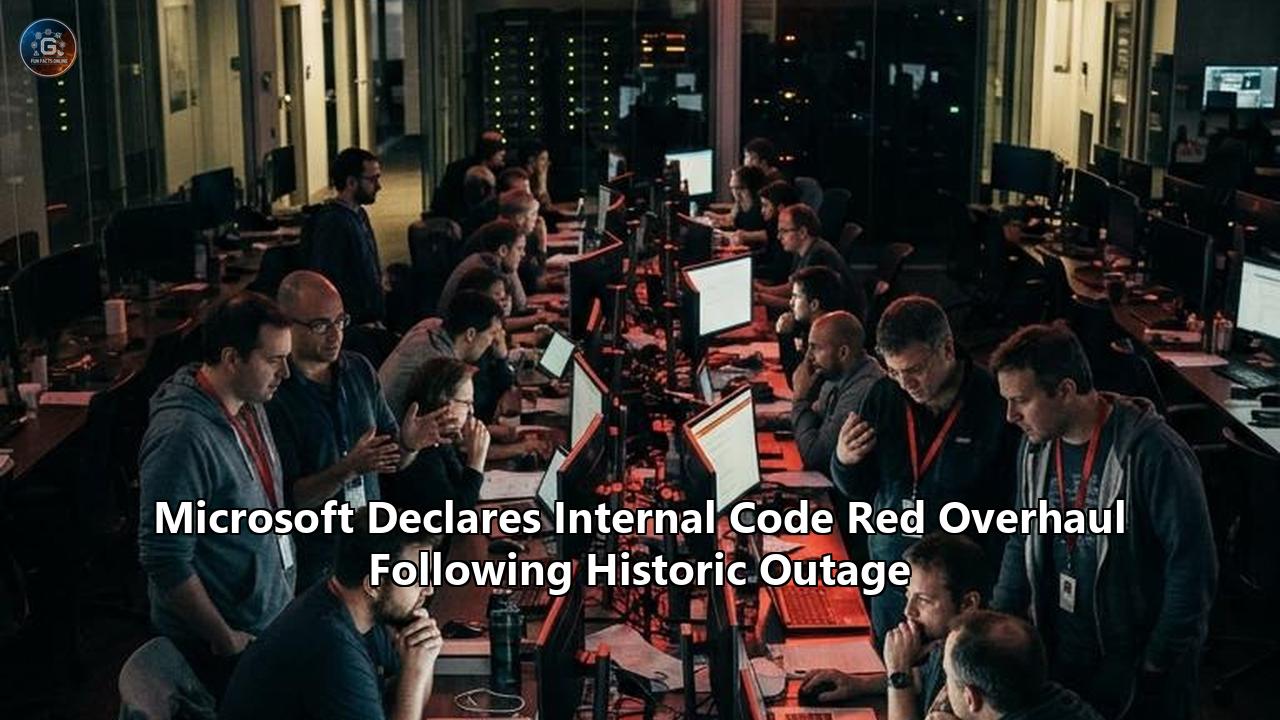
Microsoft has initiated a sweeping internal "Code Red" mobilization across its core cloud and productivity engineering units, ordering an emergency overhaul of its infrastructure following a devastating 24-hour service collapse. The disruption, which struck on November 12 and rolled into November 13, knocked Exchange Online, Outlook, Microsoft Teams, Copilot, and suite-wide Microsoft 365 services offline worldwide.
The blackout froze mission-critical operations across three continents. Government agencies in Australia, Japan, and the United States reported halted communications; financial firms experienced severe trading delays; and commercial airlines struggled with dispatch and internal logistics. In an internal memo sent to engineering staff, Jason Henderson, President of M365 Core, called the incident the most severe customer-impacting event in the history of Exchange Online. "Never before had so many customers been without email for so long," Henderson wrote, confirming that executive leadership had activated a Code Red directive—the company's highest emergency engineering designation—to fundamentally re-architect how Microsoft prevents, manages, and isolates catastrophic service failures.
At The New York Times' DealBook Summit, Chief Executive Officer Satya Nadella publicly apologized for the blackout, expressing deep regret for the operational turmoil experienced by global enterprises. Yet internal documents reviewed by Reuters paint a stark portrait of an engineering organization blindsided by architectural vulnerabilities and overwhelmed by an uncoordinated triage process. For enterprise customers tracking each new Microsoft outage update, the company’s internal review confirms that the disruption was not the product of a cyberattack or rogue AI agents. Instead, it was catalyzed by a latent software defect that lingered undetected for four months before triggering a cascading architectural collapse.
Anatomy of the Breakdown: Latent Bugs and Cascading Strain
The mechanical failure originated from an undetected Windows scalability defect introduced in a software update pushed live in July.
In software engineering, a scalability defect differs fundamentally from a traditional functional bug. A functional bug immediately breaks a feature: clicking a button yields an error, or a query fails to return data. A scalability defect, by contrast, behaves perfectly under standard testing conditions, synthetic staging environments, and moderate traffic loads. It functions as a dormant landmine, activating only when concurrent transactions, queue depths, or distributed lock contentions cross an exacting mathematical threshold.
During an internal Code Red post-mortem review, Charles Lamanna, Microsoft’s Executive Vice President of Copilot, Agents, and Platform, revealed the extreme nature of the architectural stress. The compromised component, Lamanna disclosed, had endured "roughly ten years' worth of acceptable failures" in a compressed window.
[ July Update: Latent Scalability Bug Introduced ]
                       │
                       ▼
[ Months of Normal Operation Under Standard Load ]
                       │
                       ▼
[ Concurrency Spike Triggers Resource Starvation ]
                       │
                       ▼
[ Component Absorbs Massive Failure Rate ]
                       │
                       ▼
[ Cascading Thread Exhaustion Across M365 Substrate ]
                       │
                       ▼
[ Global Outage Across Exchange, Teams, & Copilot ]
When enterprise software components fail intermittently, modern cloud platforms rely on automated fault tolerance:
- Unhealthy nodes are discarded.
- Incoming requests are redistributed to parallel server pools.
- Circuit breakers trip to stop bad requests from traveling downstream.
In this instance, the latent Windows scalability defect broke those containment barriers. Once the system crossed peak concurrency limits, the defect caused micro-delays in transaction processing. In a hyper-scale environment that handles hundreds of millions of enterprise users, a delay measured in milliseconds rapidly multiplies into a massive logjam.
Threads remained open while waiting for server resources to free up. Application queues backed up, memory consumption spiked, and servers began reporting unhealthy states to load balancers. As automated orchestrators attempted to kill and spin up replacement instances, the replacement servers inherited the exact same backlog of unresolved traffic, immediately crashing under the load.
The 'Fog of War': 11,000 Messages and Siloed Telemetry
While the infrastructure buckled, the human element of Microsoft’s response apparatus experienced an operational gridlock of its own. Amanda Silver, Corporate Vice President overseeing M365 Core and Work IQ, detailed the internal communication breakdown in an unsparing diagnostic memo. Silver disclosed that responding engineers had to work through a literal "fog of war" that severely impaired executive situational awareness and delayed remediation.
Despite assembling the company’s elite engineering and infrastructure personnel, the response effort fractured across disconnected channels. Responders generated more than 11,000 real-time messages scattered across 11 different Microsoft Teams incident chats. Diagnostic information, performance metrics, and machine health telemetry were trapped inside fragmented internal tracking platforms.
Because engineers lacked a unified, real-time dashboard displaying confirmed root causes versus untested hypotheses, duplicate efforts flourished while critical signals were buried under conversational noise. Teams working on Exchange Online data planes pursued theories that had already been invalidated by engineers monitoring core authentication layers, and diagnostic data points gathered in one region failed to reach teams troubleshooting gateway servers in another.
Engineers suffered from cognitive overload. When an infrastructure failure of this scale occurs, monitoring alerts bombard engineers with tens of thousands of automated warning tickets per minute. Distinguishing between the primary root cause and millions of secondary downstream symptoms becomes extraordinarily difficult. In this case, the noise obscured the signal, preventing engineers from locating the faulty component for hours while global communication backbones remained dead.
The Code Red Overhaul: Five Structural Workstreams
To dismantle the systemic weaknesses laid bare by the crisis, Microsoft’s Code Red directive establishes five specialized engineering workstreams. Led by Silver and monitored through daily command meetings chaired by Henderson, these workstreams represent a complete rewrite of the company's enterprise availability strategy.
The latest Microsoft outage update shows the technology giant abandoning passive recovery models in favor of aggressive, automated system isolation.
1. Intelligent Load Shedding
When distributed software systems run out of memory or compute capacity, they often freeze completely because they spend all their resources trying to process an impossible backlog of work. Under the new Code Red requirements, Microsoft is rebuilding its services to implement immediate, automated load shedding.
Load shedding functions like an emergency room triage protocol. If incoming traffic surges past safe operational margins, the system deliberately drops non-essential requests to ensure mission-critical transactions can still go through. In an enterprise email environment, the system might refuse background inbox indexing, disable real-time typing indicators, or throttle third-party calendar synchronizations, preserving 100% of available CPU power for basic email sending and delivery.
2. Strict Geographic Traffic Partitioning
Cloud computing architectures are often designed for frictionless global scale: if a data center cluster in North America fails, traffic automatically shifts to compute pools in Europe or Asia. While this setup prevents regional downtime, it also creates an avenue for catastrophic contagion. A poisonous software defect or malformed traffic pattern can propagate globally across shared infrastructure.
The geographic partitioning initiative will construct hard, uncrossable boundaries around regional cloud deployments. If an architectural collapse begins inside North American tenant environments, regional bulkheads will seal off the failure, preventing it from migrating into European or Asia-Pacific cloud substrates. Under this model, an infrastructure failure will be strictly confined to its point of origin.
3. One-Hour Worldwide Recovery Target
Historically, enterprise Service Level Agreements (SLAs) measured recovery in hours or days, accompanied by financial credits for missed uptime commitments. Microsoft has now instituted an internal mandate: engineering teams must design architectures capable of resolving global disruptions within 60 minutes.
Meeting a 60-minute recovery window requires eliminating manual intervention from incident response. The company is developing deterministic recovery runbooks that automate server restarts, rollback faulty components, and isolate failing clusters without waiting for multi-tiered executive approval chains.
4. Deploying Autonomous AI Diagnostic Agents
To eliminate the operational friction that crippled communication during the November crisis, Microsoft is integrating autonomous AI diagnostic agents directly into its incident command loops.
Rather than relying on human responders to manually query multiple monitoring tools and cross-reference error codes across scattered channels, these specialized AI agents will continuously digest telemetry from thousands of servers simultaneously. By parsing log files, network traces, and thread dumps in real time, the agents are designed to cut through operational noise, surface the single root failure point, and provide engineers with an immediate, validated hypothesis.
5. High-Velocity Patch Deployment Pipelines
The post-incident analysis uncovered a critical operational vulnerability: deployment velocity. In a separate memo reviewed alongside the Code Red announcement, Henderson revealed that a critical production patch had previously taken five to six days to reach worldwide deployment across Microsoft’s global fleet.
Under the Code Red initiative, Microsoft is redesigning its software delivery pipelines to cut the journey from bug identification to verified global deployment down to one hour. This acceleration requires completely re-engineering automated validation suites to run exhaustive regression and performance tests in minutes rather than days.
Technical Deep-Dive: Understanding the M365 Substrate
To understand why a defect in a single core component could take down email, real-time messaging, and generative AI assistants simultaneously, one must examine the architecture of the Microsoft 365 Substrate.
┌────────────────────────────────────────────────────────┐
│                   USER ACCESS LAYER                    │
│   Outlook Web/App  │  Teams Client  │  Copilot Chat    │
└───────────┬───────────────────┬────────────────┬───────┘
            │                   │                │
            ▼                   ▼                ▼
┌────────────────────────────────────────────────────────┐
│               MICROSOFT 365 SUBSTRATE                  │
│                                                        │
│  ┌──────────────────┐  ┌────────────────────────────┐  │
│  │ Identity & Auth  │  │ Unified Data Store         │  │
│  │ (Entra ID)       │  │ (Mail, Chats, Files, Meta) │  │
│  └────────┬─────────┘  └──────────────┬─────────────┘  │
│           │                           │                │
│           └─────────────┬─────────────┘                │
│                         ▼                              │
│  ┌──────────────────────────────────────────────────┐  │
│  │ Intelligent Fabric: Semantic Index & Copilot LLM │  │
│  └──────────────────────────────────────────────────┘  │
└─────────────────────────┬──────────────────────────────┘
                          ▼
┌────────────────────────────────────────────────────────┐
│               WINDOWS SERVER OS & HARDWARE             │
│   Kernel Drivers  │  TCP/IP Stack  │  Hyper-V Nodes    │
└────────────────────────────────────────────────────────┘
The general public often views Outlook, Teams, OneDrive, SharePoint, and Copilot as separate software applications. In enterprise reality, they are different user interfaces sitting atop a single distributed foundation known as the Substrate.
The Substrate acts as an intelligent data layer. It houses an enterprise's emails, chat messages, file attachments, calendar events, search indexes, and security compliance labels within a unified architecture. When an enterprise user queries Microsoft Copilot to summarize an email chain or retrieve insights from a Teams discussion, Copilot does not interact with separate external servers. It sends internal API calls directly into the Substrate's unified data plane.
This design delivers seamless interoperability, but it also creates shared dependencies:
- If the underlying Substrate data plane stumbles, every service built on top of it stumbles too.
- Exchange Online serves as the operational anchor of this data plane; its messaging protocols route communications not just for email, but for calendar invites, meeting transcripts, and compliance telemetry.
- When the latent Windows scalability defect crippled the server nodes hosting Substrate processes, the failure blinded the services above it.
Teams lost its ability to log chat histories, retrieve organizational rosters, or populate meeting links. Copilot lost access to the enterprise data groundings needed to process user prompts. Outlook could neither send nor receive data, freezing users out across the globe. The unified foundation had turned into a systemic vulnerability.
The Thundering Herd: How Software Recovers—or Fails To
The length of the disruption—spanning a full 24-hour cycle—highlights one of the most stubborn engineering dilemmas in distributed computing: the recovery loop.
Once a massive cloud infrastructure layer experiences a hard failure, bringing it back online is rarely as simple as restarting the servers. Distributed systems frequently fall victim to what software engineers call the "thundering herd" problem, accompanied by aggressive retry storms.
                               ┌────────────────────────┐
                               │  Primary Node Crashes   │
                               └───────────┬────────────┘
                                           │
                                           ▼
┌────────────────────────┐     ┌────────────────────────┐
│ Massive Client Retries │ ──> │ Replacement Node Boots │
│ (Thundering Herd)      │     └───────────┬────────────┘
└────────────────────────┘                 │
                                           ▼
                               ┌────────────────────────┐
                               │ CPU Hits 100% Instantly│
                               │ Node Crashes Again     │
                               └────────────────────────┘
Consider the automated behavior of modern client software. When Outlook on a corporate laptop loses connection to Exchange Online, it does not simply wait passively. Built-in network logic instructs the client to retry its connection. Initially, it waits two seconds, then four seconds, then eight seconds—a process known as exponential backoff.
However, when tens of millions of devices are disconnected at the same time, this retry mechanism turns into an accidental distributed denial-of-service (DDoS) attack. The moment engineers reboot a regional server cluster, millions of client applications instantly flood the newly booted servers with connection requests, authentication tokens, and pending outbound messages.
The replacement servers are hit with peak-hour connection volumes before their internal caches have even populated. Within seconds, CPU utilization jumps to 100%, memory pools run out, and the newly restarted nodes crash once again.
Breaking this destructive feedback loop requires engineers to deliberately sever customer access. They must wall off the servers, spin up the compute pools in absolute isolation, pre-warm data caches with artificial traffic, and gradually open the digital floodgates region by region. Doing this safely across a global enterprise network is why resolving the outage took a full 24 hours.
Safe Deployment Practices vs. The Need for Speed
The Code Red initiative has also forced Microsoft to confront a difficult engineering trade-off: balancing progressive software rollouts against the demand for rapid emergency patching.
In modern site reliability engineering (SRE), updates are deployed using Safe Deployment Practices (SDP). Under SDP, a software build is never released to the entire world at once. Instead, it moves through progressive deployment rings:
- Ring 0: Internal engineering systems.
- Ring 1: Microsoft-wide employees (dogfooding).
- Ring 2: Canary enterprise tenants who opt into early access.
- Ring 3: General production regions, rolled out over days or weeks.
This phased progression is designed to catch unexpected bugs before they reach wide distribution. Yet, as Henderson noted in his memo, this careful approach has a serious downside: it makes deploying urgent fixes dangerously slow. When a severe infrastructure bug or zero-day security flaw is discovered in production, waiting five to six days for a patch to crawl through sequential rings leaves enterprise systems exposed to real-world risks.
The challenge Microsoft now faces is finding a way to compress that deployment timeline from nearly a week down to a single hour without abandoning critical safety gates. Safely rolling out a global patch in 60 minutes requires automated testing environments that can accurately simulate the chaotic, messy conditions of global Internet routing in minutes. If Microsoft accelerates its deployment pipelines without building rock-solid automated verification, it risks shipping patches that introduce more issues than they solve.
The Macroeconomics of Cloud Monoculture
The November collapse has reignited debate among corporate risk managers, economists, and government regulators regarding cloud concentration risk. The global economy runs on digital infrastructure controlled by a tiny handful of hyper-scale providers: Microsoft Azure, Amazon Web Services (AWS), and Google Cloud Platform (GCP).
┌────────────────────────────────────────────────────────┐
│             HYPERSCALE CLOUD CONCENTRATION             │
│                                                        │
│   ┌─────────────────┐ ┌─────────────────┐ ┌─────────┐  │
│   │  AWS (~31-33%)  │ │ Microsoft (~20%)│ │  GCP    │  │
│   │                 │ │                 │ │ (~10%)  │  │
│   └─────────────────┘ └─────────────────┘ └─────────┘  │
└───────────────────────────┬────────────────────────────┘
                            │
     Shared Critical Infrastructure Dependencies
                            │
  ┌─────────────────────────┼─────────────────────────┐
  ▼                         ▼                         ▼
Aviation Logistics    Financial Systems      Government Operations
When an enterprise productivity suite fails, the economic losses cascade far beyond idle corporate chat channels. The November 12–13 outage disrupted high-frequency financial trading desks, where missed trade confirmations directly translate into millions of dollars in exposure.
Commercial airlines faced operational logjams as crews lost the ability to access digital flight plans, maintenance tickets, and gate coordination workflows. Public sector agencies could not process official cross-departmental documentation.
This level of supply-chain exposure explains why any major Microsoft outage update is scrutinized by international regulatory bodies. Organizations like the European Banking Authority (via the Digital Operational Resilience Act, or DORA), the United States Federal Trade Commission, and financial oversight bodies across Asia have warned that cloud monoculture poses systemic macroeconomic risks.
If a single software defect inside a single vendor's operating system can disrupt international logistics, financial markets, and sovereign government systems for an entire day, that provider ceases to be a simple software vendor. It functions as a de facto public utility—yet operates without the strict operational oversight and public utility regulations applied to electric grids or water networks.
Enterprise Chief Information Officers (CIOs) are reconsidering their reliance on single-vendor ecosystems. While bundling cloud compute, operating systems, workplace chat, email, and artificial intelligence into a single vendor contract makes financial sense, it introduces a severe point of failure. The financial cost of hours of downtime can quickly wipe out any cost savings achieved through volume licensing discounts.
Key Takeaways: Redmond's Re-Engineering Blueprint
To gauge whether Microsoft can successfully deliver on its Code Red promises, infrastructure analysts and enterprise IT directors should monitor several key milestones over the coming quarters:
- Shorter Time-to-Remediation: Track whether subsequent localized disruptions show evidence of the 60-minute resolution target, signaling that automated runbooks and AI diagnostic agents are successfully cutting through incident triage delays.
- Execution of Regional Traffic Partitioning: Monitor future service communications to verify whether infrastructure failures remain contained within isolated geographic blast radiuses, rather than cascading across continents.
- Reformed Safe Deployment Practices: Watch how Microsoft balances safety and speed as it updates its patch delivery pipelines to hit its target of 60-minute global deployments.
- Implementation of Client-Side Resilience: Observe how desktop and mobile apps (Outlook, Teams) are updated to manage connection failures more gracefully, avoiding aggressive retry storms that overwhelm recovering servers.
- Independent Audits and Regulatory Scrutiny: Follow upcoming compliance filings under European DORA regulations and US federal infrastructure inquiries, which will likely demand independent validation of Microsoft's new architectural fail-safes.
The Path Forward
Declaring a Code Red is an extraordinary admission of structural vulnerability from one of the world's most valuable technology companies. By formally acknowledging that its historical engineering and incident management practices were not sufficient to prevent a global operational failure, Microsoft has committed itself to its most significant architectural restructuring in years.
The company's core challenge is executing this deep structural overhaul without breaking the complex systems running beneath the surface. Upgrading the underlying Substrate, isolating geographic traffic pipelines, and rebuilding deployment systems while supporting millions of active enterprise users is the software equivalent of swapping out a jet engine mid-flight.
Enterprise trust is fragile. Customers accept that individual servers fail and networks experience occasional disruptions; what they cannot accept is an uncontained architectural cascade that knocks out communications for 24 hours while responders scramble in the dark.
As Henderson's Substrate engineering team convenes its daily operational reviews, the success of the Code Red overhaul will not be measured by the eloquence of internal post-mortems. It will be judged when the next latent software defect surfaces—and whether Microsoft's new architecture can quietly isolate and eliminate the threat before the rest of the world even notices.
Reference:
- https://ugdiplomat.com/microsoft-declares-code-red-after-historic-24-hour-global-outage/
- https://www.thedailybeast.com/microsoft-declares-code-red-after-massive-365-outage
- https://www.ctvnews.ca/sci-tech/article/microsoft-declares-code-red-after-historic-outage-internal-memos-show-reuters-exclusive/
- https://it.slashdot.org/story/26/11/24/1859221/microsoft-declares-code-red-after-historic-outage
- https://thenextweb.com/news/microsoft-code-red-exchange-online-outage-memos-reuters
- https://www.investing.com/news/stock-market-news/microsoft-declares-internal-code-red-after-historic-24hour-outage--reuters-5048793
- https://newscord.org/article/microsoft-declares-code-red-after-24-hour-global-microsoft-365-outage--Story_20261124_Microsoftshistoriccl2ebad515