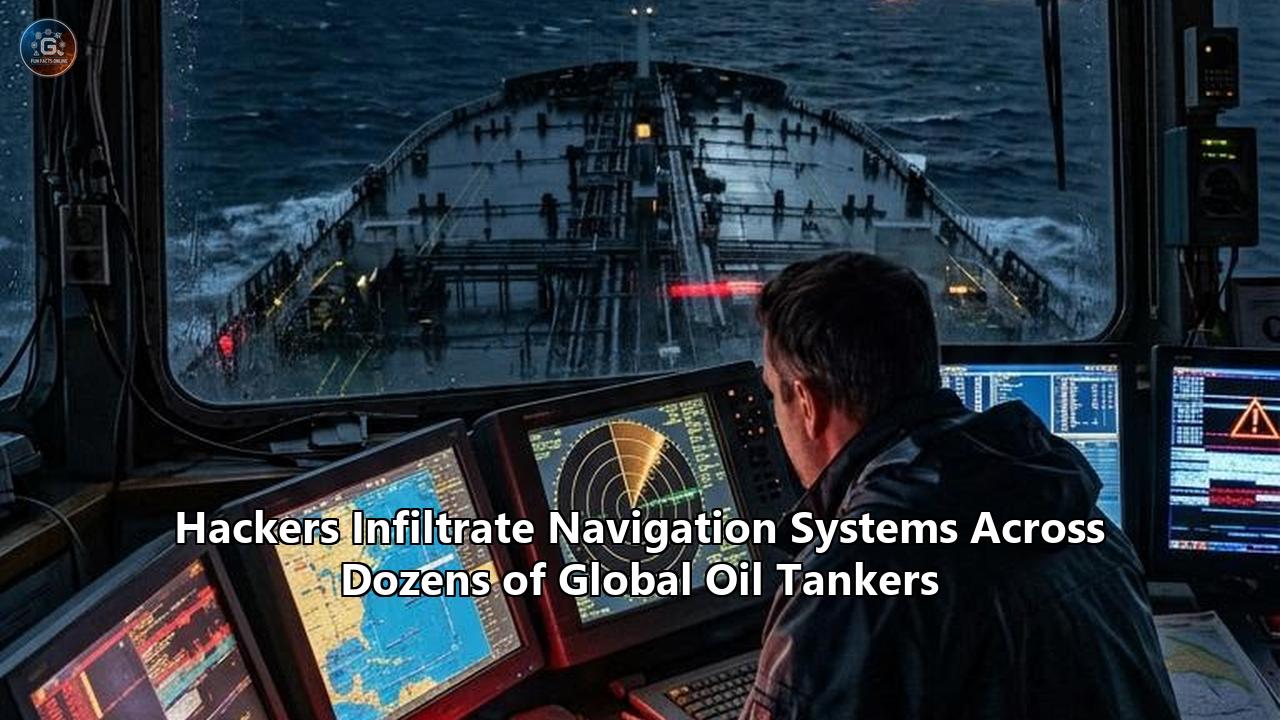
Coordinated cyber intrusions have penetrated the bridge navigation and operational technology systems of up to 50 commercial energy vessels worldwide, triggering multi-agency tactical offshore boardings by federal authorities and exposing systemic security failures across maritime supply chains.
Federal investigators and intelligence agencies have confirmed that hackers breached the core digital infrastructure of supertankers, liquefied natural gas (LNG) carriers, and chemical transports traversing vital shipping lanes between Europe, Asia, and North America. The crisis culminated in high-seas operations in the Gulf of Mexico, where specialist teams from the U.S. Coast Guard Cyber Protection Team (CPT) and the FBI Cyber Action Team boarded inbound foreign-flagged crude carriers to isolate compromised systems before the vessels could approach domestic ports.
The operation targeted vessels including the Liberian-flagged very large crude carrier (VLCC) Prosperity, carrying approximately 2.3 million barrels of crude, and the tanker Kohaku. Concurrently, crews aboard several targeted vessels received direct extortion messages and bomb threats over their personal cellular devices warning that "traitor ships will burn in hell," while a digital ransom demand sent to the master of the Prosperity described the takeover as a "planned execution".
At least one vessel suffered a complete 30-hour loss of external communications alongside direct manipulation of its integrated propulsion and steering displays while transiting near the Strait of Gibraltar, forcing the crew to sever digital links and revert to emergency manual controls.
ATTACK PATHWAY: FROM SATELLITE WAN TO INTEGRATED BRIDGE SYSTEM
========================================================================================
[Satellite Constellation] (VSAT / L-band / LEO)
         │
         ▼
[Vessel Edge Gateway] (Compromised Fortinet FortiGate Appliance)
         │  ◄── Ingress via FortiBleed Credential Leak & Exposed Admin Interfaces
         ▼
[Vessel IT Network] (Administrative LAN / Crew Wi-Fi / Voyage Management)
         │
         ▼  ◄── Breakdown of Boundary Segmentation (Cross-VLAN Routing / Dual-Homed PCs)
[Operational Technology] (OT / Marine Automation)
         │
         ├───────────────► [ECDIS Navigation Workstations] (NMEA 0183/2000 Serial Feeds)
         │                    └── Chart layer tampering, spoofed depth contours, CPA offsets
         ├───────────────► [Autopilot / Steering Control] (Heading output corruption)
         └───────────────► [Machinery Alarm & Engine Telemetry] (False normal baselines)
========================================================================================
The intrusions exploited perimeter networking hardware manufactured by Fortinet, capitalizing on vulnerabilities such as CVE-2026-24858, CVE-2025-25252, and the widespread "FortiBleed" credential disclosure that leaked administrative access keys for roughly 74,000 devices across maritime and industrial transportation sectors. By compromising edge firewalls and Virtual Private Network (VPN) routers, the attackers bridged the traditional gap separating administrative information technology (IT) from vessel operational technology (OT). Once across the boundary, they accessed the Integrated Bridge System (IBS), which coordinates Electronic Chart Display and Information Systems (ECDIS), gyrocompass telemetry, autopilot computers, and the Automatic Identification System (AIS).
While U.S. intelligence officials continue to investigate whether state-backed Iranian cyber units orchestrated the campaign as asymmetric retaliation for broader regional military strikes, alternate state actors including Russia remain under examination. Regardless of final state attribution, the scope of the campaign marks a fundamental turning point: navigation systems aboard the world's largest hazardous-cargo vessels are no longer merely vulnerable to radio-frequency jamming from the shoreline, but are being systematically penetrated over wide-area networks from thousands of miles away.
The Shift from Radio-Frequency Denial to Bridge Intrusion
To understand why this wave of vessel compromises has alarmed naval authorities and commercial operators alike, the incident must be contrasted with earlier maritime electronic warfare. For nearly a decade, maritime disruption was dominated by radio-frequency (RF) interference. State actors in the Black Sea, the Baltic Sea, and the Strait of Hormuz routinely deployed high-power terrestrial jamming stations to drown out Global Navigation Satellite System (GNSS) frequencies, or terrestrial spoofing systems to broadcast counterfeit radio signals that caused shipboard GPS receivers to calculate false positions.
RF JAMMING & SPOOFING vs. DEEP OT NETWORK INTRUSION
-----------------------------------------------------------------------------------------
Vector Dimension          External RF Manipulation             Internal OT Network Intrusion
-----------------------------------------------------------------------------------------
Point of Origin           Terrestrial / Aerial RF emitters     Satellite WAN / Edge Gateway
Physical Range            Line-of-sight (20–60 nautical miles) Global / Internet-accessible
Bridge Indication         Signal loss alarms, HDOP degradation Displays appear completely normal
Sensor Trust              All GNSS receivers affected equally  Internal bus data rewritten
Scope of Threat           Position, Velocity, Time (PVT)       Navigation, Steering, Propulsion
Remediation               Exit jamming zone / switch to radar  Full network quarantine / wipe
-----------------------------------------------------------------------------------------
External RF spoofing is inherently loud. When a shore station overwhelms satellite signals, shipboard receivers experience sudden spikes in signal-to-noise ratios, alarming the bridge watchstander with abrupt drops in dilution of precision, or showing sudden, geographically impossible leaps across coordinates. In contrast, internal OT penetration operates silently inside the vessel's local data buses.
Modern supertankers integrate navigation instruments through serial communication protocols—predominantly NMEA 0183, which runs on point-to-point RS-422 connections, and NMEA 2000, built on a Controller Area Network (CAN bus) architecture governed by the International Electrotechnical Commission (IEC) 61162 standard. Designed decades ago when commercial vessels were isolated floating islands, these protocols possess zero native encryption, zero source authentication, and zero message verification. Every sensor broadcast on an NMEA bus—from a satellite compass heading to an echo sounder's depth reading—is inherently trusted by every receiving device on that circuit.
When attackers breach an edge router and manipulate the serial-to-Ethernet converters or bridge workstations tied to these buses, they can manipulate navigation data without triggering system alarms. An altered ECDIS display can subtly misrepresent a vessel's position by 150 meters, suppress collision warnings from radar inputs, or manipulate depth contours to make a shallow reef appear as a deep-water channel.
The physical characteristics of crude carriers elevate these technical vulnerabilities into catastrophic environmental and commercial threats. A fully laden VLCC displaces over 300,000 metric tons, measures more than 330 meters in length, and requires up to three nautical miles to come to a complete halt from service speed. The margins for error in critical bottlenecks—such as the Dover Strait, the Strait of Malacca, the Houston Ship Channel, or the Bab-el-Mandeb—are measured in tens of meters. By subverting the integrity of bridge instruments rather than simply turning them off, internal network intrusions deny mariners the ability to distinguish between genuine operational data and manufactured reality.
Defensive Architecture: Galvanic Air-Gaps vs. Zero Trust Microsegmentation
The infiltration of bridge networks has reopened an intense debate across maritime engineering and naval architecture: how to balance the commercial demand for real-time vessel connectivity against the fundamental requirement for operational isolation.
The maritime industry is divided between two competing architectural philosophies: the traditional push for physical isolation via hardware-enforced air-gapping, and the implementation of software-defined Zero Trust Network Architectures (ZTNA).
DEFENSIVE ARCHITECTURAL TRADEOFFS
-----------------------------------------------------------------------------------------
Operational Factor        Physical Air-Gaps & Diodes           Zero Trust & Microsegmentation
-----------------------------------------------------------------------------------------
Remote Attack Surface     Zero inbound IP exposure             Persistent attack surface
Chart Licensing (S-63)    Manual via USB (Sneakernet risk)     Automated real-time updates
Voyage Optimization       Severely delayed / offline           Continuous dynamic routing
Implementation Cost       High hardware cost / simple ops      High software & subscription cost
Human Dependency          High risk of procedure violation     Low human error / policy driven
Regulatory Alignment      Meets baseline segregation rules     Complies with IACS UR E26/E27
-----------------------------------------------------------------------------------------
Approach 1: Physical Air-Gapping and Hardware Data Diodes
The air-gap philosophy asserts that critical Operational Technology—specifically the Integrated Navigation System (INS), propulsion automation, and steering gear—must have no direct or indirect IP routing to satellite communication modems, crew networks, or administrative computers. Proponents advocate for complete physical separation, supplemented in modern setups by hardware data diodes.
A hardware data diode uses a physical optical link—an LED transmitter coupled to a photodiode receiver across a severed fiber strand—to guarantee that data can only move unidirectionally. In a tanker implementation, telemetry such as main engine exhaust temperatures, fuel consumption, and cargo pump pressures can be streamed outward from the engine room to shore-side fleet monitoring centers. However, because no physical return path exists on the circuit board, no inbound IP packet, malicious command, or exploit payload can travel backward into the vessel's critical operational networks.
The Tradeoffs of Physical Isolation
While data diodes eliminate remote network infiltration, their rigidity clashes directly with modern navigational compliance and maritime operations:
- The "Sneakernet" Threat Vector: Under the International Hydrographic Organization (IHO) S-63 data standard, commercial tankers must receive weekly Electronic Navigational Chart (ENC) updates and security keys to maintain legal passage. On an air-gapped bridge, updates must be downloaded onto a connected administrative computer, transferred onto a physical USB drive, and walked across the bridge into the ECDIS terminals. This manual transfer process has historically served as a prime attack vector for malicious payloads, such as Stuxnet or bridge-specific wiper malware, entirely bypassing physical network barriers.
- Loss of Adaptive Voyage Analytics: Pure isolation prevents modern engine management platforms from dynamically adjusting RPM and trim based on cloud-streamed weather routing, ocean current models, and canal transit scheduling. For a VLCC consuming 40 to 60 tons of fuel oil daily, forfeiting real-time routing optimization imposes immense fuel and emission surcharges.
- Delayed Remote Incident Diagnosis: When complex electronic fuel-injection systems or bridge processors malfunction mid-ocean, air-gapping prevents shore-side original equipment manufacturer (OEM) engineers from conducting remote diagnostics, requiring expensive specialist port visits that can delay operations.
Approach 2: Zero Trust Network Architecture and Microsegmentation
The modern IT-security paradigm argues that air-gaps are an operational fiction in 21st-century shipping. Proponents contend that as soon as a technician plugs an uninspected laptop into an engine interface, or an officer updates charts via a personal thumb drive, the air-gap collapses. Instead, this approach advocates for deploying enterprise-grade Zero Trust Network Architecture adapted to marine operational constraints.
Governed by frameworks such as the International Electrotechnical Commission (IEC) 62443 industrial cybersecurity standard, marine ZTNA partitions shipboard infrastructure into distinct security zones interconnected exclusively through monitored conduits. An integrated bridge architecture is segmented so that the ECDIS, radar scanners, automatic autopilot controllers, and machinery monitoring networks inhabit isolated Virtual Local Area Networks (VLANs).
Traffic crossing between these zones must pass through software-defined Next-Generation Firewalls (NGFW) with deep packet inspection (DPI) capable of analyzing industrial protocols. The system operates on continuous cryptographic verification: no bridge device, workstation, or remote maintenance session is trusted by default, regardless of its physical network connection.
The Tradeoffs of Microsegmentation
While ZTNA supports automated chart streaming, live diagnostic feeds, and granular access control, it introduces significant technical liabilities that contributed directly to the recent intrusions:
- Perimeter Appliance Vulnerability: As demonstrated by the exploitation of Fortinet FortiOS devices, the entire security posture of a microsegmented vessel relies on the integrity of the gateway firewall. If that single edge appliance contains an exploitable buffer overflow or leaked administrative credentials, an attacker can bypass zone controls, compromise routing tables, and gain privileged access to the internal network.
- The Satellite Bandwidth Bottleneck: Modern enterprise zero-trust platforms depend on continuous connectivity to cloud identity providers (such as Entra ID or Okta) and centralized security incident event management (SIEM) systems. Operating across high-latency, intermittent satellite constellations—whether geostationary VSAT links, L-band safety backups, or low-Earth-orbit arrays like Starlink—causes policy-synchronization failures, false-positive network lockouts, and unpatched vulnerability windows.
- Onboard Operational Overhead: Tanker crews do not include dedicated cyber systems engineers. Expecting an overstretched Chief Mate or Second Officer to diagnose an anomalous firewall rule, resolve a corrupted cryptographic certificate, or oversee an industrial intrusion-detection appliance during a high-stress harbor approach is an unrealistic operational expectation.
Navigational Redundancy: Analogue Reversion vs. Resilient PNT Technologies
When navigation displays fail or are deliberately manipulated, bridge teams face an immediate dilemma: fall back on traditional seamanship or rely on automated backup systems. The emergency responses documented across the targeted tankers reveal a stark operational divide between human-centric analogue navigation and automated Position, Navigation, and Timing (PNT) resilience.
NAVIGATIONAL REDUNDANCY TRADEOFFS
-----------------------------------------------------------------------------------------
Redundancy Method         Analogue Fallback (Paper/Optics)     Resilient PNT (eLoran/INS)
-----------------------------------------------------------------------------------------
Cyber Attack Immunity     Absolute (Non-electronic)            Susceptible to firmware exploits
Crew Workload             Extremely high / Exhaustive          Low / Automated fusion
Position Accuracy         Moderate to poor (100m–1 nautical)   High (5–20 meters)
Infrastructure Burden     Vessel carries physical paper kits   Requires multi-million retrofits
Regulatory Viability      Requires dual-mode exemption         Meets SOLAS digital mandates
Congested Water Usability Extremely difficult under stress     Seamless CPA calculation
-----------------------------------------------------------------------------------------
Approach 1: Analogue Reversion and Human Seamanship
On the tankers that detected bridge intrusions during the recent offensive, crews disconnected automated track-control autopilots, switched electro-hydraulic steering gears to manual wheel control, and relied on visual navigation.
Analogue fallback strips the bridge of digital mediation:
- Mariners stow the ECDIS displays and pull out physical paper nautical charts.
- Deck officers determine fixes by taking visual compass bearings to prominent coastal features using an optical pelorus mounted on the bridge wings.
- In open water, navigators take sun sights and star sights with optical sextants, reducing angles manually using nautical almanacs and sight-reduction tables.
- Parallel indexing on raw, unnetworked X-band and S-band radar monitors provides physical range-and-bearing clearance from coastlines and navigational hazards without relying on networked AIS telemetry.
Operational Limitations of the Analogue Ideal
While paper charts and magnetic compasses are completely immune to network compromise, relying on analogue navigation during a modern transit introduces significant operational hazards:
- The Bridge Manning Deficit: Over the past four decades, commercial automation reduced bridge crews from five or six experienced navigators to a single Officer of the Watch (OOW) supported by a deck rating lookout. Manually plotting three-bearing visual fixes every six minutes while calculating tidal streams, managing VHF radio communications, and tracking dozens of nearby vessels is cognitively overwhelming for a skeleton bridge team.
- Skill Atrophy: A generation of junior deck officers has trained almost exclusively on digital interfaces. Many have never executed a running fix on a paper chart under emergency conditions or corrected a magnetic compass heading for localized deviation without automated software assistance.
- The Loss of Predictive Target Tracking: Paper charts cannot automatically calculate a Closest Point of Approach (CPA) or Time to Closest Point of Approach (TCPA) for 30 radar contacts simultaneously. In restricted visibility or narrow sealanes, stripping away automated digital tracking sharply increases the risk of human collision error.
Approach 2: Technological Redundancy via Resilient PNT Fusion
Rather than retreating into an analogue past, a growing coalition of maritime electronics engineers and classification societies advocates for advanced, spoof-resistant digital PNT architectures. This methodology retains digital automation while validating every sensor input through multi-source sensor fusion.
RESILIENT MULTI-SOURCE PNT SENSOR FUSION
========================================================================================
[Space-Based Layer]          [Terrestrial RF Layer]        [Vessel Autonomous Layer]
- GPS (L1/L2/L5)             - eLoran (Low Frequency)      - Marine Ring Laser Gyro INS
- Galileo with OSNMA Auth.   - Terrestrial R-Mode          - Doppler Velocity Log (DVL)
- BeiDou / GLONASS           - Radar SLAM Feature Match    - Raw Radar Target Tracking
        │                               │                              │
        └───────────────────────┐       │       ┌──────────────────────┘
                                ▼       ▼       ▼
              ┌──────────────────────────────────────────────────┐
              │ KALMAN FILTER ENGINE & ANOMALY DETECTION ENGINE   │
              │ - Validates cryptographic message authentication │
              │ - Cross-checks acceleration against Doppler log  │
              │ - Drops inputs violating dead-reckoning vectors  │
              └──────────────────────────────────────────────────┘
                                        │
                                        ▼
                  [Hardened, Authenticated True Nav Baseline]
                                        │
                         ┌──────────────┴──────────────┐
                         ▼                             ▼
                 [Secured ECDIS]               [Steering Autopilot]
========================================================================================
Modern resilient PNT systems rely on three mutually independent layers:
- Cryptographically Authenticated Satellite Signals: Integrating multi-constellation GNSS receivers that process Galileo’s Open Service Navigation Message Authentication (OSNMA). OSNMA embeds asymmetric cryptographic signatures directly into the civilian satellite broadcast, allowing the ship's receiver to mathematically verify that a signal originates from a genuine satellite rather than an attacker's transmitter.
- Terrestrial Low-Frequency Radio Signals (eLoran): Operating at 100 kHz, enhanced Loran (eLoran) uses high-power, land-based broadcast towers. Its signals are millions of times stronger than space-based GNSS broadcasts, making them exceptionally difficult to jam or manipulate without industrial-scale transmitters.
- Internal Inertial Navigation Systems (INS) and Doppler Velocity Logs (DVL): Using marine-grade Ring Laser Gyroscopes (RLG) and sub-surface acoustic transceivers that measure exact speed over the seabed, an INS calculates continuous position through dead reckoning completely independent of all external radio-frequency emissions.
Engineering Hurdles of Resilient PNT
While technically robust, deploying multi-source sensor fusion fleet-wide faces steep economic and geopolitical obstacles:
- Asymmetric Global Infrastructure: While South Korea, China, and parts of the United Kingdom maintain operational eLoran or terrestrial "R-Mode" transmitter networks, large swaths of the globe—including key energy corridors in the Persian Gulf, the Red Sea, and the Atlantic seaboard—lack operational low-frequency terrestrial PNT coverage.
- Prohibitive Retrofit Costs: Outfitting an existing tanker with military-grade inertial navigation, multi-band authenticated antennas, and specialized Kalman-filtering sensor hubs can cost between $150,000 and $300,000 per vessel. For independent tanker owners operating on narrow voyage charter margins, capital expenditures that yield no direct commercial freight premium are routinely resisted until compelled by law.
- Inertial Drift Dynamics: Without regular absolute position updates, even commercial-grade marine INS units accumulate positioning drift over multi-week ocean voyages, requiring external reference inputs to maintain safe navigation parameters.
Operational Interventions: Sovereign Military Boardings vs. Commercial Managed Defense
The discovery of compromised networks on vessels approaching international ports forced a confrontation between two fundamentally different operational responses: sovereign, state-led tactical interception and private, commercial Managed Detection and Response (MDR).
OPERATIONAL RESPONSE MODELS
-----------------------------------------------------------------------------------------
Operational Vector        Sovereign Military/Coast Guard       Commercial Marine SOC/MDR
-----------------------------------------------------------------------------------------
Trigger Threshold         Credible nation-state threat/alert   Anomalous telemetry detection
Intervention Type         Offshore tactical boarding / seizure Remote network monitoring / patch
Legal Authority           Sovereign Port State Jurisdiction    Contractual shipowner agreement
Operational Disruption    Vessel stopped, anchored, delayed    Minimal / Continuous transit
Forensic Depth            Physical hardware extraction         Log file analysis / API telemetry
Deterrence Effect         High geopolitical deterrence         Zero geopolitical deterrence
Demurrage Financial Cost  Extreme ($50k–$120k/day fees)        Predictable recurring SaaS cost
-----------------------------------------------------------------------------------------
The State-Led Model: Offshore Tactical Interception
The August boardings executed by the U.S. Coast Guard and FBI in the Gulf of Mexico establish an aggressive operational precedent. Rather than awaiting a vessel’s arrival at the pilot station, federal authorities deployed tactical boarding teams via cutters and helicopters to intercept the Prosperity and Kohaku miles offshore.
Coast Guard Cyber Protection Teams, operating alongside counterintelligence agents, boarded the ships, physically isolated their satellite telecommunications equipment, connected forensic data capture hardware directly to bridge routers, and audited OT network buses for rogue persistence mechanisms before granting security clearance to enter U.S. territorial waters.
SOVEREIGN INTERVENTION JURISDICTION (UNCLOS vs. PORT STATE CONTROL)
========================================================================================
[International Waters (High Seas)]
- Exclusive Flag State Jurisdiction (UNCLOS Art. 92)
- Freedom of Navigation
- Sovereign boardings strictly limited (Piracy, Slave Trade, Unauthorized Broadcasting)
--------------------------------------- [Contiguous Zone: 24 Nautical Miles] -----------
[Contiguous Zone / Approaching Territorial Waters]
- Coastal State exerts authority to prevent infringement of customs, fiscal,
  immigration, or sanitary laws (UNCLOS Art. 33)
- Expanded national security interpretations post-9/11 (MTSA / ISPS Code)
--------------------------------------- [Territorial Waters: 12 Nautical Miles] --------
[Territorial Waters & Internal Ports]
- Complete Port State Control (PSC) sovereignty
- Absolute right to deny port entry or order anchorage based on cyber safety risk
- Forced physical network isolation and forensic verification
========================================================================================
Strategic Tradeoffs of Tactical Interception
This aggressive posture reflects an imperative to protect domestic energy terminals and coastal populations from weaponized marine disasters. However, it creates severe geopolitical and commercial frictions:
- The UNCLOS Jurisdictional Dilemma: Under the United Nations Convention on the Law of the Sea (UNCLOS), vessels on the high seas enjoy freedom of navigation and fall under the exclusive jurisdiction of their flag state. While the 1982 convention permits boardings under narrow exceptions—such as suspected piracy, slave trading, or unauthorized broadcasting—deploying armed boarding parties onto foreign-flagged vessels in international waters based on cyber intelligence tests traditional interpretations of maritime sovereignty. It establishes a precedent that nations like China, Iran, or Russia can exploit to board Western-flagged commercial vessels traversing strategic straits under the pretext of conducting maritime cybersecurity audits.
- Severe Economic Demurrage: A supertanker's commercial value depends on strict schedule adherence. Halting a VLCC for 48 to 72 hours offshore while federal cyber specialists conduct network memory dumps and firmware verifications triggers charter party disputes and demurrage claims ranging from $50,000 to over $120,000 per day. If applied broadly across global shipping hubs, offshore tactical boardings could disrupt maritime trade schedules as severely as a localized canal blockage.
- Scalability Bottlenecks: There are simply not enough military cyber protection teams in the world to board, audit, and clear the hundreds of commercial tankers entering major global refineries every day.
The Private-Sector Model: Onboard Managed Detection and Response (MDR)
The shipping industry’s commercial mainstream argues that vessel cybersecurity must be handled privately by shipowners, technical managers, and specialized maritime cybersecurity firms. This model relies on deploying hardened, non-intrusive sensor hardware onto vessel networks, linked via satellite to commercial Maritime Security Operations Centers (SOCs).
Companies specializing in maritime OT cybersecurity—such as Naval Dome, Cydome, and CyberOwl—deploy proprietary network sensors that monitor NMEA 0183/2000 serial data feeds, Modbus protocol registers, and bridge Ethernet switches in real time. These systems run behavioral baselines: if an ECDIS workstation suddenly issues a steering command via autopilot that violates the vessel’s approved voyage plan, or if an engine room Programmable Logic Controller (PLC) reports sudden ballast valve actuations that contradict cargo software profiles, the anomaly engine generates an immediate alert to both the bridge watchstander and the commercial SOC ashore.
Operational Limitations of Private MDR
While commercial MDR preserves the vessel's operational schedule and operates smoothly within maritime law, its protective capabilities face clear ceilings:
- The Bandwidth-Latency Trap: Commercial satellite links are expensive and subject to packet loss during bad weather or intense vessel motion. Streaming high-resolution packet captures and system telemetry from 50 remote tankers back to a shore-side SOC can overwhelm allocated vessel satellite bandwidth, forcing operators to downgrade monitoring from real-time prevention to delayed, batch-processed log reviews.
- Inability to Counter Physical Extortion: Private cyber vendors are fundamentally powerless when an adversary complements digital bridge intrusions with direct threats to the crew’s personal cell phones, as occurred during the recent tanker compromises. A commercial software agent cannot verify whether a physical explosive has been placed aboard, nor can it provide legal authorization to lock out an adversary operating through compromised hardware.
- Supply Chain Exploitation: Many private security solutions run software agents on the very Windows- and Linux-based workstations they are tasked with defending. If an attacker exploits an underlying operating system vulnerability or executes a kernel-level privilege escalation, the security monitoring software itself can be silenced or manipulated.
Regulatory Strategies: Formal IMO Frameworks vs. Market-Driven Sanctions
The persistence of unpatched network gateways across commercial fleets exposes an underlying structural tension in global shipping governance: how to enforce security standards across a highly fragmented, foreign-flagged industry. Two competing enforcement mechanisms have emerged to address this challenge: top-down institutional mandates from the International Maritime Organization (IMO), and bottom-up financial coercion driven by marine insurers and Port State Control (PSC) authorities.
REGULATORY FRAMEWORK COMPARISON
-----------------------------------------------------------------------------------------
Enforcement Vector        IMO / IACS Unified Requirements      Insurers & Port State Control
-----------------------------------------------------------------------------------------
Primary Mechanism         Safety Management Audits (ISM Code)  Coverage Warranties / Detention
Enforcement Entity        Flag State Administration / Auditors P&I Clubs & Hull Underwriters
Speed of Implementation   Glacial (5–10 year development)      Immediate (Policy renewal cycles)
Fleet Reach               Global / Universal                   Select commercial operators
Operational Focus         Procedural documentation & policies  Active patching & technical audits
Vulnerability Blindspot   Grandfathers existing legacy fleets  Drives delinquent ships to shadow fleet
Punitive Measure          Audit non-conformity notice          Denial of claim / Vessel arrest
-----------------------------------------------------------------------------------------
Approach 1: Institutional Compliance (IMO & IACS Mandates)
The formal approach to maritime cybersecurity operates through the slow, consensus-driven machinery of the United Nations. Under IMO Resolution MSC.428(98), maritime cyber risks must be addressed within each ship's formal Safety Management System (SMS), as mandated by the International Safety Management (ISM) Code.
To reinforce this procedural requirement with technical engineering standards, the International Association of Classification Societies (IACS) introduced Unified Requirements (UR) E26 and E27:
- UR E26: Dictates cyber resilience requirements for the ship as a complete integrated system, focusing on network segmentation, access control, and incident recovery capabilities.
- UR E27: Establishes rigorous cyber protection standards for individual onboard third-party equipment, requiring manufacturers of bridge automation, ECDIS, and engine control systems to certify the cyber resilience of their hardware and firmware interfaces prior to installation.
THE IMPLEMENTATION CHASM: LEGACY FLEET VS. NEWBUILDS
========================================================================================
[GLOBAL COMMERCIAL TANKER FLEET: ~8,500 HULLS]
┌──────────────────────────────────────────────────────────────────────────────────────┐
│ LEGACY FLEET: Built Prior to July 1, 2024 (~88% of Total Active Tonnage)            │
│ - Grandfathered past IACS UR E26/E27 hardware design mandates                        │
│ - Unsegmented NMEA 0183 serial buses without source authentication                  │
│ - Unpatched Fortinet/Cisco/MikroTik edge firewalls running obsolete firmware        │
│ - Governed only by generic, process-oriented IMO MSC.428(98) paperwork audits       │
└──────────────────────────────────────────────────────────────────────────────────────┘
        │
        ▼ (Gradual fleet attrition: 20–25 year operational lifespan)
┌──────────────────────────────────────────────────────────────────────────────────────┐
│ NEWBUILDS: Contracted Post-July 1, 2024 (~12% of Total Active Tonnage)               │
│ - Mandatory IACS UR E26 vessel-wide network segmentation                            │
│ - Mandatory IACS UR E27 factory-certified component cyber resilience                 │
│ - Hardened hardware interfaces, encrypted internal communications                    │
└──────────────────────────────────────────────────────────────────────────────────────┘
========================================================================================
Structural Flaws in the Institutional Model
While IMO and IACS standards establish essential international engineering baselines, their practical real-world enforcement exhibits severe structural weaknesses:
- The "Grandfather Clause" Protection: IACS UR E26 and E27 apply exclusively to newbuild vessels contracted on or after July 1, 2024. They impose no retroactive engineering mandates on the existing legacy fleet. Commercial crude tankers operate for 20 to 25 years; exempting existing hulls means that the vast majority of the world's active tanker fleet will continue sailing with unsegmented networks and obsolete bridge buses for decades.
- The Bureaucratic Paperwork Trap: ISM Code audits are conducted largely through document reviews. Shipowners routinely fulfill their IMO cybersecurity obligations by purchasing templated policy manuals, requiring crew members to sign computer usage agreements, and affixing warning labels over bridge USB ports. A vessel can be fully certified as compliant with IMO cyber safety regulations while its primary perimeter router runs vulnerable firmware with leaked administrative credentials.
- Flag of Convenience Arbitrage: Many commercial tankers register under open registries—such as Panama, Liberia, or the Marshall Islands—which compete for ship registration fees. While top-tier open registries enforce rigorous safety inspections, smaller flags lack the technical personnel to conduct deep firmware and network architecture audits, creating regulatory safe harbors for poorly maintained ships.
Approach 2: Market Enforcement via Insurance Warranties and Port State Control
Frustrated by the glacial pace of international treaties, the private marine insurance industry and sovereign Port State Control (PSC) regimes are executing a market-driven enforcement campaign.
Marine hull underwriters, war risk syndicates, and Protection and Indemnity (P&I) Clubs face direct exposure to catastrophic, billion-dollar claims stemming from an environmentally disastrous cyber-induced tanker collision or terminal explosion. In response, underwriters are stripping away ambiguous coverage terms:
- Exclusionary Clauses: Insurers are updating traditional marine cyber attack exclusion clauses (such as the Joint Rig Committee’s CL 380 and LMA 5403) to enforce strict cyber warranties. Under these revised terms, if an owner fails to maintain critical firmware patches, fails to implement multifactor authentication on remote management ports, or ignores public CISA/FBI emergency vulnerability alerts, the insurance policy is automatically voided in the event of a navigational casualty.
- Port State Control Detentions: Under the Paris and Tokyo Memoranda of Understanding on Port State Control, PSC inspectors possess sovereign authority to board foreign vessels and verify their operational readiness. Inspectors are no longer merely checking lifeboats and fire dampers; they are beginning to inspect bridge network topology, interrogate firewall firmware versions, and review router access logs. If a tanker's primary navigation system is found connected to an unpatched, exploitable internet-facing router, inspectors can issue a formal detention order under SOLAS Chapter V, physically barring the vessel from leaving port until the safety deficiency is certified as remediated.
Structural Tradeoffs of Market-Driven Enforcement
While insurance cancellations and port detentions force immediate behavioral changes among tier-one operators, this approach drives a dangerous wedge through the maritime industry:
- The Expansion of the "Shadow Fleet": Aggressive insurance exclusions only influence law-abiding, Western-insured shipping lines. Over the past four years, international trade sanctions on crude oil have catalyzed the growth of a massive "shadow fleet"—an armada of hundreds of aging, poorly maintained tankers operating under obscure flags, using fraudulent AIS transmissions, and carrying proprietary, state-backed insurance from non-compliant jurisdictions. Denying Western insurance to vessels with weak cybersecurity simply pushes older, more vulnerable hulls directly into this unmonitored shadow market, where they continue to navigate sensitive international straits carrying millions of barrels of crude with unpatched bridge networks.
- Commercial Opacity and Ransom Concealment: Harsh policy cancellation terms create strong financial disincentives for shipowners to report ongoing network intrusions. If admitting a bridge breach voids an owner's insurance policy and guarantees a lengthy port detention, maritime executives are heavily incentivized to quietly pay digital extortion demands, wipe infected routers, and conceal incidents from international authorities, depriving global defense agencies of vital threat intelligence.
Technical and Operational Matrix
The following analytical matrix summarizes the technical architecture, failure modes, operational tradeoffs, and resource demands across the competing defensive and navigational paradigms:
TECHNICAL & OPERATIONAL TRADE-OFF MATRIX
========================================================================================================================
Strategy / System       Technical Vector          Primary Vulnerability     Operational Cost   Scalability Horizon
========================================================================================================================
PHYSICAL AIR-GAPS       Physical disconnection of Trans-boundary USB        Low software fees; Immediate across
& DATA DIODES           IBS/OT networks;          malware ("sneakernet");   Extreme loss of    fleet, but breaks
                        unidirectional optical    delays S-63 electronic    voyage analytics   dynamic routing and
                        hardware data diodes.     chart update cycles.      and automation.    S-63 chart standards.
------------------------------------------------------------------------------------------------------------------------
ZERO TRUST NETWORK      Microsegmentation via     Edge device exploit       High subscription  High technical
ARCHITECTURE (ZTNA)     IEC 62443 zones; DPI      (e.g. FortiOS zero-days); fees; complex on-  barrier; requires stable
                        firewalls; continuous     credential theft via      board admin; high  satellite bandwidth
                        cryptographic access.     external infrastructure.  satellite data.    and specialized crew.
------------------------------------------------------------------------------------------------------------------------
ANALOGUE REVERSION      Paper nautical charts;    Human cognitive overload; Extremely low      Immediate on-vessel
(HUMAN SEAMANSHIP)      optical pelorus; visual   inability to track dense  hardware costs;    option, but limited by
                        radar plotting; manual    targets in narrow sealanes severe crew risk  skeleton bridge crews
                        hydraulic wheel control.  with reduced bridge crews.and delay fees.    and skill atrophy.
------------------------------------------------------------------------------------------------------------------------
RESILIENT MULTI-SOURCE  Galileo OSNMA; eLoran;    Terrestrial coverage      $150k–$300k        Decade-long global
PNT SENSOR FUSION       Marine Ring Laser Gyro    gaps; mechanical gyro     retrofit cost per  rollout; constrained
                        Inertial Navigation;      drift over multi-week     hull; zero voyage  by capital expense and
                        Kalman filter validation. transoceanic voyages.     delay impact.      shore infrastructure.
------------------------------------------------------------------------------------------------------------------------
SOVEREIGN TACTICAL      Multi-agency offshore     Escalates high-seas       Absorbed by state  Extremely low; limited
INTERCEPTION            tactical boardings by     jurisdiction disputes     defense budgets;   by specialized military
                        Coast Guard & military    under UNCLOS; high        Extreme demurrage  personnel to few select
                        cyber protection teams.   vessel demurrage costs.   fees for owners.   coastal approaches.
------------------------------------------------------------------------------------------------------------------------
COMMERCIAL MANAGED      Vessel OT sensors;        Bandwidth saturation;     Continuous SaaS    Highly scalable across
DETECTION (MDR / SOC)   continuous NMEA bus       cannot counter physical   expense; requires  commercial fleets via
                        anomaly tracking via      cellular extortion or     stable satellite   subscription-based
                        satellite-linked SOC.     state-level actors.       connectivity.      vendor operations.
========================================================================================================================
The Strategic Frontier of Maritime Hybrid Warfare
The penetration of navigation and propulsion controls across dozens of global energy carriers marks an evolution in asymmetric conflict: critical energy logistics are now active targets for remote digital coercion. Modern crude carriers are floating chemical storage facilities; compromising their guidance systems near sensitive environmental reserves or congested harbor approaches creates risks that extend far beyond information theft.
Naval planners and maritime intelligence agencies must now grapple with the strategic implications of these intrusions:
- The Asymmetric Lever of Energy Supply Disruption: Shutting down or rerouting commercial tankers does not require firing anti-ship missiles or deploying naval mines. By intermittently corrupting bridge coordinates or threatening vessel systems via targeted digital extortion, an adversary can disrupt critical energy supply chains, drive maritime insurance rates to prohibitive highs, and induce regional fuel price spikes without crossing the kinetic threshold of formal naval warfare.
- The Convergence of Electronic and Cyber-Physical Warfare: The maritime industry can no longer treat radio-frequency electronic warfare, enterprise information security, and bridge operational technology as separate operational disciplines. When an edge firewall exploit gives an adversary direct access to manipulate an NMEA serial bus, the digital boundary between shore, satellite, and the physical rudder completely dissolves.
The immediate milestones to watch over the coming months will test whether global maritime governance can adapt to this new operating environment:
- The IMO Maritime Safety Committee Actions: Whether the upcoming assembly of the IMO Maritime Safety Committee will accelerate revisions to the ISM Code, transitioning maritime cyber risk management from passive, checklist-driven paperwork into mandatory technical compliance standards that require multi-factor authentication, perimeter network auditing, and firmware attestation across legacy hulls.
- Flag State and Port State Regulatory Enforcement: How international port authorities and flag states respond to the precedent set by federal tactical boarding teams in the Gulf of Mexico. If port states begin conditioning territorial access on deep network forensic audits, the friction between national security imperatives and traditional UNCLOS freedom-of-navigation principles will trigger intense legal battles across international admiralty courts.
- The Proliferation of Resilient Bridge Architectures: Whether commercial tanker owners, faced with escalating underwriter warranties and the threat of catastrophic bridge manipulation, will commit the capital necessary to transition away from vulnerable, unauthenticated legacy serial protocols and embrace cryptographically secured, multi-source resilient PNT systems.
The era when a commercial supertanker could be treated as an isolated vessel navigating purely through independent seamanship has come to a close. The bridge of every modern commercial tanker is an exposed node on a contested global network. How the maritime sector resolves the engineering, regulatory, and tactical tradeoffs between automated digital efficiency and operational resilience will determine whether the world's maritime supply lines can survive the intensifying pressures of global cyber conflict.
Reference:
- https://ground.news/article/when-the-hacker-comes-aboard_356917
- https://techcrunch.com/2026/11/24/dozens-of-oil-and-shipping-tankers-hacked-in-recent-weeks-per-report/
- https://ground.news/article/when-the-hacker-comes-aboard_356917
- https://maritime-executive.com/magazine/when-the-hacker-comes-aboard
- https://newsfire.gr/en/coast-guard-boards-2-foreign-ships-bound-for-us-amid-iran-hack-probe/
- https://secithub.com/tanker-cyberattacks-iran/
- https://www.groundcontrol.com/blog/tackling-gps-jamming-rockfleet-assured/
- https://archive.dimacs.rutgers.edu/People/Staff/froberts/MaritimeCyberSecurityCorfu7-5-15.pptx.pdf
- https://www.cc.gatech.edu/external-news/when-gps-lies-sea-how-electronic-warfare-threatening-ships-and-their-crews
- https://maritimecybersecurity.nl/incident/qZ3zEnboAK
- https://par.nsf.gov/servlets/purl/10166239
- https://maritime-executive.com/article/tests-show-ease-of-hacking-ecdis-radar-and-machinery
- https://www.zdnet.com/article/maritime-navigation-hack-has-potential-to-wreak-havoc-in-english-channel/
- https://www.tankeroperator.com/news/managing-cyber-risks-of-ecdis/12687.aspx
- https://www.ajupress.com/view/20261124171242105