In the quiet, sub-zero cleanrooms of Redmond, Washington, a long-simmering scientific gamble has erupted into a high-stakes clash over the future of computation.
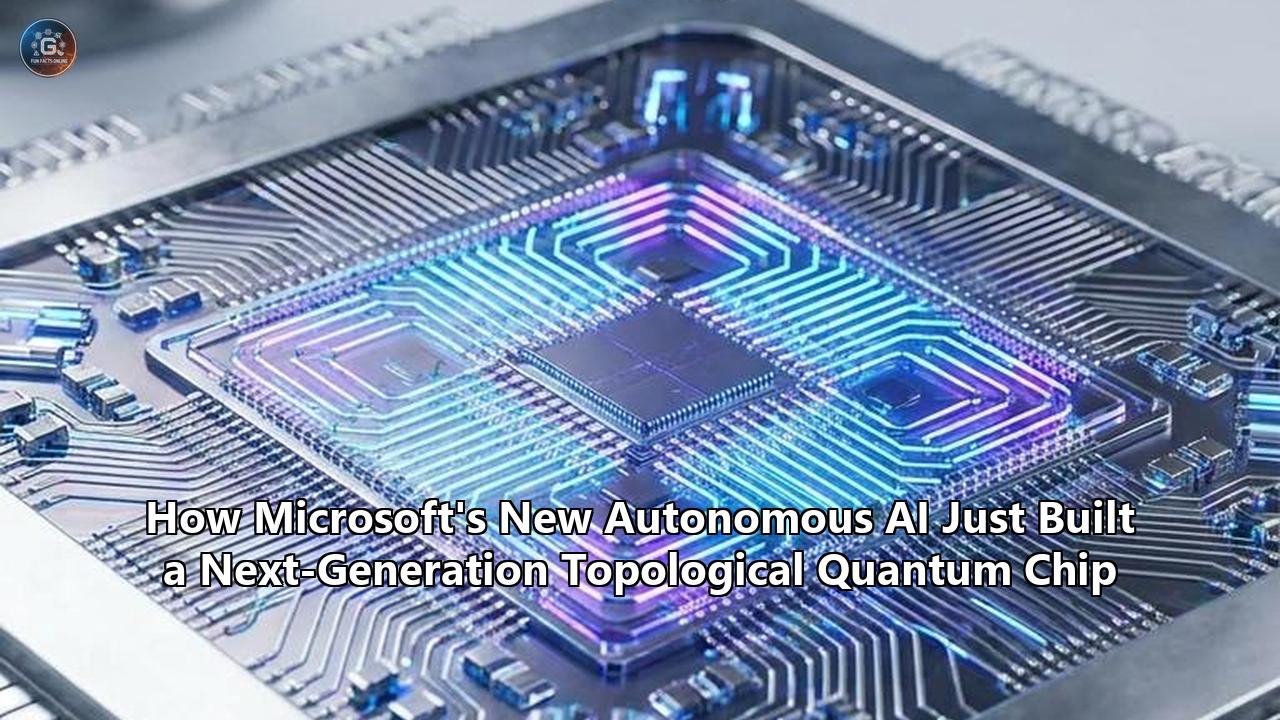
On June 2, 2026, Microsoft stunned the technology and physics communities by unveiling Majorana 2, its second-generation topological quantum processing unit (QPU). Boasting qubits that are 1,000 times more reliable than their predecessors, the chip achieved a mean qubit lifetime of 20 seconds—with some individual qubits remaining coherent for over a minute. Compared to the microsecond lifetimes of traditional superconducting qubits, the announcement was a bombshell.
Even more startling was how the chip was designed. Rather than relying solely on the slow, iterative trial-and-error of human physicists, Microsoft achieved this breakthrough by deploying its newly launched Microsoft Discovery platform—a cloud-based, multi-agent AI system designed specifically to act as an autonomous scientific collaborator. By utilizing autonomous AI quantum computing paradigms, Microsoft managed to cut its roadmap for delivering a commercial-grade, utility-scale quantum supercomputer in half, pulling the target date forward from 2033 to 2029.
But the celebration was short-lived. Just three weeks later, on June 24, 2026, the prestigious journal Nature published a peer-reviewed critique that sent shockwaves through the quantum computing community.
Written by Dr. Henry Legg, a quantum physicist at the University of St. Andrews, the critique alleged that Microsoft’s foundational 2025 "topological gap" breakthrough—which served as the physical baseline for Majorana 2—was actually the result of basic Python programming errors. According to Legg, a critical data-processing script utilized by Microsoft had inadvertently discarded noisy data, creating the mathematical illusion of a stable topological state where only random physics existed.
The unfolding drama represents a profound collision between two eras: the classic, slow-moving rigor of academic peer review and the hyper-accelerated, AI-driven pace of industrial engineering. To understand how Microsoft reached this critical juncture, one must trace the timeline of a two-decade-long scientific gamble that has now escalated into a battle over the soul of quantum research.
The Topological Gamble: Two Decades of Lone Bet on the Majorana Fermion
To appreciate the significance of Majorana 2, one must first look at the unique, highly controversial path Microsoft chose for its quantum journey.
Beginning in the early 2000s, while competitors like IBM, Google, and Rigetti focused on superconducting "transmon" qubits, Microsoft took a radically different road. Superconducting qubits are relatively easy to build but are notoriously fragile. The slightest change in temperature, electromagnetic interference, or physical vibration can cause "decoherence," destroying the quantum state in a fraction of a millisecond. To make a superconducting quantum computer work, engineers must build massive error-correction systems, requiring upwards of 10,000 physical qubits just to yield a single, reliable "logical" qubit.
Microsoft's alternative was the topological qubit. Instead of encoding quantum information in the delicate state of an individual physical particle, topological quantum computing stores data non-locally.
By creating exotic quasiparticles known as Majorana zero modes (MZMs) at the boundaries of specialized materials, quantum information could be "braided" across two or more physical locations.
   Traditional Qubit (Transmon)             Topological Qubit (Majorana)
  +-----------------------------+         +-------------------------------+
  |  Data stored on single,     |         |  Data "braided" non-locally   |
  |  highly sensitive particle  |         |  across multiple particles    |
  |                             |         |                               |
  |     (O) <- Noise destroys   |         |    (M1)=============(M2)      |
  |            state instantly  |         |    If one is disturbed, state |
  |                             |         |    remains protected in fabric|
  +-----------------------------+         +-------------------------------+
This mathematical structure makes the qubit inherently resistant to local environmental noise. If you tear half a page containing a braided topological state, the global information remains intact—like a word written across two separate slips of paper.
The catch? Majorana zero modes, first theorized by Italian physicist Ettore Majorana in 1937, are incredibly difficult to synthesize. They require creating a highly specific "topological superconductor"—a state of matter that does not exist in nature.
Microsoft’s single-minded pursuit of these particles has been plagued by extreme highs and lows:
- 2018: Microsoft researchers announced they had successfully detected experimental evidence of Majorana zero modes. The tech giant declared a major milestone.
- 2021: Following scrutiny from independent physicists, who discovered that the published data had been inappropriately cropped and filtered, Microsoft was forced to retract the 2018 paper from Nature. The scientific community grew deeply skeptical, with some declaring the Majorana approach a dead end.
- 2023: Microsoft rebounded, publishing new experimental signatures consistent with Majorana zero modes, but peer skepticism remained high. The company realized that proving the physical existence of these states required a level of material cleanliness and tuning precision that human hands could not consistently achieve.
The 2025 Rebound: Majorana 1 and the Birth of the Topological Gap Protocol
On February 19, 2025, Microsoft announced what it claimed was a definitive breakthrough: the Majorana 1 quantum chip.
  Majorana 1 Material Stack (2025)
  +---------------------------------------+
  |  Aluminum Superconducting Layer (Al)  |
  +---------------------------------------+
  |  Indium Arsenide Nanowire (InAs)     |  <-- InAs-Al Interface
  +---------------------------------------+
  |  Dielectric Substrate                 |
  +---------------------------------------+
Built using an ultra-clean semiconductor-superconductor interface—specifically, Indium Arsenide (InAs) nanowires coated with a thin layer of Aluminum (Al)—the Majorana 1 chip featured eight topological qubits.
To prove they had successfully transitioned the nanowire into a topological state, Microsoft’s research team developed the Topological Gap Protocol (TGP).
The TGP was a highly rigorous, multi-step data-analysis pipeline designed to detect a "topological gap" in the conductive nanowires. In physics, this gap is the ultimate smoking gun: a protective energy barrier separating the topological ground state (which houses the MZMs) from noisy bulk thermal excitations.
However, proving the presence of this gap was an operational nightmare. It required physicists to manually tune hundreds of electrostatic gate voltages along the nanowires to find the precise sweet spot where the topological state emerged.
A single experimental run could take weeks. The data generated was massive, noisy, and highly multidimensional.
Human researchers were trapped in a bottleneck: they spent far more time manually calibrating gates and writing custom Python scripts to parse massive conductance datasets than actually doing quantum physics.
Microsoft’s leadership realized that if they wanted to scale past a simple 8-qubit proof-of-concept, they had to automate the entire scientific process.
The Agentic Turn: Deploying Microsoft Discovery for Scientific Synthesis
This bottleneck laid the groundwork for Microsoft’s pivot to autonomous AI quantum computing.
For years, artificial intelligence in the sciences had been used as a passive tool—essentially advanced calculators or pattern-recognition systems that researchers had to prompt manually. But in the spring of 2026, Microsoft Quantum and Azure AI teams merged these capabilities into Microsoft Discovery, a cloud-based agentic AI platform explicitly engineered for high-throughput, data-heavy scientific disciplines like semiconductor design and molecular synthesis.
Unlike standard generative AI, Microsoft Discovery operates via autonomous multi-agent orchestration.
At its core is the Discovery Engine, a graph-based knowledge mapping system that synthesizes decades of historical scientific publications, internal experimental data, and physical simulation parameters.
The platform does not wait for user prompts; instead, it deploys teams of specialized AI agents that act as digital lab assistants, handling the entire iterative loop of the scientific method autonomously:
                     +---------------------------------------+
                     |         The Discovery Engine          |
                     |  (Graph-Based Scientific Knowledge)   |
                     +---------------------------------------+
                                         |
                                         v
   +---------------------------------------------------------------------------+
   |                       Multi-Agent Orchestration Loop                      |
   |                                                                           |
   |    [Hypothesis Agent] ---> [Simulation Agent] ---> [Fabrication Agent]    |
   |           ^                                                 |             |
   |           |                                                 v             |
   |    [Validation Agent] <--- [Measurement Agent] <--- [Tuning Agent]         |
   |                                                                           |
+---------------------------------------------------------------------------+- Hypothesis Formulation: AI agents analyze historical material stacks and formulate hypotheses on how to improve qubit coherence.
- Experimental Design & Simulation: Specialized agents spin up massive, parallel physical simulations using Azure Quantum Elements, testing molecular dynamics and band structures.
- Autonomous Device Tuning: Once physical chips are fabricated, a dedicated Tuning Agent directly interacts with the cryostats, adjusting hundreds of electrostatic gate voltages simultaneously. Using reinforcement learning, the agent learns the behavior of the chip in real time, reducing a tuning process that previously took weeks down to mere hours.
- Analysis & Validation: Measurement agents process the resulting conductance data, running mathematical protocols to verify the presence of the topological gap and feeding the results back into the central Discovery Engine.
Chetan Nayak, Microsoft's Technical Fellow and Vice President of Quantum Hardware, remarked on this transition:
"Agentic AI has permeated almost everything we do. The AI agents are now essential collaborators, not just tools in the scientific process."
From Aluminum to Lead: How the AI Re-Engineered the Materials Stack
The first major assignment given to Microsoft Discovery’s autonomous agents was to fix the critical physical limitation of the Majorana 1 chip.
While Majorana 1 proved that a topological state could be mathematically identified, its aluminum-based material stack was highly fragile. Aluminum has a very small superconducting energy gap, which meant that even at temperatures close to absolute zero (around 20 millikelvin), the topological state was highly sensitive to thermal noise.
To build a genuinely resilient QPU, Microsoft needed a new superconducting material.
The AI agents set their sights on Lead (Pb). On paper, lead is an outstanding candidate for topological quantum computing. It has a much larger superconducting energy gap and a higher critical transition temperature than aluminum, meaning it provides vastly superior protection against the thermal fluctuations that cause qubit decoherence.
However, fabricating an ultra-thin, epitaxial layer of lead on an Indium Arsenide nanowire had stumped human materials scientists for decades. Lead has an incredibly high surface energy and low adhesion to semiconductors; when deposited, it tends to "dewet"—balling up into isolated, disjointed metallic droplets rather than forming a smooth, uniform crystalline layer.
   Human Attempt (Dewetting)               AI Optimized Epitaxy
   +-----------------------+               +-----------------------+
   |   ( )   ( )   ( )     | (Droplets)    |=======================| (Uniform Pb Layer)
   +-----------------------+               +-----------------------+
   | Indium Arsenide (InAs)|               | Indium Arsenide (InAs)|
   +-----------------------+               +-----------------------+
To solve this material fabrication crisis, Microsoft Discovery’s autonomous agents initiated a massive, multi-threaded optimization campaign:
- Step 1: Literature Synthesis. The AI synthesized and cross-referenced old, obscure metallurgical studies from the mid-20th century, extracting forgotten parameters on how lead behaves at ultra-low temperatures.
- Step 2: Simulation of Molecular Interfaces. The simulation agents ran millions of density functional theory (DFT) calculations, testing various "buffer layers" that could be placed between the InAs semiconductor and the Lead superconductor to prevent dewetting.
- Step 3: Growth Parameter Optimization. The fabrication agents optimized the molecular beam epitaxy (MBE) growth parameters, autonomously adjusting substrate temperatures, deposition rates, and vacuum pressure curves.
The result was a breakthrough: the successful synthesis of a atomically smooth, uniform, defect-free epitaxial Lead-Indium Arsenide (Pb-InAs) materials stack. This newly engineered material possessed a robust topological gap that was physically immune to the microscopic imperfections that had crippled previous topological devices.
The June 2, 2026 Announcement: Majorana 2 Redefines the Timeline
The culmination of this AI-driven materials exploration was the official unveiling of the Majorana 2 chip on June 2, 2026.
  Majorana 2 Material Stack (2026)
  +---------------------------------------+
  |  AI-Optimized Lead Layer (Pb)         | <-- Larger energy gap, robust protection
  +---------------------------------------+
  |  Specialized Epitaxial Buffer Layer   | <-- Engineered by AI to prevent dewetting
  +---------------------------------------+
  |  Indium Arsenide Nanowire (InAs)     |
  +---------------------------------------+
By substituting aluminum with lead and utilizing Microsoft Discovery’s autonomous gate-tuning pipelines, the performance metrics of the new chip shattered all prior expectations:
Majorana 2 Physical & Operational Specifications
| Metric | Majorana 1 (2025) | Majorana 2 (2026) | Competitive Superconducting Chips |
|---|---|---|---|
| Active Qubits | 8 | Variable/Scalable | ~100–1,000 (IBM/Google) |
| Superconducting Layer | Aluminum (Al) | Lead (Pb) | Aluminum/Niobium |
| Mean Qubit Lifetime | Microseconds | 20 Seconds (Peak: 60s) | Microseconds (~100–300 $\mu$s) |
| Qubit Physical Size | ~0.1 mm | 0.01 mm | ~1.0 mm |
| Operation Speed | ~10 microseconds | ~1 microsecond | ~10–100 nanoseconds |
| Reliability Improvement | Baseline | 1,000x Increase | Highly prone to cosmic ray errors |
The physical size of the Majorana 2 qubits—just 0.01 mm—is particularly critical.
Because superconducting qubits are so large (roughly 1 mm across), scaling a superconducting computer to the millions of physical qubits required for error correction would result in a machine the size of a football field.
Majorana 2’s microscopic footprint means that Microsoft can theoretically pack millions of highly stable, topological qubits onto a single, standard-sized silicon wafer.
The immediate consequence of this hardware leap was a dramatic revision of Microsoft’s commercial roadmap.
Previously, Microsoft projected that a utility-scale, error-corrected quantum supercomputer would not be realized until 2033 or 2035. Thanks to the deployment of autonomous AI quantum computing and the rapid development of Majorana 2, Microsoft boldly announced it would deliver a commercial quantum supercomputer by 2029—effectively cutting its development timeline in half.
"The real breakthrough isn't just the chip," noted technology analysts at the time. "It is the proof that agentic AI can compress decades of complex, high-risk physical research and development into a matter of months."
The June 24 Escalation: The Python Bug That Threatened to Unravel Everything
Just as Microsoft was basking in the glow of its accelerated roadmap, the academic community fired back, setting off a fierce intellectual and corporate battle.
On June 24, 2026, Dr. Henry Legg of the University of St. Andrews published a peer-reviewed critique in Nature that directly challenged the scientific foundation upon which Microsoft’s entire quantum program was built.
Legg’s critique focused not on the newly announced Majorana 2, but on the February 2025 paper detailing the Majorana 1 chip and the "Topological Gap Protocol" (TGP).
Because the TGP is the mathematical framework Microsoft uses to prove that its chips are indeed operating in a topological state, any flaw in the TGP would cast a shadow over both Majorana 1 and the newly unveiled Majorana 2.
According to Legg’s analysis, the custom Python scripts Microsoft used to process the massive electrical conductance data from the nanowire devices contained fundamental programming and logical errors.
   Microsoft's Claimed TGP Pipeline:
   Raw Conductance Data ---> [TGP Python Script] ---> Filtered "Clean" Signal ---> Verified Topological Gap

   Dr. Henry Legg's Critique:
   Raw Conductance Data ---> [TGP Python Script] ---> Discarded "Noisy" Data ---> Artificial Signal (Mathematical Illusion)
                             (Array Handling Bug)
The critique argued that:
- Array Handling Failures: The Python code contained indexing and array-handling bugs that improperly aligned the measured conductance voltages.
- Biased Data Filtering: The script’s data-filtering logic was written in a way that automatically discarded data runs containing high levels of noise or contradictory electrical signals.
- Manufacturing the Signal: By weeding out the "inconvenient" noisy data, the software highlighted only the highly specific electrical measurements that supported the existence of a topological gap.
Legg was unsparing in his assessment, comparing Microsoft's automated search for the topological gap to looking for patterns in random background noise:
"If you're looking into something which is essentially just random physics, eventually you will find the Jesus in your toast. If you look through an entire bakery’s worth of loaves, you will find it. Microsoft's software yielded inconsistent and misreported outcomes, and a broader dataset they released but did not include in the paper showed random noise, with no clear evidence of the gap they claimed to find."
The backlash from the wider academic community was immediate and severe.
Dr. Sergey Frolov, a prominent physicist at the University of Pittsburgh who has long been a vocal critic of corporate quantum claims, publicly stated that Microsoft's 2025 Nature paper was fundamentally flawed and should be retracted.
For Microsoft, the allegations opened up old, painful wounds, drawing direct comparisons to the retracted 2018 research and threatening to completely derail the credibility of their newly announced 2029 quantum supercomputer timeline.
The Clash of Paradigms: Academic Purism vs. Industrial Engineering
The controversy surrounding Majorana 2 has exposed a profound, structural divide in how modern science is conducted.
On one side is the traditional academic community, which demands absolute physical proof, open data replication, and exhaustive peer review. To physicists like Legg and Frolov, Microsoft’s reliance on proprietary, highly complex software pipelines to "infer" the existence of unproven quasiparticles is an invitation to confirmation bias—particularly when billions of dollars in corporate valuation and government contracts are on the line.
On the other side is Microsoft's industrial-engineering paradigm, which prioritizes functional, scalable systems over academic consensus.
Microsoft was quick to mount a fierce defense of its research. The company immediately published a formal reply in Nature, standing firmly behind its data, its methodology, and its roadmap.
Dr. Chetan Nayak vigorously rejected the premise of Legg's critique, arguing that the disputed Python script was never intended to be a static, academic proof of a theoretical particle. Instead, Nayak described the software as a "practical tuning tool"—a real-time, algorithmic utility used to identify the best physical locations on a chip to initialize qubits.
Nayak argued that the proof of the technology's validity was not in the pristine aesthetics of a single data plot, but in the physical reality of the running hardware:
"It's almost like arguing, is flight possible or not? And then you're standing next to an airplane. At the end of the day, success is the delivery of a scalable quantum computer. We stand by our results and our roadmap, and the code works well enough that we are regularly using it to set up chips that are actively carrying out quantum operations right now."
To bolster its position, Microsoft pointed to its ongoing collaboration with the U.S. Defense Advanced Research Projects Agency (DARPA).
Under the Underexplored Systems for Utility-Scale Quantum Computing (US2QC) program, DARPA has been rigorously auditing and verifying Microsoft’s topological hardware designs. Microsoft maintains that DARPA’s independent verification teams have continued to validate the physical viability of their roadmap, regardless of academic debates over historical Python scripts.
The Next Frontier: What to Watch in the Race to 2029
As the second half of 2026 begins, the quantum computing landscape finds itself in an incredibly dynamic state.
The integration of autonomous AI quantum computing platforms like Microsoft Discovery has permanently altered the physics R&D workflow, compressing material discovery cycles from decades to months. Yet, the scientific community's severe pushback highlights the unresolved tension of trusting automated, AI-driven pipelines to claim fundamental breakthroughs in physics.
Going forward, the industry will be watching several critical milestones:
1. Independent Verification of the Lead-Based Stack
The ultimate test for Majorana 2 will be whether independent research laboratories can successfully replicate the epitaxial growth of Lead on Indium Arsenide nanowires and verify the 20-second qubit coherence times claimed by Microsoft. If independent labs confirm these metrics, it will solidify Lead as the premier material for topological QPUs, regardless of the software disputes over the older Aluminum-based Majorana 1.
2. The Resolution of the Nature Dispute
Will Nature force a retraction of the 2025 paper, as requested by critics like Sergey Frolov, or will Microsoft's formal rebuttal satisfy the editors? A forced retraction would be a massive public relations blow to Microsoft’s 2029 roadmap, while a vindication would silence skeptics and clear the runway for their commercial supercomputer push.
3. Competitors' Adoption of Scientific AI Agents
As Microsoft Discovery demonstrates its ability to automate complex physics and materials science workflows, rivals like IBM and Google will face intense pressure to deploy their own autonomous scientific agentic platforms. The race for quantum supremacy is rapidly transforming into a race for the most sophisticated autonomous scientific AI.
Whether Microsoft's Majorana 2 is a historic leap forward or a highly publicized mirage built on biased software, one thing is certain: the era of the lone physicist manually tuning gates in a basement lab is coming to an end. The age of AI-conducted, autonomous physical science has arrived, and its first battleground is the cold, quiet frontier of topological quantum computing.
Reference:
- https://news.microsoft.com/source/features/innovation/majorana-2-microsoft-discovery-agentic-ai/
- https://www.youtube.com/watch?v=wE6yIcszHAU
- https://www.forbes.com/sites/moorinsights/2026/06/25/microsoft-discovery-aims-to-advance-the-era-of-agentic-science/
- https://quantum.microsoft.com/
- https://www.investing.com/news/stock-market-news/microsofts-quantum-computing-technology-called-into-question-again-4758550
- https://www.neowin.net/news/researchers-claim-microsofts-quantum-breakthrough-is-flawed-by-basic-python-errors/
- https://www.networkworld.com/article/4189610/researchers-cast-new-doubt-on-microsofts-quantum-computing-advance.html
- https://www.bluequbit.io/blog/microsoft-quantum-chip
- https://pcur.princeton.edu/2025/03/now-next-microsofts-quantum-computing-breakthrough-revolution-or-overstatement/
- https://medium.com/@sam.wylie/what-does-microsofts-new-quantum-technology-mean-for-ai-1f32dcfcbe1d
- https://news.az/news/microsofts-quantum-computing-claims-face-new-scientific-doubts
- https://forklog.com/en/physicist-challenges-microsofts-topological-qubit-claims/