The July 2026 Breakthrough: Achieving Universal Quantum Logic via Topological Braiding
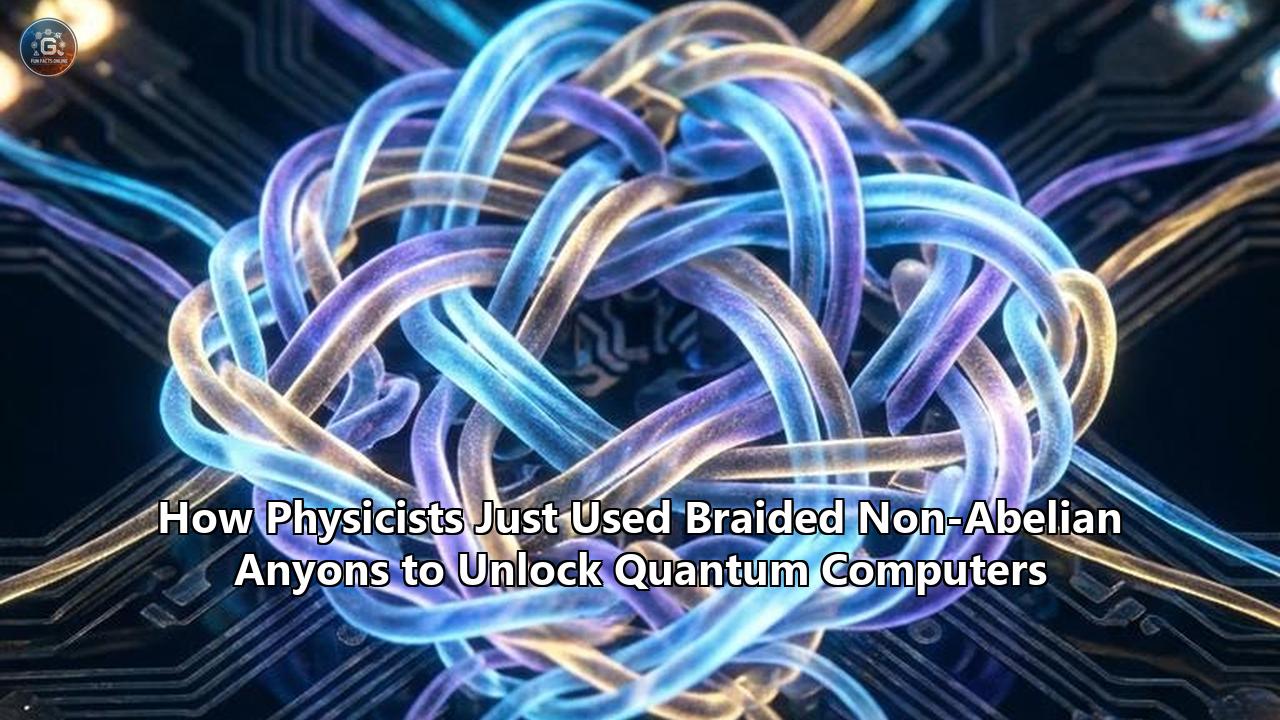
On July 15, 2026, a research collaboration spanning the University of Chicago, Quantinuum, Harvard University, and Stony Brook University published a landmark paper in Nature that fundamentally altered the trajectory of quantum technology. Operating on Quantinuum’s 54-qubit H2 trapped-ion processor, the team successfully created, braided, and fused a complex class of quasiparticles known as $S_3$ non-Abelian anyons. In doing so, they achieved what physicists had sought for nearly three decades: the world's first complete, universal quantum gate set executed through topological operations.
  CHRONOLOGY OF TOPOLOGICAL QUANTUM LOGIC
  ========================================================================================
  1977           1982          1997          2023           2024           JULY 2026
  Leinaas &      Wilczek       Kitaev        Google &       Quantinuum     UChicago/Quantinuum
  Myrheim        coins         formulates    Quantinuum     demonstrates   demonstrates FIRST
  prove 2D       "Anyon"       Topological   braid non-     $D_4$ order    UNIVERSAL GATE SET
  statistics                   Qubits        Abelians       on 27 qubits   via $S_3$ Anyons
  ========================================================================================
"A universal computer needs to be able to run any algorithm at all, with the same versatility an ordinary processor offers," said Ruben Verresen, assistant professor of molecular engineering at the University of Chicago and a primary architect of the experiment. "In earlier demonstrations, the mathematical 'universe' we created was not rich enough to support arbitrary quantum computing. By moving to $S_3$ topological order and combining braiding with topological fusion, we demonstrated that emergent topological forces are sufficient for universal computation."
The July 2026 breakthrough solved a central bottleneck in physics: how to manipulate fragile quantum states without exposing them to the environmental noise that degrades traditional quantum bits (qubits). Instead of encoding information within individual subatomic particles—where a stray thermal photon or electromagnetic fluctuation can cause catastrophic bit-flip errors—topological computing stores quantum information non-locally within the collective geometry of exotic quasiparticles.
  Traditional Qubit vs. Topological Qubit Encoding
  ----------------------------------------------------------------------------------------
  TRADITIONAL QUBIT:                 TOPOLOGICAL QUBIT (ANYON PAIR):
  [ Single Particle ]                 [ Anyon A ] <--- Braid Path ---> [ Anyon B ]
  Localized State                     Information stored in global spacetime knot
  Vulnerable to local noise           Immune to local perturbations
  ----------------------------------------------------------------------------------------
This milestone coincided with another major advancement in solid-state hardware. Just weeks prior, at its Build 2026 conference in June, Microsoft unveiled Majorana 2, its next-generation topological quantum processor. Developed using agentic AI models from Microsoft Discovery, the Majorana 2 chip replaced traditional aluminum superconductors with a lead-based (Pb) hybrid quantum well stack. This material engineering expanded the chip's protective "topological gap" by more than two-fold and extended qubit parity lifetimes to 20 seconds—a 1,000-fold stability increase over its 2025 predecessor. Citing these findings, Microsoft accelerated its timeline for deploying a commercial, fault-tolerant topological quantum computer from 2033 to 2029.
Together, these dual achievements mark the transition of topological physics from theoretical speculation to functional hardware. To appreciate how physicists harnessed these braided quasiparticles, one must trace the multi-decade sequence of theoretical leaps, experimental setbacks, and paradigm shifts that led to this moment.
Act I (1977–1997): Theoretical Genesis and the Topology of Two Dimensions
For most of the twentieth century, fundamental quantum mechanics divided the microscopic world into two distinct classes of particles:
- Bosons: Particles with integer spin (such as photons and gluons) that can occupy the same quantum state simultaneously, giving rise to phenomena like lasers and Bose-Einstein condensates.
- Fermions: Particles with half-integer spin (such as electrons, protons, and neutrons) governed by the Pauli Exclusion Principle, which prevents any two identical fermions from sharing the same state, forming the foundation of solid matter and chemistry.
Mathematically, this division stems from how wavefunctions behave when two identical particles exchange positions in three-dimensional space. Exchanging two identical bosons leaves the quantum wavefunction $\psi$ unchanged:
$$\psi(r_1, r_2) = +\psi(r_2, r_1)$$
Exchanging two identical fermions multiplies the wavefunction by a minus sign:
$$\psi(r_1, r_2) = -\psi(r_2, r_1)$$
In a three-dimensional universe, repeating an exchange brings the particles back to their original configuration via a path that can be continuously shrunk to a point without crossing another particle trajectory. Mathematically, the permutation group $S_N$ completely describes particle exchange in $3D$ (or higher) space.
  3D Exchange (Permutation) vs. 2D Spacetime Braiding
  ----------------------------------------------------------------------------------------
  3D Space:  Paths can slide over each other. Double exchange = Identity.
  2D Space:  Paths wrap around each other in time.
             Worldlines form non-trivial knots (Braid Group B_n).
  ----------------------------------------------------------------------------------------
The Two-Dimensional Exception
In 1977, Norwegian physicists Jon Magne Leinaas and Jan Myrheim published a theoretical proof demonstrating that this binary rule breaks down when particles are confined to a two-dimensional plane. In two spatial dimensions plus time ($(2+1)D$), particle trajectories form worldlines that weave around one another in continuous spacetime. Because worldlines cannot pass through each other without intersecting, a continuous path formed by swapping two particles cannot be smoothly deformed into a non-swapped path.
The mathematical structure governing these worldlines transitions from the symmetric group $S_N$ to the infinite Braid Group $B_N$.
In 1982, MIT theoretical physicist and Nobel laureate Frank Wilczek coined the term anyons to describe these hypothetical 2D entities, reflecting that their quantum exchange phase could take any arbitrary value $e^{i\theta}$ between bosons ($\theta = 0$) and fermions ($\theta = \pi$):
$$\psi(r_1, r_2) = e^{i\theta} \psi(r_2, r_1)$$
The Discovery of Non-Abelian Anyons
While these simple "Abelian" anyons acquire a complex phase factor upon exchange, their order of exchange does not matter ($e^{i\theta_1} e^{i\theta_2} = e^{i\theta_2} e^{i\theta_1}$). In 1991, theorists Gregory Moore and Nicholas Read proposed something even more exotic: non-Abelian anyons.
When multiple non-Abelian anyons are present, the system develops a ground state that is degenerate—meaning there are multiple distinct quantum states that possess the exact same lowest energy level. Exchanging two non-Abelian anyons doesn't merely multiply the wavefunction by a single complex phase; it performs a matrix rotation within this degenerate ground-state subspace:
$$\psi_a \to \sum_b U_{ab} \psi_b$$
Because matrix multiplication is non-commutative ($U_A U_B \neq U_B U_A$), the sequence in which these quasiparticles are braided matters. The final state of the system retains a physical record of the precise geometric history of how the particles were wound around one another.
  Abelian vs. Non-Abelian Braid Operations
  ----------------------------------------------------------------------------------------
  ABELIAN EXCHANGE:         Braid A then B  ==  Braid B then A
                             (Phases commute: e^{iθ1} e^{iθ2} = e^{iθ2} e^{iθ1})

  NON-ABELIAN EXCHANGE:     Braid A then B  ≠   Braid B then A
                             (Matrices do not commute: U_A U_B ≠ U_B U_A)
  ----------------------------------------------------------------------------------------
Alexei Kitaev and Topological Fault Tolerance
In 1997, theoretical physicist Alexei Kitaev, then at the Landau Institute for Theoretical Physics, connected these physical principles to computational hardware in his landmark paper "Fault-tolerant quantum computation by anyons."
Kitaev recognized that conventional quantum computers built on physical qubits (such as superconducting loops or trapped ions) suffer from extreme sensitivity to local environmental noise. A single stray photon, a thermal fluctuation, or a microscopic defect in a chip substrate can flip a qubit's state ($X$-error) or alter its phase ($Z$-error), causing rapid decoherence. Standard fault-tolerant architectures, such as the surface code, counter this by grouping hundreds or thousands of physical qubits to form a single error-corrected "logical qubit," constantly measuring error syndromes in complex feedback loops.
Kitaev proposed a different approach: store the quantum information inside the non-local topological properties of non-Abelian anyons. Because a single non-Abelian qubit is encoded across the collective wavefunction of separated anyons, a local perturbation—such as noise striking one specific point in the device—cannot alter the global braided state. To corrupt the information, an environmental error would have to spontaneously loop an anyon around another across macroscopic distances.
Topological quantum computation thus promised hardware-level fault resistance, potentially reducing physical qubit overhead by orders of magnitude.
Act II (2000–2020): The Solid-State Hunt and the Material Bottleneck
Following Kitaev’s theoretical work, physicists embarked on a twenty-year search to isolate solid-state materials that naturally host non-Abelian anyons as collective electronic excitations (quasiparticles).
  SOLID-STATE SEARCH TIMELINE (2000–2020)
  ----------------------------------------------------------------------------------------
  2000–2010   Focus on Fractional Quantum Hall Effect (FQHE) at filling fraction ν = 5/2.
  2010–2017   Focus on hybrid Semiconductor-Superconductor nanowires (InAs/Al).
  2018        High-profile setbacks; false Majorana zero mode signals identified.
  2020        First direct observation of *Abelian* anyons via charge interferometry.
  ----------------------------------------------------------------------------------------
The Fractional Quantum Hall Effect
The initial frontier centered on two-dimensional electron gases created inside ultra-pure gallium arsenide (GaAs/AlGaAs) heterostructures subjected to powerful magnetic fields (exceeding 10 Tesla) and cooled near absolute zero ($< 20 \text{ millikelvin}$).
Physicists focused on the fractional quantum Hall state at a specific filling factor, $\nu = 5/2$. Theory suggested that low-energy excitations at $\nu = 5/2$ were non-Abelian Moore-Read anyons. However, experimental validation proved elusive. Signal signatures were repeatedly obscured by thermal noise, bulk leakage currents, and subtle material impurities.
Topological Superconductors and Majorana Nanowires
By the late 2000s, attention shifted toward hybrid condensed-matter platforms. Theorists proved that pairing a 1D semiconductor nanowire with strong spin-orbit coupling (such as Indium Arsenide, InAs) to a conventional $s$-wave superconductor (such as Aluminum, Al) under a parallel magnetic field would induce topological superconductivity.
At the exposed ends of these nanowires, isolated electronic bound states called Majorana zero modes (MZMs) were predicted to form. Mathematically, a Majorana zero mode acts as its own anti-particle:
$$\gamma_i = \gamma_i^\dagger$$
A pair of spatially separated Majorana zero modes forms a single, non-local Dirac fermion that can store a logical qubit. Swapping the positions of adjacent Majorana modes performs a non-Abelian topological operation.
Between 2012 and 2017, multiple research teams reported zero-bias conductance peaks in electrical transport measurements—interpreted as evidence of Majorana zero modes. However, the field faced significant setbacks in 2018–2021 when subsequent analysis revealed that non-topological disorder and localized Andreev bound states could produce identical electrical signals, prompting paper retractions and pushing researchers to rebuild their fabrication protocols.
The 2020 Abelian Milestone
In 2020, independent teams at the LPN Marcoussis/ENS in France and Purdue University in the United States successfully performed collider and interferometric experiments in 2D electron gases, offering the first definitive proof of Abelian anyon statistics.
While this validated that low-dimensional systems could host fractional quasiparticles, Abelian anyons were insufficient for non-commutative quantum computing gates. The field remained stuck: nature refused to easily yield clean, controllable non-Abelian states in solid-state devices.
Act III (2022–2023): The Synthetic Pivot and First Demonstration of Non-Abelian Statistics
Faced with the material science challenges of condensed-matter systems, a subset of quantum information scientists conceived a radical alternative: synthetic topological order.
Instead of searching for rare minerals or complex heterostructures that natively generate non-Abelian anyons at millikelvin temperatures, why not use programmable, gate-based quantum processors to artificially synthesize the quantum wavefunction of a non-Abelian topological state?
If a general-purpose quantum computer could entangle physical qubits into a specific, highly correlated surface code pattern, the collective excitations of that artificial state would mathematically behave as true non-Abelian anyons.
  SYNTHETIC TOPOLOGICAL EMERGENCE
  ----------------------------------------------------------------------------------------
  Physical Hardware Qubits (Superconducting or Trapped Ion Grid)
                      │
                      ▼ Apply Adaptive Entangling Circuit & Stabilizer Gates
  Highly Entangled Many-Body Quantum State (Surface Code Lattice)
                      │
                      ▼ Deform Lattice Vertices / Shift Local Defects
  Emergent Non-Abelian Anyons (Excitations that carry non-local braid memory)
  ----------------------------------------------------------------------------------------
The Google Quantum AI Demonstration (2022–2023)
In an October 2022 preprint later published in Nature in May 2023, Google Quantum AI, working alongside theoretical physicists Eun-Ah Kim and Yuri Lensky from Cornell University, announced a major experimental success.
Using their 53-qubit Sycamore superconducting processor, Google's team initialized a grid of physical qubits into an entangled checkerboard state. By dynamically squashing, stretching, and altering the connectivity of the stabilizer code lattice, they created defects at specific polygon graph vertices that hosted non-Abelian $D_3$ (Ising-type) anyons.
  Google's Lattice Deformation Method (Sycamore Processor)
  ----------------------------------------------------------------------------------------
  1. Initialize physical qubits on a 2D square checkerboard grid.
  2. Dynamically modify local stabilizer measurements to alter vertex connectivity.
  3. "Drag" defect vertices across the 2D grid to physically braid anyons.
  4. Measure state modifications to verify non-Abelian exchange dynamics.
  ----------------------------------------------------------------------------------------
The Google team physically dragged these vertex defects around one another on the chip, weaving their spacetime worldlines. When two defects were swapped, the team measured a distinct, non-commutative change in the system's global quantum state—the first direct experimental observation of non-Abelian exchange statistics. Using this braiding protocol on 8 graph vertices, they encoded three logical qubits and entangled them into a Greenberger-Horne-Zeilinger (GHZ) state entirely through topological movement.
"Observing the bizarre behavior of non-Abelian anyons for the first time really highlights the type of exciting phenomena we can now access with quantum computers," remarked Trond I. Andersen, lead author and Google Quantum AI researcher, at the time of the publication.
The Quantinuum Trapped-Ion Advance (2023–2024)
Concurrently, quantum computing company Quantinuum—collaborating with Ashvin Vishwanath and Ruben Verresen from Harvard University and Nathanan Tantivasadakarn from Caltech—executed a parallel demonstration on their H1-1 and H2 trapped-ion processors.
Published in Nature in February 2024 (after initial May 2023 preprints), Quantinuum prepared the ground state of $D_4$ non-Abelian topological order across a kagome lattice of 27 trapped Ytterbium ions.
Quantinuum utilized a key advantage of trapped-ion systems: high-fidelity mid-circuit measurement and feedforward. They used adaptive quantum circuits to measure auxiliary qubits mid-computation and dynamically apply gate corrections based on the measurement outcomes. This allowed them to collapse the physical qubits into a non-Abelian topological ground state with site-fidelity exceeding 98.4%.
  Quantinuum $D_4$ Kagome Lattice Braiding (2023–2024)
  ----------------------------------------------------------------------------------------
  • Platform: H2 Trapped-Ion Processor (27 Ytterbium Ions).
  • State: $D_4$ non-Abelian topological order on a kagome lattice.
  • Method: Adaptive circuits + real-time mid-circuit measurement feedforward.
  • Signature: Anyons moved along Borromean rings in 3D spacetime.
  • Topological Degeneracy: Generated all 22 distinct ground states on a torus.
  ----------------------------------------------------------------------------------------
By creating anyonic excitations and threading them around one another along intricate 3D topological configurations known as Borromean rings, Quantinuum demonstrated non-Abelian braiding interferometry. Moving anyons around the toroidal boundary of the system generated all 22 ground states of the $D_4$ state, proving that synthetic systems could support topological degeneracies.
Act IV (2024–2025): Scaling Qutrits and the Quest to Bypass Magic State Distillation
Despite the demonstrations from Google and Quantinuum, the quantum computing community confronted a fundamental theoretical hurdle dubbed the Universality Wall.
  THE UNIVERSALITY WALL
  ----------------------------------------------------------------------------------------
  Ising / $D_4$ Anyons   ==>  Yield ONLY Clifford Gates (CNOT, Hadamard, Phase).
  Clifford Operations    ==>  Can be efficiently simulated on classical supercomputers
                              (Gottesman-Knill Theorem). NOT computationally universal!
  To Reach Universality ==>  Requires non-Clifford gates (e.g., T-gate: e^{iπ/8 Z}).
  ----------------------------------------------------------------------------------------
In standard quantum error-correction schemes (like the 2D surface code), physical operations executed strictly via topological logic are restricted to the Clifford group. Clifford gates alone cannot achieve quantum supremacy or execute algorithms like Shor’s factoring algorithm or complex chemical simulations.
To achieve universal quantum computation, standard systems must inject non-topological "magic states" into the lattice. Because these injected states are unprotected, they must go through a process called magic state distillation, repeatedly filtering out noise through cascades of physical qubits.
Resource calculations showed that magic state distillation was prohibitively expensive: as much as 80% to 90% of a quantum computer's total physical qubit array and operational runtime was consumed purely by distillation, rather than executing actual algorithmic logic.
  Conventional Surface Code Resource Allocation
  ========================================================================================
  [ Physical Hardware Array ]
  ├── 85% Resources: Magic State Distillation Factories (Purifying unprotected T-gates)
  └── 15% Resources: Actual Logical Qubit Operations
  ========================================================================================
If non-abelian anyons quantum computing was ever to outperform conventional error-correction protocols, scientists needed to find a non-Abelian system whose native physics supported non-Clifford operations directly—bypassing the need for distillation altogether.
The Qutrit Transition (Late 2024)
In November 2024, Quantinuum, in continued partnership with Harvard and Caltech, published results taking the next step toward solving this resource constraint.
Instead of building topological states using standard two-level qubits (states $|0\rangle$ and $|1\rangle$), the team configured their trapped ions into three-level qutrits (states $|0\rangle$, $|1\rangle$, and $|2\rangle$). They successfully prepared the ground state of a $Z_3$ toric code in qutrit Hilbert space and created "parafermion" and charge-conjugation defects.
  Qubit vs. Qutrit Hilbert Space for Topological Codes
  ----------------------------------------------------------------------------------------
  QUBIT (2-Level System):   Hilbert Space Dim = 2  ==>  Hosts Z_2 Toric Codes
  QUTRIT (3-Level System):  Hilbert Space Dim = 3  ==>  Hosts Z_3 / S_3 Topological Codes
  ----------------------------------------------------------------------------------------
By entangling pairs of charge-conjugation defects, the team established a critical stepping stone toward $S_3$ topological order—the non-Abelian symmetry group based on the permutations of three elements. Unlike $D_4$ or Ising topological codes, $S_3$ topological order possesses a mathematical structure rich enough to bypass the Clifford restriction.
Act V (2026): The Dual Escalation — Universal $S_3$ Logic and the Majorana 2 Chip
The convergence of theoretical protocol design and hardware scaling culminated in mid-2026 with two significant developments.
  2026 DUAL ADVANCEMENTS
  ========================================================================================
  JUNE 2026: MICROSOFT UNVEILS "MAJORANA 2" (INTRINSIC TOPOLOGICAL HARDWARE)
  • Lead-based (Pb) topoconductor stack designed by agentic AI.
  • 20-second qubit parity lifetime (1,000x improvement).
  • Scalable target timeline brought forward to 2029.

  JULY 2026: UCHICAGO / QUANTINUUM DEMONSTRATE UNIVERSAL GATE SET (SYNTHETIC ANYONS)
  • 54 physical qubits on H2 processor arranged in $S_3$ topological order.
  • Combined non-Abelian braiding with topological *fusion* measurements.
  • Prepared magic states topologically—completely bypassing distillation.
  • Achieved FIRST computationally universal topological gate set in history.
  ========================================================================================
Milestone 1: The First Universal Topological Gate Set (July 2026)
The July 15, 2026 publication in Nature by researchers from the University of Chicago, Quantinuum, Harvard, and Stony Brook demonstrated a complete universal gate set on physical quantum hardware.
Building on a theoretical proposal originally authored by physicist Carlos Mochon in 2003, the team realized that while $S_3$ non-Abelian braiding alone cannot generate every required quantum gate, combining braiding with topological fusion measurements achieves full quantum universality.
  CARLOS MOCHON'S UNIVERSALITY PARADIGM (2003 / Realized July 2026)
  ----------------------------------------------------------------------------------------
  [ Non-Abelian Braiding ]   +   [ Topological Fusion ]  ==>  UNIVERSAL QUANTUM LOGIC
  (Winding particles in 2D)     (Measuring outcomes)         (Arbitrary Gate Set)
  ----------------------------------------------------------------------------------------
The July 2026 Breakthrough Protocol
- State Preparation: Using 54 physical qubits on Quantinuum’s H2 trapped-ion machine, the team constructed a 54-qubit state with $S_3$ non-Abelian topological order.
- Logical Encoding: Quantum information was encoded as logical qutrits within the non-local fusion space of non-Abelian flux excitations.
- Braiding Operations: $S_3$ flux anyons were moved and wound around one another, executing unitary topological logic gates protected by the topological gap.
- Fusion Measurements: Pairs of anyons were brought together to collide. The outcome of their fusion—which can collapse into distinct particle channels—was measured non-destructively.
- Direct Magic State Generation: Using the combined braid-and-fuse sequence, the researchers generated a high-fidelity magic state directly through topological physics, eliminating the need for magic state distillation factories.
  Topological Magic State Preparation vs. Traditional Distillation
  ----------------------------------------------------------------------------------------
  TRADITIONAL METHOD:
  Unprotected Gate ---> Injection ---> Distillation Factory (90% Overhead) ---> Magic State

  2026 TOPOLOGICAL METHOD:
  S_3 Topological State ---> Braiding + Fusion Measurement ---> Magic State (0% Distillation)
  ----------------------------------------------------------------------------------------
"In 2024, our group created non-Abelian topological order on 27 qubits, but that particular universe was not rich enough to execute arbitrary computation," said Ruben Verresen. "This new experiment proves that by combining $S_3$ braiding with fusion, the emergent forces of non-Abelian anyons are rich enough to run any quantum algorithm natively."
Milestone 2: Microsoft’s Majorana 2 Chip (June 2026)
While Quantinuum and its academic partners achieved universality via synthetic topological states, Microsoft pushed forward on the solid-state intrinsic front.
At Build 2026, Microsoft announced Majorana 2, a quantum processor built on hardware-level topological qubits. In 2025, Microsoft’s precursor "Majorana 1" chip proved the viability of aluminum-indium arsenide (InAs/Al) hybrid nanowire devices. However, thermal decoherence from the aluminum layer limited operational lifetimes.
To address this, Microsoft leveraged an agentic AI platform called Microsoft Discovery to screen thousands of candidate superconductor-semiconductor material combinations. The AI model recommended replacing the aluminum superconducting layer with lead (Pb) deposited over a composite quantum well heterostructure.
  Majorana 1 vs. Majorana 2 Hardware Stack
  ----------------------------------------------------------------------------------------
  MAJORANA 1 (2025):    Aluminum (Al) + Indium Arsenide (InAs) Nanowire
                        • Parity Lifetime: 5 to 10 milliseconds
                        • Topological Gap: Baseline

  MAJORANA 2 (2026):    Lead (Pb) + Composite Quantum Well
                        • Parity Lifetime: 20 Seconds (1,000x increase!)
                        • Topological Gap: Expanded by >2x
                        • Switching Time: Accelerated 1,000x
  ----------------------------------------------------------------------------------------
By switching to lead, Microsoft more than doubled the topological gap—the energy barrier that prevents random heat fluctuations from creating unwanted quasiparticles and destroying the qubit's quantum state. The device demonstrated a parity lifetime of 20 seconds, representating a 1,000-fold stability increase over Majorana 1.
Following these results, Microsoft updated its quantum deployment roadmap, announcing that it expects to deliver a utility-scale, fault-tolerant quantum computer containing a million topological qubits on a single palm-sized chip by 2029.
Mechanics of Topological Control: Worldlines, Fusion Spaces, and Braid Geometry
To understand how non-abelian anyons quantum computing works on a physical level, it is useful to examine the quantum mechanics governing these quasiparticles.
  SPACETIME BRAIDING GEOMETRY

         Time (t)
            │
            │       /────\  (Anyon A loops around Anyon B)
            │      /      \
            │     /  ┌──┐  \
            │    │   │B │   │
            │    │   └──┘   │
            │     \        /
            │      \──────/
            │         │
            └─────────┴───────────── Space (x, y)
Braid Operators and Matrix Multiplication
Consider a 2D plane containing $n$ identical non-Abelian anyons. The positions of these anyons are fixed at distinct spatial coordinates. Let $\sigma_i$ represent the elementary braid operation that swaps the position of anyon $i$ with anyon $i+1$ in a clockwise direction.
The operators $\sigma_1, \sigma_2, \dots, \sigma_{n-1}$ satisfy the fundamental Braid Group Relations:
$$\sigma_i \sigma_{i+1} \sigma_i = \sigma_{i+1} \sigma_i \sigma_{i+1} \quad \text{for all } i$$
$$\sigma_i \sigma_j = \sigma_j \sigma_i \quad \text{for } |i - j| \ge 2$$
  The Braid Relation: σ_i σ_{i+1} σ_i  =  σ_{i+1} σ_i σ_{i+1}

   Topological Equality of Swapping Paths in Spacetime:

     Line 1 \  /   │         Line 1 │   \  /
             \    /                 │    \
     Line 2  / \  /    ===   Line 2 \  /  \
            /   \/                   \/    \
     Line 3 │   /\           Line 3  /\    │
  ----------------------------------------------------------------------------------------
Because these braid operations act as non-commutative unitary matrices on the degenerate ground space, applying a series of braids is equivalent to performing a quantum circuit:
$$|\Psi_{\text{final}}\rangle = \sigma_{i_k} \cdots \sigma_{i_2} \sigma_{i_1} |\Psi_{\text{initial}}\rangle$$
If a local error alters the trajectory of an anyon slightly during its movement, the global topology of the braid remains unchanged. As long as the error path does not fully encircle another anyon, the matrix applied to the logical qubit remains mathematically exact.
  Imperfect Braid Path vs. Ideal Braid Path
  ----------------------------------------------------------------------------------------
  Ideal Braid Path:     Smooth circular loop around adjacent Anyon.
  Distorted Path:       Wiggly, noisy loop caused by local stray magnetic fields.

  RESULT:               MATH IS IDENTICAL. Both paths belong to the same topological
                        homotopy class. The executed quantum gate matrix is EXACT.
  ----------------------------------------------------------------------------------------
Fusion Rules and Fusion Channels
When two non-Abelian anyons $a$ and $b$ are brought together, they interact through a process called fusion. The outcome of fusing $a$ and $b$ is governed by the system's topological fusion algebra:
$$a \otimes b = \sum_c N_{ab}^c \, c$$
Here, $c$ represents the possible outcome anyon species, and $N_{ab}^c$ is an integer specifying the number of distinct ways $a$ and $b$ can fuse into $c$.
  FUSION SCHEMATIC
  ----------------------------------------------------------------------------------------
  Anyon 'a' ───┐
               ├──> Fusion Channel Measurement ==> Outcome 'c_1' or 'c_2'
  Anyon 'b' ───┘
  ----------------------------------------------------------------------------------------
For non-Abelian anyons, the sum $\sum_c N_{ab}^c$ is greater than 1, meaning that bringing two particles together can yield multiple potential outcomes. The quantum state is stored in the fusion space—the internal, non-local Hilbert space that determines which fusion outcome will manifest upon measurement.
In the July 2026 $S_3$ experiment on Quantinuum’s H2 processor, logical qutrits were encoded directly into these multi-dimensional fusion spaces. Measuring the fusion outcome non-destructively extracted quantum information, allowing researchers to complete the universal gate set without relying on unprotected physical operations.
Synthetic vs. Intrinsic Paradigms: The Hardware Battleground
The breakthroughs of 2026 highlight two distinct methodologies in non-abelian anyons quantum computing.
  SYNTHETIC TOPOLOGICAL SYSTEMS          INTRINSIC TOPOLOGICAL SYSTEMS
  (Quantinuum, Google, Harvard)          (Microsoft Majorana 2)
  ───────────────────────────────          ─────────────────────────────
  • Active Entanglement Encoding          • Native Material Protection
  • Standard Qubits (Ion/Supercond)       • Solid-State Nanowires (Pb/InAs)
  • Dynamic Lattice Deformations          • Hardware-Level Majorana Modes
• Universal TODAY via $S_3$ Logic • Scaling to Millions on One Chip| Architectural Metric | Synthetic Topological Computing (e.g., Quantinuum H2 / Google) | Intrinsic Topological Computing (e.g., Microsoft Majorana 2) |
|---|---|---|
| Physical Implementation | Standard trapped ions or superconducting loops entangled via software layers. | Solid-state hybrid nanowires (Lead + Indium Arsenide). |
| Protection Source | Active measurement, real-time feedforward, and lattice stabilizer tracking. | Passive protection from the intrinsic superconducting energy gap. |
| Current Qubit Scale | 27–54 physical ions/qubits generating 3–6 logical topological qutrits/qubits. | Arrays of Majorana zero mode pairs on prototype test chips. |
| Universal Gate Capability | Proven (July 2026) via $S_3$ non-Abelian braid + fusion protocols. | Theoretical path mapped; experimental verification ongoing. |
| Primary Limitation | Circuit depth is constrained by underlying physical gate fidelities. | Significant material fabrication challenges; high sensitivity to interfacial disorder. |
| Key Advantage | Uses existing, highly mature quantum computing hardware platforms. | Potential to fit millions of topological qubits onto a single CMOS chip. |
The Synthetic Approach
Pioneered by Quantinuum, Google Quantum AI, and academic collaborators, this strategy uses highly reliable, traditional quantum processors to "simulate" a non-Abelian topological phase.
- Strength: Requires no new material discoveries. Researchers can program non-Abelian anyons on existing gate-based processors.
- Weakness: Because the underlying physical qubits are non-topological, errors can still accumulate if the physical gate fidelity drops below error-correction thresholds.
The Intrinsic Approach
Pioneered by Microsoft and partner research institutes, this strategy engineers solid-state materials that host Majorana zero modes or topological phases natively.
- Strength: True hardware-level protection. The qubit is inherently stable at the atomic scale, offering long coherence times (20 seconds in Majorana 2) and fast switching speeds without requiring continuous active software stabilization.
- Weakness: Atomically precise nanofabrication is difficult. Eliminating microscopic material defects that close the topological gap requires advanced engineering.
Horizon 2030: Fault Tolerance, Resource Scaling, and Unresolved Questions
The demonstration of universal topological logic using braided non-Abelian anyons addresses one of the longest-standing theoretical questions in quantum information science. However, translating these proof-of-principle demonstrations into utility-scale quantum supercomputers presents new engineering challenges.
  THE ROADMAP TO UTILITY-SCALE TOPOLOGICAL COMPUTING
  ========================================================================================
  2022–2024      First observation and braiding of non-Abelian anyons.
  2026           Demonstration of a complete Universal Topological Gate Set ($S_3$).
  2027–2028      Integration of active fault-tolerant error correction cycles with braiding.
  2029–2030      Commercial deployment of multi-logical-qubit topological chips.
  ========================================================================================
The New Computational Resource Budget
The primary motivation for advancing non-abelian anyons quantum computing is resource efficiency. Conventional surface-code architectures require roughly $1,000$ to $10,000$ physical qubits to construct a single fault-tolerant logical qubit capable of running complex algorithms, largely due to the overhead of magic state distillation.
By generating magic states topologically through $S_3$ anyon braiding and fusion, researchers project that physical qubit requirements could drop by an order of magnitude or more.
  PHYSICAL QUBIT OVERHEAD COMPARISON
  ----------------------------------------------------------------------------------------
  CONVENTIONAL SURFACE CODE:
  1 Logical Qubit  ≈  1,000 to 10,000 Physical Qubits (80%+ bound to Distillation)

  NON-ABELIAN $S_3$ TOPOLOGICAL CODE:
  1 Logical Qutrit ≈  100 to 300 Physical Qubits (Direct Topological Logic)
  ----------------------------------------------------------------------------------------
Key Technical Challenges Ahead
- Active Real-Time Error Correction During Braiding: While the July 2026 UChicago/Quantinuum experiment demonstrated universal operations, it did so without continuous active error correction running simultaneously over thousands of cycles. The next major milestone will require maintaining non-Abelian states indefinitely while actively correcting physical background errors.
- Speed Limits and Adiabaticity: Braiding non-Abelian anyons requires moving quasiparticles slowly enough to avoid exciting the system out of its degenerate ground state—a requirement known as the adiabatic limit. If an anyon is moved too quickly, energy is injected into the system, closing the topological gap and causing errors. Physicists are currently developing "shortcut-to-adiabaticity" pulse protocols to accelerate braid speeds without compromising topological protection.
- Multi-Logical Qubit Entanglement Networks: Scaling up requires braiding and fusing dozens of non-Abelian flux excitations across distributed quantum registers. Managing dense arrays of anyons without accidental crossing or unwanted fusion collisions requires new topological routing algorithms.
What to Watch Next
As the field moves toward 2030, several key milestones will signal the transition from experimental physics to commercial quantum computing:
- 2027: The first demonstration of repeated, active quantum error correction executed on a braided $S_3$ topological logical qubit.
- 2028: Experimental integration of hybrid topological processors—combining synthetic trapped-ion $S_3$ logical qutrits with optical interconnects for distributed topological computing.
- 2029: Microsoft’s targeted commercial release of the Majorana 2 / 3 architecture, aiming for 100+ hardware-protected logical qubits operating on a single solid-state processor.
Decades after Jon Magne Leinaas, Jan Myrheim, Frank Wilczek, and Alexei Kitaev first proposed that two-dimensional physics could unlock exotic statistics, the braiding of non-Abelian anyons has progressed from a theoretical concept to an operating quantum architecture. By fusing topological physics with hardware design, researchers have opened a clear path toward fault-tolerant, utility-scale quantum computation.
Reference:
- https://quantum-brief.com/blog/news-2026-07-27-quantinuum-anyons-universal-gates/
- https://pme.uchicago.edu/news-events/news/braided-exotic-particles-could-build-reliable-universal-quantum-computers
- https://scitechdaily.com/quantum-computings-dark-horse-just-cleared-a-major-hurdle/
- https://www.quantinuum.com/blog/quantinuum-demonstrates-the-first-creation-and-manipulation-of-non-abelian-anyons
- https://physics.cornell.edu/news/cornell-google-first-detect-key-quantum-computing-future
- https://www.forbes.com/sites/moorinsights/2026/07/16/microsoft-doubles-down-on-topological-qubits-with-majorana-2-chip/
- https://quantumcomputingreport.com/microsoft-announces-an-improved-majorana-qubit-design/
- https://bsiegelwax.substack.com/p/microsoft-is-making-significant-advances
- https://www.azoquantum.com/Article.aspx?ArticleID=428
- https://www.sciencenews.org/article/quantum-computers-braided-anyons-quasiparticles-memory
- https://research.google/blog/the-worlds-first-braiding-of-non-abelian-anyons/
- https://en.wikipedia.org/wiki/Anyon
- https://www.quantinuum.com/blog/a-step-forward-for-non-abelian-quantum-computing
- https://postquantum.com/quantum-computing-companies/microsoft/
- https://siliconangle.com/2026/06/02/microsofts-new-majorana-2-quantum-chip-claims-dramatic-breakthrough-qubit-stability/
- https://www.eurekalert.org/news-releases/989056
- https://pubmed.ncbi.nlm.nih.gov/38356069/