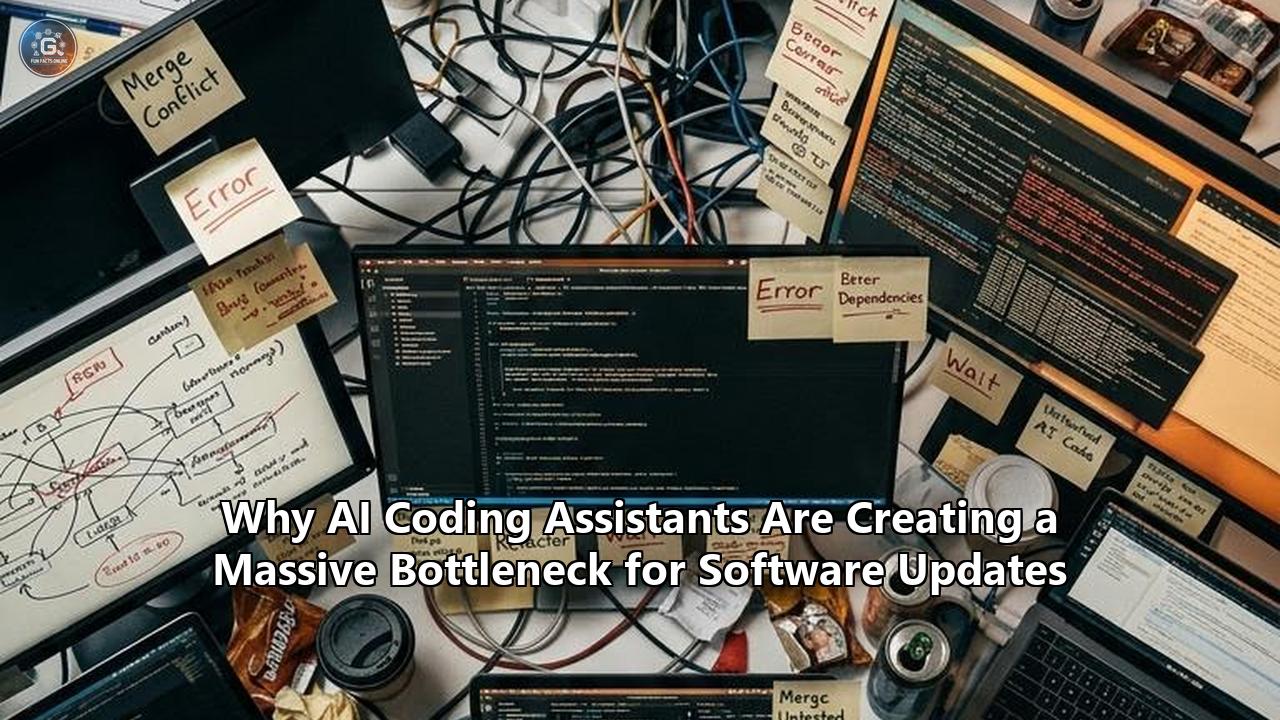
Software engineering teams are colliding with an unexpected operational wall: the faster developers write code using artificial intelligence, the slower production software updates actually deploy.
Cross-industry research across major DevOps platforms has exposed a stark structural breakdown in the modern delivery lifecycle. Faros AI’s multi-organization analysis of more than 10,000 developers reveals that pull request (PR) review times surged by 91% following widespread assistant deployment. Concurrent telemetry from CircleCI’s State of Software Delivery tracking 28 million pipeline runs shows that while feature-branch throughput jumped 59% year-over-year, deployment frequency to production branches for the median team actively declined. Meanwhile, longitudinal data from GitClear, analyzing over 623 million code changes, revealed that code churn—the rate at which newly committed lines are reverted, modified, or scrapped within two weeks—has climbed past 7.1%, more than doubling pre-AI baselines.
The findings dismantle a fundamental assumption of modern developer operations: that generating syntax faster accelerates software delivery. Instead, software delivery organizations find themselves swamped by synthetic pull requests that overwhelm the human and technical infrastructure designed to validate them. As asynchronous pull request queues swell into multiday backlogs, engineering organizations have fragmented into distinct operational camps.
Some enterprises are deploying autonomous review bots to check AI-authored pull requests, attempting to scale verification at machine speed. Others are taking a reactionary stance, clamping down on autonomous output with strict pull-request size limits, mandatory synchronous pair-programming triads, and governance throttles. Concurrently, infrastructure pioneers are rethinking software architecture entirely, isolating synthetic components behind WebAssembly sandboxes and ephemeral micro-runtimes, while traditionalists advocate for upstream formal specifications before an assistant ever generates a line of code.
Analyzing these competing paradigms exposes the fundamental tradeoffs tech leaders face as they attempt to unclog the software delivery pipeline.
The Upstream Surge Meets Downstream Friction
The root of the bottleneck lies in a severe throughput asymmetry: synthetic code generation operates in seconds, but verification, comprehension, and integration still obey human and systems constraints.
┌─────────────────────────────────────────────────────────────┐
│                    UPSTREAM VELOCITY                        │
│   Individual Code Generation (Copilot, Cursor, Devin)       │
│   Throughput: +59% Feature Branch Creation                  │
└──────────────────────────────┬──────────────────────────────┘
                               │
                               ▼
┌─────────────────────────────────────────────────────────────┐
│                 THE PULL REQUEST FUNNEL                     │
│   • Semantic Review Latency (+91% wait time)                │
│   • Code Duplication (+81% block duplication)               │
│   • Mock Poisoning & Test Suite Bloat                       │
└──────────────────────────────┬──────────────────────────────┘
                               │
                               ▼
┌─────────────────────────────────────────────────────────────┐
│                   DOWNSTREAM DELIVERY                       │
│   Production Deployments: Stalled / -1.5% Throughput        │
│   System Change Failure Rate: +7.2% Instability             │
└─────────────────────────────────────────────────────────────┘
The 2025 and 2026 DORA (DevOps Research and Assessment) reports highlighted this dynamic. DORA researchers documented that while 90% of developers adopted AI tooling, a 25% increase in AI tool adoption was associated with a 1.5% decline in overall delivery throughput and a 7.2% spike in delivery instability. In a separate study tracking more than 100,000 GitHub developers conducted by Demirer, Musolff, and Yang, autonomous and interactive code agents drove a 180% surge in raw commit volume; yet that tidal wave diminished to a 30% increase in actual software releases.
The missing 150% disappears into the verification gap.
When developers write code line-by-line, they build a granular, cognitive model of the system’s dependencies, boundary cases, and edge behaviors. Reviewing an asynchronous pull request authored by a human colleague historically leveraged that shared context. The reviewer and the author operated under roughly similar cognitive constraints, producing concise diffs bounded by the human developer's working memory.
AI assistants disrupt this balance. By lowering the mechanical cost of typing code to zero, they encourage developers to offload structural thinking to large language models. The result is a flood of bloated pull requests characterized by syntactic fluency and architectural myopia. Developers prompt a model to build an endpoint or patch a service, accept hundreds of lines of plausible-looking scaffolding without deep inspection, and ship the resulting diff into the review queue.
Navigating AI coding assistants risks requires engineering leaders to confront the reality that code production is no longer the rate-limiting step of software engineering. The constraint has shifted downstream to the pull request review, continuous integration (CI) test execution, and production verification stages.
+-----------------------------------+--------------------+--------------------+
| Software Metric                   | Pre-AI Baseline    | AI-Era Measurement |
+-----------------------------------+--------------------+--------------------+
| PR Review Wait Times              | Benchmark (1.0x)   | +91% increase      |
| Code Churn (Reverted in 2 weeks)  | 3.3%               | 7.1%               |
| Block Duplication (per 1M lines)  | 40.3               | 73.0 (+81%)        |
| Refactoring Line Moves            | 21.0%              | 3.8% (-70%)        |
| Commit-to-Release Ratio           | ~1.2:1             | ~3.4:1             |
+-----------------------------------+--------------------+--------------------+
The Deterioration of Code Reuse
GitClear's analysis highlights why reviewing these pull requests requires so much cognitive effort. Rather than leveraging existing functions, inheritance trees, or internal abstractions, models favor inline generation. Per million lines of code analyzed, code block duplication—repeated contiguous blocks of logic—rocketed up 81%. Within-commit copy-pasting jumped 41%, while refactoring operations (moving code lines cleanly between architectural layers) collapsed by 70%.
Assistant-generated code routinely violates the "Don't Repeat Yourself" (DRY) principle. Because an LLM context window rarely maintains a deep, live semantic graph of a 2-million-line proprietary codebase, it generates a locally optimal, isolated function that duplicates code existing three directories away.
Reviewers must mentally map uncurated, repetitive code to determine whether an updated feature will break legacy behaviors. This cognitive tax turns human review into a grueling, forensic audit. Faced with a 700-line diff that appears stylistically immaculate yet masks subtle domain mismatches, reviewers either spend hours reverse-engineering the logic, or they succumb to review fatigue and rubber-stamp the change, pushing integration issues downstream into production staging environments.
The Illusion of Passing Tests
The bottleneck is compounded by synthetic test suites. Developers lean heavily on models to generate unit tests for their newly generated code. On paper, test coverage metrics improve, creating an impression of engineering discipline.
Inside continuous integration pipelines, however, these tests often prove fragile or misleading. AI agents frequently hallucinate mocks that mirror the exact assumptions of the broken code they were prompted to test, a vulnerability known as "mock poisoning." A function might fail when encountering null database returns, but the assistant-generated unit test mocks the database to always return a sanitized object.
The test passes cleanly in CI, consuming pipeline runner capacity and execution minutes, but asserts nothing about production reality. As synthetic tests balloon the runtime of automated build pipelines from 12 minutes to 45 minutes, runner queues back up across entire engineering divisions, stalling deployment cadence.
Strategy 1: Algorithmic Gatekeeping (AI Reviewing AI)
Faced with an unmanageable volume of synthetic code, one prominent segment of the industry has turned to algorithmic remediation: utilizing large language models and static analysis agents to review pull requests before humans ever see them. Platforms like CodeRabbit, GitHub Copilot PR Review, and customized enterprise agents are now deployed directly within GitHub Actions, GitLab CI, and Bitbucket pipelines to parse diffs, flag potential regressions, and summarize code intent.
Developer Prompt ──► AI Agent Generates Code ──► Pull Request Opened
                                                       │
                                                       ▼
                                            AI Review Agent Runs
                                                       │
                         ┌─────────────────────────────┴─────────────────────────────┐
                         ▼                                                           ▼
                [Optimistic Outcome]                                        [Pathological Loop]
         Nits, formatting & simple logic                             Reviewer AI flags hallucinated flaw;
           filtered before human review.                              Generator AI submits flawed fix;
         Human review time drops 30-40%.                            PR comments expand to 50+ entries.
The Mechanics
Algorithmic review platforms bypass line-by-line human scanning by running multi-stage evaluation pipelines across pull requests:
- Semantic Diff Summarization: The model ingests the Git diff, parses the abstract syntax tree (AST), and produces a plain-English explanation of the intended architectural delta.
- Contextual Static Checking: The system contrasts the changes against historical commit styles, internal API schemas, and predefined rule sets (e.g., custom linter policies or OpenSSF security guidelines).
- Automated Triage and Nit-Picking: The bot highlights stylistic variances, missing null checks, unguarded concurrent routines, or omitted environment configs, automatically posting comments or blocking merges if critical vulnerabilities appear.
Advocates of this model point to cycle-time recovery on low-risk changes. By offloading superficial checks—syntax discrepancies, obvious SQL injection vulnerabilities, missing test files—human reviewers can bypass line-by-line auditing and focus exclusively on high-level system intent. For organizations processing hundreds of daily micro-updates across distributed teams, algorithmic gatekeeping acts as an immediate filter for developer output.
Tradeoffs and Failure Modes
Algorithmic review, however, often trades a human review bottleneck for an operational loop failure.
Evaluating how automated linters handle AI coding assistants risks reveals that models reviewing model-generated code frequently produce hallucination feedback loops. An AI reviewer might flag a legitimate concurrency pattern as dangerous because it misinterprets an asynchronous framework idiom. The human developer, lacking deep comprehension of the code they prompted an agent to write in the first place, prompts an assistant to fix the flagged review comment.
The assistant writes a workaround that satisfies the AI reviewer's heuristic, but degrades runtime performance or introduces memory pressure. Pull request threads balloon with automated back-and-forth arguments, generating noise that frustrates developers and distracts human reviewers.
+───────────────────────────────+───────────────────────────────────────────────────+
| Algorithmic Gatekeeping: Pros | Algorithmic Gatekeeping: Cons                     |
+───────────────────────────────+───────────────────────────────────────────────────+
| Operates instantly at 24/7    | Prone to "echo-chamber" hallucination loops       |
| machine scale                 | between author and reviewer models                |
|                               |                                                   |
| Eliminates bikeshedding over  | Floods pull requests with pedantic, low-value     |
| style, formatting, and syntax | automated comments                                |
|                               |                                                   |
| Catches baseline security and | Fails to detect holistic, multi-service           |
| missing edge-case assertions  | architectural drift                               |
+───────────────────────────────+───────────────────────────────────────────────────+
Algorithmic reviewers inherently struggle with architectural intent. A model can verify that an API route properly serializes JSON; it cannot determine whether that API route should exist, whether it duplicates logic encapsulated in an adjacent domain service, or whether its database access patterns will saturate read-replicas under production traffic spikes. Far from resolving the bottleneck, algorithmic gatekeepers can institutionalize a false sense of security, passing synthetic PRs that meet local linting criteria while degrading macro-system health.
Strategy 2: Strict Human-in-the-Loop Governance & Throttling
In direct opposition to automated review chains, a growing cohort of engineering leaders is imposing strict governance models that restrict autonomous output, downscale batch sizes, and require synchronous pairing.
Championed across mission-critical software environments—such as aerospace, medical device firmware, banking core systems, and teams influenced by Extreme Programming (XP)—this strategy rejects asynchronous pull request reviews for AI-generated code. Instead, it asserts that software velocity is governed by comprehension and maintainability, not the speed of syntax generation.
The Mechanics
Organizations adopting this approach implement aggressive structural constraints inside their engineering workflows:
- Hard PR Batch Limits: Repositories enforce pre-commit or CI hooks that reject any pull request containing more than 200 lines of modified code (excluding auto-generated dependency lockfiles). If an assistant generates a 600-line module, the developer must break that output into three cohesive, self-contained diffs, forcing human verification at every step.
- Synchronous Triad Pairing: Pull requests created by AI agents are barred from asynchronous review queues. Instead, engineers operate in real-time "triads": a senior engineer, a junior engineer, and an AI assistant. Code is evaluated line-by-line as it streams onto the screen; architectural choices are debated immediately, and commits are signed off simultaneously.
- Proof-of-Comprehension Defense: Some enterprises have experimented with oral PR defenses or random comprehension checks during review stages, where developers must explain the system-level mechanics of every line committed under their author tag.
Asynchronous Queue (High Friction)
Developer ──► Prompts AI ──► Generates 500 LOC ──► PR Queue ──► Days of Latency / Backlog
                                                                        │
Synchronous Triad (Zero Backlog)                                        ▼
[Senior Dev + Junior Dev + AI] ──► Real-Time Audit ──► Merged Direct / Pre-Approved
Tradeoffs and Failure Modes
The synchronous governance model addresses the core issue identified by GitClear and DORA: it prevents uninspected, duplicate code from entering the repository, and caps code churn at the source. Developers cannot dump massive synthetic diffs into an asynchronous queue, maintaining high overall system coherence.
+───────────────────────────────+───────────────────────────────────────────────────+
| Strict Human Governance: Pros | Strict Human Governance: Cons                     |
+───────────────────────────────+───────────────────────────────────────────────────+
| Halts synthetic code bloat    | Substantially reduces nominal individual coding   |
| and duplicate logic upstream  | speed metrics                                     |
|                               |                                                   |
| Maintains high developer      | Clashes with distributed, asynchronous-first      |
| mental models and shared repo | engineering team cultures                         |
| knowledge                     |                                                   |
|                               |                                                   |
| Dramatically reduces escaped  | High cognitive fatigue on senior engineering      |
| production defects and rework | staff acting as manual gatekeepers                |
+───────────────────────────────+───────────────────────────────────────────────────+
However, the organizational costs are steep. Imposing rigid line-count caps and synchronous pairing regimes collides directly with the modern remote-work ethos. Engineering leaders face backlash from developers who feel artificially constrained, especially when tools like Cursor or Devin can construct an entire feature scaffolding in moments.
Moreover, synchronous pairing is expensive. Tying up two engineers to supervise an LLM's output eliminates the individual velocity gains that justified software investments in AI tooling in the first place. If a team writes code five times faster but requires three times as many senior engineering hours to review and shepherd it through deployment, overall product delivery velocity remains flat while operational burn rates climb.
Strategy 3: Architecture-Driven Isolation & Disposable Services
Rather than trying to police synthetic code quality through human reviews or algorithmic filters, a third paradigm focuses on infrastructure. This philosophy accepts that AI assistants produce fragile, high-churn code, and mitigates that risk by changing how systems run in production.
Known as "disposable micro-architecture" or "ephemeral sandboxing," this strategy treats AI-generated code not as a permanent, curated asset, but as short-lived, isolated logic run inside secure wrappers.
┌────────────────────────────────────────────────────────┐
│            HOST APPLICATION RUNTIME                    │
│                                                        │
│  ┌──────────────────┐            ┌──────────────────┐  │
│  │  WASM Sandbox A  │            │  WASM Sandbox B  │  │
│  │ (AI Component)   │   gRPC /   │ (AI Component)   │  │
│  │ Memory: Capped   │◄──────────►│ Memory: Capped   │  │
│  │ IO: Strictly     │  Internal  │ IO: Strictly     │  │
│  │     Enforced     │    Bus     │     Enforced     │  │
│  └──────────────────┘            └──────────────────┘  │
│           ▲                               ▲            │
└───────────┼───────────────────────────────┼────────────┘
            │                               │
    [Zero Direct Access             [No Unvetted Network
      to Database Layer]              Calls Permitted]
The Mechanics
Architecture-driven isolation shifts verification from pre-merge review to runtime sandboxing:
- Micro-Modularization via WebAssembly (WASM): AI assistants are directed to output pure functions compiled into isolated WASM modules. These modules execute within strict memory and capability boundaries. If an AI-generated payment formatting module attempts an unauthorized network call or enters an infinite loop, the WebAssembly runtime terminates it without destabilizing the host system.
- Ephemeral Microservices: Large monolithic codebases are segmented into micro-components. If a synthetic service incurs defects or requires maintenance, engineers do not refactor the code. They overwrite the service by issuing a fresh prompt to an agent, deploying the new build into a Canary deployment lane, and discarding the prior iteration entirely.
- Strict Interface Contracts (Zero-Trust Logic): The application core exposes its capabilities via immutable gRPC, OpenAPI, or Protocol Buffer contracts. AI-generated code is confined to consumer logic outside the core persistence boundary. Reviewers verify only that the component strictly satisfies contract input/output schemas, ignoring internal code style or duplicate abstractions.
Tradeoffs and Failure Modes
This architecture resolves the PR review bottleneck by narrowing the blast radius of any individual change. A reviewer doesn't need to pore over 800 lines of dense, duplicate code to ensure it won't crash the database, because the runtime prevents direct database access. Review cycles shrink from days to hours, and deployment pipelines accelerate as integration risks are managed by runtime boundaries rather than human review committees.
+────────────────────────────────+──────────────────────────────────────────────────+
| Architectural Isolation: Pros  | Architectural Isolation: Cons                    |
+────────────────────────────────+──────────────────────────────────────────────────+
| Reduces reviewer cognitive load| Massive distributed systems operational          |
| via hermetic runtime sandboxes | complexity and infrastructure overhead           |
|                                |                                                  |
| Isolates system failures,      | High latency penalties across inter-service      |
| memory leaks, and vulnerabilities boundaries and IPC serialization               |
|                                |                                                  |
| Allows safe, high-churn        | Hard to debug deep, cross-boundary logic bugs    |
| replacement of legacy code     | across dozens of isolated components             |
+────────────────────────────────+──────────────────────────────────────────────────+
Yet, structural isolation introduces significant operational overhead. Dividing applications into sandboxed micro-modules creates distributed systems complexity. Cross-module serialization, network latency, distributed tracing overhead, and complex contract synchronization require sophisticated infrastructure.
Debugging a runtime error that spans six WASM micro-sandboxes is far more difficult than stepping through a monolithic stack trace. For small to mid-sized engineering teams lacking dedicated platform operations divisions, building and managing this infrastructure creates an operational burden that outweighs the time saved on code reviews.
Strategy 4: Specification-First & Formal Verification (Moving Intent Upstream)
A fourth paradigm targets the source of the breakdown: how instructions are given to AI models in the first place. Proponents of Specification-Driven Development (SDD) argue that the review bottleneck happens because teams prompt models with ambiguous human language, generating incomplete code that forces reviewers to decipher the author's intent during pull request reviews.
Instead of reviewing synthetic code after it is generated, this methodology shifts verification upstream by requiring developers to write formal, machine-readable specifications before generating any implementation code.
Traditional AI Prompting (Ambiguous)
Informal Prompt ──► Assistant Outputs Code ──► Human Must Audit Everything

Specification-First Pipeline (Constrained)
Strict Interface Spec ──► Property-Based Tests ──► Assistant Generates ──► Deterministic
(OpenAPI/TypeSpec)          Generated First          Code to Pass Tests      CI Verification
The Mechanics
Specification-first workflows invert standard generative workflows:
- System Modeling via Strict Schemas: Developers write declarations using schema definition tools like TypeSpec, OpenAPI, or formal modeling languages like TLA+ and Alloy. They define types, state transitions, security perimeters, and boundary constraints.
- Automated Property-Based Test Synthesis: Before writing application code, the specification is used to generate property-based tests (e.g., using frameworks like QuickCheck or Hypotheses). These suites define performance invariants, concurrency properties, and failure modes across thousands of synthetic edge cases.
- Constrained Model Generation: The AI assistant is provided the specification, the schema, and the test suite, with instructions to write implementation code that passes the test harness without violating type contracts.
- Automated Merging: If the generated code satisfies the formal specification and passes all property-based tests, the pull request bypasses manual line-by-line code review and moves straight to staging. Human review is restricted to evaluating the specification during the design phase.
A specification-first approach directly targets core AI coding assistants risks by bounding the model's operational envelope before it generates syntax.
Because the assistant is constrained by type contracts and automated property tests, it cannot casually hallucinate non-existent database calls or generate inconsistent state alterations.
Tradeoffs and Failure Modes
The upstream specification approach avoids the cognitive fatigue that bogs down typical pull request queues. Reviewers evaluate clean, highly abstracted design documents—often spanning 50 lines of clear interface definitions—rather than 800 lines of synthetic, copy-pasted implementations. Once the design is approved, compilation and integration can be automated safely.
+────────────────────────────────+──────────────────────────────────────────────────+
| Specification-First: Pros      | Specification-First: Cons                        |
+────────────────────────────────+──────────────────────────────────────────────────+
| Eliminates downstream review   | Steep learning curve for teams unfamiliar with   |
| bottlenecks entirely           | formal specification systems                     |
|                                |                                                  |
| Catches logic bugs and edge    | Poorly suited for rapid product iteration and    |
| cases before implementation    | exploratory, shifting business requirements      |
|                                |                                                  |
| Deterministic: code must pass  | High upfront time investment required before any |
| formal, automated invariants   | executable code is generated                     |
+────────────────────────────────+──────────────────────────────────────────────────+
The primary hurdle is developer education and flexibility. Most software engineers are trained in imperative programming; they write code, run it, observe the output, and iteratively debug. Formally modeling system properties using TypeSpec, Alloy, or strict OpenAPI schemas requires a different skill set and mindset.
In early-stage startups or fast-moving product teams where user requirements change weekly, the overhead of writing and maintaining rigorous formal specifications can slow momentum. If a product requirement shifts, the entire formal contract must be rewritten and re-verified, creating an upstream bottleneck that can be as frustrating as the downstream review queue it replaces.
Comparative Matrix: Evaluating Approaches to the Delivery Bottleneck
| Evaluation Dimension | Algorithmic Gatekeeping (AI Reviewers) | Strict Human Governance (Pairing/Throttles) | Architectural Isolation (Sandboxing/WASM) | Specification-First (SDD / Formal) |
|---|---|---|---|---|
| Primary Goal | Scale verification to match generation velocity | Eliminate synthetic code churn at the source | Minimize downstream blast radius of broken code | Prevent ambiguous code generation upfront |
| Impact on PR Latency | Low to Moderate (Prone to comment feedback loops) | Zero queue time, but high authoring latency | Extremely Low (Automated contract checking) | Near Zero (PRs merge autonomously via specs) |
| Cognitive Load on Seniors | Moderate (Must resolve bot-author disputes) | Very High (Active, continuous line-by-line auditing) | Low (Shifted to platform architecture design) | Low (Shifted to upfront specification review) |
| Risk of Escaped Logic Defects | High (Hallucinated alignments, surface checks) | Low (Deep human comprehension maintained) | Low to Moderate (Isolated, but inter-service bugs remain) | Very Low (Constrained by property assertions) |
| Impact on Long-Term Maintainability | Poor (Does not stop duplicate or dead code accrual) | Very High (Protects DRY design and system hygiene) | Moderate (Encourages disposable, ephemeral codebases) | High (Specifications serve as living documentation) |
| Operational & Tooling Cost | Moderate (SaaS bot fees, token consumption) | High (Senior developer payroll and pairing time) | Very High (Distributed systems and runtime tooling) | Low to Moderate (Schema tooling, training investments) |
Why This Bottleneck Is Structurally Unique
The software industry has navigated throughput imbalances before, but the current bottleneck is fundamentally distinct.
When high-level languages like C and Fortran replaced assembly in the 1960s, compilation speeds initially slowed down software builds. Yet the compiler was a deterministic, mathematically rigorous translation layer: given the same source inputs, it produced identical machine code every time. The human developer retained complete responsibility for structural intent, and the translation step introduced zero semantic ambiguity.
Similarly, when Agile methodology and Continuous Integration swept through enterprise engineering in the late 2000s, replacing slow, quarterly waterfall releases, the resulting build queues were unclogged by modularizing architectures and automating test pipelines. Crucially, the code moving through those pipelines was still authored line-by-line by humans who understood its functional constraints.
The challenge presented by modern generative models is their probabilistic, non-deterministic nature. LLMs output code that appears correct because it mirrors patterns learned across millions of public GitHub repositories. However, it lacks a verified model of the system it is modifying.
Synthetic code displays high syntactic fluency alongside unpredictable logical gaps. A developer who prompts an assistant to generate a distributed cache invalidation routine might receive fifty lines of clean TypeScript that reads like senior-level code, compiles without warning, and passes simple unit tests. Yet hidden in those fifty lines may be an off-by-one race condition that will exhaust database connection pools under high loads.
Deterministic Tool Transitions (Historical)
[Source Code] ──► Compiler / CI ──► [Predictable, Repeatable Binary]
                  (Rigid Rules, 0 Ambiguity)

Probabilistic Tool Transitions (Today)
[Natural Prompt] ──► LLM ──► [Plausible, Non-Deterministic Output]
                             (Syntactically Valid, Semantically Unverified)
Human brains are poorly optimized to act as line-by-line interpreters for plausible, syntactically perfect, yet fundamentally unverified code. It requires more cognitive effort to read, analyze, and debug someone else's—or an AI's—semi-correct logic than it does to write the code from scratch.
When engineering teams try to process this volume through review practices built for human-authored diffs, the system inevitably breaks. The pull request, which served for fifteen years as the primary control point for software quality and knowledge sharing, becomes overwhelmed by synthetic output.
Addressing structural AI coding assistants risks will ultimately determine whether engineering organizations realize genuine productivity gains or find themselves caught in a cycle of high output, low deployment, and mounting technical debt.
The Road Forward: Engineering Pipelines in Flux
As the software development lifecycle shifts to absorb generative tooling, several emerging patterns are shaping how teams unclog the pull request bottleneck:
1. Shift from Asynchronous Diffs to Continuous Context
The traditional, asynchronous pull request model is losing viability on AI-heavy teams. Leaving large diffs in a queue for hours or days introduces too much friction.
Organizations are moving toward continuous, streaming review environments where IDE-integrated agents, static analyzers, and developers run in a shared session. Catching architectural mismatches, code duplication, and test weaknesses inside the editor as the model outputs code avoids the downstream queue entirely.
2. Replacing Line-by-Line Auditing with Semantic Telemetry
Rather than reviewing syntax line by line, teams are shifting toward empirical validation. Emerging platforms deploy pull requests into ephemeral, production-mirrored test environments within seconds.
Reviewers focus less on inspecting variable names or loop counters, and more on observing how the code behaves under synthetic traffic: Does it exceed its memory budget? Does it introduce N+1 query patterns? Does it leak context? If the component passes behavioral profiling, the internal syntax matters far less.
3. Redefining the Senior Engineer
The role of the senior developer is undergoing a fundamental shift. Senior engineers are spending less time writing code and less time reviewing manual syntax.
Instead, their responsibilities are moving toward systems architecture, defining domain boundaries, setting up automated review gates, and designing formal interface contracts. The senior engineer is becoming a systems curator—ensuring that the continuous stream of synthetic code generated by newer developers and autonomous agents remains safely contained within clear architectural boundaries.
The downstream bottleneck in software delivery is not a temporary growing pain that will vanish with faster models. Smarter models simply generate more code, faster, intensifying the strain on review pipelines.
Resolving this crisis requires engineering leaders to look beyond the illusion of individual coding speed. True delivery velocity is measured by how quickly and safely an idea moves from concept to production, not how fast an assistant can generate syntax on a branch. The organizations that thrive will not be those that simply generate the most code, but those that adapt their verification, review, and deployment architectures to safely absorb the synthetic surge.
Reference:
- https://medium.com/@jaychopra05/the-code-review-paradox-why-faster-coding-is-slowing-you-down-fe113309d6ac
- https://blog.codacy.com/ai-breaking-code-review-how-engineering-teams-survive-pr-bottleneck
- https://larridin.com/developer-productivity-hub/code-churn-ai-era-doubled
- https://www.gitclear.com/recent_ai_developer_productivity_code_quality_research
- https://www.thoughtworks.com/en-us/insights/blog/testing/code-review-dead-long-live-code-review
- https://www.coderabbit.ai/blog/the-pull-request-lives-on-ai-gave-it-a-bigger-job
- https://www.metacto.com/blogs/code-review-bottleneck-ai-development
- https://dora.dev/insights/balancing-ai-tensions/
- https://dora.dev/ai/gen-ai-report/report/
- https://blog.google/innovation-and-ai/technology/developers-tools/dora-report-2025/
- https://www.freecodecamp.org/news/how-to-unblock-ai-pr-review-bottleneck-handbook/
- https://nexadevs.com/ai-code-review-bottleneck/
- https://www.gitclear.com/the_ai_code_quality_maintainability_gap
- https://arc.dev/talent-blog/impact-of-ai-on-code/
- https://linearb.io/library/ai-in-software-development
- https://www.scrum.org/resources/blog/dora-report-2025-summary-state-ai-assisted-software-development
- https://visdom-maturity-matrix.virtuslab.com/guides/development/review-bottleneck-2h-waiting-for-feedback