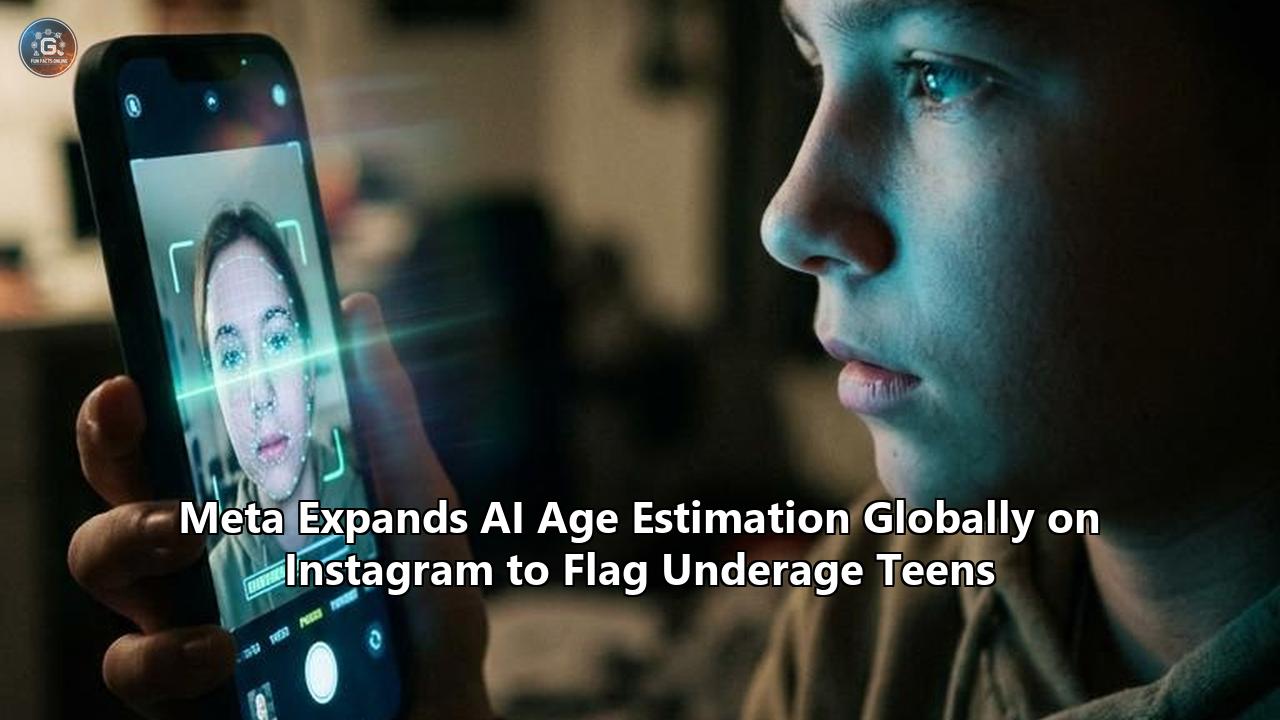
Meta has begun activating its automated age-detection classifier across Instagram worldwide, initiating a systematic demotion of millions of accounts from unrestricted adult status into tightly governed Teen Accounts. The global rollout, announced November 9, 2026, marks the end of social media’s reliance on the honor system for user birthdates, replacing self-declaration with automated algorithmic inference.
Under the global system, any Instagram user suspected of being between the ages of 13 and 17 is placed directly into restricted Teen Account protections, regardless of the birth year entered at registration. The underlying models review an array of behavioral metadata, social graph linkages, natural language interactions, and visual markers in uploaded imagery. Accounts evaluated as belonging to children under 13 are flagged for termination under the platform's terms of service and federal child privacy regulations.
                     ┌──────────────────────────────────┐
                     │   Incoming Instagram User Stream  │
                     │  (Registered as Age 18+ or Teen) │
                     └─────────────────┬────────────────┘
                                       │
                                       ▼
                     ┌──────────────────────────────────┐
                     │     Meta "Adult Classifier"      │
                     │   Multimodal Inference Engine    │
                     └───────┬──────────────────┬───────┘
                             │                  │
               [Inferred Age < 13]        [Inferred Age 13-17]
                             │                  │
                             ▼                  ▼
              ┌─────────────────────┐   ┌──────────────────────────────┐
              │ Account Termination │   │   Teen Account Protections   │
              │  & COPPA Purge Queue│   │  - Strict Messaging Limits   │
              └─────────────────────┘   │  - Explore/Reels Censorship  │
                                        │  - 60-Min Daily Limit        │
                                        │  - Overnight Sleep Curfew    │
                                        └──────────────┬───────────────┘
                                                       │
                                        [Disputed Age Claim / Appeal]
                                                       │
                                                       ▼
                                        ┌──────────────────────────────┐
                                        │ Yoti Biometric & ID Engine   │
                                        │  - Facial Age Vectorization  │
                                        │  - Gov ID Document Analysis  │
                                        └──────────────────────────────┘
The expansion comes on the heels of an $18 billion bipartisan settlement finalized in August 2026 between Meta and 52 state attorneys general, overseen by Chief Judge Yvonne Gonzalez Rogers in the U.S. District Court for the Northern District of California. That settlement ended the consolidated multidistrict litigation In re: Social Media Adolescent Addiction/Personal Injury Products Liability Litigation, legally binding the company to verifiable age-assurance accuracy benchmarks, mandatory nighttime lockouts, and algorithmic safeguards for minors.
What is being presented publicly as a youth safety initiative represents an operational shift inside Meta’s engineering and product organizations. Behind the public interface, the global deployment of Instagram AI age estimation represents a complex machine learning pipeline designed to bypass user self-reporting, untangle the social graph of hundreds of millions of users, and construct an automated enforcement boundary against youth engagement—all while navigating technical false-positive rates and geopolitical regulatory conflicts.
Inside the "Adult Classifier": The Multimodal Inference Architecture
At the technical center of Meta's enforcement engine is a proprietary neural network framework known internally as the Adult Classifier. Initially piloted in the United States in April 2025 and expanded across the UK, Canada, Australia, the European Union, and Brazil over the subsequent 18 months, the model processes real-time and historical account activity to compute an age-likelihood probability vector.
The classifier rejects the premise that a user’s self-declared date of birth is a trustworthy data point. Instead, it processes account signals through a tiered, asynchronous inference pipeline that splits inputs into three primary feature tracks:
+---------------------------------------------------------------------------------------+
|                       META ADULT CLASSIFIER: THREE FEATURE TRACKS                     |
+--------------------------+------------------------------+-----------------------------+
| 1. Behavioral & Graph    | 2. Semantic & Linguistic     | 3. Computer Vision          |
|    Telemetry             |    Analysis                  |    Inference                |
+--------------------------+------------------------------+-----------------------------+
| - Follower age-median    | - Public birthday comments   | - Facial proportion ratios  |
| - Reciprocal follow nets | - Educational milestones     | - Epicanthic/cheek contours |
| - High-velocity shifts   | - Youth colloquialisms       | - Skeletal morphology       |
| - Usage diurnal curves   | - Academic calendar markers  | - Scene context markers     |
+--------------------------+------------------------------+-----------------------------+
1. Behavioral and Graph Telemetry
The behavioral component exploits network homophily—the mathematical reality that individuals on social networks disproportionately connect with peers of similar chronological age. Meta’s graph neural networks (GNNs) evaluate an account’s egocentric network:
- If an account claiming to belong to a 24-year-old is embedded within follower clusters where 85% of members are verified or inferred 14-to-16-year-olds, the homophily weight pulls the confidence score toward the minor threshold.
- The system analyzes reciprocal direct message relationships, interaction speeds, high-velocity following of youth-oriented content creators, and diurnal usage patterns. An account exhibiting drop-offs in platform activity conforming to middle- or high-school instructional hours and nighttime blackouts creates an anomaly score against typical adult cohorts.
2. Semantic and Linguistic Signal Extraction
Natural language processing (NLP) models monitor unstructured textual surfaces across public posts, profile bios, and inbound public comment streams.
- Inbound birthday greetings serve as primary anchors. If an account claiming adult status receives comments such as "Happy 15th birthday!" or "Can't believe you finally got your learner's permit!", transformer-based entity extractors parse the numerical value, correlate it with the recipient’s claimed timeline, and trigger a mismatch flag.
- The model continuously parses slang syntax, school grade references (e.g., "sophomore year"), and sports league participation markers. Identifying details are decoupled from raw identifiers and fed into an evaluation matrix calibrated to detect linguistic markers associated with teenage communication.
3. Visual and Skeletal Cue Processing
The visual feature extractor functions as a passive computer vision filter applied to uploaded media. Unlike active face-recognition architectures that query centralized biometric identity databases, Meta’s passive visual classifier extracts facial morphology, bone structure indicators, and scene context.
- Deep convolutional neural networks (CNNs) evaluate spatial ratios: the distance between ocular centers relative to mandibular breadth, cheekbone elevation, and facial fullness, which vary predictably across adolescent development.
- Scene-parsing sub-models register context: high school lockers, classroom desks, youth sports uniforms, or playground environments. Combined, these vectors yield an age-estimation probability score calibrated between 0.00 and 1.00.
Algorithmic Scoring and the Threshold Mechanics
Meta's adult classifier does not generate a single static age estimate; it outputs a dynamic confidence interval that updates as new features enter the user’s event log. The core scoring mechanism uses an ensemble architecture where tree-based models (such as gradient-boosted decision trees) sit on top of the deep feature representations generated by the text and vision sub-networks.
The model calculates an aggregate risk vector $R_{teen}$, defined mathematically as the joint probability across observed independent signals:
$$R_{teen} = \sigma \left( \sum_{k=1}^{n} w_k \cdot \phi_k(x) \right)$$
Where $\phi_k(x)$ represents the extracted feature functions (graph homophily index, visual skeletal metric, inbound birthday text extraction, and hardware identity clusters), $w_k$ denotes the empirical weight assigned to each vector, and $\sigma$ represents the logistic sigmoid function mapping the score into a continuous probability range $[0, 1]$.
      Inference Score (R_teen)
0.00                                   0.45             0.72                     1.00
  ├─── Unrestricted Adult Status ───────┼── Under Review ──┼── Force-Demote to Teen ───┤
  │    (Standard Account Access)        │  (Feature Flags) │   (Teen Protections Active)│
  │    Ad targeting enabled             │  Ad load steady  │   Targeted ads barred      │
  │    Explore feeds open               │  Graph tracked   │   Explore heavily damped   │
  └─────────────────────────────────────┴──────────────────┴────────────────────────────┘
When an account lists an adult birthday (e.g., 22 years old), but the aggregate confidence score crosses the proactive threshold (internally calibrated at approximately $R_{teen} \ge 0.72$), the system dispatches an automated event via Meta’s backend service orchestrator.
The account’s permission state in the profile database is rewritten without human review. The profile switches to private status, the algorithmic recommendation pipelines in Reels and Explore apply strict content damping, direct messages from non-following accounts are closed, and nighttime screen time limits deploy automatically.
Hardware Fingerprinting and the "Alt-Account" Web
A recurring problem in teenage social media usage is account bifurcation: maintaining a tightly supervised primary account for parents and teachers while operating secondary, unmonitored accounts ("finstas") registered with adult birthdays to evade supervision.
To counter account evasion, Meta’s deployment links account profiles through hardware and network fingerprinting. When an adolescent user creates an alternative account, the backend infrastructure does not evaluate the account in isolation. It aggregates hardware signals:
- Unique Mobile Equipment Identifiers (IMEI)
- MAC addresses and device advertising identifiers (IDFA / AAID)
- Browser canvas fingerprints and shared local IP subnets
- Keychain-stored device tokens that persist across application uninstalls
  +---------------------------------------------------------------------------------+
  |                 META HARDWARE IDENTITY LINKING PIPELINE                         |
  +---------------------------------------------------------------------------------+
  |                                                                                 |
  |   +--------------------------+           +--------------------------+           |
  |   |    Teen Account A        |           |    "Alt" Account B       |           |
  |   |    (Declared Age: 15)    |           |    (Declared Age: 23)    |           |
  |   +------------+-------------+           +-------------+------------+           |
  |                │                                       │                        |
  |                ▼                                       ▼                        |
  |         [Device Token]                           [Device Token]                 |
  |         [Secure Enclave Hash]                    [Secure Enclave Hash]          |
  |                │                                       │                        |
  |                └───────────────────┬───────────────────┘                        |
  |                                    │                                            |
  |                                    ▼                                            |
  |                 +--------------------------------------+                        |
  |                 | Hardware Cluster Matching Engine     |                        |
  |                 | - Shared Kernel Hardware ID          |                        |
  |                 | - Baseband Serial Cross-Match        |                        |
  |                 | - High-Entropy IP Telemetry Match    |                        |
  |                 +------------------+-------------------+                        |
  |                                    │                                            |
  |                                    ▼                                            |
  |                 [Result: Direct Identity Link Established]                      |
  |                 Account B Inherits Protections of Account A                     |
  |                                                                                 |
  +---------------------------------------------------------------------------------+
If an account declared as belonging to a 23-year-old authenticates from an iPhone whose Secure Enclave persistent token matches the hardware container hosting an active 15-year-old Teen Account, the adult classifier triggers an immediate flag. The probability distribution of the secondary account is instantly inherited from the verified baseline of the primary profile.
Under the terms established in the August 2026 multistate settlement, Meta is legally required to identify and link these cross-account clusters, preventing minors from bypassing time restrictions by alternating between multiple accounts on a single phone.
The Escalation Pipeline: Biometric Proofing via Yoti
When the classifier flags an adult account as belonging to a teenager, the affected user is given a choice: accept the Teen Account restrictions, or appeal the designation by verifying their true chronological age.
Because storing government identification cards across billions of users creates a data security and regulatory liability under the EU General Data Protection Regulation (GDPR) and state biometric data laws, Meta outsourced age verification mechanics to UK-based digital identity provider Yoti.
                     ┌───────────────────────────────────┐
                     │ User Appeals "Suspected Teen" Tag │
                     └─────────────────┬─────────────────┘
                                       │
                      Selects Age Verification Mechanism
                                       │
                ┌──────────────────────┴──────────────────────┐
                │                                             │
                ▼                                             ▼
  ┌───────────────────────────┐                 ┌───────────────────────────┐
  │ Option 1: Video Selfie    │                 │ Option 2: Government ID   │
  │ Streamed to Yoti          │                 │ (Driver's License/Passport│
  └─────────────┬─────────────┘                 └─────────────┬─────────────┘
                │                                             │
                ▼                                             ▼
  ┌───────────────────────────┐                 ┌───────────────────────────┐
  │ 1. Anti-Spoofing Liveness │                 │ 1. Cryptographic Watermark│
  │    Detection Engine       │                 │    Validation             │
  │ 2. Facial Age Estimation  │                 │ 2. OCR Expiration & Date  │
  │    Pixel Vectorization    │                 │    of Birth Extraction    │
  │ 3. Age Prediction Output  │                 │ 3. Age Proof Generation   │
  └─────────────┬─────────────┘                 └─────────────┬─────────────┘
                │                                             │
                └──────────────────────┬──────────────────────┘
                                       │
                                       ▼
                     ┌───────────────────────────────────┐
                     │ Age Attestation Token Sent to Meta│
                     │ (Binary: "Pass 18+" or "Fail")    │
                     └─────────────────┬─────────────────┘
                                       │
                                       ▼
                     ┌───────────────────────────────────┐
                     │ Zero-Persistence Data Scrub:      │
                     │ - Raw Video Selfie Deleted        │
                     │ - Government ID Document Scrubbed │
                     │ - Ephemeral Cache Flushed         │
                     └───────────────────────────────────┘
The Yoti facial age estimation pipeline operates fundamentally differently from biometric facial recognition. Facial recognition matches a facial image against an indexed gallery of identities to answer the question, "Who is this person?" In contrast, Yoti's system performs facial analysis: it converts pixel arrays of a localized face into an abstract numeric vector to answer, "How old does this person appear to be?"
Pixel Processing and Neural Architecture
- Liveness Verification: When the user initiates a video selfie, an active liveness module checks for micro-reflections in the cornea, sub-dermal pulse variations (remote photoplethysmography), and motion depth to prevent attacks using high-resolution 2D photographs, silicone masks, or deepfake injection drivers.
- Feature Extraction: Once verified as an authentic, real-time capture, the face is normalized for scale, yaw, pitch, and lighting. The image passes through a deep convolutional network trained on millions of diverse, ethically sourced, ground-truth-labeled faces. The network extracts micro-textural patterns—wrinkle depth, pore distribution, skin elasticity indicators, and orbital fat pad changes.
- Inference and Zero-Persistence Wipe: The neural net outputs a predicted age and confidence interval. For users between ages 13 and 17, the algorithm achieves a Mean Absolute Error (MAE) of approximately 1.1 to 1.3 years.
Once the age estimation score is calculated, Yoti transmits a cryptographically signed binary attestation token back to Meta’s servers (e.g., Status: Inferred_Age >= 18; Confidence: 0.96), and the raw video selfie is permanently deleted from volatile memory.
If the user selects the alternate path—uploading a passport, driver’s license, or national identity card—the document undergoes optical character recognition (OCR), hologram/tamper checking, and date verification before being permanently scrubbed.
Technical Edge Cases: The False-Positive Dilemma
Automated classification systems operating on consumer populations inevitably produce classification errors. When Instagram AI age estimation scales to more than 2 billion monthly active users, a marginal error rate of 2% impacts tens of millions of individuals.
+---------------------------------------------------------------------------------------+
|                    THE OPERATIONAL AGE-CLASSIFICATION ERROR MATRIX                    |
+--------------------------+------------------------------+-----------------------------+
| System Decision          | Actual Under-18 Minor        | Actual 18+ Adult            |
+--------------------------+------------------------------+-----------------------------+
| Inferred Under-18        | True Positive (Target State) | False Positive (Over-Gating)|
| (Apply Restrictions)     | - Protection enforced        | - Adults locked into teen UI|
|                          | - Regulatory compliance met  | - Feature loss, friction    |
|                          | - Account monetization down  | - High appeal volume        |
+--------------------------+------------------------------+-----------------------------+
| Inferred 18+             | False Negative (Under-Gating)| True Negative (Target State)|
| (Allow Full Access)      | - Severe regulatory exposure | - Unrestricted adult access |
|                          | - Legal liability under COPPA| - Full monetization options |
|                          | - Multistate fine triggers   | - Normal user experience    |
+--------------------------+------------------------------+-----------------------------+
The engineering teams managing the deployment face an operational tradeoff between False Negatives (failing to identify an actual teenager) and False Positives (misclassifying a legal adult as a minor).
The Cost of False Negatives
For Meta, false negatives carry existential legal liabilities. Under the terms of the August 2026 multistate settlement and the UK Online Safety Act, failing to flag a 14-year-old child exposed to harmful content or adult contact carries fines that reach billions of dollars and can trigger court-appointed compliance sanctions.
The Friction of False Positives
Conversely, a false positive creates significant operational drag:
- A 22-year-old adult mistakenly classified as a 16-year-old is suddenly subjected to the 60-minute daily screen time limit, loses the ability to receive direct messages from people they do not follow back, and sees their posts shifted to private mode.
- In previous localized trials, adult creators, small business operators running storefronts on Instagram, and users with youthful facial features found themselves cut off from administrative tools and messaging capabilities.
- The appeals infrastructure must process millions of verification attempts simultaneously. If verification queues stall, affected adult users abandon the platform or express their frustration publicly, undermining trust in the platform’s administrative integrity.
       Cost / Risk Function
        │
  High  │         \                 /
        │          \               /
        │  False Negative Risk    /  False Positive Risk
        │  (COPPA Fines, AG      /   (User Churn, Support Overload,
        │   Contempt Sanctions, /     Creator Attrition)
        │   Litigation)        /
        │                     /
   Low  │                    V  [Optimal Classifier Operating Window]
        └───────────────────────────────────────────────
          0.0 (Permissive)       Threshold      1.0 (Strict)
To balance these dynamics, the model uses an asymmetric loss function during training. The system penalizes the failure to detect a minor far more heavily than the inconvenience of misclassifying a young adult. In cases falling within ambiguous statistical boundaries (such as individuals aged 17 to 20), the system defaults toward restriction, shifting the burden of identity proofing onto the end user.
The $18 Billion Catalyst: How Multistate Litigation Forced Meta’s Hand
Meta’s decision to globally activate its Instagram AI age estimation framework is not merely an internal product evolution; it is a defensive response to an unprecedented wave of global regulatory actions and state-level legal interventions.
  +---------------------------------------------------------------------------------+
  |                 LEGAL AND REGULATORY DRIVERS FOR GLOBAL ROLLOUT                 |
  +---------------------------------------------------------------------------------+
  |                                                                                 |
  |  +---------------------------+   +--------------------------+                   |
  |  | August 2026 Settlement    |   | EU Digital Services Act  |                   |
  |  | - 52 US Attorneys General |   | - Article 28 Audits      |                   |
  |  | - Up to $18 Billion Value |   | - High Privacy Defaults  |                   |
  |  | - Strict Accuracy Targets |   | - Ban on Minor Profiling |                   |
  |  +-------------+-------------+   +------------+-------------+                   |
  |                │                              │                                 |
  |                └──────────────┬───────────────┘                                 |
  |                               │                                                 |
  |                               ▼                                                 |
  |                +------------------------------+                                 |
  |                | Meta Global System Mandate   |                                 |
  |                | - Eliminate Self-Declaration |                                 |
  |                | - Deploy Adult Classifier    |                                 |
  |                | - Independent Model Auditing |                                 |
  |                +--------------+---------------+                                 |
  |                               │                                                 |
  |                ┌──────────────┴───────────────┐                                 |
  |                ▼                              ▼                                 |
  |  +---------------------------+   +--------------------------+                   |
  |  | UK Online Safety Act      |   | Australia Youth Ban &    |                   |
  |  | - Ofcom Age-Assurance     |   | OS Age-Range Integration |                   |
  |  |   Enforcement             |   | - Shared Platform Pilot  |                   |
  |  | - Strict Criminal Torts   |   | - Mandatory Gating       |                   |
  |  +---------------------------+   +--------------------------+                   |
  |                                                                                 |
  +---------------------------------------------------------------------------------+
The Multidistrict Legal Reckoning
On August 26, 2026, during the second week of a federal jury trial in Oakland, California, Meta agreed to a sweeping settlement with attorneys general representing 52 states, territories, and the District of Columbia. The lawsuit had consolidated hundreds of claims alleging that Meta intentionally engineered algorithmic feedback loops to addict adolescents, concealed internal research demonstrating psychiatric harms, and systematically failed to enforce the Children’s Online Privacy Protection Act (COPPA) by permitting millions of under-13 children to operate under falsified adult birthdates.
Under the terms approved by Chief Judge Yvonne Gonzalez Rogers, Meta agreed to financial commitments of up to $18 billion payable over a 10-year timeline. Crucially, the injunctive terms dictated structural changes to the company's product architecture:
- Mandated Accuracy Benchmarks: The settlement established concrete performance minimums for age estimation systems. Meta's classifiers must maintain a verified false-positive error rate of no more than 3 percent for users aged 13 to 15, and no more than 10 percent for users aged 16 to 17.
- Third-Party Algorithmic Audits: Meta’s classification pipelines can no longer operate as black-box systems. They are subject to annual testing by an independent auditor jointly appointed by the Settling States and certified through the Age Verification Providers Association (AVPA).
- Mandatory Screen-Time Limits: In addition to content filtering, the settlement mandated default two-hour daily operational limits, overnight blackouts from midnight to 6:00 a.m., and notification silences during educational hours—controls that can only be adjusted through verified parental consent.
- Active Discovery of Under-13 Accounts: The platform must use its machine learning pipelines to aggressively surface and terminate under-13 profiles. It can no longer wait for inbound user reports to establish the "actual knowledge" threshold required for COPPA compliance.
The European and Global Cross-Currents
Outside the United States, regulatory enforcement escalated in parallel. The European Commission launched formal proceedings under Article 28 of the Digital Services Act (DSA), which mandates that platforms accessible to minors guarantee high levels of privacy, safety, and security by design.
Simultaneously, the UK Office of Communications (Ofcom) advanced enforcement of the Online Safety Act, threatening penalties reaching 10% of global turnover for platforms that fail to demonstrate robust age-assurance methods to keep minors away from self-harm and sexually explicit materials.
By standardizing age estimation across its global codebase rather than maintaining fragmented, jurisdiction-specific models, Meta has moved to establish a single technical defense against regulators worldwide.
The Strategic Battle: Platform-Level vs. OS-Level Verification
While Meta is rolling out its internal classifiers worldwide, the company is engaged in a lobbying campaign targeting Capitol Hill, Westminster, Brussels, and Canberra. Meta’s central policy argument is clear: social media networks should not bear the sole responsibility for age verification. Instead, that burden should be shifted to operating system gatekeepers—namely Apple (iOS) and Google (Android).
┌───────────────────────────────────────────────────────────────────────────────────┐
│              COMPETING ARCHITECTURES OF AGE ASSURANCE JURISDICTION                 │
├─────────────────────────────────────────┬─────────────────────────────────────────┤
│ Meta's Proposed Architecture            │ The Incumbent App Store Architecture   │
│ (OS-Level Device Verification)          │ (Platform-by-Platform Verification)     │
├─────────────────────────────────────────┼─────────────────────────────────────────┤
│ 1. Parent registers device at setup     │ 1. App Store acts as agnostic pipeline; │
│    with Apple/Google.                   │    passes raw binary to user.           │
│                                         │                                         │
│ 2. OS verifies age via parent ID,       │ 2. Meta must deploy complex adult       │
│    billing method, or government ID.    │    classifiers to monitor all content.  │
│                                         │                                         │
│ 3. OS broadcasts cryptographic token   │ 3. Meta must partner with vendors like  │
│    to downloaded apps:                  │    Yoti to capture video selfies.       │
│    `Age_Class: Minor_13_15`             │                                         │
│                                         │ 4. If a teen evades detection, Meta     │
│ 4. Instagram, TikTok, YouTube set       │    faces billions in regulatory fines   │
│    defaults automatically. Zero model   │    while the OS gatekeeper remains      │
│    inference or behavioral tracking.    │    completely insulated from liability. │
└─────────────────────────────────────────┴─────────────────────────────────────────┘
Meta Chief Legal Officer C.J. Mahoney and Instagram head Adam Mosseri have framed platform-level age estimation as an inefficient solution. They point out that a teenager must navigate repetitive, intrusive age checks across every distinct application—Instagram, TikTok, Discord, Snap, and YouTube—uploading identity documents or video selfies to numerous disparate third-party services.
If Apple and Google verified user age at the hardware activation or app store checkout layer, a single cryptographically signed, zero-knowledge signal could be passed via an API to every installed application.
                     ┌───────────────────────────────────┐
                     │ Apple/Google Device Activation    │
                     │ (Parent Verified via Payment/ID)  │
                     └─────────────────┬─────────────────┘
                                       │
                                       ▼
                     ┌───────────────────────────────────┐
                     │ Hardware-Protected Age-Range API  │
                     │ e.g., iOS Age-Range Signal Token  │
                     └─────────────────┬─────────────────┘
                                       │
            ┌──────────────────────────┼──────────────────────────┐
            │                          │                          │
            ▼                          ▼                          ▼
┌───────────────────────┐  ┌───────────────────────┐  ┌───────────────────────┐
│ Instagram Application │  │  TikTok Application   │  │  YouTube Application │
│ Default: Teen Mode    │  │  Default: Teen Mode    │  │  Default: Restricted  │
└───────────────────────┘  └───────────────────────┘  └───────────────────────┘
To demonstrate the viability of this model, Meta expanded a pilot project in Australia integrating Apple’s age-range signal. Under this architecture, when an Australian parent sets up a device for a teenager through iOS Family Sharing, the App Store generates an approximate age classification token.
When the teenager downloads Instagram, the application queries the iOS API, receives the age classification token, and instantly locks the profile into the Teen Account configuration before the user even completes the account registration flow.
Apple and Google have historically resisted mandatory, universal OS-level age verification. Both firms argue that acting as universal age gatekeepers would force them to collect sensitive identity data on all device owners, turning mobile operating systems into surveillance bottlenecks and exposing them to privacy litigation across privacy-stringent jurisdictions like the European Union.
By pushing its global expansion of Instagram AI age estimation now, Meta is highlighting this contrast: demonstrating that it is taking independent action while continuing to lobby lawmakers to force Apple and Google into the compliance loop.
The Privacy Paradox: Surveilling More to Protect Better
The global deployment of Instagram AI age estimation reveals a fundamental tension at the center of modern internet regulation: to protect youth privacy, platforms must first eliminate adult anonymity.
                        The Youth Safety Mandate
                    (Identify every minor on platform)
                                   │
                                   ▼
             Requires continuous behavioral and visual analysis
                   of EVERY registered user on the service
                                   │
                                   ▼
          +──────────────────────────────────────────────────+
          |           THE CENTRAL PRIVACY CONTRADICTION      |
          +──────────────────────────────────────────────────+
          | In order to protect children from unauthorized   |
          | data harvesting and targeted exposure, the       |
          | platform must run deep multimodal surveillance   |
          | across 2+ billion accounts to verify that they   |
          | are NOT children.                                |
          +──────────────────────────────────────────────────+
                                   │
                                   ▼
                        The Privacy Backlash
         (Civil liberties groups challenge passive biometric
               profiling and persistent behavioral scoring)
Digital rights organizations, including the Electronic Frontier Foundation (EFF) and European civil liberties advocates, have raised structural concerns about the shift toward proactive inference. Under traditional data-minimization principles established by regulations like the GDPR, platforms are discouraged from collecting, aggregating, or processing personal data beyond what is strictly necessary to deliver a requested service.
Meta’s automated age estimation inverted that paradigm. To accurately discern whether an account holder is 16 or 19, the Adult Classifier must ingest:
- Inbound and outbound communication patterns
- Social interactions and relationship ties
- Ephemeral linguistic markers
- Visual features, skeletal properties, and environmental surroundings in photos and videos
The platform is effectively building an ongoing behavioral and biometric profile for every user, including adults, to prove they are not minors.
While Meta explicitly notes that raw video selfies sent to Yoti are promptly deleted and that the passive visual processing pipeline within its core architecture does not link back to persistent biometric identity databases, the reality remains: continuous behavioral and visual surveillance has become the price of entry for an open social platform.
The systemic question of whether this balance violates global data-protection principles remains untested in European and international courts.
Economic Fallout: The Ad Impression Compression Engine
Behind the regulatory filings and algorithmic architectures lies an economic calculation. Teenagers and young adults represent one of the most commercially coveted cohorts in digital media, yet this demographic is also the most challenging to monetize under evolving regulatory regimes.
The automated demotion of millions of users into Teen Accounts has direct, measurable consequences for Meta’s primary revenue generator: auction-based digital ad impressions.
                Meta Digital Ad Revenue Funnel
                              │
               User Accesses Instagram Services
                              │
               ┌──────────────┴──────────────┐
               │                             │
        [Adult Account]               [Teen Account]
               │                             │
    Full Auction Dynamics         Constrained Ad Pipeline
  ┌────────────────────────┐    ┌────────────────────────┐
  │ - Behavioral Targeting │    │ - NO Behavioral Ads    │
  │ - Lookalike Audiences  │    │ - Coarse Age/Geo Only  │
  │ - Off-Platform Signals │    │ - 60-Min Time Cap      │
  │ - Infinite Engagement  │    │ - Overnight Blackout   │
  │ - Direct DM Retargeting│    │ - Explore/Reels Damped │
  └───────────┬────────────┘    └───────────┬────────────┘
              │                             │
              ▼                             ▼
        Maximized ARPU                Depressed ARPU
     ($40-$80+ Global Blended)     ($8-$15 Heavily Discounted)
The Monetization Constraints of Teen Accounts
- Targeting Restrictions: Once an account transitions to Teen status, Meta’s ad engine disables behavioral and contextual retargeting. Advertisers can no longer deliver ads to these minors based on in-app activities, followed creators, or browsing histories. Only basic signals—broad geographic location and self-declared age—can be utilized in ad auctions.
- Impression Supply Reduction: Teen Accounts introduce structural inventory friction. Built-in nudges remind teens to exit the application after 60 minutes each day. Sleep mode silences notifications and closes direct messaging channels from 10:00 p.m. to 7:00 a.m. (or midnight to 6:00 a.m. under specific settlement jurisdictions). This reduces the total available ad surface during historically peak engagement hours.
- Algorithmic Damping: Stricter content controls applied to Explore feeds and Reels suppress borderline and sensational content, significantly reducing average session lengths among younger demographics.
+---------------------------------------------------------------------------------------+
|              ESTIMATED AVERAGE REVENUE PER USER (ARPU) METRICS: ADULT VS. TEEN        |
+--------------------------+------------------------------+-----------------------------+
| Region                   | Standard Unrestricted Adult  | Inferred Teen Account       |
|                          | Annual ARPU (Estimated)      | Annual ARPU (Estimated)     |
+--------------------------+------------------------------+-----------------------------+
| US & Canada (UCAN)       | $240.00 – $280.00            | $35.00 – $55.00             |
| Europe (EU + UK)         | $75.00 – $95.00              | $15.00 – $24.00             |
| Rest of World (Global)   | $18.00 – $32.00              | $3.50 – $6.00               |
+--------------------------+------------------------------+-----------------------------+
The gap in monetization between adult and teen profiles creates an unusual product tension. Product and engineering teams are normally tasked with maximizing daily active users (DAU) and platform session times.
Here, the safety and integrity engineering groups are actively working to suppress engagement metrics and ad revenue for millions of platform users.
The settlement with state attorneys general addressed this commercial dynamic through an unusual withholding-of-funds mechanism. Under the agreement, Meta’s financial payout obligations can be reduced if competing platforms like TikTok and YouTube do not adopt identical technical safeguards and agree to proportional settlement terms.
By deploying Instagram AI age estimation globally, Meta is attempting to establish its architecture as the baseline industry standard, forcing competitors to absorb identical operational overhead, impression suppression, and product frictions.
Adversarial Evasion and the Evolving Cat-and-Mouse Dynamic
Teenagers are among the most digitally adept and technically adaptable cohorts online. The global rollout of passive age inference has triggered a cat-and-mouse game between teenagers seeking unrestricted access and the platform's classification algorithms.
+-----------------------------------------------------------------------------------+
|               THE ADVERSARIAL CAT-AND-MOUSE AGE EVASION CYCLE                     |
+-----------------------------------------------------------------------------------+
|                                                                                   |
|  1. CLASSIFIER DEPLOYMENT                                                         |
|     Meta trains transformer and vision models on age markers (slang, school       |
|     calendars, mutual follower clusters, facial bone morphology).                 |
|                                                                                   |
|  2. TEEN EXPLOIT DISCOVERY                                                        |
|     Youth communities discover algorithmic signals via social coordination.       |
|     Techniques emerge: linguistic scrubbing, dummy follow-rings, burner SIMs.     |
|                                                                                   |
|  3. SYNTACTIC & METADATA CAMOUFLAGE                                               |
|     Teens adopt stylized phrasing to spoof adult corpora; comments containing     |
|     "Happy Birthday" are scrubbed; mutual follows are deliberately cross-linked   |
|     with verified adult demographic profiles to skew homophily scores.            |
|                                                                                   |
|  4. BIOMETRIC CHALLENGE DRIFT                                                     |
|     Users trick Yoti video-selfie capture using generative video filters,         |
|     sub-surface skin-tone smoothing hacks, or borrowing older siblings.           |
|                                                                                   |
|  5. MODEL RETRAINING & FEATURE ADDITION                                           |
|     Meta deploys deeper hardware telemetry, multi-account device graph clustering,|
|     and active adversarial retraining to close evasion vectors.                   |
|                                                                                   |
+-----------------------------------------------------------------------------------+
Digital Evasion Tactics
Within youth communities across TikTok, Discord, and Reddit, playbooks for evading age classification have proliferated:
- Linguistic Spoofing: Teens strip profile bios of references to high school graduations, sports clubs, or age numbers. When birthdays occur, users actively delete public comments from peers containing numbers, slang, or celebratory markers, moving those interactions to third-party messaging services.
- Network Camouflage: Teens systematically follow news outlets, financial institutions, home improvement accounts, and niche adult hobbyist pages to pull their social graph centroid away from teen clusters.
- Hardware Rotation and Multi-Profiles: Minors use burner mobile devices, secondary virtual machines, or public Wi-Fi profiles to break the deterministic linking between their monitored accounts and unflagged profiles.
- Biometric Circumvention: In the appeals phase, some users have attempted to fool Yoti’s facial estimation using high-resolution video projection, facial-distortion filters, or by having an older sibling or friend complete the video selfie verification check.
Meta's engineering teams counter these methods by retraining their evaluation models to identify synthetic or adversarial behavior.
When an account displays unnatural, sudden shifts in following behavior—such as a profile rapidly following dozens of enterprise trade publications while exclusively direct-messaging middle-school accounts—the anomaly detector flags the activity as an evasion attempt. This elevates the risk score, accelerating the transition to Teen Account status.
Technical Specifications: Meta's Age Assurance Infrastructure
+------------------------------------------------------------------------------------+
|               SYSTEM SPECIFICATION: META AGE ASSURANCE INFRASTRUCTURE              |
+---------------------------------+--------------------------------------------------+
| Attribute                       | Technical Detail / Parameter                     |
+---------------------------------+--------------------------------------------------+
| Primary Core Classifier         | Adult Classifier (Ensemble GBDT + GNN + Vision)  |
| Visual Sub-Models               | Deep CNN / Vision Transformer (ViT) Morphology   |
| NLP Engine                      | Transformer-based Entity & Slang Extraction      |
| Graph Infrastructure            | Distributed Graph Neural Networks (Homophily)    |
| Biometric Verification Partner  | Yoti Ltd (London, UK)                            |
| Liveness Detection Standard     | iBeta Level 1 and Level 2 PAD Compliant          |
| Facial Inference Metric         | Mean Absolute Error (MAE): 1.1–1.3 years         |
| Settlement Legal Mandate        | In re: Social Media Adolescent Addiction (N.D.   |
|                                 | Cal. 2026), 52 Attorneys General Agreement       |
| Mandated Accuracy Benchmarks    | ≤3% False Positives (13–15); ≤10% (16–17)        |
| Inferred Under-13 Protocol      | Account Deletion & COPPA Purge Queue Entry       |
| Default Inferred Teen State     | Private Profile, Sensitive Content Damped,       |
|                                 | Sleep Mode (10 p.m.–7 a.m.), 60-min Daily Cap    |
| External Signals Integrated     | Apple iOS Age-Range API (Australia Pilot)        |
+---------------------------------+--------------------------------------------------+
What Lies Ahead: Global Rollout Milestones and Technical Horizon
With Instagram AI age estimation now deploying globally across Instagram’s production environments, Meta’s engineering teams are preparing the next stages of the rollout across the company's broader family of apps:
  +---------------------------------------------------------------------------------+
  |                  ROLLOUT TIMELINE AND UPCOMING TECHNICAL MILESTONES             |
  +---------------------------------------------------------------------------------+
  |                                                                                 |
  |  NOVEMBER 2026                                                                  |
  |  - Global Instagram activation completed.                        |
  |  - In-feed educational video rolled out to U.S. parents via ConnectSafely       |
  |    collaboration.                                                |
  |                                                                                 |
  |  DECEMBER 2026 – EARLY 2027                                                     |
  |  - Facebook age-detection rollout expands from U.S. baseline to global scale    |
  |    across all active web and mobile nodes.                       |
  |  - Threads begins global testing of its multimodal age classifier.|
  |                                                                                 |
  |  MID-2027                                                                       |
  |  - First annual court-mandated audit under the 52-State Attorney General         |
  |    settlement submitted to Judge Yvonne Gonzalez Rogers.         |
  |  - Delivery of independent false-positive verification data by third-party      |
  |    auditors (AVPA certification verification).                   |
  |                                                                                 |
  |  LATE 2027 & BEYOND                                                             |
  |  - Potential legislative showdowns over device-level age-assurance mandates     |
  |    in the U.S. Congress, EU Parliament, and Australian Parliament|
  |  - Proposed expansion of zero-knowledge cryptographic device attestation APIs  |
  |    across both Apple iOS and Google Android ecosystems.                 |
  |                                                                                 |
  +---------------------------------------------------------------------------------+
1. Cross-Platform Expansion: Facebook and Threads
The rollout on Instagram is the leading edge of a broader deployment. Meta is actively extending the Adult Classifier across the legacy Facebook web and mobile app ecosystems, where age verification had previously remained anchored to older registration databases.
Concurrently, engineering teams are testing a lightweight, text-first variant of the model for Threads, slated for release worldwide. Because Threads relies heavily on text interactions and real-time short-form discourse, its classifier emphasizes semantic markers and cross-federated account links over computer-vision inference.
2. The First Court-Supervised Audits
The initial audit reports required by the August 2026 legal settlement will be delivered to the court within the coming year. Independent examiners will evaluate whether Meta’s production models successfully meet the mandatory accuracy benchmarks: maintaining false-positive rates strictly below 3% for early adolescents and below 10% for older teens.
If Meta’s systems fail these empirical tests, the company faces immediate enforcement actions, substantial civil contempt fines, and potential product restrictions from the settling states.
3. The Legislative Showdown Over Operating Systems
Meta’s voluntary expansion of Apple’s age-range signal in Australia is laying the groundwork for a broader policy showdown. If the pilot demonstrates that device-level age transmission reduces platform friction and eliminates user circumvention, Meta and other major platforms will have strong leverage to push lawmakers toward making operating-system-level age assurance mandatory.
Such a mandate would require Apple and Google to integrate cryptographic, zero-knowledge identity tokens into the core architectures of iOS and Android.
4. Technical Resilience of the Architecture
Ultimately, Meta's global implementation of AI-driven age assurance represents a major test of whether an algorithmic system can police the boundaries of childhood across an audience of billions. The initiative replaces self-reported birthdates with a system of automated behavioral monitoring, multimodal computer vision, and third-party identity proofing.
Whether this architecture emerges as a durable model for digital child protection or unearths new operational frictions across privacy, system accuracy, and user retention will determine the future of age verification across the open internet.
Reference:
- https://aiweekly.co/alerts/meta-takes-instagram-ai-age-estimation-global-for-teens
- https://www.unite.ai/meta-takes-ai-age-estimation-global-for-instagram-teen-protections/
- https://finance.biggo.com/news/fa68fb54-aaaa-4027-8b0b-126a309efafe
- https://superpowerdaily.com/posts/meta-takes-instagram-s-ai-age-estimates-global-to-catch-teens-using-adult-birthdays
- https://www.aei.org/research-products/report/metas-multistate-settlement-over-alleged-harm-to-minors-and-deception-context-review-and-analysis/
- https://www.legal500.com/intelligence/united-states/privacy/meta-settles-multi-state-child-safety-and-privacy-litigation
- https://www.biometricupdate.com/202608/metas-accuracy-minimums-confirm-that-yes-some-third-party-age-checks-do-work
- https://www.reddit.com/r/technology/comments/1gjnkxc/meta_details_adult_classifier_tool_for_catching/
- https://www.engadget.com/social-media/meta-details-adult-classifier-tool-for-catching-teens-who-lie-about-their-age-on-instagram-164439051.html
- https://tech.facebook.com/artificial-intelligence/2022/6/adult-classifier/
- https://www.engadget.com/2310848/meta-is-expanding-ai-age-detection-for-instagram-teen-accounts/
- https://patents.google.com/patent/US5781650A/en
- https://www.tipranks.com/news/meta-stock-rallies-over-4-on-plans-to-ai-age-check-teens-on-instagram
- https://www.biometricupdate.com/202411/meta-announces-new-age-checking-measures-for-young-instagram-users
- https://nordvpn.com/blog/yoti-age-verification/
- https://sencanada.ca/Content/Sen/Committee/451/LCJC/briefs/LCJC_S-209_Bundle-Brief_YOTI_e.pdf
- https://www.courthousenews.com/meta-agrees-to-landmark-settlement-over-social-media-addiction-cases/
- https://ag.ny.gov/press-release/2026/attorney-general-james-secures-171-billion-and-groundbreaking-reforms-meta
- https://thenextweb.com/news/meta-instagram-ai-age-estimation-global
- https://kgi.georgetown.edu/wp-content/uploads/2026/01/Age_Assurance_Online_Technical-Assessment_Report_KGI.pdf?utm_source=chatgpt.com
- https://cdn.dal.ca/content/dam/dalhousie/pdf/dept/maceachen-institute/researchreports/Dalhousie%20Age%20Verification,%20Karanicolas.pdf
- https://cyberpeace.org/resources/blogs?99fd07b9_page=4
- https://www.aichatdaily.com/ai-security/meta-expands-instagram-ai-age-estimation-teens-worldwide