Late this week, the established timeline of celestial discovery shattered. A collaborative investigation by an astrophysicist and a historian has uncovered compelling evidence that the predictable, cyclical nature of the solar system’s most famous comet was identified not in the scientific ferment of the 18th century, but in a damp English monastery in the year 1066.
For more than three centuries, the credit for recognizing the 76-year orbital period of 1P/Halley has belonged exclusively to Edmond Halley, the British Royal Astronomer who published his mathematical proofs in 1705. The textbooks recount a clean, linear narrative of Enlightenment-era triumph: Halley applied Isaac Newton’s new laws of gravitation to historical data, noticed a pattern, and predicted the comet's return.
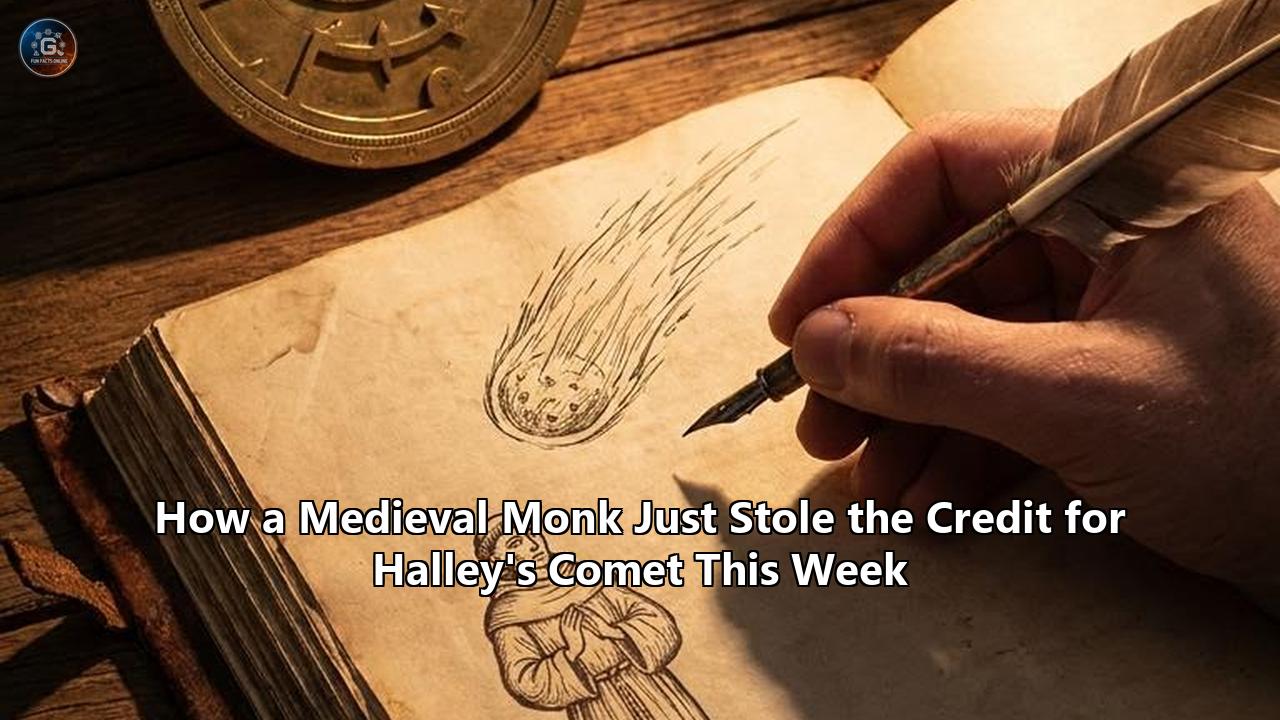
But new findings published by Professor Simon Portegies Zwart, an astronomer at Leiden University, and Michael Lewis, a researcher with the British Museum, dismantle that orderly version of Halley's Comet history. By cross-referencing sophisticated computer models of historical night skies with obscure 12th-century Latin chronicles, the researchers revealed that an elderly Benedictine monk named Eilmer of Malmesbury recognized the comet’s periodicity nearly 640 years before Edmond Halley was even born.
The discovery reframes an iconic scientific milestone and demands a massive reassessment of medieval observational astronomy. Far from being passive victims of superstitious dread, figures like Eilmer were actively connecting decades of astronomical data through personal observation and institutional memory.
The Smoking Gun in the Malmesbury Chronicles
The evidence trail begins with a single, highly specific passage recorded by the chronicler William of Malmesbury around 1125, in his sweeping historical work Gesta Regum Anglorum (Deeds of the Kings of England). William was documenting the chaotic spring of 1066, a period when a terrifyingly bright object appeared in the sky over Europe.
The comet materialized during the brief, doomed reign of King Harold Godwinson. It hung in the sky for weeks, growing a brilliant tail that stoked terror across the British Isles. While most observers viewed the object as a novel and terrifying omen of impending war—a fear validated months later by the Norman Conquest—William of Malmesbury recorded a distinctly different reaction from an elderly monk named Eilmer.
According to the manuscript, Eilmer, old and physically disabled, dragged himself out to view the celestial visitor and spoke directly to it:
"You've come, have you? You've come, you source of tears to many mothers. It is long since I saw you; but as I see you now you are much more terrible, for I see you brandishing the downfall of my country."For generations, historians translated this passage and dismissed it as dramatic literary flair—a poetic expression of generalized medieval dread. But Portegies Zwart and Lewis approached the text differently. They treated Eilmer’s words not as poetry, but as literal observational data.
The phrase "It is long since I saw you" is precise. Eilmer was not saying he had seen a comet before; he was stating unequivocally that he recognized this specific comet from a prior encounter. This realization prompted the researchers to launch a rigorous forensic investigation into Eilmer’s timeline, hunting for the earlier sighting that the elderly monk was referencing.
The Profile of an Aviator Monk
To understand how Eilmer could have made such a profound intuitive leap, one must look at the deeply unconventional life he led. Eilmer was not a cloistered ascetic who kept his eyes entirely focused on scripture. He was, in modern terms, an experimental engineer and a keen student of the natural world.
Long before his realization about the comet, Eilmer cemented his place in local legend through an act of supreme audacity. Sometime between the years 995 and 1010, motivated by an intense fascination with the Greek myth of Daedalus, Eilmer constructed a pair of rigid wings. According to the abbey's records, he strapped the contraption to his arms and legs, climbed to the summit of the Malmesbury Abbey tower, and launched himself into the prevailing winds.
Against all odds, the apparatus generated lift. Eilmer glided for an estimated 200 meters (roughly a furlong) before a sudden downdraft destabilized him. He plummeted to the ground, shattering both of his legs, an injury that left him permanently lame. In the aftermath of the crash, rather than attributing his failure to divine punishment, Eilmer analyzed the aerodynamics. He concluded with startling mechanical pragmatism that his design failed simply because he had forgotten to build a tail to stabilize his flight.
This biographical detail is crucial to the new research. It establishes Eilmer as an individual with an intensely analytical mind, someone capable of structural thinking, risk assessment, and sustained observation of the physical world. When Eilmer looked up at the sky in 1066, he was applying the same analytical scrutiny to the heavens that he had once applied to the wind currents over Wiltshire.
Interdisciplinary Forensics: Rewinding the Orbital Clock
To verify Eilmer’s claim of having seen the comet long before 1066, Portegies Zwart and Lewis had to prove that the orbital mechanics of 1P/Halley aligned with the biological realities of Eilmer’s lifespan.
This required merging the distinct disciplines of historical text analysis and astrophysics. Portegies Zwart utilized advanced N-body simulation software to run the solar system’s clock backward. Cometary orbits are notoriously difficult to retroactively model because they are constantly perturbed by the gravitational pull of massive planets like Jupiter and Saturn, and because the comets themselves lose mass as their ice sublimates near the Sun, creating tiny propulsive jets that alter their trajectory.
Despite these variables, the model confirmed that the comet had indeed passed through the inner solar system 77 years prior, in the late summer of 989 CE.
The researchers then turned back to the monastic records. Eilmer's exact birth year is unrecorded, but his flight from the tower occurred in his youth, around the turn of the millennium. For Eilmer to be an old man in 1066, he would have been born sometime around 980 CE. This meant that during the comet's prior visitation in 989, Eilmer would have been a boy of eight or nine years old—placing him at the exact cognitive stage where a brilliant, terrifying object in the sky would burn an indelible memory into his mind.
"He realized that he had seen the same comet earlier, in 989," the researchers note in their findings, recently published in the academic text Dorestad and Everything After. Eilmer held onto that visual data for 77 years, eventually matching the morphological characteristics of the 1066 apparition—its brightness, its specific trailing coma, its apparent motion against the background stars—to the childhood memory.
Edmond Halley and the Mathematical Formalization
To fully grasp the magnitude of Eilmer’s stolen credit, we must examine the man whose name is permanently etched into the comet's ice. How did Edmond Halley secure the glory, and does this new finding diminish his actual scientific achievements?
By the late 17th century, the prevailing scientific consensus regarding comets was heavily fractured. Johannes Kepler had observed them carefully but believed they traveled in straight lines through the solar system. Even the brilliant Isaac Newton struggled to reconcile the erratic paths of comets with his newly minted laws of universal gravitation. Prior to Halley’s breakthrough, mainstream European science largely treated comets as isolated, one-off events—stray rocks making a single, chaotic pass around the Sun before disappearing into the void forever.
Edmond Halley, working closely with Newton, suspected otherwise. In his seminal 1705 paper, Synopsis of the Astronomy of Comets, Halley compiled a vast array of historical astronomical data. He looked at detailed observations made by Petrus Apianus in 1531, by Johannes Kepler in 1607, and his own personal observations of a comet in 1682.
Applying Newton's physics, Halley laboriously calculated the gravitational effects of Jupiter and Saturn on these seemingly disparate objects. He realized that the orbital elements—the inclination, the longitude of the ascending node, and the perihelion distance—were nearly identical across all three sightings. Halley made the massive inductive leap that these were not three different comets, but a single object locked in a highly elliptical orbit spanning roughly 76 years.
He publicly staked his reputation on a prediction: the comet would return in late 1758. When the comet appeared in the sky on Christmas Day of that year, exactly as the mathematics dictated, Halley (who had died 16 years prior) was immortalized.
The new research by Portegies Zwart and Lewis does not invalidate Halley’s math. The British astronomer genuinely provided the first robust mathematical proof of the comet's cycle. However, the foundational concept—the realization that these terrifying celestial bodies were cyclical, recurring visitors—was definitively not his original idea. Eilmer of Malmesbury achieved the conceptual breakthrough solely through observational endurance and memory, stripping away the prevailing mythos of his era to recognize a pattern in nature.
Recontextualizing the 1066 Global Phenomenon
The year 1066 stands as perhaps the most culturally saturated point in Halley's Comet history. Because the comet’s cycle roughly coincided with the average human lifespan of the era, a single person rarely lived long enough to see it twice. Eilmer’s longevity was an anomaly that allowed him to crack the code. For the rest of the world, the 1066 event was an isolated, terrifying spectacle.
Astronomers globally were intensely focused on the skies that spring. Chinese imperial astronomers documented the 1066 apparition with extraordinary precision, tracking its path against the constellations for more than two months and noting its peak brightness around April 22. Two days later, it became glaringly visible over the British Isles and the European continent.
Because comets shed massive amounts of dust and gas as solar radiation heats their nuclei, they can stretch across massive portions of the night sky. In the medieval mind, a star "with flaming hair" was a disruption of the divine order, an imbalance that demanded earthly consequences.
Nowhere is this better illustrated than in the Bayeux Tapestry, the 70-meter-long embroidered cloth depicting the events leading up to the Battle of Hastings. The tapestry features a famous panel showing the comet streaking overhead while King Harold’s subjects point upward in terror. The accompanying Latin text reads Isti mirant stella ("These men marvel at the star").
For centuries, historians analyzing Halley's Comet history have used the Bayeux Tapestry as the ultimate symbol of medieval astronomical ignorance—proof that people of the 11th century could only interpret the cosmos through a lens of superstition and fear. Eilmer’s quote to William of Malmesbury was lumped into this same category.
But the Leiden and British Museum researchers argue that Eilmer was doing something vastly more sophisticated than the artisans of the Bayeux Tapestry. While the tapestry weaponized the comet as post-hoc propaganda to legitimize the Norman Conquest, Eilmer was engaged in pattern recognition. His fear, expressed in his quote about the "downfall of my country," was arguably secondary to his primary cognitive realization: I know what this object is, and I know I have seen it before.
Institutional Memory and the Myth of the Dark Ages
The elevation of Eilmer of Malmesbury from an eccentric historical footnote to a pioneer of astrophysics challenges the deeply entrenched bias against medieval intellectualism. The Enlightenment era heavily promoted the idea that the Middle Ages were a scientific wasteland, a "Dark Age" where curiosity was suppressed by theology until men like Galileo, Newton, and Halley rescued human thought.
This recent investigation dismantles that binary thinking. Monasteries like Malmesbury were not intellectual vacuums; they were the data centers of the 11th century. Monks served as scribes, timekeepers, and chroniclers. Because the liturgical calendar relied heavily on the precise tracking of lunar phases and solar equinoxes, monasteries required men with a deep, functional understanding of the night sky.
By meticulously recording anomalous events—from solar eclipses to crop failures to the movements of wandering stars—these institutions built multi-generational databases. Eilmer’s identification of the comet’s return was the culmination of his own extraordinary memory, but it was preserved precisely because the monastic tradition valued the recording of such data.
"That leap matters because it suggests medieval observers weren't merely recording wonders; they were beginning to interpret long-term patterns from historical memory and written tradition," notes the analysis surrounding the Leiden University release.
Furthermore, Portegies Zwart and Lewis’s research highlights the dangers of modern scientific arrogance. By assuming that medieval texts contained nothing but religious allegory or fake news designed to frighten peasants, modern astronomers missed a glaring, mathematically verifiable observation hiding in plain sight for nearly 900 years.
Will They Rename the Comet?
Whenever a foundational historical narrative is overturned, the immediate question turns to nomenclature. If Edmond Halley merely provided the mathematical scaffolding for a discovery made nearly seven centuries prior, should 1P/Halley be renamed to 1P/Eilmer?
From a purely historical standpoint, Portegies Zwart and Lewis have argued that the current designation is historically inaccurate and represents a significant historiographical injustice. "Portegies Zwart and Lewis argue that, since the identity and periodicity of the comet were established by Eilmer of Malmesbury almost seven centuries before Halley published his calculations, the designation Halley's Comet is historically inaccurate," reported interdisciplinary outlets reviewing the study. They openly advocate for a change that recognizes the English monk’s priority.
However, the inertia of scientific culture is immense. The name "Halley's Comet" is woven deeply into global lexicon, literature, and educational systems. While a formal petition to the International Astronomical Union (IAU) to alter the comet's official name remains a theoretical possibility, the bureaucratic and cultural hurdles are staggering.
The more likely outcome is a swift revision of academic curricula. Much like the recent societal shift that accurately credits Rosalind Franklin alongside Watson and Crick for the discovery of the DNA double helix, Eilmer of Malmesbury is poised to become a mandatory fixture in any comprehensive overview of Halley's Comet history. The textbook chapters will need to be rewritten, framing Edmond Halley not as the isolated genius who pulled the concept of cometary periodicity out of thin air, but as the mathematician who formalized the intuition of a disabled medieval monk.
What to Watch For: Untranslated Archives and the 2061 Return
The implications of this week’s discovery extend far beyond a single comet. The methodology employed by Portegies Zwart and Lewis has essentially created a new blueprint for historical astronomy.
If a discovery of this magnitude was hiding in the relatively well-studied Gesta Regum Anglorum, researchers are now looking hungrily at the thousands of untranslated or under-analyzed manuscripts housed in European abbeys, Middle Eastern libraries, and Chinese imperial archives. The synergy of modern orbital simulation software and rigorous historical translation holds the potential to solve other astronomical mysteries. Future milestones in this nascent field will likely involve identifying the historical counterparts of rogue meteors, unexplained supernovae, or anomalous atmospheric phenomena currently dismissed as medieval hallucinations.
"This research was enormously rewarding to carry out, but I also encountered the challenge of working on such an interdisciplinary project alongside a historian," Portegies Zwart stated, confirming that their group intends to continue investigating historical evidence of periodic celestial events through ongoing partnerships between astronomy and history.
Meanwhile, the object itself continues its long, dark plunge through the outer solar system. After reaching aphelion (its furthest point from the Sun) late last year, the comet is currently turning back toward Earth.
When it finally breaches the inner solar system and lights up the night sky in mid-2061, humanity will be waiting with autonomous probes, space telescopes, and atmospheric sensors. But the cultural context of that highly anticipated return has just been fundamentally altered. When our children and grandchildren look up to watch that ancient ice burn across the sky, they will not just be witnessing a triumph of Newtonian physics. They will be sharing a direct, unbroken line of sight with Eilmer of Malmesbury, the brilliant, broken-legged aviator who looked into the dark in the spring of 1066 and recognized an old friend.
Reference:
- https://holistic.news/en/who-discovered-halleys-comet-a-monk-beat-halley/
- https://www.labrujulaverde.com/en/2026/01/an-11th-century-monk-dethrones-edmond-halley-the-comets-periodicity-was-understood-seven-centuries-earlier-than-established/
- https://en.wikipedia.org/wiki/Halley%27s_Comet
- https://www.heritagedaily.com/2026/01/11th-century-english-monk-first-identified-the-cycles-of-halleys-comet/156847
- https://www.universiteitleiden.nl/en/news/2026/01/halleys-comet-wrongly-named-11th-century-english-monk-predates-british-astronomer
- https://www.livescience.com/archaeology/halley-wasnt-the-first-to-figure-out-the-famous-comet-an-11th-century-monk-did-it-first-new-research-suggests
- https://www.historyextra.com/period/medieval/halleys-comet-misnamed-elmer-monk-bayeux-tapestry-norman-conquest/
- https://www.athelstanmuseum.org.uk/malmesbury-history/people/eilmer-the-flying-monk/
- https://www.techno-science.net/en/news/halley-comet-renamed-after-medieval-monk-N28313.html
- https://www.ancient-origins.net/news-history-archaeology/halley-s-comet-name-00102477