Beneath the harsh sun of southern Iraq, a team of researchers from the British Museum and the Iraqi State Board of Antiquities and Heritage is currently digging through literal garbage. But this is not an ancient Sumerian refuse pit. The team at Girsu, a megacity that flourished in the third millennium BCE, is meticulously excavating the discarded dirt, broken tools, and scattered backfill left behind by French antiquarians over a century ago.
Simultaneously, 2,000 miles away in the Moravian Karst of the Czech Republic, researchers at the Švédův stůl cave recently announced they had abandoned the supposedly "empty" cave interior. Instead, they sank their trenches into the massive spoil heaps sitting just outside the entrance—piles of dirt dumped by 19th- and 20th-century diggers. Within this discarded earth, they uncovered a limestone block featuring engraved Magdalenian art, alongside critical Neanderthal and early Homo sapiens artifacts that the original pioneers simply threw away.
A stark realization is sweeping through the discipline in 2026: some of the most vital discoveries are no longer emerging from pristine, untouched historical sites. They are being pulled from the trash of older archaeologists.
This pivot toward re-excavating old spoil heaps—the technical term for the mountains of discarded soil, rubble, and rock generated during a dig—marks a fundamental shift in how modern researchers operate. Driven by the realization that early excavators lacked the technology, patience, and methodological rigor of contemporary science, today’s fieldworkers are treating the Victorian and early 20th-century trenches with the exact same forensic reverence they apply to ancient ruins.
The Rescue of Tablet Hill
The situation at Girsu, located in modern-day Tello, Iraq, provides the most urgent example of this trend. Under the direction of the Girsu Project—a collaborative initiative scheduled to run through 2026 and funded by the Meditor Trust—archaeologists are attempting to reconstruct the scattered legacy of one of the world's oldest cities.
Girsu was the sanctuary of the Sumerian heroic god Ningirsu and yielded some of the earliest known evidence of cuneiform writing and complex urban organization. However, its initial "discovery" in the late 19th century was an academic disaster by modern standards. Early excavators, operating in a frantic rush to extract museum-quality display pieces, employed hundreds of local laborers to hack into the mudbrick architecture. They ignored stratigraphy, tore through undocumented walls, and haphazardly tossed millions of tons of earth into massive, unsystematic spoil heaps.
Dr. Sébastien Rey, leading the British Museum's efforts, has centered the current fieldwork on "Tablet Hill," an area heavily damaged by these early interventions and subsequent decades of looting. By carefully peeling back the historic spoil heaps and re-examining the jagged edges of the century-old trenches, Rey’s team reconstructed a continuous sequence of architecture that early antiquarians missed.
In 2024, this method led to the recovery of a previously unknown Sumerian Library. The older archaeologists had dug right through it, extracting the large, obvious tablets while discarding fragments, throwing the contextual soil away, and obliterating the floor plans. By treating the 19th-century dirt as an archaeological layer in its own right, the current team is currently piecing together the exact locations of cuneiform archives that were violently dispersed across global museums over a century ago.
Missing the Microscopic
To understand why so much value remains in these century-old dumps, one must examine the evolution of archaeological excavation history.
For generations, the primary objective of an excavation was the recovery of monumental architecture, precious metals, complete ceramics, and legible texts. The methodology was correspondingly blunt. Laborers used picks and heavy shovels, loading the "overburden" into barrow runs or rail-tubs and dumping it at the edge of the site.
The early pioneers did not look for pollen, microscopic phytoliths, or isotopic signatures. They did not systematically screen or water-sieve their soil. As a result, anything smaller than a coin—including rodent bones that indicate ancient climate conditions, seeds that reveal agricultural diets, and tiny flint micro-blades used in composite tools—was shoveled into carts and tipped down the side of the nearest hill.
The Švédův stůl cave excavation in the Czech Republic, detailed in a late 2025 report in the Journal of Archaeological Science Reports, illustrates the sheer volume of data lost to these methods. Over the last 150 years, European archaeologists targeted caves and rock shelters, effectively emptying them of their pristine cultural deposits to study the Middle-to-Upper Palaeolithic transition. Švédův stůl was presumed fully excavated. The original investigators cleared out the cave down to the bedrock, seeking large cave bear skulls and obvious human remains.
When a modern team returned, they recognized that the cave itself was a lost cause, but the massive Victorian spoil heap outside the entrance was a time capsule. By excavating the previous researchers' garbage, the modern team recovered milky white erratic flint flakes with backing retouch, dark grey Olomučany chert interpreted as Neolithic sickle blades, and a limestone block with engraved horse depictions. More importantly, they recovered tiny bone and tooth samples. Using OxCal 4.4 and the IntCal 20 calibration curve, they successfully radiocarbon-dated these discarded fragments, pulling hard chronological data from a site that the academic community had written off as fully depleted.
The Stratigraphy of a Spoil Heap
Excavating another archaeologist's trash requires an entirely different methodology than digging a virgin site. A pristine site operates on the principle of superposition: the oldest materials are at the bottom, and the newest are at the top. A spoil heap is the inverse.
When early miners or antiquarians dug a trench, they removed the newest (top) layers first and dumped them on the ground. As they dug deeper into the older layers, they piled that dirt on top of the earlier dumps. Consequently, a classic conical spoil heap often features inverted stratigraphy: the oldest artifacts are sitting at the very peak of the mound, while the newest are buried at the base.
However, the reality is rarely that mathematically perfect. In the field, modern researchers must disentangle highly mixed mounds. Teams rely on subtle indicators to "read" the discard piles. A thin, unsorted lens of clay or chalk often indicates a prehistoric or early hand-dumped basket tip. Thicker, better-sorted layers point to high-medieval or 19th-century cart tips.
Modern fieldworkers now utilize Light Detection and Ranging (LiDAR) to map these artificial landscapes before breaking ground. LiDAR pulses penetrate vegetation to reveal the precise topography of the forest floor, exposing the zigzag haul ramps, the twin ruts of late horse-tram spoil routes, and the exact volume of the waste mounds. By mapping the geometry of the spoil heap, researchers can reverse-engineer where the dirt originally came from, mapping specific piles of discarded soil back to specific voids in the ancient ruins.
This forensic approach to archaeological excavation history is yielding dividends across the globe, from the Middle East to rural England.
The Cookham Monastery Safety Net
At the site of an 8th-century Anglo-Saxon monastery in Cookham, Berkshire, the University of Reading has spent the 2024 and 2025 seasons demonstrating how older, and even current, spoil heaps serve as crucial data repositories. The site, directed by Professor Gabor Thomas, is a dense matrix of post holes, hearths, middens, and cemeteries.
Here, the project actively integrates local metal detectorists from groups like the Maidenhead Search Society to scour the excavation's own spoil heaps. Even with modern hand-troweling techniques, small mud-encrusted items are easily missed when deep trenches are cleared. The detectorists act as a complementary safety net, scanning the mounds of removed earth.
In a recent season, detectorist Jim Mather was sweeping a spoil heap when he uncovered a small, highly corroded silver coin. It was confirmed by Professor Thomas to be an Anglo-Saxon Offa penny—the first found at the site in four years. Other volunteers working the spoil pulled out an unidentified silver sceat, a lead weight, and a 12th-century gilded copper alloy saint figurine mount.
The Cookham project highlights a nuanced reality: even modern excavations produce flawed waste. The sheer volume of earth moved during an excavation—often expanding to three times its compacted volume once loosened from the ground—makes a 100 percent recovery rate impossible. Acknowledging this, field directors are building spoil-heap analysis into their daily workflows, assigning dedicated teams to sieve, detect, and float the discarded soil.
Excavating the Crimes of the Nighthawks
Not all older trenches were dug by well-meaning, if clumsy, antiquarians. A significant portion of modern spoil heap excavation involves tracking the movements of illicit looters, known in the UK as "nighthawks."
According to research published by Archaeology International in late 2025, investigators at the Hanbury hillfort (Church Hill) in Worcestershire had to deploy forensic excavation techniques to understand a heritage crime. In August 2023, illicit detectorists illegally cleared scrub in the woodland on the hilltop and dug three massive looter trenches.
When professional archaeologists arrived to assess the damage, they did not just measure the holes; they carefully excavated the looters' spoil heaps. The looters were looking for high-value metal commodities to sell on the black market. Everything else—the actual historical data—was discarded as trash.
By sieving the 37.9 square meters of earth left beside the pits, the archaeological team recovered a quantity of Roman and post-medieval pottery, as well as disturbed human remains. The looters had inadvertently hacked through a documented Anglo-Saxon minster cemetery. The archaeologists submitted the discarded bone fragments for radiocarbon dating. The results returned a calibrated date range confirming activity between 670 and 870 CE (with a 94 percent probability).
While the illicit detecting robbed the site of key spatial information, excavating the looters' trash generated precise chronological data regarding human activity at Church Hill. The project proved that even severely disturbed sites retain high academic value, provided researchers are willing to look closely at the soil that others have thrown away.
The Reintegration of Legacy Collections
This movement toward re-excavation is intrinsically linked to the crisis of "legacy collections" currently burdening global museums. Throughout the 19th and 20th centuries, colonial powers extracted millions of artifacts from the Global South, depositing them in institutions like the Louvre, the British Museum, and the Pergamon Museum.
Because these items were pulled from the ground without stratigraphic context, they are often academically mute. A Sumerian statue sitting in a glass case in London is beautiful, but without knowing exactly which room, which layer, and which surrounding artifacts it was buried with, its scientific value is severely restricted.
The most ambitious chapter in archaeological excavation history is now unfolding through digital reintegration. By re-excavating the early excavators' trenches and spoil heaps, teams like the Girsu Project can identify the exact architectural footprints of buildings that were destroyed to extract the artifacts. They find the broken bases of statues where the tops were shipped to Europe, or they find the micro-debris of a bead-making workshop exactly where an 1890s journal vaguely noted finding "some jewelry".
Using geographic information systems (GIS) and interoperable digital databases, modern archaeologists are stitching the severed past back together. They map the newly recovered contextual data—the exact soil chemistry, the radiocarbon dates of the surrounding discarded charcoal, the pollen records from the old spoil heap—and digitally attach it to the orphaned artifact sitting in a foreign museum.
This provides a pathway for intellectual repatriation. While physical repatriation debates remain politically complex, the act of re-excavating a site like Girsu ensures that the capacity building, the raw data, and the heritage management skills remain firmly within Iraqi institutions. Students from universities across Iraq are currently using these damaged sites as training grounds, learning best practices in non-invasive surveying and the stabilization of fragile architecture, such as the Temple of Ningirsu and the 4,000-year-old Bridge of Girsu.
Why This Matters Now
The sudden urgency to excavate old dumps is driven by external pressures. Pristine archaeological sites are disappearing at an unprecedented rate. Sea-level rise is eroding coastal middens; industrial agriculture is dragging deep plows through shallow prehistoric features; and rapid urban expansion is paving over the rest.
At the same time, the ethics of the discipline have shifted dramatically. Archaeology is inherently destructive. To dig a site is to destroy it. Once the dirt is removed, the context is gone forever, existing only in the notes, photographs, and interpretations of the excavator. For decades, the standard practice was to dig a site in its entirety. Today, modern archaeologists view themselves as both educators and potential destroyers, acutely aware that the technology of 2076 will vastly outstrip the technology of 2026.
Consequently, modern site directors deliberately leave large portions of their sites unexcavated for future generations. The push to re-evaluate the spoil heaps of the past serves as a massive, low-impact data reservoir. Why destroy a pristine, undisturbed site when there are millions of tons of Victorian spoil heaps sitting on the surface, packed with untapped isotopic, genetic, and material data?
The Taphonomy of Garbage
The study of how these old dumps decay and settle over time—the taphonomy of the spoil heap—has become a specialized sub-field.
When Victorian archaeologists dumped their dirt, they fundamentally altered the chemical makeup of the soil. By mixing deep anaerobic clay with highly oxygenated topsoil, they triggered new rates of decay. Organic materials that had survived for 4,000 years in a stable underground environment were suddenly exposed to the elements.
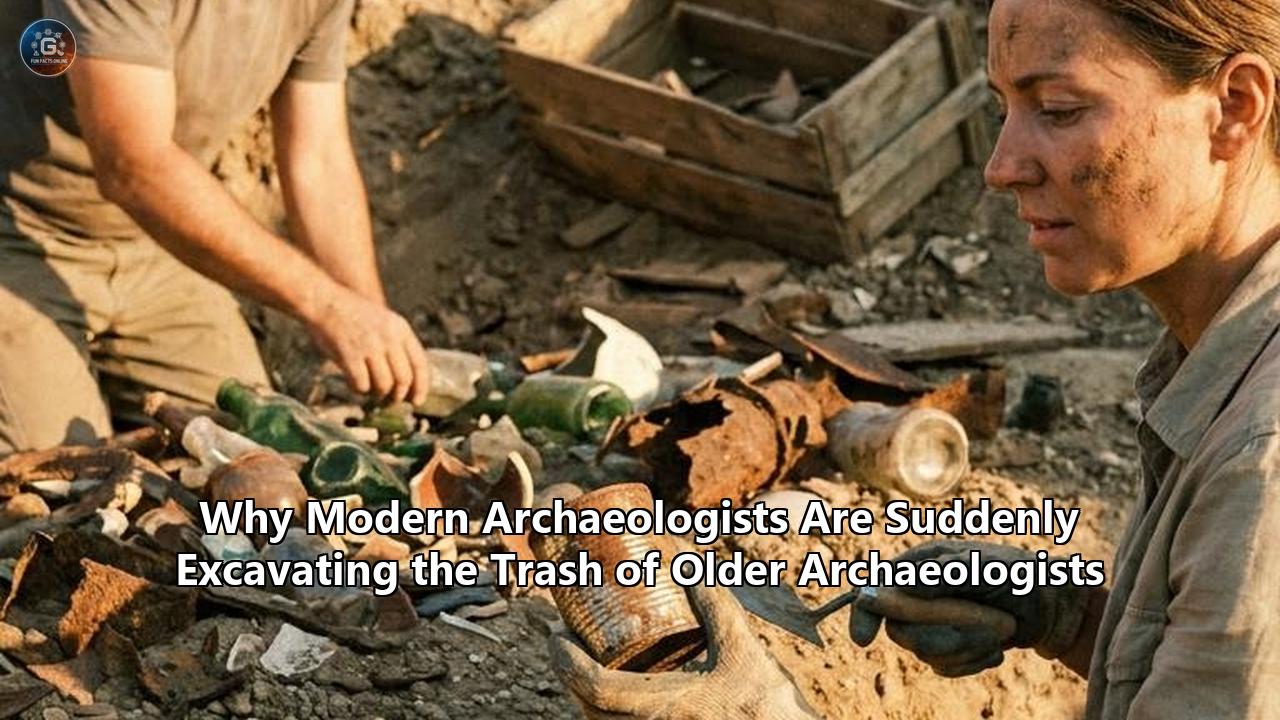
Modern teams examining the 100-year-old dumps at sites in the Middle East and Europe are finding that the "trash" has formed its own micro-environments. A spoil heap from 1910 might contain ancient Roman pottery rubbing against a discarded 19th-century French medicine flask, a 1920s newspaper, or a tin can left behind by the early laborers.
Far from viewing this as mere contamination, historians view these mixed contexts as a dual record. The spoil heap tells the story of the ancient civilization that made the pottery, alongside the story of the early modern laborers who dug it up. At the Damascus Citadel, researchers excavating older deposits noted that the 20th-century trash was often more revealing than the official excavation diaries. The diaries detailed what the early archaeologists wanted the world to see; their trash revealed what they actually ate, drank, and discarded when they thought no one was looking.
Looking Forward: The Next Era of Excavation
As the discipline moves deeper into the late 2020s, the boundary between "ancient ruin" and "modern trash" will continue to blur. The Girsu Project is scheduled to conclude its current funding phase in late 2026, by which time the team expects to have fully mapped the spatial relationship between the Victorian spoil heaps and the remaining in-situ architecture of the Sumerian administrative center.
Watch for an increase in dedicated remote sensing surveys targeting not ancient monuments, but the artificial landscapes of 19th-century resource extraction. Across Europe, LiDAR mapping is currently being deployed to catalog massive extractive waste-mounds—whether from flint mining at Grimes Graves, Roman gold washing at Dolaucothi, or early 20th-century antiquarian trenching.
The unresolved question hanging over this new methodology is how far forward the timeline extends. Today, archaeologists are happily sorting through the 120-year-old trash of Edwardian excavators. But modern civilization is currently generating massive, engineered landfills lined with plastic barriers and methane-capture pipes. While organic matter rapidly degrades, the plastics, ceramics, glass, and technological waste we deposit today remain perfectly preserved in anaerobic tombs.
Future researchers will not need to hunt for scattered middens; they will inherit highly structured mountains of our daily discards. Just as Dr. Rey’s team in Iraq is currently decoding the frantic, disorganized methods of 19th-century diggers through the dirt they threw away, the archaeologists of the 22nd century will undoubtedly turn their trowels toward the vast, sealed landfills of 2026. They will bypass our digital records—knowing them to be curated, biased, and highly ephemeral—and look directly at the physical trash.
For now, the focus remains firmly on correcting the errors of the past. The meticulous extraction of a single missing cuneiform fragment from a dusty Iraqi spoil heap, or a tiny Neolithic sickle blade from a Czech cave dump, proves that the discipline of archaeology is finally learning to recycle. The most profound discoveries in the next decade will not necessarily come from breaking new ground, but from having the humility to sift through the dirt our predecessors walked away from.
Reference:
- https://iaassyriology.com/in-the-spotlight-the-girsu-project-with-sebastien-rey/
- https://www.britishmuseum.org/research/projects/girsu-project
- https://www.researchgate.net/publication/396465595_Re-excavation_of_cultural_deposits_at_S_veduv_stul_cave_in_the_Moravian_Karst_Czech_Republic
- https://en.wikipedia.org/wiki/Spoil_(archaeology))
- https://brigantesnation.com/guide-spoil-heaps/
- https://scrca.foscl.org.uk/what-are-spoil-tips-and-how-were-they-formed
- https://www.rusthallvillage.org/images/Hoxne-Test-Pit-Guidebook.pdf
- https://mss-detecting.org/news/f/cookham-update-2024
- https://journals.uclpress.co.uk/ai/article/id/3700/
- https://leicsfieldworkers.org/wp-content/uploads/2021/05/leicestershire-fieldworkers-fieldwork-guide-6v3-a-quick-guide-to-archaeological-excavation.pdf
- https://www.youtube.com/watch?v=VE9b0tG5Rtw
- https://www.quora.com/Do-archaeologists-come-up-with-a-systematic-plan-for-digging-into-old-landfills-and-garbage-dumps-after-an-appropriate-time-has-passed-and-what-would-be-appropriate-100-years-150-or-more
- https://www.quora.com/If-archaeologists-1000-years-in-the-future-dig-up-landfills-what-will-they-find