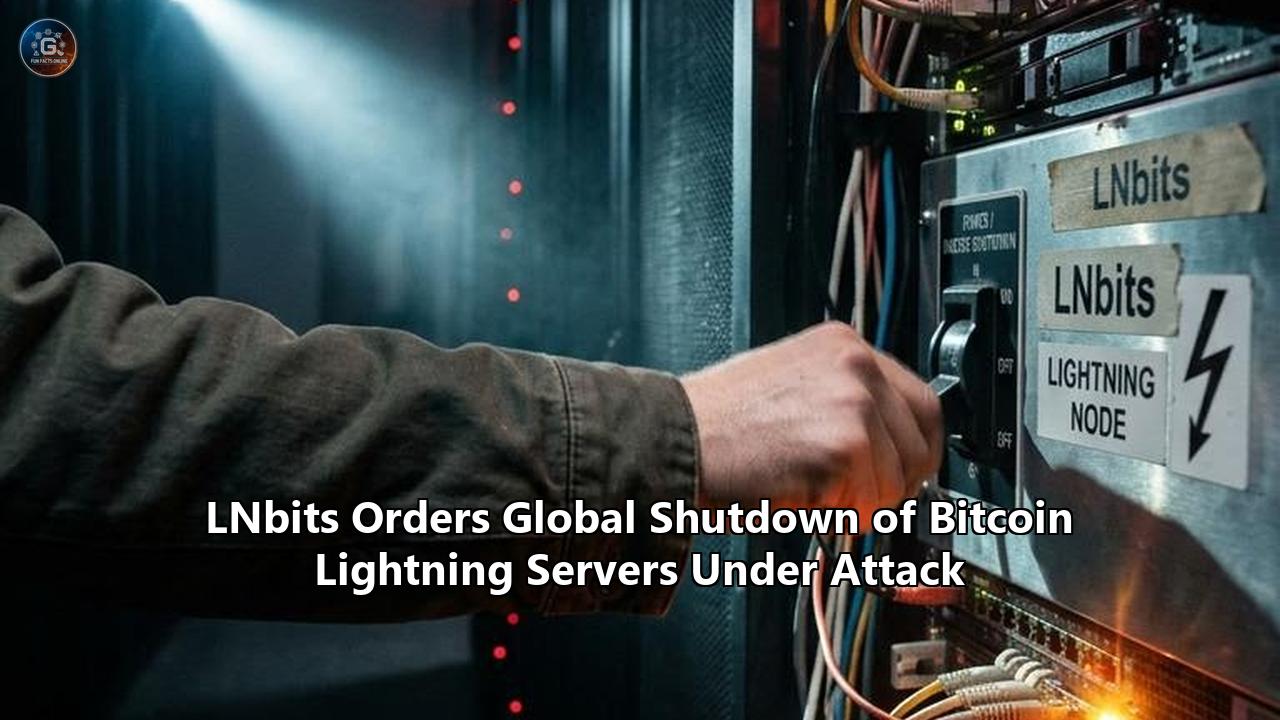
At 13:56 UTC on Sunday, November 8, 2026, the core developers of LNbits issued an unprecedented directive to thousands of Bitcoin node runners worldwide: turn off your servers immediately.
The advisory was not a routine request to schedule an upcoming maintenance window. It was an emergency order triggered by a wave of coordinated, automated cyberattacks targeting self-hosted instances of the popular open-source Lightning Network accounting and wallet platform. Within minutes, LNbits co-founder Ben Arc took to developer channels and social platforms to plead with operators to sever their connections to the Lightning Network. Simultaneously, the project pulled the plug on its own hosted cloud infrastructure at my.lnbits.com, locking down servers to prevent further automated bleeding of customer and merchant balances.
The attack had already produced documented financial casualties. In the Netherlands, Kevin Ravensberg, operator of the Telegram-based Lightning tipping service BitTipBot, watched helplessly as an attacker created unauthorized accounts on his LNbits instance and systematically drained 2,285,545 satoshis (approximately 0.023 BTC) over a five-hour window spanning 09:22 to 14:00 UTC. The draining concluded just minutes before the development team could sound the global alarm.
The incident struck at the heart of the Bitcoin Lightning ecosystem. Unlike traditional banking networks where fraudulent wire transfers can be recalled or on-chain Bitcoin transactions where mempool congestion offers a narrow window for fee-bumped cancellation, Lightning Network transactions settle in milliseconds across private channels. Once outbound satoshis hop across routing nodes and clear the network, they are irretrievably gone.
By the time the emergency shutdown notice crossed public forums, merchants running point-of-sale terminals, developers powering Nostr tipping bots, and operators hosting custodial sub-wallets for communities across Latin America, Africa, and Europe were forced to pull their payment rails offline. The emergency led to a high-stakes, 48-hour development race that resulted in the emergency release of LNbits version 1.7.0 on November 10, accompanied by a comprehensive architectural recovery playbook.
This incident exposes a fundamental structural tension within decentralized financial infrastructure: while the Bitcoin base chain and underlying Lightning Network routing daemons held firm without a glitch, the application layer built to make those networks usable introduced an attack vector that threatened millions of satoshis.
Defining the Challenge: Application-Layer Fragility in a Hot-Wallet World
To understand the systemic problem exposed by this attack, one must separate the core protocols of Bitcoin from the middleware systems that businesses use to interact with them. Neither Bitcoin’s base-chain proof-of-work consensus nor the Lightning Network’s Basis of Lightning Technology (BOLT) channel specifications failed. The cryptographic integrity of Hash Time-Locked Contracts (HTLCs), payment channel commitments, and routing nodes running implementations like Lightning Network Daemon (LND) or Core Lightning (CLN) functioned as designed.
The failure occurred entirely within Layer 3—the application and accounting middleware.
+-------------------------------------------------------------+
| Layer 3: Application / Middleware (LNbits, BTCPay, Wallets) |  <-- ATTACK SURFACE
+-------------------------------------------------------------+
                              |
                              v  (Macaroons / REST APIs)
+-------------------------------------------------------------+
| Layer 2: Lightning Routing Nodes (LND, Core Lightning, Eclair)
+-------------------------------------------------------------+
                              |
                              v  (On-Chain Commitments)
+-------------------------------------------------------------+
| Layer 1: Bitcoin Base Blockchain (Proof-of-Work Consensus)   |
+-------------------------------------------------------------+
LNbits is a lightweight, Python-based financial engine designed to sit directly on top of a Lightning node. In native Lightning deployments, running a dedicated node for every employee, sub-merchant, or application is technically and financially impractical. Nodes require liquidity management, on-chain channel opening fees, and persistent watchtower monitoring. LNbits solves this by acting as a multi-tenant accounting system. A single operator connects one well-capitalized Lightning node to LNbits. LNbits then partitions that node's aggregate liquidity into thousands of independent, ledger-based virtual wallets, complete with granular API keys, point-of-sale interfaces, paywalls, and specialized plugins.
This convenience creates a critical architectural dilemma. An LNbits server is, by definition, a hot-wallet orchestrator. To generate invoices, receive inbound payments, and execute outbound payments for its users, LNbits must hold live credentials to the underlying Lightning node. In LND setups, this typically means storing an administrative or invoice-and-payment macaroon—a cryptographic bearer token granting programmatic access to spend funds—inside the LNbits configuration.
When an application layer holds spending credentials, any logic vulnerability inside that application becomes a direct financial conduit to the node's liquid funds. If a malicious actor bypasses access control inside LNbits, they do not just corrupt an internal SQL database; they command the underlying Lightning daemon to route satoshis out of active payment channels to an external destination under their control.
The discovery of the LNbits security vulnerability revealed that thousands of server operators globally were running configurations where open web-facing interfaces had direct, unrestricted conduits to automated withdrawal engines. The attack proved that in decentralized finance, application-layer convenience without strict, defense-in-depth isolation transforms accounting middleware into an existential liability for node liquidity.
Anatomy of the Attack: What Went Wrong Inside the System
The crisis began unfolding in the early European morning hours of Sunday, November 8, 2026. Threat actors initiated automated reconnaissance scripts scanning public IP spaces and Shodan indices for exposed LNbits web servers.
The attack capitalized on a combination of permissive default configurations, an exploitable modular extension, and a severe Server-Side Request Forgery (SSRF) flaw in how the platform handled internal request routing.
+------------------+
| Automated Botnet |
+------------------+
         |
         | 1. Discovers public instance & exploits open user registration
         v
+-----------------------------------------------------------------+
| LNbits Web Frontend (FastAPI / Starlette)                       |
+-----------------------------------------------------------------+
         |
         | 2. Injects malicious callback payload via vulnerable extension
         v
+-----------------------------------------------------------------+
| Modular Extension (Paywall / Internal HTTP Client)             |
+-----------------------------------------------------------------+
         |
         | 3. Server-Side Request Forgery (SSRF) hits loopback (127.0.0.1)
         v
+-----------------------------------------------------------------+
| LNbits Core Admin / Internal APIs (Bypasses Auth & Firewalls)   |
+-----------------------------------------------------------------+
         |
         | 4. Ledger credited with unauthorized internal balances
         v
+-----------------------------------------------------------------+
| LNbits Payment Engine (Issues programmatic spend command)       |
+-----------------------------------------------------------------+
         |
         | 5. Valid payment command executed via Admin Macaroon
         v
+-----------------------------------------------------------------+
| Lightning Node Daemon (LND / Core Lightning)                    |
+-----------------------------------------------------------------+
         |
         | 6. Settles HTLC across public channels in milliseconds
         v
+------------------------------------+
| Attacker's External Lightning Node |  <-- FUNDS PERMANENTLY EXTRACTED
+------------------------------------+
The Initial Precaution: The Paywall Add-On
At 12:33 UTC, the official LNbits account posted its first warning, instructing operators who had the Paywall extension installed to disable it immediately. Paywall is an add-on that enables content creators to lock digital media, articles, or downloads behind micro-payments. To facilitate dynamic payment checking and webhooks, the extension accepts callback URLs and external triggers.
Security researchers tracking the incident noted that attackers were passing crafted payloads into extension endpoints that interacted with LNbits’ internal asynchronous HTTP clients. Because earlier iterations of the software did not strictly isolate extension endpoints from internal server resources, these inputs created an opening for attackers to manipulate server-side communications.
Escalation: Bypassing Access Control and Faking Internal State
Within 80 minutes of the initial Paywall alert, the development team discovered that the threat was not confined to a single extension. The core architecture allowed attackers to exploit account creation routines.
In many default self-hosted deployments of LNbits, open user registration was enabled. Anyone visiting the server's root URL could create a new account. Under normal conditions, a newly registered user receives an empty wallet with zero satoshis and an isolated API key. They can invoice funds and spend what they deposit, but they cannot access the balances of other users or the node runner's primary reserve.
However, the attackers chained open registration with an SSRF vulnerability that allowed them to trick the local LNbits server into querying its own administrative endpoints (loopback requests to 127.0.0.1 or localhost). By masquerading as an internal system service, the attackers bypassed administrative authentication checks.
This allowed the rogue accounts to falsely validate payment states or manipulate internal database ledgers, reflecting positive balances within the software's SQLite or PostgreSQL database without depositing actual funds into the node's Lightning channels.
The Instantaneous Extraction Loop
Once the rogue account was credited with an artificial balance on the internal ledger, the attacker executed the final phase: the Lightning withdrawal.
The attacker generated a series of standard Lightning payment requests (invoices) from an external node they controlled. Using the newly created, artificially funded LNbits wallet, they commanded the LNbits server to pay those invoices.
The LNbits payment orchestrator, reading what it believed to be a legitimate internal ledger balance, retrieved the node’s stored administrative credentials (such as LND’s admin.macaroon) and instructed the underlying routing node to dispatch real satoshis across the public network.
The underlying Lightning daemon had no way of knowing that the internal application ledger had been manipulated. It simply executed a valid cryptographic instruction from an authorized client, routing outbound HTLCs through network channels until they reached the attacker’s destination node.
Attack Progression Timeline (November 8, 2026):

09:22 UTC - Attacker begins creating accounts and issuing drain requests on target servers
12:33 UTC - LNbits core team flags Paywall extension; issues initial disable advisory
13:56 UTC - Full crisis declared; LNbits issues global emergency shutdown order
14:00 UTC - Final fraudulent transaction clears against BitTipBot instance (2.28M sats total)
17:18 UTC - LNbits disables hosted instances at my.lnbits.com
In the case of BitTipBot, operator Kevin Ravensberg confirmed that unauthorized accounts were spun up repeatedly over nearly five hours, skimming small to mid-sized payments continuously. By the time Ravensberg identified the anomalous traffic and terminated the service at 14:00 UTC, the attackers had extracted 2,285,545 satoshis.
Because Lightning payments clear outside the base-chain block verification process and utilize onion-routed Sphinx packets that hide intermediate nodes from the sender and receiver, tracking where those satoshis went became nearly impossible once they settled.
The Technical Solution: Inside Pull Request #4310 and Version 1.7.0
When the severity of the exploit became clear, the LNbits maintainer team, led by Ben Arc, initiated an intensive remediation cycle. They faced a dual challenge: they had to push code that eliminated the attack vector while simultaneously convincing an autonomous, decentralized operator base to leave their payment gateways dark until verified patches were ready.
Work centered on two major pull requests merged into the project's development branch: PR #4310 and PR #4313. These patches directly dismantled the exploit chain that made the attack possible.
Neutralizing SSRF and Internal Loopbacks
The technical core of the fix, encapsulated in PR #4310, overhauled the way LNbits interacts with the network. Titled "fix: centralize SSRF protection and block self-targeted requests," the patch introduced an aggressive filtering layer across all outbound HTTP requests executed by the backend.
# Conceptual representation of centralized request filtering introduced in PR #4310
import ipaddress
import socket
from urllib.parse import urlparse
import httpx

BLOCKED_IP_NETWORKS = [
    ipaddress.ip_network("127.0.0.0/8"),      # IPv4 Loopback
    ipaddress.ip_network("::1/128"),          # IPv6 Loopback
    ipaddress.ip_network("10.0.0.0/8"),       # Private RFC 1918
    ipaddress.ip_network("172.16.0.0/12"),    # Private RFC 1918
    ipaddress.ip_network("192.168.0.0/16"),   # Private RFC 1918
    ipaddress.ip_network("169.254.0.0/16"),   # Link-Local / Cloud Metadata
]

def validate_outbound_url(target_url: str):
    parsed = urlparse(target_url)
    hostname = parsed.hostname
    if not hostname:
        raise ValueError("Invalid target destination")

    # Resolve target hostname to evaluate underlying IP addresses
    resolved_ips = socket.getaddrinfo(hostname, None)
    for family, _, _, _, sockaddr in resolved_ips:
        ip_addr = ipaddress.ip_address(sockaddr[0])
        for blocked_net in BLOCKED_IP_NETWORKS:
            if ip_addr in blocked_net:
                raise SecurityException(f"Outbound request to internal resource blocked: {ip_addr}")
Prior to this change, individual extensions could utilize Python’s httpx or requests libraries to communicate with external APIs, such as sending webhooks or querying remote LNURL parameters. If an extension failed to sanitize user-provided URLs, an attacker could supply a callback pointing to http://127.0.0.1:5000/api/v1/..., causing the server to send an authenticated HTTP request to its own administrative interface.
PR #4310 centralized all outbound network calls through a hardened wrapper. Before any network socket is opened, the destination domain is resolved to its underlying IP addresses. The software cross-references these IPs against a strict denylist containing:
- Loopback addresses (127.0.0.0/8, ::1)
- Standard private networks defined by RFC 1918 (10.0.0.0/8, 172.16.0.0/12, 192.168.0.0/16)
- Link-local and cloud provider metadata addresses (169.254.169.254)
- Custom local service ports
If a user or extension attempts to trigger a request that resolves to an internal interface, the application terminates the request immediately and writes an alert to the security audit log.
Closing Open Registration
The second critical mitigation addressed account creation. In versions prior to 1.7.0, an unconfigured server allowed any visitor to establish a user session. PR #4310 flipped this default posture.
Starting with LNbits 1.7.0, public account registration is disabled out of the box. New installations require the operator to define explicit administrative credentials during initial deployment. Additional users can only be onboarded if an administrator explicitly enables public registration via a toggled setting or manually issues an invitation link backed by cryptographic authorization tokens.
The Official Release of Version 1.7.0
On November 10, 2026, the project released LNbits version 1.7.0. The project’s security advisory was unsparing in its assessment:
"Following the recent vulnerability in LNbits discovered on 8 November all operators must upgrade to LNbits 1.7.0 before running LNbits. Versions prior to 1.7.0 are affected, and funds running on prior versions of LNbits are at risk of being stolen".
The production release delivered a comprehensive security overhaul alongside the emergency patches:
- Time-Based One-Time Password (TOTP) Authentication: Native two-factor authentication for administrative accounts, closing off brute-force credential stuffing attacks against node dashboards.
- Separation of On-Chain Operations: Introduction of isolated on-chain wallet handling to prevent application plugins from interacting with base-chain node balances.
- BOLT12 Offer Integration: Upgraded payment primitives supporting reusable, cryptographically authenticated payment offers, reducing reliance on insecure external HTTP polling for payment state verification.
- Extension Sandboxing and Dependency Hardening: Upgraded dependencies across the core framework (migrating key components to Pydantic v2 for strict type and schema enforcement) and restricted permissions for third-party extensions.
The Node Operator Recovery Runbook: Remediating Beyond Code
Releasing patched code solved only half the problem. The broader issue confronting developers was that thousands of decentralized instances were already potentially breached.
If an attacker had exploited an instance during the five-hour attack window on November 8, simply typing git pull or updating a Docker container to version 1.7.0 would not remove the attacker’s foothold. If an intruder had already obtained API keys, administrative passwords, or database credentials, they could reconnect to the server as soon as it came back online.
The LNbits security team issued an uncompromising recovery directive: do not just patch; rebuild, rotate, and isolate.
+-----------------------------------------------------------------+
| OPERATOR RECOVERY PROTOCOL (LNbits v1.7.0)                      |
+-----------------------------------------------------------------+
                               |
                               +--> 1. FREEZE & PRESERVE
                               |    Preserve server logs; halt running daemons
                               |
                               +--> 2. PROVISION PRISTINE ENVIRONMENT
                               |    Deploy fresh OS / VPS; do not trust old image
                               |
                               +--> 3. DEPLOY HARDENED VERSION
                               |    Install v1.7.0 with registration disabled
                               |
                               +--> 4. EXECUTE SUPER-ADMIN KEY RESET
                               |    Revoke all wallet API keys and extension tokens
                               |
                               +--> 5. ROTATE FUNDING SOURCE CREDENTIALS
                               |    Regenerate LND Macaroons / Core Lightning Runes
                               |
                               +--> 6. AUDIT & RE-ESTABLISH EXTENSIONS
                               |    Re-bind NWC, LNDHub, TPOS, Bolt Card endpoints
                               |
                               +--> 7. ENFORCE COLD-STORAGE THRESHOLDS
                                    Sweep non-operational channel balances offline
1. The Fresh-Server Mandate
The official upgrade guidance warned operators that updating software in place cannot evict an adversary who has achieved unauthorized persistence.
Node operators were instructed to provision an entirely new operating system environment. The old virtual machine or bare-metal environment had to be audited, its logs preserved for forensic analysis, and its storage wiped to ensure that persistent web shells, rogue background processes, or modified Python site-packages were eliminated.
2. Comprehensive Super Admin Key Invalidation
Once LNbits 1.7.0 was deployed on clean infrastructure, administrators had to break all active API connections. Inside the software's management dashboard, developers implemented an emergency reset mechanism under Settings → Users → Reset Wallet Keys.
Triggering this command immediately invalidates every user-level invoice key, admin key, and read-only API secret across the entire database. While this clean sweep temporarily disabled legitimate point-of-sale terminals, e-commerce plugins, and mobile wallet integrations, it guaranteed that any API keys exfiltrated by attackers during the compromise were rendered useless.
3. Funding-Source Credential Invalidation
The most critical step in the recovery sequence occurred outside of LNbits itself. Because LNbits stores the credentials needed to command the underlying Lightning node, administrators had to assume those credentials had been read.
For nodes connected to LND, operators were instructed to access their underlying command-line interface and revoke their active macaroons:
# Invalidate existing administrative macaroons on LND
lncli revokemacaroon <macaroon_id>

# Generate a fresh, constrained macaroon for LNbits v1.7.0
lncli bakemacaroon --save_to=lnbits_new.macaroon \
  uri:/lnrpc.Lightning/SendPaymentSync \
  uri:/lnrpc.Lightning/AddInvoice \
  uri:/lnrpc.Lightning/LookupInvoice \
  uri:/lnrpc.Lightning/GetInfo \
  uri:/lnrpc.Lightning/ListChannels
By revoking the old macaroons and baking new ones with specific URI caveats rather than blanket root administrative access, operators closed the door to any attacker attempting to control the node directly using intercepted keys.
For Core Lightning (CLN) operators, the remediation required invalidating existing administrative runes and generating restricted runes strictly limited to invoice creation and outbound payment routing.
4. Extension Ecosystem Audit
The remediation protocol required a manual audit of every active extension. The project specifically highlighted plugins that manage persistent network sessions or handle sensitive signing material:
- Nostr Wallet Connect (NWC) Provider: Revoking and regenerating all Nostr pairing secrets to prevent unauthorized remote zapping.
- LNDHub: Invalidating all bearer tokens used by mobile wallet clients such as BlueWallet or Zeus.
- Bolt Cards: Re-keying NFC payment cards running on off-chain authentication services.
- TPOS (Terminal Point of Sale): Re-authorizing merchant point-of-sale hardware terminals.
- Bleskomat and FOSSA: Regenerating API access tokens for physical Bitcoin hardware ATMs and automated cash-to-Lightning kiosks.
The Open-Source Dilemma: Infrastructure Scale vs. Security Resources
The emergency shutdown of LNbits is not an isolated anomaly. It is the latest manifestation of a structural crisis affecting open-source Bitcoin and Lightning infrastructure.
Just one week prior to the LNbits crisis, on November 1, 2026, BTCPay Server—the industry-standard self-hosted Bitcoin payment processor—was forced to issue an urgent security advisory and patch regarding an API key vulnerability. Both incidents underscore how modern commerce relies heavily on community-maintained, volunteer-led open-source software.
+-----------------------------------------------------------------+
| THE APPLICATION LAYER SECURITY GAP                             |
+-----------------------------------------------------------------+
|                                                                 |
|   INSTITUTIONAL / MERCHANT LIQUIDITY:                           |
|   Tens of millions of dollars in active, routable Bitcoin       |
|                                                                 |
|   APPLICATION CODEBASE:                                         |
|   Complex Python/FastAPI stacks, modular plugin architectures,   |
|   hundreds of asynchronous API endpoints                        |
|                                                                 |
|   MAINTAINER TEAMS:                                             |
|   Small core developer groups operating primarily on community   |
|   grants, open-source sponsorships, and personal savings        |
|                                                                 |
+-----------------------------------------------------------------+
LNbits is not an enterprise software giant with hundreds of internal security engineers. It is an open-source project founded by Ben Arc, built with contributions from independent developers globally. The software serves a vast audience: small merchants accepting Bitcoin in El Salvador, independent developers creating games on Nostr, non-profit organizations collecting donations, and individuals running private family banks.
This model delivers accessibility. Anyone with a Raspberry Pi or an inexpensive cloud server can install LNbits in ten minutes, instantly converting an isolated node into a full-featured digital payments bank. But that accessibility brings an asymmetric threat landscape.
Sophisticated cybercriminal syndicates deploy automated scanning tools, fuzzing frameworks, and exploit suites against self-hosted infrastructure. These attackers know that while breaking Bitcoin's SHA-256 cryptographic hashing or cracking Lightning channel commitment scripts is practically impossible, finding a logic flaw or an unvalidated input in a web form takes only a matter of hours or days.
The investigation into the LNbits security vulnerability highlights the limitations of traditional, point-in-time security audits. Earlier in 2026, cybersecurity firm V12 completed a formal code audit of LNbits, discovering authentication-cache bypasses and integration flaws that were remediated in version 1.6. Yet despite professional auditing, the interplay between dynamic extensions, default account creation settings, and internal HTTP request routing left exploitable gaps that attackers leveraged in production.
In dynamic, modular ecosystems where extensions can be installed from remote repositories, a clean audit of the core engine does not guarantee security across every combination of plugins, network environments, and reverse-proxy configurations.
Architectural Blueprints: Hardening the Next Generation of Lightning Middleware
To prevent future disruptions, security engineers and protocol designers are advancing concrete architectural solutions aimed at isolating application middleware from liquid funds. The consensus across the developer community is clear: self-hosted financial platforms must adopt strict defense-in-depth engineering principles.
+-------------------------------------------------------------+
| PROPOSED HARDENED LIGHTNING ARCHITECTURE                    |
+-------------------------------------------------------------+

                      UNTRUSTED INTERNET
                              |
                              v
+-------------------------------------------------------------+
| Reverse Proxy (Caddy / Nginx)                               |
| - Enforces Rate Limiting, Geo-blocking, WAF                 |
| - Restricts Admin Paths (/admin) to WireGuard/Tor           |
+-------------------------------------------------------------+
                              |
                              v
+-------------------------------------------------------------+
| Application Middleware (LNbits Core Engine)                 |
| - Public Registration Disabled                              |
| - Outbound Egress Filter Blocks All Internal RFC 1918 IPs   |
| - Extensions Isolated in WebAssembly (Wasm) Micro-Runtimes  |
+-------------------------------------------------------------+
                              |
                              v  (Restricted Spend Macaroon)
+-------------------------------------------------------------+
| Liquidity Proxy / Policy Daemon (e.g., Circuit Breaker)     |
| - Enforces Velocity Limits (Max X sats per hour)            |
| - Requires Time-Locks on Anomaly Spikes                     |
+-------------------------------------------------------------+
                              |
                              v  (Direct RPC)
+-------------------------------------------------------------+
| Lightning Routing Node (LND / Core Lightning)               |
| - Minimal Hot Liquidity Online                              |
| - Automated Sweeps Route Excess Balances to Cold Storage    |
+-------------------------------------------------------------+
1. Enforcing Strict Macaroon and Rune Constraints
Operators must abandon the practice of passing full administrative bearer tokens into web applications. Middleware should only ever interact with proxy layers or use credentials governed by cryptographic caveats:
- Spending Caps: An application macaroon should explicitly contain caveats limiting outbound transactions to a maximum threshold per transaction (e.g., no single payment exceeding 100,000 satoshis).
- Rate Limits: Middleware credentials should enforce velocity controls, ensuring that no more than a pre-defined sum of satoshis can leave the node within any rolling 60-minute window.
- Namespace Isolation: Applications should be cryptographically barred from accessing channel management, peers, on-chain wallets, or chain-signing RPC calls.
2. Sandboxing Modular Extensions
The LNbits crisis exposed the danger of running modular extensions within the same process space and memory boundaries as the primary database and payment engine.
Architects are actively exploring WebAssembly (Wasm) sandboxing and containerized microservice runtimes for plugins. Under an isolated model:
- An extension cannot import arbitrary networking libraries or open direct network sockets.
- Extensions must declare their requested capabilities (e.g., network.outbound, wallet.invoice, database.read) in a cryptographically signed manifest during installation.
- Any attempt by an extension to interact with an unapproved API or query an internal server address is trapped and terminated by the runtime engine before the request touches the host kernel.
3. Implementing Policy Firewalls and Velocity Proxies
Between the application middleware and the Lightning node, operators are increasingly inserting specialized Lightning policy daemons, such as Lightning Labs’ Circuit Breaker or custom gRPC interceptors.
A velocity proxy intercepts every payment request sent by LNbits before it reaches LND or Core Lightning. If an attacker initiates an automated loop draining thousands of satoshis in rapid succession, the proxy detects the anomalous velocity spike, trips an emergency circuit breaker, and halts outbound payments automatically—regardless of what the application software requests.
4. Operational Hygiene: Restricting the Hot-Wallet Surface
The final and most crucial line of defense remains operational discipline. The LNbits maintainers emphasized a cardinal rule of digital asset security:
"LNbits is a hot wallet. Hot wallets carry risk as the credentials needed to spend funds are available to an online system... Keep only the funds needed for day-to-day operations online, regularly review balances and outgoing payments, and send excess funds to an onchain wallet whose spending keys are kept offline".
Node operators running commercial payment gateways must implement automated liquidity sweeps. By configuring automated scripts that monitor aggregate balances and route surplus satoshis off-node—either closing loop funds into multisig cold storage or moving them via submarine swaps to hardware-secured vaults—operators can ensure that even if an application-layer zero-day occurs, the maximum possible loss is strictly capped.
Hardening Checklist for Lightning Infrastructure Administrators
For developers, systems engineers, and node runners maintaining LNbits deployments, ensuring infrastructure resiliency requires an active, multi-stage defense. The following technical checklist compiles the mandatory configurations needed to secure a deployment against application-layer exploits:
| Administrative Domain | Mandatory Security Configuration | Operational Objective |
|---|---|---|
| Code Base & Versioning | Upgrade immediately to LNbits v1.7.0 or later. | Eliminates known SSRF vectors and patches account-creation vulnerabilities. |
| User Registration | Set LNBITS_ALLOWED_USERS and disable public registration in server settings. | Prevents anonymous attackers from generating rogue wallets and exploiting internal state. |
| Authentication Controls | Enforce TOTP Two-Factor Authentication across all Super Admin and Admin profiles. | Protects administrative management consoles from brute-force and credential-stuffing attacks. |
| Network Egress (Firewall) | Configure outbound firewall rules (iptables / nftables) blocking port 80/443 calls to private subnets. | Enforces network-level isolation, preventing the application from querying loopback or LAN infrastructure. |
| Node Credentials | Revoke administrative macaroons; bake URI-restricted macaroons for LNbits. | Ensures compromised middleware cannot execute on-chain sweeps, close channels, or access root node commands. |
| Reverse Proxy Hardening | Place server behind Caddy/Nginx; restrict /admin endpoints to internal VPN or Tor hidden services. | Eliminates exposure of management dashboards to public scanning engines and botnets. |
| Liquidity Management | Establish automated off-node balance sweeps and enforce outbound channel velocity caps. | Restricts active hot liquidity to minimal operational requirements, neutralizing large-scale drain attempts. |
What Happens Next: Industry Milestones and Forward Outlook
The global shutdown directive of November 8, 2026, marks a watershed moment in the maturation of Bitcoin's secondary and tertiary layers. As nodes slowly rejoin the network running version 1.7.0, the broader community is monitoring several immediate milestones and unresolved challenges:
- The Full Technical Post-Mortem and CVE Publication: The LNbits development team has promised a detailed technical report outlining the exploit mechanics, the specific role of the Paywall extension, and formal Common Vulnerabilities and Exposures (CVE) identification. This documentation will be critical for security teams auditing other Lightning management platforms.
- Estimating the Global Blast Radius: While Kevin Ravensberg’s BitTipBot is the only confirmed instance with a publicly quantified financial loss (2.28 million sats), security researchers are scanning the mempool and routing analytics to determine whether other silent, unannounced drains occurred before servers went offline.
- Decentralized Alerting Mechanisms: The incident revealed that coordinating an emergency shutdown across thousands of sovereign, self-hosted node runners is messy and slow. Because independent operators do not check developer social media feeds constantly, many servers remained online and vulnerable for hours after the alarm sounded. Discussions are now accelerating around standardizing cryptographically authenticated security broadcast channels—potentially utilizing signed Nostr events (NIPs) embedded directly into node operating systems like Umbrel, Start9, and RaspiBlitz—to automatically alert administrators or pause services when zero-day attacks hit production networks.
The events of November 2026 demonstrate that building global, non-custodial financial rails requires vigilance that extends far beyond the base blockchain consensus. When transactions settle with finality in milliseconds, there is no margin for error in the application layer. The resolution of this crisis proves that while open-source software is susceptible to coordinated attack, the speed of its decentralized developer base remains its greatest defense. The imperative for operators everywhere is clear: audit your stack, constrain your credentials, and assume every online system is a live target.
Reference:
- https://www.tftc.io/lnbits-emergency-shutdown-active-attack-funds-drained
- https://www.kucoin.com/news/flash/lnbits-urges-users-to-shut-down-servers-amid-security-attacks
- https://nodewitness.com/en/analysis/lnbits-tells-operators-shut-down-servers-after-attacks/
- https://coinness.com/en/news/1174981
- https://cyberdefendnews.com/lnbits-orders-emergency-server-shutdown-following-active-cyberattacks/
- https://www.bitkub.com/en/blog/lnbits-servers-urged-offline-due-to-lightning-vulnerability-wH6TrWG5GbKKHFmJa2PFpA
- https://thehackernews.com/2026/11/lnbits-urges-all-operators-to-shut-down.html
- https://aviatrix.ai/threat-research-center/lnbits-bitcoin-lightning-wallet-exploit-financial-theft-2026/
- https://bitcoinmagazine.com/news/lnbits-releases-1-7-0-urgent-security-update-after-november-8-attacks-drain-funds
- https://news.lnbits.com/news/lnbits-1-7-0-security-update
- https://www.reddit.com/r/Bitcoin/comments/1xrv3aw/lnbits_urges_bitcoin_lightning_server_operators/
- https://bingx.com/en/flash-news/post/lnbits-advises-users-to-shut-down-servers-after-reported-attacks-on-lightning-wallet-software
- https://docs.lnbits.com/guide/what-is-lnbits
- https://github.com/lnbits/lnbits
- https://cryptoslate.com/lnbits-disables-hosted-bitcoin-services-with-no-restart-timeline/
- https://www.cisa.gov/news-events/bulletins/sb25-097
- https://www.globalcryptopress.com/2026/11/anyone-with-server-running-lnbits-told.html
- https://bitcoinmagazine.com/news/lnbits-releases-1-7-0-urgent-security-update-after-november-8-attacks-drain-funds
- https://github.com/lnbits/inventory
- https://lnbits.github.io/
- https://github.com/raspiblitz/raspiblitz/blob/dev/CHANGES.md