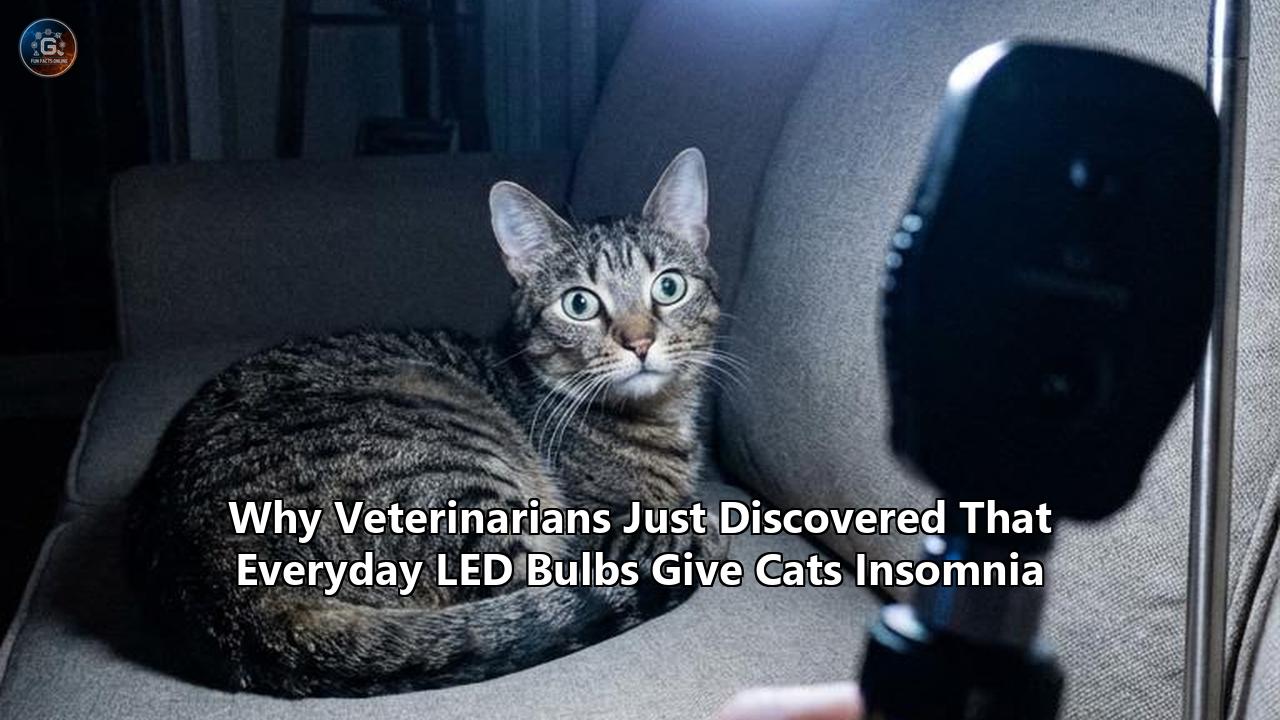
For millions of pet owners, the scenario is a nightly routine: the clock strikes 2:00 AM, and the family cat begins a relentless, vocal patrol of the house. They pace the hallways, paw at closed doors, and stare wide-eyed into the dark. Historically, veterinarians and behaviorists have dismissed this nocturnal restlessness as a quirky remnant of the feline predatory drive, jokingly referring to it as the "midnight zoomies." But a newly published investigation reveals a distinctly modern, technological culprit hanging directly overhead.
In March 2026, a landmark peer-reviewed study published in the journal iScience definitively proved that standard indoor lighting—specifically modern light-emitting diode (LED) fixtures—is severely disrupting the feline circadian rhythm. Researchers from Michigan State University, working alongside the veterinary technology firm PetPace, uncovered that the very bulbs designed to brilliantly and efficiently illuminate our homes are silently subjecting domestic cats to intense physiological stress, elevated cortisol levels, and chronic sleep deprivation.
The scientific consensus is rapidly shifting. What many owners have written off as behavioral quirks is actually a widespread case of LED lights cat insomnia, a modern environmental affliction triggered by blue-light toxicity and high-frequency flicker rates invisible to the human eye.
The findings fundamentally challenge how we design interior spaces for domestic animals. By tracking 101 cats using AI-powered health collars, the researchers generated continuous, high-resolution data that exposed the invisible trauma caused by everyday lighting. The solution, the data shows, requires a radical rethinking of the visual environment we force our pets to inhabit.
The Michigan State University Investigation
To understand exactly how artificial light fractures a cat's biological clock, the Michigan State University (MSU) research team, led by Dr. Alexandra Yaw alongside Drs. Hanne Hoffmann and Jackie Jacobs, engineered a meticulous environmental study. Funded by the MSU Department of Animal Science, the researchers set out to measure the precise impact of light quality and composition on the domestic cat (Felis catus).
The clinical setting was an animal shelter—an environment where feline stress is notoriously high and where bright, continuous overhead lighting is standard protocol. The Association of Shelter Veterinarians’ Guidelines for Standards of Care mandates lighting that promotes a safe work environment for human staff and allows for the effective observation of animals. For decades, this has meant blasting the kennels with cheap, high-intensity fluorescent tubes or commercial-grade LEDs.
The MSU researchers divided 101 shelter cats into distinct environmental groups during their first five days of arrival, a critical acclimation window. One group was housed under standard bright lights. A second group was placed under dim lighting. A third group was exposed to "sunset-like" dim, blue-depleted lights.
Because the mere presence of a human observer or a veterinary phlebotomist can instantly spike a cat's stress hormones, the team needed a way to measure physiological baseline data without touching the animals. They utilized the PetPace smart collar, a clinically validated device that uses artificial intelligence to monitor vital signs, locomotor activity, and behavior continuously and non-invasively. This allowed the team to track the exact minute-by-minute movement intensity and daily rhythms of the cats without human interference. To corroborate the behavioral data, researchers analyzed urinary cortisol levels, providing a biological metric of systemic stress.
The results were unequivocal. Across the board, cats exhibited clear circadian locomotor activity that peaked the moment the lights were turned on. However, the cats housed under standard bright lights maintained elevated levels of urinary cortisol. Furthermore, their nocturnal resting periods were highly fragmented. Conversely, the cats housed under the dim, blue-depleted lighting saw a notable and significant decrease in cortisol levels by day five. Their validated cat stress scores dropped, their sleep patterns stabilized, and their erratic nighttime pacing subsided.
"The PetPace collar was an essential tool in our study, providing continuous, high-resolution data allowing us to generate precise data that would have not been possible with spot-check methods," Dr. Yaw noted in the study's release.
The data confirms that the standard lighting environment in millions of homes and clinics is biologically hostile to feline neurochemistry. But the root of the problem extends far beyond mere brightness. The crisis is an intersection of ancient predatory anatomy and cutting-edge semiconductor physics.
The Anatomy of an Overloaded Eye
To grasp why a 60-watt equivalent LED bulb can trigger acute neurological distress in a cat, one must trace the evolutionary engineering of the feline eye. Cats are obligate carnivores and crepuscular hunters, meaning their visual systems evolved over millions of years to operate at peak efficiency during the low-light hours of dawn and dusk.
The mammalian eye relies on two primary types of photoreceptor cells embedded in the retina: cones, which detect color and function best in bright light, and rods, which detect shape, motion, and operate in extreme dimness. The human retina is heavily populated with cones, optimized for a diurnal, sunlit existence. The feline retina, by contrast, is dominated by rods. Cats possess roughly three times as many rods as humans.
However, the sheer volume of rods is only half the equation. The true amplifier of feline vision is a specialized layer of iridescent retroreflective tissue located immediately behind the retina, known as the tapetum lucidum (Latin for "bright tapestry").
When light enters a human eye and strikes the retina, whatever photons are not immediately absorbed by the photoreceptors are lost, absorbed by the dark tissue at the back of the eye. In a cat, the tapetum lucidum acts as a biological mirror. Made up of intricate cells containing riboflavin crystals—a highly reflective form of Vitamin B—this layer bounces unabsorbed light back through the retina, giving the rods a second chance to capture the visual data. This constructive interference of light waves effectively multiplies the ambient illumination.
Because of their massive, rapidly dilating pupils, their rod-dense retinas, and the reflective power of the tapetum lucidum, a cat can see perfectly in environments that contain only one-sixth of the light required for human vision.
This evolutionary masterpiece allows a leopard to navigate a dense jungle canopy at midnight, but it becomes a profound liability in a modern residential living room. When a human turns on a standard 800-lumen LED overhead light, the human visual cortex registers a comfortable, appropriately lit room. The feline eye, artificially forced to process that same 800 lumens through a hyper-sensitive tapetal amplifier, registers blinding, stadium-level intensity. The sheer volume of photons aggressively stimulates the optic nerve, sending continuous, high-alert signals to the brain.
The Silent Strobe: Pulse Width Modulation and Flicker Fusion
The intensity of the light is compounded by the mechanical delivery of the photons. The second, and perhaps most insidious, factor driving LED lights cat insomnia is the temporal frequency of the illumination itself.
Before the widespread adoption of LEDs, homes were lit by incandescent bulbs. An incandescent bulb operates by passing an electrical current through a tungsten filament until it heats up and glows. Because it relies on thermal mass, the light emitted is continuous and steady. When the alternating current (AC) feeding the bulb cycles off and on, the glowing filament remains hot enough that the light output barely dips.
LEDs operate on entirely different physical principles. An LED is a semiconductor. It emits light only when an electrical current passes through it in a specific direction. Because standard residential power grids operate on alternating current—which reverses direction 50 to 60 times per second (50-60 Hz)—a basic LED connected to an AC supply will actually turn completely on and completely off 100 to 120 times every second.
To the human eye, this rapid strobing is utterly invisible. This physiological limitation is quantified by a metric called the Critical Flicker Fusion (CFF) threshold. The CFF threshold is the frequency at which a flickering light source blends into a perceptually steady, continuous beam. For the average human, the flicker fusion threshold sits between 50 and 60 Hz. Anything flashing faster than 60 times a second looks perfectly solid to us.
Animals engineered to hunt fast-moving prey, however, have significantly higher temporal visual processing speeds. A dog's flicker fusion threshold is approximately 80 Hz. A cat's threshold is similarly elevated, allowing them to track the erratic wing beats of a bird or the sudden darting of a mouse with pinpoint accuracy. Research into visual neurophysiology has demonstrated that modulation of light in the 100 Hz to 120 Hz range causes phase-locked firing of cells in the lateral geniculate nucleus of the feline thalamus—the part of the brain responsible for relaying visual information to the cortex.
In practical terms, this means that while you sit on your couch enjoying the steady glow of your modern lighting, your cat is living inside a high-intensity discotheque. The lights are visibly and rapidly flashing.
Veterinary ophthalmologists and behaviorists are now realizing the profound psychological toll this takes. Imagine trying to sleep, relax, or simply exist in an environment where a bright light is relentlessly strobing overhead. The constant visual processing required to interpret a flickering environment forces the feline brain to remain engaged and hyper-vigilant. It is a state of perpetual sensory bombardment that makes restorative sleep virtually impossible.
The Illusion of Dimmability
Many well-meaning owners attempt to accommodate their pets by lowering the lights, assuming that a dimmer switch will solve the problem. Paradoxically, due to the engineering of modern lighting circuits, dimming an LED often exacerbates the invisible strobe effect.
To dim a traditional incandescent bulb, a switch simply restricts the voltage, causing the filament to cool down and emit less light. Because an LED requires a specific, constant forward voltage to operate, you cannot simply lower the power to dim it. Instead, lighting engineers utilize a technique called Pulse Width Modulation (PWM).
PWM dimming works by rapidly turning the LED entirely on and entirely off. To make the bulb appear 50% dimmer to a human, the circuit simply turns the bulb off for 50% of its operational cycle. To make it 10% bright, the bulb is off for 90% of the time and flashes on for only 10% of the cycle.
Therefore, when an owner dims their living room LEDs to create a relaxing evening ambiance, they are drastically increasing the duration of the dark periods between the flashes. The temporal contrast—the sharp, violent difference between bright light and total darkness—becomes much more pronounced. To the feline visual cortex, a dimmed LED bulb is a far more aggressive, noticeable strobe light than a bulb running at full power.
This technological trap perfectly explains the sharp rise in nocturnal behavioral complaints. As the human dims the house to wind down for bed, the visual environment for the cat actually becomes more chaotic and stimulating, triggering the pacing, vocalization, and restlessness that define LED lights cat insomnia.
Endocrinology and the Blue Light Drought
If the intensity overloads the retina, and the flicker rate overstimulates the visual cortex, the actual color spectrum of the LED fundamentally breaks the feline endocrine system.
To achieve a crisp, white light, the vast majority of commercial LEDs utilize a blue pump mechanism. At its core, the diode emits a powerful, sharp spike of short-wavelength blue light. This blue diode is then coated in a yellow phosphor. The combination of the blue light leaking through and the yellow fluorescence creates the illusion of white light. Even bulbs marketed as "warm white" or "soft white" possess a significant underlying spike in the blue spectrum.
This spectral composition is chemically devastating to mammalian circadian rhythms. The biological clocks of both humans and cats are regulated by the suprachiasmatic nucleus (SCN), a tiny region in the hypothalamus situated directly above the optic chiasm. The SCN receives light data directly from specialized photosensitive retinal ganglion cells in the eyes.
When these retinal cells detect short-wavelength blue light—the exact wavelength emitted by the midday sun—they send a signal to the SCN indicating that it is daytime. The SCN then suppresses the pineal gland, halting the production and secretion of melatonin, the primary hormone responsible for inducing sleep and regulating the sleep-wake cycle.
"All light bulbs, laptops, computers, cell phones, and TV screens emit blue light which halts nighttime melatonin production," notes Dr. Vilnis E. Kubulins, an expert on the biological impacts of artificial light. Melatonin is not merely a sleep aid; it is a master regulator. It participates heavily in the antioxidant system, scavenging free radicals and preventing oxidative damage to cells at a molecular level.
Before the advent of widespread artificial lighting, a cat's biological clock was perfectly synchronized with the rotation of the earth. As the sun set, the blue wavelengths in the atmosphere scattered, leaving only the long, red wavelengths of dusk. The feline retina detected this shift, the SCN signaled the pineal gland, and melatonin flooded the bloodstream, preparing the animal for a natural cycle of rest and crepuscular hunting.
Today, a house cat is exposed to an environment entirely decoupled from nature. When the sun goes down, the overhead LEDs turn on. The cat’s eyes are bombarded with short-wavelength blue light deep into the night. The pineal gland is chemically suppressed. Melatonin production drops to zero.
The biological signal to sleep never arrives. The cat is left chemically stranded in a state of artificial midday, entirely awake, physically exhausted, but hormonally incapable of resting. This endocrine disruption is the exact chemical mechanism driving LED lights cat insomnia.
The Cortisol Cascade: From Behavioral Quirk to Clinical Pathology
The lack of sleep and constant sensory stimulation do not merely result in an annoyed or hyperactive pet; they initiate a cascade of physiological damage. When an animal is deprived of restorative sleep and subjected to continuous environmental stress, the hypothalamic-pituitary-adrenal (HPA) axis activates.
The adrenal glands begin pumping cortisol into the bloodstream. Cortisol is a glucocorticoid hormone designed to manage acute, short-term survival scenarios—the classic "fight or flight" response. It raises blood sugar, increases blood pressure, and shuts down non-essential functions like digestion and immune response to route energy to the muscles.
Cortisol is highly toxic when elevated chronically. The Michigan State University study’s most alarming finding was not just the behavioral unrest, but the objectively measurable spike in urinary cortisol among cats subjected to standard lighting.
In a domestic cat, chronic cortisol elevation manifests in severe clinical pathologies. The immune system, suppressed by the constant stress hormones, becomes highly vulnerable. This is particularly devastating in animal shelter environments, where lighting-induced stress dramatically increases the risk of upper respiratory infections (URI), such as feline herpesvirus and calicivirus, tearing through the population.
Furthermore, chronic stress is the leading trigger for Feline Idiopathic Cystitis (FIC), a painful and potentially life-threatening inflammation of the bladder. Cats suffering from severe stress often develop urinary blockages, urinate outside the litter box, or groom themselves until they are completely bald.
Veterinarians are increasingly connecting the dots between a home's interior lighting design and the prevalence of these idiopathic diseases. For years, veterinarians have treated FIC and chronic anxiety with a combination of specialized diets, pheromone diffusers, and prescription medications like fluoxetine or gabapentin. Now, the clinical evidence suggests that a significant portion of this stress could be mitigated simply by unscrewing a lightbulb.
The MSU data proved that environmental modification works rapidly. By placing cats in environments with dim, blue-depleted lighting—effectively mimicking the natural spectral shift of a sunset—the researchers watched the cortisol levels plummet by day five. Stripping the blue light from the environment allowed the cats' natural melatonin production to resume, effectively reversing the stress cascade.
The Veterinary Lighting Revolution
The revelations surrounding feline light sensitivity are already beginning to alter the landscape of veterinary medicine and shelter design. For decades, the architectural standard for a veterinary Intensive Care Unit (ICU) or a municipal animal shelter was maximum visibility: sterile white walls, stainless steel cages, and unbroken banks of high-output overhead lights.
A study of veterinary ICUs confirmed that bright, continuous lighting drastically disrupts normal circadian rhythms and prevents hospitalized animals from sleeping. While critically ill humans in ICUs can be given eye masks and earplugs to block out the harsh environment, animals cannot tolerate such interventions. They are entirely at the mercy of the ambient environment.
Guided by the new data from MSU and PetPace, progressive veterinary architects and shelter managers are abandoning the clinical white-light model. They are retrofitting wards with sophisticated, programmable smart-lighting systems that follow an automated circadian schedule.
During the morning hours, the lights provide full-spectrum illumination to facilitate cleaning, feeding, and medical examinations. By late afternoon, the system automatically shifts, dialing down the intensity and stripping away the blue spectrum. The lights transition to warm amber and red hues. By nighttime, the wards operate on extreme dimming, using only low-frequency, constant-current red lights—a wavelength that allows human staff to see well enough to monitor patients, but falls outside the primary visual sensitivity of the feline retina, allowing the animals to sleep.
Dr. Alexandra Yaw’s research has provided the empirical bedrock for this shift. Proving that simple light quality modifications can actively modulate a primary stress hormone like cortisol empowers shelters to improve animal welfare and boost adoption rates without requiring massive budgetary increases for pharmacological interventions.
Reclaiming the Feline Night: Actionable Steps for Owners
For the average cat owner, the realization that their home lighting is causing neurological and endocrine distress in their pet demands immediate environmental adjustments. Curing LED lights cat insomnia does not require living in darkness, but it does require strategic technological choices and a deeper empathy for feline sensory perception.
The most effective intervention is mimicking the natural photoperiod of the sun. Owners should establish a firm "light curfew" in their homes. After dusk, the intense overhead lighting should be turned off.
If overhead lighting is necessary, owners should systematically replace cheap, high-flicker LED bulbs with high-quality, constant-current LED fixtures that boast a low flicker percentage. Bulbs marketed specifically as "flicker-free" utilize advanced internal drivers that smooth out the alternating current, preventing the rapid strobing that triggers the feline visual cortex.
Furthermore, color temperature matters immensely. Light color is measured in Kelvins (K). Standard daylight bulbs sit around 5000K, emitting massive amounts of melatonin-suppressing blue light. Warm white bulbs sit around 2700K to 3000K. To truly protect a cat's circadian rhythm, evening lighting should utilize specialized amber or red bulbs that drop below 2000K.
Smart lighting systems, such as Philips Hue or LIFX, offer a highly effective solution. These bulbs can be programmed via a smartphone to automatically transition their color spectrum and intensity based on the time of day. By setting the living room and bedroom lights to automatically shift to a dim, deep orange at 7:00 PM, owners actively facilitate the release of melatonin in their cats’ brains, signaling that it is time to rest.
It is also vital to recognize the role of electronic screens. The modern living room features massive flat-screen televisions and computer monitors, all of which blast high-intensity blue light and refresh at rapid frequencies (typically 60Hz to 120Hz or higher). To a cat, a 60Hz television screen is not a moving picture; it is a giant, rapidly flickering strobe light dominating the room.
Veterinary behaviorists strongly recommend creating a designated "dark zone" in the house—a room completely free of LED bulbs, televisions, and electronic devices, outfitted only with heavy blackout curtains. This provides the cat with a sanctuary where they can retreat when the visual noise of the human environment becomes too overwhelming.
When observing the behavioral changes after implementing these adjustments, owners report dramatic transformations. Cats that previously spent the hours between midnight and 4:00 AM yowling and pacing often settle down and sleep through the night. Over-grooming subsides. Litter box habits improve. The animal becomes visibly more relaxed.
The Future of Multi-Species Architecture
The discovery that everyday lighting profoundly damages feline health is part of a much larger, emerging field of study known as multi-species architecture. For centuries, humans have designed the built environment exclusively for human comfort, human visual acuity, and human thermal preferences. We construct sealed, climate-controlled boxes, blast them with artificial daylight at midnight, and then force our companion animals to live inside them.
We are only now beginning to measure the biological cost of that forced assimilation. The domestic cat is an apex predator perfectly calibrated by nature to hunt in the shadows. Their eyes are marvels of optical physics, capable of amplifying starlight and processing microscopic temporal shifts in the brush. Forcing that hyper-sensitive biological machinery to endure the relentless, flickering glare of alternating current is a recipe for systemic breakdown.
The continuous data generated by the PetPace smart collars during the Michigan State University trials has permanently altered the evidentiary standard for animal welfare. We can no longer guess whether our pets are comfortable; we have the physiological telemetry to prove exactly how our interior design choices affect their internal organs.
As we move forward, the lighting industry, architectural designers, and pet owners must collaborate to establish new environmental standards. The engineering of artificial lighting must evolve beyond merely illuminating a room for human eyes. Future lighting technology must feature variable spectral output, ultra-low flicker drivers, and automated circadian dimming as standard, baseline features rather than luxury upgrades.
The integration of smart home technology with veterinary science offers a pathway out of this biological mismatch. A home can be programmed to satisfy the diurnal needs of the human resident during the day and automatically transition into a biologically safe, blue-depleted sanctuary for the feline resident at night.
The midnight pacing, the distressed vocalizations, and the chronic anxiety do not have to be permanent fixtures of cat ownership. The science is clear, the exact mechanisms of retinal overload and melatonin suppression have been identified, and the clinical solutions are available right now on the shelf of the local hardware store.
By respecting the ancient, evolutionary design of the feline eye and mitigating the invisible hostility of modern lighting, we have the power to restore the natural biological rhythm of the animals that share our homes. The era of the silent strobe is ending. It is time to let the cats sleep.
Reference:
- https://pmc.ncbi.nlm.nih.gov/articles/PMC12182317/
- https://figopetinsurance.com/blog/do-cats-have-night-vision
- https://www.sci.news/biology/tapetum-lucidum-10711.html
- https://en.wikipedia.org/wiki/Tapetum_lucidum
- https://www.sunmory.com/blogs/career/how-indoor-lighting-affect-your-cat-s-health
- https://achapiro.github.io/cha23/cha23.pdf
- https://www.reddit.com/r/NoStupidQuestions/comments/1c53xbw/many_animals_can_see_more_than_60_frames_per/
- https://figopetinsurance.com/blog/protecting-pets-electronics
- https://ece.northeastern.edu/groups/power/lehman/Publications/Pub2010/2010_9_Wilkins.pdf
- https://www.vin.com/apputil/content/defaultadv1.aspx?pId=27294&id=10271815