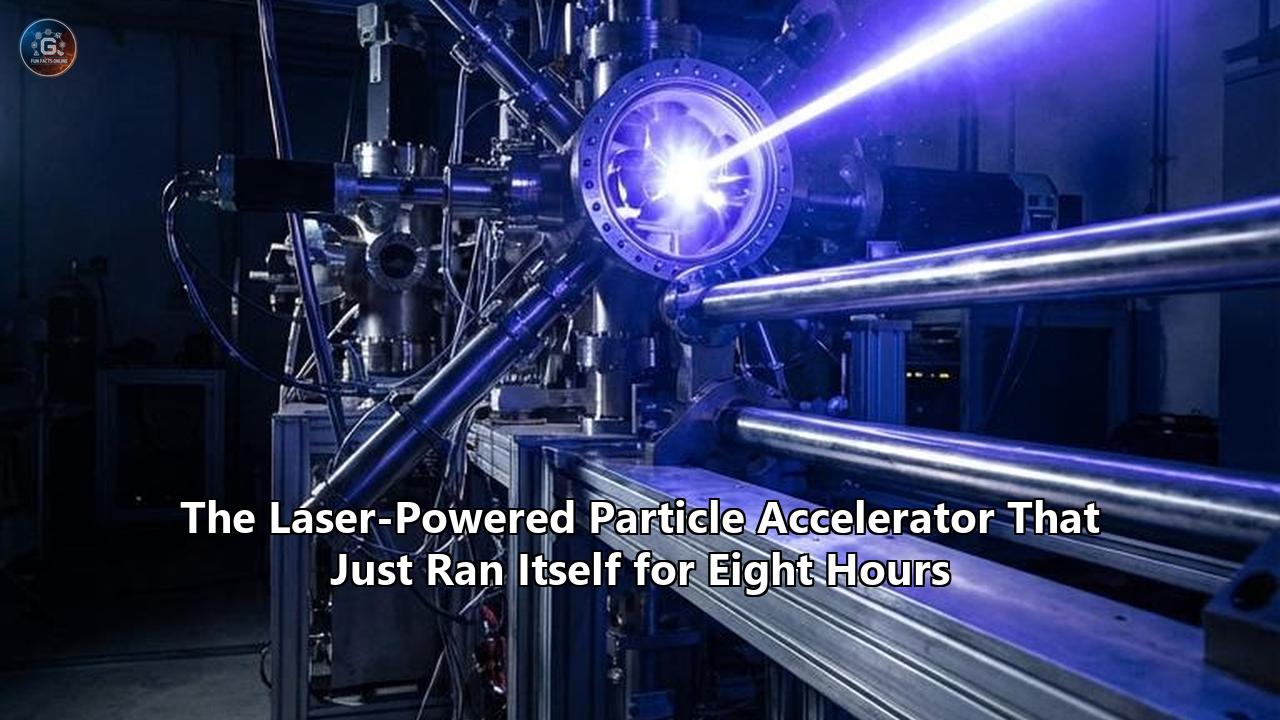
On April 8, 2026, researchers at TAU Systems and the Lawrence Berkeley National Laboratory (Berkeley Lab) activated a self-amplified spontaneous emission free-electron laser (FEL) and stepped away from the controls. For more than eight continuous hours, the system operated autonomously, delivering 100 mega-electron volt (MeV) electron beams at a steady 1 Hz repetition rate. The output was a stable, 420-nanometer blue-ultraviolet light source that required zero manual tuning.
This event marks the first time a laser particle accelerator has driven a free-electron laser with such sustained, hands-off stability. Stephen Milton, VP of Accelerator Science at the Carlsbad, California-based TAU Systems, assessed the milestone pragmatically: “This is the moment the community has been working toward. We have shown that an LPA-driven FEL is not just a proof-of-concept experiment. It is a platform capable of delivering the stability that real scientific and industrial users demand.”
The achievement at Berkeley Lab’s BELLA (Berkeley Lab Laser Accelerator) Center directly challenges the prevailing consensus on how the physics community must scale ultra-bright light sources. For decades, the primary method to generate brighter, more energetic particle beams meant constructing larger, increasingly expensive concrete tunnels. The TAU-Berkeley collaboration provides concrete evidence that autonomous, software-driven stabilization can substitute for sheer physical mass, shrinking the acceleration distance from hundreds of meters down to mere millimeters.
The Structural Tradeoffs: Solid Metal vs. Transient Plasma
To understand the engineering friction that TAU Systems and Berkeley Lab just overcame, one must examine the stark contrast between the established standard of particle acceleration and the plasma-based alternative.
Traditional radio-frequency (RF) accelerators, such as the two-mile-long linear accelerator at the SLAC National Accelerator Laboratory or the 3.4-kilometer European XFEL in Hamburg, rely on highly machined copper or superconducting niobium cavities. Engineers pump microwaves into these cavities to create oscillating electric fields that pull and push electrons forward. The tradeoff in this architecture is strict: to prevent the immense electric fields from sparking and destroying the metal cavities—a phenomenon known as RF breakdown—the acceleration gradient is strictly capped. Room-temperature copper cavities generally max out around 20 to 100 megavolts per meter. Superconducting cavities operate with high efficiency but require massive liquid helium cryogenic plants to maintain operating temperatures of 2 Kelvin. If a facility requires higher energies, the only physical option is to build a longer tunnel. This translates directly to billions of dollars in capital expenditure and massive geographic footprints.
Conversely, a laser particle accelerator—specifically a laser wakefield accelerator (LWFA)—replaces the rigid metal cavity with a transient cloud of ionized gas, or plasma. When an ultra-intense laser pulse, often measured in hundreds of terawatts, plows through this plasma, it displaces the lighter electrons out of its path while leaving the heavier, slower ions relatively stationary. This aggressive separation of charge creates a positively charged "bubble" trailing immediately behind the laser pulse. Electrons injected into the rear of this bubble surf the electrostatic wake, experiencing acceleration gradients up to 100 gigavolts per meter. This gradient is a thousand times stronger than what conventional RF accelerators can sustain, allowing researchers to pack the equivalent of a football field of RF cavities into a gas cell the size of a fingernail.
The historical drawback of the plasma approach has been its chaotic volatility. Plasmas are highly nonlinear fluid dynamics environments. Slight variations in the drive laser’s pulse shape, ambient room temperature, or the gas target's density can cause the resulting electron beam to fluctuate wildly in charge, energy profile, and trajectory. While RF accelerators provide predictable beams for weeks on end, plasma accelerators have historically struggled to maintain beam quality for more than a few minutes before thermal drift or gas fluctuations degrade the output. Furthermore, when a copper cavity experiences a breakdown, it can suffer permanent surface damage. When a plasma accelerator "breaks down," the gas simply disperses, and a fresh jet of hydrogen or helium is injected a microsecond later. The accelerating medium is effectively disposable and self-healing.
Navigating the Parameter Space: Algorithmic Control vs. Hardware Brute Force
The eight-hour autonomous run achieved by the Hundred Terawatt Undulator (HTU) experiment at BELLA highlights a deep philosophical split in how engineers mitigate instability in high-energy physics.
The traditional response to beam instability is hardware over-engineering. In conventional RF facilities, engineers rely on extensive mechanical isolation, massive concrete shielding, and active liquid cooling loops to lock every physical variable into place. The environment is forced into strict compliance.
The commercial approach utilized by TAU Systems accepts the inherent volatility of the plasma and compensates with agile, real-time algorithmic adjustments. By engineering a suite of interlinking stabilization technologies, the team mapped the exact correlations between the properties of the drive laser, the plasma source, the electron beam, and the final FEL output. Instead of attempting to freeze the physical environment, the control system continuously reads the diagnostic output and adjusts the input parameters on the fly.
This expands upon foundational academic research from earlier in the decade. In 2020, researchers from Imperial College London and the UK’s Central Laser Facility deployed Bayesian optimization to tune a 100 MeV plasma accelerator. They proved that machine learning algorithms could control a six-dimensional parameter space—simultaneously altering the spectral phase, spatial phase, plasma length, plasma density, and laser focal position. The algorithm detected subtle optimizations in the laser pulse shape that human operators consistently missed during manual single-variable scans, yielding an 80% increase in electron beam charge.
However, optimizing an electron beam is only the first step. Driving a free-electron laser requires that electron bunch to pass through an undulator—an alternating array of precise magnets—to emit coherent light. The undulator amplifies any latent instability in the source beam; if the electrons enter with a wide energy spread or a poor trajectory, the light flash fails to reach the exponential amplification required for a "lasing" effect. The HTU experiment’s achievement lies in stabilizing the entire coupled sequence: the drive laser, the plasma wake, the electron beam, and the final SASE FEL output, holding a 420 nm wavelength steady for an entire working day.
The Wavelength Race: Why We Need Compact Free-Electron Lasers
The push to commercialize the laser particle accelerator is driven by intense demand from specific industrial sectors that require localized access to extreme ultraviolet (EUV) and X-ray light.
Currently, high-energy light source generation is the exclusive domain of state-sponsored megaprojects. Facilities like CERN, DESY, and LBNL operate as open-access hubs where researchers submit grant proposals for a few precious hours of beamtime. Demand drastically outstrips supply. A structural biology team aiming to image a complex protein at Angstrom resolution, or an advanced materials firm testing battery degradation, must wait months and travel to these specific geographic nodes.
The semiconductor industry feels this bottleneck acutely. As chipmakers like TSMC and Intel push production down to the 2-nanometer node, they require EUV light for both lithography and inspection. While laser-produced plasmas currently generate the EUV light used to print the chips, inspecting those chips requires coherent, laser-like EUV radiation to detect microscopic defects in three dimensions. A commercial, compact FEL could provide an on-site actinic mask inspection tool that fits inside a fabrication plant, rather than treating synchrotron beamtime as a scarce logistical constraint.
This operational reality defines the business model of venture-backed firms like TAU Systems. By commercializing a technology that replaces kilometer-scale infrastructure with a room-sized machine, they trade the absolute peak performance of a national laboratory for immediate, localized access.
The Micro-Accelerator Arms Race: Competing Architectures
While laser wakefield acceleration currently dominates the commercialization narrative for compact light sources, it faces direct competition from alternative micro-accelerator architectures. Examining these approaches reveals a distinct set of operational tradeoffs.
Dielectric Laser Accelerators (Nanophotonic Accelerators)
Developed heavily by teams at Stanford University and the Friedrich-Alexander-Universität (FAU) in Germany, the dielectric laser accelerator (DLA) relies on microscopic silicon or fused silica structures. These structures are etched with precise nanoscale gratings. When an infrared or optical laser shines across the grating, it generates an accelerating electric field in the tiny vacuum channel between the pillars.
The contrast in scale is severe. A DLA is literally a particle accelerator on a chip; the entire accelerating structure is less than a millimeter long, and the channels are a few hundred nanometers wide. In contrast, an LWFA requires a gas cell several centimeters long, backed by the substantial footprint of a terawatt-class drive laser system.
Power requirements also diverge sharply. DLAs use commercial optical lasers with peak energies a million times lower than the massive 850-terawatt pulses utilized in advanced plasma wakefields. However, the critical operational tradeoff is total charge. Because the DLA channel is microscopic, it can only accelerate a tiny fraction of electrons at a time (often measured in atto-coulombs). While their repetition rate is extremely high, the overall beam charge is currently insufficient to drive a high-power free-electron laser. The laser particle accelerator based on plasma operates at lower repetition rates—like the 1 Hz demonstrated in the BELLA run—but accelerates massive, dense electron bunches capable of generating the intense flashes required for FELs.
Direct Proton-Driven Plasma Wakefields
Another competing approach bypasses the drive laser entirely. The AWAKE experiment at CERN uses a high-energy bunch of protons—sourced from the Super Proton Synchrotron—to plow through the plasma and create the wakefield, which then accelerates an injected electron beam.
Proton bunches carry exponentially more total energy than a laser pulse. While a laser pulse depletes its energy after a few centimeters in the plasma, a proton driver can sustain the wakefield over significantly longer distances in a single stage. A proton driver could theoretically accelerate electrons to the tera-electron volt (TeV) scale in a single, hundred-meter-long plasma cell. The obvious tradeoff is that this architecture inherently requires a massive conventional RF accelerator just to generate the driver protons, directly defeating the goal of building a standalone, commercial-scale machine.
The Re-Injection Problem and Staging Limitations
The 100 MeV achievement by TAU Systems is highly stable, but scaling that energy up to the multi-GeV levels required for hard X-ray applications introduces severe physical limitations.
In 2019, a team led by Tony Gonsalves at the BELLA Center set a world record by accelerating electrons to 7.8 GeV in a single 20-centimeter plasma capillary. They utilized a nanosecond-long "heater" pulse to drill a deep plasma channel, confining the 850-terawatt drive laser and preventing it from diffracting. However, reaching the energies required for a future particle collider (TeV scale) requires linking dozens or hundreds of these plasma stages together.
This introduces the "re-injection woe." Getting a bunch of electrons out of one plasma cell and injecting it perfectly into the next 10-micron-wide plasma bucket—without losing the beam's tight focus or shedding particles—is exceptionally difficult. Researchers at Shanghai Jiao Tong University have proposed a bypass to this limitation: curved plasma channels. In their design, the electrons travel straight down a primary unbroken plasma channel. Instead of injecting the electrons into a new stage, fresh drive laser pulses are guided down curved intersecting plasma channels, merging into the straight path "just like a highway ramp". This replenishes the wakefield's energy without forcing the fragile electron beam to cross a vacuum gap between physical stages.
Surviving the Shift: Thermal Drift and High Repetition Rates
The specific environmental threats that emerge during an eight-hour continuous run dictate why this milestone is technically significant. Over the course of a standard industrial shift, the environment degrades. The ambient temperature in the laser clean room drifts by fractions of a degree. The concrete building settles. Most critically, the laser amplifiers and the gratings in the pulse compressor experience thermal lensing.
When a high-power drive laser fires repeatedly, the optics absorb residual energy and heat up. In older experimental setups, this thermal expansion subtly warped the gratings, distorting the laser's wavefront and destroying the precise focal spot required to maintain a consistent plasma wake. Within minutes, the electron beam would lose its energy peak or veer off-axis.
The stabilization suite implemented at BELLA succeeded because it utilized active diagnostic feedback to map and counter this specific thermal drift in real-time, executing micro-corrections to the laser wavefront without requiring human operators to stop the run, physically adjust mirrors, or manually alter the gas pressure.
However, operating at 1 Hz is merely a baseline. Many industrial inspection and high-speed imaging applications require repetition rates of 100 Hz or 1 kHz. Scaling a laser particle accelerator to 100 Hz introduces a geometric increase in heat load. Competing laboratories are currently testing advanced cryogenic cooling systems and synthesizing novel grating materials with near-zero thermal expansion coefficients to handle the incoming thermal constraints.
Looking Forward: The Path to Democratized Beamtime
The eight-hour run by TAU Systems and Berkeley Lab provides the massive datasets necessary to train the next generation of predictive algorithms. By logging every micro-fluctuation of the drive laser against the final FEL output over tens of thousands of consecutive shots, machine learning models can shift from reactive correction to proactive optimization.
Upcoming milestones will inevitably focus on scaling both repetition rates and output energy. TAU Systems has recently secured beamtime on the Extreme Light Infrastructure Nuclear Physics (ELI-NP) facility’s 10-petawatt laser—the most powerful ultrafast laser in the world—to test self-guided wakefield acceleration at unprecedented intensities. Simultaneously, national laboratories like DESY and SLAC are upgrading their internal plasma research lines, analyzing how to integrate these autonomous AI-driven control architectures into the blueprint of their next-generation colliders.
The primary engineering focus has visibly shifted. The fundamental physics of surfing electrons on plasma waves is validated and established. The current competition centers strictly on systems integration, thermal management, and algorithmic control software.
As these compact, stabilized light sources mature, the geographic monopoly held by massive particle physics facilities will fracture. Access to extreme ultraviolet and X-ray free-electron lasers will transition from a highly contested privilege granted by national research committees to a standard, purchasable capability for commercial deep-tech laboratories. The unblinking, eight-hour run of this autonomous system proves that this operational transformation is already underway.
Reference:
- https://contentmediasolution.com/news/tau-systems-lawrence-berkeley-lab-achieve-breakthrough-in-laser-powered-accelerator-enable-8-hours-of-continuous-fel-output/
- https://cuos.engin.umich.edu/researchgroups/hfs/research/laser-wakefield-acceleration/
- https://scitechdaily.com/tiny-laser-plasma-accelerator-breakthrough-could-revolutionize-scientific-research/
- https://www.thebrighterside.news/post/desktop-particle-accelerators-are-opening-new-frontiers-in-physics/
- https://www.semanticscholar.org/paper/Automation-and-control-of-laser-wakefield-using-Shalloo-Dann/ce65ec4d11a9f6aed7eeeb60504ac2cbdf46edbd
- https://www.clf.stfc.ac.uk/Pages/Automated-Plasma-Accelerator-.aspx
- https://arxiv.org/abs/2007.14340
- https://www.tausystems.com/news-center/press-releases/first-electron-beam/
- https://www.iflscience.com/lasers-power-a-particle-accelerator-that-almost-fits-on-a-coin-71319
- https://cerncourier.com/a/acceleration-but-not-as-we-know-it/
- https://science.thewire.in/the-sciences/powered-by-monster-laser-mini-particle-smasher-sets-new-energy-record/
- https://cerncourier.com/a/bella-sets-new-record-for-plasma-acceleration/
- https://physicsworld.com/a/new-particle-accelerator-is-driven-by-curved-laser-beams/
- https://bib-pubdb1.desy.de/record/453227/files/Masterarbeit_Jan_Lukas_Dresselhaus.pdf?subformat=pdfa&version=1
- https://www.tausystems.com/news-center/press-releases/
- https://www.symmetrymagazine.org/article/machine-evolution?language_content_entity=und