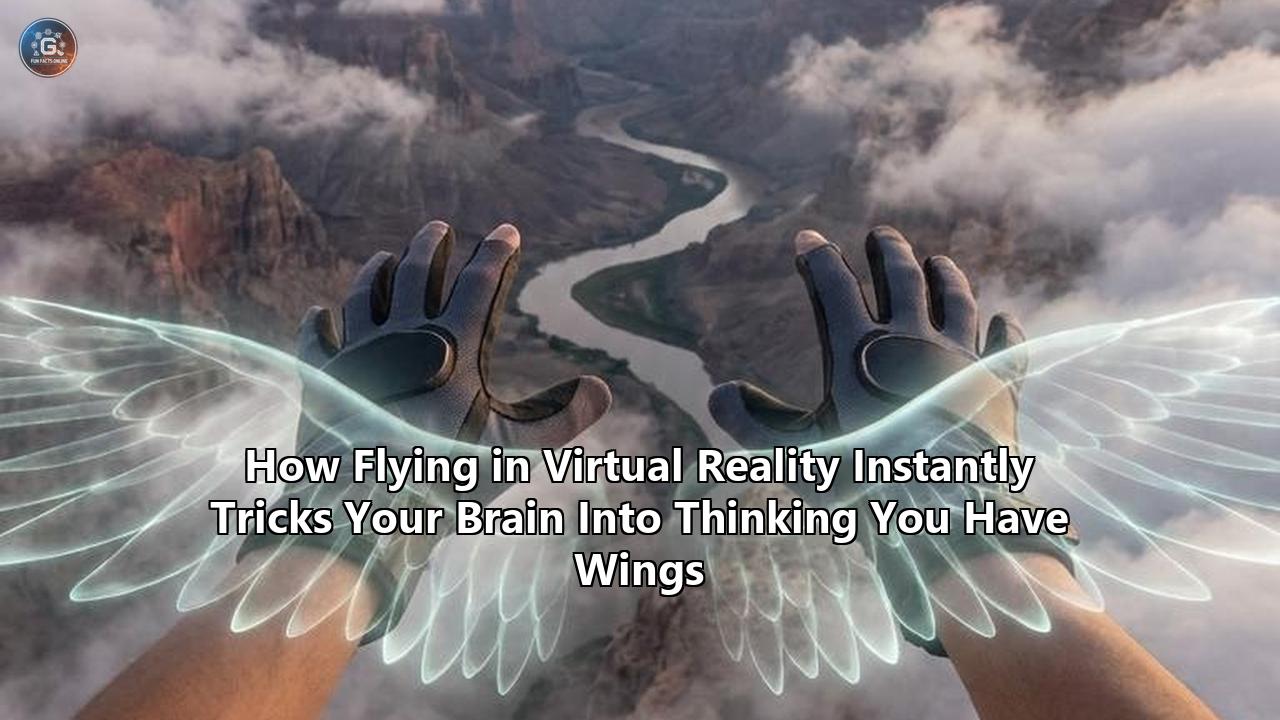
In a quiet laboratory in Beijing, twenty-five human volunteers spent a week doing something that should have been biologically impossible: they sprouted huge, feathered wings and took to the sky.
They did not do this through gene editing or surgical modification. Instead, they strapped on virtual reality headsets, adjusted motion-tracking sensors on their arms, and looked into a virtual mirror. Standing before them was a feathered, avian avatar whose massive, rust-colored wings emerged directly from their virtual shoulders. When the volunteers moved their arms, the wings flapped. When they twisted their wrists, the feathers adjusted to catch the wind. Within hours, they were navigating complex aerial courses, soaring through floating rings, and diving over steep digital cliffs.
The real surprise came when the flights ended. While the volunteers were back on solid ground, their brains were still, in some sense, airborne.
A peer-reviewed study published in Cell Reports by a research team at Peking University and Beijing Normal University reveals that a mere week of virtual flight training fundamentally alters how the human brain processes the visual and structural representation of the body. By taking functional magnetic resonance imaging (fMRI) scans of the participants before and after the training, the researchers discovered that the brain’s visual body-processing systems had begun treating the virtual wings not as tools, equipment, or external objects, but as actual, physical parts of the human body.
This study does more than showcase a highly immersive piece of technology. It serves as an empirical window into the extraordinary plasticity of human cognition, offering a rich look at how virtual reality brain perception operates under extreme morphological alterations. By analyzing this specific research as a case study, we can extract profound principles about how the mind constructs its sense of self, how it integrates multisensory feedback, and how we might one day engineer human-machine interfaces that feel as natural as our own flesh and bone.
The Mechanics of Flight: Deconstructing the Beijing Experiment
To appreciate how the brain was tricked, we must first look at the elegant design of the training protocol itself. Led by neuroscientists Ziyi Xiong and Yiyang Cai, along with senior authors Kunlin Wei and Yanchao Bi, the study was designed to bridge a gap between classical cognitive psychology and advanced human-computer interaction.
Historically, experiments testing "embodiment"—the psychological feeling that an artificial object is part of one's body—have relied on simple, static setups. The most famous of these is the Rubber Hand Illusion, where a participant’s hidden hand is stroked in unison with a visible rubber hand, eventually causing the brain to register the rubber hand as its own. While powerful, these illusions are passive and fleeting.
[Real Arm Movement] ----> [Motion Sensors] ----> [Aerodynamic VR Engine]
       ^                                                    |
       |                                                    v
[Proprioceptive Feedback] <--- [Visual Synchronization] <--- [Feathered Wings Flap]
The Beijing team wanted to know if the brain could actively incorporate an entirely non-human "effector"—a body part used to act upon the world—that has no analogue in human evolutionary history. Wings were the perfect candidate: they look biological, they require complex motor coordination, but they do not belong on a primate skeleton.
The experiment was structured across seven days, featuring four training sessions that totaled roughly two hours of active flight. The researchers took several key steps to construct this morphological illusion:
- Total Visual Substitution: Inside the VR headset, the participants' real arms were completely hidden. Where their arms should have been, the massive feathered wings extended from their shoulders.
- Dynamic Motion Mapping: Using high-precision motion-tracking sensors on the elbows, wrists, and shoulders, the system translated the physical movements of the participants' real arms into the real-time kinematics of the wings.
- Real Aerodynamic Simulation: The flight environment was not just a visual trick; it incorporated a physics engine designed around the actual mechanics of bird flight. To generate lift and climb, participants had to perform a coordinated motion: extending their wings on the downstroke, and then tucking or contracting them on the way up to minimize drag.
- Active Goal-Directed Tasks: Rather than simply floating, participants had to complete increasingly difficult maneuvers. They deflected incoming aerial balls, imitated precise wing postures in front of a virtual mirror, maintained steady altitudes over jagged canyon landscapes, and steered themselves through rings suspended in mid-air.
The behavioral results were swift and dramatic. In the first session, participants struggled with the complex physics of flapping and gliding, achieving an average success rate of just 44.8% on the ring-navigation task. By the fourth session, that score soared to 75.2%.
Some volunteers mastered the wings almost instantly, while others required several sessions to get their bearings. But by the end of the week, every participant reported a highly intuitive sense of agency over the wings. They were no longer thinking about how to move their arms to control a digital graphic; they were simply flying.
Under the fMRI Hood: What Happened to the Visual Cortex?
To find out whether this behavioral adaptation had left a physical mark on the brain, the researchers placed the participants in an fMRI scanner before the week of training began, and then again immediately after it concluded.
They focused their analysis on a highly specialized region of the brain known as the occipitotemporal cortex (OTC). The OTC is located toward the back and bottom of the brain, running along the visual processing pathway. Within cognitive neuroscience, the OTC is renowned for housing areas like the Extrastriate Body Area (EBA), which is heavily involved in visually processing human body parts, limbs, and bodily silhouettes. For hundreds of thousands of years, evolutionary pressures have hardwired this region of the brain to recognize the standard human form: arms, hands, legs, feet, and faces.
Before the flight training, when participants in the scanner were shown pictures of bird wings, their OTC treated them like ordinary external objects—highly distinct from images of human arms. The neural activation patterns for wings looked much more like those for hand-held tools, animal tails, or inanimate objects.
PRE-TRAINING BRAIN STATE (OTC):
[Images of Arms]  ---> Activates Body-Schema Network (Limb Category)
[Images of Wings] ---> Activates Object-Schema Network (Tool/Animal Category)

POST-TRAINING BRAIN STATE (OTC):
[Images of Arms]  ---> Activates Body-Schema Network (Limb Category)
[Images of Wings] ---> Shifts toward Body-Schema Network (Partial Limb Category)
After only two hours of virtual flight training, however, this functional taxonomy was rewritten:
1. Elevated Neural Response
The OTC responded significantly more strongly to images of wings than it had prior to the study. The region of the brain dedicated to identifying body parts was suddenly paying intense visual attention to wings.
2. Neural Pattern Convergence
Using multivariate pattern analysis—a method that looks at the distinct spatial signature of brain activity—the researchers discovered that the neural patterns triggered by seeing wings had shifted. Especially in the right side of the brain (which is heavily dominant in processing visual body configurations), the pattern representing "wings" became remarkably similar to the pattern representing "arms". The brain was visually categorizing the wings within the same neural domain as biological limbs.
3. Generalization to Unseen Wings
Strikingly, this neural shift was not limited to the specific, rust-colored wings the participants used during training. When shown pictures of other biological bird wings that they had never controlled, their OTC still demonstrated the same arm-like neural activation. They had not just memorized a specific graphic; they had adopted "wings" as a general class of functional, body-like effectors.
4. Rewired Frontoparietal Connectivity
The changes were not confined to visual processing alone. The fMRI scans showed a substantial increase in functional connectivity—the real-time communication link—between the visual OTC and the frontoparietal networks. The frontoparietal regions of the brain are responsible for sensorimotor planning, the integration of touch and movement, and the real-time execution of actions.
By binding the visual representation of the wings (in the OTC) to the motor planning systems (in the frontoparietal cortex), the brain built a functional highway. It was linking the visual sensation of "seeing wings" directly to the physical sensation of "moving the body".
The researchers were careful to qualify these results, noting that the wings had not entirely replaced the concept of arms in the brain. The neural patterns for wings still maintained some characteristics of tools. However, the shift toward the biological limb category was clear, measurable, and remarkably fast.
This case study proves that the human brain does not possess a rigid, unyielding map of what the body is "supposed" to look like. Instead, our neurobiology is governed by a dynamic, highly adaptable self-concept that can be stretched to accommodate the physically impossible.
Principle 1: Morphological Plasticity and the Dynamic Body Schema
To understand why this happens, we must distinguish between two fundamental concepts in cognitive psychology: the Body Image and the Body Schema.
| Concept | Definition | Key Characteristics | Brain Regions Involved |
|---|---|---|---|
| Body Image | The conscious, conceptual, and aesthetic representation of one's physical self. | Descriptive, evaluative, emotionally charged; "What do I look like?" | Parietal cortex, temporoparietal junction, prefrontal networks. |
| Body Schema | The unconscious, dynamic, and sensory-motor map of the body used to guide action. | Operational, rapidly updated, functionally driven; "Where am I in space, and what can I reach?" | Frontoparietal networks, primary motor cortex, somatosensory cortex. |
Historically, scientists believed that the body schema was relatively fixed, bounded by our evolutionary genetics. We are born primates; therefore, our motor planning systems are fundamentally tuned to control primate limbs. When we use tools—like a hammer, a rake, or a car—we extend our reach, but the tool remains categorized as an external object.
This view is supported by classical studies in macaque monkeys trained to use rakes to retrieve food. While the monkey's parietal neurons updated their receptive fields to include the tip of the rake, the brain still maintained a distinct boundary between "flesh" and "tool." The tool was a means to an end, processed as an external instrument.
What the virtual wings study demonstrates is a phenomenon we can call morphological plasticity. Because the virtual environment completely replaced the physical arms with wings, and because those wings were controlled through direct biological motor commands, the brain did not process them as tools. It processed them as a morphological expansion of the body schema itself.
The brain's internal prediction models are highly pragmatic. It does not care about the evolutionary history of feathers; it cares about correlation and control. If a visual structure consistently responds to motor commands, provides predictable sensory feedback, and allows the organism to navigate its environment, the brain’s body schema will rapidly expand its boundaries to claim ownership over that structure.
This is the first major lesson of the Beijing experiment: the body schema is not a static template, but a flexible hypothesis. It is constantly being renegotiated based on the physical feedback of our active interactions with the environment.
Principle 2: The Triad of Multisensory Congruence
How does this transition happen so quickly? The instant adaptation observed in virtual flight relies on a tightly synchronized neurological process called multisensory integration. The brain constructs its perception of the body by constantly comparing inputs from three distinct sensory channels:
                  +------------------------+
                  |  Visual Feedback       |
                  |  (Wings flapping in    |
                  |  the virtual mirror)   |
                  +-----------+------------+
                              |
                              v
+-------------------------+   |   +-------------------------+
| Proprioceptive Feedback |<--+-->| Motor Intent (Efference)|
| (Muscle movement and    |       | (The brain's command to |
| joint articulation)     |       | flap and steer)         |
+-------------------------+       +-------------------------+
When these three channels are brought into perfect temporal and spatial harmony, the brain experiences a massive drop in "prediction error". The mind operates as a Bayesian inference engine—it is constantly generating predictions about what it should see, hear, and feel, and then updating those predictions based on incoming sensory data.
In the case of virtual flight, the setup engineered by the researchers maximized this sensory loop through three distinct mechanisms:
Visuomotor Synchronization
When a participant decided to flap their arms (motor intent), their physical muscles contracted (proprioception), and they immediately saw the massive feathered wings sweep downward in their field of view (visual feedback). Because the delay between the physical movement and the virtual render was virtually imperceptible, the brain had no reason to separate the biological action from the digital reaction. It concluded that the wings were being driven by its own nervous system.
Visual Dominance (The "Ventriloquist Effect")
In the hierarchy of human senses, vision is incredibly dominant. When there is a conflict between what we feel (our real arms moving in a standard primate arc) and what we see (massive wings sweeping through a vast, three-dimensional space), the visual cortex will actively override the somatosensory cortex.
By completely removing the visual sight of the participant's physical arms, the VR system broke the brain's baseline sensory expectations. Deprived of visual confirmation of its primate limbs, the brain accepted the visual substitute—the wings—as the ground truth of the body's structure.
Proprioceptive Re-mapping
Because the wings were larger than human arms and operated under simulated aerodynamic forces (such as lift and drag), the participants had to adjust the speed and intensity of their arm movements to maintain stable flight. This forced their motor control networks to constantly update their calculation of "where" their limbs were in space.
This functional adjustment is key: virtual reality brain perception is not a passive visual illusion. It is an active, goal-directed loop. It is the physical effort of navigating, correcting for wind resistance, and executing precise movements that forces the motor planning areas to permanently integrate the virtual limb into the body map.
Principle 3: Hierarchical Embodiment and Atypical Congruence
One of the most complex questions raised by the Cell Reports study is how the brain resolves what cognitive scientists call atypical congruence.
Under normal circumstances, our bodies are perfectly congruent: our hands look like hands, move like hands, and feel like hands. In the virtual flight experiment, the congruence was highly atypical. The visual input was non-human (feathered wings), yet the motor input was human (primate arms).
How does a primate brain resolve this biological contradiction?
The researchers suggest that embodiment is not a flat, single-step process, but rather a hierarchical loop. This loop operates across different levels of abstraction in the brain, continuously trading information between visual categorization areas and motor execution networks.
HIERARCHICAL EMBODIMENT LOOP:

[Top-Level: Frontoparietal Networks]
- Focuses on functional agency: "I can control this shape to fly."
- Prioritizes outcome over biological appearance.
       |
       | (Downstream signals: "This is my effector")
       v
[Bottom-Level: Occipitotemporal Cortex (OTC)]
- Evaluates visual category: "Does this look like a human arm?"
- Reconciles evolutionary expectations with active functional control.
- Shifts visual taxonomy: Classifies "wing" closer to "limb."
At the top of the hierarchy sit the frontoparietal networks, which are highly focused on functional outcomes. For these motor planning regions, physical appearance is secondary to control. If the motor system can successfully use the virtual wings to fly through a ring or deflect a ball, the frontoparietal network codes those wings as a highly reliable "effector"—a functional extension of the self.
Once this functional control is established, the frontoparietal networks send downstream signals back to the visual body-processing areas in the OTC. It is as if the motor system tells the visual system: "I am actively controlling this feathered structure; therefore, it belongs to us."
Over the course of a week, this continuous dialogue rewires the visual cortex. The OTC, reconciling this intense functional control with its visual input, begins to adapt its categorical boundaries. It gradually shifts the visual concept of "wings" out of the "external object" category and into the "biological body part" category.
This hierarchical model explains why the illusion is so powerful and so resilient. By targeting both the functional planning systems and the visual categorization systems simultaneously, VR bypasses the brain's evolutionary defenses, letting us embody shapes that have no basis in our biological history.
Cybernetic Expansion: Translating Virtual Flight to Real-World Engineering
The findings of this case study stretch far beyond the realm of consumer VR headsets and flight simulators. By showing us how the brain adapts to radical structural changes, the Beijing study provides a blueprint for the future of human augmentation, prosthetic design, and neurorehabilitation.
                     +---------------------------+
                     |  NEUROLOGICAL PRINCIPLES  |
                     |  - Morphological Plasticity|
                     |  - Multisensory Triad     |
                     |  - Hierarchical Loop      |
                     +-------------+-------------+
                                   |
         +-------------------------+-------------------------+
         |                         |                         |
         v                         v                         v
+------------------+     +------------------+     +------------------+
| PROSTHETIC DESIGN|     | SUPERNUMERARY    |     | NEURO-           |
| Deep integration |     | CYBERNETICS      |     | REHABILITATION   |
| of artificial    |     | Control of third |     | Treatment of     |
| limbs as true    |     | arms, wings, or  |     | phantom pain     |
| body parts|     | robotic tails|     | and stroke|
+------------------+     +------------------+     +------------------+
1. The Next Generation of Advanced Prosthetics
For decades, physical prosthetics have struggled with a major cognitive hurdle: users often perceive them as tools rather than true replacements for their missing limbs. A prosthetic hand might be highly functional, but to the user’s brain, it often feels like a sophisticated pair of pliers attached to the arm.
The VR wings study suggests that this barrier is not insurmountable. To trick the brain’s body schema into truly incorporating a prosthetic, we must design the interface around the principles of hierarchical embodiment:
- Total Sensory Feedback Loops: Modern prosthetics should not only focus on motor output; they must provide rich, real-time visual, proprioceptive, and haptic feedback. If a prosthetic hand can send subtle electrical stimulations to the user's remaining nerves that match the visual impact of grasping an object, the brain's Bayesian engine will rapidly shift the prosthetic into the biological "limb" category.
- Immersive Pre-Training: Before amputees are fitted with physical prosthetics, they could undergo training in customized virtual environments. By placing patients in a VR space where their missing limb is represented by a highly responsive digital avatar, clinicians can prime the visual and motor networks to accept the new appendage long before the physical prosthetic is even strapped on.
2. Controlling Supernumerary Cybernetic Limbs
As robotics and brain-machine interfaces continue to advance, engineers are exploring the possibility of giving humans entirely new, "supernumerary" limbs—such as a robotic third arm for industrial workers, a prehensile tail for balance, or wearable wings for localized flight.
A major question in this field has been whether the human brain has the spare cognitive capacity to control an extra limb without sacrificing control over its existing body parts.
The Beijing experiment offers a highly optimistic answer. If the brain can seamlessly adapt its visual and motor cortex to control wings within just a few sessions, it possesses the neural bandwidth to manage entirely new cybernetic structures.
The limiting factor is not the brain's capacity to adapt; it is the quality of the sensorimotor feedback loop we design to link our biology with the machine.
3. Virtual Neurorehabilitation
The capacity to rewrite the brain’s body map holds profound potential for patients recovering from strokes, spinal cord injuries, or severe chronic pain.
- Treating Phantom Limb Pain: Amputees frequently suffer from phantom limb pain, a condition where the brain's sensory map of a missing limb becomes tangled, sending agonizing pain signals. Traditional "mirror box" therapies attempt to trick the brain by reflecting the intact limb to make it look like the missing one.
Immersive virtual reality can take this concept to a whole new level. By placing patients in an environment where they can see, move, and complete tasks with a fully rendered, virtual version of their missing limb, we can soothe the somatosensory cortex and untangle the mismatched sensory signals, easing pain in ways that traditional therapies cannot match.
- Stroke Recovery: When a stroke damages the motor cortex, patients often develop "learned non-use," where they stop attempting to move their affected limbs because the physical effort feels too difficult or unrewarding.
By placing stroke survivors in VR and amplifying the visual movements of their paretic limbs—making a small, physical hand twitch appear as a full, fluid grasp on-screen—we can exploit visual dominance. The brain sees its motor intention rewarded with successful visual movement, triggering neuroplastic pathways that speed up motor recovery.
The Long-Term Cognitive Footprint: What Happens in a Multi-Avatar Future?
While the therapeutic and cybernetic benefits of this neural flexibility are clear, we must also consider the deeper, long-term cognitive implications.
The Beijing study involved healthy adults who spent a total of only two hours in virtual flight over the course of a single week. Yet, this brief exposure was enough to physically alter the visual and functional organization of their brains.
This raises a vital question: what happens to the human mind when we begin to spend hours, days, or years inside virtual realities, operating through vastly different physical forms?
              +------------------------------------------+
              |       THE MULTI-AVATAR COGNITIVE LOOP    |
              +--------------------+---------------------+
                                   |
         +-------------------------+-------------------------+
         |                                                   |
         v                                                   v
+------------------+                               +------------------+
| Cognitive Gain   |                               | Psychological    |
| - Fluid empathy  |                               | Risk             |
| - Accelerated motor skill acquisition            | - Body schema fragmentation
| - Transcendence of physical limits       | - Avatar depersonalization
+------------------+                               +------------------+
As spatial computing, immersive work environments, and virtual social spaces become central to daily life, many of us will find ourselves switching between avatars on a regular basis. In the morning, you might work as a standard humanoid avatar. In the afternoon, you might operate a multi-armed industrial drone in a virtual simulator. In the evening, you might play a game as an avian creature soaring over mountains.
This lifestyle could lead to a series of fascinating psychological shifts:
Body Schema Fragmentation
If the brain is constantly expanding and rewriting its body map to accommodate different virtual forms, will it struggle to maintain a stable, baseline sense of its own physical biology? Could long-term VR users experience a mild, chronic form of depersonalization, where their real physical bodies begin to feel unfamiliar, awkward, or structurally "limiting"?
The "Proteus Effect" Extended
Psychologists have long documented the Proteus Effect—the phenomenon where a person’s behavior, confidence, and cognitive style shift to match the characteristics of their virtual avatar. For example, people embodying taller avatars negotiate more confidently, while those embodying creative-looking avatars perform better on creative tasks.
If virtual reality brain perception is capable of rewiring the visual and motor cortex to accommodate wings, the Proteus Effect is not just a psychological posture; it is a neurological transformation. Embodying non-human forms could unlock entirely new cognitive styles, sensory patterns, and creative ways of thinking that are physically inaccessible within our standard human geometry.
Avatar-Induced Proprioceptive Drifts
Following extended sessions in non-human bodies, users might experience sensory echoes upon returning to the physical world. Just as we experience "sea legs" after stepping off a boat, a user who has spent hours flying might experience "phantom wing syndrome"—an unconscious urge to adjust their shoulders to catch a gust of wind, or a temporary feeling of clumsiness as their motor planning systems recalibrate to the constraints of having simple, wingless human arms.
These possibilities are no longer the stuff of speculative fiction. The Cell Reports study provides the hard neuroimaging proof that our brains are incredibly eager to shed their biological constraints, adapting to virtual environments far more deeply than we ever realized.
Horizon Scanning: Unresolved Mysteries of the Virtual Mind
The Beijing experiment has opened up a rich frontier of research in cognitive neuroscience, human-computer interaction, and evolutionary biology. As scientists design follow-up studies, several critical questions remain unanswered:
How long do these neural changes last?
In the Beijing study, fMRI scans were taken immediately after the one-week training period. We do not yet know how long the brain retains this updated map of "wings" once the training stops. Does the visual cortex slowly revert to its baseline primate state over days or weeks, or does it permanently keep a "flight module" on standby, ready to be reactivated the moment the headset is turned back on?
Can we split the body schema to control extra limbs?
During the experiment, the virtual wings completely replaced the participants' real arms. The brain did not have to split its attention; it simply mapped "arm motor commands" to "wing visual movements".
The next great test of morphological plasticity will be to give participants both their standard human arms and a pair of fully functional, independent wings. Can the human brain learn to operate a four-limbed upper body, splitting its frontoparietal motor planning to control two distinct pairs of appendages simultaneously?
What are the absolute limits of homuncular flexibility?
Coined by VR pioneer Jaron Lanier, homuncular flexibility is the idea that humans can learn to control bodies that are completely different from our own. But is there a limit?
Can a human brain learn to embody a six-legged spider, a swimming eel, a complex machine with dozens of moving parts, or even a decentralized swarm of microscopic drones?
At what point does the structural mismatch between our biological nervous system and the virtual effector become too wide for our multisensory integration networks to bridge?
A New Window Into Human Identity
For millenia, our ancestors looked up at the sky and dreamed of flying on their own wings. We wrote myths about Icarus, painted angels with feathered backs, and designed massive metallic tubes to carry us across oceans. But throughout all that history, our biological brains remained firmly tethered to our primate bodies, keeping a strict, evolutionary ledger of what was "self" and what was "other".
The Beijing case study shows us that these boundaries are far more fragile than they appear. Armed with nothing more than a headset, some motion sensors, and an aerodynamic software engine, we can bypass millions of years of evolutionary hardwiring in just a couple of hours.
Our brains do not just like the idea of flying; they are fully prepared to adapt to it, rewiring our visual and motor pathways to claim the sky as our own.
As we stand on the cusp of an era defined by spatial computing, cybernetic enhancements, and neural interfaces, this research is a powerful reminder of what makes our species so unique. Our defining evolutionary trait is not a fixed, perfect physical body. It is an incredibly plastic, infinitely curious mind—an organ that is always ready to look at a pair of digital feathers, take a deep breath, and believe it has wings.
Reference:
- https://www.zmescience.com/medicine/mind-and-brain/vr-wings-body-parts/
- https://spacedaily.com/d-in-a-beijing-laboratory-25-volunteers-spent-a-week-learning-to-fly-with-feathered-virtual-reality-wings-flapping-to-stay-aloft-swerving-through-rings-swatting-falling-balls-and/
- https://www.sciencenews.org/article/virtual-wings-brain-changes
- https://www.grewi.de/gehirn-kann-kuenstliche-koerperteile-als-eigen-akzeptieren/
- https://www.sciencealert.com/scientists-gave-people-wings-in-vr-and-it-triggered-changes-in-the-brain
- https://note.com/huge_cosmos1671/n/n43cdcfcd3140?hl=en-US
- https://sciencex.com/news/2026-05-flying-virtual-wings-week-brain.html
- https://www.researchgate.net/publication/404629541_Virtual_flying_experience_changes_neural_responses_to_seeing_wings
- https://www.scivillage.com/thread-20464-lastpost.html
- https://www.researchgate.net/publication/381435597_Wings_of_Imagination_Strengthening_Avian_Embodiment_and_Flight_Immersion_in_Virtual_Reality_Through_Multisensory_Haptic_Feedback
- https://www.reddit.com/r/science/comments/1t6d4qx/25_people_learned_to_fly_with_virtual_wings_after/
- https://www.vice.com/en/article/people-learned-to-fly-with-vr-wings-then-their-brains-did-something-weird/