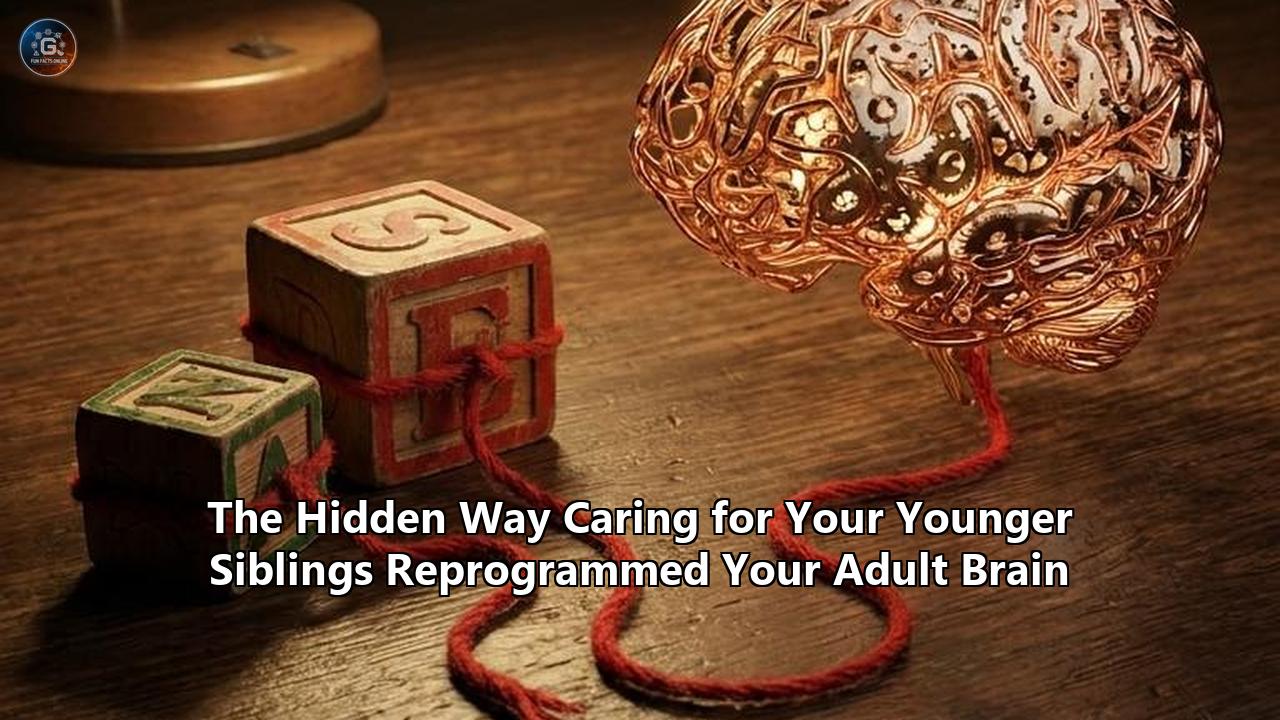
For generations, families have operated under a silent social contract: when parents are overwhelmed, overworked, or absent, the eldest child steps in. Whether it is preparing school lunches, mediating parental arguments, or keeping younger siblings quiet during moments of high family tension, these acts of childhood caregiving have long been dismissed as simple birth-order responsibilities. But a remarkable wave of scientific research has revealed that this childhood role reversal—known in clinical settings as "parentification"—does not merely shape a person’s personality. It physically rewires the architecture of the developing human brain, leaving a permanent neurological signature that dictates how these individuals process stress, perceive danger, and navigate adult relationships decades later.
The scientific foundation for this neurological rewriting was dramatically expanded by a landmark, 15-year longitudinal study led by researchers at the University of California, Los Angeles (UCLA) and published in Psychoneuroendocrinology. Tracking families from pregnancy through their children's adolescence, the research team, led by UCLA anthropologist Molly Fox and UC Merced psychologist Jennifer Hahn-Holbrook, discovered a striking biological link: first-born daughters whose mothers experienced high levels of prenatal stress showed significantly earlier signs of adrenal puberty, or adrenarche.
Adrenarche is the early phase of puberty during which the adrenal glands begin secreting hormones like DHEA and various androgens. Crucially, this biological shift does not trigger physical reproductive capability; rather, it drives cognitive, social, and emotional maturation. From an evolutionary perspective, this accelerated maturation acts as a biological "helper-at-the-nest" mechanism. The stressed mother's biology essentially programs her eldest daughter to grow up faster, equipping her with the neurological maturity to help raise younger siblings before she is physiologically ready to bear her own children.
This discovery has completely reframed the deeply studied field of oldest sibling psychology. What was once dismissed as a collection of behavioral habits or internet memes—colloquially termed "eldest daughter syndrome"—is now understood to be an evolutionary stress-response system written directly into the human nervous system.
To fully understand this reprogramming of the adult brain, we must examine the competing scientific frameworks, neurological theories, and therapeutic approaches that try to make sense of this unique situation. By contrasting these ideas, we can map the exact trade-offs of growing up too fast, and explore what these neural changes mean for the millions of adults who carried the weight of their families on their childhood shoulders.
The Evolutionary "Helper-at-the-Nest" vs. The Developmental Trauma Model
To make sense of the reprogrammed adult brain, scientists and clinicians are divided into two primary camps: those who view these changes through the lens of evolutionary adaptation, and those who see them as a form of chronic developmental trauma.
┌────────────────────────────────────────────────────────────────────────────────────────────────────────┐
│                              COMPETING FRAMEWORKS FOR CHILDHOOD CAREGIVING                             │
├──────────────────────────────────────┬─────────────────────────────────────────────────────────────────┤
│ Evolutionary Adaptation Model        │ • Views accelerated development as a survival-driven success.   │
│ (The "Helper-at-the-Nest")           │ • Focuses on species preservation and lineage resilience.       │
├──────────────────────────────────────┼─────────────────────────────────────────────────────────────────┤
│ Developmental Trauma Model           │ • Views role reversal as a pathology of boundary distortion.     │
│ (Parentification)                    │ • Focuses on the erasure of self and adult emotional distress. │
└──────────────────────────────────────┴─────────────────────────────────────────────────────────────────┘
The evolutionary adaptation model, championed by Fox and Hahn-Holbrook, posits that the accelerated maturation of the eldest daughter is a triumph of natural selection. In highly unstable or demanding environments, a mother who is stressed, economically insecure, or physically exhausted needs assistance to ensure her offspring survive. By transmitting stress hormones across the placental barrier, the mother's body "warns" the developing female fetus that she is entering a harsh world.
The fetal brain adapts. By accelerating adrenal puberty, the daughter achieves the mental and social competency required to care for others much earlier than her peers. Because this hormonal surge does not initiate menstruation or breast development, she remains temporarily infertile, ensuring that her caregiving energy is channeled entirely toward her younger siblings rather than her own children. Under this model, the rewired brain is a highly functional, survival-driven asset.
On the opposite side of the spectrum sits the clinical trauma model, which categorizes this experience as "destructive parentification". First conceptualized by pioneering psychiatrist Ivan Boszormenyi-Nagy, parentification is viewed not as a successful adaptation, but as a severe distortion of generational boundaries that violates the fundamental developmental needs of the child.
Under this psychological framework, which is fundamental to oldest sibling psychology, the child who must consistently care for others learns a damaging lesson: my worth is entirely dependent on my usefulness, and having my own needs is a threat to the family’s survival.
While the evolutionary model celebrates the "helper-at-the-nest" for ensuring family survival, the developmental trauma model points to the heavy toll paid in adulthood. Adult survivors of parentification frequently suffer from chronic anxiety, hyper-independence, boundary confusion, and a deep, somatic inability to relax or receive care from others.
The trade-offs between these two perspectives are clear:
- The Evolutionary Perspective highlights the immediate survival benefits and the early cultivation of leadership, empathy, and organizational skills. However, it often overlooks the long-term emotional and physiological depletion that occurs when a child's nervous system is permanently set to "active duty".
- The Clinical Trauma Perspective provides diagnostic clarity, validating the deep emotional exhaustion and relational struggles of parentified adults. But by framing the experience primarily as trauma, it can pathologize the very real strengths—such as exceptional resilience, emotional intelligence, and crisis-management abilities—that these individuals carry into their adult lives.
The Neurological Speed-Run: Accelerated Amygdala-mPFC Connectivity
How does this psychological tension manifest physically within the brain? Neuroimaging studies, including resting-state functional magnetic resonance imaging (rs-fMRI) data from the massive Adolescent Brain Cognitive Development (ABCD) Study, have revealed that chronic early stress—such as the burden of sibling caregiving—fundamentally alters the speed at which brain networks mature.
In a typical childhood trajectory, the brain’s emotional processing center, the amygdala, and its executive control center, the medial prefrontal cortex (mPFC), exhibit a positive functional connectivity. During these early years (typically ages 6 to 10), the child relies on external cues—specifically maternal and parental comfort—to soothe fear and regulate emotions.
As the child transitions into adolescence and early adulthood, this neural pathway undergoes a developmental shift, turning into a negative functional connectivity. The mature prefrontal cortex takes over, actively down-regulating the hyper-reactive amygdala, allowing the individual to self-soothe and make rational, emotionally regulated decisions.
   TYPICAL DEVELOPMENTAL TRAJECTORY (Ages 6 to 20+)
   Childhood (6-10)          Adolescence (11-17)        Adulthood (18+)
   [Positive Connectivity] ──> [Connectivity Shift] ───> [Negative Connectivity]
   (Relies on parents for    (Nervous system matures)   (Self-regulation,
    emotional regulation)                                prefrontal control)

   ACCELERATED "SPEED-RUN" TRAJECTORY (Parentified Child)
   Childhood (6-10)          Adulthood (18+)
   [Negative Connectivity] ──> [Permanent Hyper-Vigilance]
   (Premature prefrontal      (Exhausted regulatory systems,
    control of emotions)       inability to access vulnerability)
However, when a child is forced to step into an adult caregiving role, the brain is forced to perform a neurological "speed-run". Because the parents are emotionally unavailable, volatile, or overwhelmed, the child cannot rely on them for emotional regulation.
The brain adapts by prematurely developing the negative amygdala-mPFC pathway. This early maturation allows the child to suppress their own fear, anxiety, and sadness, creating a calm, highly capable "little adult" who can manage a chaotic household, soothe a crying sibling, and placate a stressed parent.
The immediate developmental trade-off is highly adaptive: the child shows lower levels of outward anxiety and excels at maintaining family stability in the short term. However, the long-term cost to the adult brain is severe:
- Exhaustion of Executive Resources: The prefrontal cortex is forced to regulate emotions and coordinate complex caregiving behaviors long before it is structurally optimized to do so (the prefrontal cortex does not fully mature until age 25). This early overload can lead to chronic executive fatigue and burnout in adulthood.
- Uncoupling of Vulnerability: Because the brain learned to self-soothe by shutting down the amygdala's distress signals prematurely, the adult struggle to access genuine vulnerability. When these individuals experience distress, their default neural response is to suppress it and mobilize for action, making it incredibly difficult to form mutually supportive, intimate relationships where they can receive care.
- Default Mode Network Dysregulation: The Default Mode Network (DMN), which is highly active during self-reflection and mind-wandering, becomes tightly coupled with threat-detection networks. For a parentified adult, quiet moments of rest are not experienced as peaceful; instead, they trigger a sense of unease. The brain's default state is set to "anticipate the next crisis".
The Brain as a Prediction Machine: Kotler's Challenge to van der Kolk
To understand how this neural rewiring dictates daily adult life, we must look at a fundamental debate currently unfolding in trauma science. For years, the dominant model for understanding early childhood stress has been the physical storage model, famously popularized by Dr. Bessel van der Kolk in The Body Keeps the Score. This framework proposes that early trauma and chronic stress are "stored" directly in the tissues, muscles, and somatic pathways of the body, manifesting as physical tension, chronic pain, and autoimmune issues.
However, a groundbreaking paper by Kotler and colleagues, published in Frontiers in Systems Neuroscience, has challenged this traditional metaphor. They propose that trauma is not a physical "storage" problem, but rather a disorder of predictive coding.
┌────────────────────────────────────────────────────────────────────────────────────────────────────────┐
│                                   THEORIES OF CHRONIC CHILDHOOD STRESS                                 │
├──────────────────────────────────────┬─────────────────────────────────────────────────────────────────┤
│ Somatic Storage Model                │ • Stress is physically "stored" in the body's tissues.          │
│ (Bessel van der Kolk)                │ • Focuses on muscle tension, autoimmune reactions, and pain.     │
├──────────────────────────────────────┼─────────────────────────────────────────────────────────────────┤
│ Predictive Coding Model              │ • Stress alters the brain's internal prediction algorithms.    │
│ (Kotler et al., 2026)                │ • Focuses on "precision weighting" of threat over safety.       │
└──────────────────────────────────────┴─────────────────────────────────────────────────────────────────┘
The brain, Kotler argues, is not a passive sensory machine waiting for the environment to activate it; it is a highly active prediction machine. It continuously uses past experiences to construct internal models of what is most likely to happen next, preparing the body's nervous system, hormone levels, and cardiovascular state in advance.
When the brain holds competing internal models—for instance, one predicting threat and preparing the body for fight-or-flight, and another predicting safety and preparing the body for rest—it must choose which model to implement. It does this using a process called "precision weighting," assigning the highest confidence to the model that has been most reliably reinforced by past experiences.
And this is where oldest sibling psychology intersects with predictive coding. For a child raised as an unpaid caregiver, the most reliable past experience is that safety is fragile, parents are inconsistent, and survival requires constant vigilance.
Consequently, the brain assigns a massive, disproportionate "precision weight" to the threat-and-vigilance model. Even when the parentified child grows into a successful, safe, and financially secure adult, their brain's prediction machine continues to generate danger models.
When a parentified adult is presented with a safe, calm environment, a typical brain would register this as a "prediction error" and update its internal models to match the current safety. But a rewired nervous system suffers from a critical malfunction: it ignores safety-prediction errors.
The brain continues to project its high-precision danger models onto the present moment, preparing the body for a crisis that never comes. The adult’s physical tension, clenched jaw, and racing heart are not "stored" memories of the past; they are active, top-down predictions of a threatening present, built by a brain that has forgotten how to update its software.
This predictive coding model explains several distinct behaviors that characterize adult oldest siblings who grew up as caregivers:
- The "Crisis Competency" Paradox: Parentified adults are famously outstanding in a crisis. When chaos erupts, their brain's internal threat prediction finally matches the external reality. The prediction error drops to zero, and their nervous system experiences a strange, focused calm. They feel deeply comfortable because they are finally navigating a world they have been wired to expect.
- The Dread of Stillness: Conversely, when a parentified adult attempts to relax, take a vacation, or engage in self-care, their anxiety often spikes. Without a crisis to manage, the brain's high-precision threat model is severely challenged by the quiet environment. To resolve this cognitive dissonance, the brain will often actively search for—or unconsciously manufacture—problems to solve, ensuring that the external environment aligns with its internal threat prediction.
- Hyper-Independence as a Predictive Shield: The adult's inability to ask for help is a direct result of predictive wiring. The brain predicts that relying on others will inevitably lead to disappointment, burden, or abandonment. To protect itself from the biological expense of a failed prediction, the brain defaults to hyper-independence, refusing to delegate even minor tasks.
The Hidden Cognitive Dividend: Empathy, Resilience, and Late-Life Protection
While the developmental and predictive coding models highlight the severe emotional costs of parentification, recent neuroscience has revealed a surprising paradox: the very experiences that stress the young brain can also produce remarkable cognitive advantages and late-life neuroprotection.
┌────────────────────────────────────────────────────────────────────────────────────────────────────────┐
│                              THE COGNITIVE BALANCE SHEET OF PARENTIFICATION                            │
├──────────────────────────────────────┬─────────────────────────────────────────────────────────────────┤
│ The Neurological Toll                │ • Chronic activation of the amygdala-mPFC threat loop.          │
│                                      │ • Cognitive fatigue and emotional suppression.                 │
│                                      │ • Hyper-independence and difficulty accepting care.            │
├──────────────────────────────────────┼─────────────────────────────────────────────────────────────────┤
│ The Cognitive Dividend               │ • Enhanced white matter connectivity in motor/sensory networks. │
│                                      │ • Elevated cognitive and affective empathy.                     │
│                                      │ • Significant cognitive reserve and late-life neuroprotection.  │
└──────────────────────────────────────┴─────────────────────────────────────────────────────────────────┘
A landmark study published in the Proceedings of the National Academy of Sciences (PNAS) by researchers at Rutgers and Yale universities analyzed health data and brain scans from nearly 37,000 adults in the UK Biobank. They sought to understand how the environment of caregiving affects brain aging.
The findings were striking: parenthood and caregiving were associated with significantly stronger brain connectivity in motor and sensory networks—pathways that typically show a steep decline as a person ages. Crucially, this positive cognitive effect was cumulative (the more caregiving responsibility, the stronger the brain differences) and was present in both mothers and fathers, proving that the change was driven by the environment of caregiving rather than the biological experience of pregnancy.
This parenthood study offers a compelling parallel for the parentified child. When a young sibling caregiver is thrust into managing a household, their brain is forced to process incredibly complex, multi-layered environments. They must simultaneously monitor their parent’s facial expressions, track their younger sibling’s physical safety, coordinate daily schedules, and manage household resources.
This intense cognitive load acts as a powerful form of early-life brain training. Research published in June 2026 examined the relationship between parentification history and adult cognitive abilities, showing that adults with a history of sibling caregiving exhibited significantly elevated levels of both cognitive and affective empathy, alongside robust psychological resilience.
This "cognitive dividend" shapes these individuals into highly successful adults, particularly in demanding professions:
- The "Super-Manager" Phenotype: Parentified adults are often the organizational backbone of their workplaces. Their brains have developed an exceptional capacity for executive functioning, cognitive flexibility, and anticipating complications long before they occur.
- Exquisite Social Attunement: Because their childhood survival depended on reading the emotional weather of their household, their brains are incredibly sensitive to micro-expressions, shifts in vocal tone, and unspoken social dynamics. This neurological calibration makes them highly empathetic, perceptive, and effective leaders.
- An Unusually Robust "Cognitive Reserve": The complex, early-life environmental stimulation of sibling caregiving builds a dense network of neural connections. Just as years of higher education protect against late-life cognitive decline, the early "neuro-education" of parentification may provide these individuals with a resilient brain architecture that is better equipped to withstand the aging process.
However, this cognitive dividend represents a classic "competence at a cost" tradeoff. The very same neural pathways that allow an oldest sibling to manage a corporate crisis with ease are those that keep their sympathetic nervous system in a state of chronic, low-grade activation. They are highly functional, but they are profoundly tired.
Somatic Regulation vs. Cognitive Restructuring: How to Heal the Reprogrammed Brain
Because parentification physically alters the neural pathways of the brain, traditional "talk therapy" often proves frustratingly ineffective for adult survivors. When a parentified adult enters a therapist's office, they bring with them a highly developed prefrontal cortex that is masterfully skilled at intellectualizing emotions.
They can describe their childhood role reversal with clinical accuracy, analyze their family systems, and understand their behaviors perfectly—yet their bodies remain in a state of high alert, and their relationships continue to suffer from the same hyper-independent patterns.
This diagnostic challenge has sparked a major debate in clinical psychology, contrasting two fundamentally different therapeutic approaches: Top-Down Cognitive Restructuring versus Bottom-Up Somatic Regulation.
┌────────────────────────────────────────────────────────────────────────────────────────────────────────┐
│                              THERAPEUTIC APPROACHES TO PARENTIFICATION TRAUMA                          │
├──────────────────────────────────────┬─────────────────────────────────────────────────────────────────┤
│ Top-Down Cognitive Restructuring     │ • Focuses on prefrontal analysis and schema restructuring.       │
│ (CBT, Schema Therapy)                │ • Challenges core beliefs like "I must be useful to be loved."  │
├──────────────────────────────────────┼─────────────────────────────────────────────────────────────────┤
│ Bottom-Up Somatic Regulation         │ • Bypasses the analytical brain to target the limbic system.   │
│ (Somatic Experiencing, EMDR)         │ • Retrains the nervous system to tolerate safety and stillness. │
└──────────────────────────────────────┴─────────────────────────────────────────────────────────────────┘
The Top-Down Approach: Cognitive Behavioral and Schema Therapy
The top-down approach relies on the brain’s prefrontal executive networks to reorganize its internal schemas. In Schema Therapy, for instance, a clinician works with the adult to identify their "maladaptive schemas"—specifically those of unrelenting standards, self-sacrifice, and emotional deprivation.
The therapeutic task is to challenge the cognitive beliefs that drive the brain's prediction models. The therapist helps the client recognize that their childhood survival strategies (like managing everyone's feelings) are no longer necessary in their adult life.
- The Trade-off: This approach is highly effective for building intellectual awareness and developing conscious boundaries. It helps the parentified adult understand why they feel driven to rescue partners or work eighty-hour weeks.
- The Limitation: Because parentification has set the brain's predictive "priors" to a somatic level of high confidence, cognitive arguments are often dismissed by the deeper limbic system. The adult knows they are safe, but their body still reacts as if a crisis is imminent.
The Bottom-Up Approach: Somatic Experiencing and EMDR
The bottom-up approach argues that because the trauma of sibling caregiving is encoded in the hyper-active amygdala and the autonomic nervous system, healing must begin in the body. Somatic Experiencing (developed by Peter Levine) and Eye Movement Desensitization and Reprocessing (EMDR) bypass the highly analytical prefrontal cortex entirely.
These therapies focus on calming the brainstem and limbic structures, using physical sensations, breathwork, and bilateral stimulation to discharge the chronic arousal state of the nervous system. The goal is to retrain the brain's prediction machine by proving to the body, through physical experience, that stillness is safe.
- The Trade-off: By working directly with the nervous system, somatic therapies can break the circular loop of predictive coding. When the body's physical arousal is lowered, the brain’s prediction machine is finally forced to update its "priors," reducing the default state of hyper-vigilance.
- The Limitation: Somatic therapies can be deeply uncomfortable, even terrifying, for parentified adults. Because their brain has spent a lifetime using prefrontal control to suppress physical vulnerability, letting go of that control and feeling the raw sensation of their nervous system can trigger a severe sense of threat.
Most contemporary trauma experts now advocate for an integrated approach. By combining somatic regulation to calm the hyper-reactive physical state with cognitive restructuring to redefine boundaries, parentified adults can gradually teach their brains that their childhood "duty" is over, allowing them to finally step down from their role as the family's protector.
From Invisible Labor to Neuro-Informed Policy
As neuroscience continues to expose the profound physical footprint of childhood caregiving, the conversation is shifting from individual psychology to systemic, societal critique.
A poignant paper published in April 2026 by researchers Pamela Block and Helen Ries shed light on what they termed "Canada's quiet crisis"—a societal dependency on the unpaid, uncompensated, and invisible labor of sibling caregivers.
As individuals with intellectual disabilities, autism, and chronic illnesses live longer, the public support systems of many wealthy nations are failing to keep pace. When parents age or pass away, the immense burden of care does not disappear; instead, it is automatically transferred to brothers and sisters—most often the eldest daughter.
                     THE LIFELONG CAREGIVING PIPELINE

   Childhood                       Adulthood                     Late-Life
   [Sibling Caregiving] ─────────> [Eldercare/Parental Care] ──> [System Dependency]
   (Neurological reprogramming,    (Unpaid, systemic labor,      (Exploitation of
    adrenal acceleration)           invisible public support)     "helper" biology)
This systemic reality is the ultimate macro-level reflection of oldest sibling psychology. Modern society has designed its social safety nets around the assumption that someone in the family will step in to absorb the gap between public need and state support. This expectation exploits the biological "helper-at-the-nest" programming of eldest siblings, treating their hyper-responsibility not as a systemic failure, but as a natural, inexhaustible resource.
This realization brings us to a series of critical, forward-looking questions:
- How do we design neuro-informed public policy? If we recognize that chronic childhood caregiving alters brain development, should federal programs formally recognize and financially compensate sibling caregivers, providing them with the resources, leave policies, and mental health support necessary to protect their own neurological well-being?
- How do we shift our cultural narratives? For generations, our culture has praised the "mature," "resilient," and "responsible" eldest child. But in light of modern neurobiology, this praise is increasingly recognized as a form of societal gaslighting that celebrates a trauma response as a virtue. We must learn to ask not just how resilient a child is, but why they are being forced to be resilient in the first place.
- What is the future of preventative pediatrics? Armed with the UCLA study’s findings on prenatal stress and accelerated puberty, pediatricians and family clinicians have a unique window for early intervention. By identifying stressed mothers during pregnancy, we can provide targeted support to families, protecting the eldest daughter from being biologically drafted into an adult role before her brain is ready to carry it.
The rewired brain of the eldest sibling is a testament to the human nervous system's incredible plasticity—its ability to mold its structure to ensure survival in the face of family adversity. But as science maps the hidden pathways of this neuro-developmental speed-run, the ultimate task for parentified adults is to recognize that the biological program that kept their family alive in childhood is no longer the price of their safety in adulthood. The ultimate goal is to decouple usefulness from survival, allowing the adult brain to finally experience the quiet, unburdened peace it was denied as a child.
References
- --- Zhang, Y. (2025). "Schooling's role in sustaining cognitive health across the adult lifespan." Journal of Human Capital. Columbia University Mailman School of Public Health.
- --- National Institutes of Health (NIH). (2025). "Review of empirical research on parentification, outcomes, and related mechanisms." NIH.gov.
- --- Block, P., & Ries, H. (2026). "Canada's quiet crisis: Siblings are holding up a broken disability system." Quoi Media.
- --- Dosenbach, N., et al. (2026). "Socioeconomic conditions and chronic stress leave deepest imprint on developing brain." Science. Washington University in St. Louis.
- --- Fox, M., Hahn-Holbrook, J., et al. (2024). "Maternal prenatal stress is associated with accelerated adrenal puberty in first-born daughters." Psychoneuroendocrinology. UCLA.
- --- Holmes, A., et al. (2025). "Parenthood is associated with stronger brain functions and connectivity in late-life." Proceedings of the National Academy of Sciences (PNAS). Rutgers & Yale Universities.
- --- Kotler, et al. (2026). "Trauma as a disorder of predictive coding and neural precision weighting." Frontiers in Systems Neuroscience*.
Reference:
- https://www.psychologytoday.com/us/basics/parentification
- https://health.clevelandclinic.org/the-deal-with-eldest-daughter-syndrome
- https://pmc.ncbi.nlm.nih.gov/articles/PMC10341267/
- https://www.simplypsychology.org/parentification-effects.html
- https://www.reachlink.com/advice/relations/parentified-child/
- https://cptsdfoundation.org/2026/04/23/what-the-parentified-child-looks-like-as-an-adult/
- https://housely.com/researchers-say-theres-real-science-behind-eldest-daughter-syndrome/
- https://newsroom.ucla.edu/releases/pregnancy-stress-early-maturation-first-born-daughters
- https://www.choosingtherapy.com/oldest-child-syndrome/
- https://anniewright.com/parentification-when-you-were-the-adult-before-you-were-the-child/
- https://www.probiologists.com/article/the-pains-of-parentification-a-cross-sectional-comparison-between-belgian-women-with-fibromyalgia-rheumatoid-arthritis-depression-and-healthy-controls
- https://www.researchgate.net/publication/349251971_Maternal_parentification_history_impacts_evaluative_cognitions_about_self_parenting_and_child
- https://www.researchgate.net/publication/373732748_Association_between_negative_parent-related_family_interactions_and_child_social_anxiety_A_cross-cultural_systematic_review_and_meta-analysis
- https://www.auntminnie.com/clinical-news/mri/article/15827726/mri-scans-link-poverty-not-iq-to-childrens-brain-differences
- https://pmc.ncbi.nlm.nih.gov/articles/PMC5890821/
- https://pmc.ncbi.nlm.nih.gov/articles/PMC12506274/
- https://www.cambridge.org/core/services/aop-cambridge-core/content/view/8C505DCCA24B4875DEE18059ACFC22E2/S0007125023001071a.pdf/div-class-title-decoding-anxiety-impulsivity-subtypes-in-preadolescent-internalising-disorders-findings-from-the-adolescent-brain-cognitive-development-study-div.pdf
- https://medium.com/psyche-pedia/narcissistic-parenting-how-your-childhood-amygdala-was-hijacked-bruce-perry-explains-82a2e81e9816
- https://anniewright.com/the-parentified-child/
- https://www.frontiersin.org/journals/psychology/articles/10.3389/fpsyg.2026.1823924/full
- https://www.psychologytoday.com/sg/blog/neuroscience-in-everyday-life/202606/does-the-body-keep-the-score-or-does-the-brain-predict-it
- https://www.psychologytoday.com/sg/blog/neuroscience-in-everyday-life/202606/does-the-body-keep-the-score-or-does-the-brain-predict-it
- https://whyy.org/articles/parenthood-connectivity-aging-cognitive-decline-rutgers/
- https://www.researchgate.net/publication/399433037_Maturing_Too_Quickly_Exploring_Parentification_among_Young_Adults_Who_Experience_Psychological_Distress
- https://www.biolifehealthcenter.com/post/the-science-behind-the-birth-order-theory-how-external-influences-contribute-to-personality-express
- https://www.publichealth.columbia.edu/news/sibling-study-finds-early-education-boosts-brain-power
- https://www.gatewaytosolutions.org/hidden-wounds-of-childhood-parentification/
- https://pmc.ncbi.nlm.nih.gov/articles/PMC8039548/
- https://quoimedia.com/siblings-are-holding-up-a-broken-disability-system/
- https://www.sciencedaily.com/releases/2025/03/250317164050.htm