The wind sweeps across the arid steppes of Inner Mongolia, whispering through the scrub brush and scattering the fine, yellow dust of the Loess Plateau. To the untrained eye, the undulating hills of Qingshuihe County appear quiet, perhaps even desolate. But beneath the feet of modern herdsmen lies a secret that remained buried for over four millennia—a complex, subterranean nervous system of a stone fortress that once stood as a titan against a chaotic world.
This is Houchengzui, a city built not just of stone and earth, but of fear, ingenuity, and a desperate will to survive.
Recent archaeological excavations have peeled back the layers of this 4,300-year-old site, revealing something that challenges our understanding of Neolithic warfare: an intricate network of underground tunnels, engineered with a sophistication that rivals the defensive designs of medieval Europe or feudal Japan. These were not mere bolt-holes or root cellars; they were the tactical arteries of a thriving, militarized metropolis.
The Fortress on the Hun River
To understand the engineering marvel of Houchengzui, one must first understand the world that necessitated it. The city flourished during the Longshan Culture period (approx. 3000–1900 BCE), an era often romanticized for its exquisite "eggshell" black pottery but characterized in reality by intense social stratification and brutal violence.
Houchengzui was no farming village. It was a regional stronghold, a "stone city" spanning nearly 350 acres (1.38 million square kilometers) on the north bank of the Hun River. Its surface fortifications alone would have been intimidating. The city was encased in a triple-layered defensive system: an inner city, an outer city, and a massive, fortified gatehouse complex that directed traffic into kill zones known as barbicans.
For years, archaeologists marveled at the surface ruins—the "horse faces" (defensive bastions protruding from the walls to allow crossfire), the strategic trenches, and the sheer volume of stone moved by hand without the aid of metal wheels or beasts of burden. But the true genius of Houchengzui lay hidden in the dark.
The Subterranean Nervous System
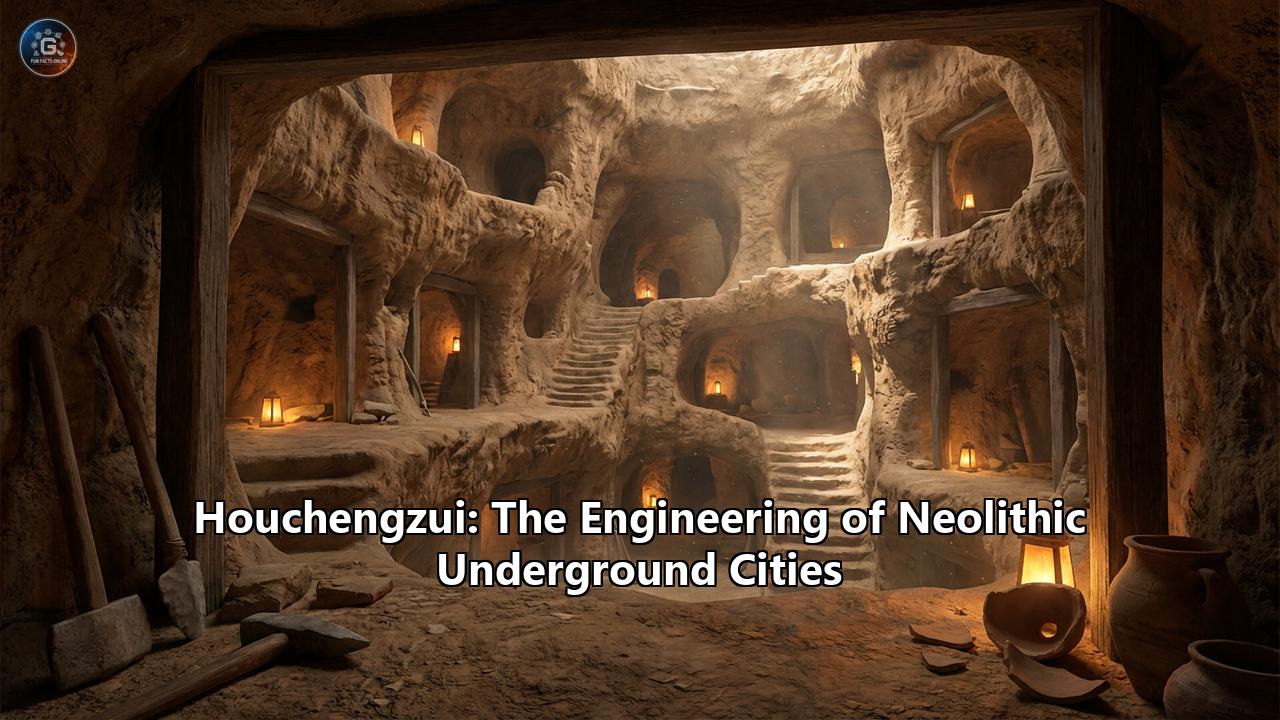
Beginning in 2019 and culminating in major announcements in late 2023 and 2024, excavations by the Chinese Academy of Social Sciences (CASS) revealed that the city sat atop a radial network of tunnels. Six major passageways have been mapped so far, buried between 1.5 to 6 meters (5 to 20 feet) beneath the surface.
These tunnels were not crude dugouts. They were engineered spaces. Ranging from one to two meters in height and about 1.5 meters wide, they were spacious enough for armed soldiers to move through rapidly, perhaps even carrying supplies or wounded comrades.
The layout was strikingly strategic. The tunnels radiated outward from the city center, acting like the spokes of a wheel. Crucially, they didn't just connect internal structures; they passed under the massive city walls and opened into the moats and trenches outside.
This design reveals a doctrine of "active defense." In a siege, static walls are a trap; eventually, the defenders starve or the walls are breached. But the Houchengzui tunnels turned the besiegers' tactics against them. Defenders could use the tunnels to send out surprise raiding parties behind enemy lines, flanking attackers who were focused on the main gates. They could smuggle in food and reinforcements during a blockade. Or, in a worst-case scenario, the city’s elite could vanish into the earth, escaping to regroup elsewhere.
Engineering the Earth: The Yaodong Connection
How did a Neolithic society, armed primarily with stone shovels and bone picks, construct a stable underground city that survived for thousands of years? The answer lies in the unique geology of the region and a vernacular architectural tradition that persists to this day: the yaodong.
The Loess Plateau is formed of wind-blown sediment—fine, mineral-rich silt that has accumulated over millions of years. This soil has a unique property: it is soft enough to carve with simple tools but structurally stable enough to hold a vertical face without collapsing, provided it is kept dry.
The engineers of Houchengzui were masters of this medium. The tunnels feature arched ceilings, a shape that naturally distributes the weight of the heavy earth above, preventing cave-ins. This is the same structural principle used in the yaodong cave dwellings that millions of people in Shaanxi and Shanxi provinces still live in today.
But while a yaodong is a home, these tunnels were military infrastructure. Tool marks found on the tunnel walls show the rhythmic, disciplined strikes of the laborers who carved them. The precision suggests a highly organized workforce, directed by a central authority with a clear blueprint. They understood ventilation, depth, and the load-bearing limits of the soil. They were not just digging holes; they were building a machine for war.
A World on the Brink
Why build such a fortress? The Longshan period was a time of "ten thousand states" (wan guo), a poetic term for the myriad of competing chiefdoms that dotted the Yellow River basin. But "competition" is a euphemism. This was a time of existential dread.
Around 4,200 years ago, the region faced a massive climatic shift, often referred to as the "4.2k Event." The climate became cooler and drier. The monsoons that fed the millet crops became erratic. As resources dwindled, neighbors became enemies. The lush plains turned into battlegrounds.
Houchengzui was likely a frontier garrison or a capital for a powerful chieftain, standing guard against rival polities like the massive Shimao city to the south. The triple walls and underground tunnels were the response to a landscape of constant threat. The elaborate "Urn City" gates (barbicans) forced attackers to enter a confined courtyard where they could be shot from above—a kill box design that would remain a staple of Chinese fortification for the next 4,000 years.
Echoes of Daily Life
Amidst this grim architecture of survival, life went on. Excavations at Houchengzui have uncovered the mundane and the beautiful alongside the martial. Archaeologists have found pottery kilns, indicating a specialized industrial district. The presence of jade axes and ritual items suggests a complex hierarchy where leaders commanded both military and spiritual authority.
The people here were farmers and herders, raising pigs and cultivating millet. They lived in semi-subterranean houses that mirrored the design of their tunnels—warm in the freezing winters and cool in the scorching summers. The tunnels likely served a dual purpose: military transport in war, and perhaps storage or shelter from the elements in peace.
The Legacy of the Stone City
The discovery of the Houchengzui tunnels forces a rewrite of the history of urbanism in East Asia. It proves that Neolithic societies were not simple tribal clusters but complex, paranoid, and highly engineered states capable of mobilizing massive labor forces for public works.
The engineering principles refined here—the use of rammed earth, the strategic depth of defense, and the mastery of the loess soil—laid the groundwork for the civilizations that followed. In the crumbling tunnels of Houchengzui, we see the embryonic logic that would one day culminate in the Great Wall.
Today, the wind still blows over the Hun River, smoothing the edges of the ancient trenches. The wooden gates have rotted away, and the names of the kings who walked these tunnels are lost to time. But the engineering remains—a silent testament to a people who looked at the earth beneath their feet and saw not just soil, but salvation.
Reference:
- https://en.wikipedia.org/wiki/Yellow_River_civilization
- https://www.youtube.com/watch?v=LsR9onSvagA
- https://www.youtube.com/watch?v=WdzZ7PvieWE
- https://www.businesstoday.in/visualstories/news/what-were-they-hiding-from-secret-tunnels-found-under-neolithic-fortress-in-china-253331-04-08-2025
- https://www.youngpioneertours.com/yaodong/
- https://www.re-thinkingthefuture.com/city-and-architecture/a4585-pit-houses-of-china-yaodong/
- https://www.labrujulaverde.com/en/2023/12/complex-network-of-tunnels-dating-back-6000-years-discovered-in-chinas-ancient-houchongzhai-stone-town/
- https://socks-studio.com/2021/06/21/living-inside-the-earth-the-yaodong-cave-buildings-in-china/
- https://www.ancient-origins.net/ancient-places-asia/yaodongs-cave-dwellings-ancient-world-002801
- https://www.visiontimes.com/2022/08/12/yaodongs-sustainable-architecture.html
- https://www.globaltimes.cn/page/202509/1344507.shtml
- https://en.wikipedia.org/wiki/Yaodong
- https://www.researchgate.net/publication/377962799_Violent_Cultural_Changes_in_the_Longshan_Period_and_Tribal_Warfare_in_Chinese_Legendary_Era
- https://www.youtube.com/watch?v=UKdrjUTntxM