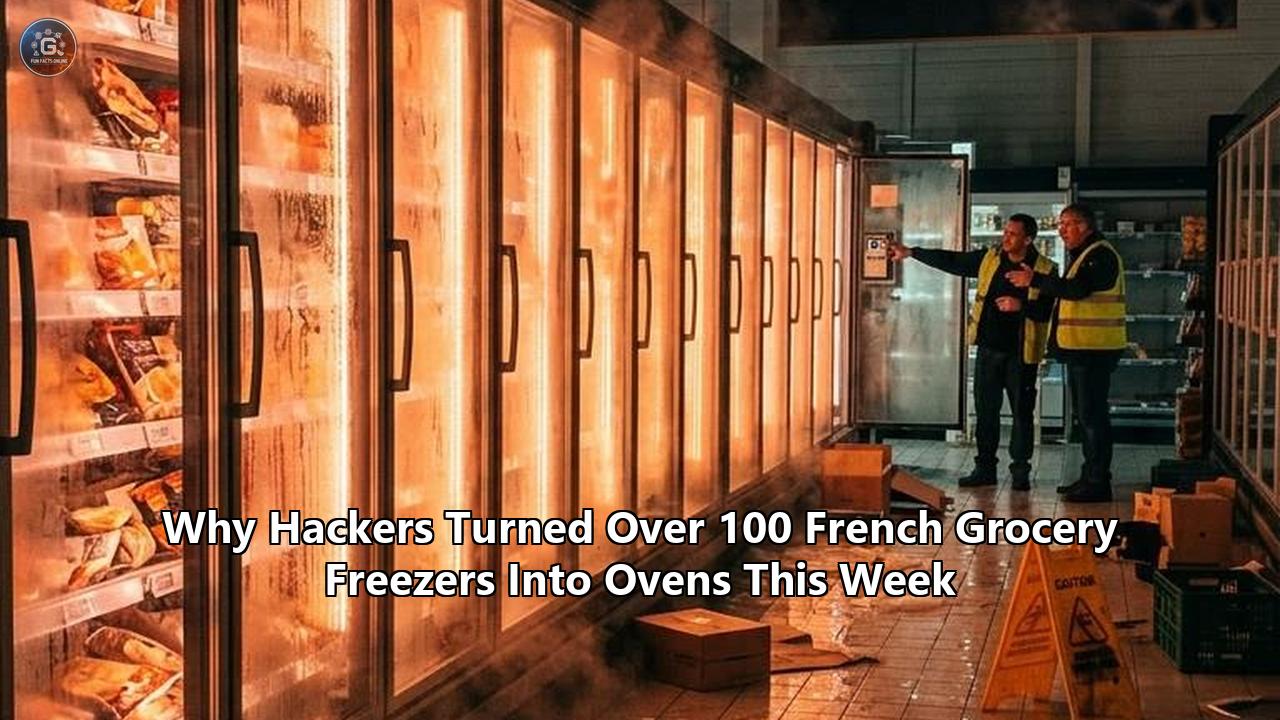
When supermarket employees unlocked the doors of an Intermarché store in the Paris suburb of Issy-les-Moulineaux before dawn on Monday, October 12, they anticipated the standard morning routine of restocking shelves, verifying delivery manifests, and baking the first batch of baguettes. Instead, they stepped into an aisle radiating intense heat.
The store’s display freezers, engineered to preserve frozen vegetables, ice cream, and seafood at -20°C, had spent the night blasting thermal energy into the sales floor. When clerks pulled open the glass lids, they were met by blasts of humid, 62°C air. Pints of ice cream had liquefied, paper packaging had soaked through, and vacuum-sealed meats were slowly baking inside their wrappers. In Normandy, another retail branch reported freezer temperatures peaking at 80°C—hot enough to cook poultry, melt internal acrylic panels, and trigger overhead fire sprinklers that flooded the aisles with hot runoff.
Across France, the same scene played out in more than 700 supermarkets. Five of the country’s largest grocery conglomerates—Les Mousquetaires (parent of Intermarché and Netto), Coopérative U, Carrefour, E.Leclerc, and Monoprix—found their cold-chain operations crippled by an aggressive, coordinated cyberattack. Between 11:00 p.m. on Sunday night and 5:00 a.m. on Monday, unknown threat actors bypassed security barriers, seized control of centralized refrigeration controllers, and remotely inverted the operational logic of commercial cooling systems.
By morning, the perpetrators had ruined hundreds of tons of perishable goods, forced dozens of stores to shutter sales floors, and inflicted an estimated €30 million to €50 million in direct product losses, equipment damage, and remediation expenses. Paris prosecutors, operating through their specialized national cybercrime division (JUNALCO), launched a criminal investigation into malicious interference with automated data processing systems and the physical sabotage of vital infrastructure. France’s national cybersecurity agency, the Agence nationale de la sécurité des systèmes d’information (ANSSI), issued urgent advisories ordering grocery operators to sever their cooling systems from external networks.
The incident represents an alarming milestone: digital sabotage crossing over from theoretical industrial risk into widespread, physical disruption of everyday consumer food supplies. What initially resembled a juvenile prank was, upon technical inspection, an unvarnished demonstration of how systemic iot security vulnerabilities can weaponize standard commercial appliances into destructive, kinetic heating elements.
The Scale of the Strike: Spoiled Inventories and Localized Blazes
The geographical breadth of the disruption demonstrated meticulous planning and automated execution. Attackers did not pick off a single regional franchise; they swept across national retail networks in a single nocturnal wave:
- Les Mousquetaires (Intermarché and Netto): More than 300 stores were struck. In approximately 150 locations, commercial refrigeration units remained locked at temperatures exceeding 50°C for over six hours, destroying entire chilled and frozen departments.
- Coopérative U: Reported intrusions across more than 100 outlets. Dominique Schelcher, the retail group’s chief executive, denounced the assault: "Targeting equipment essential to the preservation of fresh products and to the food supply of the French people is of extreme gravity and is unprecedented".
- Carrefour Market: Confirmed that 80 regional stores experienced unauthorized temperature overrides, though automated network monitoring in its larger hypermarkets blocked similar intrusions.
- E.Leclerc and Monoprix: Several dozen locations confirmed compromises, with Monoprix estimating that 5% of its nationwide store network suffered cooling system hijacks.
+-------------------------------------------------------------------------+
|                  FRENCH GROCERY SECTOR INTRUSION MAP                     |
+-------------------------------------------------------------------------+
|  Retail Chain            | Stores Impacted | Primary Impact              |
+--------------------------+-----------------+-----------------------------+
|  Intermarché / Netto     | 300+ stores     | Prolonged 50°C-62°C cycles  |
|  Coopérative U           | 100+ stores     | Complete cold-case dumping  |
|  Carrefour Market        | 80 stores       | Perimeter freezer failure   |
|  Monoprix                | ~25 stores (5%) | Fresh inventory spoilage    |
|  E.Leclerc               | Multiple sites  | Localized thermal damage    |
+--------------------------+-----------------+-----------------------------+
|  Total Confirmed Stores: | ~500 to 700+    | Cumulative Losses: €30M-€50M|
+-------------------------------------------------------------------------+
Beyond the immediate loss of food, several retail outlets faced physical property destruction. In ordinary store operations, a supermarket freezer’s evaporator fans cycle off during regular defrosting while low-wattage resistance heaters loosen accumulated ice on coils for 20 to 30 minutes. The attackers rewrote controller instructions to drive heating coils at continuous 100% duty cycles for six consecutive hours while disengaging internal thermal cut-offs.
In multiple locations across Alsace and western France, radiant heat scorched plastic wiring conduits, melted drainage pans, and set insulation materials smoldering. At an Intermarché store in Colmar, the thermal load cracked protective tempered-glass display panels and ignited synthetic display fittings, filling the supermarket with acrid plastic smoke and triggering commercial fire suppression systems. The water spray ruined ambient dry goods in nearby aisles, multiplying the financial losses far beyond the frozen food inventory.
"This was not a data breach where credit card numbers were siphoned out through a database vulnerability," said Christophe Hansen, the European Commissioner for Agriculture and Food, in an address following the attack. "This was the weaponization of the food distribution chain. The exploitation of basic human sustenance through cyber means is no longer an abstract hypothesis. It is our operational reality".
The Technical Breakdown: How Freezers Become Heaters
To comprehend how software payloads thousands of kilometers away turned commercial cooling units into industrial ovens, one must examine the architecture of modern supermarket refrigeration.
A standard consumer refrigerator relies on a mechanical thermostat or a bare-bones embedded microcontroller that directly cycles a single compressor. Commercial supermarkets do not operate this way. A typical grocery store features dozens of open-front chillers, closed freezer cases, meat counters, dairy walk-ins, and produce misters. These units connect to massive central compressor racks located in back-of-house utility plants or rooftops.
Managing this complex thermal apparatus requires an enterprise-grade Building Automation System (BAS) or Industrial Internet of Things (IIoT) refrigeration supervisory controller. The controllers targeted across France were predominantly legacy hardware units manufactured by Danish industrial engineering giant Danfoss, specifically the AK-SM 800 and AK-SC 355 series, alongside isolated installations of Copeland Dixell XWEB supervisory systems.
+-------------------------------------------------------------------------+
|                 SUPERMARKET REFRIGERATION OT TOPOLOGY                   |
+-------------------------------------------------------------------------+
|                                                                         |
|                          [ THE PUBLIC INTERNET ]                        |
|                                     │                                   |
|                Attacker Exploit Path: Web UI / Port 80/443              |
|                                     ▼                                   |
|         ┌─────────────────────────────────────────────────────┐         |
|         │  Danfoss AK-SM 800 / AK-SC 355 Controller           │         |
|         │  (End-of-Life Firmware, Hardcoded Diagnostic Logins) │         |
|         └──────────────────────────┬──────────────────────────┘         |
|                                    │                                    |
|                 RS-485 Modbus / Proprietary Fieldbus                     |
|            ┌───────────────────────┼───────────────────────┐            |
|            ▼                       ▼                       ▼            |
|     [Case Pack A]           [Case Pack B]           [Case Pack C]       |
|   (Frozen Seafood)           (Dairy Display)         (Frozen Poultry)    |
|            │                       │                       │            |
|   • Compressors: OFF      • Compressors: OFF      • Compressors: OFF    |
|   • Defrost Heaters: ON   • Defrost Heaters: ON   • Defrost Heaters: ON |
|   • Alarms: SILENCED      • Alarms: SILENCED      • Alarms: SILENCED    |
|   • Temp: Rising to 50°C  • Temp: Rising to 50°C  • Temp: Rising to 50°C|
+-------------------------------------------------------------------------+
These devices serve as the localized brain of a store's thermal envelope. They regulate refrigerant suction pressures, control expansion valves, monitor temperature probes, and orchestrate cyclical maintenance routines. Crucially, they also govern the defrost sequence.
The Defrost Mechanism Inversion
In low-temperature commercial refrigeration, moisture from ambient store air enters display cabinets and freezes onto evaporator coils. Over time, this frost creates an insulating layer that reduces heat transfer. To prevent system chokes, refrigeration controllers run an automated defrost cycle several times a day.
Two primary mechanisms accomplish this:
- Electric Resistance Defrost: High-output electric heating rods embedded between the evaporator fins are energized, raising coil temperatures above freezing while compressors pause.
- Hot-Gas Defrost: Compressor discharge valves redirect superheated refrigerant vapor directly backward through the evaporator coils instead of the condenser, turning the chiller's cooling surfaces into radiators.
Under engineered parameters, safety logic limits defrost cycles to roughly 20 to 45 minutes, terminating the cycle either via a time ceiling or when a clip-on evaporator thermostat registers roughly 10°C to 15°C.
The attackers systematically overrode these fail-safes. Leveraging administrative control over the devices, they:
- Inverted relay scheduling to force systems into permanent, indefinite defrost mode.
- Disabled maximum time cut-off parameters (Defrost Terminate Time) and manually forced thermal override switches to ignore safety cutoff probes.
- Turned off circulation fans, keeping heat trapped inside display units rather than dispersing it into the store.
- Manipulated alarm thresholds—setting alarm delays to infinite values and zeroing out alert triggers—so that internal monitoring systems failed to generate out-of-range telemetry, phone alerts, or loud supervisory beeps.
With cooling compressors disengaged and multi-kilowatt heating elements running without interruption, the freezers ceased cooling entirely. They became convection boxes, steadily pushing temperatures upward until internal cabinets hit 50°C, 62°C, and higher over hours of unattended darkness.
Why Were Controllers Reachable? The Internet Exposure Crisis
The physical result inside the supermarkets was dramatic, but the underlying vector of compromise was depressingly mundane. Threat actors did not break into retail facilities through optical physical taps or zero-day exploits developed by intelligence agencies. They found controllers left wide open to the public internet.
┌────────────────────────────────────────────────────────────────────────┐
│                   PRIMARY ATTACK SURFACE COMPOSITION                   │
├────────────────────────────────────────────────────────────────────────┤
│ 1. Direct Public IP Exposure without VPN / Firewalls                   │
│ 2. Legacy Danfoss Hardware (AK-SC 355 EOL 2016; AK-SM 800 EOL 2021)    │
│ 3. Unpatched Web Interfaces Running HTTP/HTTPS on Default Ports       │
│ 4. "Code of the Day" Master Backdoor Logic Bypassing Authentication   │
│ 5. Store Operations Segregation Failures (No Out-of-Band VLANs)        │
└────────────────────────────────────────────────────────────────────────┘
Commercial refrigeration units are rarely serviced by retail employees. Grocery chains contract out thermal engineering to third-party facilities management providers and HVAC specialists. These vendors oversee hundreds of retail sites from centralized operations centers.
To eliminate the expense of dispatching physical technicians whenever a defrost cycle drifts or an expansion valve sticks, service contractors routinely connect refrigeration controllers to store network routers. Rather than deploying encrypted, hardware-authenticated virtual private networks (VPNs) or Zero Trust Network Access (ZTNA) gateways, installers frequently forward ports directly through commercial modems or connect controllers to low-cost cellular gateways with public, static IPv4 addresses.
By doing so, facilities maintenance firms inadvertently exposed the controllers’ web administration dashboards to anyone scanning the public internet. Using automated scanning engines like Shodan, Censys, and Project Sonar, malicious actors can locate thousands of exposed refrigeration units globally in minutes using simple queries targeting HTTP server headers and specific device web titles.
The Role of Legacy Hardware and Hardcoded Flaws
The specific equipment exploited in France exposed the consequences of long-term operational technology neglect. Danfoss introduced the AK-SC 355 in the early 2000s and formally phased it out in 2016. The AK-SM 800 series reached its end-of-life (EOL) milestone in May 2021. For years, the manufacturer informed commercial clients that these systems had reached obsolescence, stopped shipping security updates, and recommended transitions to modern AK-SM 800A platforms.
Retailers largely ignored those warnings. Supermarket profit margins hover between 1% and 3%. Replacing commercial refrigeration control architecture across hundreds of retail sites can cost tens of thousands of euros per store, requiring costly operational pauses and technician hours. If a box mounted on a mechanical room wall continues switching relays and logging temperatures correctly, executives rarely approve capital expenditures to upgrade it.
As a result, hundreds of French stores ran mission-critical infrastructure on devices operating on code bases that had not received a security patch in half a decade or more.
The vulnerability ecosystem within these legacy systems was well-known. In early 2025, security researchers at Claroty’s Team82 discovered and published deep vulnerabilities in Danfoss refrigeration controller lines. The controllers featured exposed web servers with glaring authentication weaknesses:
- Administrative interfaces frequently left the default username set to admin.
- Multiple versions embedded an archaic "code of the day" maintenance bypass. This hardcoded recovery routine allowed anyone who knew the device’s current internal date to compute an administrative override code, effectively nullifying password security.
- Software layers contained unauthenticated remote code execution and parameter-injection flaws, allowing arbitrary manipulation of digital output states, setpoint files, and sensor configurations.
Danfoss released firmware patch 4.3.1 for its newer AK-SM 800A line to fix these problems. The older AK-SM 800 and AK-SC 355 systems, however, received no such remedies. They were obsolete, abandoned by maintenance schedules, yet entrusted with preserving millions of euros in consumable inventory while exposed to the open internet.
The failure to remediate these well-documented iot security vulnerabilities left the French grocery sector exposed. Attackers did not require proprietary zero-days; they merely scripted automated bots to locate exposed interfaces, calculate recovery keys, switch defrost relays, and silence warning alerts.
The Supply Chain Blame Game
In the immediate wake of the incident, fingers pointed in every direction across the retail supply ecosystem. The dispute exposed the fragmented operational accountability that plagues modern commercial infrastructure.
Retail executives moved quickly to divert criticism away from internal security governance. Dominique Schelcher of Coopérative U told French radio that his supermarket chain had no direct operational relationship with Danfoss: "Our supermarkets are not customers of Danfoss. We hire refrigeration service contractors who install, configure, and maintain these setups on our behalf".
                     RETAIL CYBERSECURITY ACCOUNTABILITY GAP

     [ Grocery Conglomerate ] ──▶ Demands low service costs & high uptime
                │
                ▼
  [ Third-Party Maintenance Vendor ] ──▶ Configures cheap remote access (Port Forwarding)
                │
                ▼
   [ Hardware Manufacturer ] ──▶ EOL notifications issued, but legacy hardware remains active
                │
                ▼
       [ Critical Cold Chain ] ──▶ Unmonitored, unsegmented, and exposed to attackers
Maintenance contractors fired back off the record, highlighting that grocery store operators regularly refuse to authorize budget outlays for equipment replacement when told that a system has reached end-of-life. Service level agreements (SLAs) frequently reward fast response times for mechanical repairs while assigning zero financial penalty to cybersecurity exposure. Remote access methods were established using direct internet routing precisely because supermarket IT teams refused to support vendor access via their enterprise VPNs or isolated subnets.
Danfoss issued a formal statement highlighting its prior safety guidance:
"Danfoss is aware of incidents in France affecting a limited number of refrigeration management systems. The affected units were legacy products running outdated firmware. We have long advised customers to keep supported systems updated with the latest firmware, implement proper firewall and VPN protections, and migrate legacy systems to current-generation solutions".
The back-and-forth exposed a widespread structural vulnerability: the operational technology running mechanical plants in commercial enterprises sits in an institutional blind spot. Enterprise Chief Information Security Officers (CISOs) monitor cloud datacenters, corporate email environments, and retail point-of-sale (POS) registers, while building facilities managers configure HVAC and refrigeration units without IT security oversight, cryptographic isolation, or patch management lifecycles.
Sabotage, Extortion, or Geopolitical Hybrid Warfare?
One aspect of the French supermarket assault stood out to cybercrime investigators: the total absence of a financial demand.
Standard cybercriminal groups rely on ransomware. They breach corporate perimeters, exfiltrate confidential files, encrypt primary databases, and leave ransom notes demanding millions in Monero or Bitcoin to restore operations. In this attack, the perpetrators issued no demands, hosted no negotiation portals on the dark web, and left behind no recovery keys.
Their objective was destruction.
"When an attacker forces physical systems to destroy physical assets without demanding money, the calculus shifts from financial extortion to pure kinetic sabotage," explained Gérôme Billois, a cybersecurity partner at management consultancy Wavestone. "The objective in this profile of attack is destabilization—sowing uncertainty in the physical infrastructure supporting daily life, eroding trust in supply stability, and testing automated attack playbooks".
┌─────────────────────────────────────────────────────────────────────────┐
│                    THREAT ACTOR PROFILES AND MOTIVES                    │
├─────────────────────────────────────────────────────────────────────────┤
│ Profile A: Financially Motivated Cybercriminals                         │
│ • Tactics: Data theft, extortion, ransomware payloads                   │
│ • Intent: Monetary gain                                                 │
│ • Outcome in France: Incompatible (no ransom notes or demands issued)   │
├─────────────────────────────────────────────────────────────────────────┤
│ Profile B: Hacktivist Collectives / Vandalism                           │
│ • Tactics: Web defacement, public credential dumps, brute-force disruption│
│ • Intent: Ideological messaging, public attention                       │
│ • Outcome in France: Possible, but lack of social claims weakens theory │
├─────────────────────────────────────────────────────────────────────────┤
│ Profile C: State-Sponsored Hybrid Warfare / Kinetic Sabotage            │
│ • Tactics: Exploiting unpatched edge controllers to destroy inventory  │
│ • Intent: Civil destabilization, psychological impact, economic friction│
│ • Outcome in France: High probability alignment with recent alerts      │
└─────────────────────────────────────────────────────────────────────────┘
The incident unfolded during heightened geopolitical tensions across Western Europe. Only weeks prior to the attack, French President Emmanuel Macron directed state security agencies to enhance physical and digital safeguards across critical infrastructure sectors in response to foreign "hybrid warfare" campaigns.
European security services have documented a wave of non-attributable infrastructure interference across the continent over the past two years:
- Unexplained undersea fiber-optic cable cuts in the Baltic Sea.
- GPS-jamming incidents disrupting commercial aviation in Scandinavia.
- Cyber intrusions against water treatment facilities and regional electricity sub-stations in Poland, Romania, and Germany.
- Mysterious defrost incidents at twelve U.S. military commissary cold-storage sites in August 2026, which spoiled thousands of pounds of rations under nearly identical controller-manipulation techniques.
France has emerged as a primary target for disruptive cyber operations in Europe. Over the past 24 months, foreign threat groups have breached France Travail (the state unemployment registry), disrupted regional healthcare networks, penetrated national identity administration systems, and breached telecommunications backbones. Striking the commercial food supply through connected grocery chillers represents a logical evolution in non-kinetic pressure: targeting consumer goods directly to erode the public's sense of domestic security.
European cyber intelligence units are currently examining telemetry and source IP addresses associated with the attack, exploring connections to Russian state-sponsored groups known for critical infrastructure sabotage, such as Sandworm (GRU Unit 74455), as well as affiliated "hacktivist" fronts that mask state operations behind ideological identities.
The Public Health and Economic Consequences
While the incident generated sensational headlines about "freezers turned into ovens," retail executives and public health authorities confronted serious operational crises.
+--------------------------------------------------------------------------+
|                     PATHOGEN GROWTH AT ELEVATED TEMPS                    |
+--------------------------------------------------------------------------+
| Temp Range   | State               | Biological Risk                     |
+--------------+---------------------+-------------------------------------+
| -22°C to 0°C | Nominal Storage     | Microbial activity arrested         |
| 4°C to 12°C  | Threshold Violation | Psychrotrophic bacterial growth     |
| 15°C to 45°C | Thermal Danger Zone | Rapid multiplication: Salmonella,   |
|              |                     | Listeria, Clostridium perfringens   |
| 50°C to 65°C | Extreme Degradation | Structural breakdown, lipid oxidation|
+--------------------------------------------------------------------------+
Food safety regulation in the European Union operates under strict statutory mandates governed by the General Food Law (Regulation EC 178/2002). The cold chain cannot be broken. When raw meats, poultry, prepared dairy, and blast-frozen items sit in the biological "danger zone" (temperatures between 5°C and 60°C) for more than two hours, bacterial pathogens multiply exponentially:
- Listeria monocytogenes can cause severe invasive infections with mortality rates nearing 20% in vulnerable demographics.
- Salmonella enterica and Campylobacter thrive in warm proteins, creating high risks of gastrointestinal toxicity.
- Clostridium perfringens spores survive moderate heat and germinate rapidly as environments shift through warm thresholds, generating potent enterotoxins.
Because the attackers manipulated thermal control files for six continuous hours, no compromised product could be salvaged. Even if an overheated chicken or frozen fish fillet feels cool once a system is switched back on, heat-stable bacterial toxins remain inside the meat tissue. Selling or donating this inventory would risk catastrophic food poisoning outbreaks across metropolitan populations.
Consequently, hit supermarket locations faced an immediate total-write-off mandate. In Issy-les-Moulineaux, store teams hauled dumpsters of vacuum-sealed beef, dairy products, ice cream, and frozen prepared dinners directly to disposal haulers. In two individual hypermarkets located in the Alsace region, spoiled merchandise write-offs totaled over €270,000 within a single eight-hour window.
+---------------------------------------------------------------------------+
|               ANATOMY OF DIRECT FINANCIAL AND OPERATIONAL DAMAGE          |
+---------------------------------------------------------------------------+
| Direct Inventory Loss     | Bulk write-offs of perishables: €25M - €35M    |
| Capital Asset Restoration | Burned heating coils, melted frames: €5M - €8M|
| Business Interruption     | Closed aisles, deep sanitization: €4M - €7M   |
| Incident Response & OT    | Emergency site visits, re-cabling: €3M - €5M  |
+---------------------------+-----------------------------------------------+
| Aggregate Cost Impact:    | €37,000,000 - €55,000,000                     |
+---------------------------------------------------------------------------+
The disruption rippled across agricultural logistics networks. Supermarkets could not simply restock shelves by Tuesday morning. Modern grocery supply chains function on "just-in-time" fulfillment workflows. Regional distribution centers (warehouses run by supply arms like ITM Alimentaire or Carrefour Supply Chain) keep minimal safety stock.
The sudden, synchronized destruction of cold inventories across 700 retail points created immense demand surges for replacement dairy, poultry, and frozen goods. Fleets of refrigerated trailers were redirected across northern France, congesting shipping lanes and leaving out-of-stock gaps in unaffected neighborhood stores.
Furthermore, retail chains face complex insurance disputes. Standard commercial property insurance covers inventory losses resulting from mechanical breakdowns, utility outages, or fire. However, modern corporate policies routinely include "cyber peril exclusion clauses" that deny property and spoil claims if the proximate cause is an intentional network intrusion. Retailers and insurers are now engaged in contentious negotiations over whether burned compressor components and melted display cases constitute physical fire damage or uninsured digital sabotage.
Tactical Response: The Emergency Triage
As the scale of the attack became clear on Monday morning, France’s national cybersecurity agency, ANSSI, mobilized its operational center (COSS). Working alongside CERT-FR (the national Computer Emergency Response Team), officials issued urgent security directives to the retail industry.
                    EMERGENCY CONTAINMENT PROTOCOL (ANSSI)

     [ Step 1: Physical Severing ]
     Pull RJ-45 Ethernet lines / Disable cellular modems on all controllers
                   │
                   ▼
     [ Step 2: Ingress Firewall Rules ]
     Drop incoming connections on Ports 80, 443, 8080, and Modbus TCP 502
                   │
                   ▼
     [ Step 3: Mechanical Fallback ]
     Manually trip contactors into fixed cooling mode; bypass controller relays
                   │
                   ▼
     [ Step 4: Identity Sanitization ]
     Invalidate default 'admin' accounts; rotate keys; disable bypass codes
Vincent Strubel, Director General of ANSSI, issued clear instructions: commercial operators had to disconnect impacted controller series from the public internet immediately. ANSSI advised retail operations to apply strict tactical measures:
- Immediate Network Severing: Technicians were ordered to physically disconnect Ethernet cables and pull cellular SIM cards from every Danfoss AK-SM 800, AK-SC 355, and related supervisory controller across retail sites.
- Access Control Filtering: For sites requiring remote monitoring, edge firewalls were configured to block inbound public traffic entirely, allowing access exclusively through dedicated IPsec VPN tunnels with multi-factor authentication (MFA) or restricted static IP whitelists.
- Firmware Upgrades and Credential Overhauls: For compatible hardware (such as newer AK-SM 800A platforms), operators were told to install update package 4.3.1 immediately, permanently revoke default admin profiles, and disable legacy maintenance bypass scripts.
- Mechanical Lockout: Retail engineering teams were dispatched to manually switch heating circuit contactors into the open (disconnected) position inside main breaker boxes, physically preventing units from energizing defrost heaters regardless of software instructions.
Across France, retail chains deployed hundreds of refrigeration technicians and IT specialists to execute manual resets on mechanical room walls. Technicians worked around the clock, climbing into back-of-house equipment lofts to pull circuit plugs, flash controller memory cards, and reset corrupted temperature setpoints.
By Wednesday evening, the vast majority of affected stores had restored manual cooling control, cleared out ruined stock, disinfected store equipment, and reopened their frozen food aisles. However, the foundational weaknesses that allowed the intrusion to occur remain widespread across the broader commercial landscape.
Architectural Reform: Eliminating IoT Security Vulnerabilities in Critical OT
The French supermarket attack marks the end of an era where operational technology could be treated as an isolated, harmless domain. Fixing these systemic iot security vulnerabilities requires transitioning from ad-hoc emergency patches to rigorous, engineering-led architectural reform.
+-------------------------------------------------------------------------+
|             SECURE OPERATIONAL TECHNOLOGY (OT) ARCHITECTURE             |
+-------------------------------------------------------------------------+
|                                                                         |
|                          [ THE PUBLIC INTERNET ]                        |
|                                     │                                   |
|                         [ Zero Trust Gateway ]                          |
|                     (MFA, Hardware Keys, Device Posture)                 |
|                                     │                                   |
|       ══════════════════════════════╪═══════════════════════════════    |
|       PERIMETER FIREWALL (Deny-All Default / Ingress Inspection)       |
|       ══════════════════════════════╪═══════════════════════════════    |
|                                     │                                   |
|                   [ Corporate Enterprise Network ]                      |
|                     (POS, Inventory, Store Office)                      |
|                                     │                                   |
|       ──────────────────────────────┼───────────────────────────────    |
|       OT SEGREGATION BARRIER (No Inter-VLAN Routing)                    |
|       ──────────────────────────────┼───────────────────────────────    |
|                                     │                                   |
|             [ Isolated Operational Technology Subnet ]                  |
|                                     │                                   |
|              ┌──────────────────────┴──────────────────────┐            |
|              ▼                                             ▼            |
|     [ Modern Controller ]                         [ Modern Controller ] |
|   (Signed Firmware, TLS 1.3)                    (Signed Firmware, TLS 1.3)
|              │                                             │            |
|              ▼                                             ▼            |
|   ┌─────────────────────┐                       ┌─────────────────────┐ |
|   │ Mechanical Limit    │                       │ Mechanical Limit    │ |
|   │ Switches (Bimetallic│                       │ Switches (Bimetallic│ |
|   │ Hard Cut-off: 10°C) │                       │ Hard Cut-off: 10°C) │ |
|   └──────────┬──────────┘                       └──────────┬──────────┘ |
|              │                                             │            |
|              ▼                                             ▼            |
|    [ Evaporator Heaters ]                        [ Evaporator Heaters ] |
+-------------------------------------------------------------------------+
Security professionals and industrial engineers are calling for structural changes to eliminate the architectural flaws exposed by the incident:
1. Enforcing the Purdue Model for Commercial Retail
Industrial facilities rely on the ISA-99/IEC 62443 standard (the Purdue Model) to segregate physical field equipment from business networks and public connections. Retail environments must implement identical isolation principles:
- Level 1 (Field Devices): Sensors, expansion valves, and thermal relays must communicate exclusively through private, non-routable serial or Modbus loops.
- Level 2 (Supervisory Controllers): Devices like the Danfoss AK-SM platform must live inside a strictly isolated, out-of-band OT virtual local area network (VLAN). Direct internet access should be systematically blocked at the router level.
- Demilitarized Zones (DMZ): External monitoring must occur via pull-only telemetry architectures. The controller pushes status metrics outward to an authenticated cloud intermediary; no outside entity should be able to initiate direct inbound connections to the controller's local web server.
2. Hardening Identity and Access Management
The era of shipping industrial controllers with static administration accounts and hardcoded factory recovery routines must end.
- Default configurations must require operators to establish cryptographically strong passwords during initial setup before the unit can switch on relays.
- All remote maintenance interactions must run through encrypted Zero Trust Network Access (ZTNA) frameworks. Technicians should authenticate via centralized single sign-on (SSO) backed by FIDO2-compliant hardware keys, ending reliance on shared passwords stored on sticky notes inside electrical panels.
- Dynamic diagnostic bypass algorithms—such as the "code of the day" mechanism—must be completely stripped out of production firmware.
3. Deploying Physical Hardware Failsafes
A foundational rule of resilient cyber-physical systems is that software instructions should never be able to push equipment beyond its safe physical operating boundaries.
- Commercial display cases and walk-in freezers must incorporate bimetallic thermal cut-off switches wired in series directly with the electric defrost heating elements.
- These mechanical snap-action switches open automatically when cabinet temperatures rise above 10°C or 15°C, physically interrupting electrical current to the heater coils.
- Because this protection relies on the physical expansion of metal rather than software logic, an attacker cannot override it through remote commands, network manipulation, or corrupted controller memory.
Regulatory Realities: NIS2 and the Cyber Resilience Act
The attack across France will accelerate policy and regulatory intervention throughout the European Union.
For years, commercial retail was treated as a low-risk corporate sector, exempt from the stringent security requirements imposed on nuclear utilities, bulk power grids, and telecommunication carriers. That regulatory exemption is evaporating.
+-------------------------------------------------------------------------+
|                  EUROPEAN REGULATORY LANDSCAPE OVERHAUL                 |
+-------------------------------------------------------------------------+
| Framework   | Scope & Mandate                     | Enforcement Impact  |
+-------------+-------------------------------------+---------------------+
| NIS2        | Food Production & Distribution now  | Fines up to €10M    |
| Directive   | designated "Important Entities"     | or 2% global turnover|
|             | Mandates strict supply-chain TPRM   | Personal executive  |
|             | and 24-hour incident notifications  | liability for lapses|
+-------------+-------------------------------------+---------------------+
| EU Cyber    | Hardware manufacturers must provide | Sales bans on       |
| Resilience  | security patches for product life   | vulnerable products;|
| Act (CRA)   | Bans hardcoded bypass mechanisms    | strict vulnerability|
|             | and unauthenticated access ports    | disclosure rules    |
+-------------------------------------------------------------------------+
The NIS2 Directive
The European Union’s Directive on Measures for a High Common Level of Cybersecurity across the Union (NIS2) explicitly expands its regulatory remit to encompass the food production, processing, and distribution sector.
Under NIS2, major supermarket networks and critical cold-chain operators are classified as "Important Entities." This classification subjects them to binding statutory requirements:
- Supply Chain Risk Management: Retailers must audit and verify the cybersecurity practices of third-party vendors, including HVAC and refrigeration maintenance contractors.
- Mandatory Incident Disclosures: Entities must issue an early warning notification to state incident response teams within 24 hours of detecting a significant cyber incident, followed by a detailed assessment within 72 hours.
- Direct Administrative Penalties: Failure to comply exposes corporate entities to fines reaching up to €10 million or 2% of total worldwide annual turnover, alongside direct personal liability and sanctions for executive board members who fail to exercise proper risk oversight.
The EU Cyber Resilience Act (CRA)
At the product level, the EU Cyber Resilience Act establishes mandatory cybersecurity requirements for all products with digital elements sold within the European single market.
The regulation directly outlaws the business practices that contributed to the French retail disaster:
- Manufacturers are barred from selling devices featuring default, unchangeable credentials or hidden maintenance override keys.
- Hardware vendors must guarantee vulnerability remediation and software updates throughout the anticipated operational life of the device.
- Manufacturers must maintain a detailed Software Bill of Materials (SBOM) and provide vulnerability reports within 24 hours of exploitation discovery.
Had the CRA and NIS2 frameworks been strictly enforced a decade ago, deploying legacy Danfoss AK-SC 355 controllers lacking firmware updates and exposing hardcoded maintenance backdoors to the open internet would have been an illegal, sanctionable offense.
What to Watch Next
As French law enforcement specialists and European intelligence agencies continue their technical forensics, the grocery sector disruption offers a clear view into the evolving nature of cyber conflicts. The line separating virtual code manipulation from physical kinetic damage has been crossed in everyday consumer spaces.
In the coming weeks and months, critical milestones will clarify the full impact of this intrusion:
- JUNALCO Forensic Findings: The Paris prosecutor's anti-cybercrime division is expected to release initial technical indicators of compromise (IOCs), detailing the origin IPs, command-and-control infrastructure, and automated scripts utilized in the attack. This attribution will help determine whether the operation was executed by a rogue hacktivist cell or state-sponsored operatives running hybrid warfare campaigns.
- European Cold-Chain Security Audits: National cybersecurity agencies across Europe—including Germany's BSI, the Netherlands' NCSC, and Spain's CCN-CERT—are coordinating with retail trade bodies to run comprehensive internet-exposure scans, forcing operators to dismantle open port forwards on commercial refrigeration hardware.
- Third-Party Contract Renegotiations: Major retail groups are overhauling standard facilities management agreements. Future vendor contracts will mandate encrypted, multi-factor remote access pathways, continuous inventory scanning, and clear liability assignments for physical damage caused by unpatched iot security vulnerabilities.
- Hardware Retrospective Upgrades: With millions in losses fresh in mind, grocery executives must decide whether to authorize the millions of euros required to rip and replace obsolete controller hardware mounted in mechanical rooms across Europe, or risk facing another midnight heating cycle.
The mass spoilage inside French supermarkets demonstrates that the Internet of Things is no longer simply an abstract network of webcams, smart speakers, and remote sensors. It is the physical framework that preserves food supplies, keeps hospitals cooled, balances municipal water systems, and stabilizes local communities.
When building systems are treated as minor conveniences rather than critical operational infrastructure, bad actors will eventually turn that negligence into heat. The burned-out freezers across France provided an unmistakable warning: secure operational access at the physical edge, or prepare to watch the cold chain melt from within.
Reference:
- https://www.theguardian.com/world/2026/oct/17/who-hacked-frances-supermarket-fridges
- https://timesofindia.indiatimes.com/etimes/trending/france-supermarket-cyberattack-hackers-turn-refrigerators-into-ovens-heating-them-to-50c-spoiling-food-at-hundreds-of-stores/articleshow/134906227.cms
- https://thecyberexpress.com/french-supermarket-cyberattack/
- https://en.wikipedia.org/wiki/2026_French_supermarket_refrigerator_hack
- https://www.oddee.com/hackers-turn-off-internet-connected-freezers-at-more-than-100-french-grocery-stores-80398/
- https://www.thenews.com.pk/latest/1419752-hackers-turn-hundreds-of-supermarket-fridges-into-ovens-in-unprecedented-cyberattack-across-france
- https://thehackernews.com/2026/10/attackers-heat-french-supermarket.html
- https://www.cbsnews.com/news/cyberattack-supermarkets-refrigerators-france-fires-food-losses/
- https://it.slashdot.org/story/26/10/12/1748203/hackers-heat-french-supermarket-fridges-sparking-fires-and-spoiling-food
- https://www.theguardian.com/world/2026/oct/12/cyber-attack-defrosts-refrigerators-france-supermarket-chains-intermarche-cooperative-u
- https://www.bleepingcomputer.com/news/security/cyberattack-shuts-down-refrigerators-at-french-supermarkets/
- https://www.afp.com/en/french-supermarkets-suffer-refrigerator-shutdown-after-unprecedented-cyberattack
- https://www.youtube.com/watch?v=Uoi9TBtIUEA
- https://www.reddit.com/r/technology/comments/1x47k5w/hackers_turn_supermarket_fridges_up_to_122/
- https://www.cnet.com/tech/services-and-software/cyberattack-hackers-target-french-supermarket-refrigerators/
- https://www.instagram.com/reel/DecHAyOjKFt/