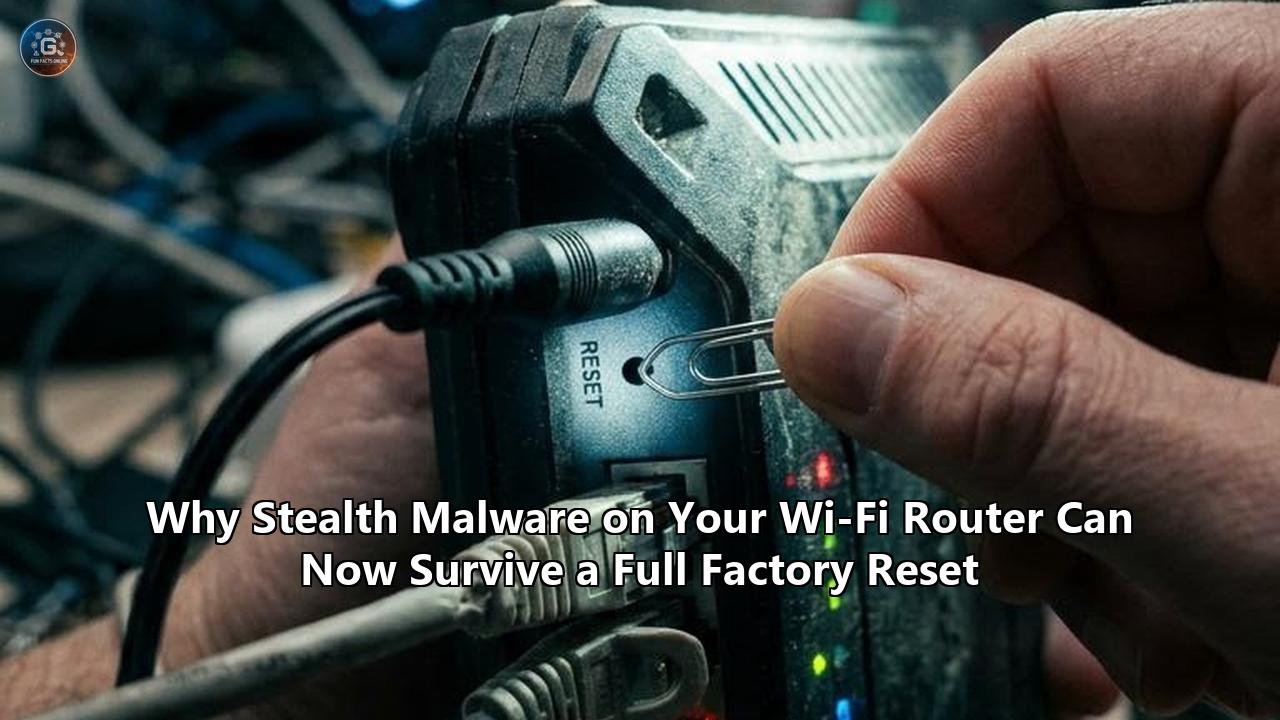
The paperclip was held down for thirty seconds, the LED indicators pulsed amber, blinked furiously, and cycled back to a calm, steady green. To every network engineer, security auditor, and home user who has ever troubleshot a compromised network, that thirty-second ritual represents the final, unassailable baseline. A hardware factory reset is designed to be the ultimate digital purge: it wipes custom configurations, clears non-volatile random-access memory, unloads volatile storage, and restores the appliance to the pristine software state it possessed when it left the factory assembly line.
Yet, inside a sealed analysis laboratory in northern Virginia earlier this year, an enterprise-grade branch router subjected to that exact reset procedure powered back on and, within four minutes, quietly re-established an encrypted TLS connection to an external command-and-control server located in Eastern Europe.
The configuration files had vanished. The Wi-Fi network names and custom admin passwords were gone. The web interface greeted researchers with the original setup wizard, asking them to select a default language. But deep within the physical silicon of the appliance’s flash storage, the infection remained entirely intact, operating with complete administrative control.
Security researchers across the globe are confronting an unsettling structural shift in network exploitation: modern router malware has broken through the containment barrier of volatile memory and configuration overlays, embedding itself directly into the underlying flash partitions that define the factory state itself. The assumption that physical possession of a device and a pinhole reset button guarantees a clean system is obsolete.
Investigating this breakdown reveals a cascade of architectural compromises across embedded hardware design: unsegmented flash controllers, unprotected memory partitions, cost-engineered board layouts that bridge physical write-protect pins directly to voltage sources, and boot systems that blindly execute whatever code is placed before them. To understand how stealth malware survives a physical wipe, one must follow the evidence trail down through the software stack, past the operating system, and straight onto the bare pins of the flash memory chips that power the internet’s perimeter.
The Forensic Anomaly: A Ghost in the Clean Slate
The trail began with a cluster of recurring intrusions within critical infrastructure networks and remote corporate offices. Incident response teams would identify malicious traffic originating from edge routers—primarily hardware from widely used brands including Cisco, Netgear, ASUS, and TP-Link. The defensive playbooks were standard and decisive: isolate the hardware, depress the physical reset switch to wipe the operational filesystem, update the administrative credentials, and restore network services.
Yet within seventy-two hours, the telemetry would reappear. Threat intelligence teams initially suspected rapid, automated re-exploitation via internet-facing zero-day vulnerabilities. If an automated botnet was scanning the IPv4 space for exposed management interfaces, an unpatched router placed back online might be reinfected within minutes.
"That was the working hypothesis for months," says Dr. Aris Thorne, a hardware security researcher and former defensive systems architect who analyzed compromised units recovered from energy and defense subcontractors. "We assumed the perimeter was simply being re-compromised through the front door the moment it reconnected to the wide-area network. So we pulled the devices out of production, placed them on an isolated air-gapped test bench, ran the physical factory reset sequence, and monitored the internal bus communications over serial interfaces without any WAN connection present."
The findings shattered the reinfection hypothesis. Even on an isolated local network, isolated from any external traffic, the routers were initializing background malware daemons upon boot. The malicious software was not arriving over the wire; it was already inside the house, waking up from the very files the router relied on to restore its clean state.
[BOOT SEQUENCE - ISOLATED LAB BENCH]
RomBOOT
U-Boot 2021.07 (May 14 2022 - 04:12:09 +0000)
CPU: MediaTek MT7621A ver 1, eco 3
Clocks: CPU: 880MHz, DDR: 1200MHz, Bus: 220MHz
Model: Hardware Baseline Edge-Router
DRAM:  256 MiB
NAND:  128 MiB
Scanning MTD partitions...
0x000000000000-0x000000080000 : "Bootloader"
0x000000080000-0x000000100000 : "Config_NVRAM"
0x000000100000-0x000000400000 : "Kernel"
0x000000400000-0x000002000000 : "RootFS"
Mounting SquashFS image from /dev/mtdblock3...
[INIT] Starting system services...
[INIT] Processing /etc/init.d/rcS...
[HOOK] Executing vendor service check: /sbin/net_check.sh
[ALERT] Process 'sys_mon_daemon' spawned PID 412 (UID 0)
[ALERT] Raw socket opened; listening for ingress knock on eth0
The system had booted cleanly from what should have been an immutable partition, yet it spawned an unauthorized root process labeled sys_mon_daemon. The process immediately opened low-level network listening sockets before the router's web management interface had even initialized. The factory reset had functioned precisely as the hardware manufacturer intended, yet the malware had not moved an inch.
Deconstructing the Paperclip: The Illusion of Immutability
To understand how malicious software survives this process, one must first dismantle the industry myth of what a factory reset actually does.
Most consumers and enterprise administrators operate under the mental model of a desktop computer or smartphone: a factory reset format wipes the drive and lays down an entirely fresh, cryptographically verified recovery image downloaded from an authoritative server or read from an isolated, protected sector.
Embedded networking hardware functions under radically different financial and engineering constraints. Routers are designed around low-cost storage—typically Serial Peripheral Interface (SPI) NOR flash chips ranging from 8 megabytes to 32 megabytes in consumer gear, or NAND flash chips ranging from 128 megabytes to 512 megabytes in small-to-medium enterprise appliances. Because these chips are small and storage is at a premium, the operating system does not maintain multiple redundant copies of a multi-gigabyte operating system.
Instead, embedded Linux distributions (including OpenWrt-derived vendor operating systems, Broadcom baselines, and proprietary vendor systems like Cisco's early RV systems or ASUSWRT) utilize a two-layer composite file architecture:
- The Base Layer (SquashFS): A compressed, highly optimized, read-only filesystem containing the core operating system, default configuration profiles, administrative web servers, and vendor executables.
- The Overlay Layer (JFFS2, UBIFS, or NVRAM): A writable filesystem mounted on top of the base layer using an overlay mechanism (such as OverlayFS or mini_fo). When a user changes an administrator password, sets a custom Wi-Fi SSID, or alters firewall rules, the base files are not altered. Instead, the modified versions are written to the overlay.
When a user inserts a paperclip into the reset pinhole and depresses the microswitch for thirty seconds, the router’s bootloader or running kernel detects the hardware interrupt via a General Purpose Input/Output (GPIO) pin. The device interprets this physical trigger as a single, simple instruction: erase the writable overlay partition.
The command executes a standard storage erase—such as jffs2_erase or an NVRAM flash clear—wiping out user passwords, custom DHCP allocations, and newly written startup files. The device then reboots. Upon initialization, the kernel sees a blank overlay partition, mounts the compressed SquashFS partition as a clean root, runs its default initialization scripts, and presents the user with the initial setup screen.
This architecture creates a catastrophic blind spot. The entire security model rests upon a single, unverified assumption: the SquashFS partition cannot be modified.
For years, security advisories casually asserted that router infections are transient. Security agencies, including the FBI and the Cybersecurity and Infrastructure Security Agency (CISA), routinely advised users to power-cycle or reset their networking equipment to dislodge botnet infections such as Mirai, which typically lived in the volatile /tmp directory hosted entirely within RAM.
However, threat actors realized that the label "read-only" in embedded systems is an administrative policy enforced by the Linux Virtual File System (VFS) driver, not an immutable law of physics or silicon. If an adversary achieves root-level access on the router, they do not have to obey the rules of the operating system. They have direct access to the underlying hardware storage drivers through the Linux Memory Technology Device (MTD) subsystem.
Following the Wire: Inside the Hardware Extraction Lab
To reveal the exact mechanics of modern router malware persistence, reverse engineers had to step outside software debugging and move to the physical component level.
At a specialized hardware security facility, researchers mounted an infected consumer enterprise edge router onto an optical inspection table. Using a hot-air rework station calibrated to 260 degrees Celsius, engineers desoldered the SPI NOR flash chip—an eight-pin SOIC package measuring barely five millimeters across—from the router's printed circuit board.
       SPI NOR Flash Pinout (SOIC-8)
             +---v---+
      /CS  1 |       | 8  VCC (+3.3V)
       SO  2 |       | 7  /HOLD (/RESET)
      /WP  3 |       | 6  SCK (Clock)
      GND  4 |       | 5  SI (Data Input)
             +-------+
The desoldered chip was seated into an external hardware programmer connected via USB to a forensic workstation. Using low-level SPI commands, the team bypassed the device's CPU and memory controller entirely, extracting a pure, byte-for-byte binary image of the entire flash layout.
The extracted binary was fed into binwalk, an industry-standard firmware analysis tool designed to identify and extract embedded file systems, compressed kernels, and bootloader signatures.
$ binwalk firmware_dump.bin

DECIMAL       HEXADECIMAL     DESCRIPTION
--------------------------------------------------------------------------------
0             0x0             u-boot legacy uImage, "U-Boot 2021.07", ARM Linux
65536         0x10000         TRX firmware header, little endian, image size: 31457280 bytes
131072        0x20000         uImage header, header size: 64 bytes, Linux-4.14.221
2097152       0x200000        Squashfs filesystem, little endian, version 4.0,
                              compression:xz, size: 28311552 bytes
Under normal circumstances, comparing the SHA-256 hash of the extracted SquashFS partition at offset 0x200000 to the manufacturer’s published factory firmware image should produce an identical match. The factory reset relied on the fact that this block of bytes remained pure.
The hashes did not match.
When the researchers unpacked the SquashFS partition, the internal structure appeared standard at first glance: the familiar directories /bin, /etc, /sbin, and /usr. But a deep differential analysis against the clean OEM baseline uncovered three subtle, deadly alterations:
- A Patched Initialization Hook: In /etc/init.d/rcS, the master system initialization script executed by PID 1 during boot, a single line had been appended to the bottom of the execution chain:
   /usr/sbin/upgrade_status_daemon &
   ```
2. **A Masquerading Binary:** At `/usr/sbin/upgrade_status_daemon`, which did not exist in the clean image, researchers found a stripped 32-bit ARM ELF executable. The binary had been packed with a modified UPX algorithm and contained zero plaintext strings.
3. **Modified Network Configuration Baselines:** In `/etc/network.config.default`—the fallback file copied to the active configuration whenever a factory reset is executed—the upstream DNS forwarders had been subtly altered. Alongside standard public DNS resolvers sat a secondary fallback address routing requests to a bulletproof hosting provider in Panama.

"The malware didn't fight the factory reset," says Marcus Brandt, a forensic reverse engineer involved in the analysis. "It hijacked the reset. The threat actors realized that if they modified the factory baseline, the reset process actually worked in their favor. It stripped away all forensic logs, killed any monitoring software or configuration flags that an IT administrator might have established, and served up their trojaned environment with fresh, clean credentials."

The device had been structurally compromised. The factory image *was* the infection.

---

## Overcoming the Silicon: The Fall of the MTD Boundary

The discovery raised an immediate technical paradox: SquashFS is, by architectural definition, a read-only filesystem. The kernel mounts it with read-only flags; it cannot be modified dynamically while running. If an operator tries to run a command like `echo "malicious_code" >> /etc/init.d/rcS` on a standard embedded Linux system, the terminal immediately returns an error: `Read-only file system`.

How, then, did the malware overwrite the SquashFS partition on a running production device without bricking the router or triggering a hardware fault?

The answer lies in the architecture of the Linux Memory Technology Device (MTD) subsystem and a widespread hardware engineering shortcut.

### The Software Execution Path

In embedded Linux, physical flash memory is divided into virtual block and character devices managed by the kernel's MTD driver. An administrator—or a malicious actor who has achieved root privileges through a command-injection vulnerability—can view this layout by interrogating `/proc/mtd`:cat /proc/mtd
dev: size erasesize name
mtd0: 00080000 00010000 "bootloader"
mtd1: 00040000 00010000 "bootloader-env"
mtd2: 00200000 00010000 "kernel"
mtd3: 01d40000 00010000 "rootfs"
mtd4: 00400000 00010000 "rootfs_data"
While the VFS layer enforces read-only access to files inside `/etc` and `/bin`, the operating system exposes the raw character devices `/dev/mtd3` and `/dev/mtdblock3` with standard Linux read/write file permissions. If an adversary runs with UID 0 (root), they do not interact with the file system through standard POSIX file operations. They interact with the physical flash storage blocks directly.

The sequence utilized by sophisticated threat actors to achieve **router malware persistence** involves a disciplined, multi-stage in-memory execution pipeline:
[Attacker Gains Root via Remote Exploit]
│
▼
[Mount RAM Filesystem at /tmp (tmpfs)]
│
▼
[Dump Active "rootfs" via /dev/mtdblock3 to RAM]
│
▼
[Unpack SquashFS Image Using Embedded Tools]
│
▼
[Inject Backdoor Script into /etc/init.d/rcS]
│
▼
[Repack SquashFS Image via mksquashfs]
│
▼
[Call ioctl(MEMUNLOCK) on Flash Controller]
│
▼
[Write Patched Image Directly to /dev/mtd3]
│
▼
[Clear Overlay (/dev/mtd4) to Erase Evidence]
│
▼
[Trigger System Reboot: Backdoor Permanently Active]
1. **Reconnaissance and Geometry Mapping:** The malware scans `/proc/mtd` to calculate the precise byte offset, block size, and partition boundary of `rootfs`.
2. **In-Memory Extraction:** Because modern routers frequently carry 128MB to 512MB of volatile RAM, the malware mounts a high-speed memory filesystem (`tmpfs`) at `/tmp`. It uses raw read operations to copy the entire compressed SquashFS block from `/dev/mtdblock3` into memory.
3. **Dynamic Modification:** The malware extracts the filesystem, injects its malicious payloads and startup hooks, and uses a compact, pre-compiled embedded binary of `mksquashfs`—matching the target architecture’s exact compression parameters (e.g., XZ, GZIP, or LZO block sizes)—to compile an identical, valid SquashFS binary in RAM.
4. **Partition Overwrite:** Embedded flash memory cannot be overwritten arbitrarily; physical blocks must be unlocked, erased, and reprogrammed in designated block sizes. The malware utilizes low-level Linux system calls:
   ```c
   // Low-level MTD flashing routine
   int fd = open("/dev/mtd3", O_RDWR);
   struct erase_info_user erase;
   erase.start = 0x0;
   erase.length = partition_size;

   // Unlock flash sectors if locked
   ioctl(fd, MEMUNLOCK, &erase);

   // Erase the physical flash sectors
   ioctl(fd, MEMERASE, &erase);

   // Write the poisoned SquashFS directly from RAM
   write(fd, patched_squashfs_buffer, patched_size);
   close(fd);
   ```
5. **Sanitizing the Crime Scene:** Once the underlying factory partition is overwritten, the malware intentionally forces a hardware-level factory reset itself. It runs `mtd erase rootfs_data` to wipe all operational traces, history, and temporary exploit files, then immediately triggers an ungraceful system reboot.

When the device powers back on, the operator or owner sees a router that appears to have experienced an unprovoked crash or reset. When they log in and set up the device again, they are typing their credentials directly into an operating system whose baseline has been permanently altered.

### The Silicon Betrayal: Why Hardware Fails to Stop the Write

Software engineers might reasonably ask: *Why does the physical flash chip allow an in-service CPU to overwrite the factory operating system partition in the first place?*

Hardware engineers know the uncomfortable answer: corporate cost optimization.

Every standard SPI flash chip in existence includes a hardware Write Protect pin—labeled **WP#** (Pin 3 on standard SOIC-8 packages). When this physical pin is held low (tied to Ground / 0V), the internal logic gates of the silicon chip physically block any write or erase operations to specific status registers and memory blocks, regardless of what software commands or electrical signals are sent over the SPI bus.

If router manufacturers designed their boards defensively, the WP# pin would be connected to a physical jumper, a hardware toggle switch, or a secure cryptographic microcontroller that only drops the write-protection line when an authorized, signed firmware update is cryptographically validated.
Insecure Industrial Implementation (Typical)
VCC (+3.3V) ────┬───────────────────┐
│ │
┌─┴───┐ ┌─┴───┐
│ Pin │ │ Pin │
│ 8 │ │ 3 │
│ VCC │ │ /WP │
└─────┘ └─────┘
[ Flash Memory IC: SOIC-8 ]
RESULT: Write-Protect is permanently DISABLED.
The chip will unconditionally execute any erase
or write command issued by software.
Instead, in tens of millions of consumer and enterprise routers, manufacturers design the printed circuit boards to save fractions of a cent per unit. They tie Pin 3 (WP#) directly to the system power rail (VCC, typically +3.3V) through a simple pull-up resistor.

This design means the chip’s physical write protection is **permanently disabled at the circuit board level**.

The hardware controller has no mechanism to distinguish between a legitimate manufacturer firmware update and a rogue root-level script rewriting the core operating system. The silicon simply processes the SPI command `0x06` (Write Enable), accepts the instruction `0xD8` (Block Erase), and vaporizes the original factory software, replacing it with whatever bytes the malware instructs it to write.

---

## Going Deeper: The Bootloader Infiltration Zone

Overwriting the SquashFS root filesystem represents a dominant vector for surviving factory resets, but forensic researchers have uncovered an even more resilient layer of compromise: **pre-boot persistence**.

Even if a router employs advanced firmware integrity checkers that verify the SquashFS hash against a known value during startup, that validation routine is governed by the bootloader—most commonly **U-Boot** (Universal Boot Loader) or **CFE** (Common Firmware Environment).
+-------------------------------------------------------------+
| BOOT EXECUTION CHAIN |
+-------------------------------------------------------------+
| 1. ROM / BootROM (Buried in System-on-Chip) |
+-------------------------------------------------------------+
│
▼
| 2. Bootloader (U-Boot) (Stored in /dev/mtd0) | <-- Injected Here
+-------------------------------------------------------------+
│
▼
| 3. Kernel (zImage/uImage) (Stored in /dev/mtd2) |
+-------------------------------------------------------------+
│
▼
| 4. Base OS (SquashFS) (Stored in /dev/mtd3) | <-- Injected Here
+-------------------------------------------------------------+
│
▼
| 5. Writable Overlay (Erased by Factory Reset) | <-- Reset Stops Here
+-------------------------------------------------------------+
The bootloader is the first code executed by the CPU when power is applied. It initializes the memory controller, configures basic hardware clocks, loads the Linux kernel from flash storage into RAM, and passes system execution arguments.

In many commercial router architectures, the bootloader resides in the very first flash partition: `mtd0`.

During a factory reset sequence, the reset routines explicitly ignore `mtd0`. Wiping or resetting the bootloader partition is exceptionally dangerous; any interruption or corruption in this block results in an irrecoverable hardware failure—a "bricked" router that will not power on, generating millions of dollars in warranty returns and support calls.

Consequently, vendors treat the bootloader partition as untouchable during administrative resets. Threat actors have turned this operational protection into an unassailable fortress.

### U-Boot Environment Manipulation

U-Boot relies on an environmental configuration table, often exposed in Linux via the `mtd1` partition or accessible via user-space utilities like `fw_printenv` and `fw_setenv`. This environment contains variables that define how the device boots.

A key variable is `bootcmd`—the set of macro commands that U-Boot automatically executes sequentially when the boot countdown timer expires.

Security researchers tracking state-sponsored intrusions have identified malware implants that do not touch the filesystem at all. Instead, they leverage root access to alter the `bootcmd` string stored inside the flash memory.

Consider a normal U-Boot execution variable:bootcmd=nand read 0x80060000 0x100000 0x400000; bootm 0x80060000
This tells the hardware: *Read 4MB of data from flash address `0x100000` (the kernel) into RAM at address `0x80060000`, then jump to that memory location and execute the kernel.*

Advanced threat actors modify this variable in raw flash storage, chaining malicious commands:bootcmd=mw.l 0x80001000 0xdeadbeef; nand read 0x80060000 0x100000 0x400000; bootm 0x80060000
In more sophisticated instances, the modified boot variable directs the bootloader to read a tiny, secondary malicious payload hidden in an unallocated flash sector (such as padding space between partition boundaries), load it into memory before the kernel boots, and patch the kernel's memory space in-flight to disable security auditing, bypass authentication daemons, or inject an unkillable root shell listener.

Because an administrative factory reset only clears the user data filesystem, the modified U-Boot environment variables remain completely untouched. Every time the router reboots, whether from an administrator pulling the power plug or holding down the reset pin for a minute, the bootloader loyally re-executes the attacker’s pre-boot commands before the operating system even draws breath.

---

## The Enterprise Battlefield: ArcaneDoor and the ROMMON Siege

The vulnerability to factory-reset-resistant implants is not confined to inexpensive consumer hardware. The same structural persistence mechanics have manifested at the highest levels of enterprise network defense.

In early 2024, Cisco Talos, along with cybersecurity authorities from the United States, the United Kingdom, Canada, and Australia, released emergency advisories detailing an espionage campaign dubbed **ArcaneDoor**, orchestrated by a sophisticated threat actor tracked as **UAT4356** (or STORM-1849).

The actors were targeting perimeter firewall appliances—specifically Cisco Adaptive Security Appliances (ASA) and Firepower Threat Defense (FTD) hardware. The implants they deployed, named **Line Runner** and **Firestarter**, revealed that nation-state groups had formalized the exploitation of low-level hardware persistence as a core operational doctrine.

Line Runner was a persistent backdoor that allowed adversaries to execute arbitrary shell commands, manipulate configurations, and intercept traffic passing through the edge of the enterprise. What stunned incident response teams was the implant's survival profile: **it survived device reboots, administrative configuration rollbacks, and even full firmware updates**.
Cisco ASA / FTD Architecture Under Attack
+-------------------------------------------------+
| ROMMON | <-- Attacker Infiltrates
| (Read-Only Memory Monitor / Low-Level Pre-OS)| Base Boot Logic
+-------------------------------------------------+
│
▼
+-------------------------------------------------+
| FXOS Base Operating System | <-- Implant Establishes
| (Underlying Hypervisor / Host Linux) | Persistent Footprint
+-------------------------------------------------+
│
▼
+-------------------------------------------------+
| ASA / FTD Software | <-- Admin Applies Patches,
| (Virtual Application Environment) | Resets Configs Here
+-------------------------------------------------+ (Implant Remains Below)
The ArcaneDoor actors realized that enterprise appliances frequently run their routing and security applications inside an abstracted software layer sitting on top of a foundational operating system—in this case, Cisco’s Firepower eXtensible Operating System (FXOS).

Forensic investigations revealed that the threat actors had modified legacy **ROMMON** (Read-Only Memory Monitor) structures and compromised the underlying FXOS platform. When administrators applied software patches, upgraded the ASA environment, or executed CLI commands to restore factory configurations, they were only wiping and re-laying the top-tier operational software.

The foundational host layer remained completely infected. The malicious implant in FXOS simply waited for the application upgrade to complete, re-hooked the newly installed software processes from underneath, disabled system logging, and resumed operational interception.

Cisco was forced to issue explicit technical advisories stating that for specific compromised appliances lacking hardware Secure Boot and Trust Anchor technologies, **no standard software command, reload, or administrative reset was sufficient to clear the infection**. The remediation required complete bare-metal hardware reimaging through specialized serial recovery channels, and in some operational environments, the outright physical destruction and replacement of the hardware.

The enterprise perimeter had encountered the exact same physical reality as the consumer router: if an adversary compromises the layer below the reset mechanism, the reset mechanism is merely theater.

---

## The Invisible Anchors: Dual-Bank Partitioning and ISP Backdoors

As manufacturers attempted to make edge hardware more resilient against power failures during firmware updates, they unwittingly introduced two new architectural vectors that modern router malware weaponizes to achieve reset survival: **dual-bank flash architectures** and **remote provisioning configurations**.

### The Dual-Bank Failover Trap

Many modern routers—from brands like Netgear, Linksys, and enterprise edge providers—feature an **A/B Dual Partition Scheme**.
Dual-Bank Flash Memory Map
+-----------------------------------------------------------------+
| Bank A (Active Firmware: v2.1.0 - Compromised) |
| - Kernel A |
| - RootFS A (Patched by Attacker) |
+-----------------------------------------------------------------+
| Bank B (Passive Recovery Firmware: v2.0.4 - Clean Baseline) |
| - Kernel B |
| - RootFS B |
+-----------------------------------------------------------------+
| Partition Metadata & Boot Counter (Tracks Boot Failures) |
+-----------------------------------------------------------------+
The device maintains two full copies of the operating system:
* **Bank A:** The active, currently running operational firmware.
* **Bank B:** The fallback, reserve firmware used if an update fails.

If a firmware update fails to boot three times consecutively, an internal hardware watchdog timer triggers a register change, and the bootloader falls back to Bank B.

Malware operators exploit this failover logic using two distinct tactics:

1. **Dual-Bank Contamination:** Once root access is achieved, the malware writes its payload to *both* flash banks. If an administrator detects anomalous behavior, assumes the current firmware is corrupted, and uses the router's recovery interface to switch to the backup partition, the appliance boots directly into a mirror of the infection.
2. **The Dormant Bank Ambush:** Alternatively, malware deliberately targets the *dormant* bank while running silently in the active bank. When an administrator notices performance anomalies and initiates a factory reset combined with a firmware update, the router flashes the active partition and shifts the primary execution flag to the reserve partition. The router reboots, cleanly clearing the user data overlay, and immediately executes the trojaned reserve image that had been silently waiting for months.

### The TR-069 Provisioning Black Hole

Another stealth persistence vector exploits the telecommunications industry's reliance on **TR-069 (CWMP - CPE WAN Management Protocol)** and its successor, **TR-369 (USP)**.

Broadband service providers deploy millions of routers to residential and commercial subscribers. To manage these fleets remotely, ISPs mandate that hardware include background management daemons that connect back to an Auto Configuration Server (ACS).

To ensure that a subscriber who pushes a paperclip into their router does not permanently sever their internet connection, manufacturers engineer the factory reset sequence to **explicitly preserve TR-069 configuration parameters, vendor certificates, and provisioning scripts**. These files are frequently stored in dedicated, write-protected hardware partitions labeled `/dev/mtd5 (nvram)` or `/dev/mtd6 (carrier_cust)`.cat /proc/mtd | grep -E "cert|cust|provision"
mtd5: 00100000 00010000 "carrier_cust"
mtd6: 00080000 00010000 "tr069_cert"
mtd7: 00040000 00010000 "acs_config"
Threat groups—including operators behind sophisticated modular botnets like **KV-Botnet** (associated with China-nexus actor Volt Typhoon) and **Cyclops Blink** (tied to the Russian GRU’s Sandworm team)—have been observed targeting these exempt carrier partitions.

By injecting execution hooks into the TR-069 client scripts or altering the URL of the Auto Configuration Server to point to a rogue proxy, the malware guarantees that when a customer executes a physical factory reset:

1. The router erases the main configuration overlay.
2. The router reads the preserved carrier provisioning partition.
3. The carrier script executes immediately during the setup wizard to establish network connectivity.
4. The injected hook executes, silently re-downloading and deploying the full malware payload from an external staging server within seconds of the reset finishing.

The user assumes their reset worked because their settings were cleared, unaware that the reset routine actively executed code to re-establish the compromise.

---

## The Weaponization Matrix: Advanced Persistent Botnets

The engineering complexity required to overwrite flash partitions and hijack boot sequences was once considered the exclusive domain of elite military intelligence agencies. Over the past twenty-four months, that boundary has dissolved entirely. Firmware-level persistence mechanisms have been industrialized across cybercrime rings, espionage units, and proxy-for-hire networks.

The strategic imperative is obvious: the edge of the network has become the ultimate high-ground. Routers do not run Endpoint Detection and Response (EDR) agents; they do not have corporate antivirus software monitoring process trees; and their memory layouts are rarely inspected by standard security operations centers. If an adversary can maintain **router malware persistence** that survives physical maintenance cycles, they secure a permanent, untraceable listening post inside the victim's perimeter.

| Malware Family / Campaign | Primary Attribution / Nexus | Primary Hardware Targets | Specific Flash Persistence Mechanism | Operational Objective |
| :--- | :--- | :--- | :--- | :--- |
| **Cyclops Blink** | Sandworm (Russian GRU) | WatchGuard Fireboxes, ASUS Routers | Direct modification of underlying OS flash images; hooks into firmware update routines to survive resets and standard updates. | Global command-and-control network, kinetic network reconnaissance, traffic redirection. |
| **ArcaneDoor (Line Runner / Firestarter)** | UAT4356 / STORM-1849 (State-Sponsored) | Cisco ASA, Cisco Firepower (FTD) Appliances | Infiltration of FXOS host architecture and legacy ROMMON boot structures; persists across reboots, upgrades, and wipes. | Deep espionage, network infrastructure manipulation, covert packet exfiltration. |
| **KV-Botnet** | Volt Typhoon (China-nexus APT) | Cisco RV-series, Netgear ProSafe, DrayTek, Fortinet | Execution inside unmonitored embedded storage; modification of secondary boot configurations to establish Operational Relay Boxes (ORBs). | Obfuscating state-sponsored attacks against critical infrastructure by routing traffic through trusted residential/SMB IPs. |
| **VPNFilter (Stage 1)** | Sandworm (Russian GRU) | Linksys, MikroTik, Netgear, QNAP, TP-Link | Stage 1 installed directly to non-volatile flash memory via MTD manipulation; survived reboots and basic resets to redownload Stage 2/3. | Industrial control system (ICS/SCADA) interception, traffic tampering, physical device bricking capabilities. |
| **AcidRain** | Russian Military Intelligence (GRU) | Viasat KA-SAT Satellite Modems, Linux Routers | Exploits low-level MTD block calls (`MEMERASE`, `MEMWRITE`) to recursively destroy flash memory storage sectors permanently. | Strategic sabotage, mass kinetic denial-of-service, satellite communications destruction during geopolitical conflict. |

The evolution from VPNFilter in 2018 to ArcaneDoor represents a fundamental professionalization of firmware exploitation. Early malware strains were often buggy, occasionally bricking the routers they attempted to infect when write operations corrupted flash blocks.

The current generation of implants contains sophisticated hardware abstractions: they test flash block health, verify compression ratios, safely execute atomic flash writes, and silently preserve device performance so that neither user nor administrator ever suspects the device is operating outside its factory baseline.

---

## The Broken Economics of Firmware Defense

If the technical vulnerabilities that allow malware to survive factory resets are well understood by security engineers, why do they remain pervasive across the global networking equipment market?

The answer is economic, structural, and cultural.

### The Razor-Thin Margins of Hardware

The consumer and small-business networking market is an ultra-low-margin industry. Commodity Wi-Fi routers frequently sell at retail for between $40 and $120. In this price band, hardware engineering teams face relentless pressure to minimize the Bill of Materials (BOM).

Implementing true, hardware-enforced **Secure Boot** requires:
* An authenticated, cryptographically signed bootloader embedded in an immutable Mask ROM inside the System-on-Chip (SoC).
* Cryptographic accelerators built into the silicon to verify public key signatures of the kernel and root filesystem in real time without introducing significant boot delays.
* Silicon-level electronic fuses (**eFuses**) blown at the factory to permanently bind the processor to the specific vendor's cryptographic signing keys.
* Managed flash memory controllers that enforce hardware-level write protection on partitions containing the factory operating system.

Every one of these architectural requirements adds dollars to the bill of materials, requires custom engineering validation, and complicates the factory provisioning process. For high-volume consumer manufacturers, the temptation to use commodity unauthenticated SoCs, solder an off-the-shelf SPI NOR flash chip onto the board, tie the Write Protect pin to the power rail, and rely on basic software integrity checks has proved irresistible.

### The Problem of the Self-Auditing Device

Even in enterprise gear where security features are prioritized, networking devices suffer from a foundational architectural challenge: **they are self-auditing systems.**

When a computer runs, security teams deploy external agents (such as CrowdStrike, Microsoft Defender, or SentinelOne) that monitor the kernel via protected operating system hooks. If the host operating system is compromised, network traffic analysis tools identify the outbound anomalous behavior.

A router, however, *is* the network infrastructure. It does not run external security software. When an administrator logs into a router's administrative dashboard or opens an SSH session to run verification scripts, they are relying on the router to report its own status accurately.

If malware has modified the SquashFS partition, the kernel, or the underlying flash drivers:
* The `/bin/ps` command can be hooked to omit malicious PIDs from process listings.
* The `/bin/netstat` utility can be patched to hide open listening sockets and active command-and-control TCP sessions.
* The firmware update page can be trojaned to intercept newly uploaded firmware images, extract them in memory, inject the malware into the new image, and flash the compromised update back to the silicon, happily informing the administrator that the upgrade was successful.

"Once the flash is compromised, you cannot ask the device whether it is compromised," says Dr. Thorne. "The device will lie to you. The kernel will lie to you, the filesystem will lie to you, and the LEDs on the chassis will lie to you. The moment an adversary secures persistent flash control, the appliance ceases to be a computer you own; it becomes an enemy node that happens to be sitting in your server rack."

---

## Remediation Realities: How to Truly Sanitize Hardware

Because the paperclip reset is no longer an effective security control against persistent implants, enterprise security architects, managed service providers, and informed users must fundamentally alter how edge equipment is handled during incident response.

If a router or edge appliance is suspected of running flash-persistent malware, software-level mitigation is futile. The recovery protocol must shift to hardware-level verification or permanent retirement.
+-----------------------------------------------------------------+
| ENTERPRISE RECOVERY DECISION TREE |
+-----------------------------------------------------------------+
│
▼
[Device Suspected of Persistent Infection]
│
▼
Does the Hardware Feature Cryptographic Secure
Boot and Hardware Root of Trust?
│
┌────────────────┴────────────────┐
▼ ▼
[ YES ] [ NO ]
│ │
Execute Full Hardware Is the Device Value
Bare-Metal Reimage via High Enough to Justify
Isolated Serial/JTAG/TFTP Physical Chip Flashing?
│ │
▼ ┌────────┴────────┐
Verify Hash Integrity ▼ ▼
via Hardware Trust Anchor [ YES ] [ NO ]
│ │ │
▼ ▼ ▼
Rotate All Certificates, De-solder/Clip IMMEDIATE
Keys, and Passwords to Flash Memory PHYSICAL
│ via External SPI DESTRUCTION
▼ Programmer AND DISPOSAL
Return to Service │
▼
Flash Raw Factory
Binary from Vendor
│
▼
Validate Operation
1. The External Programmer Purge (The Hardware JTAG/SPI Method)
The only mechanism guaranteed to eradicate a persistent flash-level implant on compromised commodity hardware is an external hardware write that completely bypasses the device’s CPU:
- The appliance is disconnected from power.
- The chassis is opened, and a hardware engineer connects directly to the SPI flash chip using an external in-circuit test clip (such as a Pomona 5250) or desolders the chip entirely.
- An external hardware flasher (such as a CH341A programmer, Bus Pirate, or DediProg) is connected to a secure, verified forensic workstation.
- The external tool issues a low-level CHIP_ERASE command, physically purging every block of the silicon down to 0xFF.
- An authenticated, bit-for-bit factory binary downloaded directly from the vendor via an out-of-band network is written directly to the chip.
- The chip is verified using cryptographic hash comparisons before power is ever reapplied to the host motherboard.
For consumer devices or inexpensive branch routers, this procedure requires specialized tools and expertise that cost substantially more than the price of the router itself.
2. The Uncompromising Reality: Physical Destruction
In high-security, defense, or critical infrastructure operations, the operational mandate for legacy equipment compromised by flash-level malware is unambiguous: physical disposal.
When agencies like CISA or foreign intelligence partners identify implants like Line Runner or Cyclops Blink on devices lacking cryptographically verified hardware root of trust, the standard operational guidance is to remove the physical device from the rack, record its serial number, and destroy the motherboard in an industrial disintegrator or shredder.
Attempting to "clean" a device that lacks the hardware architecture to defend its own recovery process is an operational liability.
3. Defensive Procurement: Demanding Silicon-Enforced Roots of Trust
Going forward, the only long-term structural defense against router malware persistence is moving procurement standards away from devices that rely on software-enforced immutability.
Network engineers and procurement officers must evaluate hardware based on architectural security specifications:
- Hardware Root of Trust (RoT): The CPU must have an unchangeable identity burned into silicon at fabrication.
- Cryptographically Enforced Secure Boot: The bootloader must cryptographically verify the signature of the kernel; the kernel must cryptographically verify the integrity of the root filesystem using tools like dm-verity. If a single bit of the SquashFS partition has been altered by an MTD write command, the hardware must physically refuse to boot.
- Hardware-Grounded Write Protection: Physical flash write-enable pins should be controlled by cryptographic microcontrollers or physical jumpers, not hardwired directly to power rails.
Until these baseline hardware standards are legally mandated and ubiquitous across consumer and enterprise hardware alike, the physical paperclip reset switch remains what it has quietly been for years: a psychological placebo.
When modern stealth malware takes control of an edge router, it does not borrow the house—it rewires the foundation. And once the foundation belongs to the adversary, pushing a plastic button on the plastic casing will never take it back.
Reference:
- https://www.triskelelabs.com/resources/cisco-firestarter-malware-cve-2025-20333-persistent-threat
- https://fortiguard.fortinet.com/threat-signal-report/5429
- https://sec.cloudapps.cisco.com/security/center/resources/asa_ftd_continued_attacks?adhoc_referrer=41806075121
- https://blog.talosintelligence.com/arcanedoor-new-espionage-focused-campaign-found-targeting-perimeter-network-devices/
- https://routersecurity.org/RouterNews.php
- https://sec.cloudapps.cisco.com/security/center/content/CiscoSecurityAdvisory/cisco-sa-asaftd-persist-CISAED25-03
- https://www.researchgate.net/publication/349753019_Persistence_in_Linux-Based_IoT_Malware
- https://routersecurity.org/RouterNews-2020-2012.php
- https://www.sentinelone.com/labs/acidrain-a-modem-wiper-rains-down-on-europe/
- https://otecosystem.com/top-20-most-dangerous-ot-malware-ics-threats/