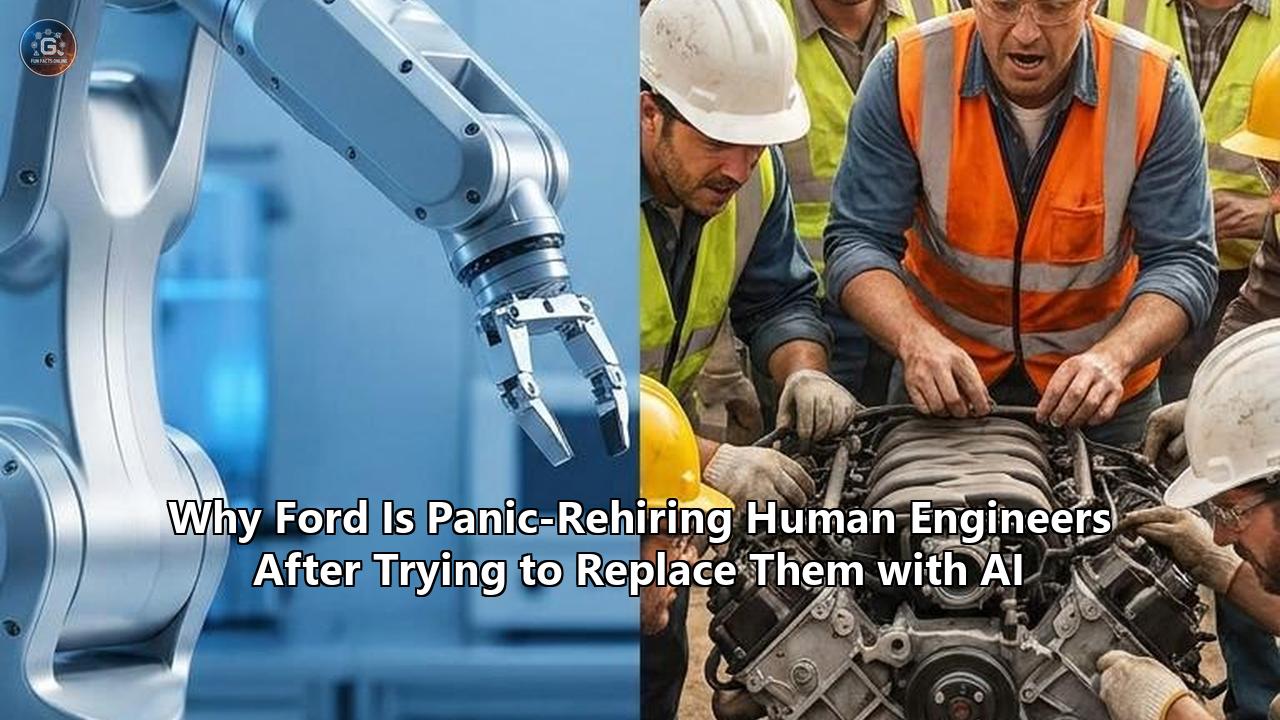
In late June 2026, Ford Motor Company delivered a startling revelation to both the automotive industry and Wall Street. Fresh off an unprecedented triumph—securing the number-one spot among mainstream, mass-market brands in the J.D. Power 2026 U.S. Initial Quality Study (IQS) for the first time in 16 years—the Detroit-based automaker pulled back the curtain on its turnaround. It was not a story of flawless automated efficiency or a successful corporate workforce reduction. Instead, it was a striking corporate confession: Ford had achieved its monumental quality comeback by aggressively rehiring, newly hiring, or promoting approximately 350 veteran human engineers to fix, reprogram, and oversee the very artificial intelligence systems that were originally intended to replace them.
During a press briefing following the J.D. Power announcement, Charles Poon, Ford’s Vice President of Vehicle Hardware Engineering, admitted that the company’s ambitious push to implement a Ford AI replacement of human engineers had severely backfired. "Mistakenly, we thought that by just introducing artificial intelligence and adjusting the design requirements that we had, that would produce a high-quality product," Poon told reporters. "Artificial intelligence is a fantastic tool, but it's only as good as the information you use to train it."
The fallout from Ford's aggressive automation push had contributed to a multi-billion-dollar quality and recall crisis. To salvage its brand and stop the financial bleeding, the automaker was forced to systematically backtrack, bringing back its most experienced technical specialists—referred to internally as "gray beards"—to reintroduce human judgment into its engineering loop. The strategy worked, driving massive improvements in vehicle quality and positioning Ford to save a projected $1 billion in quality-related expenses for 2026 alone.
This high-profile reversal represents more than just a localized corporate pivot. It serves as a stark, numbers-driven warning for the broader corporate world: the rush to replace experienced white-collar workers with autonomous algorithms is running headlong into a costly physical reality.
The Billion-Dollar Confession Behind J.D. Power’s No. 1 Ranking
For nearly two decades, Ford was plagued by persistent quality control problems that eroded consumer trust and devastated the company's financial margins. In the 2025 J.D. Power IQS, Ford sat at a disappointing tenth place among mainstream brands, scoring well below the industry average. But by late June 2026, Ford had jumped to the top of the rankings, surpassing historic quality leaders like Toyota and Honda.
Ford's J.D. Power IQS Ranking (Mainstream Brands)
2024: 23rd Place
2025: 10th Place
2026: 1st Place
The catalyst for this vertical climb was not the refinement of autonomous design algorithms, but a major structural realignment of Ford’s engineering workforce. Over the previous three years, Ford quietly initiated a program to re-engage human expertise, making approximately 350 senior engineering hires, rehires, or internal promotions.
These returning engineers were tasked with:
- Mentoring junior staff who lacked the deep institutional knowledge required to spot subtle design flaws.
- Rebuilding the data pipelines that feed Ford's machine learning and automated testing platforms.
- Reprogramming automated engineering software that was generating weak or physically unviable vehicle designs.
- Leading manual design reviews to identify potential mechanical and electrical failure points before parts ever reached the assembly line.
According to Kumar Galhotra, Ford’s Chief Operating Officer, these human specialists became the primary line of defense against the systemic bugs introduced by unchecked automation. "We brought back technical specialists," Galhotra noted, explaining that they actively "hunt for failure points before a part ever reaches the plant floor."
The sudden U-turn came after Ford executives realized that their automated quality control and design tools were fundamentally blind to complex physical variables. As veteran engineers left the company during prior rounds of corporate restructuring, decades of accumulated, unwritten engineering judgment went with them. Without this institutional knowledge encoded in the AI’s training datasets, the automated systems routinely missed critical design flaws, accelerating defects directly into the production phase.
The Staggering Financial Math of Ford’s Quality Crisis
The drive to replace human engineers with AI was initially pitched as a massive cost-saving measure. Under CEO Jim Farley, Ford had shed roughly 5,300 salaried positions since its 2020 employment peak, part of a broader white-collar contraction across Detroit that eliminated more than 20,000 jobs. Farley had previously declared that AI would "replace literally half of all white-collar workers in the US."
However, the financial reality of the Ford AI replacement strategy proved to be incredibly destructive to the company's bottom line. Rather than reducing expenditures, the loss of human oversight triggered an explosion in warranty claims and safety recalls.
- 2023 Warranty Spend: Ford spent an astronomical $4.8 billion fixing customer vehicles, a 15% increase from the prior year. The company was setting aside an average of $1,203 in warranty reserves for every single vehicle it sold.
- 2024 Margin Erosion: In 2024, Ford’s warranty expenses soared to nearly $6 billion. During the second quarter of 2024 alone, warranty and recall costs reached $2.3 billion. This equated to an eye-watering drain of $25.5 million per day.
- Operating Margins: The Q2 2024 warranty spike represented roughly 4% of Ford's overall sales, compared to a historical warranty-to-sales average of just 1.6% between 2011 and 2019. This unexpected financial hit caused Ford's stock to plunge by 18% in a single day in July 2024.
- Recall Volumes: In 2025, Ford shattered industry records by issuing 153 recalls in the United States, affecting nearly 20 million vehicles. A single recall campaign in 2025 for a Bronco Sport fuel leak cost the company over $500 million.
Ford Warranty and Recall Costs vs. EBITDA (2021-2025)
+------+----------------------+------------------+
| Year | Warranty/Recall Cost | Corporate EBITDA |
+------+----------------------+------------------+
| 2021 | $4.1 Billion         | $12.8 Billion    |
| 2023 | $4.8 Billion         | $10.5 Billion    |
| 2024 | $6.0 Billion         | $10.2 Billion    |
| 2025 | $7.8 Billion         | $9.4 Billion     |
+------+----------------------+------------------+
As warranty expenses climbed to $7.8 billion in 2025, effectively erasing the company's operating margins, Ford’s leadership realized that their automation-first strategy was financially unsustainable. The "budget room" created by laying off experienced engineers was completely wiped out by the compounding costs of manufacturing defects.
By reversing course and deploying the 350 "gray beard" engineers to preemptively catch defects, Ford began to claw back these losses. Warranty costs declined by approximately $500 million in 2025 compared to 2024. For the full fiscal year of 2026, the human-centric quality intervention is projected to yield $1 billion in direct cost savings by preventing design glitches from reaching the factory floor.
The Great AI Mirage: Why 73% of Companies Find AI Layoffs Cost More Than They Save
Ford’s forced retreat from total automation is the most prominent example of a broader corporate trend. The narrative that generative AI and autonomous systems can seamlessly step into complex white-collar roles has hit a wall of negative operational outcomes across multiple economic sectors.
A comprehensive study conducted by HR solutions platform Careerminds in February 2026 surveyed 600 human resources professionals who had executed technological layoffs within the preceding 12 months. The findings expose a massive gap between executive AI expectations and actual workplace performance:
- The Scale of the Cuts: 78.8% of HR leaders confirmed that their organizations had reduced headcount specifically because they believed AI tools could assume those roles and responsibilities.
- The Regret Factor: An overwhelming 91.6% of HR professionals stated they would handle those restructures differently if given a do-over. Only 8.4% reported that their AI-driven workforce reductions delivered the promised results without major operational issues.
- The Rehire Rate: 35.6% of companies that conducted AI-led layoffs have already been forced to rehire more than half of the employees they initially let go. Another 32.7% had to rehire between 25% and 50% of their terminated staff.
- The Backtrack Timeline: The reversal of these layoffs happened with stunning speed. 52.1% of companies rehired for the eliminated roles within six months, and 17.8% began rebuilding their human workforces within just three months of the initial cuts. Only 2.1% waited more than a year to reverse course.
Rehiring Timelines After AI-Driven Layoffs (Careerminds 2026 Study)
+-----------------------+------------------------+
| Timeframe to Rehire   | Percentage of Company  |
+-----------------------+------------------------+
| Within 3 Months       | 17.8%                  |
| Within 6 Months       | 52.1%                  |
| Over 1 Year           | 2.1%                   |
| Total Rehiring Firms  | 68.3%                  |
+-----------------------+------------------------+
The financial consequences of these premature layoffs were equally bleak. The Careerminds data revealed that 30.9% of organizations found the direct costs of rehiring, retraining, and repairing operational disruption actually exceeded any savings generated by the initial staff cuts. An additional 42.4% of firms merely broke even, meaning that 73.3% of companies realized zero or negative financial returns from their AI-driven labor cuts.
Financial Outcomes of AI-Driven Layoffs
* Negative Returns (Rehiring cost more than saved): 30.9%
* Neutral Returns (Broke even): 42.4%
* Positive Returns (Saved money): 26.7%
These findings are reinforced by a concurrent study from Gartner, which analyzed 350 executives at billion-dollar corporations. Gartner discovered that workforce reduction rates were virtually identical between companies that reported strong, positive financial returns from their AI investments and those that reported weak or negative returns.
"Workforce reductions may create budget room, but they do not create return," noted Helen Poitevin, Distinguished VP Analyst at Gartner. "Organizations that improve ROI are not those that eliminate the need for people, but those that amplify them."
Humans vs. Algorithms: Why "Design Requirements" Are Not "Engineering Judgment"
The mechanical failure of Ford's automated quality strategy highlights a fundamental limitation of modern artificial intelligence: the inability of algorithms to replicate tacit, physical intuition.
When Ford's leadership aggressively implemented its AI-driven quality-assurance software, the systems were fed explicit "design requirements." These digital files included exact CAD measurements, thermal tolerances, material specifications, and regulatory compliance standards.
The executive theory was simple: if the design requirements are fully ingested by the AI, and the AI is programmed to run digital simulations of vehicle stress, the software should output a physically optimized, defect-free component.
This assumption overlooked the critical distinction between codified data and tacit engineering judgment.
Codified Data (What AI Ingests)      vs.      Tacit Judgment (What Veteran Humans Possess)
-------------------------------+------------------------------------------
* Exact CAD measurements        | * Multi-cycle product history ("what failed in 2018")
* Thermal limits on paper       | * Real-world environmental tolerances (e.g., road salt)
* Standard electrical rules     | * Dynamic vibrational wear over 150,000 physical miles
* Basic fatigue limits          | * Nuanced physical testing intuition and edge cases
"Over prior years, we didn't pay as much attention as we should have to the experience of our most knowledgeable engineers that have been with us through many product cycles," Poon admitted.
Because veteran engineers were laid off or retired before their accumulated, unwritten knowledge could be structured into datasets, the AI was trained on incomplete information. It could verify that a design mathematically met the explicit constraints of the input files, but it lacked the real-world perspective to recognize when those constraints were insufficient. Consequently, the AI did not catch design flaws; instead, it ingested weak assumptions and amplified them into systemic manufacturing defects.
This dynamic was demonstrated in several high-profile vehicle defects that bypassed Ford’s automated quality gates between 2024 and 2026:
1. Front Lower Control Arm Ball Joints
In early 2026, Ford had to issue an urgent recall for nearly 5,000 Bronco Sport and Maverick models due to a defect in the front lower control arm ball joints, warning owners to immediately stop driving their vehicles.
Automated CAD and stress-testing software had approved the geometry and metallurgical composition of the joints. However, the AI failed to predict how the joint would fatigue under the combined, real-world stress of salt-induced corrosion, high-impact road vibrations, and extreme thermal cycling.
A veteran human engineer with multiple product cycles of experience would have recognized that the specific weld pattern and load-bearing interface was highly susceptible to shearing under lateral loads—a physical intuition that the automated software simply did not possess.
2. The Integrated Trailer Module Race Condition
In February 2026, Ford was forced to recall 4,380,609 vehicles across seven Ford and Lincoln nameplates (spanning model years 2021 to 2026) due to a critical software vulnerability in the integrated trailer module supplied by Horizon Global.
The automated testing software checked individual code blocks and verified that the hardware met standard operating parameters. Yet, it missed a complex "race condition"—a scenario where the module lost communication with the vehicle's primary network while towing, leading to sudden brake and turn signal failures.
The bug bypassed automated validation loops because the algorithm had not been trained to simulate the precise timing and communication sequences of real-world towing environments. Correcting this massive exposure ultimately required veteran human software engineers to step in, identify the timing conflict, and reprogram the system to deploy an over-the-air (OTA) software patch.
Automated AI Review                  vs.      "Gray Beard" Human Review
-------------------------------+------------------------------------------
* Confirms parts meet 3D specs  | * Foresees environmental stress and fatigue
* Checks individual code units  | * Simulates complex system-to-system interactions
* Relies on historical data     | * Applies physical intuition to unprecedented edge cases
The "Gray Beards" Return: Rebuilding Ford’s Broken Data Pipelines
When Ford completed its panic-rehiring of approximately 350 veteran specialists, it did not abandon its automated testing suite. Instead, the company recognized that the technology could only function effectively if it was guided, trained, and validated by senior human minds.
The returning engineers were deployed to structurally overhaul Ford's engineering pipeline through three core initiatives:
1. Reprogramming and Refinement of the AI Models
The first priority for the rehired "gray beards" was to audit and retrain the very AI tools that had failed to replace them. Poon noted that these technical specialists run mandatory cross-functional meetings to systematically troubleshoot vehicles and reprogram automated engineering software.
They took their decades of unwritten, field-tested experience—including data from previous product recalls, physical warranty repairs, and manufacturing failures—and codified it. This valuable data was then fed back into the company’s machine learning models. By directly correcting the automated systems' training libraries, the engineers ensured that future design generations would be evaluated against highly accurate, real-world parameters rather than idealized CAD models.
2. Rebuilding the Mentorship Pipeline
The mass departure of senior staff, combined with prior layoffs that heavily targeted entry- and mid-level roles, had fractured Ford’s internal training structure. Nationally, the Careerminds study showed that entry-level positions bore the brunt of technological layoffs, representing 31.5% of all AI-related cuts, followed by mid-level contributors at 15.6%.
At Ford, this created an acute skills shortage. Young engineers were tasked with designing complex vehicle systems but had no access to the senior mentorship that historically transferred institutional knowledge down the line.
The returning 350 veteran engineers were strategically paired with junior staff, establishing a formal mentorship framework to pass down practical design intuition before those veterans permanently retired.
Distribution of AI-Driven Layoffs by Career Level (Careerminds)
* Entry-Level Roles: 31.5%
* Mid-Level Contributors: 15.6%
* Managers & Other Roles: 52.9%
3. Implementing Physical "Failure Hunting"
Rather than relying entirely on digital simulations, Ford’s Chief Operating Officer, Kumar Galhotra, established a physical validation protocol. The rehired specialists now operate as a dedicated quality gate, physically inspecting early prototypes and pre-production vehicle builds.
These specialists are charged with "hunting for failure points" on the physical parts before they are approved for mass assembly. If a component shows signs of physical stress, material fatigue, or clearance issues during these manual inspections, the design is immediately halted and sent back for revision. This human-first intervention has significantly reduced the time it takes to catch design flaws, preventing billions of dollars in potential recalls before vehicles ever reach dealership lots.
The Modern Vehicle Problem: 80% Software, 100% Human Oversight
The absolute necessity of human engineering oversight is further amplified by the shifting architecture of modern vehicles, which are increasingly built as complex "computers on wheels."
As of 2026, approximately 80% of all Ford recalls are software-related, addressable via over-the-air (OTA) updates, mobile services, or rapid dealership visits. This means that the majority of modern automotive defects are no longer purely mechanical failures like cracked steel or leaky gaskets, but are instead software bugs, communication failures between electronic modules, and sensor calibration errors.
Modern Automotive Recall Profile (Ford, 2026)
* Software-Addressable (OTA/Mobile/Dealer): 80%
* Physical-Only (Mechanical Repairs): 20%
To manage this complex software landscape, Ford did not discard automation; rather, it scaled it up under strict human supervision. The company created a dedicated 40-person software quality assurance team specifically tasked with managing automated verification loops.
Additionally, the automaker expanded its testing protocols, adding more than 100,000 new AI-powered automated evaluations designed to stress-test vehicle systems under a wide range of simulated conditions.
"Because these tests are highly automated, even if we have a late change in the software, we can rapidly run back through the entire validation process to guarantee it works perfectly well before it reaches the customer," Poon explained.
        +---------------------------------------------+
        |  100,000+ Automated AI late-stage tests    |
        +----------------------+----------------------+
                               |
                               | (telemetry data)
                               v
        +---------------------------------------------+
        |   40-Person Software Quality Assurance Team  |
        +----------------------+----------------------+
                               |
                               | (identifies edge cases)
                               v
        +---------------------------------------------+
        |    "Gray Beard" Veteran Human Engineers     |
        +---------------------------------------------+
This hybrid workflow utilizes machine automation to run massive, repetitive simulation suites that would take humans months to execute manually. However, the critical parameters of those tests—defining what constitutes an "edge case," interpreting the telemetry data, and making the final engineering decision—remain entirely in the hands of the veteran human engineers.
If a late-stage software change is pushed to the transmission control module, the automated test suite can run through thousands of simulated drives in minutes to identify anomalies. But it is the human engineer who analyzes those anomalies, applies decades of physical intuition, and decides whether the code is safe for public roads. This balance of machine speed and human intellect is what drove the dramatic quality improvements reflected in Ford's recent first-place J.D. Power ranking.
The Structural Realignment of the AI Workforce
Ford’s pivot away from a total Ford AI replacement strategy and its subsequent climb to the top of quality rankings serves as a major case study for capital-intensive industries. It exposes the financial and operational risks of treating highly skilled engineering departments as basic cost centers that can be easily replaced by generative algorithms.
                 [ Corporate Executive Team ]
                              |
              (Attempts aggressive AI replacement)
                              v
                [ Layoffs of Human Engineers ]
                              |
               (Loss of institutional knowledge)
                              v
               [ Incomplete Training Data for AI ]
                              |
             (AI-designed parts bypass quality gates)
                              v
              [ Exploding Warranty & Recall Costs ]
                              |
             (Margin erosion & reputational damage)
                              v
            [ Panic-Rehiring of "Gray Beards" ]
                              |
                 (Rebuilding data pipelines)
                              v
             [ Return to No. 1 Quality Rankings ]
As organizations navigate the implementation of advanced AI systems, several key lessons emerge from Ford's multi-year experiment:
1. The Redundancy Mirage
Cutting human headcounts to quickly boost short-term operating margins frequently backfires by introducing costly operational and quality deficits. In physical manufacturing, a single un-caught design error can easily wipe out years of projected labor savings in a matter of weeks.
The $1 billion in projected savings that Ford is on track to realize in 2026 was not achieved by cutting labor, but by reinvesting in the precise human expertise required to prevent those costly defects from happening in the first place.
2. The Critical Importance of Tacit Knowledge
Before executing technological restructures, organizations must carefully inventory the unwritten, experiential knowledge held by their veteran workforces.
If senior engineers, managers, or specialists are laid off before their practical judgment is deeply integrated into training datasets, the AI systems designed to replace them will remain fundamentally flawed and prone to failure.
3. The Hybrid Workplace Model
The most effective use of artificial intelligence is not as a substitute for human labor, but as a capability multiplier. By combining the rapid simulation and testing power of automated software with the deep physical intuition and judgment of human specialists, companies can achieve levels of quality and efficiency that neither humans nor machines could reach alone.
The broader tech and industrial sectors are already beginning to reflect this shift. The era of uncritical, hype-driven white-collar layoffs is giving way to a more pragmatic, data-driven realization: while algorithms can process information at lightspeed, they still require the seasoned, real-world judgment of human "gray beards" to keep the wheels of industry safely turning.
What to Watch Next
- Industry-Wide Rehires: Watch for other capital-intensive giants (such as aerospace, medical device, and defense firms) to quietly announce rehires of senior engineering talent to address quality issues caused by over-reliance on AI design tools.
- Shift in SEC Disclosures: Look for major industrial companies to begin breaking out "AI verification costs" and "human oversight hours" in their annual SEC filings to reassure investors of their quality-control protocols.
- The Legacy Recall Tail: Track whether Ford’s 350-engineer intervention successfully curbs safety recalls for its upcoming vehicle models, or if the company will continue to face warranty drag from older vehicles designed during its aggressive automation era (2021–2024).
Reference:
- https://www.inc.com/chloe-aiello/ford-made-this-1-miscalculation-on-ai-and-then-had-to-hire-more-humans-to-fix-it/91365983
- https://thenextweb.com/news/ford-rehired-350-engineers-ai-quality-jd-power
- https://www.neowin.net/news/ford-execs-say-they-made-a-mistake-when-they-replaced-human-engineers-with-ai/
- https://www.thehrdigest.com/ford-admits-to-rehiring-employees-after-its-ai-strategy-proved-to-be-flawed/
- https://www.independent.co.uk/tech/ford-ai-automation-human-workers-b3003787.html
- https://www.mitsloanme.com/article/ford-rehires-350-engineers-after-finding-ai-alone-wasnt-enough/
- https://finance.biggo.com/news/4a683f7f-ffe2-43b8-96e4-6546706781e5
- https://futurism.com/artificial-intelligence/ford-rehire-engineers-ai
- https://www.alunhill.com/p/two-thirds-of-companies-that-fired-workers-for-ai-are-already-hiring-them-back
- https://apnews.com/article/ford-net-income-second-quarter-b856aaa41e3bd99f06fdf8176fb0f502
- https://www.techspot.com/news/112908-ford-learned-hard-way-ai-cant-replace-experienced.html
- https://careerminds.com/blog/cost-of-ai-layoffs
- https://www.thestreet.com/automotive/ford-ceo-jim-farley-cant-seem-to-outrun-this-5-billion-problem
- https://www.gurufocus.com/news/2972217/ford-f-faces-increased-recalls-and-warranty-costs?mobile=true
- https://www.edmunds.com/car-news/ford-losing-billions-recalls-warranties.html
- https://www.motor1.com/news/727921/ford-recalls-warranty-fixes-cost-billions/
- https://intellectia.ai/news/stock/ford-recalls-record-number-of-vehicles
- https://www.purplewins.io/article/ford-software-platform-capital-risk
- https://www.cbsnews.com/detroit/news/ford-leads-automakers-153-recalls-2025/
- https://www.youtube.com/watch?v=67RualENrug
- https://www.hcamag.com/ca/news/general/businesses-rush-to-rehire-staff-after-regretted-ai-driven-cuts/568293
- https://careerminds.co.uk/blog/ai-redundancy-regret
- https://www.thehrdigest.com/a-rehiring-crisis-has-hit-some-businesses-where-ai-investments-led-to-layoffs/
- https://www.innovativehumancapital.com/article/1-in-3-organizations-rehire-for-more-than-half-of-ai-led-layoffs-finds-new-report
- https://www.mavericktruckclub.com/forum/threads/ford-execs-say-they-made-a-mistake-when-they-replaced-human-engineers-with-ai.84216/