The human face is a highly sophisticated communication suite. Its 43 muscles twist, pull, and relax in thousands of microscopic permutations to broadcast emotion, signal intent, and negotiate social hierarchies. For centuries, science treated this complex anatomical canvas as a blueprint drawn almost exclusively by genetics, weathered over time by gravity, sun exposure, and the inevitable decay of cellular regeneration.
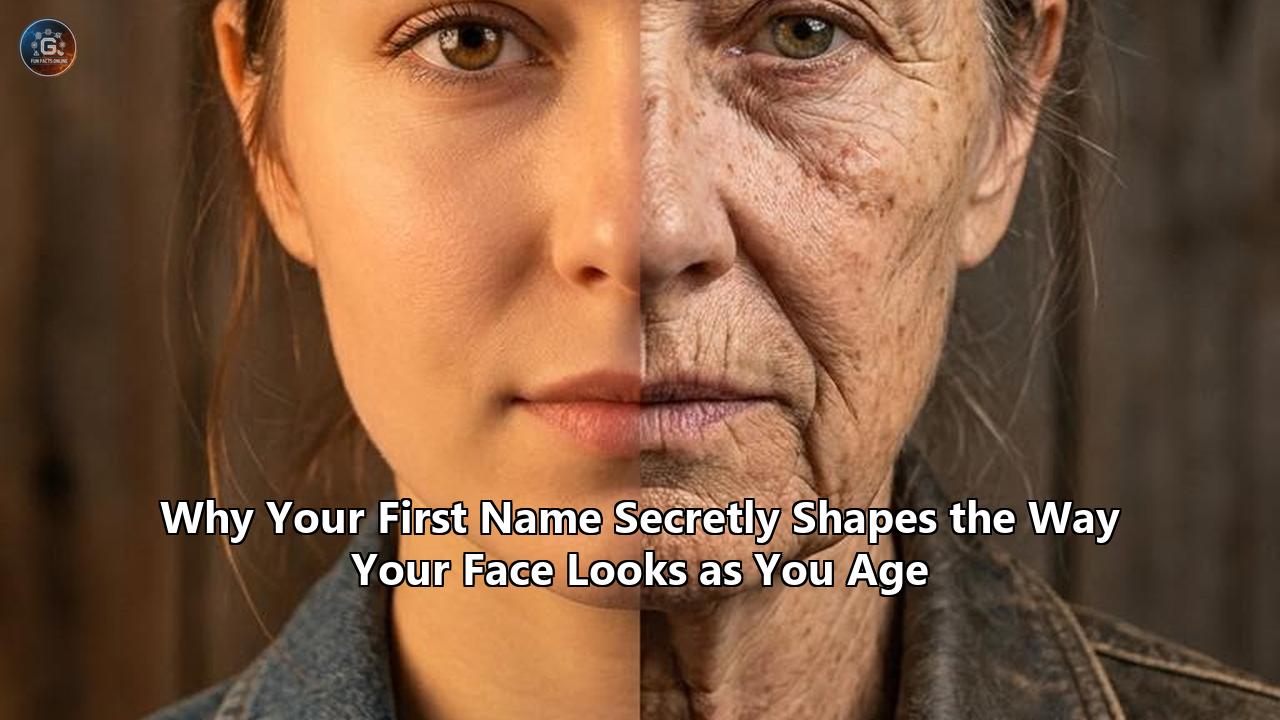
But a series of landmark studies has shattered this purely biological view, revealing a quiet, almost unsettling truth: the word your parents chose to label you at birth is actively carving itself into the physical structure of your face as you grow old.
This biological transformation represents a physical manifestation of a psychological curiosity known as nominative determinism—the concept that our names shape our destinies. Yet, while scholars historically limited this theory to our choice of careers, recent breakthroughs prove that nominative determinism facial features are a tangible, physiological reality.
From early, highly disputed behavioral observations to a decisive, machine-learning-backed discovery published in the Proceedings of the National Academy of Sciences (PNAS), scientists have slowly mapped out how society's collective expectations of a name act as a physical sculptor. It is a real-world "Dorian Gray effect," demonstrating that our faces are not just passive products of our DNA, but living, breathing records of our social contracts.
The Prehistory of the Label: From Career Paths to Skeptical Glances
To understand how your first name became etched into your jawline and eye crinkles, one must trace the concept back to its behavioral roots. In 1994, the humor column "Feedback" in New Scientist coined the term "nominative determinism" after noticing a peculiar pattern of researchers writing on topics that matched their surnames—such as a paper on incontinence written by authors named Splatt and Weedon.
For decades, this was treated as an amusing cognitive bias. Psychologists chalked it up to "implicit egotism," a subconscious human tendency to gravitate toward things, people, and places that resemble oneself, including the letters of one's own name. Studies showed that people named Dennis are disproportionately likely to become dentists; people named Laura are more likely to become lawyers; and individuals named George or Geoffrey are statistically overrepresented in the field of geophysics.
But these were behavioral choices—cognitive decisions made by a conscious mind seeking comfort in the familiar. The idea that a name could somehow transcend psychology and physically reshape human bone, fat, and muscle tissue was considered absurd.
If you met a man named Bob who possessed a round, friendly face, or a woman named Katherine who carried a sharp, authoritative gaze, it was dismissed as mere coincidence. Standard biological consensus dictated that facial geometry was a closed genetic system. The shape of your zygomatic arch, the distance between your pupils, and the natural contour of your jaw were locked in at conception.
The first cracks in this rigid genetic consensus emerged not from anatomy labs, but from social psychology. Researchers began to wonder: if society holds collective, deeply ingrained stereotypes about how certain names "should" look and act, is it possible that we subconsciously alter our self-presentation to match those expectations?
February 2017: The First Crack in the Genetic Mirror
The scientific landscape changed permanently in early 2017. A team of researchers led by Dr. Yonat Zwebner, then a doctoral candidate at the Hebrew University of Jerusalem, alongside Professor Ruth Mayo and their colleagues, published a paper in the Journal of Personality and Social Psychology titled, "We Look Like Our Names: The Manifestation of Name Stereotypes in Facial Appearance."
                       THE 2017 CHICKEN-OR-EGG DILEMMA

      [ Parents choose name ]                  [ Child is named ]
                 │                                      │
                 ▼                                      ▼
     "Innate Matching" Hypothesis           "Developmental Molding" Hypothesis
  Parents look at a newborn's face,        The child internalizes the name's
  spot subtle geometric traits, and        cultural stereotypes over decades,
  select a name that "fits."               physically reshaping their own face.
                 │                                      │
                 └───────────► WHICH IS IT? ◄───────────┘
The team designed a series of deceptively simple experiments. They recruited hundreds of independent human observers in Israel and France and showed them a series of color headshots of complete strangers. Underneath each photograph was a list of four or five common names, only one of which was correct.
If facial appearance was entirely unrelated to a person's name, the participants should have guessed the correct name roughly 20 to 25 percent of the time—the equivalent of rolling a die. Instead, the observers consistently beat the odds, matching faces to names with an accuracy rate of 35 to 40 percent.
"We ran more than a dozen studies, and each time we had this feeling like, 'Oh boy, maybe this time it won't work,'" Zwebner recalled of the initial trials. "And each time, it worked. That was really surprising."
Crucially, the 2017 study revealed that this face-name matching effect was highly culture-specific. When French participants were shown French faces, they guessed the names accurately. But when French participants were shown Israeli faces, their accuracy plummeted back down to random chance—and the same happened when Israeli participants were shown French faces. This proved that the phenomenon was not based on some universal, biological link between facial types and specific vocal phonemes, but rather on localized, culturally shared stereotypes associated with names.
As this body of research evolved, scientists began to investigate whether nominative determinism facial features could be quantified through computational models. To eliminate human bias, subjectivity, and any potential micro-expressions that might tip off human observers, Zwebner’s team turned to artificial intelligence.
They trained a machine-learning algorithm on a massive dataset of over 94,000 facial images. The computer was presented with two names and asked to choose the correct one for a given face. Operating without human empathy, societal prejudices, or cultural upbringing, the algorithm still managed to match the names at an accuracy rate of 54 to 64 percent—significantly above the 50 percent threshold of random chance.
When the researchers analyzed where the AI was finding the structural consistencies among people with the same name, they discovered something fascinating: the similarities were heavily concentrated in the regions of the face most associated with expression—specifically around the eyes and at the corners of the mouth.
Despite the mathematical rigor of the 2017 paper, the scientific community remained fiercely polarized. Critics, including Brock University psychologist Cathy Mondloch, raised valid counter-arguments. The central point of contention was a classic chicken-and-egg dilemma:
- The Innate Matching Hypothesis: Do parents look at their newborn baby, subconsciously recognize subtle, genetic facial structures that conform to a name stereotype, and name the infant accordingly? (e.g., "This baby has a soft, round jaw; let's name him Bob.")
- The Developmental Molding Hypothesis: Or does a completely neutral newborn face slowly morph over decades of lived experience, micro-expressions, and social pressures to conform to the cultural archetype of their given name?
For several years, the mechanism remained shrouded in mystery. Skeptics insisted that parents were simply highly intuitive namers, picking labels that matched their children's innate, genetic trajectories.
2018–2023: The Mechanics of the Dorian Gray Effect
To bridge the gap between human behavior and biological tissue, researchers spent the years following the 2017 breakthrough exploring the physiological mechanics of how a social label could warp physical anatomy. They turned to a concept known in psychological literature as the Dorian Gray effect—named after the protagonist of Oscar Wilde’s classic novel whose portrait aged and altered to reflect his internal state and moral corruption.
In a scientific context, the Dorian Gray effect describes how internal factors—such as personality traits, chronic emotional states, and self-perception—eventually manifest in a person's physical facial features.
                          THE DORIAN GRAY FEEDBACK LOOP

 ┌────────────────────────────────────────────────────────────────────────┐
 │                                                                        │
 ▼                                                                        │
[ A child is given the name "Tyler," which carries athletic stereotypes ]  │
 │                                                                        │
 ▼                                                                        │
[ Society treats Tyler with expectations of confidence and energy ]        │
 │                                                                        │
 ▼                                                                        │
[ Tyler internalizes these expectations, adopting matching expressions ]   │
 │                                                                        │
 ▼                                                                        │
[ Chronic muscle tension, smiles, and habits sculpt the jaw and eyes ]    │
 │                                                                        │
 └────────────────────────────────────────────────────────────────────────┘
Consider the name "Tyler," which in many English-speaking cultures carries connotations of physical activity, youthfulness, and extroversion. A young boy given this name is subjected to a lifetime of subtle, often subconscious social cues. His peers, teachers, and parents hold default assumptions about his temperament.
Over time, the boy internalizes these expectations. He may adopt a more confident posture, engage in more outdoor activities, and frequently utilize facial expressions associated with social dominance or athletic confidence.
These constant, daily expressions are not cosmetically neutral. Muscles that are repeatedly contracted grow stronger and bulkier; skin that is repeatedly creased in the same pattern eventually folds permanently into specific wrinkle lines.
- A person with a name stereotyped as friendly and cheerful (like "Joy" or "Dan") may smile more frequently, permanently deepening the zygomaticus major pathways and creating prominent crow's feet around the lateral canthus.
- Conversely, a person with a name associated with solemnity, intellect, or sternness (like "Winston" or "Arthur") may spend decades in expressions of deep thought or skepticism, altering the muscle tone of the corrugator supercilii and creating distinct vertical frown lines between the eyebrows.
Furthermore, our choices in self-presentation—hairstyles, eyeglasses, facial hair, and makeup—are heavily influenced by how we want to be perceived in relation to our name. In one of the 2017 experiments, human observers were able to match names to faces at above-chance levels even when they were only allowed to see the person’s hairstyle. This was a critical clue: we voluntarily sculpt our frames to fit our labels.
Yet, despite these compelling theoretical models, the empirical proof was still missing. The skeptics’ defense remained structurally sound: if a person's facial geometry in adulthood matches their name, it could still be because their parents chose a name that aligned with their baby’s natural, genetically pre-programmed bone structure.
To silence the critics, scientists needed to find a way to isolate the environmental variable of time. They needed to study the faces of humans before and after they had lived a life under the influence of their names.
July 2024: The Smoking Gun in the PNAS Archives
The definitive resolution to the debate arrived in late July 2024. Prof. Ruth Mayo, Dr. Yonat Zwebner, Dr. Moses Miller, Prof. Jacob Goldenberg, and Noa Grobgeld published a brilliant, multi-tiered study in the Proceedings of the National Academy of Sciences (PNAS).
By combining human perception tests with cutting-edge artificial intelligence and digital age-regression algorithms, the team designed an airtight experiment to isolate the exact timeline of the face-name matching effect.
Experiment 1: Children vs. Adults (The Human Test)
The researchers gathered a large pool of photographs of adults and children. Importantly, they ensured that the children and adults shared the exact same pool of common names. They then asked both adult and child participants to match the faces to their correct names in a series of blind tests.
- The Adult Faces: Once again, both human adults and children successfully matched adult faces to their corresponding names at rates significantly higher than chance.
- The Children’s Faces: When presented with photographs of children, however, the results changed drastically. Neither the adult nor the child participants could match the children’s faces to their names with any accuracy above random guess levels.
This was the first massive blow to the "Innate Matching" theory. If parents were simply naming babies based on inherent, lifelong facial characteristics present at birth, then observers should have been able to match the babies and young children to their names just as easily as they did with adults. The fact that children’s names could not be guessed suggested that the name-face alignment is not there at the start of life; it must be acquired.
Experiment 2: Siamese Neural Networks (The AI Analysis)
To verify these findings with absolute mathematical objectivity, the researchers employed a Siamese Neural Network (SNN)—an advanced machine-learning framework specifically designed to measure the precise geometric similarity between two distinct images.
The SNN analyzed a highly controlled dataset consisting of 607 adult faces and 557 child faces, all sharing the same 20 names.
                  SIAMESE NEURAL NETWORK RESULTS

     ADULT FACES (Same Name)            CHILD FACES (Same Name)
     ┌───────────────────────┐          ┌───────────────────────┐
     │                       │          │                       │
     │   HIGH SIMILARITY     │          │    NO SIMILARITY      │
     │   (Significantly      │          │   (Identical to       │
     │    above baseline)    │          │    random pairing)    │
     │                       │          │                       │
     └───────────────────────┘          └───────────────────────┘
The algorithm's findings were stark:
- Adults with the same name exhibited a degree of facial similarity that was statistically significant when compared to adults with different names.
- Children with the same name showed absolutely no enhanced facial similarity whatsoever. Their geometric facial structures were completely indistinguishable from random pairings.
Experiment 3: The Digital Aging Test (The Killer Blow)
The most ingenious element of the 2024 study was its third phase, designed to eliminate the final remaining defense of the genetic determinists.
Skeptics could still argue that while children don't yet look like their names, parents might possess an unconscious ability to predict their child’s future adult facial structure and name them based on that latent trajectory.
To test this, the researchers utilized Generative Adversarial Networks (GANs)—the highly advanced artificial intelligence systems used to generate and manipulate hyper-realistic human faces. They took the photographs of the children from the previous experiments and digitally "aged" them, creating realistic, computer-generated adult versions of those same children.
                         THE GAN AGING EXPERIMENT

    [ Real Child Face ] ────► [ GAN Digital Aging ] ────► [ Artificial Adult Face ]
            │                                                      │
            ▼                                                      ▼
  Name-face match rate:                                  Name-face match rate:
     RANDOM CHANCE                                          RANDOM CHANCE
If a child was genetically destined to grow into a face that matched their name, then these digitally aged, "artificial adults" should have exhibited the face-name matching effect. The biological blueprint of their future face was already encoded in their childhood photographs; the GAN simply accelerated the timeline.
The results were definitive:
- When human participants were asked to match the names to these digitally aged "artificial adult" faces, they failed completely.
- The SNN algorithm also found zero name-based facial similarities in the digitally aged cohort.
Because these artificial adults had never actually lived a single day under the social influence of their names, they never developed the characteristic facial traits associated with them. The facial alignment was not pre-written in their skull structure; it required the actual, physical process of living in a society that treated them as a "Daniel," an "Emily," or a "Sarah".
"These results suggest that the congruence between facial appearance and names is not innate, but rather develops as individuals mature," Prof. Ruth Mayo explained following the publication. "It appears that people may alter their appearance over time to conform to cultural expectations associated with their name."
With this paper, the debate was effectively settled. The concept of nominative determinism facial features was elevated from a fringe psychological theory to an empirically verified biological phenomenon.
The Escalation of Social Sculpting
The realization that an arbitrary social label can warp human physical anatomy has sent shockwaves far beyond the fields of social psychology and facial recognition. It raises profound, existential questions about the sheer power of social expectation and the nature of individual identity.
If a simple first name can systematically alter the physical layout of our facial muscles, fat pads, and skin folds over time, what else are our social constructs doing to our bodies?
The Biology of the Self-Fulfilling Prophecy
The face-name matching effect is a highly visible, measurable example of a social self-fulfilling prophecy. It demonstrates that our physical bodies are highly plastic, deeply porous systems that continuously adapt to the social roles we are assigned.
                       THE LANDSCAPE OF PHYLOGENETIC SCULPTING

     ┌────────────────────────────────────────────────────────────────────────┐
     │  SOCIAL EXPECTATIONS (Stereotypes, Names, Labels, Cultural Codes)      │
     └───────────────────────────────────┬────────────────────────────────────┘
                                         │
                                         ▼
     ┌───────────────────────────────────┴────────────────────────────────────┐
     │  BEHAVIORAL ADAPTATION (Posture, Micro-expressions, Muscle Tension)    │
     └───────────────────────────────────┬────────────────────────────────────┘
                                         │
                                         ▼
     ┌───────────────────────────────────┴────────────────────────────────────┐
     │  PHYSIOLOGICAL CHANGE (Bone remodeling, Muscle growth, Skin creasing)  │
     └────────────────────────────────────────────────────────────────────────┘
This realization forces a reevaluation of other social categories. For centuries, sociologists have argued that labels related to socioeconomic status, gender roles, and regional stereotypes shape our opportunities, mental health, and behaviors. The PNAS study suggests these labels may also be actively shaping our physical biology.
If a teacher notices a link between a certain name and a disruptive nature, they might project prejudice toward a child with that name. The child, internalizing this negative social feedback, may spend their school years in a state of chronic defensive tension, adjusting their resting facial expressions in a way that eventually carves a wary, hostile, or closed-off look into their adult face.
Our physical biology, it turns out, is not an isolated fortress. It is a dynamic, lifelong conversation with our environment.
The Dark Side of Facial Analytics
In the commercial and security sectors, the verification of nominative determinism facial features has massive implications for artificial intelligence and surveillance.
We are moving into an era where facial analysis software is used by employers to evaluate job candidates, by insurance companies to assess risk, and by law enforcement to flag suspicious behavior. If these AI systems are trained on datasets where faces have been subtly molded by the stereotypes associated with their names, the systems will inevitably internalize and amplify these biases.
For example, if an algorithm learns that people named "Katherine" look structurally more "successful" than people named "Bonnie", a hiring AI might subconsciously favor candidates whose facial geometry aligns with the "Katherine" archetype, regardless of their actual qualifications. This creates a dangerous feedback loop where societal prejudices are hard-coded into algorithmic gatekeepers, further forcing individuals to conform to their assigned social roles just to survive.
What We Face Next: The Digital Age of Naming
As we look toward the future, the dynamic between names and facial structures is poised to undergo its most radical shift since the dawn of human language. The PNAS study was conducted on individuals who grew up in the late 20th and early 21st centuries—an era dominated by face-to-face interactions, localized cultural norms, and traditional naming conventions.
Today, we are raising the first generation of humans whose identities are forged in highly fragmented, globalized digital spaces. This shifting landscape raises several critical questions that scientists are now rushing to answer:
1. The Death of Regional Stereotypes
Because the face-name matching effect relies entirely on shared cultural stereotypes, what happens when those stereotypes are diluted by the internet?
A child named "Liam" growing up in a small town in Ohio is no longer just exposed to the local, Midwestern archetype of a "Liam." They are exposed to Liams from London, Tokyo, Sydney, and Johannesburg. As regional name stereotypes dissolve into a globalized, homogenized digital monoculture, will the specific facial alignments associated with those names begin to blur? Or will we see the rise of new, hyper-specific global archetypes?
2. The Rise of "Influencer" and Non-Traditional Names
Modern parents are increasingly eschewing traditional, culturally established names in favor of highly unique, phonetic creations, or names inspired by natural objects, luxury brands, and digital trends (e.g., "North," "Nova," "Apex," or "Storm").
Because these names do not carry decades of deeply ingrained, multi-generational cultural stereotypes, how will the faces of these children adapt? Without a clear, socially agreed-upon template to conform to, will these individuals exhibit a greater degree of facial diversity? Or will society rapidly construct new, real-time stereotypes for these modern labels, carving brand-new physical archetypes into the next generation?
3. The Digital Avatar Feedback Loop
For many young people, their primary public face is no longer their physical one—it is a carefully curated digital avatar, a stylized profile picture, or a filter-modified image on social media.
If we spend hours every day interacting through digital avatars that conform to our desired online personas, will our physical faces begin to mold themselves to match our digital names and handles rather than our legal ones? Could a person who goes by a pseudonymous online handle eventually develop a facial structure that matches the digital stereotype of that handle, bypassing their birth name entirely?
4. The Impact of Legal Name Changes
One of the most compelling frontiers of this research is the study of transgender individuals and adults who choose to legally change their names.
If an adult named "Robert" decides at age 30 to legally change their name to "Julian," does their facial structure undergo a measurable shift over the next decade? Does the abandonment of the old name's social expectations and the adoption of the new name's stereotypes trigger a physical remodeling of their micro-expressions, muscle tone, and resting facial geometry?
Early indications from the 2017 study showed that observers were significantly less accurate at guessing the birth names of people who exclusively used a nickname. This suggests that the physical molding process is highly sensitive to the name we actually use and identify with on a daily basis, rather than just the arbitrary letters printed on our birth certificates.
                         THE COGNITIVE ANATOMY OF A NAME

                      ┌─────────────────────────────────┐
                      │    Birth Name (e.g., Robert)    │
                      └────────────────┬────────────────┘
                                       │
                         Is it actively used in life?
                               ┌───────┴───────┐
                               ▼               ▼
                             [ YES ]        [ NO ]
                               │               │
        Develops name-congruent│               │Adopts a nickname or
        facial features over   │               │different identity
        decades of social use  │               │
                               ▼               ▼
                      ┌─────────────────┐     ┌─────────────────┐
                      │ Structural Face │     │ Remains neutral │
                      │  Matching (SNN) │     │  to birth name  │
                      └─────────────────┘     └─────────────────┘
The Marks We Bear
We are accustomed to thinking of our bodies as biological sanctuaries—vessels of flesh and bone that belong entirely to our genetic lineages. We look in the mirror and trace our noses to our fathers, our eyes to our mothers, and our jawlines to our grandparents.
But the discovery of how our first names shape our faces forces us to confront a far more porous reality. Your face is not a private monument; it is a public canvas.
From the moment your parents uttered your name in the delivery room, society handed you a subtle, invisible mask. For decades, through every smile, every frown, every raised eyebrow, and every tense meeting, you have been slowly, subconsciously pressing your face into that mask, molding your physical flesh to fit the contour of a word.
The next time you look in the mirror, look closely at the fine lines around your eyes, the set of your jaw, and the natural curve of your mouth. They are not just the marks of aging, gravity, and genetics. They are the physical signature of your name, written in bone and muscle, proving that the world’s expectations of who you should be have been carving themselves into your flesh since the very beginning.
Chronological Summary of the Face-Name Matching Discoveries
- 1994: The term nominative determinism is coined by New Scientist, describing the subconscious behavioral pull of names on career choices.
- February 2017: Dr. Yonat Zwebner and Prof. Ruth Mayo publish their first groundbreaking paper in the Journal of Personality and Social Psychology. They demonstrate that humans and neural networks can match adult faces to names at above-chance levels, establishing the "face-name matching effect".
- 2018–2023: Researchers hypothesize the "Dorian Gray effect" as the primary biological driver. Debate rages over whether this is an acquired developmental process or if parents simply name babies based on innate, future-predicting facial structures.
- July 2024: The team publishes a definitive paper in PNAS. By testing children, adults, and GAN-aged digital faces, they prove that name-face congruence is entirely absent in children and only develops over a lifetime of social feedback.
- 2026: Researchers pivot to studying how digital monoculture, algorithmic facial recognition, and non-traditional naming trends are warping this physical feedback loop on a global scale.
Reference:
- https://jewishpress.com/names-may-shape-facial-appearance-over-time-israeli-study-suggests/
- https://europeanfriends.huji.ac.il/news/clone-transforming-higher-education-minority-students-minor-adjustments-major-1
- https://scienceblog.com/name-may-help-shape-face/
- https://www.zmescience.com/science/can-your-name-predict-your-looks-this-wild-study-thinks-so/
- https://www.apa.org/news/press/releases/2017/02/look-like-name
- https://www.wgbh.org/news/2017-02-27/your-name-might-shape-your-face-researchers-say
- https://www.sciencefocus.com/science/heres-how-your-name-could-shape-your-face-over-time
- https://pmc.ncbi.nlm.nih.gov/articles/PMC11287245/
- https://www.bfhu.org/2024/07/30/names-may-shape-facial-appearance-over-time-new-study-suggests/