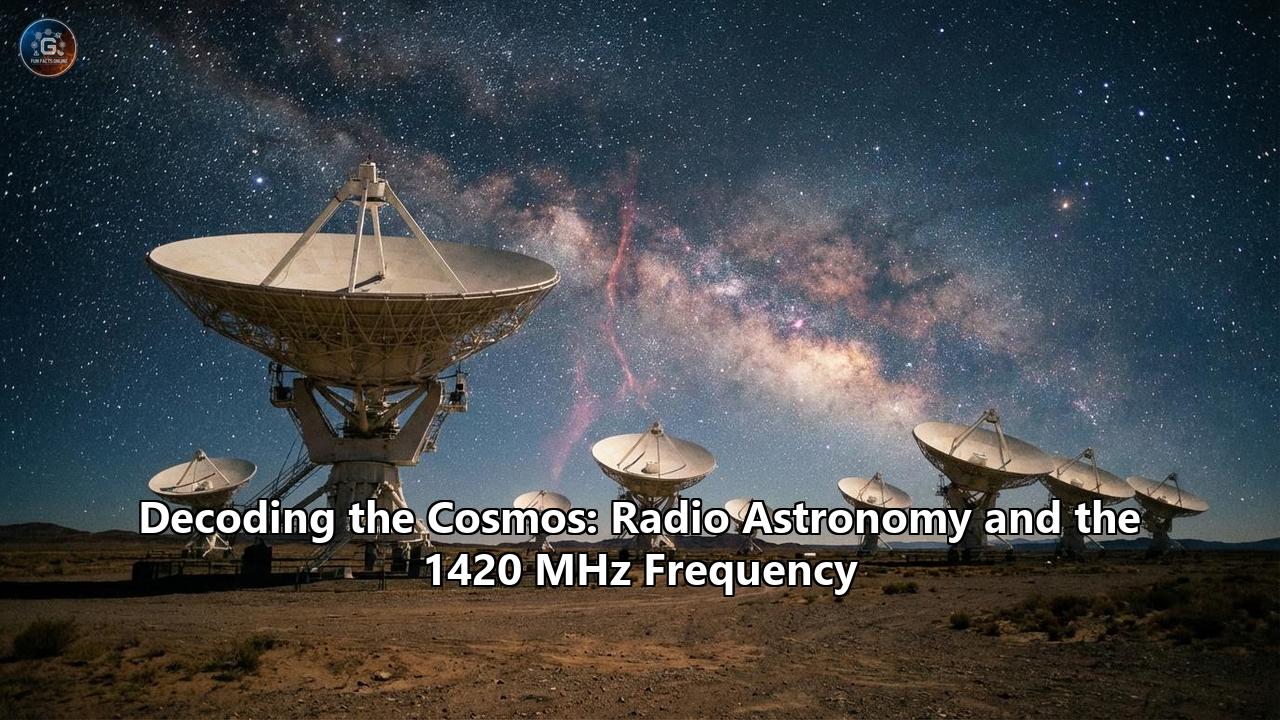
When we look up at the night sky, our eyes deceive us. They tell a story of a quiet, static void punctuated by the twinkling of stars. But if we could swap our human eyes for antennas and tune our vision to the radio spectrum, the universe would explode into a vibrant, chaotic symphony of invisible light. Pulsars would flash like cosmic lighthouses, supermassive black holes would roar from the centers of distant galaxies, and the faint, ubiquitous hum of the cosmos itself would become audible.
To decode this hidden universe, astronomers rely on a very specific magic number: 1420 Megahertz (MHz).
Also known as the 21-centimeter line, this specific frequency is the undisputed king of radio astronomy. It is the signature broadcast of neutral hydrogen, the most abundant element in the universe. From mapping the spiraling arms of our own Milky Way to searching for extraterrestrial intelligence, and from measuring the accelerated expansion of the cosmos to peering back into the "Dark Ages" before the first stars were born, the 1420 MHz frequency is the ultimate cosmic decoder ring.
Here is the comprehensive story of how a faint radio whisper from a single atom revolutionized our understanding of space, time, and our place in the universe.
The Physics of a Cosmic Whisper: What is the 21-Centimeter Line?
To understand why 1420 MHz is so important, we have to zoom in on the simplest and most common atom in existence: hydrogen. A neutral hydrogen atom consists of just one proton and one electron. According to the bizarre rules of quantum mechanics, both the proton and the electron have a property known as "spin."
You can think of these particles as tiny spinning tops that also act like microscopic magnets. When the electron and the proton are spinning in the same direction (parallel), the atom is in a slightly higher energy state. However, the universe favors laziness—everything wants to be in its lowest possible energy state. Eventually, the electron will spontaneously flip its spin to the opposite direction of the proton (anti-parallel).
This "spin-flip" transition releases a tiny burst of energy in the form of a photon (a particle of light). Because the energy difference between these two states is incredibly small, the resulting photon has a very low energy, which corresponds to a very long wavelength: exactly 21.106 centimeters. In terms of radio frequency, this translates to 1420.4058 Megahertz.
For a single isolated hydrogen atom, this spin-flip is an exceedingly rare event, taking place roughly once every 10 million years. If we were dealing with just a few atoms, we would never detect it. But space is vast, and hydrogen accounts for about 75% of all the normal matter in the universe. Because interstellar space is filled with colossal clouds containing unimaginably vast numbers of hydrogen atoms, these spin-flips are happening constantly, collectively producing a steady, continuous radio hum at 1420 MHz that can be picked up by radio telescopes here on Earth.
The Historic Breakthrough: Tuning in for the First Time
The story of the 1420 MHz line is a triumph of theoretical prediction meeting experimental ingenuity. In 1944, a young Dutch astronomy student named Hendrik van de Hulst mathematically predicted that neutral hydrogen should emit a radio signal at 21 centimeters. At the time, his home country of the Netherlands was under Nazi occupation, but the idea circulated quietly among astronomers.
However, building equipment sensitive enough to detect this faint signal proved phenomenally difficult. It wasn't until the spring of 1951 that the signal was finally caught. Harold "Doc" Ewen and Edward Purcell, working at Harvard University's Lyman Laboratory of Physics, constructed a makeshift horn antenna—which looked like a giant metal funnel—and stuck it out of a fourth-floor window. After months of fighting against background noise and terrestrial interference, they successfully detected the 1420 MHz whisper of interstellar hydrogen.
The discovery earned Purcell a share of a Nobel Prize and immediately changed the landscape of astronomy. Until that moment, optical astronomers were virtually blind to the structure of our own galaxy. Interstellar dust blocks visible light, meaning optical telescopes could only see a fraction of the Milky Way. But radio waves at 21 centimeters easily pass right through the dense dust clouds, completely unhindered.
By tuning into 1420 MHz, astronomers mapped the distribution of hydrogen gas and, for the first time, definitively proved that the Milky Way is a spiral galaxy. They measured the velocity of the gas clouds using the Doppler effect—if a cloud was moving toward Earth, the 1420 MHz signal was slightly compressed to a higher frequency (blueshift); if it was moving away, it was stretched to a lower frequency (redshift). This allowed scientists to map the rotation of the galaxy and eventually led to the realization that there must be an invisible mass—dark matter—holding the spinning galaxy together.
Expanding Horizons: Cosmology and the Shifting Frequencies
Today, the 1420 MHz line is not just a tool for mapping our local galactic neighborhood; it is the key to understanding the evolution of the entire universe.
Because the universe is expanding, the fabric of space itself is stretching. When a 1420 MHz photon is emitted by a hydrogen cloud in a distant galaxy, it begins its journey across the cosmos. As it travels over billions of light-years, the expanding universe stretches the photon's wavelength, causing its frequency to drop. By the time it reaches our radio telescopes on Earth, that original 1420 MHz signal might be detected at 800 MHz, 400 MHz, or even lower.
This phenomenon, known as cosmological redshift, turns neutral hydrogen into a brilliant cosmic time machine. By measuring the exact frequency at which we detect the "shifted" 1420 MHz signal, astronomers can calculate exactly how far away the hydrogen is, and therefore, how far back in time we are looking.
Piercing the "Dark Ages" and Cosmic Dawn
Astronomers are currently using this shifted hydrogen line to probe the universe's ultimate "blank spot": the Cosmic Dark Ages. This was a period shortly after the Big Bang, before the very first stars and galaxies had ignited. The universe was simply a vast, expanding fog of pitch-black neutral hydrogen gas.
Eventually, the first stars ignited (a period known as the Cosmic Dawn), emitting intense ultraviolet radiation that heated the surrounding hydrogen, fundamentally altering the way the gas absorbed and emitted 21-cm radio waves. By searching for incredibly faint radio signals shifted all the way down to frequencies between 50 and 200 MHz, astronomers are attempting to detect the shadowy imprint of the first stars turning on. It is one of the most difficult measurements in science, requiring researchers to pick out a signal measuring just a fraction of a Kelvin against the roaring background noise of our own galaxy.
Mapping Dark Energy with CHIME
Fast forward in cosmic history, and the shifted 1420 MHz line is being used to investigate another profound mystery: Dark Energy. Deep in the mountains of British Columbia, Canada, sits the Canadian Hydrogen Intensity Mapping Experiment (CHIME). Unconventional in its design, CHIME features no moving dish antennas; instead, it consists of four massive 100-meter-long cylindrical reflectors that look more like snowboard half-pipes than a traditional telescope.
CHIME acts as a transit telescope, observing the sky as the Earth rotates. Its primary mission is to detect the redshifted 21-cm signals of hydrogen from when the universe was between 2.5 and 7 billion years old. Because the universe's expansion stretched the waves, CHIME is tuned to listen between 400 and 800 MHz.
By creating a massive three-dimensional map of hydrogen across a massive swath of the observable universe, CHIME measures "Baryon Acoustic Oscillations" (BAO)—vast cosmic ripples left over from the Big Bang. Measuring the scale of these ripples at different points in cosmic time allows physicists to track the expansion rate of the universe with incredible precision, providing vital clues about the nature of dark energy, the mysterious force causing the expansion of the universe to accelerate.
The "Water Hole" and the Search for Extraterrestrial Intelligence (SETI)
While cosmologists use the 1420 MHz line to study the architecture of the universe, another group of scientists views this frequency through a completely different lens: as the most logical place to say "Hello."
In 1959, physicists Philip Morrison and Giuseppe Cocconi published a landmark paper suggesting that if an advanced extraterrestrial civilization wanted to broadcast their presence to the universe, they would need a universal frequency—a cosmic standard that any technologically capable species would inevitably discover. They pointed to the 1420 MHz line. Because hydrogen is the most common element in the universe, any civilization that studies the stars would naturally build radio telescopes tuned to this exact frequency.
This idea gave birth to the modern Search for Extraterrestrial Intelligence (SETI). The 1420 MHz frequency sits at the bottom of a quiet radio band known as the "Water Hole." Bounded on the lower end by the hydrogen line (1420 MHz) and on the upper end by the hydroxyl line (1662 MHz)—the two components of water (H and OH)—this specific slice of the radio spectrum is relatively free from the background noise of the galaxy and the Earth's atmosphere. It is the quietest channel on the cosmic radio dial. As SETI pioneer Bernard Oliver famously remarked, "Where shall we meet? At the water hole."
The "Wow!" Signal
It was at this exact frequency that SETI researchers recorded their most tantalizing anomaly. On August 15, 1977, the "Big Ear" radio telescope at Ohio State University detected a powerful, narrowband radio signal lasting exactly 72 seconds. The signal was incredibly strong and peaked at a frequency of 1420.4556 MHz—virtually identical to the hydrogen line.
When astronomer Jerry Ehman reviewed the computer printout of the data days later, he was so astounded by the signal's intensity and its unmistakable hallmark of an artificial source that he circled the letters on the printout with a red pen and wrote "Wow!" in the margin.
To this day, the Wow! signal remains unexplained. Despite decades of continuous searching, we have never heard it again. Whether it was a highly classified military transmission bouncing off space debris, an exotic natural astrophysical phenomenon, or a genuine ping from an alien civilization, the Wow! signal permanently etched the 1420 MHz frequency into modern pop culture.
Because of its unparalleled importance to science, the 1420 MHz frequency band is legally protected globally. No Earth-based television, cellphone, or radar networks are allowed to broadcast in the 1420.0 to 1422.0 MHz range. It is an internationally recognized quiet zone, preserved solely for listening to the universe.
The Next Generation: SKA and the Future of 1420 MHz
As we push further into the 21st century, the ambition of radio astronomy is scaling up to staggering proportions. The current crown jewel of this endeavor is the Square Kilometre Array Observatory (SKAO), an international mega-science project that represents the largest coordinated scientific effort on the planet.
The SKA is not a single telescope, but two massive networks of antennas spanning two continents.
- SKA-Low: Located in the remote, radio-quiet Murchison region of Western Australia, this array consists of over 130,000 dipole antennas (looking somewhat like metallic pine trees) spread across miles of desert. It is designed to detect the highly redshifted hydrogen signals (50 to 350 MHz) from the cosmic dawn.
- SKA-Mid: Located in the Karoo region of South Africa, this array comprises 197 massive parabolic dishes. It operates at higher frequencies (up to 15 GHz), right through the heart of the 1420 MHz band, to study galaxy evolution, pulsars, and the nature of gravity.
By early 2026, the SKA project hit unprecedented milestones. The SKA-Mid array successfully achieved "first fringes," effectively bringing the South African array alive as a working scientific instrument, while the SKA-Low array in Australia began capturing its first deep images of supermassive black holes and distant galaxies. As the observatory moves toward its operational milestones, with data pipelines flowing through a vast global network of supercomputing regional centers (SRCNet), it will soon map the universe's hydrogen gas a million times faster than any legacy telescope.
Joining the SKA in this golden age of radio astronomy is China’s FAST (Five-hundred-meter Aperture Spherical radio Telescope). Nestled in a natural karst depression in Guizhou province, FAST's massive surface area gives it unparalleled sensitivity to detect the faintest 1420 MHz whispers from the deep universe, making it a formidable tool for both mapping dark matter and expanding the SETI search.
The Lunar Horizon: Escaping the Noise
Despite the legal protections of the 1420 MHz band, radio astronomers face a growing existential threat: Radio Frequency Interference (RFI). The Earth is getting louder. The proliferation of mega-constellations of broadband satellites in low-Earth orbit has blanketed the sky in radio noise. Even though satellites don't intentionally broadcast at 1420 MHz, their electronic "leakage" and out-of-band emissions can blind sensitive radio receivers.
To survive this rising tide of technological noise, the future of 1420 MHz astronomy may require leaving Earth entirely. Space agencies and astronomical consortiums are actively drafting plans for radio arrays on the far side of the Moon. Because the Moon is tidally locked to Earth, its far side never faces our planet. A radio telescope built in a lunar crater would be shielded by thousands of miles of solid rock, completely blocking out the radio chatter of humanity. In this absolute silence, astronomers could tune their receivers to the redshifted 21-cm line with pristine clarity, reading the universe's history from its explosive birth to its modern architecture.
The Enduring Legacy of a Single Atom
It is a profound realization that so much of human knowledge about the vast, incomprehensible scale of the cosmos is derived from the tiniest of changes within the simplest of atoms. The 1420 MHz frequency is more than just a number on an engineer's dial; it is the fundamental heartbeat of the universe.
Every second, countless electrons in the frozen void of deep space flip their spin, releasing tiny flashes of invisible radio light. Together, they create a chorus that reveals the hidden skeletons of galaxies, the fingerprints of the Big Bang, the accelerating engine of dark energy, and just perhaps, the distant greetings of another civilization. By continuing to tune our instruments to this cosmic frequency, we are slowly but surely translating the oldest, grandest story ever told.
Reference:
- https://science.nrao.edu/about/publications/pawsey/nrao-online-54-hi-timeline
- https://www.jb.man.ac.uk/distance/exploring/course/content/module1/
- https://en.wikipedia.org/wiki/Wow!_signal
- https://physicsworld.com/a/cosmic-dawn-the-search-for-the-primordial-hydrogen-signal/
- https://en.wikipedia.org/wiki/Canadian_Hydrogen_Intensity_Mapping_Experiment
- https://www.dunlap.utoronto.ca/instrumentation/chime/
- https://physics.yale.edu/news/chime-telescope-delivers-deepest-ever-radio-view-cosmic-web
- https://www.mpifr-bonn.mpg.de/announcements/2025/5
- https://ska-spain.es/en/auto-draft/
- https://atlast-fr-days.sciencesconf.org/data/pages/AtLAST_FR_Ferrari_2025.pdf
- https://www.skao.int/en/science-users/timeline-science