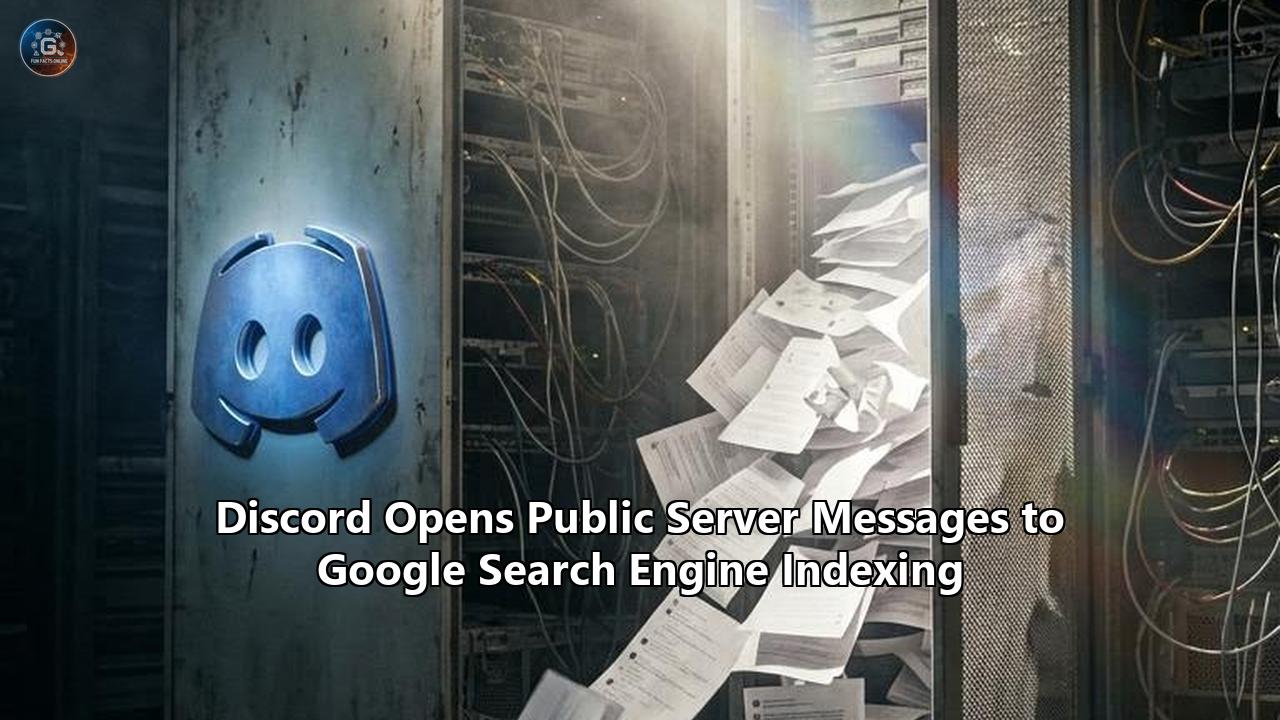
Discord is officially dismantling the walled garden that has separated its vast real-time discussions from the public internet. In a policy and infrastructure shift announced on October 27, 2026, the communications platform confirmed that messages posted across tens of thousands of its largest public servers will soon become crawlable, cataloged, and displayed by external search crawlers.
The transition will arrive in two distinct phases. On November 16, 2026, Discord will automatically generate public-facing "Server Web Pages" for every server enrolled in its Server Discovery directory—a network encompassing more than 63,000 large communities. These web landing pages, accessible via any standard browser without an account or login prompt, will feature community overviews and automated summaries of active discussions. Exactly one month later, in mid-December 2026, Discord will begin publishing verbatim chat messages from eligible public channels directly onto those web hubs, exposing them to search engines.
The development means that troubleshooting guides, niche hardware fixes, modding instructions, and casual banter will no longer require an invitation link or an authenticated application session to read. For the broader internet, the appearance of Discord messages in Google search marks a significant structural realignment in where peer-to-peer technical knowledge lives and how it is discovered. For Discord’s estimated 200 million monthly active users, however, the sudden exposure of conversational spaces has ignited debates over consent, data harvesting, and the erosion of digital semi-private spaces.
The Two-Stage Rollout: Engineering the Public Surface
The infrastructure behind this release is designed to turn Discord from an isolated messaging application into an indexable repository of web content. Discord's technical team has constructed a progressive pipeline that separates the static discovery layer from the dynamic chat stream.
+-----------------------------------------------------------------------------------+
|                           DISCORD CRAWLABILITY PIPELINE                           |
|                                                                                   |
|  [Phase 1: Nov 16, 2026]                                                          |
|  Discoverable Servers (63,000+)  -->  Public Server Web Pages                     |
|                                       - Community metadata & descriptions         |
|                                       - AI-generated Channel Discussion Summaries |
|                                                                                   |
|  [Phase 2: Mid-Dec 2026]                                                          |
|  Eligible Public Channels        -->  Verbatim Messages Published to Web          |
|                                       - Usernames & avatars stripped              |
|                                       - Google / Bing / DuckDuckGo Indexing       |
|                                       - Direct web landing for search queries     |
+-----------------------------------------------------------------------------------+
Phase 1: Automated Server Web Pages (November 16)
The initial phase focuses on directory-level indexing. Starting November 16, Discord will deploy standalone web pages for all Discoverable Servers that do not already maintain one. A server qualifies as "Discoverable" under Discord’s current platform rules if it satisfies strict operational thresholds:
- It must maintain a membership base of at least 1,000 users.
- It must be active for a minimum of eight weeks.
- It must have the explicit "Enable Discovery" toggle turned on by administrators, requiring strict compliance with community guidelines, content moderation standards, and zero adult-content (NSFW) flags across entry channels.
These Server Web Pages will host server rules, member counts, voice channel activity overviews, and algorithmic summaries of public channels. Rather than displaying raw text immediately, Discord’s proprietary summarization models will parse conversation threads to generate topical bullet points describing what the community is actively debating.
Phase 2: Literal Message Indexing (Mid-December)
The platform will expand from metadata summaries into literal text publishing in mid-December. Text posted in public channels flagged for web inclusion will be rendered directly in clean, static HTML components on the Server Web Pages. Web spiders from Googlebot, Bingbot, and other search engines will crawl these pages natively.
To limit potential privacy violations, Discord has put mechanical guardrails in place:
- No Retroactive Indexing: The crawler integration will only capture messages posted after the mid-December rollout begins. The platform's ten-year archive of historical chat logs will remain hidden behind authenticated logins.
- Pseudonymity Stripping: Published web messages will deliberately omit the username, discriminator, unique user ID, and avatar of the original author. The text will appear as an unattributed contribution within the conversation stream on the public web view.
- Exclusion of Closed Surfaces: Direct Messages (DMs), Group DMs, invite-only private servers, role-gated channels, and non-discoverable community hubs are entirely quarantined from this architecture.
Discord tested this architecture across major gaming partnerships prior to issuing the broad announcement. The official servers for Dead by Daylight, NBA 2K, and Facepunch Studios' Rust served as sandbox environments. During those pilots, however, the visibility was largely restricted to announcements and developer-curated posts. The mid-December launch marks the first time that consumer-generated messages will be sent out into the public web search ecosystem.
Why Discord Is Opening the Gates: The Death of the Open Forum
To explain why a chat client long treated as a private sanctuary is exposing itself to web crawlers, Discord leadership pointed directly to the degradation of the open web's knowledge base.
Over the past decade, internet communications underwent a quiet migration. Message board systems that defined the early web—bulletin boards running on phpBB, vBulletin, Invision Power Board, and dedicated hobbyist portals—withered. They were abandoned not because their utility expired, but because Discord offered gaming studios, software projects, and creative collectives a free, real-time voice and text platform with built-in moderation tools and zero hosting costs.
Yet that migration created an information black hole. Millions of solutions to software bugs, game progression guides, PC hardware diagnostics, and indie development wikis were locked inside closed chat applications. If a user searched Google for a niche error code, the resolution might exist only in message #4,821 of a troubleshooting channel on a 50,000-member Discord server—inaccessible unless the searcher already knew the server existed, generated an invite link, verified their phone number, passed onboarding rules, and used Discord’s internal search interface.
LEGACY WEB MODEL (2000-2015)
Search Query  -->  Googlebot  -->  Public Forum (phpBB/vBulletin)  -->  Read Solution
                                   [No Account Required]

WALLED GARDEN CRISIS (2016-2025)
Search Query  -->  Googlebot  -->  [ DEAD END: Knowledge Hidden in Private Chat Apps ]
                                   User must create Discord account, join server,
                                   bypass gates, and query internal search.

INDEXED DISCORD MODEL (Late 2026+)
Search Query  -->  Googlebot  -->  Server Web Page (Discoverable Server)  -->  Read Solution
                                   [No Account Required; In-App Conversion Path]
"Prior to Discord's launch, message boards were common, ranging from community-driven forums to official ones run by game studios," Discord explained in its official documentation announcing the shift. "These message boards excelled at hosting long-form, structured conversations about helping people, theory crafting, and more. While they still exist today, many have moved into Discord servers. This has led to valuable information being locked in Discord conversations, inaccessible to the wider internet. We want to fix this."
The platform's ambition is straightforward: re-establish the Discoverable Discord community as the functional equivalent of the 2000s message board. By converting its channel threads into crawlable web real estate, Discord intends to reinsert itself into the open web's reference layer. When a user runs into a game-breaking glitch or searches for an obscure software patch, Discord wants its communities to occupy the search real estate that traditionally belonged to independent blogs and forums.
Search Economics: Google, Reddit, and the Race for Human Consensus
The decision to open Discoverable servers to spiders cannot be divorced from the broader economic battle over web traffic and search index quality.
Over the last three years, traditional search engines have struggled with an influx of programmatic, low-quality, search-engine-optimized content generated by large language models. The open web has been flooded with machine-generated affiliate sites and regurgitated articles, forcing search engines to alter their ranking algorithms.
Google, in particular, responded by prioritizing first-person experience, discussion forums, and authentic community chatter—encapsulated by its internal focus on "Hidden Gems" and updates to its helpful content systems. The primary beneficiary of that algorithmic pivot was Reddit, which saw its search engine impressions skyrocket after signing a multi-million-dollar data licensing and training pact with Google. Searching almost any consumer inquiry on Google routinely produces Reddit threads dominating the top organic results.
+---------------------------------------------------------------------------------------+
|                       THE SEARCH INDEX SHIFT: 2023 - 2026                             |
|                                                                                       |
|  Synthetic Content Proliferation       Search Engines Rebalance Toward Forums        |
|  [SEO Content Farms / AI Spam]    -->   [Google elevates Reddit, Quora, and Forums]   |
|                                                                                       |
|  Discord's Strategic Re-Positioning:                                                  |
|  - Discord recognizes Reddit's massive organic traffic windfall from search.          |
|  - Over 63,000 Discoverable Servers possess deep, human-generated conversational text.|
|  - Opening servers captures organic search intent and drives top-of-funnel growth.    |
+---------------------------------------------------------------------------------------+
Discord recognized the financial and operational reality: human conversations are the internet's most valuable remaining digital commodity. By letting search crawlers view Discoverable conversations, Discord captures immense search traffic that currently flows to Reddit, Stack Overflow, and specialized forums.
For users running technical inquiries, encountering Discord messages in Google search provides a direct bridge to real-time problem solving. Clicking an indexed thread will land the user on a clean, responsive web view containing the relevant discussion. From that landing page, Discord embeds a direct funnel: users can read the answer immediately without registering, but a persistent call-to-action encourages them to "Jump into Discord" to reply, ask follow-up questions, or join the server.
This creates a frictionless user acquisition funnel. Rather than spending marketing dollars to recruit users into its desktop and mobile clients, Discord can rely on its 63,000 public communities to serve as organic, self-updating landing pages that draw searchers straight into its ecosystem.
The Consent Architecture: Default Configurations and Opt-Out Controls
The announcement triggered immediate pushback across Discord communities, primarily focused on the mechanics of user consent.
The friction centers on how the feature is deployed: for users in the United States and the majority of non-regulated international territories, indexing is enabled by default. If an adult user in the US posts a message in an eligible Discoverable channel once the mid-December update lands, that message is considered public domain for search engines unless either the server administrator or the individual author has taken proactive steps to disable it.
+-----------------------------------------------------------------------------------+
|                        INDEXING STATUS BY JURISDICTION                            |
|                                                                                   |
|  UNITED STATES & GLOBAL DEFAULT:                                                  |
|  [ Adult Users ]    -->  OPT-OUT MODEL (Enabled by default; requires action)      |
|  [ Minor / Teens ]  -->  STRICTLY EXCLUDED (Cannot opt in)                        |
|                                                                                   |
|  REGULATORY EXCEPTION MARKETS:                                                    |
|  EU, UK, Canada, Brazil, Australia, South Korea                                   |
|  [ All Users ]      -->  OPT-IN MODEL (Disabled by default; requires action)      |
+-----------------------------------------------------------------------------------+
The Regulatory Firewall
In sharp contrast to its US strategy, Discord was forced to implement an opt-in model across jurisdictions governed by strict digital privacy frameworks. The feature will be disabled by default for all accounts registered in:
- The European Union (governed by the General Data Protection Regulation)
- The United Kingdom (UK GDPR / Data Protection Act)
- Canada (PIPEDA / Consumer Privacy Protection Act)
- Brazil (LGPD)
- Australia (Privacy Act)
- South Korea (Personal Information Protection Act)
In these regions, user messages will not appear on Server Web Pages or search engine indexes unless the individual user manually toggles the setting to allow it.
Discord has also locked down youth accounts globally: teen accounts will have the functionality permanently turned off and cannot opt in under any circumstances until they reach the age of majority.
User-Level Controls and the "Permanence Trap"
For individual users who want to prevent their messages from being exposed to search engines, Discord has deployed a toggle within its client.
To opt out, a user must execute the following path on a desktop client or web browser:
- Navigate to User Settings (the gear icon adjacent to the user profile).
- Select Data & Privacy from the left-hand navigation rail.
- Locate the toggle labeled: "Show my message content from Discoverable channels on web pages".
- Switch the setting to Off.
User Settings
 └── Data & Privacy
      └── [TOGGLE OFF] "Show my message content from Discoverable channels on web pages"
While this toggle grants users control over their future output, privacy advocates have flagged what community members call the "permanence trap":
- The setting does not work retroactively in reverse. If a user posts messages while the indexing toggle is enabled, and those messages are published to the Server Web Page, turning the toggle off at a later date will not pull down the previously published text.
- To erase previously published content, the user must manually locate and delete each individual post from Discord. Deleting a Discord account altogether will merely dissociate the profile; the raw text will remain visible on the server and on the public search index.
- The Channel Summary loophole: Even if a user disables message publishing, their conversational text can still be consumed by Discord’s automated AI summarization algorithms. User opt-outs do not apply to Channel Summaries. If an opted-out user helps resolve a problem, an AI engine can still read the exchange, synthesize the solution into a bullet point, and display that summary on the public web page.
+---------------------------------------------------------------------------------------+
|                         THE PRIVACY ASYMMETRY BREAKDOWN                               |
|                                                                                       |
|  USER ACTION                               RESULTING EXPOSURE                         |
|  ---------------------------------------   -----------------------------------------  |
|  User opts OUT in settings                 Verbatim messages are blocked from web.    |
|                                            HOWEVER: Chat text can still be fed into   |
|                                            automated Channel Summaries on Google.     |
|                                                                                       |
|  User switches toggle OFF later            Future posts remain private to the app.    |
|                                            Past published posts REMAIN on the web     |
|                                            until individually and manually deleted.   |
|                                                                                       |
|  User deletes Discord account              Messages remain posted and indexed.        |
+---------------------------------------------------------------------------------------+
Administrative Levers: Server-Wide Opt-Outs
Server administrators carry the highest authority over whether their communities are exposed to web crawlers. Admins of Discoverable Servers have been granted a suite of controls located in Server Settings > Web Presence:
Server Settings
 └── Web Presence
      ├── Channel Inclusion Toggles (Selectively enable/disable public channels)
      ├── Discussion Summaries Toggle (Disable AI Channel Summaries entirely)
      └── Nuclear Option: Revert from "Discoverable" to "Community Server"
Administrators have three distinct choices before the November 16 deadline:
- Granular Channel Exclusion: Admins can selectively audit their channel directory and toggle individual public channels off. For example, a gaming server can leave an #announcements or #guides channel open to search engines while toggling off #general-chat and #off-topic.
- Channel Summary Deactivation: Admins can disable the automated AI discussion summaries entirely, preventing Discord’s models from distilling server chats for web viewers.
- Opting Out the Entire Community: If an administrative team does not want any presence on the public web, their only recourse is structural: they must remove the server from the Discovery directory and downgrade the server type from "Discoverable" back to a standard "Community Server". Doing so terminates the creation of the Server Web Page, preserving the server's gated status.
Privacy, Surveillance, and the Legacy of Platform Scraping
The controversy surrounding the decision to feature Discord messages in Google search is deeply tied to the platform's history with unauthorized data harvesters.
In the spring of 2024, the Discord ecosystem was shaken by the exposure of Spy.pet, an illicit surveillance and scraping operation. Operating in plain sight, Spy.pet deployed thousands of automated bot accounts that infiltrated public and semi-public Discord servers. Over several years, the operation scraped more than 4 billion messages from over 620 million users across roughly 14,000 servers, compiling cross-referenced dossiers on user activity, connected gaming accounts, and messaging habits—which it then sold for cryptocurrency.
Discord eventually filed cease-and-desist orders and terminated the bot accounts, but the incident highlighted a widespread user misconception: that chat rooms on large servers are protected, private spaces. This was compounded in 2025 by Searchcord, an open-source indexing project that amassed an archive of over 63 billion messages pulled from Discoverable communities.
+------------------------------------------------------------------------------------+
|                      SCRAPING VULNERABILITY COMPARISON                             |
|                                                                                    |
|  HISTORICAL THREAT (Spy.pet / Searchcord):                                         |
|  Attacker -> Infiltrates via user bot accounts -> Queries Gateway/REST API         |
|  * High barrier to entry (rate limits, phone verification, IP bans, API audits)    |
|                                                                                    |
|  NEW SURFACE (Server Web Pages):                                                   |
|  Attacker -> Simple HTTP GET Requests -> Public Static Web Pages                   |
|  * Low barrier to entry (No Discord account required, no client fingerprinting,    |
|    clean DOM trees, trivial to parse at scale)                                     |
+------------------------------------------------------------------------------------+
By transitioning conversations to unauthenticated Server Web Pages, Discord dramatically lowers the technical barrier to data aggregation.
Historically, scraping Discord required orchestrating malicious client tokens, bypassing Cloudflare protections, evading heuristic bot detection, and dealing with aggressive rate-limiting on Discord's internal Gateway API. From mid-December onward, data scrapers will no longer need to interact with Discord's API at all. Anyone with a basic Python script, an HTTP library, and a residential proxy pool will be able to scrape conversation logs by pinging public web pages.
The AI Training Land Grab
Beyond private surveillance firms, the largest consumer of this public chat data will inevitably be artificial intelligence labs.
As commercial model developers exhaust the supply of high-quality web text, conversational human dialogues have become a hot commodity. Search crawlers dispatched by OpenAI (GPTBot), Anthropic (ClaudeBot), Google (Google-Extended), and common web scrapers like Common Crawl continuously scan the open web for novel training data.
While Discord asserts that usernames and avatars will be stripped from public views, the semantic contents of the messages remain intact. Without robust robots.txt enforcement or commercial barriers, the conversational nuances, idioms, specialized gaming jargon, and problem-solving steps shared in Discoverable servers will flow directly into training corpora for future foundation models. Discord’s official announcement noticeably avoided guaranteeing that search-indexed messages would be shielded from AI model training, stating only that discussions would be accessible to "web search".
Technical Architecture: Rendering, Structured Data, and Crawl Dynamics
Making a real-time, WebSocket-heavy application readable by search spiders requires a total transformation of how Discord delivers data to the client.
The standard Discord desktop and mobile clients operate as single-page applications (SPAs) built primarily on React and Electron, fed by a continuous stream of JSON payloads over WebSockets. Search engine crawlers, despite advances in rendering JavaScript, often struggle to reliably index dynamic, infinite-scrolling WebSocket feeds.
+-------------------------------------------------------------------------------------+
|                  DISCORD WEB SEARCH INDEXING ARCHITECTURE                           |
|                                                                                     |
|   Discoverable Channel Stream                                                       |
|   (Internal Gateway WebSocket)                                                      |
|              │                                                                      |
|              ▼                                                                      |
|   Ingestion & Anonymization Engine                                                  |
|   - Strips Usernames, Avatars, Discriminators, Snowflake User IDs                   |
|   - Filters pre-December 2026 data                                                  |
|   - Evaluates User/Channel Opt-Out States                                           |
|              │                                                                      |
|              ▼                                                                      |
|   Static Web Builder (Next.js / Edge Server Rendering)                              |
|   - Generates Server Web Pages at https://discord.com/servers/[server-id]           |
|   - Injects Schema.org JSON-LD (DiscussionForumPosting / QAPage)                    |
|   - Establishes Canonical URLs & OpenGraph Metadata                                 |
|              │                                                                      |
|              ▼                                                                      |
|   Public Search Engine Crawlers (Googlebot, Bingbot)                                |
|   - Fetches lightweight, pre-rendered static HTML                                   |
|   - Indexes message text into search engine database                                |
+-------------------------------------------------------------------------------------+
To bridge this gap, Discord is using a decoupled web-rendering architecture for its Server Web Pages:
1. Edge-Rendered Static Hydration
Server Web Pages are rendered at the edge as lightweight, pre-compiled HTML shells. When Googlebot issues a standard HTTP GET request to a public Discord URL, it does not receive an empty React shell waiting for a WebSocket handshake. Instead, it gets an optimized, statically generated HTML document containing the channel summaries, post hierarchy, and textual body of eligible messages.
2. Semantic Discussion Structured Data (JSON-LD)
To secure premium positioning in search engine results pages (SERPs)—such as Google’s "Discussions and Forums" search carousel—Discord uses Schema.org structured data. The underlying HTML incorporates DiscussionForumPosting and QAPage semantic markup:
{
  "@context": "https://schema.org",
  "@type": "DiscussionForumPosting",
  "headline": "How to resolve error code 0x80070005 when updating the game",
  "articleBody": "Navigate to the installation directory, clear the manifest cache folder, and restart the launcher with administrative permissions.",
  "author": {
    "@type": "Person",
    "name": "Community Member"
  },
  "publisher": {
    "@type": "Organization",
    "name": "Discord",
    "url": "https://discord.com"
  },
  "isPartOf": {
    "@type": "DiscussionForum",
    "name": "Official Modding & Tech Support Hub"
  }
}
By categorizing conversations with JSON-LD markup, Discord signals to Google’s indexing engines that its pages contain direct solutions to real-world questions, increasing the likelihood that they will be selected for Google AI Overviews and highlighted answer boxes.
3. Canonical URLs and Crawl Budget Management
With more than 63,000 servers each hosting dozens of channels and generating thousands of messages daily, the platform faces a crawl-budget challenge. If every unvetted channel were thrown open to spiders, search engines would quickly exhaust their assigned crawl budgets on empty chit-chat and moderation notifications.
To manage crawl frequency, Discord uses a tiered URL and canonicalization structure:
- Server landing pages serve as root nodes (/servers/{server-slug}).
- Thread-specific and topic-specific URLs are established for cohesive conversation blocks (/servers/{server-slug}/channels/{channel-id}/discussions/{discussion-id}).
- Channel summaries are used as anchor documents to direct crawler traffic toward high-density informational threads, while high-velocity, single-word reaction channels (e.g., #memes or #counting) are excluded from search indexing by default.
Community Backlash: The Battle for the Digital Living Room
The shift toward search indexing has caused friction within Discord's broader community, highlighting the ongoing tension over what kind of platform Discord actually wants to be.
Founded in 2015 as a dedicated VoIP and chat tool for multiplayer gamers, Discord grew because it felt private, contained, and informal. Unlike Twitter, where every tweet is an audition for public engagement, or Reddit, where user posts are permanently indexed by default, Discord felt like a collection of digital living rooms. Users shared thoughts, works-in-progress, and personal conversations under the assumption that only their peers in that specific channel would ever see them.
+------------------------------------------------------------------------------------+
|                         THE CULTURAL SPECTRUM OF PLATFORMS                         |
|                                                                                    |
|  OPEN / TOWN SQUARE                  HYBRID / TRANSITIONAL      CLOSED / PRIVATE   |
|  [Reddit, X, Public Forums]    ──>   [Discord Discoverable]   ──> [Signal, DMs]    |
|                                                                                    |
|  - Universal Search                  - Indexed Web Pages        - E2E Encrypted    |
|  - Public Audience                   - Stripped Usernames       - Invite-Only      |
|  - Permanent Archives                - Walled App Core          - Transient Text   |
+------------------------------------------------------------------------------------+
The realization that everyday discussions might be indexed by Google has unsettled many users. While power users understand the technical distinction between private servers and Discoverable communities, casual users rarely differentiate between joining a 500-person private community via an invite link and joining a 10,000-person public server via Discovery.
The user reaction has been exacerbated by platform fatigue. Over the past twelve months, Discord’s administration has rolled out a series of controversial platform changes:
- Aggressive Age Verification: Mandating third-party age verification checks in multiple territories, prompting fears regarding the security of government IDs.
- False AI Moderation Bans: An automated moderation rollout that mistakenly banned thousands of legitimate users for sharing innocent media—such as chessboard screenshots misinterpreted as explicit content.
- In-Client Advertising: The introduction of "Sponsored Quests" and promotional banners into the user interface, chipping away at the platform's once-clean design.
Against this backdrop, opting users into search engine visibility by default in major markets felt to many critics like another corporate encroachment.
Moderators also worry about a new operational challenge: SEO spam. If search engines begin ranking Discord channels, black-hat SEO marketers, crypto spammers, and affiliate link builders will have an incentive to infiltrate Discoverable servers, post keyword-stuffed promotions in public channels, and exploit Discord’s domain authority (discord.com) to boost external rankings. This would shift the burden of maintaining the integrity of Google search results onto unpaid community moderators.
Cross-Platform Comparisons: The Shrinking Unindexed Internet
Discord is not the first community-driven service to rethink its relationship with the broader web. The entire tech sector is navigating a retreat from the open internet, followed by corporate efforts to selectively monetize access to private conversational data.
+----------------------------------------------------------------------------------------+
|                          PLATFORM CRAWLABILITY MATRICES                                |
|                                                                                        |
|  PLATFORM       PUBLIC INDEX STATUS            MONETIZATION / TRAFFIC MODEL            |
|  ─────────      ───────────────────            ──────────────────────────────────────  |
|  Reddit         Fully Indexed                  Direct licensing deals with search/AI;  |
|                 (Aggressively surfaced)        heavy algorithmic Google promotion.     |
|                                                                                        |
|  Twitter / X    Partially Gated                Paywalled API; sporadic crawler bans;   |
|                 (Login walls frequent)         exclusive real-time xAI/Grok training.  |
|                                                                                        |
|  Stack Overflow Fully Indexed                  Google Cloud partnership; official API  |
|                 (Declining volume)             integrations; declining user submissions.|
|                                                                                        |
|  Discord        Hybrid Rollout                 Server Web Pages; selective channel     |
|                 (Starting Dec 2026)            indexing; zero-auth funnel into client. |
+----------------------------------------------------------------------------------------+
Reddit vs. Discord: Two Divergent Approaches
Reddit’s model has always been public-by-default. Every post and comment submitted to a public subreddit is intended for public consumption and indexing, accompanied by persistent user handles and historical post tracking. When Google elevated Reddit discussions across SERPs, the transition aligned naturally with the platform's forum roots.
Discord, by contrast, is attempting a tricky hybrid model. By stripping usernames, Discord is trying to ease the privacy concerns of its user base while still feeding search engine spiders.
However, this compromise creates its own challenges. A forum thread without author identity strips away the reputational context that users rely on to judge advice. On Reddit or Stack Overflow, a reader can evaluate a post based on user karma, account longevity, community badges, and upvotes. On a stripped Discord Server Web Page, a reader sees a stream of unattributed comments without clear indicators of who is a verified developer, an experienced moderator, or an unvetted participant offering bad advice.
Legal and Regulatory Implications: GDPR and the Right to Be Forgotten
The deployment of searchable message pages introduces legal hurdles across multiple regulatory regimes.
Under the European Union’s General Data Protection Regulation (GDPR), the legal threshold for collecting and processing user data rests on defined lawful bases—typically explicit user consent or legitimate interest. While Discord opted users out by default in the EU, UK, Brazil, Canada, Australia, and South Korea, international data transfers and indexing cross-border data flows present major compliance headaches.
+---------------------------------------------------------------------------------------+
|                      GDPR COMPLIANCE FRICTION: ARTICLE 17                             |
|                                                                                       |
|   User posts message on Discord  ──>  Published to Server Web Page (Edge HTML)        |
|                                                     │                                 |
|                                                     ▼                                 |
|                                        Crawled & Cached by Google                     |
|                                                     │                                 |
|                                                     ▼                                 |
|   User invokes "Right to Erasure"  ──>  Message deleted from Discord DB               |
|                                                     ≠                                 |
|                                        Message REMAINS in Google Cache                |
|                                        & Third-Party Archival Spiders                 |
+---------------------------------------------------------------------------------------+
1. The Right to Erasure (Article 17)
The central legal challenge lies in the mechanics of data deletion. Under GDPR Article 17 (the "Right to be Forgotten"), data subjects have the right to obtain the erasure of personal data without undue delay.
When a user deletes a message inside a private Discord server, the record is removed from Discord’s production databases. But once that message is pushed onto a publicly accessible, search-indexed website, Discord loses exclusive control over that data.
Even if Discord purges the message from its Server Web Page upon deletion, Google's index, search cache snapshots, the Internet Archive's Wayback Machine, and automated scraping spiders may retain copies indefinitely. For users in jurisdictions without clear opt-in defaults, establishing that Discord maintained a valid lawful basis to broadcast real-time discussions to global search crawlers could face legal challenges from European data protection authorities, such as Ireland’s Data Protection Commission (DPC) or France’s CNIL.
2. Pseudonymization vs. Anonymization
Discord argues that omitting usernames and avatars protects user identity. Under European legal precedent, however, stripping a username does not turn personal data into completely anonymous data if the individual remains identifiable through contextual clues.
If a user writes, "I just pushed version 2.4 of my open-source project to GitHub at user/repository," or details their unique geographic location, workplace, and personal issues within a message, the content itself can directly identify them. Regulators have consistently ruled that pseudonymous data remains personal data if it can be combined with other information to identify an individual.
Consequently, Discord's default-on approach across non-EU territories could expose the platform to class-action scrutiny under US state laws, such as the California Consumer Privacy Act (CCPA) and the California Privacy Rights Act (CPRA), which grant consumers the right to restrict the public dissemination and sale of their personal information.
Action Plan: How Communities and Users Must Prepare Before November 16
With the two-phase rollout officially underway, server owners, community moderators, and everyday users have a limited window to audit their digital footprint and configure their environments before public web pages go live.
+------------------------------------------------------------------------------------+
|                         ROLLOUT TIMELINE AND ACTION DATES                          |
|                                                                                    |
|  [NOW - NOV 15]   Audit Server Settings; configure Web Presence; toggle user privacy|
|  [NOV 16, 2026]   Phase 1: Automated Server Web Pages & Discussion Summaries live  |
|  [MID-DEC 2026]   Phase 2: Verbatim messages published to web & search indexing   |
|  [EARLY 2027]     First Discord conversation results surface in Google SERPs       |
+------------------------------------------------------------------------------------+
For Server Administrators
Administrators of Discoverable Servers must make key decisions about their community's web presence before November 16:
- Audit Channel Permissions:
Navigate to Server Settings > Web Presence. Review every channel currently marked as public. Explicitly toggle off channels dedicated to open-ended community chat, off-topic discussions, venting, or internal coordination. Only leave channels marked for web exposure if they serve as documentation, announcements, or structured FAQ hubs.
- Review Channel Summary Settings:
Determine whether your server should participate in automated AI summarization. If your community discusses sensitive topics or values conversational nuance, turn off Discussion Summaries in Server Settings.
- Consider Server Status Downgrade:
If your leadership team wants no search presence on the wider web, switch your server from "Discoverable" to a standard "Community Server" prior to November 16. Your community will retain moderation bots, announcement channels, and onboarding tools, but will be excluded from the directory that triggers the creation of Server Web Pages.
- Draft Clear Community Disclosures:
Update your onboarding rules and channel descriptions. Notify your user base that public channels in your server are now indexed by search engines, ensuring members understand that anything posted in non-role-gated channels is visible on the open web.
+-----------------------------------------------------------------------------------+
|                        ADMINISTRATOR CHECKLIST                                    |
|                                                                                   |
|  [ ] Navigate to Server Settings > Web Presence                                   |
|  [ ] Audit every public channel; toggle off general/social channels               |
|  [ ] Decide on AI Discussion Summaries toggle                                     |
|  [ ] If total exclusion is needed, change server type from Discoverable           |
|  [ ] Update community rules to inform members of public indexing status           |
+-----------------------------------------------------------------------------------+
For Individual Users
Individual Discord users who want to protect their conversations must act directly within their client settings:
- Audit Account Data Settings:
Open User Settings, select Data & Privacy, and locate the toggle labeled "Show my message content from Discoverable channels on web pages." Turn this off to prevent your future messages from being published onto public pages across all servers you participate in.
- Audit Server Memberships:
Review your server list. If you participate in large public servers with more than 1,000 members—especially gaming, fan, or technology hubs—assume those servers are Discoverable.
- Separate Private and Public Identity:
If you post in public servers, avoid sharing personally identifiable details, personal links, contact information, or sensitive work discussions in un-gated channels, even if your username is stripped on web views.
- Monitor Future Channel Badges:
Once the system goes live in mid-December, pay attention to the in-app indicators Discord plans to display alongside public channels. These badges will signal when a channel's messages are feeding directly into public web pages.
+-----------------------------------------------------------------------------------+
|                            USER CHECKLIST                                         |
|                                                                                   |
|  [ ] Open User Settings > Data & Privacy                                          |
|  [ ] Toggle OFF "Show my message content from Discoverable channels on web pages" |
|  [ ] Check server list for large communities (>1,000 members)                     |
|  [ ] Avoid posting personal identifying details in non-role-gated channels        |
|  [ ] Watch for channel-level web presence indicators rolling out in December      |
+-----------------------------------------------------------------------------------+
What Comes Next: The Reshaping of Search
The integration of Discord messages in Google search marks a turning point in the evolution of modern chat platforms.
For years, platforms grew by walling off access: building walled gardens, requiring app installations, and keeping communication private. That isolation protected user privacy, but it also fractured the open web's collective memory, turning troubleshooting and technical research into a frustrating game of chasing invite links.
Now, driven by the realities of search engine competition, algorithmic changes, and the demand for authentic human discussion, Discord is stepping back onto the public internet.
Whether this transition succeeds depends on how well Discord balances discoverability with user trust. If the platform manages to bring genuine technical knowledge to search results while respecting user privacy and keeping scrapers at bay, it could help restore the conversational, helpful web that disappeared when traditional forums faded.
However, if the rollout results in widespread data harvesting, unwanted exposure for everyday users, and an influx of SEO-driven spam into community channels, Discord may face the same user backlash that has plagued other social platforms.
As the mid-December indexing date approaches, both search engines and communities will be watching closely. The transition from a closed chat app to an open, searchable forum is officially underway, and the walls around Discord's communities are coming down.
Reference:
- https://www.androidauthority.com/discord-messages-google-search-opt-out-3728857/
- https://www.dexerto.com/entertainment/discord-will-soon-let-anyone-find-public-server-messages-through-google-3422244/
- https://www.reddit.com/r/LinusTechTips/comments/1xh2c38/discord_is_making_public_server_messages/
- https://www.bleepingcomputer.com/news/security/discord-to-let-search-engines-index-public-server-messages/
- https://mashable.com/tech/discord-public-server-web-pages-messages-discoverable-in-google-search
- https://www.digitec.ch/en/page/content-from-public-discord-servers-will-soon-appear-in-google-search-results-44238?utm_source=rss-feed&utm_medium=rss
- https://mashable.com/tech/discord-messages-how-to-remove-them-from-google-search
- https://redact.dev/blog/discord-public-server-messages-google-search
- https://www.engadget.com/2299126/discord-server-messages-google-searchable-opt-out/
- https://www.techpowerup.com/354205/discord-makes-content-on-discoverable-servers-searchable-on-google-and-other-search-engines
- https://9to5google.com/2026/10/28/discord-updates-server-web-pages-for-search/
- https://mezha.ua/en/news/discord-public-messages-may-appear-in-google-search-316624/