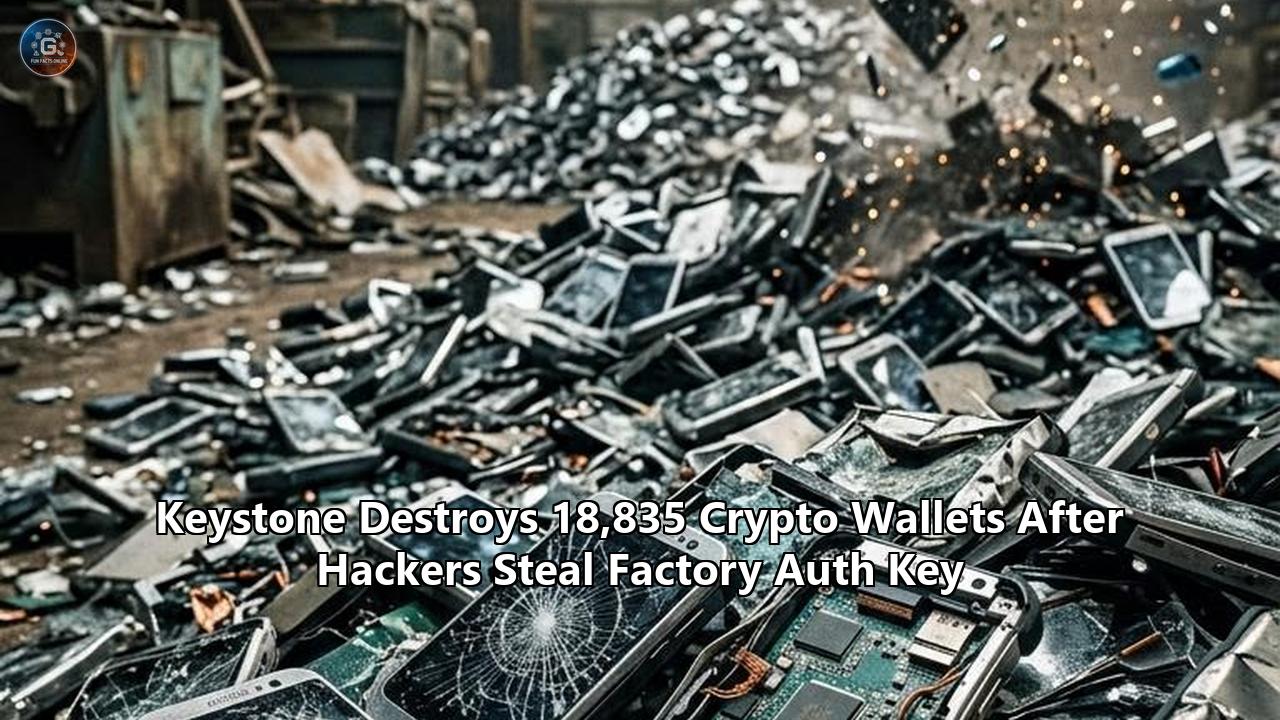
Hardware wallet manufacturer Keystone will physically scrap and destroy 18,835 unsold devices after threat actors breached its web infrastructure and stole the proprietary factory authentication key used to verify whether its hardware is genuine. The disclosure, published in a critical security advisory on October 26, 2026, details a catastrophic failure in device attestation: because the compromised cryptographic key is burned permanently into the physical memory of the devices during manufacturing, the company cannot patch, rotate, or re-sign the keys on inventory sitting in its warehouses.
The incident transformed within 48 hours from a routine data breach into one of the most severe supply-chain crises experienced by a hardware wallet manufacturer. Keystone first revealed on October 24 that attackers had accessed its official web properties six days prior, on October 20, by weaponizing a vulnerability in a third-party data-monitoring tool. That breach exposed the full names, physical shipping addresses, contact numbers, and order histories of 25,964 customers spanning purchases made between 2024 and 2026, alongside 12,873 incomplete checkout records. By October 26, internal forensics confirmed that the hackers had not merely extracted customer databases; they had systematically escalated privileges to siphon off the core WebAuth device-authentication key.
Keystone halted all outgoing fulfillment, suspended direct sales on its website, transitioned incoming purchases to an indefinite pre-order queue, and committed to sending its entire affected warehouse inventory to an industrial shredder. The destruction of nearly 19,000 units represents an extraordinary operational and financial loss designed to prevent rogue, malicious clones from entering the broader market.
An attacker possessing the factory authentication key can manufacture counterfeit hardware, install backdoored firmware, and program the hardware to pass Keystone’s official online authenticity checks without raising a single red flag. For an industry built on the foundational doctrine of "don't trust, verify," the theft systematically destroys the mathematics underlying the verification mechanism itself.
The Attack Chain: From Web Telemetry to Factory Firmware Secrets
The intrusion began on October 20, 2026, when network telemetry detected unauthorized administrative operations inside the back-end application layer supporting Keystone’s primary domain. According to incident response disclosures, the initial compromise originated within a third-party software integration used for website data monitoring, application performance metrics, and user telemetry.
Modern web architecture frequently incorporates dozens of external software-as-a-service (SaaS) hooks: session-replay scripts, error-tracking modules like Sentry or Datadog, tag managers, and transactional telemetry handlers. In this instance, attackers identified an unpatched vulnerability in an integrated analytics module. By chaining this exploit with an access-control misconfiguration, the intruders achieved remote code execution and rapidly escalated privileges across Keystone’s private server instances.
[Attacker]
     │
     ▼ (Exploitation of Third-Party Monitoring SDK)
[Keystone Web Server Infrastructure]
     │
     ├─► [Privilege Escalation via Internal Misconfiguration]
     │
     ├─► [Exfiltration of Shopify API Caches & Customer PII]
     │         └── 25,964 Completed Buyer Records (2024-2026)
     │         └── 12,873 Abandoned Checkout Records
     │
     └─► [Exfiltration of Factory Provisioning Repositories]
               └── Master WebAuth Factory Device-Authentication Key
Once administrative access was secured, the threat actor pivoted in two distinct directions. First, they exfiltrated customer purchase records by querying back-end caches and application programming interface (API) hooks linked to the company’s e-commerce platform, hosted via Shopify. Second, and far more consequentially, the actor probed internal administrative environments containing factory provisioning assets and cryptographic verification tools. Within these secure assets lay the private signing material and WebAuth keys that Keystone’s web portal uses to execute device attestation when an end user powers on a new wallet for the first time.
Keystone’s technical team severed the unauthorized access vectors on October 20, disabled vulnerable web interfaces, and brought external forensic teams on-site. However, the data had already been copied. While the customer database breach triggered immediate data-privacy liabilities, the discovery that the WebAuth key was in the wild forced an immediate reckoning with physical inventory: 18,835 sealed, packaged, and warehoused hardware wallets had instantly transformed from high-security consumer electronics into an unacceptable supply-chain liability.
Cryptographic Attestation Explained: How Hardware Wallets Prove Their Identity
To understand why the theft of a single authentication key necessitates the physical destruction of thousands of physical devices, one must examine how cryptographic attestation works inside high-security hardware.
A hardware wallet is fundamentally an isolated computer engineered to generate and isolate private keys, sign blockchain transactions, and never reveal cryptographic secrets to an internet-connected host machine. Yet, a fundamental vulnerability exists before the user even turns the device on: the supply chain. Between the assembly plant in Shenzhen and a customer’s mailbox in Berlin, London, or Tokyo, a package can be intercepted. A malicious courier, an intelligence agency, or a compromised distributor could open the packaging, solder a hardware implant onto the printed circuit board (PCB), re-flash the microcontrollers with malicious firmware designed to leak seed phrases, shrink-wrap the box, and forward it to the unsuspecting buyer.
To combat this "evil maid" and interdiction threat, modern hardware wallet manufacturers implement cryptographic device attestation.
+---------------------------------------------------------------------------------+
|                         TYPICAL DEVICE ATTESTATION FLOW                         |
+---------------------------------------------------------------------------------+

 [Keystone Web Server]                                  [Hardware Wallet]
          │                                                     │
          │ 1. Generates Ephemeral Challenge (R)                │
          │────────────────────────────────────────────────────►│
          │    (Transmitted via QR Code scanned by device)      │
          │                                                     │
          │                                                     │ 2. Device retrieves
          │                                                     │    immutable private
          │                                                     │    Auth Key from
          │                                                     │    Secure Element (SE)
          │                                                     │
          │                                                     │ 3. Computes Signature:
          │                                                     │    S = Sign(AuthKey, R)
          │                                                     │
          │ 4. Transmits Signature (S)                          │
          │◄────────────────────────────────────────────────────│
          │    (Transmitted via Screen QR / Verification Code)  │
          │                                                     │
          │ 5. Server checks S against Public Key:              │
          │    Is Signature Genuine?                            │
          │    [YES] -> "Device is Genuine"                     │
          │    [NO]  -> "Device is Counterfeit / Tampered"      │
          ▼                                                     ▼
The Challenge-Response Exchange
Attestation operates on an asymmetric challenge-response framework:
- Factory Injection: During manufacturing, a unique cryptographic key pair (or a fleet-wide signing key tied to a public certificate authority owned by the vendor) is provisioned directly into the device’s Secure Element (SE) or One-Time Programmable (OTP) eFuses.
- The Verification Portal: When the end user unboxes the device, they navigate to the manufacturer’s official verification website (e.g., Keystone’s WebAuth portal).
- The Challenge Generation: The manufacturer's server generates an unpredictable, high-entropy cryptographic challenge—a pseudo-random string of bytes designed to prevent replay attacks. This challenge is rendered on the computer monitor as an animated or static QR code.
- The Device Sign-Off: Because the Keystone device features an integrated camera and is completely air-gapped (lacking USB data channels, Bluetooth, Wi-Fi, or NFC), the user scans the challenge QR code using the device's optical sensor.
- Cryptographic Proof: The device's internal secure microcontroller takes the challenge string, feeds it into its cryptographic hardware engine alongside the embedded factory private authentication key, and computes an elliptic curve signature (typically utilizing ECDSA or Ed25519).
- The Response Loop: The device displays the resulting cryptographic proof on its touchscreen as a visual response code or secondary QR code. The user inputs this code into the browser or scans it using an attached webcam.
- Attestation Validation: The manufacturer’s server uses the corresponding public key to verify that the mathematical signature could only have originated from a device holding the genuine, uncompromised factory private key. If the signature computes correctly, the browser presents a green badge: "Device Verified as Genuine."
This handshake guarantees two things to the customer: the device was built in Keystone's authorized manufacturing line, and the firmware running inside the chip has not been altered or replaced with a rogue operating system.
When hackers extracted the WebAuth key during the breach, this entire security architecture collapsed. Possessing that key allows anyone to write custom software on a cheap microchip that computes flawless cryptographic signatures identical to those generated by legitimate devices. To Keystone's web server, a malicious simulator, an altered device, or a complete knock-off looks indistinguishable from a legitimate, unblemished unit.
Why the Devices Cannot Be Patched: The Immutability Trap
When software companies suffer a key compromise, the standard remediation playbook is straightforward: revoke the compromised certificate, push an emergency over-the-air (OTA) software patch to client applications, update the cryptographic trust store, and deploy replacement keys.
Hardware wallet architecture deliberately makes this kind of remote intervention impossible.
+---------------------------------------------------------------------------------+
|              INSIDE THE KEYSTONE ARCHITECTURE: THE ROOT OF TRUST                |
+---------------------------------------------------------------------------------+

                      ┌─────────────────────────────────┐
                      │    Host Application Processor   │
                      │  (Touchscreen, QR Camera, UI)   │
                      └────────────────┬────────────────┘
                                       │ Serial Peripheral Interface (SPI)
                                       ▼
                      ┌─────────────────────────────────┐
                      │     Tamper-Resistant Silicon    │
                      │         (Secure Element)        │
                      │                                 │
                      │   ┌─────────────────────────┐   │
                      │   │  One-Time Programmable  │   │
                      │   │     (OTP) eFuses        │   │
                      │   │                         │   │
                      │   │   [WebAuth Factory Key] ◄───┼── Compunded at factory.
                      │   │    * Physical silicon   │   │   Cannot be updated,
                      │   │      interconnects      │   │   overwritten, or
                      │   │      blown permanently  │   │   erased post-fab.
                      │   └─────────────────────────┘   │
                      │                                 │
                      │   ┌─────────────────────────┐   │
                      │   │  Secure Enclave (BIP39) │   │
                      │   │    Private Seed / Key   │   │
                      │   └─────────────────────────┘   │
                      └─────────────────────────────────┘
Hardware wallets are built under strict defense-in-depth principles. To prevent sophisticated adversaries from flashing malicious firmware or extracting master keys using side-channel attacks (such as voltage glitching, electromagnetic analysis, or differential power analysis), key cryptographic credentials are embedded into One-Time Programmable (OTP) eFuses or locked securely inside a Common Criteria EAL5+ or EAL6+ rated Secure Element.
An eFuse is a microscopic circuit on a silicon wafer designed to be permanently "blown" using a focused current spike during initial factory provisioning. Once blown, physical copper or polysilicon pathways are severed at the microscopic level. The logic states transition permanently from 0 to 1, or vice versa. There is no biological, chemical, or computational mechanism to un-blow an eFuse over the air.
The factory WebAuth authentication key is burned into these physical registers at the factory floor. Keystone engineered the device so that this key:
- Cannot be read out via serial debug ports (JTAG/SWD interfaces are severed or permanently disabled before shipping).
- Cannot be rewritten via firmware updates.
- Cannot be cleared by a factory reset.
This immutable design feature is intended to protect the user: even if a malicious state-sponsored actor temporarily stole a user’s physical wallet, they could not rewrite the device’s root identity to turn it into a spy tool without completely destroying the chip.
However, immutability cuts both ways. The moment the corresponding back-end keys were exfiltrated during the Keystone crypto wallet hack, the 18,835 units waiting in factory fulfillment hubs became a massive liability. Keystone was trapped by an inescapable mathematical dilemma:
- Option A: Retain the Key. Keystone could keep the existing verification key live on its WebAuth servers to allow those 18,835 units to pass authentication checks when sold. However, doing so would mean that any rogue device manufactured by hackers with the stolen key would also pass authentication without friction. The verification system would be completely compromised.
- Option B: Revoke the Key on the Server. Keystone could instantly invalidate the stolen key on its public verification servers and rotate to a newly minted key pair. However, because the 18,835 existing units possess the old key burned permanently into their silicon, every single one of those legitimate devices would immediately fail authentication. Unboxing customers would be presented with a stark warning: "Authentication Failed: Device May Be Tampered or Counterfeit."
- Option C: Issue a Firmware Patch. Impossible. The bootloader and Secure Element design explicitly forbid the runtime firmware from modifying or replacing the burned-in factory root key.
With no computational path to salvage the hardware, Keystone chose the only path available to maintain operational integrity: write off the entire production run, physically destroy the 18,835 devices, retool the factory firmware injection pipeline with a fresh, isolated cryptographic key pair, and restart the assembly line from scratch.
Threat Modeling: Separating User Assets from Factory Keys
When news broke that thousands of hardware wallets were facing destruction, panic spread across cryptocurrency forums. Users feared their on-chain capital was actively vulnerable to remote drainage. To understand the actual exposure, it is critical to separate the device authentication key from a user’s private cryptographic keys.
+---------------------------------------------------------------------------------+
|                       CRYPTOGRAPHIC SEPARATION OF CONCERNS                      |
+---------------------------------------------------------------------------------+

                      ┌─────────────────────────────────────────┐
                      │          THE HARDWARE WALLET            │
                      └────────────────────┬────────────────────┘
                                           │
         ┌─────────────────────────────────┴─────────────────────────────────┐
         │                                                                   │
         ▼                                                                   ▼
┌─────────────────────────────────┐                         ┌─────────────────────────────────┐
│     Device Attestation Key      │                         │  Master Private Seed (BIP-39)   │
├─────────────────────────────────┤                         ├─────────────────────────────────┤
│ • Injected at factory           │                         │ • Generated client-side         │
│ • Stolen in website breach      │                         │ • Derived via TRNG on device    │
│ • Proves hardware is genuine    │                         │ • Never leaves Secure Element   │
│ • No access to blockchain funds │                         │ • Signs on-chain transactions   │
│                                 │                         │                                 │
│ STATUS: COMPROMISED             │                         │ STATUS: SAFE AND UNEXPOSED      │
└─────────────────────────────────┘                         └─────────────────────────────────┘
The stolen WebAuth key is completely isolated from the cryptographic engine that generates recovery phrases (BIP-39/BIP-44 standards), derives hierarchical deterministic addresses, and signs blockchain transactions.
When a user powers on a genuine Keystone wallet:
- The internal True Random Number Generator (TRNG) samples physical thermal and electronic noise to generate 128 to 256 bits of internal entropy.
- That entropy is converted into a 12 or 24-word recovery seed phrase entirely offline.
- Those private keys are generated inside the device's secure enclave and are never transmitted to Keystone’s servers, never seen by the factory, and cannot be derived from the WebAuth attestation key.
Therefore, Keystone explicitly advised that existing users do not need to panic-transfer their bitcoin or ether to temporary software wallets solely because of this incident. The Keystone crypto wallet hack does not empower remote adversaries to calculate user private keys, crack seed phrases, or decrypt the physical devices in users' possession.
The Real Danger: The "Ghost Clone" Attack Vector
The actual danger posed by the stolen authentication key lies in the future distribution of cloned hardware.
If a criminal syndicate constructs knock-off Keystone hardware or intercepts genuine units in transit to modify their internals, they can preload modified firmware designed to:
- Generate deterministic seed phrases from a pre-computed attacker list instead of true random entropy.
- Silently leak entered seed phrases through steganographic changes in the QR codes displayed on the device's screen during everyday transaction signing.
- Pre-set a backdoor master pin.
Historically, knowledgeable users protected themselves against this attack vector by unboxing the unit and running it through the vendor's web attestation portal. The server would challenge the device, the rogue device would fail to provide the authentic signature, and the user would immediately discard the compromised unit.
With the factory key in criminal hands, that security net is dismantled. An attacker can manufacture a batch of altered devices, inject the stolen WebAuth key, flash the malicious seed-stealing firmware, and list the units on unauthorized secondary markets like eBay, Amazon, AliExpress, or through compromised regional retail channels. A buyer might verify the rogue unit on Keystone’s official website, see a legitimate verification badge, deposit millions of dollars in digital assets, and watch those funds get swept clean weeks later.
+---------------------------------------------------------------------------------+
|                         THE CLONED DEVICE ATTACK VECTOR                         |
+---------------------------------------------------------------------------------+

 [Attacker / Fraudster]
     │ 1. Manufactures lookalike wallet or modifies genuine chassis
     │ 2. Flashes backdoored OS (Entropy rigged to pre-computed seeds)
     │ 3. Installs Stolen Factory WebAuth Key
     ▼
 [Tampered Device]
     │
     │ 4. Sold via third-party marketplace or intercepted in shipping
     ▼
 [Unsuspecting Buyer]
     │
     │ 5. Initiates verification on Keystone Official Web Portal
     │    Device provides signature using STOLEN key
     ▼
 [Keystone WebAuth Portal]
     │
     │ 6. Validates signature -> Displays "100% Genuine Device"
     ▼
 [Buyer Trusts Device]
     │
     │ 7. Generates compromised seed phrase & deposits crypto assets
     ▼
 [Attacker Drains Funds]
This specific threat dynamic led Keystone to issue an urgent warning regarding delivery timing:
- Units delivered before October 20, 2026: If the device arrived before the initial unauthorized breach was detected, its attestation chain remains trustworthy. Keystone confirmed these units can be verified and operated normally.
- Units received after October 20, 2026: Any unit carrying the legacy key that arrived after October 20 cannot be definitively certified by the automated web tool alone. Keystone stated: "Even if such a device passes authentication, we cannot completely rule out the possibility that it is counterfeit." Owners of these units have been instructed to refrain from generating wallets and to contact official customer support for secondary validation.
The Compounding Crisis: Customer Data Leaks and Physical Threat Vectors
The destruction of 18,835 hardware devices is only half of the unfolding crisis. The breach simultaneously compromised a database containing 25,964 completed purchase records alongside 12,873 incomplete checkouts, exposing real names, phone numbers, email addresses, and physical home addresses.
This leak resulted from a systemic breakdown in data lifecycle governance: Keystone had a public commitment to purge customer purchase information from its e-commerce systems after 180 days. However, the company disclosed that an automated bulk-erasure tool had silently malfunctioned, leaving transaction records from 2024 through 2026 sitting on internet-facing systems. Keystone admitted the failure, shortened its data retention policy to 90 days, and initiated a manual scrubbing protocol scheduled to conclude on November 3.
+---------------------------------------------------------------------------------+
|                        PHYSICAL ATTACK SURFACE MATRIX                           |
+---------------------------------------------------------------------------------+

 EXPOSED DATA                   ATTACK VECTOR                 CONSEQUENCE
 ─────────────────────────────────────────────────────────────────────────────
 Full Name + Home Address  ──►  Physical Coercion         ──► Home invasions /
                                ("$5 Wrench Attack")          Extortion

 Physical Address + Order  ──►  Counterfeit Hardware Mail ──► Malicious wallet
 History                        Interception                  implant deployed

 Email + Phone Number      ──►  Spear-Phishing Campaigns  ──► Seed phrase entry
                                ("Urgent Device Recall")      via fake forms
In cryptocurrency security, customer shipping registries are among the most dangerous data points an attacker can obtain. The intersection of physical addresses and hardware ownership gives adversaries a verified, geo-located target list of individuals who maintain self-custody over crypto assets.
Lessons from the 2020 Ledger Leak
The cryptocurrency sector has navigated this exact crisis before. In July 2020, hardware wallet manufacturer Ledger suffered an e-commerce database breach via a compromised API key that exposed the personal contact details and physical addresses of over 270,000 customers.
The consequences of that leak persisted for years:
- Targeted Home Extortion: Victims received physical letters threatening home invasion, kidnapping, and violent assaults unless ransoms were paid in Bitcoin or Monero.
- SIM-Swapping and Harassment: Threat actors launched targeted SIM-swap attacks using exposed mobile numbers to breach associated exchange accounts.
- Malicious Mail Drops: Threat actors began mailing altered Ledger devices in professional, shrink-wrapped packaging directly to the physical homes of the leaked victims. The packages contained counterfeit letters purportedly signed by Ledger's executive team, claiming: "Your device is running outdated, vulnerable architecture. For your security, immediately migrate your funds onto this enclosed replacement unit." Inside was a flash drive or backdoored hardware wallet containing an instruction manual telling users to type their existing 24-word recovery phrase into a compromised configuration utility.
Because Keystone's customer database was compromised alongside the WebAuth key, the risk of a similar physical mail campaign is elevated. Attackers have access to the exact customer addresses, the specific model purchased, and the cryptographic key needed to make a counterfeit hardware replacement appear valid on Keystone’s website.
Recognizing this threat vector, Keystone issued an explicit operational warning: the company is not executing a consumer recall. It will never instruct an existing owner to send a wallet back, will never mail an unsolicited replacement device, and will never request a seed phrase under any circumstances. Keystone instructed customers to treat any communication demanding physical hardware returns or seed verification as an active phishing attack.
2026: An Unprecedented Wave of Hardware Wallet Supply-Chain Attacks
The crisis at Keystone does not exist in an operational vacuum. Late 2026 has witnessed an unprecedented series of security compromises targeting the physical custody supply chain, forcing security teams to rethink the threat model surrounding hardware wallets.
+---------------------------------------------------------------------------------+
|                 LATE 2026 HARDWARE WALLET SECURITY INCIDENTS                    |
+---------------------------------------------------------------------------------+

 VENDOR       INCIDENT DATE      ATTACK VECTOR              PRIMARY IMPACT
 ─────────────────────────────────────────────────────────────────────────────
 Coinkite     July 2026          PRNG Entropy Flaw in       Low-entropy seed
 (Coldcard)                      Firmware                   phrases; drained funds

 Ledger       Early Oct 2026     Physical Interdiction /    Hardware implants
                                 Reseller Infiltration      stealing recovery seeds

 Foundation   Late Oct 2026      Compromised Cloudflare     Spoofed domain emails
                                 API Keys                   pushing fake recalls

 Keystone     Late Oct 2026      Third-Party SDK Exploit    18,835 units destroyed;
                                 & WebAuth Key Theft        25,964 customer PII leaked
The Coldcard Entropy Anomaly (July 2026)
In late July 2026, Coinkite issued an urgent advisory regarding an algorithmic flaw within its Coldcard firmware. The bug degraded the pseudo-random number generation (PRNG) process under specific edge conditions, causing devices to generate seed phrases with significantly less entropy than the cryptographic standard dictated. Because the entropy space was drastically reduced, sophisticated actors were able to execute targeted brute-force attacks against resulting wallet addresses, directly sweeping millions of dollars in user assets.
The Ledger Reseller Supply-Chain Infiltration (October 2026)
Earlier in October 2026, Ledger initiated an emergency suspension of its retail channels and authorized resellers across Southeast Asia and Hong Kong. Field investigations discovered that hardware inventory distributed through specific regional logistics partners had been physically intercepted and modified. Attackers had managed to place micro-implants onto internal printed circuit boards capable of logging recovery phrases and exfiltrating them over covert channels.
The Foundation Spoofed Domain Phishing Campaign (October 2026)
Simultaneously with Keystone’s disclosure, hardware manufacturer Foundation revealed that its administrative systems had been compromised via stolen Cloudflare API keys. Hackers weaponized the keys to reconfigure DNS records, spinning up malicious infrastructure underneath official company domains. They then blasted thousands of customer emails with official-looking security alerts claiming that display components inside Foundation Passport devices had been compromised by a hostile supplier, prompting users to click a malicious link to secure their funds.
This cascade of security failures underscores a glaring reality: hardware wallets have moved to the center of the cryptocurrency threat model. As decentralized finance (DeFi) protocols and primary smart contracts harden their codebases against traditional reentrancy and flash-loan exploits, cybercriminal syndicates have shifted their focus to the ultimate single point of failure: the physical human custody interface.
The industry sells the promise of absolute mathematical sovereignty, but that sovereignty remains tethered to web analytics trackers, third-party logistics firms, e-commerce storefronts, and factory assembly lines. The Keystone crypto wallet hack demonstrates how a failure in a minor web-analytics integration can directly compromise the physical hardware layer.
The Industrial and Economic Fallout of Scrapping 18,835 Devices
The decision to scrap 18,835 fully assembled units is an extraordinary industrial write-down for a hardware company of Keystone's size.
The Direct Balance Sheet Impact
Hardware wallets like the Keystone 3 Pro retail at an average price point between $129 and $169. At retail value, 18,835 destroyed units represent an immediate pipeline value erasure of approximately:
$$\text{Pipeline Impact} = 18,835 \times \$149 \approx \$2,806,415$$
From a pure manufacturing and bill-of-materials (BOM) perspective, the losses remain severe:
- Custom Injection-Molded Enclosures: Specialized ABS/polycarbonate tooling with anti-tamper ultrasonic welding cannot simply be cracked open and reused without damaging structural integrity.
- High-Definition Capacitive Displays and Cameras: Desoldering components from finished circuit assemblies introduces micro-fractures, thermal stress, and high defect rates, rendering component salvage economically inefficient compared to full replacement.
- Secure Elements and Silicon: The microcontrollers and Common Criteria EAL-rated secure chips carry irreversible OTP eFuse configurations. Because the old authentication keys are burned into their silicon substrate, those chips cannot be flashed or transferred to a new product line—they are total write-offs.
- Raw De-manufacturing and Secure Disposal: You cannot simply throw 18,835 hardware devices containing lithium-ion batteries and proprietary cryptographic secrets into municipal landfills. Keystone must contract specialized electronic waste de-manufacturing facilities to shred the units under cryptographic witness to guarantee that no partially intact circuit boards or authentic chassis can be scavenged by bad actors.
+---------------------------------------------------------------------------------+
|                   ESTIMATED ECONOMIC COST BREAKDOWN                             |
+---------------------------------------------------------------------------------+

 EXPENDITURE CATEGORY                            ESTIMATED IMPACT (USD)
 ─────────────────────────────────────────────────────────────────────────────
 Bill of Materials (BOM) & Direct Assembly       $800,000 - $1,100,000
 Gross Revenue Pipeline Loss (Unsold Stock)      $2,400,000 - $3,100,000
 Specialized E-Waste Destruction & Logistics    $40,000 - $75,000
 Forensic Incident Response & Third-Party Audit  $150,000 - $300,000
 Customer Service & Verification Overhead        $75,000 - $120,000
 ─────────────────────────────────────────────────────────────────────────────
 TOTAL ESTIMATED ECONOMIC IMPACT                 $3,465,000 - $4,695,000
Beyond direct manufacturing costs, the operational halt inflicts massive indirect damage. Halting current shipments and shifting to a pre-order model stalls real-time cash flow while ongoing warehouse, logistical, and payroll expenses continue. The broader cryptocurrency bull-and-bear cycles require manufacturers to maintain steady inventory to capture demand spikes; a multi-week factory halt during peak market activity risks forfeiting market share to rivals like Trezor, Ledger, BitBox, and Tangem.
Despite the heavy economic toll, Keystone’s decision to openly scrap the inventory rather than push an undocumented work-around represents a necessary step to protect its brand. In the high-security hardware space, hiding an attestation key breach is a terminal event: if independent security researchers discover that a company quietly sold devices capable of being spoofed by hackers, the loss of trust is permanent.
Architectural Post-Mortem: How Device Attestation Must Evolve
The Keystone breach highlights a vulnerability in how hardware device attestation has traditionally been architected: the reliance on shared fleet-wide authentication keys or web-accessible validation signing servers.
For the broader hardware industry, this incident highlights the need for several crucial engineering changes:
+---------------------------------------------------------------------------------+
|                   LEGACY VS. MODERN ATTESTATION ARCHITECTURE                    |
+---------------------------------------------------------------------------------+

 LEGACY ATTESTATION MODEL (Fragile)
 [Factory Server] ────► Injects Shared Key ────► [Device 1] [Device 2] [Device 3]
        │
   Key Leaked! = Entire batch compromised. Revocation destroys all devices.

 ─────────────────────────────────────────────────────────────────────────────────

 MODERN PER-DEVICE PKI WITH PUF (Resilient)
 [Internal Hardware PUF] ────► Generates Private Key (Silicon Never Leaves Chip)
        │
 [Secure Element] ────► Signs CSR inside on-chip engine
        │
 [Factory Root CA] ────► Issues UNIQUE Certificate per Serial Number (Hierarchical)
        │
   One Key Leaked? = Revoke only ONE device certificate via public CRL.
1. Shift from Shared Secrets to Hierarchical Per-Device PKI
Historically, hardware architectures often injected a shared fleet-wide authentication key into large production batches to simplify web verification portals. If that key is compromised, every single device tied to the batch falls with it.
Modern attestation must adopt a strict Public Key Infrastructure (PKI) model:
- Every single hardware device must generate its own unique asymmetric key pair internally within the Secure Element using physical PUF (Physically Unclonable Function) silicon structures.
- The device private key must never leave the silicon—not even during factory provisioning.
- The device exports only its public key to the factory provisioning server. The factory signs that public key with an intermediate Certificate Authority (CA) key, issuing an individualized Device Certificate.
- The factory CA keys must be housed inside an offline, air-gapped Hardware Security Module (HSM) (such as a Thales Luna or YubiHSM) operating under strict m-of-n multi-party authorization, entirely separated from corporate web servers or e-commerce databases.
- In this architecture, if an attacker compromises a web application server, they capture zero signing keys. Even if an attacker physically extracts the key from a single consumer unit using scanning electron microscopy, they compromise only that single device. The manufacturer can simply revoke that specific unit's serial number via a Certificate Revocation List (CRL) without impacting a single other unit in inventory.
2. Physical Air-Gapping of Web Telemetry from Production Keys
Keystone’s post-mortem identified that an exploit in an analytics/monitoring tool allowed attackers to bridge network boundaries into production validation infrastructure.
The lesson is unequivocal: Web-facing applications and factory-provisioning pipelines must never share network segments, IAM credentials, or key storage. Production key verification should rely on read-only public key stores. The verification server needs access only to public keys to validate challenge responses; it never needs access to private device-authentication keys. If a public verification server is completely breached, the attacker should gain nothing more than an index of public certificates, which are already designed to be public knowledge.
3. Rigorous Automation and Observability in Data-Purging Pipelines
Keystone’s disclosure that customer transaction data from 2024 remained stored due to a silent script failure points to an issue with compliance automation: writing a cron job to delete old records is insufficient if the job lacks automated observability.
Under data privacy standards like the European Union’s General Data Protection Regulation (GDPR) and the California Consumer Privacy Act (CCPA), the principle of data minimization is a binding legal obligation. Hardware manufacturers must implement:
- Automated, immutable data lifecycles directly at the database engine level (e.g., PostgreSQL Time-to-Live [TTL] partitions), ensuring records self-expire at the storage block layer even if external maintenance scripts fail.
- Regular external synthetic penetration tests specifically designed to verify data deletion.
- Independent cryptographically signed logs confirming database deletions.
Actionable Security Protocols for Keystone Owners and Crypto Custodians
For cryptocurrency investors who own or manage Keystone hardware wallets, the recent disclosures require careful, methodical evaluation rather than panic. The following operational checklist outlines immediate triage steps:
+---------------------------------------------------------------------------------+
|                       USER ACTION MATRIX & DECISION TREE                        |
+---------------------------------------------------------------------------------+

                      When did you receive your Keystone device?
                                          │
                     ┌────────────────────┴────────────────────┐
                     ▼                                         ▼
           [BEFORE October 20, 2026]                [AFTER October 20, 2026]
                     │                                         │
                     ▼                                         ▼
         1. Check device authenticity              1. DO NOT initialize or
            via WebAuth portal.                       generate seed phrases.
                     │                                         │
         2. Passing result is VALID.               2. Online verification is
                     │                                INSUFFICIENT.
                     ▼                                         │
         3. Assets are SAFE.                       3. Contact official support
            NO seed migration needed.                 for secondary validation.
                     │                                         │
                     ▼                                         ▼
         4. Beware of postal & email scams.        4. Await replacement hardware.
Protocol 1: Triage Existing Devices by Arrival Date
- Units Delivered Before October 20, 2026:
Run the device through the standard WebAuth verification page. If it passes the challenge-response check, the device's hardware chain of custody is secure.
You do not need to move your funds, generate a new seed phrase, or migrate to another hardware brand solely due to this breach. Your private keys, PINs, and transaction signers remain mathematically secure.
- Units Received After October 20, 2026:
Halt initialization. Do not generate a new recovery phrase and do not import an existing seed phrase into the unit.
Understand that passing the standard web authentication check on these specific units is no longer a definitive guarantee of safety.
* Keep the device powered off, navigate to Keystone’s official support portal directly (by typing the URL manually), and request secondary manual authentication and verification support.
Protocol 2: Establish Anti-Phishing Defenses
Because customer personal information (names, emails, physical addresses, order histories) has been exfiltrated, expect highly sophisticated social engineering campaigns:
- Ignore Any "Recall" Notices: Keystone is not issuing a product recall. Any email, SMS, or physical letter instructing you to send your wallet to a return address is an attempt to steal your hardware.
- Reject Replacement Hardware Received in the Mail: If a courier delivers an unsolicited package containing a "replacement Keystone wallet" or an "emergency firmware upgrade flash drive," do not plug it in, power it on, or follow any included setup instructions. Document the packaging, notify incident responders, and dispose of the hardware securely.
- Never Disclose Your Seed Phrase: Genuine hardware wallet operating systems will never ask you to read your 24-word recovery phrase back to a website, a customer support agent, an email address, or an external keyboard. The seed phrase belongs exclusively inside the isolated secure chip of the device.
Protocol 3: Harden Hardware Purchasing Habits
The cascading failures across multiple hardware vendors in 2026 demonstrate that individuals must actively minimize their supply-chain footprint when ordering custody equipment:
- Use Disposable PII: When ordering hardware wallets, use privacy-centric email aliases (e.g., SimpleLogin or Apple Hide My Email), use secondary phone numbers via VoIP/prepaid SIMs, and ship packages to a commercial parcel locker, PO box, or business address rather than a primary residence.
- Avoid Resellers and Secondary Markets: Never purchase hardware custody units from third-party resellers on secondary marketplaces. Buy directly from the primary manufacturer, and inspect the outer tamper-evident seals and PCB screw integrity immediately upon receipt.
- Adopt Multi-Vendor Multisignature Architectures: The ultimate mathematical defense against single-vendor supply-chain compromises is multisignature (multisig) custody. In a 2-of-3 multisig setup combining three distinct hardware vendors (for example, a Keystone, a Trezor, and a Coldcard managed via Sparrow Wallet or Casa), a total hardware or attestation failure in any single vendor cannot compromise the vault's assets. Even if one manufacturer's factory key is compromised and its firmware backdoored, the attacker cannot access user funds without compromising a second, physically distinct device from an entirely different company.
The Custodial Horizon: Milestones to Monitor
As Keystone moves forward from the immediate fallout of the breach, the company faces several critical operational milestones and unresolved questions that will shape the hardware security landscape:
+---------------------------------------------------------------------------------+
|                              CRITICAL MILESTONES                                |
+---------------------------------------------------------------------------------+

 MILESTONE               TARGET DATE        SECURITY OBJECTIVE
 ─────────────────────────────────────────────────────────────────────────────
 Data Deletion Review    Nov 3, 2026        Complete manual scrub of overdue
                                            customer records from back-end caches.

 New Key Injection       Q4 2026            Roll out new factory signing keys
                                            isolated inside physical HSMs.

 Inventory Destruction  Ongoing            Cryptographically witness physical
                                            shredding of all 18,835 legacy units.

 Order Resumption        TBD                Fulfill waitlisted pre-orders with
                                            next-generation authenticated hardware.
The first near-term checkpoint is November 3, 2026, the target date Keystone established to finish manually purging the remaining overdue customer transaction records. In parallel, the company plans to launch a dedicated verification utility enabling customers to directly check whether their personal details were included within the 25,964 breached transaction files.
The second major milestone involves the physical verification of inventory destruction. The broader crypto ecosystem will watch for independent, cryptographically attested proof confirming the physical destruction of the 18,835 decommissioned devices. Transparent chain-of-custody documentation and third-party forensic sign-offs are necessary steps to confirm that zero residual units carrying the compromised old key remain in circulation.
Finally, Keystone must prove the integrity of its new manufacturing line. Shipping replacement hardware requires deploying newly provisioned attestation keys isolated within hardened Hardware Security Modules, ensuring back-end operational networks are completely severed from client-facing web servers.
The Keystone crypto wallet hack serves as a lasting case study in hardware security engineering: the physical security of a cryptographic device is only as dependable as the web servers, databases, and third-party code that back it. When building devices designed to protect generational wealth, the boundary of what constitutes the "wallet" cannot stop at the edge of the printed circuit board—it encompasses every single line of code, logistics server, and cryptographic key that touches the hardware throughout its lifecycle.
Reference:
- https://thedefiant.io/news/security/keystone-to-destroy-18-835-wallets-after-device-authentication-key-theft
- https://coinmarketcap.com/academy/article/keystone-destroy-18835-wallets-device-key-theft
- https://news.bitcoin.com/security/keystone-breach-deepens-18835-crypto-hardware-wallets-face-destruction/
- https://gizmodo.com/two-more-crypto-hardware-wallet-manufacturers-have-been-hacked-2000830786
- https://finance.biggo.com/news/aef3d300-b010-475c-a545-c81972f50308
- https://menafn.com/1111870140/Keystone-Breach-Worsens-Stolen-Verification-Key-Impacts-Wallet-Authenticity
- https://grafa.com/en/news/crypto/keystone-to-destroy-18-835-wallets-after-key-theft
- https://www.blockhead.co/2026/10/27/keystone-to-destroy-18-835-hardware-wallets-after-attacker-steals-device-authentication-key/
- https://www.tradingview.com/news/cointelegraph:d9f2d89b7094b:0-keystone-breach-deepens-hackers-stole-key-used-to-verify-wallets-as-genuine/
- https://crypto.news/keystone-to-destroy-18835-hardware-wallets-after-authentication-key-breach/