For millennia, humanity’s view of the night sky was dominated by a profound yet limiting illusion: stillness. The stars appeared fixed, the darkness between them empty, and the architecture of the cosmos eternal. Today, we know the universe is anything but static. It is a vast, furiously expanding theater of creation and destruction, governed by invisible forces and populated by billions of unseen worlds. We have entered the golden age of cosmic cartography, a transformative era driven by large-scale cosmological sky surveys.
These massive observational campaigns are not just snapping photographs of individual galaxies or stars; they are industrial-scale engines of discovery, systematically mapping the heavens across time and space. By harnessing billions of data points, modern observatories are simultaneously tackling two of the most profound mysteries in science: the macro-scale enigma of dark energy, which is tearing the universe apart, and the micro-scale search for exoplanets, which may harbor life beyond our solar system.
From robotic fiber-optic eyes perched on mountain peaks to next-generation telescopes floating in the freezing void of space, a synchronized fleet of instruments is currently coming online or releasing their first revolutionary datasets. The Dark Energy Spectroscopic Instrument (DESI), the European Space Agency’s Euclid telescope, the Vera C. Rubin Observatory, and the soon-to-launch Nancy Grace Roman Space Telescope represent a paradigm shift in astronomy. Together, they are rewriting the textbooks on cosmology and planetary science.
The Dark Energy Enigma and the Cracks in the Standard Model
To understand the scale of the dark energy problem, we must look back to the late 1990s, when astronomers measuring the light of distant supernovae made a terrifying and beautiful discovery: the expansion of the universe was not slowing down under the inward pull of gravity, but accelerating. The driver of this acceleration was dubbed "dark energy," a placeholder term for a profound state of ignorance. In the standard model of cosmology, known as Lambda-CDM ($\Lambda$CDM), dark energy is treated as a "cosmological constant"—an unchanging, intrinsic property of space itself. As the universe expands, more space is created, and the total amount of dark energy increases, pushing galaxies apart ever faster.
For a quarter of a century, this model held firm. But precision sky surveys are now putting that constant under unprecedented stress.
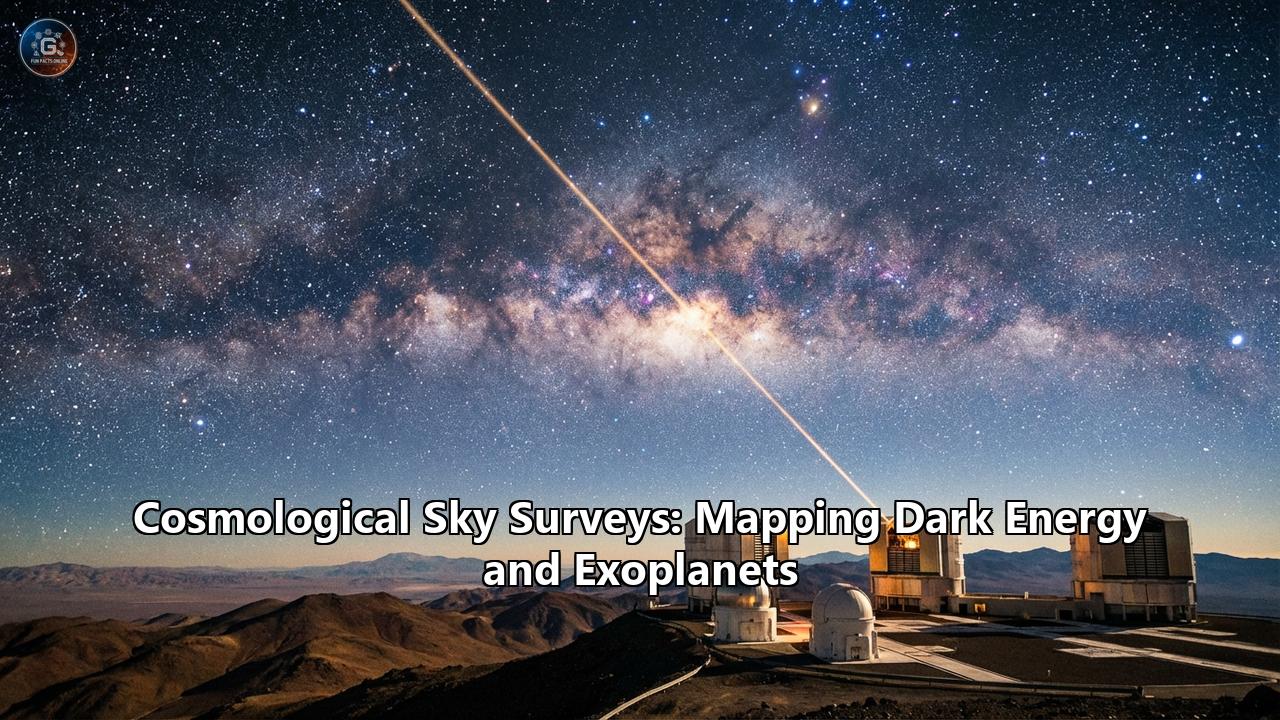
Enter the Dark Energy Spectroscopic Instrument (DESI), mounted on the Nicholas U. Mayall 4-meter telescope at the Kitt Peak National Observatory in Arizona. DESI is a marvel of optical engineering. Instead of a traditional camera, its focal plane is equipped with 5,000 robotically controlled fiber-optic cables. Every night, as the telescope points to a new patch of sky, these tiny robots swirl into position, aligning perfectly with the incoming light of 5,000 distinct galaxies and quasars simultaneously. By analyzing the spectrum of light from each object, DESI precisely measures its distance, allowing scientists to construct the largest and most detailed 3D map of the universe ever made.
In March 2024, the DESI collaboration dropped a bombshell on the physics community with its Data Release 1 (DR1). By tracking how matter clumped together over the past 11 billion years—specifically using a metric known as Baryon Acoustic Oscillations (BAO), which are frozen "sound waves" from the plasma of the early universe—DESI found that the expansion rate didn't perfectly align with the cosmological constant. When combined with data from the cosmic microwave background and supernovae, the results showed a stunning hint: dark energy might be weakening, or evolving, over time.
By May 2025, DESI's Data Release 2 (DR2) amplified this seismic shift. Utilizing a staggering 14 million redshifts (more than double the data of DR1), the survey provided even stronger evidence that dark energy's equation of state is not strictly constant. The data suggested that the energy density driving the universe’s expansion may have peaked at a redshift of 0.45 and is now slowly decreasing. While the physics community rigorously awaits the gold-standard "5-sigma" threshold for a definitive discovery, these observations, resting around a 3 to 4-sigma confidence level, have cracked the foundational $\Lambda$CDM model. If dark energy is indeed a dynamical fluid or field rather than a constant property of the vacuum, the ultimate fate of the universe—whether it ends in a Big Freeze, a Big Rip, or a Big Crunch—is entirely up for debate.
Euclid: Europe’s Wide-Eyed Sentinel in the Dark
While DESI works from the ground, the European Space Agency’s Euclid telescope is tackling the dark universe from space. Launched in July 2023, Euclid was designed to measure both the distribution of galaxies and the subtle warping of their light caused by dark matter—a phenomenon known as weak gravitational lensing.
By February 2024, Euclid had begun its grueling six-year main survey, aiming to cover one-third of the entire sky and catalog billions of galaxies. Its capabilities were breathtakingly demonstrated in May 2024 with its Early Release Observations, and further cemented in March 2025 with the monumental "Q1" data release. The Q1 release alone mapped an unprecedented 63 square degrees of the sky in immaculate high-resolution visible and near-infrared light, an area 300 times larger than the full Moon.
Euclid’s images are a masterpiece of cosmic depth. In observing the Abell 2390 galaxy cluster, located 2.7 billion light-years away, Euclid captured more than 50,000 galaxies in a single frame. The massive gravitational bulk of the cluster, dominated by invisible dark matter, acts as a cosmic magnifying glass, bending and curving the light of background galaxies into luminous arcs. By systematically mapping these distortions across the sky, Euclid will allow astrophysicists to trace the invisible scaffolding of dark matter that dictates where galaxies form, and measure how dark energy has stretched that scaffolding over the last 10 billion years.
Yet, large-scale cosmological surveys inevitably become treasure troves for other disciplines. During its early observations, Euclid not only hunted for dark energy; it stumbled upon hundreds of new dwarf galaxies, surveyed star-forming regions like Messier 78 with unprecedented infrared clarity, and discovered a multitude of free-floating "rogue" planets—worlds untethered to any star, drifting through the galactic void. This beautifully illustrates the dual nature of modern sky surveys: a wide-angle lens meant to capture the architecture of the cosmos naturally captures the wandering planets in our own backyard.
The Cinematic Universe: The Vera C. Rubin Observatory
If Euclid is photographing the static architecture of the cosmos, the Vera C. Rubin Observatory is filming its action movie. Perched high in the dry, thin air of the Chilean Andes, the Rubin Observatory represents the pinnacle of ground-based optical astronomy. At its heart sits the Legacy Survey of Space and Time (LSST) camera, a mind-boggling 3.2-billion-pixel digital sensor—the largest ever constructed.
On June 23, 2025, Rubin released its highly anticipated "First Light" images, capturing the Virgo galaxy cluster and the radiant Trifid and Lagoon Nebulae in astonishing detail. The Virgo cluster image alone, composed of over 1,100 overlapping exposures totaling three trillion pixels, encompassed roughly 10 million galaxies. Yet, this was merely a static preview. The true power of the Rubin Observatory lies in its temporal resolution.
When its 10-year LSST survey fully commences in 2026, Rubin will photograph the entire visible southern sky every few nights, generating a high-definition, decade-long time-lapse of the universe. On February 24, 2026, the observatory gave the world a taste of this dynamic capability when it launched its Alert Production Pipeline. In a single night, the system fired off 800,000 automated notifications to astronomers worldwide, flagging celestial events that had changed brightness or position since the last observation. Once fully operational, it will generate up to 7 million alerts per night.
Through this relentless optical sweep, Rubin is expected to discover millions of transient events—supernovae exploding in distant galaxies, tidal disruption events where supermassive black holes shred wandering stars, and the flickering of active galactic nuclei. But closer to home, Rubin’s massive field of view is revolutionizing our understanding of the Solar System and the local stellar neighborhood. In early 2026, the observatory spotted 2025 MN45, a 0.4-mile-wide rock that completes a full rotation every 1.88 minutes, making it the fastest-spinning large asteroid ever found. By cataloging millions of near-Earth asteroids, Kuiper Belt objects, and stellar phenomena, Rubin provides the ultimate dataset to bridge the gap between cosmology and planetary science.
The Exoplanet Revolution and the Roman Space Telescope
While surveys like DESI, Euclid, and Rubin have secondary benefits for planetary science, the upcoming Nancy Grace Roman Space Telescope (RST) is explicitly designed to conquer both dark energy and exoplanetary astrophysics simultaneously.
Named after NASA’s first chief astronomer and the "Mother of Hubble," the Roman Space Telescope successfully completed its structural assembly in a massive cleanroom at NASA's Goddard Space Flight Center in November 2025. Scheduled to launch on a SpaceX Falcon Heavy rocket as early as the Fall of 2026, Roman will carry a 2.4-meter primary mirror—the exact same size as the Hubble Space Telescope. However, thanks to its cutting-edge Wide Field Instrument (WFI), a 300-megapixel infrared camera, Roman’s panoramic field of view will be 100 to 200 times larger than Hubble’s. It will capture the same staggering depth of the universe, but across vast swaths of the sky in a single exposure.
Roman is poised to complete the exoplanetary census begun by the legendary Kepler space telescope. Kepler revolutionized astronomy by proving that there are more planets than stars in the Milky Way, primarily using the "transit method"—watching for the minute dimming of starlight when a planet crosses in front of its host star. However, Kepler was mostly sensitive to large planets orbiting close to their stars.
Roman will push our planetary search to the outer limits using a technique perfectly suited for a wide-field cosmological survey: gravitational microlensing. This occurs when a foreground star passes directly in front of a background star from Earth's perspective. The gravity of the foreground star acts as a lens, temporarily magnifying the light of the background star. If the foreground star has planets orbiting it, those planets add their own tiny gravitational warps, creating a secondary spike in the magnification.
Because microlensing does not rely on the light from the planet or the host star itself, it is incredibly sensitive. Roman is expected to monitor hundreds of millions of stars toward the galactic center, discovering thousands of exoplanets in the process. Crucially, microlensing is sensitive to planets orbiting far from their stars—the cold gas giants and ice giants—as well as rocky, Earth-sized planets that previous missions struggled to detect. It will also find hundreds of rogue planets wandering the dark space between stars.
Furthermore, Roman carries a revolutionary Coronagraph Instrument. This complex system of masks, prisms, and deformable mirrors uses destructive optical interference to physically block out the blinding glare of a host star, allowing astronomers to directly image the faint planets orbiting it. By separating the planet's light, Roman will allow scientists to analyze their atmospheres, searching for the chemical signatures of habitability.
The Ultimate Cosmic Synergy: The Convergence of Scales
What makes the 2024–2026 era of astronomy so historically significant is the profound convergence of disciplines. Historically, a cosmologist studying the accelerated expansion of the universe and a planetary scientist searching for habitable worlds operated in different academic silos, using different instruments. Today, the very same data streams are fueling both fields.
The physics of General Relativity is the thread tying it all together. The weak gravitational lensing used by Euclid and Rubin to map dark matter and constrain the evolution of dark energy is the exact same physical mechanism—scaled up—as the microlensing Roman will use to find Earth-mass exoplanets. You cannot map the distant universe without looking through the foreground of our own galaxy, and in doing so, the local and the universal become intertwined.
Moreover, the sheer volume of data produced by these observatories has necessitated a revolution in computer science. The 270 terabytes of data from DESI's DR1, the millions of alerts generated nightly by Rubin, and the massive infrared panoramas from Euclid and Roman cannot be analyzed by human eyes alone. Artificial intelligence and deep neural networks have become standard astronomical tools. Over 50% of the scientific articles published alongside Euclid's Q1 data release relied on AI to classify galaxy morphologies and infer merging tidal tails. Additionally, citizen science platforms like Zooniverse are stepping in to help crowdsource discoveries, inviting the public to comb through Rubin and Euclid’s data streams to spot asteroids, supernovae, and peculiar galaxies that algorithms might miss.
A Map to the Unknown
We stand on the precipice of a fundamentally new understanding of reality. The early returns from DESI suggest that the dark energy pushing our universe apart is not a monolithic constant, but a shifting, dynamic force—a revelation that, if confirmed, will shatter the $\Lambda$CDM standard model and require a complete rewrite of modern physics. Euclid is successfully rendering the invisible dark matter webs that dictate cosmic structure into stunning visual catalogs. The Vera Rubin Observatory is currently awakening, preparing to stream a live, ten-year cinematic record of the shifting heavens. And the Nancy Grace Roman Space Telescope sits in a cleanroom, fully assembled and waiting for its Fall 2026 launch to peer deep into the infrared void, ready to image the atmospheres of alien worlds while tracing the expansion history of the cosmos.
To map the sky is to map our origins and our destiny. Through the combined power of these massive cosmological surveys, we are tracing the universe from the largest scales of dark energy acceleration down to the smallest rocky planets drifting in the galactic night. The static night sky is gone forever, replaced by a living, breathing cosmos that we are finally learning how to read.
Reference:
- https://www.stsci.edu/roman
- https://www.ukri.org/news/desi-results-suggest-dark-energy-may-evolve-over-time/
- https://cerncourier.com/desi-hints-at-evolving-dark-energy/
- https://attheu.utah.edu/facultystaff/desi-results-strengthen-hints-that-dark-energy-may-evolve/
- https://www.universetoday.com/articles/desis-dizzying-results
- https://indico.ijclab.in2p3.fr/event/11110/contributions/37831/attachments/25732/37928/PZarrouk_COLOURS_10-06-25.pdf
- https://www.manchester.ac.uk/about/news/scientists-reveal-first-data-from-euclid-telescope-offering-snapshot-of-cosmic-history/
- https://www.nasa.gov/missions/euclid/new-images-from-euclid-mission-reveal-wide-view-of-the-dark-universe/
- https://www.euclid-ec.org/public/press-releases/first-science-results-and-exclusive-ero-data/
- https://www.oulu.fi/en/news/new-images-euclid-space-telescope-reveal-planets-loose-and-hundreds-new-galaxies
- https://www.space.com/astronomy/asteroids/vera-rubin-observatory-discovers-the-fastest-spinning-asteroid-ever-and-its-huge
- https://gizmodo.com/astronomers-wake-up-to-800000-notifications-from-observatory-watching-the-night-skies-2000727018
- https://blog.zooniverse.org/2025/06/23/vera-rubin-observatory-first-look/
- https://en.wikipedia.org/wiki/Vera_C._Rubin_Observatory
- https://www.mpg.de/24900555/vera-rubin-observatory-first-images
- https://www.planetary.org/space-missions/roman-space-telescope
- https://www.nasa.gov/missions/roman-space-telescope/nasa-completes-nancy-grace-roman-space-telescope-construction/
- https://www.esa.int/Science_Exploration/Space_Science/Roman_factsheet
- https://www.universetoday.com/articles/the-nancy-grace-roman-telescope-is-complete