Part I: The Death of Syntax and the Rise of Orchestration
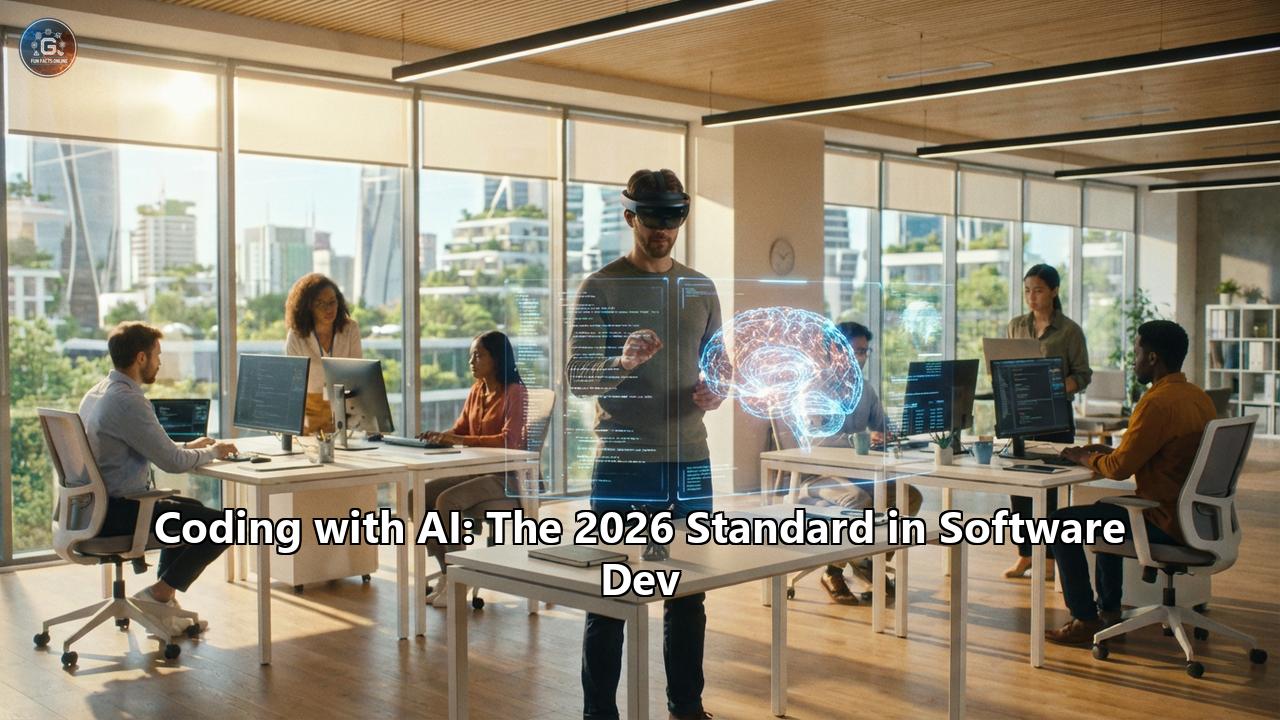
If you fell asleep in 2023 and woke up today, in early 2026, you wouldn't just be confused by the tools; you would be confused by the silence. Walk into a modern engineering floor—or more likely, log into a distributed "huddle"—and you won't hear the clatter of mechanical keyboards furiously typing out boilerplate. You’ll hear conversation. You’ll see architects drawing on infinite canvases while streams of logic materialize in the background.
We have officially crossed the rubicon. For decades, "coding" was synonymous with "typing." It was a manual trade, closer to bricklaying than architecture. You had a blueprint in your head, but you had to lay every syntactic brick by hand.
In 2026, the bricks lay themselves.
The "AI Summer" of 2024–2025 didn’t just make us faster; it fundamentally inverted the stack. We are no longer writers of code; we are Architects of Intelligence and Orchestrators of Agents. The standard in 2026 isn't about how many lines of Python you can write; it's about how many autonomous agents you can successfully shepherd toward a business goal without crashing production.
The shift from "Copilot" to "Co-Founder"
Three years ago, we marveled at "Copilots"—autocomplete on steroids that could guess the next three lines of a function. It felt magical. Today, that technology feels as quaint as T9 texting.
The standard has shifted to Agentic Workflows. We don't ask AI to "write a function to sort this list." We ask an AI agent to "refactor the payment microservice to support the new EU compliance standards, write the migration scripts, and update the documentation." And then we go get coffee.
When we return, we don't review code line-by-line in the traditional sense. We review intent. We review logic. We audit the agent's decision-making process. The AI has graduated from a junior pair programmer to a tireless, hyper-fast, mid-level engineer that never sleeps but occasionally hallucinates dangerous dependencies.
Part II: The 2026 Toolchain – A New Iron Throne
The "IDE Wars" of the early 20s are over, and the winner wasn't a text editor—it was the Context Environment.
1. The rise of "Windsurf" and "Antigravity"
While VS Code remains the skeleton of the industry, the organs have been replaced. Two dominant paradigms have emerged in 2026:
- Windsurf (The Flow State Engine): This tool popularized the concept of "Deep Context Awareness." It doesn't just see the file you have open; it indexes your entire repo, your Slack history, your Jira tickets, and your production logs. When you type fix the bug, Windsurf knows which bug you mean because it saw the Sentry alert five minutes ago. It pre-emptively suggests architectural changes, not just syntax fixes.
- Google Antigravity (The Agent Orchestrator): This platform feels less like a text editor and more like a command center. You don't "write" code here; you manage lanes of agents. Lane 1 is working on frontend components. Lane 2 is optimizing database queries. Lane 3 is writing integration tests. Your job is to resolve conflicts between them. It’s "Minority Report" for DevOps.
2. The Terminal Returns
Ironically, as GUIs became smarter, the Command Line Interface (CLI) made a massive comeback. Tools like Claude Code and Gemini CLI turned the terminal into a conversational interface.
Developers in 2026 often spend their day in a natural language terminal:
$ agent run --task "Analyze the last 500 error logs and generate a patch for the memory leak"
> Agent 1: Analyzing logs...
> Agent 1: Pattern identified in image-processing-worker.
> Agent 1: Drafted patch. Running regression tests...
> Agent 1: Tests passed. Ready for review.
This isn't scripting; it's delegation. The CLI is no longer a place for memorizing flags; it's the direct line to the synthetic workforce.
3. "Vibe Coding" vs. "System Engineering"
A cultural schism has formed in the developer community.
On one side, we have "Vibe Coding"—a term coined for rapid prototyping where the human creator knows almost no code. they describe a "vibe" or a feature set, and the AI builds the entire app. This has democratized software creation, allowing marketing teams and product managers to ship internal tools without bothering engineering.
On the other side is "System Engineering." This is where the professionals live. Because AI writes code so easily, the volume of code has exploded. The professional's job is to manage this complexity. They focus on:
- Governance: Ensuring the AI isn't introducing licenses we can't use.
- Security: "Prompt Injection" in code generation is the new SQL Injection.
- Cost: An infinite loop of AI agents calling APIs can bankrupt a startup in an hour.
Part III: The New Skill Set – What "Senior" Means Now
The most anxious question of 2024 was: "Will AI replace developers?"
The 2026 answer is nuanced:AI replaced the typist, but it elevated the thinker.
If your value proposition was memorizing the syntax of the Java Stream API, you are obsolete. If your value proposition was understanding distributed system consistency and business logic, you are now 10x more valuable.
1. Context Engineering
Prompt engineering was a fad. Context Engineering is the discipline. It’s the art of curating the "knowledge graph" that the AI uses.
An AI is only as good as the context it’s fed. A Senior Developer in 2026 spends hours configuring the .cursorrules or agent.yaml files. They define the "personality" of the codebase.
- “In this module, we prefer functional patterns.”
- “Never use this library, it has a known vulnerability.”
- “When touching the billing system, require double-human-approval.”
You are programming the programmer.
2. The "Blue Team" Mindset
With AI generating 90% of the code, the human becomes the permanent Auditor. The skill of Code Review has become more important than code writing. But it’s harder now. You didn't write the code, so you don't have the mental model of why it was written that way.
Developers are developing a "forensic" skillset. They use AI tools to "interrogate" the code:
- "Why did you choose this sorting algorithm?"
- "Show me the edge case where this fails."
- "Simulate a high-latency network environment for this function."
3. Orchestration & Soft Skills
The "Lone Wolf" 10x engineer is a dying breed. The 2026 10x engineer is a Force Multiplier. They manage a squad of 5 autonomous AI agents and coordinate with human stakeholders.
Communication is paramount. You have to translate vague business requirements into rigid "Specs" that an AI can execute without hallucinating. The ambiguity of human language is the biggest bottleneck. The best developers are now essentially contract lawyers—writing specifications so tight that the AI cannot misinterpret them.
Part IV: The AI-Native SDLC
The Software Development Life Cycle (SDLC) has collapsed. The linear Waterfall or even Agile sprints feel sluggish. We are in the era of Continuous Generation.
Planning: The Death of the Blank Page
Nobody starts from a blank file anymore.
- 2023: "I need to build a user auth system. Let me search Stack Overflow."
- 2026: "Agent, scaffold a user auth system using our company's security library, adhering to SOC2 compliance, and draft the GraphQL schema."
- Result: 30 seconds later, you have a working skeleton. The "planning" phase is now a "prototype review" phase.
Testing: The Inversion of Control
Test-Driven Development (TDD) has finally won, but not how we expected.
Humans write the Tests; AI writes the Implementation.
This is the "Golden Rule" of 2026: Never let the AI write its own tests. If the AI hallucinates the code, it will likely hallucinate a test that passes that code.
The human role is to define the "Truth" (the test cases). The AI's job is to satisfy the Truth.
- Human: "Here is a suite of 50 tests covering every edge case of the pricing logic."
- AI: "I have written the code. It passes 48 tests. I am refactoring to pass the last 2."
Deployment: Self-Healing Infrastructure
CI/CD pipelines are no longer static scripts. They are intelligent.
If a deployment fails in staging, the pipeline doesn't just fail; it diagnoses and patches.
- Alert: "Deployment failed. Latency spike in API."
- AI Ops: "Rolling back. Analyzing logs. Found a N+1 query introduced in commit #4a2b. Generating patch. Re-running tests."
This "Self-Healing" capability has reduced pager fatigue, but it introduces a fear of "Ghost Code"—fixes running in production that no human explicitly authorized.
Part V: The Junior Developer Crisis
This is the elephant in the room. In 2026, the industry is facing a crisis of Apprenticeship.
The "Missing Middle"
Traditionally, junior developers learned by doing the grunt work: writing simple functions, fixing minor bugs, writing documentation.
Today, AI does all of that instantly and perfectly.
So, how does a Junior become a Senior?
If you never struggle with a syntax error, do you ever truly understand how the compiler thinks? If you never write a SQL query by hand, do you understand execution plans?
Companies are scrambling to solve this. We are seeing the rise of:
- "Flight Simulators": Artificial environments where juniors are forced to code "manually" or debug broken AI systems to prove their competence.
- The "Architect Track" for Grads: Computer Science degrees are pivoting away from syntax and toward system design, ethics, and product management. The CS grad of 2026 is less of a C++ wizard and more of a Systems Architect.
Part VI: The Dark Side – Security, Ethics, and Copyright
It’s not all utopian efficiency. The 2026 landscape is a minefield of new risks.
1. The Security Arms Race
"Vulnerability Injection" is a real threat. Malicious actors are poisoning the training data of open-source models. An agent might innocently suggest a package that contains a dormant backdoor.
Security teams are no longer looking for bugs; they are looking for patterns of deception in AI output.
"Zero Trust Coding" is the standard. Every line of AI-generated code is treated as potentially hostile until verified.2. The Copyright Quagmire
Legal battles are still raging. When an AI generates a function that looks 99% like a proprietary algorithm from a competitor, who is liable?
Enterprise "Clean Rooms" are standard. Corporate AI models are trained only on permissible open-source code and internal codebases, walled off from the "wild internet" to prevent IP contamination.
3. Technical Debt at the Speed of Light
It is easier than ever to create code. It is harder than ever to maintain it.
We are seeing "Code Bloat" on a massive scale. Because AI can "write it for you," developers are accepting 500 lines of code where 50 would do.
"Refactoring Agents" are constantly running in the background, trying to prune the jungle that the "Creation Agents" are growing. It’s a constant battle between growth and decay.Part VII: A Day in the Life (The 2026 Developer)
09:00 AM: Log in. The "Daily Briefing" agent summarizes the night's automated work. "I optimized 4 SQL queries, updated the React dependencies, and flagged a potential security risk in the login module." 09:30 AM: Standup is a text-based sync with the team and the "Squad Lead" AI. The humans discuss strategy; the AI updates the Jira board based on git commits. 10:00 AM: "Deep Work." You open Windsurf. You need to build a new feature: Voice-to-Action for the mobile app.You don't type import Audio.
You open a canvas and drag in the "Audio Processing Agent" and the "UI Component Agent."
You write a spec: "The user should be able to hold a button, speak a command, and have the app execute it. Latency must be under 200ms."
You watch as the agents generate the frontend components, the backend API endpoints, and the WebSocket handlers.
Your job is to spot the mistake: The agent forgot to handle the "offline mode" state. You add a comment: "Handle offline graceful degradation." The code rewrites itself in seconds.
01:00 PM: Code Review. A junior dev (aided by AI) submitted a PR. You use an AI auditor to highlight logic flaws. You focus your human energy on mentoring the junior on why the architectural choice matters for scalability. 03:00 PM: Incident! Production is slow. You don't SSH into a server. You query the Observability Agent: "Correlate the latency spike with recent changes."It tells you:
"The new feature introduced a non-indexed database read."You approve the AI's suggested fix. It deploys. Solved in 4 minutes.
05:00 PM: You log off. You wrote maybe 50 lines of actual code today. But you shipped a feature that would have taken a team of three two weeks to build in 2023.Conclusion: The Human Anchor
The standard in 2026 is Speed, Scale, and Orchestration.
But amidst the agents and the automation, the most critical component remains the Human Anchor.
AI can answer any
How.It can solve any
What.But it still cannot answer
Why. Why are we building this feature? Why does this user experience matter? Why is this ethical?The developers of 2026 are not just machine operators. They are the guardians of intent. They are the bridge between human desire and machine execution.
Coding is dead. Long live Software Engineering.
Reference:
- https://www.crossover.com/resources/the-big-3-ai-tools-for-software-development-in-2026
- https://www.champsoft.com/2026/01/29/how-ai-is-reshaping-the-software-development-lifecycle-in-2026/
- https://resources.anthropic.com/hubfs/2026%20Agentic%20Coding%20Trends%20Report.pdf?hsLang=en
- https://www.calcalistech.com/ctechnews/article/1e2bgn8sj
- https://www.forbes.com/sites/forrester/2025/12/04/predictions-2026-software-development-hits-all-the-right-notes/
- https://kansoftware.com/ai-agile-software-development-life-cycle-2026/
- https://www.youtube.com/watch?v=SsHNwjexmOI
- https://medium.com/ai-software-engineer/12-ai-coding-emerging-trends-that-will-dominate-2026-dont-miss-out-dae9f4a76592
- https://dev.to/emmawilson01/the-best-ai-tools-for-software-development-in-2026-based-on-1000-hours-of-real-world-usage-391c
- https://medium.com/predict/the-future-of-ai-in-2026-major-trends-and-predictions-fad3b6f9ecbe
- https://www.refontelearning.com/blog/ai-developer-engineering-in-2026-mastering-the-future-of-ai-development
- https://zaigoinfotech.com/blogs/impact-of-ai-on-software-development
- https://medium.com/@sohitmishra/ai-career-growth-for-developers-what-actually-matters-in-2026-b70e4c39592a
- https://narwal.ai/ai-in-sdlc-transforming-the-software-development-lifecycle-for-the-future/
- https://news.microsoft.com/source/features/ai/whats-next-in-ai-7-trends-to-watch-in-2026/
- https://www.cortex.io/post/the-engineering-leaders-guide-to-ai-tools-for-developers-in-2026
- https://kotrotsos.medium.com/the-no-nonsense-guide-to-ai-assisted-coding-in-2026-9e3c961be244
- https://blogs.cisco.com/news/the-future-was-written-at-cisco-ai-summit
- https://dev.to/lightningdev123/best-ai-tools-for-coding-in-2026-a-practical-guide-for-modern-developers-22hk