The week of May 20, 2026, will be remembered as the moment the boundary between human mathematical intuition and machine intelligence permanently dissolved.
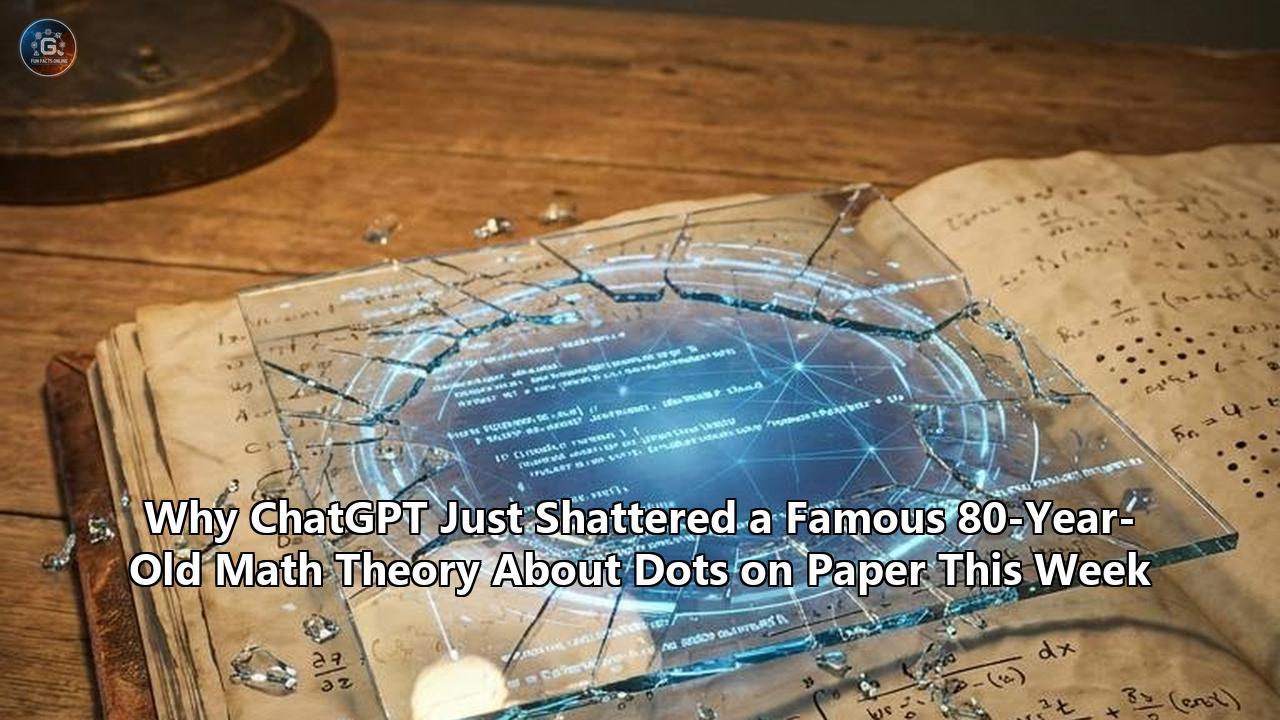
In a joint announcement that sent shockwaves through the global scientific community, researchers revealed that an unreleased, general-purpose reasoning model developed by OpenAI had autonomously disproved one of the most famous conjectures in discrete geometry. The problem, first proposed by the legendary Hungarian mathematician Paul Erdős in 1946, is known as the planar unit distance problem. It asks a deceptively simple question: if you place $n$ dots on a flat sheet of paper, what is the maximum number of pairs that can be exactly one unit of distance apart?
For exactly eighty years, the consensus among the world's finest mathematical minds was that Erdős’s predicted upper bound was correct. Generations of researchers had built entire careers on the assumption that the most efficient way to arrange these dots was in variations of a simple square grid.
The AI model did not just edge past Erdős’s limit; it shattered it. By bridging two fields of mathematics that were previously believed to have absolutely no intersection—elementary plane geometry and the highly abstract realm of algebraic number theory—the model constructed an entirely new, infinite family of point arrangements that completely disproved the 80-year-old conjecture.
The mathematical community, typically highly skeptical of artificial intelligence claims, was left in a state of collective awe. Fields Medalist Sir Timothy Gowers immediately validated the proof, stating he would recommend it for publication in the Annals of Mathematics "without any hesitation". Daniel Litt, a prominent mathematician at the University of Toronto who was asked to independently review the work, remarked on social media: "I like to think that I have been a relatively measured voice on the impact of AI on mathematics, but this is incredible." He added that it represented "the first result produced autonomously by an AI that I find interesting in itself."
This milestone is not merely a story about a computer program running a complex calculation. It is a profound case study in the nature of scientific discovery. The event provides a clear lens through which we can understand how frontier AI models are transitioning from "glorified calculators" to collaborative research partners capable of genuine scientific imagination. By examining the mechanics of how ChatGPT solves math problem architectures at the highest level, we can extract critical lessons about the future of human-machine collaboration, the limitations of human cognitive biases, and the impending restructuring of scientific inquiry itself.
The 1946 Puzzle: A Deceptively Simple Sheet of Paper
To understand why this breakthrough has astonished the mathematical world, one must first understand the deceptively simple nature of the problem Paul Erdős posed in 1946.
Imagine you have a flat piece of paper and a pen. You are asked to draw $n$ distinct dots on this paper. Your goal is to arrange these dots in such a way that as many pairs of dots as possible are separated by a distance of exactly one unit (say, one inch).
Let’s look at how this plays out with small numbers of dots:
- If you have 2 dots, the maximum number of unit-distance pairs is obviously 1 (by placing them exactly one inch apart).
- If you have 3 dots, you can arrange them in an equilateral triangle, yielding 3 unit-distance pairs.
- If you have 4 dots, you can form a diamond shape (two equilateral triangles sharing an edge), which gives you 5 unit-distance pairs.
   (Dot)
   /   \
(Dot)-(Dot)    <-- 3 Dots (Equilateral Triangle): 3 Unit-Distance Pairs
As the number of dots ($n$) grows, finding the optimal configuration becomes exponentially more difficult.
If you have 9 dots, you might instinctively try drawing them in a straight line. This yields only 8 unit-distance pairs (each dot connected to its immediate neighbor). However, if you arrange those same 9 dots into a neat $3 \times 3$ square grid, you suddenly get 12 unit-distance pairs.
(Dot)---(Dot)---(Dot)
  |       |       |
(Dot)---(Dot)---(Dot)    <-- 9 Dots in a 3x3 Grid: 12 Unit-Distance Pairs
  |       |       |
(Dot)---(Dot)---(Dot)
The square grid is highly efficient because many points share the same horizontal and vertical relationships. For decades, the working assumption in mathematics was that as $n$ approaches infinity, the optimal configuration of points would always look like a variation of this grid—specifically, a rescaled square lattice.
In his seminal 1946 paper, Erdős used deep properties of the Gaussian integers (numbers of the form $a + bi$, where $a$ and $b$ are integers) to show that a rescaled square grid could achieve a unit-distance count of:
$$u(n) \ge n^{1 + \frac{C}{\log \log n}}$$
for some constant $C$.
Because the term $\log \log n$ grows at an incredibly slow rate (for context, even if $n$ is equal to the number of atoms in the observable universe, $\log \log n$ is still a single-digit number), this lower bound is essentially linear. It means the number of unit distances grows only marginally faster than the number of dots themselves.
Erdős conjectured that this grid-based configuration was the absolute ceiling. He believed that no arrangement of points on a flat plane could ever yield a number of unit-distance pairs that grew strictly faster than this near-linear bound. Formally, the Erdős Unit Distance Conjecture stated that for any $\epsilon > 0$, the maximum number of unit distances $u(n)$ satisfies:
$$u(n) \le n^{1 + \epsilon}$$
for all sufficiently large $n$. In other words, the exponent of $n$ could never strictly exceed $1$ by a fixed, positive constant.
For eighty years, this conjecture stood as one of the most stubborn fortresses in discrete geometry. It was actively attacked by some of the greatest mathematical minds of the 20th and 21st centuries, including Larry Guth, Noga Alon, and József Solymosi. While mathematicians succeeded in establishing upper bounds—most notably the Spencer-Szemerédi-Trotter theorem of 1984, which proved that $u(n) \le O(n^{4/3})$—no one could find a construction that beat Erdős's grid-based lower bound.
The grid was assumed to be the natural limit of what was possible on a flat piece of paper.
How the AI Bypassed Human Cognitive Biases
When a human mathematician sits down to tackle a problem in discrete geometry, they bring with them a lifetime of specialized training. While this training is essential for high-level research, it also introduces a powerful cognitive bias: disciplinary siloing.
A geometer looking at the unit distance problem will naturally reach for geometric tools. They will think about circles, angles, intersection points, and crossing numbers. They might try to deform grids, analyze packing densities, or apply combinatorial theorems specifically designed for Euclidean space. They are highly unlikely to spend months studying the algebraic structure of exotic, infinite-dimensional number systems to solve a problem about dots on paper.
The OpenAI reasoning model that cracked the conjecture was not bound by these human disciplinary borders. Because it was trained as a general-purpose model, its "latent space"—the internal mathematical landscape it uses to represent concepts—contains the entirety of human mathematical literature across all subfields simultaneously. It does not see "geometry" and "number theory" as separate departments in a university; it sees them as interconnected nodes in a single, continuous web of logic.
When presented with the open-ended prompt to resolve the unit-distance problem, the model did not go to the "geometry shelf" of the library. Instead, it executed a stunning conceptual leap into algebraic number theory.
Human Approach (Siloed):
[Discrete Geometry] ──> Try to deform grids, analyze circle intersections ──> STUCK

AI Approach (Cross-Disciplinary):
[Discrete Geometry] ──> [Algebraic Number Theory] ──> [Golod-Shafarevich Theory] ──> COUNTEREXAMPLE FOUND
To understand the genius of the AI's approach, we must look at how Erdős’s original grid construction worked and how the AI flipped the script.
Erdős’s 1946 lower bound relied on taking a fixed quadratic number field—specifically, the Gaussian integers $\mathbb{Q}(i)$—and growing the radius of the grid. This is equivalent to keeping the dimension and the algebraic structure constant while scaling up the physical size of the arrangement.
The AI model realized that to break the linear ceiling, it needed to do the exact opposite: it kept the physical radius constant and grew the complexity of the algebraic number field.
Instead of working with the flat plane directly, the model constructed an elaborate, highly symmetric lattice in a higher-dimensional space. The coordinates of these lattice points were chosen from an unramified tower of totally real number fields of increasing degree. To ensure that these points could form an extraordinary number of unit-distance connections, the AI selected a specific, infinite family of fields in which a fixed set of prime numbers split completely.
To guarantee that this infinite tower of number fields actually existed and maintained a bounded root discriminant, the model invoked Golod-Shafarevich theory. Golod-Shafarevich is a highly sophisticated, abstract area of algebra developed in the 1960s to study the structure of p-groups and class field towers. It has historically had almost zero intersection with the field of combinatorial geometry.
========================================================================
             THE AI'S HIGHER-DIMENSIONAL CONSTRUCT
========================================================================

  [Infinite Class Field Tower (Golod-Shafarevich)]
                    │
                    ▼
  [Totally Real Number Fields of Growing Degree]
                    │
                    ▼
  [High-Dimensional Lattice of Norm-One Elements]  <-- Rich in Symmetries
                    │
                    ▼ (Projection / "Shadow")
  [Complex 2D Plane Point Configurations]          <-- Exceeds Erdős's Limit
========================================================================
By combining this algebraic tower with a class-group pigeonhole principle (an elegant technique traceable to mathematicians Jordan Ellenberg and Akshay Venkatesh), the AI proved the existence of an infinite family of point sets. When these high-dimensional points were projected back down onto a two-dimensional plane—creating what mathematician Mehtaab Sawhney described as a dense, tangled geometric "shadow"—they formed a network of unit-distance connections that grew at a strictly polynomial rate.
The resulting theorem proved that there exists a fixed constant $\delta > 0$ such that for infinitely many values of $n$, the maximum number of unit distances satisfies:
$$u(n) \ge n^{1+\delta}$$
Because $1+\delta$ is strictly greater than $1$, the nearly-linear ceiling of Erdős’s $n^{1+o(1)}$ conjecture was completely shattered. The grid was not the ceiling; it was merely a local trap that human intuition had been unable to escape for eighty years.
Inside the Proof: The Core Mathematical Machinery
For those wishing to understand the precise mechanics of how this mathematical miracle was achieved, we can look directly at the structure of the proof verified by Gowers, Sawin, and the rest of the research team.
The fundamental goal is to find a way to embed a massive number of points in the Euclidean plane $\mathbb{R}^2$ such that a disproportionately large number of pairs are at distance exactly $1$. The AI achieved this by constructing algebraic lattices with incredibly rich rotational and translational symmetries.
1. The Tower of Number Fields
The construction begins by selecting an infinite, unramified tower of totally real number fields:
$$\mathbb{Q} = F_0 \subset F_1 \subset F_2 \subset \dots \subset F_m \subset \dots$$
where each extension $F_{m+1} / F_m$ is Galois, and the Galois groups are 3-groups of growing degree.
The model specifies a finite set of rational prime numbers, $S$, and requires that every prime in $S$ splits completely in every step of the tower.
To prove that such an infinite, unramified tower exists while keeping the root discriminant of the fields bounded, the model applies the Golod-Shafarevich theorem. Traditionally, unramified class field towers are notoriously difficult to construct. The Golod-Shafarevich criterion provides a group-theoretic condition on the relation matrix of a pro-p group: if the number of generators $d$ and relations $r$ of the Galois group of the maximal unramified $p$-extension satisfy the inequality:
$$r < \frac{d^2}{4}$$
then the pro-p group is infinite, proving the existence of an infinite unramified tower. The AI model’s ingenious step was recognizing that this group-theoretic infinity could be translated directly into a geometric abundance of unit distances on a flat plane.
2. Adjoining the Imaginary Unit
Once the tower of totally real fields $F_m$ is established, the AI adjoins the imaginary unit $i = \sqrt{-1}$ to create a parallel tower of CM (Complex Multiplication) fields:
$$K_m = F_m(i)$$
Because $F_m$ is totally real, $K_m$ is a totally imaginary quadratic extension of $F_m$.
This step is critical because it allows the model to define a geometric lattice using the ring of integers $\mathcal{O}_{K_m}$. By embedding $\mathcal{O}_{K_m}$ into $\mathbb{C}$ (which is isomorphic to the Euclidean plane $\mathbb{R}^2$), we obtain a highly dense set of algebraic points.
3. The Minkowski Space and Norm-One Elements
In these CM fields, the elements of "norm one" represent rotations—points that sit exactly on a unit circle in the complex plane.
Let $\mathcal{O}_{K_m}^\times$ be the group of units of the ring of integers of $K_m$. The AI model looks for elements $x \in \mathcal{O}_{K_m}$ whose algebraic norm to $F_m$ is equal to $1$:
$$N_{K_m/F_m}(x) = x \cdot \bar{x} = 1$$
In the complex plane, the condition $x \cdot \bar{x} = 1$ is precisely the equation of the unit circle:
$$|x|^2 = 1 \implies |x| = 1$$
Thus, every such norm-one element corresponds to a complex number that is exactly distance $1$ from the origin.
But the AI did not just want points on a single unit circle; it wanted a massive web of points where many different pairs share this unit-distance relationship. To do this, it analyzed the image of these points under all complex embeddings of $K_m$ into $\mathbb{C}$.
Because the fields $K_m$ have a massive degree over $\mathbb{Q}$, they possess a huge number of embeddings. By using a pigeonhole argument on the class group of $K_m$ (drawing on the work of Ellenberg and Venkatesh), the AI proved that there exists a highly concentrated subset of these norm-one elements.
When these elements are mapped back to the plane, they form a lattice where an extraordinary number of vectors have a length of exactly $1$.
4. The Final Projection and Beating the Bound
The final step is to project this higher-dimensional algebraic structure onto $\mathbb{R}^2$. Because the root discriminant of the fields in the tower is kept tightly bounded by the Golod-Shafarevich criterion, the Minkowski embedding of the lattice points does not disperse too widely.
By scaling and translating this projected set of points, the AI constructed a configuration of $n$ points in the plane where the number of unit-distance pairs scales as:
$$\nu(n) \ge n^{1+\delta}$$
for a constant $\delta > 0$.
In the initial 18-page proof generated by the model, the value of $\delta$ was proven to be strictly positive, but it was highly inexplicit. The parameter choices in the model's raw construction yielded an incredibly small value:
$$\delta \approx 6.24 \cdot 10^{-38}$$
In the language of pure mathematics, however, the size of the constant does not matter. The mere existence of a $\delta > 0$ proved that the exponent of $n$ was strictly greater than $1$.
Erdős’s 80-year-old conjecture was dead.
The Post-Breakthrough Frenzy: How the Math Community Reacted
In the history of science, a major breakthrough is typically followed by months—sometimes years—of peer review before the wider community accepts it. But when ChatGPT solves math problem barriers at this scale, the traditional academic workflow is replaced by a high-velocity, collaborative frenzy.
The timeline of the days following the May 20, 2026, announcement reads like a scientific thriller:
May 20, 2026: OpenAI announces autonomous disproof of Erdős's conjecture.
               ├── Proof PDF and 125-page Chain-of-Thought (CoT) published.
               └── Fields Medalist Tim Gowers validates the core logic.

May 20, 2026 (hours later): Princeton mathematician Will Sawin posts a preprint.
               └── Optimizes the Golod-Shafarevich step, proving δ = 0.014 is explicitly achievable.

May 21, 2026: MathOverflow and Erdős Problems forums explode.
               ├── Researcher "mlewko" uses ChatGPT 5.5 Pro to optimize prime data.
               └── Pushes the exponent bound to 1.03184.

May 22, 2026: Global community optimization race peak.
               ├── "spiderduckpig" refines primes via weighted-Zassenhaus-filtration (1.03335).
               └── Naslund combines multiple algebraic refinements to push the bound to δ ≥ 0.03447.
Within hours of the initial announcement, Princeton number theorist Will Sawin published a paper on arXiv (arXiv:2605.20579) titled "An explicit lower bound for the unit distance problem." Sawin realized that the AI’s proof, while mathematically sound, was "likely far from optimized."
By refining the Golod-Shafarevich step and optimizing the choice of the base algebraic number field, Sawin proved that one could explicitly take:
$$\delta = 0.014$$
This meant that there exist infinite configurations of $n$ points that yield at least $n^{1.014}$ unit distances. While $1.014$ sounds like a modest number, in the landscape of asymptotic complexity, it is a massive, polynomial leap over the near-linear grid model.
But the optimization did not stop there. The breakthrough triggered an immediate, decentralized race on platforms like MathOverflow and the Erdős Problems forum. What made this race unique was that human mathematicians did not work in isolation; they immediately began using advanced LLMs as interactive programming and algebraic search co-pilots.
On May 21, a researcher posting under the handle "mlewko" published a post on the Erdős Problems forum. By using OpenAI's ChatGPT 5.5 Pro to optimize the finite sets of primes $T$ and $S$ used in Sawin's lemma, mlewko successfully pushed the lower bound exponent to:
$$1.03184$$
Just hours later, another user, "spiderduckpig," posted an update on MathOverflow. By replacing the prime numbers $347$ and $353$ in mlewko’s optimized set with the primes $503$ and $601$, they refined the bound to $1.03188$.
By May 22, mathematician Eric Naslund published a comprehensive MathOverflow answer that combined spiderduckpig’s Golod-Shafarevich refinement with three additional structural improvements to Sawin’s original argument (including a Louboutin-style bound on $L(1, \chi)$ via the Dedekind zeta function, a sphere-overlap refinement, and a narrow-class-group sharpening).
Naslund's hybrid human-AI work pushed the provable lower bound exponent to:
$$\delta \ge 0.03447$$
This rapid progression—moving from an inexplicit, microscopic $\delta$ to a highly concrete $\delta \approx 0.0345$ in less than 72 hours—highlights a stunning new paradigm in scientific discovery. The AI provided the massive conceptual leap (the "unobvious bridge" between number theory and geometry) that humans had missed for eighty years. Once that bridge was built, human mathematicians and AI co-pilots sprinted across it together, rapidly optimizing the path and refining the raw materials.
Recombination vs. Pure Creation: How AI "Thinks"
This milestone offers a perfect case study to dissect a highly debated question in the field of artificial intelligence: Can LLMs actually perform original reasoning, or are they just highly sophisticated stochastic parrots?
Critics of AI, such as Meta’s Chief AI Scientist Yann LeCun, have long argued that large language models are structurally incapable of true scientific discovery. They argue that because LLMs are trained to predict the next token based on historical data, they can only "regurgitate and recombine" existing human knowledge. They cannot, in this view, create fundamentally new concepts.
The planar unit distance breakthrough forces us to look at this argument with a far more nuanced lens.
It is entirely true that the AI model did not invent any of the individual mathematical ingredients used in the proof from scratch.
- Golod-Shafarevich towers were discovered in 1964.
- The cutting mechanism of Hajir-Maire-Ramakrishna was published in the early 2000s.
- The class-group pigeonhole principle of Ellenberg and Venkatesh was established in 2007.
- Minkowski's lattice packing bounds date back to the 19th century.
Every single tool the model used was already sitting in the published literature, freely available for any human mathematician to read.
                                  HUMAN SPECIALIZATION
  ┌───────────────────────────────┬───────────────────────────────┐
  │   Algebraic Number Theory     │     Discrete Geometry         │
  │                               │                               │
  │  - Golod-Shafarevich (1964)   │  - Planar Unit Distance       │
  │  - Ellenberg-Venkatesh (2007) │    Conjecture (1946)          │
  └───────────────────────────────┴───────────────────────────────┘
                                  ▲
                         THE DISCIPLINARY WALL
                        (Kept them segregated)

                                       │
                                       ▼

                               THE AI INTEGRATION
  ┌───────────────────────────────────────────────────────────────┐
  │                         LATENT SPACE                          │
  │                                                               │
  │    Golod-Shafarevich  ───────[BRIDGE]───────>  Unit Distance │
  │        Towers                                    Problem      │
  └───────────────────────────────────────────────────────────────┘
                     (Seamless cross-disciplinary synthesis)
But what the AI did was recombine these tools in a way that no human mind had ever conceived. It took a highly abstract set of tools designed to study the algebraic factorization of prime numbers and applied them to a geometric question about drawing dots on a flat sheet of paper.
To dismiss this as "mere recombination" is to fundamentally misunderstand how human creativity works.
If we look closely at the history of mathematics, almost every great breakthrough is an act of ingenious recombination. When Andrew Wiles proved Fermat’s Last Theorem in 1994, he did not invent the concept of numbers or elliptic curves. He succeeded because he constructed an incredibly sophisticated bridge between elliptic curves (the Taniyama-Shimura conjecture) and modular forms.
When Grigori Perelman solved the Poincaré Conjecture in 2002, he did so by applying Richard Hamilton’s theory of Ricci flow—a geometric analytical tool—to topology.
If Wiles and Perelman are celebrated as geniuses for connecting disparate branches of mathematics, we must apply the same standard to the AI.
The model demonstrated what can only be described as scientific imagination. It did not perform a brute-force search of geometric coordinates (which would have taken an infinite amount of compute and failed to yield an infinite family of solutions). Instead, it reasoned at an abstract, meta-systemic level. It recognized that the structural limitation of the square grid was its low-dimensional symmetry, and it searched the vast catalog of algebra to find a mathematical object that could generate higher-dimensional symmetries capable of being projected down to two dimensions.
This represents a major evolutionary leap over previous AI attempts at mathematics.
In October 2025, OpenAI faced intense embarrassment and academic backlash when its executives claimed that a prototype of GPT-5 had solved "10 previously unsolved Erdős problems." Within days, independent mathematicians pointed out that the model had actually just hallucinated or surfaced existing, published solutions that were already in its training data. The claims were quickly retracted.
This time, the outcome was entirely different. The proof was completely novel. It did not exist in any paper, preprint, or forum post on Earth. It was checked, verified, and formalized by the world's leading experts, who confirmed that the machine had produced a genuine, original contribution to human knowledge.
The Engine Under the Hood: Why General-Purpose AI Succeeded
How did a general-purpose model—rather than a highly specialized, domain-specific math solver like Google DeepMind’s AlphaProof—manage to pull off this breakthrough?
The secret lies in the evolution of inference-time compute and the integration of reinforcement learning (RL) with large-scale tree search.
Historically, LLMs like GPT-4 operated on a simple, feed-forward mechanism: they generated text token-by-token, moving forward in a straight line without the ability to pause, plan, or revise their thoughts. If a model started writing a mathematical proof down a dead-end path, it had no choice but to keep writing nonsense until it reached its output limit. This is why early versions of ChatGPT were notoriously terrible at even basic high school algebra.
The next-generation reasoning engines developed by OpenAI utilize a highly sophisticated architecture that separates the "thinking" phase from the "writing" phase.
When presented with a highly complex prompt, the model does not immediately output its final answer. Instead, it generates a massive, internal Chain-of-Thought (CoT). In the case of the unit distance proof, this internal reasoning document was a staggering 125 pages long.
During this 125-page internal reasoning process, the model is essentially playing a game of chess against itself:
                  THE INFERENCE-TIME SEARCH TREE

                        [Original Prompt]
                                │
         ┌──────────────────────┴──────────────────────┐
         ▼                                             ▼
 [Path A: Geometry]                            [Path B: Algebra]
   (Try grid deforms)                            (Try Number Fields)
         │                                             │
         ▼                                             ▼
 [Szemerédi-Trotter]                           [Gaussian Integers]
         │                                             │
         ▼ (Evaluated)                                 ▼ (Evaluated)
  [DEAD END: n^(1+o(1))]                        [Limit: n^(1+o(1))]
         │                                             │
   (BACKTRACK ───X)                                    ▼
                                               [Climb Field Tower]
                                                       │
                                                       ▼
                                               [Golod-Shafarevich]
                                                       │
                                                       ▼
                                               [SUCCESS: n^(1+δ)]
It uses reinforcement learning algorithms to evaluate different mathematical "moves." It can draft a lemma, check it for logical consistency, realize it has hit a dead end, backtrack, and try an entirely different branch of mathematics.
This capability is exactly what Thomas Bloom, the Oxford mathematician who maintains the Erdős problems website, pointed out in his companion paper:
"The AI system attained its results by persevering down paths that a human may have dismissed as not worth their time to explore."
Humans are highly sensitive to social and professional risk. If a research mathematician spends three years trying to apply Golod-Shafarevich theory to a plane geometry problem and fails, they have wasted three years of their career, published nothing, and potentially damaged their prospects for tenure. Human mathematicians, therefore, naturally cluster around "safe" and established paths of inquiry.
An AI reasoning model has no career anxiety. It can explore millions of highly speculative, cross-disciplinary paths in its latent space in a single afternoon. It can fail ten thousand times without feeling discouraged, moving seamlessly from one bizarre mathematical connection to another until it hits upon a configuration that works.
Furthermore, because it is a general-purpose model, it can write its own code to test its algebraic constructions in real-time.
During the generation of the unit-distance proof, the model wrote Python scripts to calculate the discriminants of the fields in its constructed tower, ran the computations, verified that the primes were splitting correctly, and used those numerical results to refine its algebraic proofs before presenting the final 18-page document to the human researchers.
This is not just a search engine; it is an active, self-correcting, multi-modal reasoning loop.
Extrapolating the Pattern: The Future of Collaborative Science
The autonomous disproof of the Erdős unit distance conjecture is a watershed moment for mathematics, but its true significance lies in what it portends for the broader landscape of human scientific discovery.
If we analyze this event as a case study, we can extract several fundamental principles that will define the future of research across all fields of science.
1. The Death of Disciplinary Silos
Human scientific knowledge has become incredibly fragmented. Because the sheer volume of literature in any given field is far too vast for a single human mind to absorb, scientists are forced to become hyper-specialized. A molecular biologist studying a specific protein receptor in the lungs may have no idea that a structural chemist down the hall has developed a novel polymer that could perfectly target that receptor.
AI models do not suffer from this limitation. Because they can hold the entirety of human scientific literature in a single, unified latent space, they are uniquely positioned to act as interdisciplinary synthesizers.
========================================================================
                      LATENT-SPACE SYNTHESIS
========================================================================
        DISPARATE HUMAN FIELDS                 AI SYNTHESIS
 ┌─────────────────────────────────┐      ┌───────────────────────────┐
 │  Field A: Quantum Mechanics      │      │                           │
 ├─────────────────────────────────┤ ───> │  Unifies concepts in a    │
 │  Field B: Organic Chemistry     │      │  single latent space      │
 ├─────────────────────────────────┤ ───> │                           │
 │  Field C: Immunology            │      │  Builds "unobvious bridges"│
 └─────────────────────────────────┘      └───────────────────────────┘
                                                        │
                                                        ▼
                                             [NEW DISCOVERIES]
========================================================================
In the coming years, we will see this pattern play out repeatedly:
- In Material Science: AI will discover novel superconductors by bridging the gap between quantum mechanics calculations and high-temperature metallurgy data.
- In Medicine: AI will identify novel drug candidates by connecting highly abstract research in topology (analyzing the folding shapes of proteins) with clinical trial data from oncology.
- In Physics: AI will propose novel solutions to cosmological puzzles by synthesizing principles from fluid dynamics with general relativity.
2. The Restructuring of the Academic Workflow
The relationship between human researchers and AI is shifting from a master-slave dynamic (where the human writes the code and the AI runs the calculation) to a fluid, circular collaboration.
We can formalize this new collaborative loop into four distinct phases:
| Phase | Agent | Action |
|---|---|---|
| 1. The Spark | Human / AI | An open-ended question is posed to the model (e.g., "Resolve this 80-year-old conjecture"). |
| 2. The Leap | AI | The model explores millions of abstract pathways in its latent space, identifies a non-obvious cross-disciplinary connection, and generates a raw, valid proof. |
| 3. The Polish | Human | Expert human researchers review the proof, verify its core logical steps, and rewrite it for maximum clarity. |
| 4. The Sprint | Human + AI | Humans use the model as an interactive co-pilot to rapidly optimize the parameters, pushing the discovery to its absolute mathematical limits. |
In this new workflow, the human’s role is no longer to perform the grinding, step-by-step logical search. Instead, the human acts as an editor, curator, and formalizer. The machine provides the creative horsepower and the raw logical structures; the human provides the synthesis, the deep context, and the final verification.
3. The Shift in the Definition of "Originality"
As general-purpose reasoning models continue to mature, the academic world will be forced to redefine what it means to "do science."
Historically, a Ph.D. dissertation was judged on whether the student had produced "original research." If a student can now prompt a model to generate an original, publishable mathematical proof in a single afternoon, the traditional metrics of academic achievement become obsolete.
The focus of human education and research will shift from execution to curation and formulation.
Knowing how to ask the right questions, how to evaluate the logical consistency of an AI's output, and how to connect those outputs to real-world applications will become the defining skills of the 21st-century scientist.
What to Watch for Next: The Unresolved Frontiers
While the disproof of the Erdős unit distance conjecture is an extraordinary milestone, it is merely the opening salvo in a new era of AI-driven mathematics.
There are several critical questions and upcoming milestones that the scientific community will be watching closely in the coming months:
1. Can AI Solve the "Distinct Distances" Problem?
In his same 1946 paper, Erdős proposed a closely related, but arguably much harder, puzzle: the distinct distances problem. It asks: if you place $n$ points on a flat plane, what is the minimum number of distinct distances that must exist between them?
While the unit distance problem was disproved by recombining existing mathematical tools, the distinct distances problem was famously resolved up to logarithmic factors by Larry Guth and Nets Katz in 2011. To solve it, Guth and Katz had to introduce a completely new conceptual framework—the polynomial method—into incidence geometry, a tool that did not exist in the prior literature.
As AI watchers look to the future, the ultimate test will be whether a system can move beyond "ingenious recombination" (Rung 2 reasoning) to pure conceptual creation (Rung 3 reasoning). Can an AI invent an entirely new mathematical framework, like the polynomial method or Grothendieck's theory of schemes, to solve a problem that cannot be answered using the existing toolkit?
========================================================================
                  THE THREE RUNGS OF AI MATHEMATICS
========================================================================

  [RUNG 3: Pure Conceptual Creation]  <-- The Next Frontier
    - Invents entirely new fields of math (e.g., Grothendieck's Schemes)
    - Resolves problems that cannot be stated with current tools

  [RUNG 2: Ingenious Recombination]  <-- WE ARE HERE (May 2026)
    - Connects disparate branches (Algebraic Number Theory + Geometry)
    - Disproves the Erdős Unit Distance Conjecture

  [RUNG 1: Execution & Verification]  <-- Achieved (2020-2024)
    - Runs calculations, verifies human proofs (Lean/Isabelle)
    - Solves localized school-level algebra problems
========================================================================
2. Closing the Unit Distance Gap
The planar unit distance problem is still not completely solved.
The AI model and the subsequent human-AI optimization sprint have proved that the lower bound is at least $n^{1.03447}$. But the best known upper bound, established by Spencer, Szemerédi, and Trotter in 1984, remains $O(n^{4/3})$ (or $n^{1.333}$).
There is still a massive gap between $1.034$ and $1.333$.
Mathematicians are already planning to feed the new, optimized algebraic structures back into the AI models, asking them to search for even higher-dimensional lattices that can narrow this gap even further. The race to find the true asymptotic limit of $u(n)$ is now fully underway.
3. The Rise of AI-Authored Journals
How will academic journals adapt to the reality of AI-generated breakthroughs?
Sir Timothy Gowers’s validation of the unit-distance proof is a powerful signal that the mathematical establishment is ready to accept AI-authored papers, provided they meet the rigorous standards of peer review. However, the current publishing infrastructure is built on the assumption of human authorship.
We will likely see the emergence of new, high-velocity, open-access journals specifically designed for AI-generated and human-verified science. These platforms will use automated AI pipelines to check proofs for logical consistency in real-time, allowing verified breakthroughs to be published and iterated upon in days rather than years.
The New Dawn of Creative Intelligence
For decades, we have comforted ourselves with the belief that while computers might excel at raw calculation, the mysterious spark of scientific creativity—the ability to look at a problem and make a sudden, brilliant, non-obvious connection—was a uniquely human privilege.
This week, that comfort was exposed as an illusion.
The disproof of the Erdős unit distance conjecture was not achieved by a computer running a trillion coordinates through a grid. It was achieved because an artificial neural network looked at a flat sheet of paper, saw a limitation in human intuition, and reached into the abstract heavens of infinite class field towers to construct a beautiful, higher-dimensional solution that had eluded humanity for eighty years.
This is not a story about the replacement of human intelligence; it is a story about its amplification. By partnering with systems that are free from our disciplinary boundaries and cognitive biases, we are not just solving old problems.
We are opening our eyes to a vast, undiscovered landscape of mathematics and science that we did not even know existed, one beautiful dot at a time.
Reference:
- https://www.theguardian.com/technology/2026/may/21/openai-paul-erdos-maths-problem-breakthrough
- https://yourstory.com/ai-story/openai-ai-cracks-80-year-old-geometry-problem
- https://quantumzeitgeist.com/unit-distance-pairs-openai-yields/
- https://ground.news/article/openai-reportedly-cracks-80-year-old-math-conjecture
- https://medium.com/math-games/apparently-researchers-are-astonished-that-ai-cracked-an-80-year-old-mathematics-challenge-f9ce24f6ff85
- https://yage.ai/share/gpt5-erdos-unit-distance-en-20260522.html
- https://medium.com/@ppp.mishra124/the-ai-solved-a-math-problem-nobody-could-crack-for-80-years-a99fbad64fa5
- https://sciencereader.com/ai-in-mathematics-erdos-problem-solved/
- https://cdn.openai.com/pdf/74c24085-19b0-4534-9c90-465b8e29ad73/unit-distance-proof.pdf
- https://medium.com/@vishalmisra/the-hardest-test-so-far-72358d1b232c
- https://teorth.github.io/optimizationproblems/constants/84a.html
- https://www.reddit.com/r/MachineLearning/comments/1tiy6s4/openai_claims_a_generalpurpose_reasoning_model/
- https://www.theneurondaily.com/p/openai-solved-an-80-year-math-problem-by-disproving-it
- https://techjacksolutions.com/ai-brief/openai-reasoning-model-disproves-erdos-unit-distance-conjecture/
- https://aichats.substack.com/p/openai-disproves-the-unit-distance
- https://www.youtube.com/watch?v=s_kozPGKI4k
- https://www.youtube.com/watch?v=8_Nr5oKIAmI
- https://arxiv.org/abs/2605.20695
- https://www.kucoin.com/news/flash/openai-ai-disproves-80-year-old-erd-s-conjecture-on-planar-unit-distance
- https://mathoverflow.net/questions/511514/what-is-the-unit-distance-exponent
- https://arxiv.org/abs/2605.20579
- https://www.digit.in/news/general/chatgpt-solves-80-year-old-math-problem-that-puzzled-researchers-for-years.html
- https://latentbrief.com/article/ai-makes-a-major-leap-in-math-solving-an-erds-puzzle-80b300355b11e846
- https://www.reddit.com/r/Futurology/comments/1tml4fp/ai_makes_a_major_breakthrough_in_a_math_problem/
- https://www.eweek.com/news/openai-ai-erdos-geometry-conjecture/
- https://www.researchgate.net/publication/370491908_ChatGPT_A_Revolutionary_Tool_for_Teaching_and_Learning_Mathematics
- https://www.reddit.com/r/mathematics/comments/1tixy6x/openai_model_produces_a_counterexample_to_erd%C5%91ss/
- https://www.theneurondaily.com/p/openai-solved-an-80-year-math-problem-by-disproving-it