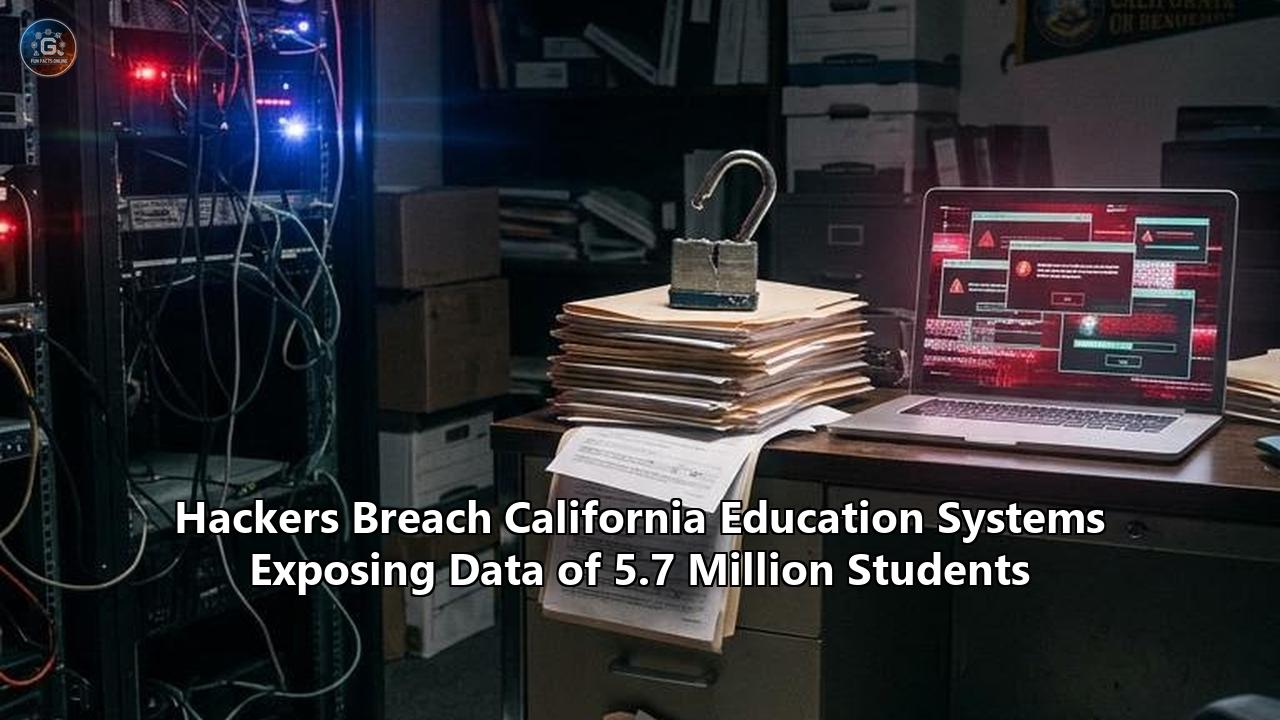
A compromised login credential inside an Educational Testing Service secure file transfer system has exposed the personal records of more than 5.7 million California public school students, triggering an expansive forensic investigation and exposing structural vulnerabilities in how the nation’s largest state public education system handles sensitive child data.
The incident, confirmed by state officials following an October 16 notice from the California Department of Education (CDE) and testing contractor Educational Testing Service (ETS), compromised records spanning every student enrolled in the state’s public schools across the past three academic years. Because the breach also scooped up historical files containing unconfirmed student transfers dating back to 2006, the true number of impacted individuals stretches well beyond the 5.7 million children currently attending transitional kindergarten through 12th grade across California's 1,000-plus school districts.
The stolen files encompass sensitive, highly granular data: full student legal names, dates of birth, home addresses, Statewide Student Identifier (SSID) numbers, grade levels, school and district affiliations, demographic profiles, country of origin, primary language, English learner designations, low-income and foster indicators, special education classifications, Individuals with Disabilities Education Act (IDEA) program accommodations, and standardized testing scores from the California Assessment of Student Performance and Progress (CAASPP) and English Language Proficiency Assessments for California (ELPAC).
Behind the initial statements lies a significant administrative and operational crisis. Digital intruders moved freely across an ETS-operated Secure File Transfer Protocol (SFTP) server for nearly four months—from May 22, 2026, until September 18, 2026—before automated logging or operational staff detected any anomaly. By the time ETS isolated the compromised credential and disabled the site on September 25, gigabytes of California's educational data pipeline had already been copied and exfiltrated.
State leaders were alerted quietly on October 2 through a confidential directive sent to county and district superintendents by California Deputy Superintendent of Public Instruction Mary Nicely. Families, however, were not informed until two weeks later. The incident has now halted core student enrollment and assessment data syncs between local school districts and the state, forcing a total infrastructure rebuild and sparking calls for legislative hearings into state contractor cybersecurity oversight.
+----------------------------------------------------------------------------------------------------+
|                                      THE ETS BREACH TIMELINE                                       |
+-------------------+--------------------------------------------------------------------------------+
| Date              | Operational / Forensic Event                                                   |
+-------------------+--------------------------------------------------------------------------------+
| May 22, 2026      | Intruder establishes initial access to ETS SFTP server using stolen login.     |
| May 22 - Sept 18  | 119-day dwell time; adversary systematically queries and copies flat files.   |
| September 18, 2026| Final logged exfiltration activity on the compromised file-transfer node.      |
| September 25, 2026| ETS internal teams identify anomalous activity; compromised account severed.   |
| October 2, 2026   | CDE Deputy Superintendent Mary Nicely issues confidential alert to LEAs.       |
| October 16, 2026  | CDE and ETS initiate public disclosure, launching 24-month Experian offering.  |
| March 19, 2027    | Final enrollment deadline for impacted minors/adults seeking identity defense. |
+-------------------+--------------------------------------------------------------------------------+
The Attack Chain: 119 Days of Undetected SFTP Exfiltration
The technical compromise at the center of this california education data breach did not rely on advanced, novel zero-day malware or destructive ransomware payloads. According to preliminary disclosures shared by ETS and state investigators, the breach was executed through valid, authenticated access: a set of legitimate administrative or service-level credentials used to log directly into an external-facing SFTP server used to sync assessment payloads with CDE systems.
In enterprise and public-sector IT architecture, an SFTP (SSH File Transfer Protocol) server acts as a digital freight depot. Instead of transmitting real-time student updates one by one through transactional APIs, educational agencies frequently compile massive extract, transform, load (ETL) batches into flat files—such as comma-separated value (CSV) or XML text files—and push them onto an SFTP server for an external contractor to process on a scheduled cron job.
+-----------------------+              +-----------------------+              +-----------------------+
|  California School    |  Batch ETL   |  CDE Internal Staging |   SFTP Sync  |   ETS Contractor SFTP |
|  Districts (1,000+    | -----------> |  (CALPADS Database)   | -----------> |   (Compromised Login) |
|  Local Agencies)      |              |                       |              |                       |
+-----------------------+              +-----------------------+              +-----------+-----------+
                                                                                          |
                                                                                Adversary Exfiltration
                                                                                (May 22 - Sept 18)
                                                                                          |
                                                                                          v
                                                                              +-----------------------+
                                                                              | Stolen Datasets:      |
                                                                              | - 5.7M+ Current PII   |
                                                                              | - IEP/504 Disability  |
                                                                              | - CAASPP/ELPAC Scores |
                                                                              | - Historical (2006+)  |
                                                                              +-----------------------+
Between May 22 and September 18, the threat actor connected to this repository repeatedly. The intruder did not execute code, alter binaries, or attempt privilege escalation on operating system kernels; they simply navigated directory trees containing student data exports and copied them off-site.
This method explains how the actor operated inside the environment for 119 days without triggering alerts:
- Session Authenticity: Because the intruder used valid access keys or user-password credentials, authentication logs initially appeared legitimate to basic rule-based monitoring tools.
- Protocol Masking: SFTP runs over port 22 (the standard SSH port), encrypting data in transit. While this prevents intermediate sniffing on the open wire, it also blinds standard boundary intrusion detection systems (IDS) to the content of outbound file transfers unless the security apparatus deploys deep session inspection, endpoint telemetry, or precise behavioral analytics on transfer volumes.
- Egress Volumetrics: The adversary conducted data extraction in discrete phases across 17 weeks. By staging downloads intermittently rather than initiating a sudden, massive multi-terabyte egress event, the activity avoided basic traffic-spike alerting thresholds.
- Absence of Ransomware Footprints: Unlike ransomware groups that leave encrypted extensions and desktop ransom notes, this actor prioritized stealthy collection, keeping network noise at a bare minimum.
Forensic engineers are scrutinizing whether the initial credential was exposed through an employee phishing campaign, an infostealer malware infection on an unmanaged workstation, or automated credential stuffing against single-factor endpoints.
A central question in the state’s technical review is whether multi-factor authentication (MFA) was enforced across every access vector connected to the SFTP node. If an automated batch service account was utilized for file ingestion, service accounts often bypass interactive MFA requirements unless bound to strict source-IP whitelisting, certificate-based authentication, or behavioral anomaly fencing. Anton Dahbura, executive director of the Johns Hopkins University Information Security Institute, has publicly questioned the authentication parameters governing the server, noting that legacy transfer systems frequently sit on vendor perimeters with inadequate conditional access policies.
Architectural Vulnerabilities: Legacy Batch Pipelines in EdTech
The incident highlights a persistent structural flaw across state education infrastructure: reliance on antiquated file-batching architectures to manage massive identity repositories.
California operates the California Longitudinal Pupil Achievement Data System (CALPADS), the foundational system of record for student demographic, enrollment, and program data across the state's public schools. To administer statewide standardized assessments, including the Smarter Balanced tests under CAASPP and the language assessments under ELPAC, CDE must exchange high-volume datasets with its primary evaluation contractor, ETS.
+----------------------------------------------------------------------------------------------------+
|                                    LEGACY SFTP VS. ZERO-TRUST API                                   |
+-----------------------------+-----------------------------------+----------------------------------+
| Security Dimension          | Legacy SFTP Batch Pipelines       | Modern Zero-Trust Ingestion      |
+-----------------------------+-----------------------------------+----------------------------------+
| Data Exposure Surface       | Broad: unencrypted flat files     | Granular: scoped payload access  |
|                             | resting on server disk space.     | processed in system memory.      |
+-----------------------------+-----------------------------------+----------------------------------+
| Encryption at Rest          | Often dependent on disk-level     | Field-level/column-level         |
|                             | controls; files sit plaintext.    | cryptographic tokenization.      |
+-----------------------------+-----------------------------------+----------------------------------+
| Identity & Access           | Static credentials or SSH keys;   | Ephemeral, short-lived tokens    |
|                             | high risk of credential reuse.    | issued via scoped mTLS.          |
+-----------------------------+-----------------------------------+----------------------------------+
| Data Minimization           | Low: bulk extraction dumps        | High: strict schema validation   |
|                             | entire rosters indiscriminately.  | limited to essential data points.|
+-----------------------------+-----------------------------------+----------------------------------+
| Threat Detection            | Retrospective: dependent on log   | Real-time: anomaly alerting      |
|                             | review of outbound file volumes.  | triggered on query parameters.   |
+-----------------------------+-----------------------------------+----------------------------------+
Rather than engineering authenticated, real-time programmatic endpoints with field-level encryption, state educational pipelines frequently rely on legacy flat-file transfers.
When a school district updates an enrollment file—noting that a student requires specialized audio accommodations for testing or has shifted to a new school—that change is written to CALPADS. At scheduled intervals, statewide aggregations are generated and synced to ETS's servers so test-delivery engines can calibrate testing forms to each student's accommodation profiles.
When an intruder enters an SFTP environment, data is organized in standard directory folders:
/sftp_root/incoming/caaspp_rosters/2025_2026/
/sftp_root/outgoing/elpac_results/2024_2025/
/sftp_root/archive/historical_reconciliation/
Inside those directories sit unsegmented, comma-delimited files containing millions of rows. If an account with broad directory traversal rights is compromised, the attacker does not need to query a structured database or bypass relational access controls. They can simply initiate an automated recursive secure copy command (scp -r or mget *) to download entire cohorts of student records.
ETS has responded by taking down the legacy SFTP site and "building an entirely new SFTP site with enhanced security controls". However, veteran cloud security architects note that replacing one SFTP site with another fails to address the underlying architectural issue: storing vast amounts of unencrypted student data in transit-staging directories.
Transitioning away from persistent file storage requires event-driven streaming architectures (such as Apache Kafka or AWS Kinesis pipelines) using Mutual TLS (mTLS), strict API gateways, and column-level encryption. Under a modern zero-trust framework, test assessment engines request only the specific student ID and accommodation code needed at the moment of testing, preventing entire statewide rosters from sitting on boundary file servers.
Deconstructing the Data Payload: Beyond the Social Security Number
Official announcements from both ETS and the California Department of Education emphasized that Social Security numbers, parent financial account information, and system passwords were not involved in the breach. While this distinction limits immediate credit card fraud, it provides a misleading view of the real operational risks facing affected families.
The exposed data fields create high-risk personal dossiers for millions of minors. The compromised records contain an extensive inventory of statutory and demographic identifiers:
- Statewide Student Identifiers (SSIDs): The 10-digit permanent number assigned to every California K-12 public school student. Unlike a credit card number, an SSID cannot be easily reissued or cancelled. It anchors the individual’s cumulative educational record across their entire academic life.
- Home Addresses and Exact Birthdates: Permanent identifying attributes used across commercial, public, and healthcare institutions for identity verification.
- Disability Classifications and Special Education Accommodations: Stolen records specify whether a child participates in Individualized Education Programs (IEPs) or Section 504 plans, along with the precise nature of their academic, cognitive, behavioral, or physical accommodations.
- Vulnerability Markers: Program participation data reveals whether a child is categorized as low-income, unhoused under the McKinney-Vento Homeless Assistance Act, or enrolled in foster care programs.
- Linguistic and Immigration Proxies: Data fields document primary spoken languages, home language survey responses, English learner progress measures, and foreign country-of-origin markers.
+----------------------------------------------------------------------------------------------------+
|                                    ANATOMY OF AN EXPOSED DOSSIER                                   |
+----------------------------------------------------------------------------------------------------+
|  [CORE IDENTITY]                                                                                   |
|  - Full Legal Name        - Date of Birth         - Residential Address                            |
|  - Gender Identity        - Country of Origin     - Primary Language Spoken                        |
+----------------------------------------------------------------------------------------------------+
|  [INSTITUTIONAL METADATA]                                                                          |
|  - 10-Digit Permanent SSID                        - District & Campus Enrollment                   |
|  - Grade Level Progression                        - English Learner Reclassification Tracking      |
+----------------------------------------------------------------------------------------------------+
|  [CONFIDENTIAL CLASSIFICATIONS]                                                                    |
|  - IDEA / IEP Disability Categories               - Section 504 Accommodation Profiles             |
|  - McKinney-Vento Homelessness Flags              - Socioeconomic / Free-Reduced Meal Eligibility  |
|  - Standardized CAASPP & ELPAC Proficiency Scores - Foster Youth Program Status Markers            |
+----------------------------------------------------------------------------------------------------+
The exfiltration of this specialized metadata creates three primary attack vectors:
1. Synthetic Identity Creation and Delayed Fraud
Minors are prime targets for synthetic identity theft. Because children have clean, unmonitored credit profiles, cybercriminals frequently pair a real child's name, date of birth, and historical address with a fabricated or unissued Social Security number. These hybrid identities can remain undetected for years, accumulating credit lines, auto loans, and government benefit claims that only surface when the victim turns 18 and applies for their first student loan or employment background check.
2. High-Context Social Engineering and Phishing
With access to a student's school, district, academic struggles, disability profile, and language status, malicious actors can launch hyper-targeted spear-phishing campaigns against parents and school districts. An email referencing a child’s specific 504 accommodation review, signed with the correct district name, has a far higher click-through rate than generic spam. Attackers can leverage these hooks to deliver infostealers, execute wire redirection scams against parents, or gain broader access to school networks.
3. Privacy Risks for Vulnerable Student Populations
The exposure of country-of-origin flags, English learner designations, and McKinney-Vento homelessness markers represents a severe privacy failure for marginalized communities. For students living in mixed-immigration-status households or non-traditional family environments, the unauthorized distribution of residential and demographic files can lead to harassment, stalking, or discriminatory targeting.
The Political and Bureaucratic Dwell Time: Sacramento’s Disclosure Gap
While the technical breakdown occurred on ETS’s infrastructure, the political fallout has centered on the California Department of Education and its handling of incident disclosure.
The timeline shows a clear gap between discovery, internal administrative alerts, and public transparency:
+-------------------+
| September 25      | --> ETS discovers unauthorized SFTP access and severs account.
+-------------------+
          |
          v (7 Days)
+-------------------+
| October 2         | --> CDE notifies district superintendents via confidential letter.
+-------------------+
          |
          v (14 Days)
+-------------------+
| October 16        | --> CDE and ETS issue first public disclosure to families.
+-------------------+
On October 2, Deputy Superintendent of Public Instruction Mary Nicely issued a restricted bulletin to local educational agency (LEA) leaders, revealing that an incident had affected ETS systems and that assessment workflows were being interrupted. The letter advised superintendents that CDE and the State Board of Education were coordinating with state cybersecurity partners to determine the scope of the incident.
For the next two weeks, however, local district superintendents were barred from informing parents, students, or classroom teachers. District IT directors across major urban centers—from the Los Angeles Unified School District to Fresno and San Diego—had to field internal questions regarding testing data sync failures while under strict non-disclosure constraints.
School district leaders have voiced frustration over this delayed communication. Local school boards, who bear the brunt of parent concerns, were forced to operate without technical details while state agencies and ETS legal teams crafted their public notifications and finalized an identity-protection package with Experian.
Behind the scenes, the delay was shaped by complex state coordinating protocols. Under California cybersecurity incident management guidelines, when a state-level contractor experiences an unauthorized network intrusion, the incident must be routed through the California Cybersecurity Integration Center (Cal-CSIC). This joint operations hub includes the California Department of Technology (CDT), the California Highway Patrol, the California Military Department, and the FBI's cyber division.
State officials argued that premature public disclosure could have alerted the cybercriminals before investigators could verify the intrusion vector and preserve forensic evidence. Cybersecurity legal experts, however, contend that with the threat actor having already exfiltrated data through September 18, delaying parent notice until mid-October served primarily to buy time for the vendor and state agencies to organize their media and technical responses.
The 20-Year Retention Anomaly: Why Were 2006 Files Accessible?
One of the most concerning discoveries in the forensic disclosures is that the compromised environment contained student data reaching back two decades.
According to the state’s official incident guidance, the breach impacts all students enrolled in California public education over the past three school years, as well as students who left a California school as far back as 2006 and whose transfer out of state or to private institutions was never officially reconciled in CDE databases.
+----------------------------------------------------------------------------------------------------+
|                                THE DATA RETENTION DISCONNECT                                       |
+----------------------------------------------------------------------------------------------------+
|                                                                                                    |
|  2006 --------------------------> 2023 ------------------------------------> 2026                 |
|  |                                |                                         |                      |
|  |-- Unconfirmed Student          |-- Active 3-Year Testing Window --------->|                      |
|      Transfer Records                 (CAASPP & ELPAC Assessment Rosters)   |                      |
|      (Never Reconciled/Purged)                                              |                      |
|                                                                             v                      |
|                                                                 +-----------------------+          |
|                                                                 | Exposed on Single     |          |
|                                                                 | External SFTP Server  |          |
|                                                                 +-----------------------+          |
|                                                                                                    |
|  SECURITY FLAW: Failure to enforce data minimization and automated archiving policies               |
|  allowed legacy cohort files to sit accessible to a single internet-facing credential.            |
+----------------------------------------------------------------------------------------------------+
This 20-year span highlights a common breakdown in enterprise data hygiene: failure to enforce data retention and minimization schedules.
Standard industry frameworks—including the National Institute of Standards and Technology (NIST) Special Publication 800-88 guidelines for data sanitization and privacy controls under ISO 27701—call for data minimization. Data should be collected only for explicit, active business purposes and securely purged or archived offline once those operations conclude.
There is no legitimate operational justification for a standardized testing contractor to maintain 2006 unconfirmed student transfer records on an active, internet-connected SFTP staging server in 2026. ETS requires current-year and recent multi-year longitudinal cohorts to administer adaptive assessments and track year-over-year school progress. It does not need persistent access to records for adults in their late twenties and thirties who attended elementary school in Sacramento or Oakland decades ago.
This retention failure significantly expanded the breach's blast radius:
- Stale Administrative Queues: Instead of systematically purging orphaned data or moving old student rosters to cold, immutable, air-gapped storage, these records were left in shared file-system directories or batch-generation scripts used by ETS.
- Elevated Exposure for Adults: Individuals who attended California schools in 2006, graduated, and built their careers elsewhere are now caught up in this incident—often without receiving direct notification, as their childhood contact information is long obsolete.
- Systemic Non-Compliance with Privacy-by-Design: The incident demonstrates that data pipelines were built around ingestive convenience rather than zero-trust security principles. Files were left in place because it was easier to retain everything than to engineer data-purging automations within complex legacy databases.
Supply-Chain Realities: Single Vendors and Structural Monopolies
The incident at ETS illustrates how modern data breaches cascade through single points of failure in the software and service supply chain.
No single school district in California was directly breached in this incident. Local network perimeters, district firewalls, and campus-level IT systems remained fully intact. Yet, because state policy centralizes assessment processing within a single vendor, compromising one third-party service account exposed records from every public school system in the state.
+----------------------------------------------------------------------------------------------------+
|                                  THE EDTECH CONCENTRATION RISK                                     |
+----------------------------------------------------------------------------------------------------+
|                                                                                                    |
|   +---------------+   +---------------+   +---------------+   +---------------+                    |
|   | Los Angeles   |   | San Diego     |   | Fresno        |   | 1,000+ Other  |                    |
|   | Unified (LAUSD|   | Unified       |   | Unified       |   | School LEAs   |                    |
|   +-------+-------+   +-------+-------+   +-------+-------+   +-------+-------+                    |
|           \                   \                   /                   /                            |
|            \                   \                 /                   /                             |
|             v                   v               v                   v                              |
|            +---------------------------------------------------------+                             |
|            |      CALIFORNIA DEPARTMENT OF EDUCATION (CALPADS)       |                             |
|            +----------------------------+----------------------------+                             |
|                                         |                                                          |
|                               Batch Sync via SFTP                                                  |
|                                         |                                                          |
|                                         v                                                          |
|            +---------------------------------------------------------+                             |
|            |        EDUCATIONAL TESTING SERVICE (ETS) PIPELINE       |                             |
|            |                                                         |                             |
|            |   * Single Compromised Credential                       |                             |
|            |   * 119 Days Undetected Egress                          |                             |
|            |   * Millions of Student Records Exfiltrated             |                             |
|            +---------------------------------------------------------+                             |
|                                                                                                    |
+----------------------------------------------------------------------------------------------------+
This vendor concentration risk is an unintended byproduct of state procurement practices:
- Monopoly Procurement Mandates: Large state-level assessments require specialized psychometric evaluation, high-capacity test hosting, and multi-lingual accessibility accommodations. Very few vendors possess the infrastructure to bid on contracts of this scale. As a result, non-profit institutions like ETS and Pearson operate as quasi-monopolies across state education systems, centralizing high-value data targets.
- The Compliance-Security Mismatch: In their contract negotiations, state agencies mandate compliance certifications (such as SOC 2 Type II reports, FedRAMP, or ISO 27001). However, static annual audits capture only a snapshot in time. They often fail to identify operational drift, such as a lingering batch script, an unmonitored SFTP directory, or an admin credential bypassing MFA.
- Unequal Resource Allocation: While local school districts invest heavily in frontline cybersecurity—deploying endpoint detection and response (EDR), user training, and email filtering—their defensive investments are easily bypassed when the state transfers aggregate local data to centralized third-party clearinghouses.
State education systems have created a system where thousands of local districts have no authority over the data security posture of the vendors handling their students' records. As this california education data breach illustrates, an IT team in Riverside or Humboldt County can maintain strict security controls on campus, only to see their entire student directory exposed through an unmonitored vendor account hundreds of miles away.
Regulatory and Legal Limbo: Why Current Frameworks Fall Short
The breach has revealed significant blind spots in the state and federal statutory frameworks designed to protect minor data.
The Federal Level: FERPA's Enforcement Vacuum
Under the Family Educational Rights and Privacy Act (FERPA), educational institutions are required to safeguard student education records. However, FERPA was enacted in 1974—long before cloud platforms, automated data pipelines, and distributed cyber attacks existed.
Critically, FERPA provides no private right of action. Individual families whose children’s disability records, home addresses, and test scores were compromised cannot sue ETS or the California Department of Education under FERPA. The law’s sole enforcement mechanism is the federal withdrawal of funding from institutions that systematically fail to protect privacy—an extreme step the U.S. Department of Education is unlikely to take against California's K-12 school system.
+----------------------------------------------------------------------------------------------------+
|                                    LEGAL FRAMEWORK MATRIX                                          |
+-----------------------+-----------------------------+----------------------------------------------+
| Statute / Regulatory  | Primary Scope and Intent    | Critical Enforcement Blind Spot Exposed      |
+-----------------------+-----------------------------+----------------------------------------------+
| FERPA (Federal)       | Privacy of educational      | No private right of action for families;     |
|                       | records; parental consent.  | penalty (funding termination) is unusable.   |
+-----------------------+-----------------------------+----------------------------------------------+
| COPPA (Federal)       | Commercial data collection  | Covers commercial websites; exempts state    |
|                       | from children under 13.     | testing contractors acting via public agency.|
+-----------------------+-----------------------------+----------------------------------------------+
| CCPA / CPRA (CA State)| Consumer privacy, tracking  | Explicitly exempts government agencies;      |
|                       | opt-outs, statutory relief. | complex carve-outs for contracted vendors.   |
+-----------------------+-----------------------------+----------------------------------------------+
| SOPIPA (CA State)     | Prohibits monetization and  | Focuses on data commercialization; weak      |
|                       | profiling of K-12 student.  | civil liability for operational breach flaws.|
+-----------------------+-----------------------------+----------------------------------------------+
The California State Level: The CCPA Exemption Gap
California is recognized as having some of the nation's strictest state-level consumer privacy laws through the California Consumer Privacy Act (CCPA) and the California Privacy Rights Act (CPRA). Under the CCPA, consumers can seek statutory damages between $100 and $750 per incident if their nonencrypted and nonredacted sensitive personal information is breached due to a business's failure to maintain reasonable security procedures.
However, the CCPA includes exemptions:
- Governmental Carve-Outs: Public school systems, state agencies, and the CDE are exempt from CCPA enforcement.
- The Contractor Gray Area: While ETS is an independent non-profit entity, it processed this data as an authorized contractor performing a mandatory government function. Defense attorneys routinely argue that contractors processing data solely on behalf of exempt state agencies are shielded from standard CCPA private-right-of-action damages.
California’s landmark Student Online Personal Information Protection Act (SOPIPA) bars operators of educational websites and cloud services from monetizing student data, engaging in targeted advertising, or building behavioral profiles for non-educational uses. Yet SOPIPA was designed to combat commercial exploitation rather than establish concrete cybersecurity liability for operational data intrusions.
This regulatory disconnect leaves affected families with limited legal recourse. Impacted individuals must rely on common-law negligence lawsuits, where plaintiffs face significant procedural hurdles proving concrete economic injury—especially when Social Security numbers and bank accounts were omitted from the exfiltrated dataset.
The primary regulatory response has been the state's standard remediation: offering affected families 24 months of complimentary credit monitoring and identity-restoration services through Experian IdentityWorks. However, privacy advocates point out that two years of credit monitoring is an inadequate remedy for young elementary students whose exposed records remain sensitive throughout their minority and beyond.
Remediating the Exposure: Steps for Impacted Families
With the notification window running through November, millions of California families must navigate the practical fallout of this exposure.
Because the stolen data does not include direct payment accounts or parent Social Security numbers, families should focus on guarding against synthetic identity creation, targeted phishing scams, and fraudulent demographic matching.
+----------------------------------------------------------------------------------------------------+
|                                    DEFENSIVE ACTION PROTOCOL                                       |
+----------------------------------------------------------------------------------------------------+
|  1. ACTIVATE PROTECTION   | Enroll eligible minors/adults in Experian IdentityWorks before         |
|                           | the March 19, 2027 statutory deadline (Helpline: 833-931-8488).        |
+---------------------------+------------------------------------------------------------------------+
|  2. ESTABLISH CREDIT FREEZES Direct inquiries with Equifax, Experian, and TransUnion to freeze   |
|                           | child files. If no file exists, demand creation and freeze of file.    |
+---------------------------+------------------------------------------------------------------------+
|  3. VERIFY COMMUNICATIONS | Treat incoming calls, texts, or emails citing child disability, IEP,   |
|                           | or test scores with extreme skepticism; verify through official LEAs.  |
+---------------------------+------------------------------------------------------------------------+
|  4. MONITOR BENEFIT CLAIMS| Check annual Social Security Administration earnings statements        |
|                           | periodically to catch fraudulent employment claims tied to minor PII.  |
+----------------------------------------------------------------------------------------------------+
Freezing Child Credit Files
The most effective defense against synthetic identity theft is placing an explicit security freeze on a child’s credit record with the three major credit bureaus: Experian, Equifax, and TransUnion.
Under federal law, credit bureaus must freeze credit files for minors under 16 upon a parent or legal guardian's request at no cost. Because a minor rarely has an existing credit file, this process requires the bureau to generate a file for the child and immediately place it in an encrypted freeze state, preventing lenders from extending credit lines under the child's identity until the freeze is lifted using a verified PIN.
Enrolling in the Identity Protection Program
Impacted families are eligible for 24 months of complimentary identity-theft monitoring through Experian, paid for by ETS. Separate coverage modules are provided for minors (which emphasizes dark web scanning and child identity-theft detection) and adults (which includes standard tri-bureau credit file alerting).
The deadline for families to complete enrollment is March 19, 2027. The state has established a dedicated administrative assistance hotline at 833-931-8488, running Monday through Friday from 6 a.m. to 6 p.m. Pacific Time, to help parents confirm if their child’s records were included in the exfiltrated directories.
Maintaining Vigilance Against Targeted Phishing
Parents and educators must remain vigilant regarding unsolicited communications that reference a child's specific school, district, academic scores, or special education needs. Threat actors often use breach data months or years later to impersonate school psychologists, district testing coordinators, or state scholarship administrators, attempting to trick parents into disclosing payment details, tax documentation, or Social Security numbers.
Structural Reforms: Preventing the Next Systematic Breach
As state investigators, legislative subcommittees, and cyber incident responders review the incident, this latest california education data breach makes clear that incremental patching and simple vendor credential resets are insufficient. Protecting student data across large public systems requires fundamental changes to IT procurement, network architecture, and state-level vendor oversight.
+----------------------------------------------------------------------------------------------------+
|                                    THE ROADMAP FOR STATE EDTECH REFORM                             |
+------------------------------------+---------------------------------------------------------------+
| Strategic Initiative               | Architectural Requirement                                     |
+------------------------------------+---------------------------------------------------------------+
| Retirement of SFTP Batch Systems   | Migrate all CDE-vendor exchanges to real-time, event-driven    |
|                                    | API architectures utilizing ephemeral identity tokens.        |
+------------------------------------+---------------------------------------------------------------+
| Mandatory Cryptographic Privacy    | Enforce field-level and column-level tokenization; testing    |
|                                    | vendors process pseudonymized IDs rather than cleartext SSIDs.|
+------------------------------------+---------------------------------------------------------------+
| Automated Data Minimization Rules  | Implement automated data lifecycle triggers that delete or     |
|                                    | air-gap student records immediately after testing cycles.     |
+------------------------------------+---------------------------------------------------------------+
| Independent Security Telemetry     | Require major contractors to pipe access logs directly to     |
|                                    | state monitoring hubs (Cal-CSIC) for independent verification.|
+------------------------------------+---------------------------------------------------------------+
Ending Unencrypted SFTP Data Exchanges
File Transfer Protocol pipelines have reached the end of their operational utility for sensitive student data. California must establish a firm deadline to eliminate batch SFTP operations for state testing and longitudinal tracking.
State infrastructure must transition entirely to modern RESTful or GraphQL API architectures that require mutual TLS authentication, client-side column-level encryption, and strict schema validation. By moving to ephemeral in-memory processing, data can be transferred and validated without ever sitting as persistent, unencrypted flat files on boundary server disks.
Implementing Field-Level Pseudonymization
Testing vendors like ETS do not need access to cleartext names, home addresses, or parental details to score an English proficiency assessment or calculate a mathematics percentile.
State architectures should deploy zero-knowledge pseudonymization. Before data leaves CALPADS for a vendor's testing engines, the student's legal name, address, and demographic markers should be stripped and replaced with an ephemeral, cryptographically salted hash token. The mapping key connecting that token back to the real student should remain exclusively within CDE’s internal systems.
Under this model, even if an adversary gains full administrative access to a vendor's servers, the exfiltrated records would contain only anonymized tokens and raw test scores, rendering the stolen data useless for identity theft, extortion, or synthetic fraud.
Mandating Continuous Telemetry and Audit Integration
Relying on vendor self-reporting when a breach occurs creates unacceptable operational delays. The 119-day dwell time in this incident demonstrates the failure of relying solely on contractor internal teams to detect and report intrusions.
Moving forward, large public-sector educational contracts should require vendors to pipe outbound access logs, authentication attempts, and data egress volumes directly to state cybersecurity operations centers, such as Cal-CSIC. By maintaining independent, real-time visibility into vendor access patterns, state security teams can spot and isolate credential abuse across critical data pipelines in hours rather than months.
Upcoming Milestones and Unresolved Questions
As California begins the complex process of notifying millions of current and former students, several key milestones and investigative questions will determine the long-term impact of this incident:
- Forensic Egress Analysis: Investigators have not yet confirmed the total volume of data exfiltrated, nor have they conclusively identified the threat actor behind the intrusion. The forensic analysis must determine whether data was copied by financially motivated cybercriminals or a foreign intelligence group looking to build long-term intelligence profiles on U.S. citizens.
- Dark Web Monitoring: While ETS and CDE state there is currently no evidence that the compromised data has been posted on dark web forums or leaked publicly, cybersecurity analysts point out that adversaries frequently hold stolen data quietly to maximize extortion leverage or broker it through private channels.
- Contract Compliance Reviews: The California Department of Education is conducting a formal review to determine whether ETS violated data security provisions, retention schedules, and breach notification windows mandated in its multi-million dollar state contract. The outcome of this inquiry could result in contract cancellations, financial clawbacks, or restructuring of the state's testing administration.
- Spring 2027 Testing Logistics: With enrollment data workflows between LEAs and ETS temporarily halted to rebuild systems, state education leaders face an operational challenge preparing testing environments for the upcoming academic testing window without compromising security.
- Legislative Oversight: California lawmakers are expected to convene oversight hearings in Sacramento to examine the multi-week delay between CDE's internal discovery of the breach and public notification to families. These hearings could spur legislation establishing stricter incident disclosure rules and ending the sovereign immunity carve-outs that leave families with limited recourse when public-sector contractors lose sensitive student data.
The compromise of California’s educational testing systems marks a turning point in public-sector data privacy. It makes clear that protecting student privacy requires moving beyond basic check-the-box vendor compliance. As school districts increasingly operate as distributed digital operations, protecting children requires building robust, zero-trust architectures that prevent single compromised credentials from exposing an entire generation's educational records.
Reference:
- https://www.edweek.org/technology/hackers-steal-personal-data-of-millions-of-california-students-in-massive-breach/2026/10
- https://www.latimes.com/california/story/2026-10-16/state-testing-student-data-hack
- https://laist.com/news/education/california-student-data-breach-2026-what-do-do
- https://www.malwarebytes.com/blog/data-breaches/2026/10/millions-of-california-students-sensitive-data-stolen-in-breach
- https://www.hungarianconservative.com/articles/tech/california-student-data-breach-ets-cyberattack-2026/
- https://education.economictimes.indiatimes.com/amp/news/international/california-student-data-breach-exposes-records-of-millions-including-disability-status/135014760
- https://groksinews.com/articles/ets-california-student-data-breach/
- https://www.thedailystar.net/news/technology/news/millions-california-students-hit-data-breach-4301671
- https://www.cybersecurity-insiders.com/millions-of-california-student-data-exposed-in-cyberattack-on-education-contractor/
- https://canadianpeace.org/article/massive-california-student-data-breach-what-you-need-to-know
- https://www.google.com/search?q=time+in+Fresno+County,+US
- https://www.securityweek.com/one-compromised-login-exposed-millions-of-california-students-records/
- https://cybrbase.com/incident-watch/california-student-data-ets-breach-2026
- https://laist.com/brief/news/education/california-student-data-breach-2026-what-do-do