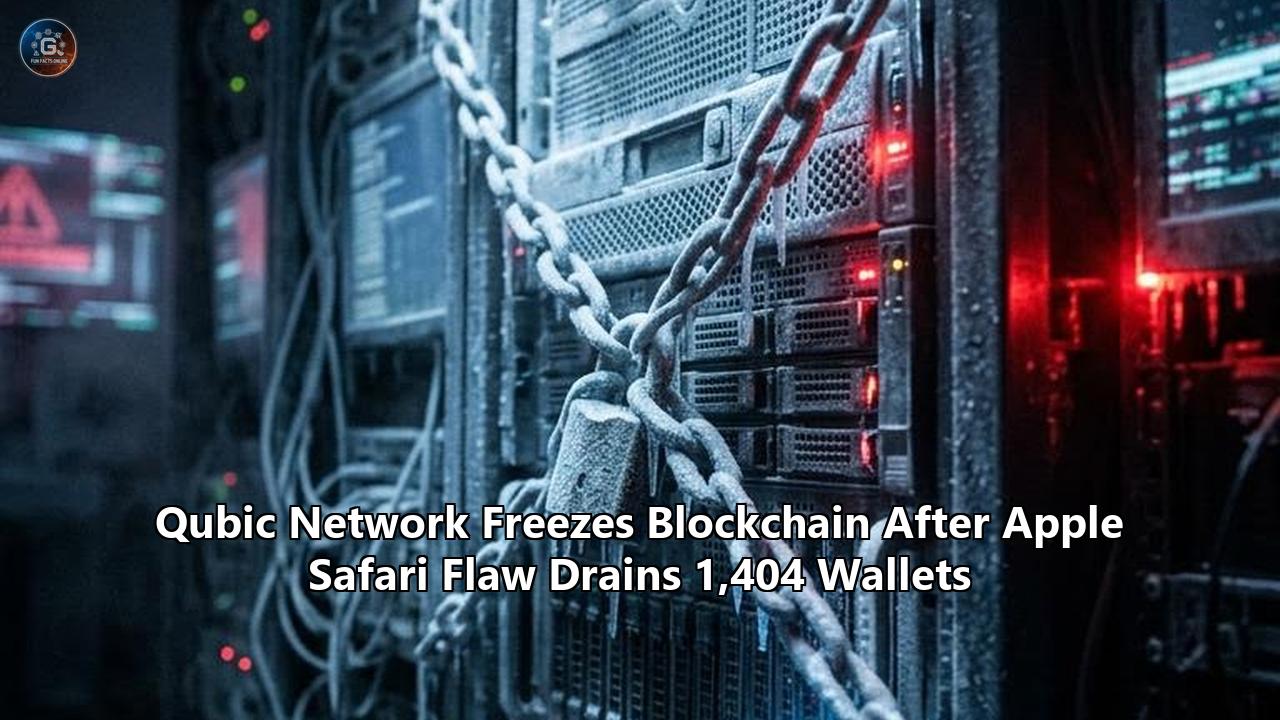
At 01:26 UTC on Sunday, October 18, 2026, the digital heartbeat of the Qubic blockchain flatlined.
Inside the decentralized layer-1 network, time is measured not in blocks, but in "ticks" — micro-intervals of state execution synchronized across a governing quorum of 676 bare-metal validator nodes known as Computors. When tick 85,371,949 was processed, the Computors took an unprecedented step: they halted consensus and froze the entire public ledger in its tracks.
The shutdown was not caused by a sudden hardware outage or an eclipse attack against node infrastructure. It was an emergency tourniquet.
Over the preceding 104 minutes, a silent, automated raid had swept through the network. Beginning at 23:42 UTC on Saturday night, an unknown entity began methodically draining one wallet after another. Private keys were not cracked by brute-forcing astronomical permutations; they appeared to be known in advance. By the time the Computors intervened, 1,404 individual user wallets had been emptied. The attacker siphoned approximately 2.94 trillion QU tokens — valued at roughly $1.4 million — across eight designated receiving addresses.
As blockchain telemetry went dark and crypto exchanges scrambled to lock their order books, early theories flooded community channels: Had the network’s custom Useful Proof of Work (UPoW) consensus collapsed? Had a zero-day exploit compromised the network’s bare-metal C++ smart contract engine?
The reality, uncovered over the ensuing hours of forensic code review, was both simpler and far more unsettling. The core blockchain protocol was entirely intact. Instead, the catastrophe stemmed from a single, unassuming line of JavaScript in client-side wallet software, compounded by a long-standing implementation quirk inside Apple’s Safari browser and the WebKit rendering engine.
What followed was a race against time across on-chain ledgers, centralized exchanges, and GitHub commits to understand how a flaw inside Apple devices left more than a thousand crypto accounts defenseless.
The 104-Minute Blitz
The attack unfolded with the mechanical precision of an automated script executing against an index.
On-chain transaction records show the first unauthorized transfer at 23:42 UTC on October 17. Unlike typical decentralized finance exploits, which target single liquidity pools or smart contract escrows with complex reentrancy calls or flash loans, this incident saw funds peeled away from separate, discrete user addresses one by one.
At an average velocity of 13.5 wallets drained every minute, the assailant moved through the ledger without encountering resistance. Each transaction carried a valid cryptographic signature, authenticated using Qubic’s native FourQ elliptic curve cryptography. To the validation nodes, every single transfer appeared completely legitimate, authorized by the true owner holding the corresponding private key.
"When you monitor network throughput and see hundreds of independent accounts broadcasting outbound sweeping transactions in rapid succession, you immediately know you are not looking at a protocol-level smart contract bug," explained Dr. Aris Thorne, an independent distributed-systems security researcher and former auditor for hardware wallet architectures. "A smart contract exploit hits a centralized liquidity hub. When individual, unlinked wallets are drained sequentially with perfect mathematical signatures, it means the keys themselves have been compromised at scale."
By 00:30 UTC, community members in European and Asian time zones began sounding alarms on the project’s Discord and Telegram channels. Balances had dropped to zero without user interaction. Wallets that had been dormant for months were suddenly broadcasting fund transfers.
As panicked messages multiplied, core developers and Computor operators organized an ad-hoc emergency war room. The network’s architectural design became its only immediate shield. Because Qubic does not operate on a traditional proof-of-stake or Nakamoto proof-of-work mechanism, consensus is governed by the 676 Computors — a fixed quorum requiring an active supermajority (451 nodes, or roughly two-thirds) to ratify state changes.
By 01:26 UTC, the attack reached account number 1,404. Minutes later, Computor operators achieved quorum to execute a coordinated network freeze at tick 85,371,949. The entire blockchain froze.
The freeze locked 87.1% of the stolen assets — approximately 2.56 trillion QU tokens — directly inside the attacker’s eight primary on-chain holding addresses. The assailant had been caught in the act, but the clock was already ticking on the remaining funds.
The Exchange Chokepoint: MEXC and Bitget
While 2.56 trillion QU sat paralyzed on the halted ledger, 12.9% of the plunder — exactly 379.04 billion QU — had already escaped before the chain was frozen.
Forensic tracing revealed that between 00:45 UTC and 01:20 UTC, the assailant routed these tokens toward a single deposit address at MEXC, a major centralized cryptocurrency exchange. The attacker's objective was standard for off-chain liquidations: swap the stolen QU for Bitcoin, Ethereum, or Tether (USDT), and bridge the capital into obfuscated privacy channels or multi-sig mixers before investigators could map the deposit hops.
"The 104-minute timeline tells us the attacker understood the risk of a quorum halt," said Elena Vance, head of threat intelligence at on-chain analytics firm CipherTraceDesk. "On an immutable, unpausable chain like Bitcoin or Ethereum, an attacker has all the time in the world to route tokens through decentralized exchanges. But on a network with a coordinated validator set, an attacker knows the window before an administrative intervention is razor-thin. They were racing the Computors."
Qubic core contributor Kimz, working with community security liaisons, established a direct emergency line to MEXC’s compliance and security desk. The notification package included raw cryptographic transfer proofs, source addresses, transaction hashes from the Qubic block explorer, and the recipient deposit ID.
At approximately 01:52 UTC — roughly 26 minutes after the network halted and less than an hour after the deposit arrived — MEXC security operators manually flagged and froze the target account. The 379.04 billion QU deposit was trapped inside the exchange’s custody architecture before it could be dumped onto the spot market or converted into stablecoins.
Shortly thereafter, Bitget, another primary exchange supporting QUBIC trading pairs, enacted precautionary measures, disabling all deposits and withdrawals to prevent secondary contamination or arbitrage attacks while the mainnet remained paused.
The immediate containment effort was a tactical success: 100% of the drained 2.94 trillion QU was effectively immobilized — 87.1% on-chain and 12.9% on a centralized exchange. Yet, the overarching mystery deepened. How had a single actor acquired the private keys to 1,404 discrete, non-custodial accounts simultaneously?
Anatomy of the Seed: How Qubic Keys Are Born
To decipher the mechanics of the breach, investigators had to dissect how identity and authentication function within Qubic’s cryptographic stack.
Unlike Bitcoin and Ethereum, which rely on the secp256k1 elliptic curve and standard 12- or 24-word BIP-39 mnemonic seed phrases derived from a dictionary of 2,048 English words, Qubic employs a different paradigm:
- Seed Structure: An account identity begins with a 55-character string composed entirely of lowercase Latin letters from a through z.
- Hashing Pipeline: This 55-character seed is ingested by the KangarooTwelve (K12) hashing algorithm — an optimized Keccak permutation — to compute a 256-bit private key.
- Public Key Derivation: From this private key, a corresponding public key is generated via scalar multiplication (ecc_mul_fixed) on the FourQ elliptic curve, a high-speed curve designed for Schnorr signatures.
- Checksum & Address: The final public address includes a K12-derived checksum appended to the public key representation, ensuring that typographical errors in addresses are caught before transmission.
Under theoretical mathematical conditions, a 55-character lowercase alphabet seed offers immense cryptographic strength. Because there are 26 possible letters for each position, the total keyspace is:
$$26^{55} \approx 6.67 \times 10^{77}$$
This translates to roughly 258 bits of entropy. For all practical purposes, guessing a single active seed from a properly generated uniform distribution would require more energy than exists in the observable universe. Even if an attacker deployed millions of high-performance GPUs, searching for an active seed among $6.67 \times 10^{77}$ combinations is computationally impossible.
Yet, an attacker had not just guessed one seed; they had identified 1,404 active seeds in a single evening.
"When an astronomically secure cryptographic keyspace is breached across thousands of accounts, the cryptography itself is rarely broken," noted Thorne. "Instead, the process used to pick the random numbers has collapsed. The lock was indestructible, but the factory making the keys was cutting the exact same pattern over and over again."
Forensic investigators began looking not at the FourQ curve or KangarooTwelve, but at the software tools users utilized to generate those 55 lowercase letters.
The Forensic Trail: The Apple Ecosystem Anomaly
As the core team gathered data from victim submissions, an unmistakable demographic and technical signature emerged.
Qubic’s community board opened an intake portal for compromised users, requesting browser metadata, device operating systems, wallet creation dates, and account addresses. Within hours, cross-referencing the intake logs revealed a striking correlation:
- Hardware & OS Signature: Virtually every victim had generated their wallet seed on an Apple device — an iPhone, an iPad, or a Mac.
- Browser Constraints: On macOS, victims had created their seeds using Apple’s default Safari browser.
- Mobile Constraints: On iOS and iPadOS, the vulnerability was universal across all third-party browsers — Chrome, Firefox, Brave, and Safari alike.
- Legacy App Impact: Users who generated their accounts through early builds of the official Qubic iOS native application prior to July 2025 were also compromised.
- The Control Group: Users who generated seeds on Windows machines via Chrome or Firefox, on Linux distributions, on Android devices, or through offline command-line scripts were unaffected.
This pattern pointed to a systemic software flaw tied directly to Apple's operating environment and rendering engine.
Under Apple’s App Store Review Guidelines, every browser running on iOS and iPadOS — regardless of whether it carries the Google Chrome or Mozilla Firefox branding — is legally and technically mandated to use Apple’s proprietary WebKit engine as its underlying rendering and JavaScript execution core. Chrome on iOS does not use Google’s V8 engine; Firefox on iOS does not use Mozilla’s SpiderMonkey. They are all, beneath the cosmetic wrapper, WebKit.
The investigation had moved from the decentralized blockchain ledger into the mechanics of WebKit's JavaScript execution engine, JavaScriptCore.
The Code Autopsy: Math.random() vs. crypto.getRandomValues()
The smoking gun was located inside the source repository of the official Qubic Web Wallet.
Following the containment of the funds, the Qubic development team pushed an emergency patch to GitHub under client version 4.26.4. A line-by-line inspection of the diff between version 4.26.3 and version 4.26.4 revealed the underlying cause of the vulnerability.
The seed generation routine in version 4.26.3 was built using standard JavaScript array constructors. To populate each of the 55 positions with a character between a and z, the routine relied on a native browser function:
// Vulnerable implementation (conceptual representation from v4.26.3)
function generateSeed() {
    const chars = 'abcdefghijklmnopqrstuvwxyz';
    let seed = '';
    for (let i = 0; i < 55; i++) {
        seed += chars.charAt(Math.floor(Math.random() * chars.length));
    }
    return seed;
}
To any non-cryptographic web developer, this loop looks standard. It runs fast, executes universally across modern web browsers, and outputs what appears to the naked eye to be a thoroughly disordered string of 55 letters.
However, in computer science and secure systems design, Math.random() carries a strict, explicit warning. The Mozilla Developer Network (MDN) documentation states the rule in plain terms:
Warning: Math.random() does not provide cryptographically secure random numbers. Do not use them for anything related to security. Use the Web Crypto API instead, and more specifically the window.crypto.getRandomValues() method.
In version 4.26.4, Qubic’s engineering team excised Math.random() entirely and rewritten the generation module using the Web Crypto API:
// Patched implementation (client v4.26.4)
function generateSecureSeed() {
    const chars = 'abcdefghijklmnopqrstuvwxyz';
    const randomBytes = new Uint8Array(55);
    window.crypto.getRandomValues(randomBytes);
    let seed = '';
    for (let i = 0; i < 55; i++) {
        seed += chars[randomBytes[i] % chars.length];
    }
    return seed;
}
The difference between these two APIs explains why the network froze.
Pseudo-Random vs. Cryptographically Secure Pseudo-Random
To understand why Math.random() failed, one must look at how browsers manufacture unpredictability.
Computers are deterministic calculation machines. A computer cannot generate true randomness out of thin air; it must run mathematical algorithms that simulate randomness. These algorithms are known as Pseudo-Random Number Generators (PRNGs).
A standard PRNG, like the ones used by Math.random(), is engineered for speed, low memory usage, and statistical distribution. It is built for rendering particle effects in browser games, animating user interfaces, or running Monte Carlo simulations where performance is critical and predictability poses no existential threat.
Inside Google Chrome's V8 engine, Firefox's SpiderMonkey, and Apple's JavaScriptCore (Safari), Math.random() is powered by non-cryptographic algorithms, most commonly variants of xorshift128+.
Xorshift128+ maintains an internal state of only two 64-bit unsigned integers: 128 bits in total. Each time Math.random() is called, the algorithm performs a sequence of bitwise shifts and XOR operations to advance its internal state and output a 64-bit floating-point number between 0 and 1.
The mathematical flaw of xorshift128+ in a security context is well-documented: it is completely linear with respect to bitwise XOR operations.
If an observer can see just two to three successive outputs of Math.random(), they do not have to guess what numbers will come next. Using basic linear algebra — specifically Gaussian elimination over the Galois field GF(2) — an attacker can reconstruct the internal 128-bit state of the generator. Once the internal state is recovered, the attacker can run the generator forward and backward, predicting every value the browser has ever generated or will ever generate during that session.
In contrast, a Cryptographically Secure Pseudo-Random Number Generator (CSPRNG), such as the one queried by crypto.getRandomValues(), is fundamentally different.
A CSPRNG interfaces directly with the host operating system's kernel entropy pool. On macOS and iOS, this calls into SecRandomCopyBytes or the kernel’s /dev/urandom equivalent, which draws on unpredictable physical hardware noise: thermal fluctuations in the processor, minuscule timing variations between keyboard strokes, interrupt requests from network controllers, and mouse jitter.
Furthermore, CSPRNGs utilize cryptographically one-way stream ciphers (such as ChaCha20 or AES-CTR). Even if an adversary observes millions of random outputs, reversing the cipher to calculate the internal state requires breaking modern public-key encryption.
By deploying Math.random(), Qubic’s web wallet discarded the operating system's cryptographic hardware protections and entrusted user funds to a fast, insecure arithmetic toy.
Why Apple? The WebKit PRNG State Trap
The revelation that Math.random() was used answered half the question. But it raised an even deeper mystery: If Math.random() is inherently non-cryptographic across all browsers, why were Chrome on Windows, Firefox on Linux, and Android users completely spared? Why did the drain exclusively claim Apple users?
The answer lies in how different browser runtimes initialize their PRNG state when a new tab or session is launched.
+-------------------------------------------------------------------------------+
|                        PRNG Seeding Architecture Comparison                    |
+-------------------------------------------------------------------------------+
|  Engine: Google V8 (Chrome / Android / Windows)                               |
|  [OS Entropy Source] ---> [MurmurHash3 Diffusion] ---> [xorshift128+ State]   |
|  * Each Realm/Tab pulls independent, high-entropy seed upon initialization.   |
|  * Result: Attacker cannot precompute global lookup table across different     |
|    machines without observing specific tab outputs.                           |
+-------------------------------------------------------------------------------+
|  Engine: Apple JavaScriptCore / WebKit (Safari / all iOS Browsers)            |
|  [Weak/Correlated Seed] ---> [WeakRandom Class] ---> [Linear Output Pipeline]  |
|  * Flaw: Seed initialization relies on low-entropy parameters (e.g. system    |
|    uptime, microsecond epoch timestamp, process PID, or unmixed thread state).|
|  * Result: Keyspace collapses from 26^55 to a narrow, brute-forceable subset  |
|    that an attacker can scan on external hardware.                            |
+-------------------------------------------------------------------------------+
In Google Chrome’s V8 engine, whenever a new execution realm (such as a website or tab) is instantiated, the engine requests a 64-bit seed from the host operating system’s cryptographic entropy provider. It then applies MurmurHash3 to diffuse the bits across the state variables before executing its first calculation.
Because Chrome pulls high-entropy initialization vectors from the OS, two different users on two different Windows machines will have wildly different, non-overlapping initial states. An attacker cannot precompute what seeds a Chrome user will generate without actively observing other Math.random() calls coming out of that specific tab session.
Apple’s JavaScriptCore (WebKit), however, has a storied, fraught history regarding PRNG entropy and initialization.
Inside JavaScriptCore, Math.random() is managed by an internal class named WeakRandom. Over successive iterations of iOS and macOS, security researchers have repeatedly exposed flaws in how WeakRandom establishes its initial seed.
In several legacy versions of WebKit, the seed was initialized using low-entropy operating system variables: the system boot time, high-resolution timestamps (mach_absolute_time()), process identifiers (PIDs), or thread execution pointers. In earlier iOS builds, multiple WebKit instances shared global seed states across web views and Safari sessions.
"When a PRNG is seeded with a timestamp or a predictable system counter, your keyspace collapses," explains Marcus Sterling, a cryptography engineer specializing in hardware security modules. "If an attacker knows the date an application was launched, or if the initialization seeds are constrained to a predictable window of microsecond timestamps, the effective search space isn't $26^{55}$. It drops down to $2^{32}$, $2^{24}$, or even less. At $2^{32}$ combinations, a standard consumer graphics card can iterate through every single possible outcome in several minutes."
This dynamic explains the pattern behind the theft. The attacker was not sitting in users' browsers watching them generate seeds in real time. Instead, the attacker discovered that on Apple’s WebKit, the sequence of numbers produced by Math.random() when visiting the Qubic Web Wallet fell into a narrow, predictable distribution.
The attacker reconstructed the WebKit seed generator, wrote a script simulating the exact algorithm, and ran it across the narrow range of possible initialization states corresponding to recent months.
For each calculated PRNG sequence, the script ran the 55-character string through KangarooTwelve, derived the FourQ public key, computed the public address, and checked it against Qubic's public ledger to see if it held a non-zero balance.
The attacker compiled a hit list of 1,404 funded addresses whose private keys they had reconstructed from mathematical models. Once the list was verified, they deployed an automated sweeping script to siphon the wallets dry.
The Breadth of the Breach
The Qubic core development team confirmed this reality in an official status disclosure published shortly after the halt:
- iPhone and iPad: Every seed generated in any browser prior to October 18, 2026, was deemed permanently insecure.
- Macintosh: Every seed generated in Safari prior to October 18, 2026, was compromised.
- Native iOS Mobile App: Every seed generated inside the official Qubic iOS application built prior to July 2025 was compromised.
The core team's technical post on Discord and X brought the operational reality to light:
"The issue was in seed generation, not in the Qubic protocol itself. Seeds created on these combinations are affected: iPhone / iPad, any browser before 2026-10-18; MacBook / iMac with Safari before 2026-10-18; Qubic iOS app before July 2025. Seed generation is fixed in version 4.26.4."
Core developer dkat issued an advisory warning the community that the 1,404 drained accounts were not the only casualties:
"Besides the 1,405 hacked IDs, a few hundred other weak IDs could be exploited the same way. Their list will be visible in the code within 1–2 days and blocked by the Computors, as planned."
The scale was sobering:
| Metric | Recorded Value |
|---|---|
| Wallets Drained | 1,404 accounts |
| Total Stolen Value | 2.94 trillion QU (~$1.3M – $1.4M) |
| Drain Velocity | ~13.5 wallets / minute |
| Attack Duration | 104 minutes (23:42 to 01:26 UTC) |
| Funds Immobilized On-Chain | 2.56 trillion QU (87.1%) |
| Funds Frozen at MEXC | 379.04 billion QU (12.9%) |
| Consensus Halt Tick | 85,371,949 |
| Vulnerable Software | Web Wallet v4.26.3 and earlier; iOS App (< July 2025) |
| Remediation Patch | Client v4.26.4 (crypto.getRandomValues) |
Beyond the Qubic Network Hack: The Industry's Cryptographic Blind Spot
The breach sent shockwaves through the broader blockchain community, not because of its total dollar volume — crypto has weathered multi-hundred-million-dollar protocol exploits — but because of its nature. The incident added another chapter to a persistent history of software entropy failures.
Crypto developers often spend millions of dollars auditing Solidity code, verifying formal mathematical specifications of consensus state machines, and testing zero-knowledge circuits. Yet the single point of failure that gives life to every crypto wallet — the random number generator used at the point of creation — frequently slips through reviews without rigorous cryptographic inspection.
The incident drew immediate technical parallels across the cybersecurity landscape:
1. The Libbitcoin Explorer "Milk Sad" Vulnerability (CVE-2023-39910)
In August 2023, cybersecurity researchers discovered that Libbitcoin Explorer (bx) — a popular command-line tool used to create Bitcoin, Ethereum, and Zcash wallets — utilized the standard Mersenne Twister PRNG (std::mt19937) to generate wallet seeds. Like xorshift128+, the Mersenne Twister is a non-cryptographic PRNG. It was seeded with nothing more than the 32-bit system time (time(NULL)).
Attackers mapped the 32-bit timestamp space across several years and methodically emptied thousands of Bitcoin wallets, looting millions of dollars in what became known as the "Milk Sad" disaster.
2. The Trust Wallet Browser Extension Flaw (CVE-2023-31291)
In late 2022, Binance-backed Trust Wallet introduced a vulnerability into its open-source browser extension. The wallet relied on the randombytes npm package, which, under specific build configurations and bundled environments, fell back to an insecure, predictable pseudorandom number generator.
The resulting keyspace was reduced to a fraction of its intended entropy, enabling an attacker to drain hundreds of thousands of dollars before a patched version was shipped.
3. The Coldcard Hardware Wallet Bug (July 2026)
In July 2026, leading hardware wallet manufacturer Coinkite disclosed a firmware vulnerability affecting select Coldcard devices. A bug in the internal entropy mixing pipeline degraded the unpredictability of generated recovery phrases, allowing threat actors who understood the flaw to narrow the recovery parameters and steal funds.
"The Qubic incident is not an isolated edge case; it is part of an ongoing lineage of entropy failures," said Thorne. "Developers consistently treat randomness as an abstract utility function rather than a cryptographic primitive. The moment a software engineer calls Math.random() to generate an asymmetric private key, the security model is dead on arrival. It doesn't matter if your elliptic curve has 256 bits of theoretical security. If the front door was selected from a list of ten thousand options, an attacker is going to walk right through."
The Governance Dilemma: 676 Computors and the Immutability Debate
While the patch in client version 4.26.4 permanently resolved the seed generation flaw for future wallets, it did nothing to resolve the immediate crisis: What happens to the frozen 2.94 trillion QU?
The decisive response that saved the network from catastrophic financial bleeding simultaneously pushed Qubic into the center of the cryptocurrency space’s oldest, most contentious philosophical debate: immutability versus intervention.
For ideological purists, the foundational premise of public blockchain technology is that code is law. Transactions, once signed by valid private keys and ratified by consensus, must remain irreversible. Pausing a blockchain to prevent an exploit — or worse, rolling back state to reallocate tokens — violates the principle of censorship resistance. It evokes memories of Ethereum’s contentious 2016 hard fork following The DAO hack, which split the community into Ethereum (ETH) and Ethereum Classic (ETC).
Yet, Qubic’s architectural identity was never framed as an unalterable, hands-off ledger.
Created under the vision of Sergey Ivancheglo (widely known in the cryptocurrency space as "Come-from-Beyond," the co-founder of IOTA and NXT), Qubic was engineered from inception around a dynamic, centralized-yet-distributed governing council. The 676 Computors are not anonymous mining pools; they are identifiable network operators selected based on performance metrics, whose primary mandate is running Useful Proof of Work computations to train artificial intelligence models (such as Aigarth) while securing the Spectrum ledger.
Under Qubic’s governance model, consensus decisions do not require hard-forking client software among millions of retail nodes. Instead, proposals are submitted directly to the Computor Quorum. If 451 out of the 676 Computors vote to pass a state transition, the change becomes authoritative.
Following the mainnet freeze, the core team moved quickly to formalize a democratic remediation pathway. Core developer Joetom announced the immediate roadmap:
- Victim Identification: Core developers analyzed on-chain transaction histories to map out every single transfer originating from the 1,404 drained accounts during the 104-minute attack window.
- Quorum Poll: A community sentiment poll was established on Discord to guide the Computors’ vote.
- State Reassignment or Burn-and-Reissue: The Computors are considering two primary technical remedies:
State Override: Voting to execute a network-level state transition at tick 85,371,950 that invalidates the attacker’s unauthorized transfers and restores original balances to the verified victim addresses.
Token Burn & Re-Minting: Permanently burning the 2.56 trillion QU frozen inside the attacker’s eight addresses and minting an equivalent supply directly into newly generated, cryptographically secure replacement addresses for the affected victims.
For the 12.9% of funds held at MEXC, the path is more bureaucratic. Because centralized exchanges operate under global anti-money laundering (AML) and counter-terrorist financing (CTF) frameworks, MEXC cannot simply wire 379 billion QU back to a project team based on a Discord poll.
Qubic’s leadership advised all affected users to file formal incident reports with domestic cybercrime and law enforcement agencies, such as the FBI’s Internet Crime Complaint Center (IC3) or Europol. Formal police case numbers provide the legal standing required for MEXC’s compliance team to hold the funds indefinitely and eventually release them via court-sanctioned restitution procedures.
"This situation highlights the distinct trade-offs of modern alternative Layer-1 networks," Vance remarked. "On Bitcoin, those 1,404 users would have lost their life savings permanently, with zero recourse. On Qubic, because the Computors exercised administrative authority and froze the chain within two hours, more than 87% of the stolen capital was saved.
"Is it decentralized in the absolute purist sense? No. But for the 1,404 people who were about to lose $1.4 million, that lack of ideological rigidity is the only reason their money still exists."
Technical Fallout and Network Hardening
As the community waited for the formal Computor vote, the incident left substantial scars on Qubic’s ecosystem metrics.
Prior to the attack, the network was riding a wave of technical momentum throughout 2026. In April, Qubic had rolled out a dual-mining architecture integrating Dogecoin ASIC hashpower directly into its Oracle Machine infrastructure, running Dogecoin mining in parallel with AI neural network simulations. The project was preparing academic submissions for international artificial life conferences and finalizing smart contract bridges to Solana.
The security breach brought those operations to an abrupt halt.
Immediately following news of the exploit and the chain suspension, Qubic’s native QU token slid more than 10% on open secondary markets, settling at an overall market capitalization of roughly $62.6 million.
Furthermore, this was not the first peripheral security tremor the ecosystem had suffered in 2026. In August, the project’s cross-chain Vottun Bridge was exploited, raising questions regarding the auditing and testing standards applied to peripheral middleware connected to the core ledger.
The discovery that the official Web Wallet had been running with an unvetted Math.random() function for months — or in the case of the legacy iOS app, since before July 2025 — sparked internal reckoning regarding quality assurance.
In response, community contributors and core tech leads outlined a sweeping overhaul of Qubic's front-end client infrastructure:
- Mandatory Client Audits: All official software interfaces — including web portals, browser extensions, and mobile applications — will be subjected to external third-party security audits prior to release, bringing client-side code to the same rigorous standards applied to bare-metal smart contracts.
- Deprecation of Insecure Endpoints: Core nodes will implement filters to reject signatures originating from known weak-entropy address spaces, preventing any lingering "weak seeds" identified during the technical autopsy from being siphoned in the future.
- Hardware Wallet Acceleration: The project is accelerating integrations with hardware wallet providers. By offloading private key generation to dedicated cryptographic chips (Secure Elements), the network aims to remove browser runtimes and operating system quirks entirely from key generation.
- Comprehensive Technical Post-Mortem: The core engineering group pledged to publish an exhaustive architectural post-mortem detailing the exact mathematical boundaries of the WebKit PRNG degradation once the victim compensation framework is executed.
What Happens Next: The Road to Mainnet Restart
At the time of writing, the Qubic mainnet remains frozen at tick 85,371,949.
The immediate next milestone is the formal Computor quorum vote. The 676 operators must reach the 451-vote supermajority threshold to ratify the recovery package. Once the governance motion passes, developers will merge the restitution state transition into core node clients, allowing validators to boot their nodes, synchronize state, and resume transaction processing.
For the broader crypto industry, the incident stands as an urgent wake-up call.
The security of a blockchain network does not begin at the consensus layer, nor does it end with formal verification of on-chain smart contracts. A system's attack surface spans the full technology stack — from cryptographic curves and bare-metal nodes down to the obscure, 15-year-old PRNG algorithms executing inside a mobile phone's web browser.
As the aftermath of the event plays out across validator nodes, Discord debate threads, and exchange compliance desks, the lesson remains clear: when engineering systems meant to custody digital wealth, there is no shortcut for genuine cryptographic entropy. A single line of non-secure code, executed inside an unsuspecting browser, can undo the strongest cryptographic fortress on earth.
Reference:
- https://cryptobriefing.com/qubic-halts-mainnet-wallet-drain/
- https://blockandcapital.com/en/qubic-dlt-and-ai/
- https://tradersunion.com/news/cryptocurrency-news/show/3867086-qubic-blockchain-freeze-wallet-seed-breach/
- https://qubicmap.org/check
- https://easternherald.com/2026/10/18/qubic-network-halt-weak-wallet-seeds/
- https://news.bitcoin.com/security/qubic-loses-1-3-million-in-wallet-raid-before-network-halts/
- https://www.tradingview.com/news/cointelegraph:0ba7947ef094b:0-qubic-freezes-chain-after-attacker-drains-1-4k-wallets-with-weak-seeds/
- https://qubic.org/faq
- https://thedefiant.io/news/hacks/qubic-halts-network-after-1-3-million-wallet-drain
- https://easternherald.com/2026/10/18/qubic-network-halt-weak-wallet-seeds/
- https://qrindex.org/projects/qubic/
- https://qubic.org/blog-detail/how-to-query-qubic-oracle-machines-using-the-qubic.net-toolkit
- https://itnext.io/can-math-random-be-random-in-a-deterministic-machine-c6e39518e7fc
- https://thedefiant.io/news/hacks/qubic-halts-network-after-1-3-million-wallet-drain
- https://johnkavanagh.co.uk/articles/javascripts-math-random/
- https://security.stackexchange.com/questions/84906/predicting-math-random-numbers
- http://www.securitygalore.com/files/Temporary_User_Tracking_in_Safari_for_Windows.pdf
- https://qubic.org/blog-detail/qubic-all-hands-recap-april-2-2026
- https://qubic.org/blog-detail/qubic-governance-framework-2026-all-hands-recap
- https://www.tradingview.com/news/cointelegraph:0ba7947ef094b:0-qubic-freezes-chain-after-attacker-drains-1-4k-wallets-with-weak-seeds/
- https://cryptobriefing.com/qubic-halts-mainnet-wallet-drain/
- https://www.exploit-db.com/exploits/35006