The modern corporate calendar has become a battlefield of self-inflicted wounds. Mid-2026 has brought a quiet crisis to the global knowledge economy: "The Age of Cognitive Overload." Despite the widespread adoption of artificial intelligence tools that promised to liberate human workers from administrative drudgery, the average executive, engineer, and creative is more overwhelmed than ever. Research reveals that knowledge workers are context-switching between different software applications upwards of 1,200 times a day while absorbing a barrage of 300 to 500 micro-notifications before their lunch break.
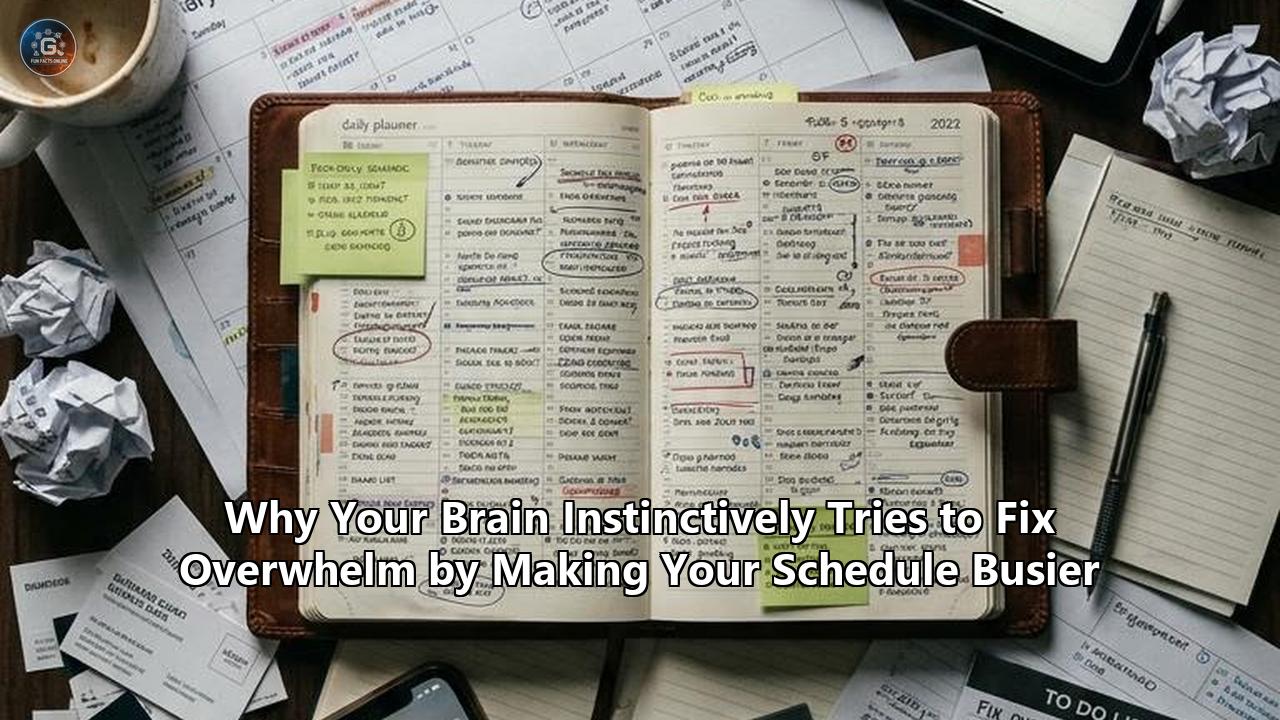
Yet, when analyzing how individuals react to this paralyzing volume of inputs, behavioral psychologists have observed a baffling behavioral loop. Instead of cancelling non-essential meetings, ruthlessly pruning their task lists, or taking prolonged offline breaks, overwhelmed professionals are doing the exact opposite. They are micro-managing their remaining free hours, booking pre-emptive "alignment syncs," downloading new productivity planners, and packing their schedules to the absolute margin.
This is not a failure of time-management discipline; it is a hardwired evolutionary survival mechanism. Under intense psychological pressure, the human brain instinctively tries to solve internal chaos by exerting control over the external environment. When cognitive overload threatens our sense of competence, our neural architecture commands us to take action—any action—even if that action involves adding more weight to an already collapsing structure.
To understand why this counterproductive loop occurs, we must trace how cognitive science, behavioral economics, and the structure of the modern workplace have combined to create a perfect psychological trap. The story of how we arrived at this breaking point spans millions of years of evolutionary history, decades of economic research, and a modern technological environment designed to exploit our deepest cognitive vulnerabilities.
The Evolutionary Blueprint: Why Stillness Equated to Death
To understand why a modern professional responds to a mountain of unread Slack messages by booking three more meetings, we must first look at the ancestral environment that shaped our neural architecture. For 99% of human history, physical stillness and cognitive passivity were not luxury states of relaxation; they were indicators of extreme vulnerability.
In the late Pleistocene epoch, a hominid who chose to sit quietly in the open without a clear task was a hominid exposed to predation, resource scarcity, and social exclusion. The human nervous system evolved to prioritize active engagement with the environment as its default defense mechanism. Survival required constant vigilance and physical agency. When faced with environmental threats—whether a shifting climate, a rival tribe, or a depleted hunting ground—the sympathetic nervous system initiated the "fight-or-flight" response.
This physiological cascade, managed by the amygdala and executed via the release of cortisol and adrenaline, was designed to prepare the body for immediate, high-energy physical exertion. In ancestral times, the threat was tangible, and the resolution was physical: you either fought the threat or ran away from it.
In the twenty-first century, the threat landscape has changed, but the neural hardware remains identical. The modern threat is abstract: an ambiguous email from a superior, an upcoming performance review, or a creeping sense that one is falling behind in an AI-accelerated market. These abstract threats trigger the exact same sympathetic nervous system response that a physical predator once did.
Because we cannot physically fight a digital spreadsheet or run away from a Zoom link, the nervous system has to redirect this frantic energy somewhere. The "flight" response of the modern knowledge worker is not a physical sprint; it is a sprint into their own to-do list. The urge to stay constantly in motion, to fill every empty block of time with administrative tasks, is the modern survival brain trying to run away from the intangible threat of failure.
Under modern conditions, this biological imperative creates a deep-seated discomfort with empty space. The search for why we stay busy often begins in this evolutionary wiring: our bodies interpret empty time as a period of unprotected exposure, urging us to build an armor of scheduled tasks to feel safe.
The Psychological Discovery: Norms, Regret, and the Action Bias (1979–2007)
========================================================================================
                               TIMELINE OF COGNITIVE BIAS DISCOVERIES
========================================================================================

    1979: PROSPECT THEORY & LOSS AVERSION
    (Daniel Kahneman & Amos Tversky)
    * Establishes that the pain of loss is twice as powerful as the pleasure of gain.
    * Sets the stage for understanding how we over-correct to avoid failure.
          │
          ▼
    1986: NORM THEORY
    (Daniel Kahneman & Dale Miller)
    * Proves that the emotional cost of an bad outcome is amplified when we deviate
      from the social norm.
          │
          ▼
    2007: THE GOALKEEPER STUDY & THE "ACTION BIAS"
    (Michael Bar-Eli et al.)
    * Analyzes 286 soccer penalty kicks.
    * Reveals that goalkeepers dive 98% of the time, even though staying in the
      center yields a 33.3% save rate (vs 12.6% when jumping).
    * Demonstrates that doing *something* shields us from regret, even if it is counterproductive.
========================================================================================
The academic foundation for understanding this behavior was laid in 1979 when psychologists Daniel Kahneman and Amos Tversky published their seminal paper on Prospect Theory. Their work on loss aversion proved that the pain of losing is psychologically twice as powerful as the pleasure of gaining. This fundamental asymmetry in human decision-making means that when we feel our status, job security, or competence is threatened, we will go to extreme lengths to avoid that perceived loss.
Building on Prospect Theory, Kahneman and psychologist Dale Miller introduced Norm Theory in 1986. They demonstrated that people experience far greater regret and self-blame when a negative outcome occurs as a result of abnormal behavior or inaction, compared to when it occurs as a result of standard, active behavior.
This psychological asymmetry was brought into sharp focus in 2007, in a study published in the Journal of Economic Psychology by researcher Michael Bar-Eli and his colleagues. The team analyzed 286 penalty kicks in elite professional soccer matches worldwide to study the decision-making patterns of goalkeepers.
The physics of a penalty kick are brutal. The ball travels from the penalty spot to the goal line in approximately 500 milliseconds—faster than the human motor system can react after observing the ball's trajectory. Consequently, a goalkeeper must decide which way to jump before they can clearly see where the ball is going.
Bar-Eli’s data revealed a striking statistical anomaly:
- Jumping Left: Goalkeepers saved the ball only 14.2% of the time.
- Jumping Right: Goalkeepers saved the ball only 12.6% of the time.
- Staying in the Center: Goalkeepers saved the ball 33.3% of the time.
Despite the clear statistical advantage of remaining completely still in the center of the goal, goalkeepers chose to stay in the center only 2% of the time. In 98% of the cases, they chose to dive frantically to the left or the right.
When Bar-Eli surveyed top professional goalkeepers to ask why they chose to jump when staying still was twice as effective, the athletes revealed the core emotional driver: regret mitigation. If a goalkeeper stands completely still in the middle of the goal and the ball sail past them on either side, they look foolish, passive, and irresponsible. They are blamed by the fans, the media, and themselves for "doing nothing." However, if they dive spectacularly to the left or right and still concede the goal, it is viewed as a noble, heroic attempt. They did everything they could.
Bar-Eli termed this phenomenon action bias: the systemic, irrational preference for taking action over inaction, even when inaction is the objectively superior strategy. The action bias is triggered primarily under conditions of high stakes, high uncertainty, and severe time pressure.
For the modern professional experiencing work-related panic, the corporate calendar is their goal line. When projects are falling behind and organizational uncertainty rises, standing still—taking a day to think quietly, canceling non-essential syncs, or simply doing nothing to allow for cognitive recovery—feels exactly like standing still in the center of the goal. The emotional and social cost of failing while doing nothing is perceived as unbearably high. By filling their calendar with frantic, visible, and easily-tracked actions, the employee is "diving." Even if those meetings and extra tasks fail to solve the underlying crisis, the individual is shielded by the societal norm of effort: at least they can point to their packed calendar and say, "Look how hard I am trying."
The Birth of "Idleness Aversion" (2010)
Three years after Bar-Eli’s goalkeeper study, a team of researchers led by Christopher K. Hsee at the University of Chicago Booth School of Business wanted to investigate whether this urge to stay active went deeper than merely avoiding social blame. They wanted to know if the human mind has a fundamental, intrinsic dread of quiet, empty time.
In a landmark 2010 study published in Psychological Science, titled "Idleness Aversion and the Need for Justifiable Busyness," Hsee and his colleagues designed an elegant, two-part experiment.
========================================================================================
                         THE CHICAGO BOOTH IDLENESS AVERSION EXPERIMENT
========================================================================================

    [Participant enters room] ───► [Completes Survey 1] ───► [Given 15-Minute Wait Period]
                                                                        │
                                      ┌─────────────────────────────────┴─────────────────────────────────┐
                             [SCENARIO A: No Justification]                                     [SCENARIO B: Specious Justification]
                             * Deliver survey to close-by room                                  * Deliver survey to close-by room
                               (yields same candy as far-away room).                              (yields Milk Chocolate).
                             * Deliver survey to far-away room                                  * Deliver survey to far-away room
                               (yields same candy as close-by room).                              (yields Dark Chocolate).
                                      │                                                                   │
                                      ▼                                                                   ▼
                             * 68% choose to deliver close-by.                                  * 59% choose to walk to far-away room.
                             * Result: Restless waiting for 15 mins.                            * Result: Eagerly walk 15 mins to get candy.
                                                                        │
                                                                        ▼
                                                       [POST-EXPERIMENT EVALUATION]
                                                       * Participants who walked the
                                                         long distance reported
                                                         significantly higher happiness
                                                         scores than those who sat idle.
========================================================================================
In the study, participants completed an initial survey and were told they had to wait 15 minutes before the next part of the experiment could begin. They were given a choice of where to drop off their completed survey:
- The Close-by Location: A drop-off box located right outside the room, which required no walking.
- The Far-away Location: A drop-off box that required a 15-minute round-trip walk.
The researchers tested two distinct scenarios:
Scenario A: No Justification
Participants were told that regardless of which drop-off location they chose, they would receive the exact same type of candy as a reward. Under these conditions, the vast majority of participants (68%) chose the close-by location. They did not want to expend unnecessary physical energy for no reason. However, they were then forced to spend the remaining 15 minutes sitting idle in the waiting room.
Scenario B: Specious Justification
In this group, participants were told that if they dropped the survey at the close-by location, they would receive a milk chocolate bar. If they walked the 15-minute round-trip to the far-away location, they would receive a dark chocolate bar (or vice versa). The candies were of equal value, and most participants did not have a strong preference between the two. However, the slight difference in the reward provided a "specious justification"—a plausible excuse to be busy. Under these conditions, the choice flipped: 59% of the participants chose to walk to the far-away location.
The most profound finding of the study came from the post-experiment happiness evaluations. Hsee and his team discovered that the participants who walked the 15-minute round-trip to the far-away location reported being significantly happier and less anxious than those who chose the close-by location and sat idle. Strikingly, this effect held true even in a control group where participants were forced to take the long walk.
Hsee’s findings provided the first empirical proof of why we stay busy: our brains find empty, unstructured time deeply uncomfortable. Without an active task, the mind drifts inward, often settling on unresolved worries, existential anxieties, and uncomfortable emotions.
To avoid this internal friction, the brain searches for any justification to occupy itself. It will latch onto the first available task—even a minor, low-priority, or "specious" one—and elevate its importance to justify the expenditure of energy. In a modern workplace, this means we will invent meetings, over-complicate processes, and seek out administrative chores, convincing ourselves that these tasks are vital to our role when, in reality, they are merely psychological shields against the discomfort of an empty hour.
The Productivity Industrial Complex and Completion Bias (2010s–2020)
As the global corporate culture shifted from industrial output to digital knowledge work, this evolutionary bug was systematically reinforced by corporate software and organizational structures. The decade leading up to 2020 saw the rise of what social critics and psychologists call the "Productivity Industrial Complex"—an ecosystem of tools, methodologies, and cultural norms that codified the action bias and idleness aversion into everyday workflows.
With the introduction of persistent digital workspaces, the physical boundaries of the office dissolved. In their place came an unprecedented visibility of effort. On digital platforms, an employee's value is often judged not by their long-term strategic breakthroughs—which are difficult to measure in real-time—but by their visible digital footprint: their green "active" status indicator, their rapid response times, and the density of their shared calendar.
This environment created a highly reactive psychological state known as completion bias. Completion bias is the neurological tendency of the brain to experience a hit of dopamine upon the successful completion of a task, regardless of that task's actual importance.
When a professional is confronted with a massive, ambiguous, and high-stakes project (such as restructuring a department or writing a complex piece of code), their prefrontal cortex experiences this task as an overwhelming threat. The project is too large to complete in a single sitting, and the path to completion is unclear. To escape the anxiety of this cognitive roadblock, the brain instinctively searches for small, easily solvable problems to restore a sense of control and trigger a dopamine release.
========================================================================================
                              THE TO-DO LIST DOPAMINE LOOP
========================================================================================

    [1. AMBIGUOUS HIGH-STAKES TASK] ───► [Triggers Amygdala / Threat Response] ───► [Anxiety Rises]
                   ▲                                                                     │
                   │                                                                     ▼
         [5. Exhaustion / Burnout]                                            [2. Search for Control]
                   ▲                                                                     │
                   │                                                                     ▼
         [4. Dopamine Hit / Relief] ◄─── [3. Minor Task Completed] ◄─── [Calendar filled with minor tasks]
                                         (Emails, quick syncs,
                                          formatting slides)
========================================================================================
This is the psychological mechanism behind the busy-work spiral:
- A worker feels overwhelmed by a major, high-stress project.
- Rather than resting or working slowly through the complexity, the anxiety drives them to seek immediate relief.
- They open their inbox or calendar and schedule three quick "check-in" meetings, reply to 20 low-priority emails, and spend an hour color-coding their weekly schedule.
- Each of these minor actions is checked off their list, yielding a temporary dopamine-driven sense of progress and safety.
- The underlying high-stakes project remains untouched, but the worker’s calendar is now entirely full, ensuring they have no remaining time to actually face the difficult task.
This feedback loop helps explain why we stay busy during times of intense personal or professional crisis. We use our Google Calendars as a form of experiential avoidance—filling up our days with structured, low-stakes activities so that we never have to sit still with the uncomfortable, looming realities of our work and lives.
The AI Acceleration and The Predictive Brain Failure (2024–2026)
By the beginning of 2026, this psychological cycle reached an inflection point. The rapid, widespread integration of generative artificial intelligence into every layer of white-collar work was supposed to reduce the time spent on repetitive tasks, giving professionals space for "strategic thinking" and "deep work".
Instead, it accelerated the velocity of expectations. Because an AI tool can draft a 10-page report in seconds, summarize a long meeting in real-time, or generate 50 code variants instantly, the volume of intellectual material that a single human brain must review, approve, and contextualize has expanded exponentially.
This has caused a profound breakdown in what neuroscientists call the "predictive brain." In her foundational work on the neuroscience of emotion, Lisa Feldman Barrett, a distinguished professor of psychology at Northeastern University, explains that the human brain does not react to the world in real-time. Instead, it is a prediction machine.
"Your brain is a prediction machine," Barrett writes. "It is always making guesses about what will happen in the next moment so it can prepare your body to deal with it." The brain draws upon decades of past experiences to construct a model of what is about to happen, allowing it to proactively allocate metabolic resources—such as glucose, oxygen, and hormones—to manage the body's physical and cognitive energy budget.
When your environment is stable and predictable, your brain’s prediction models are highly accurate. Your metabolic budget remains balanced, and you feel calm and capable. However, when the environment becomes highly volatile, chaotic, and rapid, those predictions fail.
                                  PREDICTIVE BRAIN SPIRAL

     ┌────────────────────────────────────────────────────────────────────────┐
     ▼                                                                        │
[Rapid Context-Switching] ──► [Failed Predictions] ──► [Metabolic Deficit] ───┘
                                                        (Glucose Depletion)
                                                               │
                                                               ▼
                                                     [Systemic Alarm]
                                                        (Anxiety)
                                                               │
                                                               ▼
                                                    [Urge to Restore Order]
                                                               │
                                                               ▼
                                                    [Over-Schedule Calendar]
                                                     (Specious Control)
In 2026, the velocity of the digital workplace makes prediction almost impossible. When a worker is constantly switching between tasks, managing multiple communication platforms, and adapting to changing AI workflows, their brain's predictive models are constantly failing. The nervous system interprets these failed predictions as a potential threat to survival, setting off a systemic alarm.
This state of chronic alarm drains the body's metabolic budget. The brain is burning enormous amounts of glucose trying to process failed predictions and re-orient itself after every context switch.
When looking at why we stay busy in the face of absolute burnout, we must understand this baseline energy conservation system. The brain, facing a massive metabolic deficit and feeling a complete loss of environmental control, panics. It looks for the fastest, most reliable way to restore a sense of predictability and agency.
The fastest way to restore that sense of agency is to impose absolute, rigid order on our immediate surroundings. We cannot control the market, the incoming flow of Slack messages, or the rapid advancement of technology. But we can control our digital calendars.
We open our schedules and begin blocking out every hour of our day. We schedule alignment syncs, color-code our tasks, and sign up for additional collaborative boards. This is the ultimate paradox of cognitive overwhelm: the brain tries to cure the pain of having too much to do by planning exactly when and how it will do even more. This rigid over-scheduling is not a logical strategy to increase output; it is a desperate, metabolic attempt by a failing prediction machine to force order onto a chaotic universe.
Case Study: The Post-Merger Calendar Deflection
The practical mechanics of this psychological trap are illustrated by the experiences of organizations navigating high-stress transitions. In late 2025, a major North American financial technology firm underwent a massive corporate restructuring, merging two independent product divisions. The merger introduced severe organizational ambiguity: reporting lines were blurred, duplicate teams were formed, and job descriptions were left undefined for months.
A group of behavioral consultants tracked the digital activity of 150 mid-level product managers during this period of high uncertainty. Theoretically, when job responsibilities are unclear and projects are paused, employees should experience a reduction in their active workload. However, the data revealed an alarming counter-trend:
- Meeting volume increased by 43% within the first four weeks of the merger.
- The average length of to-do lists grew by 65%.
- Mid-level managers reported a 50% increase in their overall feelings of workplace anxiety and overwhelm.
When the consultants interviewed the managers, they discovered that because these professionals were terrified of looking redundant during the merger (loss aversion) and could not predict their future roles (failed brain predictions), they began creating synthetic work.
One product manager admitted to creating a daily "Cross-Functional Sync" meeting that included 12 different stakeholders, simply to discuss which tasks might need to be done once the merger was finalized. Another manager spent two weeks building an elaborate, multi-tabbed progress tracker for a project that had been officially postponed indefinitely.
Both managers were highly capable, intelligent professionals. Yet, when confronted with existential threat and operational chaos, their brains default-clicked into the action bias. They used their calendars and to-do lists as strategic deflection shields. By keeping their schedules aggressively busy, they could block out the terrifying, silent reality that they did not know if they would have a job the following month.
De-escalating the Action Bias: Strategies for Cognitive Recovery
Unpacking why we stay busy requires us to dismantle this deep-seated fear of empty space, transitioning from reactive movement to deliberate stillness. Breaking this cycle is not about working harder or managing time better; it is about retraining our nervous systems to tolerate empty space and recognizing that resting is not a failure of performance, but a requirement for sustained cognitive function.
========================================================================================
                         THE TRANSITION TO COGNITIVE RECOVERY
========================================================================================

    REACTIVE BUSYNESS (The Survival Brain)   ►►►►►   STRATEGIC STILLNESS (The Reflective Brain)
    --------------------------------------           ------------------------------------------
    * Back-to-back meetings as safety.               * Strategic inaction / "Do Nothing" blocks.
    * Dopamine chasing via minor tasks.             * Selective prioritization (Rule of Three).
    * Constant context-switching.                    * Monotasking and digital boundaries.
    * Calendar filled to maximum margin.             * "White Space" protected as cognitive recovery.
========================================================================================
Several evidence-based strategies can help modern professionals exit the action-bias trap:
1. Reframe Inaction as "Cognitive Recovery Time"
The term "rest" or "idle time" carries deep societal baggage, often triggering feelings of guilt, unproductivity, and personal failure. To bypass this cultural resistance, we must reframe empty calendar space in metabolic terms.
Our prefrontal cortex requires glucose and mental focus to make complex decisions. Just as an elite athlete views muscle recovery days as essential to their training program, a knowledge worker must view unstructured calendar blocks as "cognitive recovery blocks." This is not passive time; it is active recovery that allows the brain's prediction machine to reset, re-balance its metabolic budget, and process complex information.
2. Implement the "Rule of Three" and Ruthless Deletion
To combat completion bias, professionals must limit their daily focus to high-impact objectives rather than long, low-value to-do lists.
- At the beginning of each day, write down exactly three high-impact goals that will genuinely move a project forward.
- Everything else must be categorized as secondary or deferred.
- If a task does not serve one of these three core objectives, resist the urge to put it on today's calendar to satisfy a dopamine craving. Practice deleting or dropping tasks that do not add value.
3. Practice "Strategic Inaction" Under Stress
When an unexpected crisis hits or an overwhelming volume of work arrives, apply a deliberate cooling-off period before making any scheduling decisions.
- Before booking a meeting, sending a defensive email, or downloading a new organization tool, pause for 10 minutes.
- Ask yourself: "Am I taking this action because it is the most effective path forward, or am I taking it to soothe my own anxiety and regain a false sense of control?"
- Combine action with careful planning, and realize that sometimes waiting for more information is the optimal path.
4. Create "Anti-Meeting" Boundaries
To reduce context-switching and protect the brain's prediction budget, organizations and individuals must establish clear boundaries.
- Designate specific, contiguous half-days on your calendar that are entirely locked against meeting invites.
- When calendar space is kept clear of sudden interruptions, the brain can drop its state of hyper-vigilance, allowing the nervous system to transition out of the sympathetic fight-or-flight state and into the parasympathetic rest-and-digest state.
The Road Ahead: Redefining Value in the Future of Work
We must reframe why we stay busy, transforming our metric of success from sheer activity to high-value cognitive output. The cognitive landscape of mid-2026 has shown us that our evolutionary and cultural habit of treating busyness as a badge of honor is no longer sustainable. Our brains were never designed to handle the sheer volume of digital inputs, app switches, and failed predictions that modern knowledge work demands.
As we move forward, the most successful organizations and individuals will not be those who can pack their calendars to the absolute margin. They will be those who develop the psychological safety, cognitive discipline, and self-awareness to stand still in the center of the goal.
The future of work belongs to those who can protect their focus, resist the frantic urge to take futile actions under stress, and re-learn the ancestral, evolutionary art of quiet, deliberate recovery. Only by stepping off the treadmill of performative activity can we begin to reclaim our cognitive autonomy, heal our overtaxed nervous systems, and build a sustainable relationship with our work, our tools, and our minds.
Reference:
- https://medium.com/@miraarden/the-age-of-cognitive-overload-why-2026-feels-like-the-year-everyones-brain-hit-a-wall-ff99f84459cc
- https://www.publichealth.columbia.edu/news/global-study-confirms-influential-theory-behind-loss-aversion
- https://thedecisionlab.com/biases/loss-aversion
- https://mpra.ub.uni-muenchen.de/4477/
- https://neofeed.com.br/finde/a-economia-do-penalti-os-500-milissegundos-que-movem-bilhoes-de-dolares/en/
- https://www.bps.org.uk/research-digest/dont-jump-advice-goalkeepers-economic-psychology
- https://focusbox.io/glossary/action-bias
- https://pubmed.ncbi.nlm.nih.gov/20548057/
- https://www.researchgate.net/publication/44673229_Idleness_Aversion_and_the_Need_for_Justifiable_Busyness
- https://medium.com/change-your-mind/a-psychological-reason-behind-the-urge-to-stay-busy-c420108b3977
- https://medtrics.org/articles/why-do-we-always-feel-the-need-to-be-busy-a-look-at-the-psychology
- https://cbtsocal.com/are-you-staying-busy-to-avoid-anxiety-heres-why-it-happens/
- https://www.youtube.com/watch?v=fYC3VRPtZtU
- https://www.wtcsb.org/why-staying-busy-can-be-a-trauma-response-and-how-to-slow-down-for-better-mental-health/
- https://www.library.hbs.edu/working-knowledge/research-based-advice-for-the-seasonally-overwhelmed-and-schedule-challenged
- https://gulfnews.com/friday/navigating-anxiety-how-routine-perspective-can-steady-the-mind-in-uncertain-times-1.500473077
- https://www.lorraineng.com/post/when-resting-feels-uncomfortable-the-psychology-behind-always-staying-busy
- https://www.psych-doctor.com/post/how-can-i-manage-anxiety-in-a-high-paced-world-in-2026