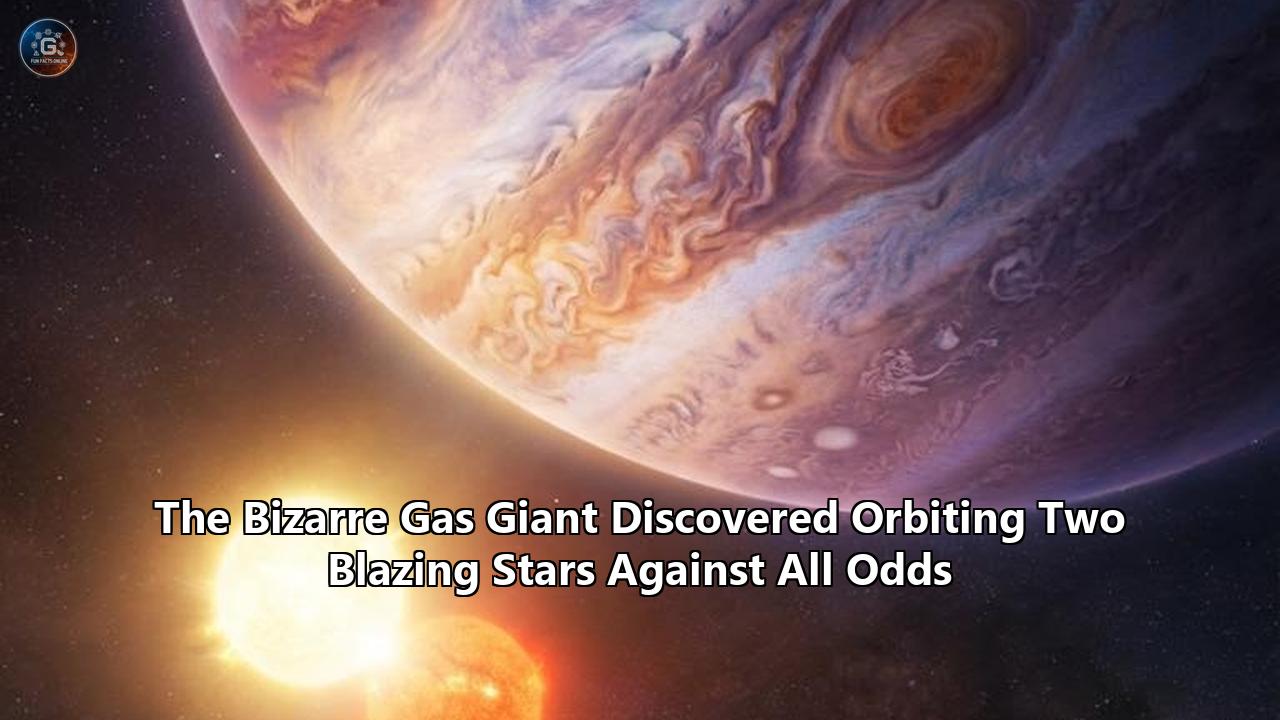
Deep within the Scorpius-Centaurus stellar nursery, 446 light-years from Earth, a newly imaged gas giant has fractured standard models of planetary formation. Identified as HD 143811 b, this colossal world boasts 6.1 times the mass of Jupiter and orbits a pair of aggressive, blazing F-type stars. The detection, finalized through independent observation campaigns utilizing the European Southern Observatory’s Very Large Telescope (VLT) and the Gemini South telescope, marks a rare direct-imaging circumbinary planet discovery that defies the established limits of astrophysics.
The planet is young—no older than 15 to 21 million years—and radiates violently at surface temperatures exceeding 1,000 Kelvin. Yet, its mere existence forces a painful reckoning within the astronomical community. It orbits at roughly 63 astronomical units from its host binary, navigating a chaotic gravitational environment governed by two stars that are significantly hotter and more massive than our Sun. The central stars whip around each other in a highly eccentric 18.59-day orbit, creating extreme tidal forces and intense ultraviolet radiation output that should have rendered the birth of a gas giant utterly impossible.
This news reveals a fundamental crisis in our understanding of how solar systems coalesce. The models that explain our own calm, single-star neighborhood fail spectacularly when applied to the violent mechanics of close binaries. In response to this, astrophysicists are tearing up the standard "core accretion" paradigm, pivoting to radical alternative theories like rapid gravitational disc fragmentation, and deploying next-generation detection methodologies to hunt for more of these impossible worlds.
The Physics of a Protoplanetary Crisis
The central problem exposed by the HD 143811 b discovery lies in the timeline and mechanics of standard planetary assembly. For decades, the dominant theoretical framework for building gas giants has been core accretion. In this model, microscopic dust grains within a young star's circumstellar disc collide and stick together over millions of years. Once these aggregated rocks form a solid planetary core of about ten Earth masses, the core's gravity becomes sufficient to rapidly vacuum up surrounding hydrogen and helium gas before the disc dissipates.
Around a single, stable star like the Sun, this slow, methodical process works. But a binary system, particularly one hosting F-type stars like HD 143811, operates under a distinctly destructive set of physical laws. F-type stars burn hotter and brighter than G-type stars (like our Sun), emitting a torrent of extreme ultraviolet (EUV) and X-ray radiation. This radiation triggers a mechanism known as photoevaporation. The high-energy photons strike the gas in the protoplanetary disc, heating the upper layers until the thermal energy of the gas exceeds the gravitational pull of the stars. The disc literally boils away into deep space.
When you have two F-type stars, the photoevaporation rate accelerates dramatically. The raw material required to build a 6.1 Jupiter-mass planet should have been blown into the interstellar void in less than 2 to 3 million years. Core accretion simply does not have enough time to operate. Building a rocky core of ten Earth masses takes roughly 3 to 5 million years under optimal, quiet conditions. By the time an embryonic core in the HD 143811 system gained enough mass to start pulling in gas, there should have been no gas left to steal.
Compounding the thermal evaporation is the devastating mechanical turbulence induced by the binary itself. The two host stars of HD 143811 possess a high orbital eccentricity (0.49), meaning their distance from one another varies wildly during their 18.59-day orbit. This eccentric dance creates severe gravitational shearing forces—or torques—that propagate outward through the surrounding disc of gas and dust.
Instead of settling into a flat, calm plane where dust particles can gently collide and stick together, the material in a circumbinary disc is subjected to violent spiral density waves and orbital resonances. Dust grains smash into each other at high velocities, shattering rather than coalescing. The gravitational clearing effect of the central binary also truncates the inner edge of the disc, pushing the raw materials further out into colder, less dense regions where the collision rates drop exponentially.
The presence of a massive gas giant here dictates that either the core accretion timeline is fundamentally wrong, or our understanding of how gas giants materialize in hostile environments is missing a massive piece of the puzzle. The challenge for modern astronomy is no longer just finding these planets; it is explaining how they survive their own violent genesis.
The Engineering Challenge of the Dual-Star Glare
Detecting HD 143811 b required overcoming optical barriers that have historically blinded astronomers to the circumbinary planet population. The vast majority of exoplanets known today were found using the transit method—monitoring a star for a temporary dip in brightness as a planet crosses its face. However, the transit method relies on strict geometrical luck; the planet’s orbital plane must align perfectly with our line of sight.
In binary systems, the orbital mechanics are chaotic. Gravitational interactions cause the orbital plane of the planet to precess and wobble, meaning a circumbinary planet might transit its stars for a decade and then not transit again for centuries. Furthermore, transits only reveal the planet's radius and orbital period, offering zero direct data regarding the planet's atmospheric composition or thermal emission.
To truly understand HD 143811 b, astronomers had to photograph it directly. Direct imaging is the most punishing discipline in observational astronomy. The planet lies roughly 430 milliarcseconds away from its host stars on the sky—an angular separation equivalent to distinguishing a firefly buzzing next to a lighthouse from hundreds of miles away. To further complicate the matter, the combined luminosity of the two F-type main-sequence stars threatens to saturate the telescope's sensors instantly, washing out the faint, infrared glow of the young planet.
This breakthrough was achieved through the ERC COBREX project, an initiative dedicated to re-analyzing archival observational data using highly advanced post-processing algorithms. The team scrutinized data from the Gemini Planet Imager (GPI) at the Gemini South telescope and the SPHERE (Spectro-Polarimetric High-contrast Exoplanet REsearch) instrument on the VLT in Chile.
These instruments rely on two critical pieces of engineering: extreme adaptive optics (XAO) and coronagraphy. As starlight travels through Earth's atmosphere, turbulent pockets of air distort the wavefront, causing the stars to twinkle and smear across the detector. The XAO systems on SPHERE and GPI measure this atmospheric distortion using a wavefront sensor thousands of times per second. A computer then calculates the exact inverse of that distortion and applies it to a deformable mirror, physically bending the glass with microscopic magnetic actuators to flatten the light waves and remove the twinkle.
Once the starlight is corrected, it enters the coronagraph—a physical mask placed in the focal plane of the telescope that acts as an artificial eclipse. The coronagraph blocks the overwhelming glare of the central binary, allowing the faint thermal glow of the 1,000-Kelvin planet to reach the infrared detectors.
Even with this hardware, HD 143811 b was initially missed. In early observations taken in 2016 and 2019, the signal was buried in residual noise—optical artifacts known as "speckles" that mimic planetary signatures. It was only through the COBREX team's deployment of cutting-edge algorithmic noise-subtraction techniques, followed by a confirming observation by SPHERE in July 2025, that the scientific community could verify the object was gravitationally bound to the binary, rather than a background star.
The Proposed Solution: Gravitational Instability
With the empirical reality of HD 143811 b confirmed, theoretical astrophysicists have been forced to propose solutions to the formation paradox. If core accretion is too slow to build a gas giant in the volatile, rapidly evaporating disc of an eccentric F-type binary, a faster mechanism must be responsible.
The leading solution gaining rapid consensus is disc fragmentation, a process driven by gravitational instability. Unlike the slow, bottom-up assembly of core accretion, gravitational instability is a violent, top-down collapse.
When a young circumbinary disc is massive enough, the local gravity of the gas in the outer regions of the disc begins to compete with the sheer force and thermal pressure of the central stars. If the disc cools rapidly enough—meaning it can radiate away the heat generated by the chaotic gravitational torques—specific pockets of gas cross a mathematical threshold known as the Toomre instability limit. Once this limit is breached, the spiral arms of the protoplanetary disc fragment directly into massive, self-gravitating clumps of gas.
A 2026 computational study by Teasdale and Stamatellos utilizing advanced 3D smooth particle hydrodynamics (SPH) simulations provided the exact mathematical framework needed to explain this circumbinary planet discovery. Their simulations modeled the behavior of gas and dust around a binary star system, specifically tracking how thermal radiation moves through the disc.
The researchers discovered a counterintuitive phenomenon: the chaotic nature of binary stars actually makes disc fragmentation easier, not harder. In a single-star system, a protoplanetary disc must contain roughly 31 percent of the star's mass to trigger a gravitational collapse. But around a binary system, the persistent gravitational tug-of-war creates massive, high-density spiral waves. The study revealed that a circumbinary disc only needs a disc-to-stellar mass ratio of about 17 percent to fragment. The minimum disc mass required to spontaneously birth a gas giant is nearly 45 percent lower in a binary system than around a solitary star.
This solves the timeline problem completely. Gravitational instability does not require 5 million years to slowly aggregate a rocky core. A disc can cross the Toomre threshold and collapse into a 6-Jupiter-mass planet like HD 143811 b in the span of just a few thousand years. The planet forms fully assembled, bypassing the core-building phase entirely, allowing it to easily beat the clock against the inevitable photoevaporation caused by the blazing F-type stars.
This theoretical breakthrough flips the narrative. The hostile gravitational environment of a binary pair, long thought to be the ultimate barrier to planet formation, may actually be the catalyst that forces a protoplanetary disc to aggressively fragment into massive super-Jupiters.
Rewriting the Search Parameters: Apsidal Precession and Radial Velocity
While theorists work to cement the mathematics of gravitational instability, observational astronomers are radically altering how they hunt for these objects. Relying on sheer luck for a transit, or waiting for young, hot planets to be far enough from their stars for direct imaging, creates severe observational biases. We are likely missing an entire demographic of circumbinary planets orbiting tighter, older, or less massive binary pairs.
To solve this detection deficit, researchers are developing frameworks that use the central binary stars as massive, sensitive instruments. One of the most promising new methods is the measurement of apsidal precession, detailed in a December 2025 study by Margo Thornton and her team using data from the Transiting Exoplanet Survey Satellite (TESS).
When two stars orbit each other in an eccentric pattern, their elliptical orbit does not remain fixed in space. The entire ellipse slowly rotates, or precesses, over time. A baseline rate of precession is expected due to general relativity and the tidal bulges the stars induce on each other. However, if a massive, unseen circumbinary planet is orbiting the system, its gravitational pull will exert a continuous tug on the binary, causing the stars' orbit to precess faster than standard physics dictates.
By analyzing the precise timing of stellar eclipses in 1,590 binary systems captured by TESS, the team ruled out standard relativistic and rotational effects, isolating the distinct gravitational signature of hidden perturbing bodies. This method yielded 27 new candidate circumbinary planets. The brilliance of the apsidal precession technique is that it completely bypasses the need for a coplanar planetary transit. As long as the planet has enough mass, its gravitational ghost will appear in the timing of the stellar eclipses, revealing massive gas giants that would otherwise remain permanently invisible.
Simultaneously, projects like BEBOP (Binaries Escorted By Orbiting Planets) are attacking the problem using high-precision radial velocity. The radial velocity method detects the microscopic "wobble" of a star caused by the gravitational pull of an orbiting planet. Applying this to a single star is standard practice, but applying it to a double-lined spectroscopic binary—where the spectral lines of two stars are constantly shifting, overlapping, and moving at dozens of kilometers per second—was long considered computationally unfeasible.
The BEBOP consortium cracked this problem by developing advanced algorithms capable of untangling the blended light spectra of the two stars. Between 2022 and 2024, BEBOP successfully detected the first circumbinary planet using radial velocity alone and has since identified nine new circumbinary systems. Their data has already yielded a critical insight into the mass distribution of these worlds: while standard gas giants are common around binary stars, planets exceeding three Jupiter masses are statistically rare. This makes the 6.1 Jupiter-mass bulk of HD 143811 b even more of an extreme outlier, cementing its status as a high-value target for continuous observation.
Furthermore, BEBOP's density analysis revealed that many of these binary-orbiting giants are significantly less dense than anticipated, exhibiting inflated, puffy atmospheres. This structural anomaly heavily supports the disc fragmentation model; planets formed via rapid gravitational collapse tend to retain highly inflated envelopes of hydrogen and helium, matching the precise thermal and atmospheric profile currently observed in HD 143811 b.
Comparing Echoes: The WISPIT 2 System
To prove that gravitational instability is responsible for these binary giants, astronomers need to catch the process happening in real-time. The confirmation of HD 143811 b aligns perfectly with parallel discoveries taking place in single-star systems, offering comparative data that solidifies the new models.
In March 2026, the European Southern Observatory published the confirmed direct imaging of the WISPIT 2 system. Located 437 light-years away, WISPIT 2 is a young star surrounded by a sprawling protoplanetary disc. Utilizing the newly upgraded GRAVITY+ interferometry instrument on the VLT, astronomers directly imaged two distinct gas giants—WISPIT 2b and WISPIT 2c—actively forming within the disc.
WISPIT 2b, roughly five times the mass of Jupiter, sits at a sprawling 60 astronomical units from its star, carving a massive gap in the dust. WISPIT 2c, twice as massive, was detected orbiting significantly closer. The architecture of the WISPIT 2 disc—featuring vast, distinct clearings and concentric rings of material—acts as a Rosetta Stone for understanding disc mechanics.
While WISPIT 2 is a single star, the behavior of its disc provides the empirical baseline needed to analyze HD 143811 b. By comparing the atmospheric chemistry, accretion rates, and orbital spacing of the WISPIT 2 planets with the lone giant orbiting the HD 143811 binary, researchers can isolate exactly how the addition of a second star alters the chemistry and timeline of gas giant formation. If the WISPIT planets show signs of standard core accretion, but HD 143811 b exhibits the isotopic signatures of direct gravitational collapse, the scientific community will have the smoking gun needed to permanently validate the disc fragmentation theory for circumbinary environments.
Spectroscopic Profiling: Decoding the Atmosphere
With the existence and theoretical origin of HD 143811 b established, the immediate challenge is characterizing exactly what this alien world is made of. The Keck NIRC2 data and the GPI H-band spectrum provided the initial proof of the object's substellar nature, but the analysis is far from over.
To extract the physical parameters of the planet, researchers applied Exo-REM exoplanet atmosphere models. These complex radiative-convective equilibrium models simulate the absorption and emission of light through various chemical layers of a gas giant's envelope. The data matching process confirmed that the planet operates at an effective temperature of approximately 1,042 Kelvin, translating its observed luminosity to a mass of 5.6 to 6.1 Jupiters based on "hot-start" evolutionary tracks.
The "hot-start" model is a critical piece of evidence. Core accretion usually results in a "cold-start" planet, where the slow buildup of the core allows much of the formation heat to radiate away before the gas envelope is fully accreted. Gravitational instability, however, creates a "hot-start" scenario, where the rapid, violent collapse of the gas traps immense amounts of thermal energy inside the planet. The fact that Exo-REM modeling strongly aligns HD 143811 b with a hot-start evolutionary track provides hard, observational backing to the theories proposed by Teasdale and Stamatellos.
The atmospheric spectra also revealed early hints about the chemical inventory of the planet. Because HD 143811 b formed at roughly 63 AU, it coalesced far beyond the binary system's "snow line"—the orbital boundary where temperatures drop low enough for volatile compounds like water, carbon dioxide, and methane to freeze into solid ice grains. By forming in this deep freeze, the planet's atmospheric chemistry will reflect the primordial makeup of the outer disc, unaffected by the intense stellar radiation that bakes the inner system.
The Unresolved Mechanics of Orbital Migration
Solving the formation problem introduces a secondary challenge: the orbital future of the planet. Currently, HD 143811 b sits comfortably at 63 AU, a relatively stable, low-eccentricity, face-on orbit with a period of roughly 320 years. But orbital dynamics in a binary system are rarely static.
According to empirical formulas like the Holman and Wiegert limit, there is an invisible boundary around every binary star pair. If a planet crosses inside this boundary, the overlapping gravitational resonances of the two stars will instantly destabilize the planet's orbit, either violently ejecting it into interstellar space as a rogue planet or dragging it inward to be incinerated by the stars.
Gas giants are known to migrate. As a young planet interacts with the residual gas and dust in its protoplanetary disc, the friction and gravitational drag cause it to slowly spiral inward. If HD 143811 b formed via disc fragmentation further out and is currently migrating inward, it is on a collision course with the Holman-Wiegert limit of its blazing F-type hosts.
Understanding the migration rate requires mapping the exact geometry of the system. The binary stars have an orbital inclination of about 22.9 degrees. Initial 9-year baseline measurements from GPI and SPHERE suggest the planet's orbit is mostly face-on and circular, meaning it may not perfectly align with the orbital plane of the central stars. This slight misalignment—a phenomenon seen in other extreme systems like the polar-orbiting brown dwarf companion 2M1510 (AB) b—could trigger Kozai-Lidov oscillations.
Under the Kozai-Lidov mechanism, a gravitational exchange occurs where the planet's orbit trades inclination for eccentricity. Over millions of years, HD 143811 b could be forced into a highly elliptical, comet-like orbit. During its closest approach (periastron), the extreme 1,000-Kelvin heat of the planet would be compounded by the searing UV output of the F-type binaries, potentially causing the planet's outer atmosphere to boil off in a massive trailing tail of hydrogen.
Experts are actively modeling these long-term N-body orbital dynamics. The survival of HD 143811 b to its current age of 15 million years suggests that the surrounding gas disc dissipated just quickly enough to halt the planet's inward migration before it crossed the fatal gravitational threshold of the central binary.
Moving Forward: Next-Generation Telescopic Upgrades
The HD 143811 b circumbinary planet discovery is not the end of the narrative; it is the calibration point for a new era of astronomical hardware. The limitations of current coronagraphs and adaptive optics have been pushed to their absolute maximum by the COBREX project. To answer the unresolved questions regarding atmospheric chemistry, isotopic ratios, and long-term orbital stability, the astronomical community is turning to next-generation observatories.
The James Webb Space Telescope (JWST), utilizing its Mid-Infrared Instrument (MIRI), is the immediate next step. Unlike ground-based telescopes, JWST does not have to contend with Earth's turbulent atmosphere, granting it unprecedented sensitivity to the thermal emissions of young gas giants. Scheduled observation cycles will target HD 143811 b to capture high-resolution spectra across the mid-infrared wavelength. This will allow scientists to precisely measure the carbon-to-oxygen ratio in the planet's atmosphere. The C/O ratio is the ultimate fingerprint of planetary formation; it will definitively prove whether the planet formed in-situ via top-down fragmentation or assembled further out and migrated inward.
Simultaneously, the European Southern Observatory is actively deploying the GRAVITY+ upgrade to the Very Large Telescope Interferometer (VLTI). By combining the light from all four of the 8.2-meter VLT unit telescopes, GRAVITY+ creates a virtual telescope with a mirror diameter of 130 meters. This staggering leap in angular resolution is what allowed the imaging of the inner WISPIT 2c planet. When GRAVITY+ is pointed at HD 143811, researchers hope to achieve micro-arcsecond astrometric precision. This will not only refine the 320-year orbit of the known gas giant but also detect the subtle gravitational tugs of any inner, terrestrial-mass planets that might be hiding within the binary's habitable zone.
Looking further into the future, the Nancy Grace Roman Space Telescope will fundamentally change the scale of the search. Equipped with an advanced coronagraph instrument utilizing active wavefront control, the Roman Space Telescope will survey the galactic bulge, highly capable of detecting both transiting circumbinary worlds and planets revealed through microlensing events. By combining Roman's wide-field surveys with the precision radial velocity data from BEBOP and the apsidal precession targets from TESS, astronomers will finally map the true statistical distribution of planets orbiting double stars.
The existence of a 6.1 Jupiter-mass giant surviving the violent radiation and chaotic gravity of two F-type stars proves that the universe is far more efficient at building worlds than our terrestrial physics initially allowed. The core accretion timeline has been successfully challenged by the rapid mechanics of disc fragmentation, providing a violent, rapid-assembly blueprint for planet formation. As the archival data of GPI and SPHERE yields to the raw power of JWST and GRAVITY+, the next decade of astronomy will shift from simply hunting for these impossible binary worlds, to mapping the exotic chemistry and chaotic orbits that define them.
Reference:
- https://en.wikipedia.org/wiki/HD_143811
- https://observatoiredeparis.psl.eu/first-image-of-a-planet-so.html
- https://www.aanda.org/articles/aa/abs/2025/10/aa57104-25/aa57104-25.html
- https://www.exoplanet.eu/catalog/hd_143811_ab_b--11274/
- https://astrobiology.com/2025/09/hd-143811-ab-b-a-directly-imaged-planet-orbiting-a-spectroscopic-binary-in-sco-cen.html
- https://science.nasa.gov/exoplanet-catalog/hd-143811-ab-b/
- https://academic.oup.com/mnras/article/doi/10.1093/mnras/stag476/8661676?rss=1
- https://astrobiology.com/2025/12/detection-of-27-candidate-circumbinary-planets-through-apsidal-precession-of-eclipsing-binaries-observed-by-tess.html
- https://en.wikipedia.org/wiki/Circumbinary_planet
- https://www.space.com/astronomy/exoplanets/astronomers-discover-images-of-a-tatooine-like-exoplanet-with-a-bizarre-orbit-hidden-in-10-year-old-data
- https://cordis.europa.eu/article/id/457135-research-reveals-new-clues-about-planets-born-around-two-suns
- https://scitechdaily.com/astronomers-capture-two-giant-planets-forming-in-real-time-around-distant-star/
- https://earthsky.org/space/astronomers-spot-2-planets-forming-around-young-star/
- https://www.discovermagazine.com/two-planets-forming-around-a-young-star-could-resemble-an-early-solar-system-48862
- https://www.futura-sciences.com/en/astronomers-witness-a-jaw-dropping-cosmic-event-a-new-solar-systems-birth_29065/
- https://exoplanet.eu/planets_binary_circum/
- https://www.birmingham.ac.uk/news/2025/astronomers-find-rare-twist-in-exoplanets-twin-star-orbit
- https://astrobites.org/2025/01/08/smoons-ploonets-and-circumbinary-planets-oh-my/